• 검색 결과가 없습니다.

Rates and Risk Factors of Bacteriuria in Patients with Bladder Cancer Who Underwent Treatment with Bacillus Calmette-Guérin

N/A
N/A
Protected

Academic year: 2021

Share "Rates and Risk Factors of Bacteriuria in Patients with Bladder Cancer Who Underwent Treatment with Bacillus Calmette-Guérin"

Copied!
7
0
0

로드 중.... (전체 텍스트 보기)

전체 글

(1)

Urogenit Tract Infect 2020;15(2):47-53

http://crossmark.crossref.org/dialog/?doi=10.14777/uti.2020.15.2.47&domain=pdf&date_stamp=2020-08-30

Rates and Risk Factors of Bacteriuria in Patients with Bladder Cancer Who Underwent Treatment with Bacillus Calmette-Guérin

Seong Jong Eun, Myung Soo Kim, Seung Il Jung, Hyun-Jung Choi

1

, Ho Seok Chung, Eu Chang Hwang, Dong Deuk Kwon Department of Urology, Chonnam National University Medical School, Gwangju,

1

Department of Laboratory Medicine, Chonnam National University Hwasun Hospital, Hwasun, Korea

Purpose: This study evaluated the rate and predictors of bacteriuria in patients who underwent transurethral resection of bladder tumor (TURBT) and Bacillus Calmette-Guérin (BCG) treatment.

Materials and Methods: We prospectively evaluated 266 patients who underwent TURBT and intravesical BCG treatment between January 2017 and September 2019. Urinalysis and urine culture were performed at the baseline, one to two weeks after TURBT and weekly during the BCG treatment period. The primary outcomes were the bacteriuria rates in BCG-treated patients, while the secondary outcomes were the risk factors of bacteriuria during BCG treatments.

Results: Of the 266 patients, the rate of bacteriuria was 4.5% before TURBT, 5.3%

in the postoperative period, and 24.4% in the BCG treatment period. After BCG instillation, urinalysis showed that 204 and 38 patients tested positive for pyuria and nitrite, respectively. Multivariate analysis indicated that the risk factors associated with bacteriuria during BCG treatment included age (odds ratio [OR]:

1.06; p=0.003), sex (female) (OR, 5.41; p=0.007), diabetes mellitus (DM) (OR, 2.82; p=0.023), postoperative bacteriuria (OR, 8.08; p=0.032), bacterial counts>100/l in urine flow cytometry (OR, 29.72; p<0.001), and positive urine nitrite test (OR, 6.20; p=0.001) at the time of positive urine culture sampling.

Conclusions: Approximately 25% of the patients suffered from bacteriuria during intravesical BCG treatment. Old age, female sex, DM, and postoperative bacteriuria were found to be the risk factors of bacteriuria during BCG treatment. Predictive factors could aid in clinical decisions during BCG treatments as well as decisions on BCG discontinuation.

Keywords: Bacillus Calmette-Guérin; Bacteriuria; Bladder cancer; Intravesical instillation

Copyright 2020, Korean Association of Urogenital Tract Infection and Inflammation. All rights reserved.

This is an open access article distributed under the terms of the Creative Commons Attribution Non-Commercial License (http://creativecommons.org/licenses/by-nc/4.0) which permits unrestricted non-commercial use, distribution, and reproduction in any medium, provided the original work is properly cited.

Received: 10 July, 2020 Revised: 17 August, 2020 Accepted: 20 August, 2020

Correspondence to: Seung Il Jung https://orcid.org/0000-0003-4864-8175 Department of Urology, Chonnam National University Hwasun Hospital, 322 Seoyang-ro, Hwasun-eup, Hwasun 58128, Korea

Tel: +82-61-379-7749, Fax: +82-61-379-7750 E-mail: [email protected]

Original Article

INTRODUCTION

Bladder cancer is the sixth most prevalent cancer and the most common urogenital malignancy [1,2]. Following a transurethral resection of the bladder, adjuvant intravesical

immunotherapy with Bacillus Calmette-Guérin (BCG) is the

standard treatment in patients with high-risk, non-muscle-

invasive bladder cancer. This treatment reduces the risk of

disease recurrence, delays progression, and improves the

overall survival [1,3,4]. On the other hand, BCG therapy is

(2)

potentially associated with a significant risk of localized or systemic adverse events, such as mycobacterial infections [5]. Urinary tract infection (UTI) is considered a risk factor for BCG complications. Hence, symptomatic UTI is an absolute contraindication to this therapy [3]. Therefore, many urologists believe that BCG therapy should be performed only in patients with sterile urine [6]. Some experts believe that bacterial cystitis traumatizes the barrier, allowing BCG to reach the bloodstream [7].

A urine culture is time-consuming. Hence, based on pyuria, many urologists administer prophylactic antibiotics before and after BCG treatment to prevent acute UTI or bacterial sepsis. On the other hand, while the clinical benefit is unclear, this antimicrobial treatment delays the adjuvant oncological treatment and potentially contributes to an increase in bacterial antibiotic resistance [8]. Simulta- neously, pyuria on the day of BCG instillation (without a positive urine culture test) appears to be one of the most common reasons for the delay of BCG immunotherapy, which may reduce the clinical efficacy of the treatment.

Therefore, detecting bacteriuria and identifying the risk factors can be helpful in BCG treatment. Accordingly, this study evaluated the bacteriuria rates and risk factors in patients who underwent a transurethral resection of bladder tumors (TURBT) and BCG treatment.

MATERIALS AND METHODS

1. Ethics Statement

The Institutional Review Board of the Chonnam National University Hwasun Hospital (IRB no. CNUHH-2018-007) approved this ongoing pattern of care study in bladder cancer patients receiving intravesical BCG, permitting the collection of prospective data on these patients. All study procedures were performed in accordance with the Declaration of Helsinki guidelines.

2. Patients and Samples

Two hundred sixty-six patients who underwent TURBT and intravesical BCG treatment between January 2017 and September 2019 were evaluated prospectively. Urinalysis and urine culture were performed at the baseline and one to two weeks after TURBT. In patients who also underwent intravesical BCG treatment, the urinalysis and urine culture were performed weekly during the BCG treatment period.

Patients diagnosed with muscle-invasive urothelial carcinoma post-TURBT and those with a clinical stage of T3 or T4 were excluded. Midstream urine specimens were collected in sterile containers for urinalysis and culture.

These specimens were placed in 10 ml urine sediment centrifuge tubes and sent to the laboratory for chemical analysis and laser flow cytometry (Sysmex UF-1000i; Sysmex, Kobe, Japan). Sysmex UF-1000i analysis was performed within 30 minutes after collection (standard urinalysis in the hospital was performed with Sysmex UF-1000i and one chemistry analyzer). The results of the sediment analysis are presented in terms of units per l and units per high power field. The primary outcomes were the rates of pyuria and bacteriuria ( ≥10

5

CFU/ml in midstream urine) in the BCG-treated patients. The secondary outcomes were the risk factors of bacteriuria during the BCG treatments. For preventative antibiotic treatment, 1 g of ciprofloxacin was administered one week before the BCG treatment, but the prophylactic use of antibiotics is not recommended in a BCG treatment. Physicians should use discretion in the management of symptoms during BCG therapy and the prophylactic use of antibiotics in patients with a high risk of infection because the use of antibiotics might reduce the incidence of side effects. In the present study, discon- tinuance of BCG depended mostly on the patients’ com- plaints and physician’s decisions if there were major side effects.

3. Statistical Analysis

The baseline characteristics are presented as frequencies

(percentages) for categorical variables and median

(interquartile range [IQR]) for continuous variables. The

baseline patient demographics were analyzed using

descriptive statistics. The data were compared using a Mann –

Whitney U-test and Kruskal–Wallis analysis for the

quantitative variables and a chi-test for the categorical

variables. Univariate and multivariate logistic regression

analyses were performed to assess the respective effects of

each variable on the occurrence of bacteriuria. The results

of standard urine culture staining, microscopic sediment

analysis, nitrite test, and UF-1000i flow cytometry results

were compared. Using receiver operating characteristic

(ROC) curves, bacteriuria on the Sysmex UF-1000i, the

diagnostic performance of the method was also evaluated

by determining the sensitivity, specificity, positive predictive

(3)

Table 2. Results of urine culture, microscopic analysis, and urine flow cytometry

 Variable Total (n=266) BCG treatmentwithout

bacteriuria (n=201)

BCG treatment with bacteriuria (n=65) p-value Preoperative bacteriuria

Preoperative pyuria

Preoperative positive urine nitrite test

Preoperative bacterial counts (/l) in urine flow cytometry 0-100

>100

Immediate postoperative bacteriuria Immediate postoperative pyuria

Immediate postoperative positive urine nitrite test

Immediate postoperative bacterial count (/ l) in urine flow cytometry 0-100

>100

Bacteriuria after BCG treatment Pyuria after BCG treatment

Positive urine nitrite test after BCG treatment

Bacterial count (/l) in urine flow cytometryafter BCG treatment 0-100

>100

12 (4.5) 73 (27.4) 7 (2.6)

198 (74.4) 68 (25.6) 14 (5.3) 191 (71.8) 18 (6.8)

195 (73.3) 71 (26.7) 65 (24.4) 204 (76.7) 38 (14.3)

149 (56.0) 117 (44.0)

6 (3.0) 57 (28.4) 6 (3.0)

156 (77.6) 45 (22.4) 7 (3.5) 140 (69.7) 10 (5.0)

156 (77.6) 45 (22.4) 0 (0.0) 144 (71.6) 11 (5.5)

145 (72.1) 56 (27.9)

6 (9.2) 16 (24.6) 1 (1.5)

42 (64.6) 23 (35.4) 7 (10.8) 51 (78.5) 8 (12.3)

39 (60.0) 26 (40.0) 65 (100.0) 60 (92.3) 27 (41.5)

4 (6.2) 61 (93.8)

0.035 0.633

>0.99 0.049

0.022 0.205 0.041 0.006

<0.001

<0.001

<0.001

Values are presented as number (%).

BCG: Bacillus Calmette-Guérin.

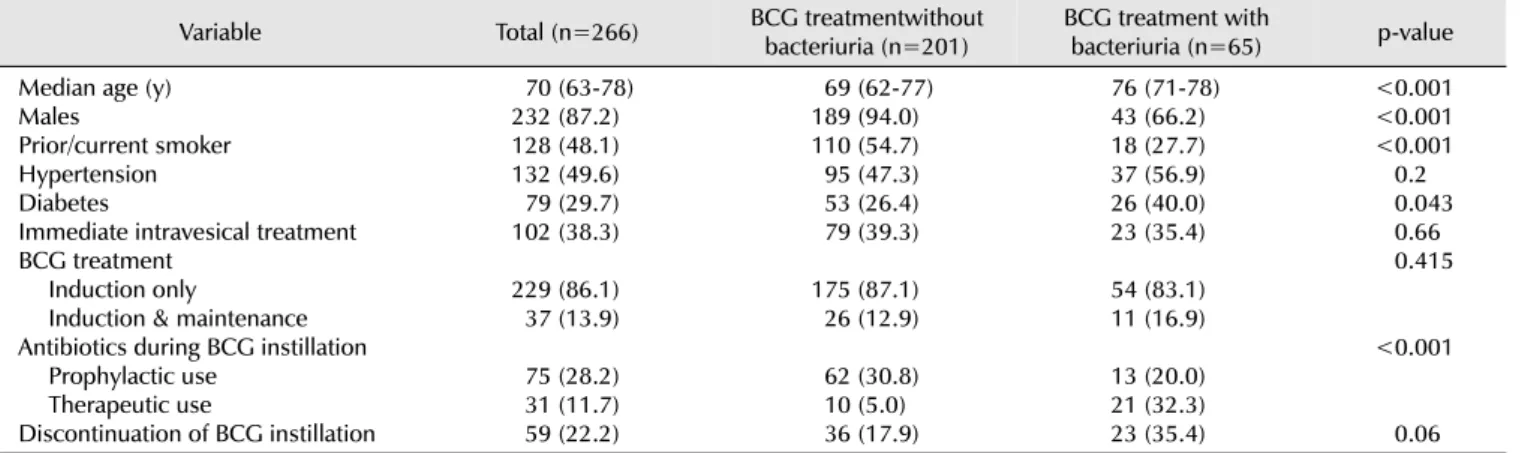
Table 1. Baseline characteristics of patients who underwent transurethral resection of bladder tumor

 Variable Total (n=266) BCG treatmentwithout

bacteriuria (n=201)

BCG treatment with

bacteriuria (n=65) p-value Median age (y)

Males

Prior/current smoker Hypertension Diabetes

Immediate intravesical treatment BCG treatment

Induction only

Induction & maintenance Antibiotics during BCG instillation

Prophylactic use Therapeutic use

Discontinuation of BCG instillation

70 (63-78) 232 (87.2) 128 (48.1) 132 (49.6) 79 (29.7) 102 (38.3)

229 (86.1) 37 (13.9)

75 (28.2) 31 (11.7) 59 (22.2)

69 (62-77) 189 (94.0) 110 (54.7) 95 (47.3) 53 (26.4) 79 (39.3)

175 (87.1) 26 (12.9)

62 (30.8) 10 (5.0) 36 (17.9)

76 (71-78) 43 (66.2) 18 (27.7) 37 (56.9) 26 (40.0) 23 (35.4)

54 (83.1) 11 (16.9)

13 (20.0) 21 (32.3) 23 (35.4)

<0.001 <0.001 <0.001

0.2 0.043

0.66 0.415

<0.001

0.06 Values are presented as median (interquartile range) or number (%).

BCG: Bacillus Calmette-Guérin.

value, and negative predictive value. A p-value <0.05 was considered statistically significant. All statistical analyses were conducted using IBM SPSS Statistics for Windows, version 23.0 (IBM Corp., Armonk, NY, USA).

RESULTS

Of the 266 patients included, 232 (87.2%) were males, and the median age was 70 years (IQR, 63-78 years). Appro- ximately 229 patients underwent only BCG induction therapy, whereas 31 patients underwent induction and maintenance BCG therapy. During BCG instillation, prophylactic and therapeutic antibiotics were administered

to 75 (28.2%) and 31 (11.7%) patients, respectively. The discontinuation rate of BCG instillation was 59 (22.2%) (Table 1).

Bacteriuria was observed in 12 patients (4.5%) in the baseline state, 14 (5.3%) in the postoperative period, and 65 (24.4%) in the BCG treatment period. After BCG instillation, urinalysis revealed pyuria in 204 patients (76.7%) and nitrite (+) in 38 patients (14.3%) (Table 2, Fig. 1).

The pyuria test had a low specificity (28.36%), whereas

the nitrite test had high specificity (94.53%) but low sensitivity

(41.54%). Urine flow cytometry showed high sensitivity,

particularly when bacterial counts of more than 100/ l were

used as the cut-off values; a cut-off value of >100 CFU/l

(4)

Table 4. Univariate and multivariate analyses predicting bacteriuria during the BCG treatment

 Parameter Univariate Multivariate

OR (95% CI) p-value OR (95% CI) p-value

Age

Sex (female vs. male) DM

Smoking HTN

Immediate postoperative instillation BCG instillation type

Induction only Maintenance Prophylactic antibiotics Preoperative bacteriuria

Immediate postoperative bacteriuria

Bacterial counts in urine flow cytometry after BCG instillation

≤100/l

>100/ l

Urine nitrite after BCG treatment Pyuria after BCG treatment

1.054 (1.022-1.086) 8.058 (3.703-17.533) 1.862 (1.035-3.349) 0.317 (0.172-0.583) 1.474 (0.839-2.591) 0.839 (0.469-1.501)

Reference

1.371 (0.636-2.956) 0.560 (0.285-1.104) 3.305 (1.027-10.633) 3.345 (1.127-9.928)

Reference

39.487 (13.714-113.695) 12.273 (5.610-26.848) 4.750 (1.814-12.436)

0.001

<0.001 0.038

<0.001 0.177 0.554

0.421 0.094 0.045 0.03

<0.001

<0.001 0.002

1.069 (1.023-1.118) 5.413 (1.582-18.521) 2.820 (1.156-6.878) 0.497 (0.201-1.229)

1.293 (0.468-3.566) 1.390 (0.222-8.71) 8.085 (1.196-54.643)

Reference

29.725 (8.508-103.858) 6.204 (2.148-17.919) 1.165 (0.28-4.842)

0.003 0.007 0.023 0.13

0.62 0.725 0.032

<0.001

0.001 0.834 BCG: Bacillus Calmette-Guérin, OR: odds ratio, CI: confidence interval, DM: diabetes mellitus, HTN: hypertension.

Table 3. Results of urine microscopy and flow cytometry for bacteriuria diagnosis

 Variable Specificity (%) Sensitivity (%) PPV (%) NPV (%) Accuracy (%)

Pyuria positive Nitrite positive

Urine flow cytometry bacterial counts (<100/l vs. ≥100/l)

28.36 94.53 72.14

92.31 41.54 93.85

29.41 71.05 52.14

91.93 83.33 97.32

43.99 81.58 77.44 PPV: positive predictive value, NPV: negative predictive value.

Fig. 1. Urinalysis and chemistry findings during the perioperative periods. BCG: Bacillus Calmette-Guérin.

resulted in a sensitivity and specificity of 93.85% and 72.14%, respectively (Table 3).

Multivariate analysis indicated that the risk factors associated with bacteriuria during the BCG treatment included the age (odds ratio [OR], 1.06; p=0.003), sex (female) (OR, 5.41; p=0.007), DM (OR, 2.82; p=0.023), immediate postoperative bacteriuria (OR, 8.08; p=0.032), bacterial counts >100/l in urine flow cytometry (OR, 29.72; p

<0.001), and positive urine nitrite test (OR, 6.20; p=0.001) at the time of sampling the positive urine culture.

Prophylactic antibiotics were not associated with bacteriuria after the BCG treatment (p=0.62) (Table 4).

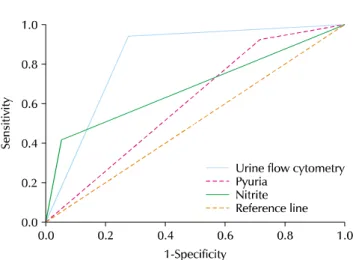
The ROC curves were used to detect bacteriuria by urine flow cytometry when <10

5

CFU/ml was chosen as the gold standard definition for negative cultures. The area under the ROC curve for the diagnosis of bacteriuria by post-BCG urine flow cytometry was 0.888 (Fig. 2).

DISCUSSION

In this study, the overall incidence of culture-documented UTI was 4.5% in the preoperative period and 5.3% in the postoperative period. The incidence increased to 24.4%

during the BCG treatment period. The age (OR, 1.06;

p=0.003), sex (female) (OR, 5.41; p=0.007), DM (OR, 2.82;

p=0.023), postoperative bacteriuria (OR, 8.08; p=0.032), bacterial counts >100/l in urine flow cytometry (OR, 29.72;

p <0.001), and positive urine nitrite test (OR, 6.20; p=0.001)

at the time of sampling the positive urine culture were found

to be independent risk factors for bacteriuria during the

(5)

Fig. 2. Receiver operating characteristic curves for bacterial detection by urine flow cytometry (when <10

5

CFU/ml is chosen as the gold standard definition for negative cultures).

BCG treatment.

BCG is a potent intravesical biological agent that decreases the recurrence and progression rates of high-grade urothelial carcinoma. Although safe, intravesical BCG can cause fever, influenza-like symptoms, and rarely, BCG sepsis.

Active UTI can promote intravasation, leading to infectious complications. Abnormal urinalysis or UTI is considered a contraindication to intravesical BCG [3].

UTIs are considered a risk factor for BCG complications, and symptomatic UTIs are an absolute contraindication to the therapy [9]. The association between UTI and the safety of BCG therapy was poorly studied, and the evidence in this field is limited. Many urologists consider sterile urine to be a necessary condition for intravesical BCG instillation.

Moreover, they believe that bacterial cystitis traumatizes the barrier for the BCG to reach the bloodstream [7].

The antimicrobial treatment during BCG treatment delays adjuvant oncological treatment and potentially contributes to the increase in bacterial resistance to antibiotics, but the clinical benefit is unclear [10].

Herr et al. [11] reported that the instillation of BCG into bladder cancer patients with asymptomatic bacteriuria (ABU) did not result in sepsis or a reduced response. Although the best-practice guidelines have outlined the use of antimicrobial therapy around the time of urological surgery [9], there are no consensus guidelines that address the prevention of infection-related complications arising from intravesical chemotherapy or intravesical biological therapy [6].

Multivariate analysis showed that prophylactic antibiotics

were not associated with bacteriuria after the BCG treatment (p=0.62). If the findings are replicated, a urine culture to detect bacteriuria and prophylactic antibiotics may be unnecessary in asymptomatic patients with bladder cancer.

ABU is common in patients with bladder cancer undergoing induction BCG therapy. Intravesical BCG immunotherapy in bladder cancer patients with ABU remains controversial. There is no evidence to support the routine treatment of ABU in patients scheduled for intravesical BCG instillations due to bladder cancer [10].

Asymptomatic patients (with bacteriuria detected by flow-cytometry) can be excluded safely from antibiotic therapy during BCG instillation [10,12,13], and routine urine analysis can be omitted safely before BCG instillation. On the other hand, symptomatic UTI is considered a risk factor of BCG complications, and symptomatic UTI is an absolute contraindication to BCG therapy [9].

There is insufficient evidence on whether irritative bladder symptoms (e.g., cystitis or pyuria on urinalysis) are sufficient to decide on whether to pursue antibiotic therapy and postpone or continue BCG treatment. These symptoms might not indicate UTI because mild to moderate irritative urinary symptoms are common in cases of a recent transurethral resection and in situ carcinoma. Irritative symptoms, such as urgency and frequency, are commonly observed in patients who undergo TURBT and subsequent intravesical therapy [14].

Many patients receiving BCG treatment have lower urinary tract symptoms, such as dysuria, frequency, urgency, and hematuria, which cannot be differentiated from UTI symptoms. Although symptomatic UTIs remain a contrain- dication for BCG therapy, bacteriuria could not be assessed on the day of the BCG treatment.

According to this study, a urine flow cytometry result of

>100 bacteria/l (OR, 29.72; p<0.001) at the time of

sampling for a positive urine culture was a predictor for

bacteriuria. These results could be determined before urine

cultures. Therefore, the Sysmex UF-1000i system can be used

to accurately predict a positive urine culture and avoid

unnecessary BCG discontinuation and urine cultures. Severe

dysuria or fever with bacteriuria (detected on flow-cyto-

metry) before the BCG treatment might indicate symptomatic

UTI. Therefore, proper pre-treatment evaluation is indi-

cated. On the other hand, pyuria and irritative urinary

symptoms without bacteriuria (i.e., not detected on

(6)

flow-cytometry) might not indicate symptomatic UTI. In this case, antibiotic treatment or postponing the BCG treatment is not recommended. The results of this study suggest that the automated urine sediment analyzers UF-1000i may be used as effective screening tools for symptomatic UTI by measuring the bacterial content of urine samples.

Various cut-off points of the bacterial count have been reported in UTI screening. When urine cultures growing at

>10

5

CFU/ml were used as a reference, the bacterial count of 100/ml, as the cut-off, resulted in a sensitivity and specificity of 96.5% and 86.7%, respectively [15]. Giesen et al. [16] reported the optimal cut-off bacterial count of 288.9/ml with a sensitivity and specificity of 89% and 79%, respectively. Recent meta-analysis reviewed recent studies to determine the capabilities of Sysmex UF-1000i to detect bacteriuria in UTI screening [17]. The pooled sensitivity and specificity were 87% and 60%, respectively, for bacteriuria.

The area under the curve was 0.93 for bacteriuria.

In this study, urine flow cytometry showed high sensitivity, particularly when bacterial counts of more than 100/ l were used as the cut-off values. A cut-off value of >100 CFU/l resulted in a sensitivity and specificity of 93.85% and 72.14%, respectively. The area under the ROC curve for the diagnosis of bacteriuria by urine flow cytometry was 0.88.

In the general population, the white blood cell (WBC) count and bacterial measurements by UF-1000i are useful indicators in UTI screening [17]. On the other hand, the WBC measurements by the UF-1000i are not useful indicators in UTI screening in patients with bladder cancer who have undergone treatment with BCG.

Based on the study findings, urinalysis should be considered in patients with a risk factor of bacteriuria during the BCG treatment. Bacteria resistance to antibiotics is a severe problem, and the risk factors or flow cytometry cannot predict the bacterial sensitivity to antibiotics. Symptomatic patients with bacteriuria detected by flow-cytometry should undergo urine culture, and antibiotic therapy should be considered before BCG instillation.

This study had several limitations. The study was limited by a small number of patients treated by one surgeon in a single center. Another study limitation is that the current study was prospective; it was not randomized to prophylactic antibiotic treatments. There were insufficient guidelines about bacteriuria patients in BCG treatment. Therefore, there is no consensus on the optimal management of

symptoms and the use of antibiotics in patients who received BCG therapy. Additional prospective studies will be needed to evaluate the managements further according to the risk factors of post-BCG bacteriuria and the results of urine flow cytometry.

CONCLUSIONS

Approximately 25% of the patients suffered from bacteriuria during the intravesical BCG treatment. Old age, female, DM, and postoperative bacteriuria were the risk factors of bacteriuria after the BCG treatment. Prophylactic antibiotics are not recommended for the prevention of bacteriuria following the BCG treatment. Urine flow cytometry could help in a bacteriuria diagnosis in BCG-treated patients. The predictive factors and prediction of UTIs by urine flow cytometry could aid in clinical decisions during the BCG treatments and on BCG discontinuation.

CONFLICT OF INTEREST

No potential conflict of interest relevant to this article was reported.

ACKNOWLEDGMENTS

This study was supported by a grant (HCRI 19017) from the Chonnam National University Hwasun Hospital Institute for Biomedical Science.

AUTHOR CONTRIBUTIONS

S.J.E. participated in data collection and wrote the manuscript. H.J.C. participated in data collection. M.S.K.

participated in the study design and performed the statistical analysis. H.S.C. and E.C.H. performed the statistical analysis.

S.I.J. participated in the study design and coordination and helped to draft the manuscript. D.D.K. participated in coordination. All authors read and approved the final manuscript.

ORCID

Seong Jong Eun, https://orcid.org/0000-0003-1476-6608

Myung Soo Kim, https://orcid.org/0000-0003-1456-2154

(7)

Seung Il Jung, https://orcid.org/0000-0003-4864-8175 Hyun-Jung Choi, https://orcid.org/0000-0003-2901-5962 Ho Seok Chung, https://orcid.org/0000-0001-9883-1539 Eu Chang Hwang, https://orcid.org/0000-0002-2031-124X Dong Deuk Kwon, https://orcid.org/0000-0002-4544-5420

REFERENCES

1. DeGeorge KC, Holt HR, Hodges SC. Bladder cancer: diagnosis and treatment. Am Fam Physician 2017;96:507-14.

2. Haresh KP, Julka PK, Sharma DN, Rath GK, Prabhakar R, Seth A.

A prospective study evaluating surgery and chemo radiation in muscle invasive bladder cancer. J Cancer Res Ther 2007;3:

81-5.

3. Babjuk M, Bohle A, Burger M, Capoun O, Cohen D, Comperat EM, et al. EAU guidelines on non-muscle-invasive urothelial carcinoma of the bladder: update 2016. Eur Urol 2017;71:

447-61.

4. Novotny V, Froehner M, Ollig J, Koch R, Zastrow S, Wirth MP.

Impact of adjuvant intravesical bacillus Calmette-Guerin treatment on patients with high-grade T1 bladder cancer. Urol Int 2016;96:136-41.

5. Brausi M, Oddens J, Sylvester R, Bono A, van de Beek C, van Andel G, et al. Side effects of Bacillus Calmette-Guerin (BCG) in the treatment of intermediate- and high-risk Ta, T1 papillary carcinoma of the bladder: results of the EORTC genito-urinary cancers group randomised phase 3 study comparing one-third dose with full dose and 1 year with 3 years of maintenance BCG. Eur Urol 2014;65:69-76.

6. Wolf JS Jr, Bennett CJ, Dmochowski RR, Hollenbeck BK, Pearle MS, Schaeffer AJ; Urologic Surgery Antimicrobial Prophylaxis Best Practice Policy Panel. Best practice policy statement on urologic surgery antimicrobial prophylaxis. J Urol 2008;179:

1379-90.

7. Decaestecker K, Oosterlinck W. Managing the adverse events of intravesical bacillus Calmette-Guerin therapy. Res Rep Urol

2015;7:157-63.

8. Herr HW. Outpatient urological procedures in antibiotic-naive patients with bladder cancer with asymptomatic bacteriuria.

BJU Int 2012;110(11 Pt B):E658-60.

9. Babjuk M, Burger M, Comperat EM, Gontero P, Mostafid AH, Palou J, et al. European Association of Urology guidelines on non-muscle-invasive bladder cancer (TaT1 and carcinoma in situ) - 2019 update. Eur Urol 2019;76:639-57.

10. Poletajew S, Zapała P, Radziszewski P. Safety and Efficacy of intravesical bacillus Calmette-Guerin immunotherapy in patients with non-muscle-invasive bladder cancer presenting with asymptomatic bacteriuria: a systematic review. Urol Int 2017;99:1-5.

11. Herr HW. Intravesical bacille Calmette-Guerin in patients with asymptomatic bacteriuria. JAMA 2011;305:1413-4.

12. Herr HW. Cystoscopy and intravesical bacille Calmette-Guerin therapy in antibiotic-naive patients with bladder cancer with asymptomatic bacteriuria: an update. Arab J Urol 2016;14:

75-7.

13. Zhao LC, Meeks JJ, Helfand BT, Ross FR, Herr HW, Kundu SD.

Screening urine analysis before bacille Calmette-Guerin ins- tillation does not reduce the rate of infectious complications.

BJU Int 2012;109:1819-21.

14. Thrasher JB, Crawford ED. Complications of intravesical chemotherapy. Urol Clin North Am 1992;19:529-39.

15. De Rosa R, Grosso S, Bruschetta G, Avolio M, Stano P, Modolo ML, et al. Evaluation of the Sysmex UF1000i flow cytometer for ruling out bacterial urinary tract infection. Clin Chim Acta 2010;411:1137-42.

16. Giesen CD, Greeno AM, Thompson KA, Patel R, Jenkins SM, Lieske JC. Performance of flow cytometry to screen urine for bacteria and white blood cells prior to urine culture. Clin Biochem 2013;46:810-3.

17. Shang YJ, Wang QQ, Zhang JR, Xu YL, Zhang WW, Chen Y, et al.

Systematic review and meta-analysis of flow cytometry in urinary tract infection screening. Clin Chim Acta 2013;424:

90-5.

수치

Table 2. Results of urine culture, microscopic analysis, and urine flow cytometry
Fig. 1. Urinalysis and chemistry findings during the perioperative  periods. BCG: Bacillus Calmette-Guérin.
Fig. 2. Receiver operating characteristic curves for bacterial detection by urine flow cytometry (when  <10 5  CFU/ml is chosen as the gold  standard definition for negative cultures).

참조

관련 문서

The results showed that male bladder cancer patients with urinary diversion experienced various symptoms at the same time, and the identified symptom clusters affected

period was prolonged unavoidably, (3) by explaining the risk factors associated with the failure to patients honestly, and subsequently performing

Seung Soo Jang Sung Gyun Shin Min Jae Lee Sang Soo Han Chan Ho Choi Sungkyum Kim Woo Sung Cho and Song Hyun Kim POSTECH Yeong Rok Kang Wol Soon Jo Soo Kyung Jeong and

Chang Goo Kang, Ah Hyun Park, Jang Ho Ha, Young Soo Kim, Joon-Ho Oh, Jeong Min Park, Soo Mee Kim, Seung-Jae Lee, Seung Hee Lee, and Han Soo Kim(KAERI). Fabrication

IL Soon Hwang, Myung Hyun Kim, Han Gyu Joo, Kyung Woo Yi, Bong Yoo, Moo Hwan Kim, Seung Rok Oh, Yoon Jae Kim, Jong Gye Shin, Kwang Myung Lee, Jae Yong

For my study, this being diagnosed with prostate cancer receiving treatment in patients with complementary and alternative therapies for their experience

Dong Jun Park, Hyun Gil Kim, Yang Il Jung, Jung Hwan Park, Byoung Kwon Choi, Young Ho Lee, and Jae

 Although van der Waals equation is still less accurate at high