• 검색 결과가 없습니다.

Non-Odontogenic Toothache Caused by Acute Maxillary Sinusitis: A Case Report JOMP

N/A
N/A
Protected

Academic year: 2021

Share "Non-Odontogenic Toothache Caused by Acute Maxillary Sinusitis: A Case Report JOMP"

Copied!
5
0
0

로드 중.... (전체 텍스트 보기)

전체 글

(1)

pISSN 2288-9272 eISSN 2383-8493 J Oral Med Pain 2016;41(2):80-84 http://dx.doi.org/10.14476/jomp.2016.41.2.80

Non-Odontogenic Toothache Caused by Acute Maxillary Sinusitis:

A Case Report

Ki-Mi Kim, Jin-Seok Byun, Jae-Kwang Jung, Jae-Kap Choi

Department of Oral Medicine, School of Dentistry, Kyungpook National University, Daegu, Korea

Received May 21, 2016 Revised May 31, 2016 Accepted May 31, 2016

Non-odontogenic toothaches are frequently present and can be challenge to the dental clini- cian. A 41-year-old male patient with sharp and spontaneous pain on the right maxillary pos- terior dentition, which developed as like localized toothache 3 months ago, was finally treated with endoscope assisted sinus surgery on right maxillary sinus. Although the initial clinical characteristics are similar to odontogenic toothache in this patient, previous several treatment with the affected teeth did not alleviate the pain. Sinusitis around the facial structure is one of the common causes to make referred pain to maximally teeth and the sinus toothache re- sembles the pulpal or the periodontal toothache. The clinician should be well aware of various causes of the non-odontogenic toothache and be able to differentiate them.

Key Words: Maxillary sinus; Referred pain; Sinusitis; Toothache

Correspondence to:

Jae-Kap Choi

Department of Oral Medicine, School of Dentistry, Kyungpook National University, 2177 Dalgubeol-daero, Jung-gu, Daegu 41940, Korea Tel: +82-53-600-7321 Fax: +82-53-426-2195 E-mail: [email protected]

JOMP

Journal of Oral Medicine and Pain

Copyright Ⓒ 2016 Korean Academy of Orofacial Pain and Oral Medicine. All rights reserved.

CC This is an open-access article distributed under the terms of the Creative Commons Attribution Non-Commercial License (http://creativecommons.org/licenses/by-nc/4.0/), which permits unrestricted non-commercial use, distribution, and reproduction in any medium, provided the original work is properly cited.

INTRODUCTION

Orofacial area is one of most prevalent pain site on the body, and 22% of general population reported to having experience of orofacial pain last 6 months.

1)

Toothache de- fined as any pain or soreness within or around a tooth, in- dicating inflammation and possible infection, is one of the most common types of orofacial pains.

Most of the toothaches are originated from specific pulp- al or adjacent periodontal tissues. The orofacial pain from dental origin was specifically called “odontogenic tooth- ache”. Odontogenic toothache is generally correlated to the patient’s subjective symptoms and diagnosed by clinical examination such as temperature test, electrical test, me- chanical test. However, some toothaches may give arise from non-dental origin, and it can be challenge to the den- tal clinicians.

The term “non-odontogenic toothache” defined the pain on tooth and adjacent structure which has not originat- ed from pulpal and periodontal tissues. Non-odontogenic

toothaches could be emanated from myofascial, neurovas- cular, neuropathic or paranasal sinus (PNS) problems. These non-odontogenic pain induce a diagnostic dilemma for the general dental clinicians who are familiar with diagnoses and treat the patient with dental pain.

We experienced a case of middle-aged man with sinus toothache previously misdiagnosed as toothache with pulp- al origin, and he was finally referred to the otorhinolar- yngology for the surgery. His toothache disappeared right after the sinus surgery. This article demonstrates the im- portance of having a thorough knowledge of both odonto- genic and non-odontogenic toothache, as well as the need for careful evaluation of the nature of the pain and patient history, clinical and radiographic examinations of orofacial structures.

CASE REPORT

A 41-year-old man was referred from a local dental clinic

to the Department of Oral Medicine, Kyungpook National

(2)

University Hospital (Daegu, Korea) with chief complaint of the pain on right maxillary posterior dentition. The first symptom he felt was a toothache around the right maxillary posterior gingiva 3 months ago. The patient described his pain as severe sharp and spontaneous nature. His first den- tist started treating the right maxillary second premolar and the right maxillary second molar subsequently under the diagnosis of odontogenic toothache. However, the patient’s symptoms did not alleviated during the treatment. After several root canal treatments, the patient asked his dentist to extract the tooth. Unfortunately, toothache was not im- proved at all even after the extraction. Finally his doctor considered non-odontogenic toothache such as trigeminal neuralgia and referred him for the further evaluation.

His chief complaint was the spontaneous and sharp throbbing pain on the right upper second molar area where is edentulous. He also complained about dull pain on right periorbital area and the pain was worse right after awak- ing. He also said that the supine position deteriorate the symptom. He also said non-steroidal anti-inflammatory drugs and antibiotics were slightly helpful in subsidiz- ing his symptoms. The numeric rating scale of the pain was six out of ten. He felt similar pain on palpation of the right upper gingival area and percussion to right upper sec- ond premolar. Mechanical test was all negative on right first and second premolar. Panoramic radiograph showed no specific tooth problems, however, haziness of the right maxillary sinus was observed (Fig. 1). Waters’ view clearly

demonstrated the haziness of right PNS area, and radiopac- ity of the right maxillary and frontal sinus has increased compared with those of left (Fig. 2).

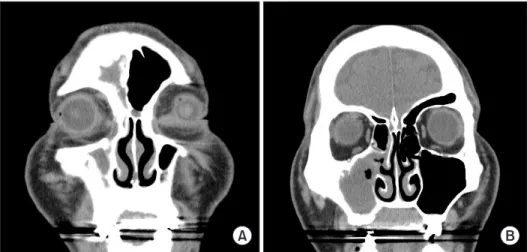
The tentative diagnosis was the maxillary sinusitis and the patient was referred to otorhinolaryngology for the fur- ther evaluation. Purulent discharge from the right nose was observed by nasal endoscope. The patient was prescribed antibiotics for 2 weeks and PNS computed tomography (PNS CT) involving maxillary and frontal sinus. PNS CT showed the haziness on the right frontal sinus (Fig. 3A) and max- illary sinus (Fig. 3B). Even though the antibiotics therapy, his symptoms were not relieved. Therefore, he underwent the endoscope assisted sinus surgery on right maxillary si- nus and biopsy specimen was sent to pathology. Submitted specimen showed chronic inflammation with necrosis con- sistent with chronic maxillary sinusitis, clinically. Gingival pain and toothache disappeared after 1 week of the surgery.

Fig. 4 shows decreased radiopacity on right PNS one week after the surgery.

DISCUSSION

Odontogenic pain emanated from the pulp or the peri- odontal supportive tissues is one of the most prevalent oro- facial pain and usually inflammatory in its origin.

2,3)

The

Fig. 1. Panoramic radiograph of the patient at first visit. The radiopacity has increased on the right maxillary sinus compared with those of the left. The right maxillary first molar had already been extracted long time ago and the right maxillary second molar was extracted due to the pain. The right second premolar was post- endodontic state due to the pain.

Fig. 2. Waters’ view of the patient at first visit. The radiopacity of

the right maxillary sinus and the right frontal sinus has increased

compared with those of the left.

(3)

characteristics of the pulpal pain are usually deep, dull, aching pain

3)

and those of periodontal pain are also dull and aching.

4)

The patient with odontogenic origin generally indicate the location of the pain quite specifically, and there is identifiable condition that reasonably explains the symp- toms such as caries, fracture, deep restoration, periodon- tal pocket, abscess, and so on. In case of both pulpal and periodontal pain, local anesthesia of the suspected tooth or periodontal tissue can eliminate the pain. Since dental pain is the most common cause of orofacial pain and typical in clinically, the clinician can easily drawn to this diagnosis.

However, if odontogenic pain is severe, it may be punctuat- ed by lancinating exacerbations that radiate throughout the

face and head.

5)

In order to successfully evaluate odontogenic pain, there- fore, the clinicians have to appreciate the differences be- tween “the site” and “the source” of pain.

6)

The terms “re- ferred pain” and “heterotropic pain” are indicated when the source of pain is not coincide with the site of pain. These type of pain is broadly categorized in non-odontogenic pain if the source of pain is not primarily on the teeth. The patient in the case initially complained about specific teeth area and received several endodontic treatments based on the diagnosis of odontogenic toothache. However, the pain and symptoms got worse, the extraction of the tooth was performed, finally. Unfortunately, the symptoms was not resolved after the extraction, then the clinician tried to find another source of pain and referred to specialist. Once non- odontogenic pain is suspected, the clinician have to inves- tigate adjacent structures thoroughly which can induced referral pain on teeth or periodontium. Common non-odon- togenic toothaches could be derived from myofascial,

7)

neu- rovascular,

8)

cardiac,

9)

or sinus problems.

10)

Sinusitis is a common disease and about 16 million visits to the physician is annually in US.

11)

Of the sinusitis, maxil- lary sinusitis is representative sinusitis in prevalence and it is characterized by constant burning pain around zygoma and tenderness of the teeth from inflammation of the max- illary sinus. About 10% of maxillary sinusitis cases are di- agnosed as having an odontogenic origin.

12)

Acute sinus- itis can induce referred pain to maxillary teeth. Toothache due to acute sinusitis often occurs in the maxillary premo- lar and molar regions because the apices of the teeth are

Fig. 3. Paranasal sinus computed tomo- graphy views showed the haziness on the right frontal sinus (A) and maxillary sinus (B).

A B

Fig. 4. Waters’ view one week after the sinus surgery. The radio-

pacity of the right maxillary sinus is reduced compared with those

of preoperative state but the haziness is still remaining.

(4)

very intimate to the sinus region. They are frequently seen with the roots protruding well into the sinus cavity. Due to the close proximity, an infectious process in the denti- tion or surrounding periodontal tissue may present an acute or chronic sinusitis; conversely, inflammation and infec- tion originating in the maxillary sinus may be perceived as odontogenic pain. It is reasonable inference that the teeth and periodontium could be a potential source of maxillary sinus problem. In some case, maxillary sinus cavity was just separated by the thin membrane called Schneiderian membrane.

13)

According to a study of the symptoms of acute sinus- itis, maximally toothache was highly specific (93%), but only 11% of patients with sinusitis actually had pain from the tooth.

14)

In the case of sinusitis, a feeling of constant dull, aching pressure of discomfort can be present in these teeth. The teeth can be sensitive to percussion, chewing, and sometimes cold. If these teeth have caries coincident- ly, dentists are prone to treat the teeth without careful dif- ferential diagnostic examination.

5)

In the case of sinusitis, other symptoms such as headache, halitosis, fatigue, na- sal discharge or congestion and even ear pain could be appeared.

12)

In case of sinus pain referral, toothache are generally in- duced by acute sinusitis. The exact mechanism how the si- nus mucosal pain referred to maxillary tooth is not fully understood yet, the same sensory innervation of sinus mu- cosa and maxillary teeth could be the clue of this phenom- enon. Sensory innervations of the nasal-PNS complex are supplied by the first and second divisions of the trigeminal nerve and secondary interneurons from sinus area shares with those of teeth. The pain from the sinus complex is typical deep visceral pain and it can cause central sensitiza- tion such as secondary hyperalgesia, referred pain and au- tonomic response. In the early stage of sinusitis, facial pain and headache is common. Hyperalgesia on affected region by central sensitization make the pain more chronic and change the nature of pain more complex in this case. This can make a proper diagnosis difficult.

Based on this case and literature reviews, several key points for differential diagnosis between odontogenic tooth- ache and sinus toothache might be suggested as follows:

1. Typically, a patient has a history of upper respiratory

infection, nasal congestion or sinus problems preced- ing or accompanying the toothache.

2. The patient reports infraorbital tenderness to palpation over the affected sinus.

3. The toothache is increased with lowering of the head or bending forward.

4. Local anesthetic of the tooth does not eliminate the pain.

5. The diagnosis can be confirmed by air/fluid level seen in Waters’ radiograph or CT.

In conclusion, odontogenic toothache and sinus tooth- ache can make diagnostic challenge to dentists and unnec- essary treatment such as root canal treatment or tooth ex- traction could be applied to the patient. Obtaining a metic- ulous history and physical examination in conjunction with ordering relevant radiography is the most important thing to diagnosis properly and the clinician should postpone the dental treatment unless there is a firm belief that the pain emanated from the tooth or adjunct periodontal tissues.

CONFLICT OF INTEREST

No potential conflict of interest relevant to this article was reported.

REFERENCES

1. Lipton JA, Ship JA, Larach-Robinson D. Estimated prevalence and distribution of reported orofacial pain in the United States. J Am Dent Assoc 1993;124:115-121.

2. Annino DJ Jr, Goguen LA. Pain from the oral cavity. Otolaryngol Clin North Am 2003;36:1127-1135.

3. Okeson JP, Falace DA. Nonodontogenic toothache. Dent Clin North Am 1997;41:367-383.

4. Ikeda H, Suda H. Sensory experiences in relation to pulpal nerve activation of human teeth in different age groups. Arch Oral Biol 2003;48:835-841.

5. Okeson JP. Non-odontogenic toothache. Northwest Dent 2000;79:

37-44.

6. Okeson JP, Bell WE. Bell’s orofacial pains: the clinical manage- ment of orofacial pain. 6th ed. Chicago: Quintessence; 2005. pp.

64-67.

7. Fricton JR, Kroening R, Haley D, Siegert R. Myofascial pain syn- drome of the head and neck: a review of clinical characteristics of 164 patients. Oral Surg Oral Med Oral Pathol 1985;60:615-623.

8. Delcanho RE, Graff-Radford SB. Chronic paroxysmal hemicrania

presenting as toothache. J Orofac Pain 1993;7:300-306.

(5)

9. Tzukert A, Hasin Y, Sharav Y. Orofacial pain of cardiac origin.

Oral Surg Oral Med Oral Pathol 1981;51:484-486.

10. Hansen JG, Højbjerg T, Rosborg J. Symptoms and signs in cul- ture-proven acute maxillary sinusitis in a general practice popu- lation. APMIS 2009;117:724-729.

11. Fagnan LJ. Acute sinusitis: a cost-effective approach to diagnosis and treatment. Am Fam Physician 1998;58:1795-1802.

12. Balasubramaniam R, Turner LN, Fischer D, Klasser GD, Oke-

son JP. Non-odontogenic toothache revisited. Open J Stomatol 2011;1:92-102.

13. Brook I. Sinusitis of odontogenic origin. Otolaryngol Head Neck Surg 2006;135:349-355.

14. Williams JW Jr, Simel DL, Roberts L, Samsa GP. Clinical evalua-

tion for sinusitis. Making the diagnosis by history and physical

examination. Ann Intern Med 1992;117:705-710.

수치

Fig. 4 shows decreased radiopacity on right PNS one week  after the surgery.
Fig. 4. Waters’  view one week after the sinus surgery. The radio- radio-pacity of the right maxillary sinus is reduced compared with those  of preoperative state but the haziness is still remaining

참조

관련 문서

Modern Physics for Scientists and Engineers International Edition,

Five days later, on 15 January 1975, the Portuguese government signed an agreement with the MPLA, FNLA and UNITA providing for Angola to receive its independence on 11

Usefulness of co-treatment with immunomodulators in patients with inflammatory bowel disease treated with scheduled infliximab maintenance therapy.. Oussalah A, Chevaux JB, Fay

Inclusion and Inclusiveness: Shared Vision of Youth for Local, National, and Global Village Inclusion at large stands for embracing populations with disabilities and

웹 표준을 지원하는 플랫폼에서 큰 수정없이 실행 가능함 패키징을 통해 다양한 기기를 위한 앱을 작성할 수 있음 네이티브 앱과

• The avoidance of unwanted heat loss or gain, and the positive use of sun energy for heating and cooling … become compelling principles of site

The index is calculated with the latest 5-year auction data of 400 selected Classic, Modern, and Contemporary Chinese painting artists from major auction houses..

The key issue is whether HTS can be defined as the 6th generation of violent extremism. That is, whether it will first safely settle as a locally embedded group