620 http://dx.doi.org/10.9713/kcer.2014.52.5.620
PISSN 0304-128X, EISSN 2233-9558
Comparison of Low Concentration and High Concentration Arsenic Removal Techniques and Evaluation of Concentration of Arsenic in Ground Water:
A Case Study of Lahore, Pakistan
Abdullah Yasar†, Amtul Bari Tabinda, Uzma Shahzadi and Pakeeza Saleem Sustainable Development Study Center, GC University, Lahore, Pakistan (Received 6 March 2014; Received in revised form 22 May 2014; accepted 25 May 2014)
Abstract − The main focus of this study was the evaluation of arsenic concentration in the ground water of Lahore at different depth and application of different mitigation techniques for arsenic removal. Twenty four hours of solar oxi- dation gives 90% of arsenic removal as compared to 8 hr. or 16 hr. Among oxides, calcium oxide gives 96% of As removal as compared to 93% by lanthanum oxide. Arsenic removal efficiency was up to 97% by ferric chloride, whereas 95% by alum. Activated alumina showed 99% removal as compared to 97% and 95% removal with bauxite and char- coal, respectively. Elemental analysis of adsorbents showed that the presence of phosphate and silica can cause a reduc- tion of arsenic removal efficiency by activated alumina, bauxite and charcoal. This study has laid a foundation for further research on arsenic in the city of Lahore and has also provided suitable techniques for arsenic removal.
Key words: Coagulants, Activated Alumina, Calcium Oxide, Solar Oxidation, Elemental Analysis
1. Introduction
Water is essential for all life forms on earth and is considered very important for our proper body functioning. The human brain is made up of 95% water; whereas blood and lungs contain 82% and 90%
water, respectively, so water contamination can pose a serious threat to human health. Arsenic is a general ecotoxin whose presence in water is a severe hazard for more than 100 million people around the world [1].
Arsenic water poisoning has become a more discussed and inves- tigated topic for all the countries using arsenic polluted water [2].
Arsenic is a very carcinogenic and toxic element. Pollution of ground water with arsenic from both natural and anthropogenic sources is the cause of great global concern [3].
Arsenic mobilization under natural conditions is the main cause of environmental arsenic problems. But other factors like mining activ- ities, combustion of fossil fuels, arsenic pesticides, herbicides, crop desiccants and arsenic additives used in livestock feed create addi- tional problems [4,5]. Long term exposure to even low levels of arse- nic in the food and water may produce a disease, arsenicosis. Arsenic poisoning can also cause many other health impacts like neurological effects, diabetes, cardio-vascular and peripheral vascular diseases and cancers of the skin, lung, liver, kidney, and bladder [6]. Arsenic is a serious hazard to the biosphere. It cannot be discharged as such with the effluents. Removal of arsenic is very important because of
its highly toxic effects not only on the human but also on the environ- ment. It is hard to find the level of contamination of arsenic because it gives no color, odor and taste even at higher concentration in water.
Safe level of arsenic in drinking water has changed from 50 µgL- to 10 µgL-1 [7,8]. This same limit is applicable for the other countries like the US (since January 2006), India, Taiwan, Vietnam, and Japan [5,9].
But the maximum arsenic contaminant level (MCL) is 25 µgL-1 in Germany and Canada, whereas 50 µgL-1 in Pakistan, Bangladesh, china, and most of the Latin American countries [9,10]. The major arsenic treatment technologies for drinking water include pre-oxidation of arsenic (III) to arsenic (V), adsorption methods, membrane meth- ods, point-of-use methods, (coagulation/precipitation/adsorption/fil- tration), (oxidation/coagulation/precipitation/ filtration), (oxidation/
filtration/adsorption), adsorption/ filtration and phyto-remediation or biological arsenic removal. Arsenic water poisoning is a worldwide problem but has become more serious threat for the people of devel- oping countries where the majority of the population utilizes ground- water for drinking purposes. Arsenic mainly exists in trivalent As (III) and penta-valent As (V) oxidation states. It is found that the arsenite is more toxic as compared to arsenate and is mainly found in ground water [11]. Many chemical and physical treatment techniques have been used to treat arsenic-contaminated waste-waters. Flocculation is a widely used method. Whereas, other removal techniques com- monly used to remove arsenic species from aqueous solutions are chemical precipitation, iron precipitation, solvent extraction, reverse osmosis, and ferri hydrite precipitation. High cost, higher demand of energy and incomplete removal of arsenic are the limitations of these processes [12].
Access to clean drinking water is a survival issue for a large city like Lahore with a population exceeding ten million, along with about
†To whom correspondence should be addressed.
E-mail: [email protected]
This is an Open-Access article distributed under the terms of the Creative Com- mons Attribution Non-Commercial License (http://creativecommons.org/licenses/by- nc/3.0) which permits unrestricted non-commercial use, distribution, and reproduc- tion in any medium, provided the original work is properly cited.
2000 industrial units which can be one of the major causes of arsenic pollution. Groundwater arsenic concentration has exponentially endan- gered the lives of the residents of Lahore.
The purpose of this research is to quantify the concentration of arsenic in the groundwater of Lahore at various depths and compare the efficiency of different arsenic removal techniques like solar oxi- dation, oxidation (calcium and lanthanum oxide), coagulation (ferric chloride and alum) and adsorption (activated alumina, charcoal and bauxite). The present study will help in cleaning the drinking water contaminated with arsenic and mitigate the related issue with arsenic contamination.
2. Methodology
2-1. Study area
Lahore is the second largest city of Pakistan with an area of about 1772 Sq. KM and population of about 10 million growing at about 3.3% per year. The people of Lahore rely on three major service modes for water, which include the piped supply network of the Lahore Development Authority (LDA), the piped supply network of the various Cantonment authorities, and household groundwater wells.
Samples were collected randomly from 392 tube wells of Lahore.
2-2. Experimental work
The work was conducted in two phases. In first phase ground water samples were taken and arsenic concentration correlation with depth was estimated. In second phase low and high arsenic removal techniques were evaluated for their efficiency which includes solar oxidation, oxides of calcium and lanthanum, coagulation/filtration and adsorbents (activated alumina (AA), charcoal, and bauxite). The removal efficiency % was calculated by the formula
Removal efficiency % =
(Ci is initial arsenic concentration) (Cf is final arsenic concentration)
2-3. Low concentration removal techniques 2-3-1. Solar oxidation
Solar oxidation is an easy and simple method for arsenic removal.
One liter of water with 500 ppb arsenic conc. was taken in three dif- ferent plastic bottles. Then 0.2 g of ferrous hydroxide was added with 6-8 drops of lemon juice to enhance the photo-oxidation of arsenite (III) to arsenate (V). After that, these bottles were placed in sunlight and arsenic concentration was measured by Merck Field Arsenic Kit.
2-3.2. Oxides of calcium and Lanthanum
Calcium oxide and lanthanum oxide were used for arsenic removal.
Two grams per liter of calcium oxide was added in water samples with arsenic concentration of 500 ppb and 1000 ppb. Dosage of 1 g/l of lanthanum oxide was added for same concentrations. The solutions
were left overnight and filtered. Concentration of arsenic was mea- sured.
2-4. High Concentration removal techniques 2-4.1. Coagulation/filtration
Two coagulants, ferric chloride and alum, were used. One liter of water with 20 ppm arsenic concentration was used. KMnO4 was added to water to oxidize Arsenite (III) to Arsenate (V) to achieve maximum arsenic removal. Coagulants (ferric salts or alum) were then added, and the solution was stirred well for a 4-5 minutes.
Microflocs began forming rapidly as the solution was stirred gently to allow the formation of easily settable flocs. Filtration was carried out with filter paper. Microfiltration was also done and pH was adjusted at 6.7 to 7.7. Experiment was performed by varying arsenic concentration and doses of coagulants.
2-4.2. Adsorption method
Charcoal, alumina and bauxite were used as adsorbents. Each adsorbent was ground, sieved and dried before use. Oxidation of the prepared arsenic solution was done by adding 0.0015 g of potassium per magnate. One gram of the each adsorbent sample was loaded in the separate flasks, and then 500 ml of 20 ppm arsenic solution was added to each flask. pH was adjusted by using HNO3 and NaOH for each adsorbent .The flasks were then capped and placed on a shaker (HY-Vibrator with adjustment speed multiple usage Functions) at 150 rpm for 2 hours. After the reaction period, all samples were cen- trifuged for 10 minutes and then filtered by filter paper. Scanning electron microscopic images of the adsorbent materials with and without as loaded were analyzed by scanning electron microscope
‘SEM’ (HITACHI model S-3400).
3. Result and Discussion
3-1. Arsenic level in ground water of Lahore
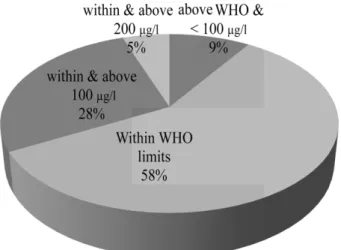
It was identified that most of the area of Lahore has high arsenic concentration above MCL (50 µg/l). About 58% of ground water of Lahore is within the WHO arsenic limits (50 µg/l) and 48% has arse- nic level above WHO limit (Fig. 1). Over abstraction to meet the needs of increasing population is the main cause of water contamina- tion. Excessive groundwater extraction may be the vital reason for creating a zone of aeration in clayey and peaty sediments containing arseno-pyrite. Under aerobic condition, arseno-pyrite decomposes and releases arsenic that mobilizes to the subsurface water. The mobilization of arsenic is further enhanced by the compaction of aquifers caused by groundwater withdrawal. Hazardous waste dis- posal is another major source of arsenic contamination of soil and aquatic systems. Arsenic and fluoride both occur in the ground water of Lahore [13].
The groundwater in the deep tube wells is less contaminated because deep aquifers have much less arsenic concentration than the shallow ones. The monitored tube wells of the study area have differ- Ci–Cf
Ci×100 ---
ent depths from 150-275 meters, and thus water for drinking pur- pose is extracted from different depths of the land. It was observed that the tube wells with different depths have different arsenic con- centration, and the tube wells with depth in the range of 152-198 meters are more contaminated. It was found that when the depth was more than 213 meters, the arsenic contamination decreased which may be owed to the anthropogenic activities. The area of Lahore near Ravi was identified as highly arsenic contaminated. It may be due to the waste of different industries dumped in the water of Ravi River.
This waste may leach and contaminate the sediments of the Ravi River, which results in the arsenic contamination of water in the area near Ravi River. The results of this study are found to be comparable to other studies. Arsenic contamination of the groundwater and sedi- ments occurs due to the industrial waste, natural processes and agro- chemical applications [14]. Arsenic concentration has correlation with the depth of tube wells (Fig. 2).
3-2. Solar oxidation
Solar oxidation is a simple method of solar oxidation of arsenic in transparent bottles to reduce arsenic content in drinking water [15].
One day solar oxidation gives 90% of arsenic removal due to com- plete oxidation of arsenic (III) to arsenic (V) as compared to 8 hr. or 16 hr. of oxidation that gives 80% and 87% removal efficiency. This method of solar oxidation requires addition of citrate in the form of lemon juice to the arsenic-contaminated water, followed by the
exposure to bright sunlight. The iron of ferrous hydroxide will react with citric acid and iron citrate formed as a product. Conversion of ferrous ions to ferric produces a number of other oxidizing species that are capable of increasing the rate of As (III) oxidation. Then the photolysis of iron citrate complex enhances the rate of oxidation of As (III) to As (V) and hence increases the percentage uptake of arse- nic by the subsequent formation of iron oxide precipitates. In this way, sunlight plays an important role for conversion of As (III) to As (V) and results in better removal of arsenic [16,17].
3-3. Use of Oxides
Different oxides can be used for arsenic removal. Lanthanum salts and oxides are used for this purpose, but calcium oxide is commonly used for arsenic removal.
(a) By using calcium oxide, the arsenic removal efficiency was 80%, 89%, and 96% at pH 8.5, 9.5 and 10.5, respectively when arse- nic concentration was 500 ppb, whereas arsenic removal efficiency was 78%, 91% and 95% at pH 8.5, 9.5 and 10.5, respectively, at arse- nic concentration of 1000 ppb (Fig. 3). Results indicate that 96% of arsenic removal efficiency was achieved by calcium oxide at pH adjusted 10.5. The addition of lime increases the pH of solution, thereby causing a shift in the carbonate equilibrium and the forma- tion of calcium carbonate and magnesium hydroxide precipitates.
Lime softening operates within the optimum pH range of more than 10.5 [18]. At pH levels above 10.5, co-precipitation of As (V) with magnesium hydroxide is the primary arsenic removal mechanism.
These precipitates can be removed by clarification and filtration.
Using this process solely for arsenic removal is generally considered cost-prohibitive due to the associated chemical supply and sludge removal costs. Laboratory results showed that adding 0.1% (by weight) of lime to contaminated water reduced arsenic to safe levels after a settling time of 10 hours. After 16 hours, no arsenic was detected.
(b) Lanthanum oxides and salts are widely used for arsenic removal.
Calcium oxide gives better results as compared to lanthanum oxide.
Lanthanum chloride exhibits a wider pH range compared to ferric chloride in the coagulation of arsenate; the respective pH is 5-10 and 5-7 [19]. Arsenic removal efficiency of 93% was achieved when lan- thanum oxide was used for treatment of water with 1000 ppb con- centrations of arsenic. Lanthanum oxide and lanthanum-alumina oxide have been used for removing arsenate and arsenite species Fig. 1. Percentage of Arsenic contamination in ground water of Lahore.
Fig. 2. Correlation of Arsenic Concentration with Depth. Fig. 3. Arsenic removal efficiency by using Calcium oxide.
from solution. Lanthanum oxide alone or in conjunction with alu- mina solids and other oxides can remove arsenic to low levels (<50 ppb). Also, the adsorption kinetics was found to be extremely fast compared to other adsorbents such as alumina.
3-4. Coagulation/Filtration
Coagulation is the most commonly used method for arsenic removal. Ferric chloride and alum were used as coagulant and found to be efficient regarding arsenic removal. Arsenic removal effi- ciency was up to 97% by ferric chloride and up to 95% by alum. In addition to better coagulant ferric chloride, it is a cheap coagulant as compared to alum. Better removal by ferric chloride is due to the complete conversion of ferric ions into ferric hydroxide. However, not all of the aluminum of alum coagulant precipitates as aluminum hydroxide, especially above pH 8, where aluminum hydroxide is sol- uble. So pH adjustment is important when alum is used as coagulant for arsenic removal [20]. Approximately 95% removal efficiency can be achieved by oxidizing the As (III) to As (V), and removal effi- ciency increases slightly by increasing the coagulant dose. Increased coagulant dose increases the interaction between coagulants and arse- nic, thus presenting a greater number of adsorption sites on the sur- face of the particulates in solution where arsenate may adsorb [21].
3-5. Use of Different Adsorbents
Oxidation of As (III) to As (V) was done by potassium permanga- nate before treatment by adsorbents. Different adsorbents like acti- vated alumina (AA), bauxite and charcoal were used for arsenic removal.
(a) Activated alumina is a porous, granular material having good sorption properties. More than 99% arsenic removal efficiency was reported in this study by the use of activated alumina. The arsenic removal efficiency by activated alumina is typically >95% but has more preference towards As (V) than As (III) [22]. The sorption sites on the activated alumina surface are also attractive to a number of anions other than arsenate. Selectivity sequence of activated alu- mina in the pH range of 5.5 to 8.5 as:
OH- > H2AsO4- > Si(OH)3O- > HSeO3- > F- > SO42- > CrO42- >>
HCO3- >Cl- > NO3- > Br- > I
Because of activated alumina’s strong selectivity for arsenate, competing anions pose fewer problems than with ion exchange resins.
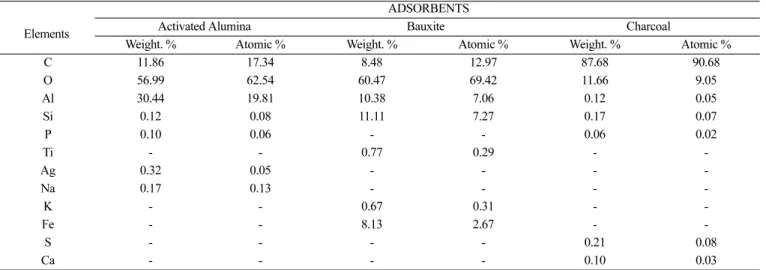
(b) Bauxite is also used for arsenic removal with removal effi- ciency of approximately 97%. The behavior of arsenic sorption by adsorbent materials depends upon the initial concentrations of arse- nic. Presence of phosphate and silica can be a cause of reduced arse- nic removal efficiency. Elemental analysis by scanning electron microscope (SEM) indicates the presence of phosphorus and silica, which can be considered as the reason for reduced arsenic removal efficiency. Arsenic removal efficiency by using calcined refractory grade bauxite is 99.5%.
(c) Charcoal is generally used as a reactive material for heavy metal removal in wastewater because it has high adsorption capacity
[23]. In the present study, arsenic removal was 95% by use of char- coal (Fig. 4). In fact, charcoal contains oxides of aluminum, calcium and silicon; those are responsible for the development of charges on the adsorbent surface when charcoal comes in contact with water, and due to the development of charges a significantly high electro- static attraction exists between the positively charged surface of the adsorbent and the negatively charged H2AsO4-1 ions. Hence, the As (V) removal is maximum. The negatively charged arsenic ion and positively charged adsorbent surface favors the arsenic adsorption.
For arsenic removal, activated alumina was found to be a better adsorbent as compared to the other adsorbents like bauxite and char- coal. However, bauxite is a better adsorbent for arsenic removal as compared to charcoal. However, adsorption onto activated carbon or activated alumina is not well suited for removal of high concentra- tions of arsenic. The reason for such unsuitability is that these adsor- bents are very costly because they degenerate after use. So every time, new adsorbents are needed for more arsenic removal and recoveries are significantly less than quantitative [24].
3-5.1. SEM/EDS Analysis
Arsenic removal performance via adsorption media can be impacted by the pH of the water, the presence of other constituents competing for adsorption sites such as silica, fluoride and selenium, and fouling of media by particulate matter, such as colloids and metal oxides.
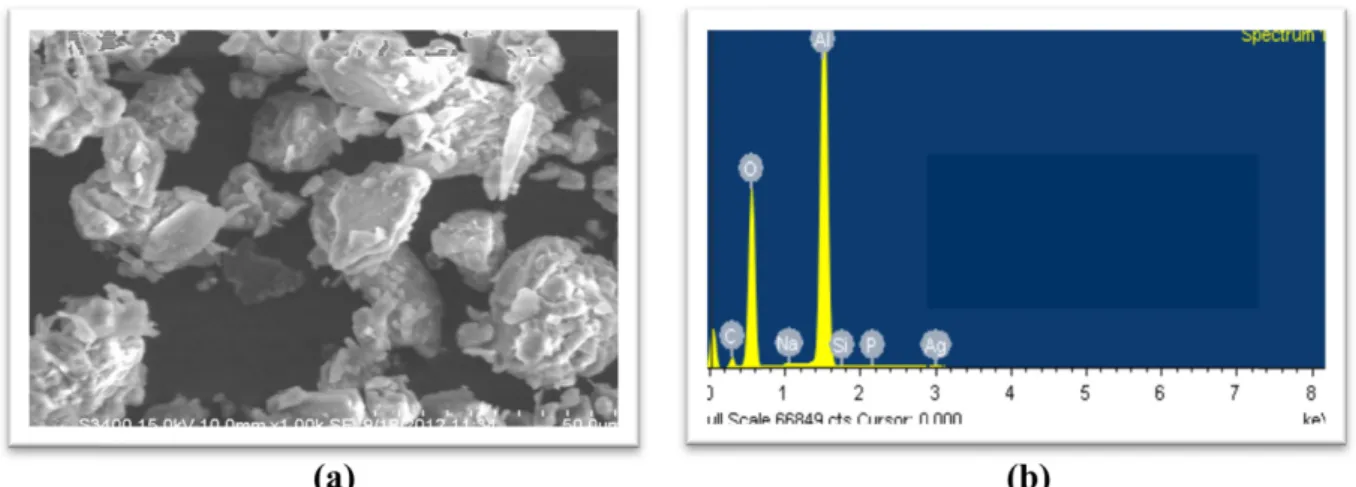
Scanned electron microscope images of the precipitates of AA, bauxite and charcoal and the corresponding EDS spectrum were obtained. As can be seen in the energy dispersive spectra (EDS) anal- ysis (Fig. 5(a), (b)), the precipitates of AA obtained exhibit content of carbon, oxygen, aluminum, sodium, silicon, phosphorus, and sil- ver. Several constituents can interfere with the adsorption process by AA, either by competing for adsorption sites or clogging the media with particulate matter. There are several emerging proprietary media, commonly referred to as modified AA, which contain alumina in a mixture with other substances such as iron and sulfur. In some instances, these media have greater overall adsorptive capacities, enhanced selectivity towards arsenic, and/or greater overall operational flexi- bility than conventional AA, thus making them more cost effective.
Addition of either silicate or phosphate has some effects on arsenic removal, but the presence of both can reduce arsenate removal by Fig. 4. As removal efficiency (%) with different adsorbents.
39% and arsenite removal by 69% [25].
In bauxite ore, major peaks of Al, Si, O and Fe are present as (Fig.
6(a), (b)), which means Al2O3, SiO2 and Fe2O3 are present. Also, a small peak of K along with other peaks shows that kaolin clay is pres-
ent. The oxides of iron, aluminum and silicon have arsenic reduction ability. A small peak of titanium is present, which shows that traces of titanium oxide are present, which according to another study reveals that the nanoparticles of TiO2 show arsenic removal activity [26].
Fig. 5. (a) SEM Image of Activated Alumina and (b) Spectrum Image of Activated Alumina.
Fig. 6. (a) SEM Image of Bauxite and (b) Spectrum Image of Bauxite.
Fig. 7. (a) SEM Image of Charcoal and (b) Spectrum Image of Charcoal.
It can be seen in the EDS analysis (Fig. 7(a), (b)) that the precipi- tates of charcoal obtained exhibit content of carbon, oxygen, sulfur, silicon, phosphorus, calcium, and aluminum. In activated charcoal, active sites and nano pores are present, due to which it shows arsenic removal activity. SEM images showed that adsorbent material is comprised of many crushed particles, while the image was taken with a particle size of 50µm. These have rough surfaces that can help increase the surface area available for adsorption of the arsenic, and the small particles adhere on the surface of adsorbent material and form a multilayer.
The EDS microanalysis of the precipitates of all the used adsor- bents obtained during the treatment of ground water indicates the presence of silicon, phosphorus and calcium (Table 1). These dis- solved species compete particularly with arsenic for the adsorption sites increasing the treatment time or can also reduce arsenic removal from ground water. Inhibitors of various compounds can be used.
The addition of a silicon inhibitor compound to ground water, which exhibits a high affinity for silicon species, reduces the interaction of these species with the adsorbents, and by consequence reduces the treatment time for the arsenic removal to almost 50%. So addition of inhibitors like silicon adsorption inhibitor compound has a high affinity for silicon and calcium and for this reason forms complex agglomerates, which precipitate reducing the competency with arse- nic for the adsorption sites and consequently reduce the treatment time for arsenic removal from ground water [17].
3-6. Efficiency Comparison of Different Techniques
Arsenic removal efficiency comparison of different techniques showed that the best efficiency can be achieved by activated alu- mina, 99% among adsorbents. Ferric chloride is a better coagulant as compared to alum for arsenic removal. In case of oxides, calcium oxide is a better option as compared to lanthanum oxide. Solar oxi- dation is less efficient as compared to activated alumina, but it is cost efficient as compared to all other treatment techniques that imply use of certain chemicals (Fig. 8).
4. CONCLUSION
It was found that about 58% ground water source of Lahore is within World Health Organization (WHO) arsenic limits (50 µg/l) and the remaining has arsenic concentration above the WHO limits.
Even 28% of study area has arsenic level above 100 µg/liter. Among various techniques evaluated for arsenic removal, activated alumina was found to be the best adsorbent for removal of arsenic as contrast to the charcoal and bauxite. But the use of activated alumina is expensive for arsenic removal. Elemental analysis showed that dif- ferent elements interfere with the ability of adsorbents to remove arsenic. Besides that, dissolved species compete particularly with arsenic for the adsorption sites, increasing the treatment time or can also reduce arsenic removal from ground water. Inhibitors of various compounds can be used to resolve that problem. Among oxides, cal- cium oxide is better than lanthanum oxide for arsenic removal. Fer- ric chloride and alum coagulation is also economically favorable for arsenic removal. Solar oxidation can be a cost-effective method if the contaminated water has iron. This study has laid a foundation for fur- ther research on arsenic in the city of Lahore, and these treatment methods can be used from ground water treatment to industrial efflu- ent treatment.
Table 1. Quantitative Elemental Analysis
Elements
ADSORBENTS
Activated Alumina Bauxite Charcoal
Weight. % Atomic % Weight. % Atomic % Weight. % Atomic %
C 11.86 17.34 8.48 12.97 87.68 90.68
O 56.99 62.54 60.47 69.42 11.66 9.05
Al 30.44 19.81 10.38 7.06 0.12 0.05
Si 0.12 0.08 11.11 7.27 0.17 0.07
P 0.10 0.06 - - 0.06 0.02
Ti - - 0.77 0.29 - -
Ag 0.32 0.05 - - - -
Na 0.17 0.13 - - - -
K - - 0.67 0.31 - -
Fe - - 8.13 2.67 - -
S - - - - 0.21 0.08
Ca - - - - 0.10 0.03
Fig. 8. Comparison of Efficiency for Arsenic Removal.
References
1. Tyrovola, K., Kibriya, E., Slavkovich, M. G., Jasmine, F., Gam- ble, M. V. and Graziano, J. H., Eur. J. Soil Biol., 43, 356 (2007).
2. Ahsan, H., Chen, Y., Kibriya, M. G., Slavkovich, V., Parves, F., Jasmine, F., Gamble, M. V. and Graziano, J. H., Canc. Drug Del., 16(6), 1270 (2007).
3. Malay, G. K., Gerrard, P. J. E., Touma, I. B. and Pritam, S., Korean J. Chem. Eng., 29(1), 95 (2012).
4. Mukherjee, A. B. and Bhattacharya, P., Environ. Rev. 9, 189 (2001).
5. Mohan, D. and Pittman Jr, C. U., J. Hazard. Mater., 142, 1 (2007).
6. Ravenscroft, P., Brammer, H. and Richards, K., Arsenic Pollution: A Global Synthesis, John Wiley & Sons. Publication, 94 (2011).
7. WHO (World Health Organization), Guideline for Drinking Water Quality, Recommendations, 3rd ed. Geneva, 306 (2004).
8. Sahu, N. K., Barsha, D., Suchismita, S., Bhattacharya, I. N. and Subbaiah, T., Korean J. Chem. Eng., 29(11), 1638 (2012).
9. Mondal, P., Majumder, C. and Mohanty, B., J. Hazar. Mater., 137(1), 464 (2006).
10. Stanton, M., Sanzolone, R., Grimes, D. and Sutley, S., In: Bar- tolino, J.R., (Ed.), US Geological Survey Middle Rio Grande Basin Study - Proceedings of the Third Annual Workshop; US Geo- logical Survey Open-File Report 99-203, Albuquerque, New Mexico, 62 (1999).
11. Kapaj, S., Peterson, H., Liber, K. and Bhattacharya, P., J. Environ.
Sci. Heal. A, 41, 2428 (2006).
12. Choong, J., Korean J. Chem. Eng., 28(3), 813 (2011).
13. Nickson, R. T., McArthur, J. M., Shrestha, B., Kyaw-Myint, T.
O. and Lowry, D. Appl. Geochem., 20, 55 (2005).
14. Keon, N. E., Swartz, C. H., Brabander, D. J., Harvey, C. and Hemond, H. F., Environ. Sci. Technol., 35, 2778 (2001).
15. Wegelin, M., Gechter, D., Hug, S., Mahmud, A. and Motaleb, A., SORAS-a Simple Arsenic Removal Process, http://phys4.har- vard.edu/wilson/mitigation/SORAS Paper.html (2000).
16. Hug, S. J., Canonica, L., Wegelin, M., Gechter, D. and von Gunten, U., Environ. Sci. Technol., 35, 2114 (2001).
17. Lara, A. M. G. and Ocampo, C. M., Water Air Soil Poll., 205, 237 (2010).
18. Gholikandi, G. B., Orumieh, H. R. and Riahi, R., Int. J. Safe. Secu- rity Eng., 1(3), 326 (2011).
19. Tokunaga, S., Yokoyama, S. and Wasay, S. A., Water Environ.
Res., 71(3), 299 (1999).
20. Edwards, M., J. Am. Water Work. Assoc., 86(9), 64 (1994).
21. Neil, L. M. and Edwards, M., J. Am. Water Work. Assoc., 89(1), 75 (1997).
22. Singh, P., Singh, S. T. and Pant, K. K., Res. J. Chem. Environ., 5(3), (2001).
23. Debasish, M., Debaraj, M. and Ho, P. K., J. Environ. Sci., 20(6), 683 (2008).
24. Mondal, P., Balomajumder, C. and Mohanty, B., J. Hazard. Mater., 144, 420 (2007).
25. Leist, M., Casey, R. J. and Caridi, D., J. Hazard. Mater., 76(1), 125 (2000).
26. Meng, X., Bang, S. and Korfiatis, G. P., Water Res., 34, 1255 (2000).