ABSTRACT
Purpose: Human parvovirus B19 infection is widespread and has a heterogeneous clinical spectrum, ranging from asymptomatic infection to potentially life-threatening complications. We investigated the various clinical features of human parvovirus B19 infection during an outbreak of the virus in our community.
Methods: A retrospective chart review study was conducted at the Pusan National University Children's Hospital from December 2017 to April 2019. We investigated the clinical features of children with parvovirus B19 immunoglobulin M or parvovirus B19 DNA detected using polymerase chain reaction.
Results: A total of 24 children were diagnosed with parvovirus B19 infection. Twelve (50%) had lace form rashes, and four (16.7%) had petechial rashes. Two (8.3%) were diagnosed with fever without a focus. Six (25%) developed aplastic crisis as a complication of infection, of whom three were previously diagnosed with hereditary spherocytosis and three with acute lymphoblastic leukemia.
Conclusions: In addition to erythema infectiosum, the parvovirus B19 infection can present clinically with various types of rashes and fever without a focus. Furthermore, hematologic manifestations such as neutropenia and aplastic crisis can occur during infection.
Keywords: Parvovirus; Child; Rash; Aplastic crisis
INTRODUCTION
Human parvovirus B19 infection is associated with a heterogeneous clinical spectrum, ranging from asymptomatic to potentially life-threatening complications, such as aplastic crisis in chronic hemolytic anemia, hydrops fetalis, and neurologic disease.1) This infection usually causes erythema infectiosum, also known as fifth disease, a benign self-limiting disease characterized by typical cutaneous manifestations.2) In addition to erythema infectiosum, acute infection with parvovirus B19 can be associated with purpuric or petechial rashes, often with focal acral petechial eruption, referred to as papular-purpuric
“gloves-and-socks” syndrome.3) A few reports have described generalized petechial rashes associated with parvovirus B19 infection.4-6) Although parvovirus B19 infection is common in children, there are only a few case reports emphasizing specific symptoms of parvovirus B19 infection in Korea.7-10)
Original Article
Received: Dec 21, 2019 Revised: Jul 4, 2020 Accepted: Jul 4, 2020 Correspondence to Su Eun Park
Department of Pediatrics, Pusan National University Children's Hospital, 20 Geumo-ro, Meulgeum-eup, Yangsan 50612, the Republic of Korea.
E-mail: [email protected]
Copyright © 2020 The Korean Society of Pediatric Infectious Diseases
This is an Open Access article distributed under the terms of the Creative Commons Attribution Non-Commercial License (https://
creativecommons.org/licenses/by-nc/4.0/) which permits unrestricted non-commercial use, distribution, and reproduction in any medium, provided the original work is properly cited.
ORCID iDs Kyo Jin Jo
https://orcid.org/0000-0002-4947-3672 Yeoun Joo Lee
https://orcid.org/0000-0001-8012-5433 Kyung Mi Park
https://orcid.org/0000-0003-2864-7255 Eu Jeen Yang
https://orcid.org/0000-0002-3796-6242 Sukdong Yoo
https://orcid.org/0000-0003-2365-9134 Taek Jin Lim
https://orcid.org/0000-0002-1817-5138 Su Eun Park
https://orcid.org/0000-0001-5860-821X Conflict of Interest
No potential conflict of interest relevant to this article was reported.
Kyo Jin Jo , Yeoun Joo Lee , Kyung Mi Park , Eu Jeen Yang , Sukdong Yoo , Taek Jin Lim , Su Eun Park
Department of Pediatrics, Pusan National University Children's Hospital, Yangsan, the Republic of Korea
Clinical Characteristics of Human
Parvovirus B19 Infection in Children
Author Contributions
Conceptualization: Park SE; Data curation:
Jo KJ; Formal analysis: Yoo SD; Investigation:
Jo KJ; Methodology: Lim TJ; Project administration: Park SE, Jo KJ; Resources: Lee YJ; Software: Yoo SD; Supervision: Park SE;
Validation: Park KM; Visualization: Yang EJ;
Writing - original draft: Jo KJ; Writing - review
& editing: Park SE.
From December 2017 to April 2019, the number of patients presenting with symptoms suggesting parvovirus B19 infection, such as erythema infectiosum, or purpuric or petechial rashes, increased in Gyeongsangnam-do area compared to that in the previous eight years. The aim of this study was to investigate the various clinical features in children with confirmed parvovirus B19 infection.
MATERIALS AND METHODS
We conducted a retrospective medical chart review in children ≤18 years old tested for parvovirus B19 immunoglobulin M (IgM) or parvovirus B19 polymerase chain reaction (PCR) at the Pusan National University Children's Hospital between December 2017 and April 2019. Data on sex, age, fever, rashes, complete blood count, and liver function tests were collected from medical records. Serologic tests for parvovirus B19 IgM antibodies were performed at GC LabCell (Yongin, Korea) using an enzyme immunoassay (Denka Seiken Co., Tokyo, Japan). Serum tests for detection of parvovirus B19 DNA were performed using PCR (Biometra GmbH, Germany) with 2 primers directed at the VP1 gene.
This study was approved by the Institutional Review Board of Pusan National University Yangsan Hospital (approval No. 05-2019-088). Written informed consent was waived due to the retrospective study design.
RESULTS
A total of 66 patients were tested for parvovirus B19 IgM or parvovirus B19 PCR from December 2017 to April 2019. There were various reasons of suspecting parvovirus B19 infection in these patients, such as a diffuse maculopapular rash evolving to a reticular pattern, petechial rashes, leukopenia, anemia, pancytopenia, elevated liver function test parameters, fetal hydrops, or fever without a focus. The most common reason for parvovirus B19 testing was diffuse maculopapular rashes evolving to a reticular pattern.
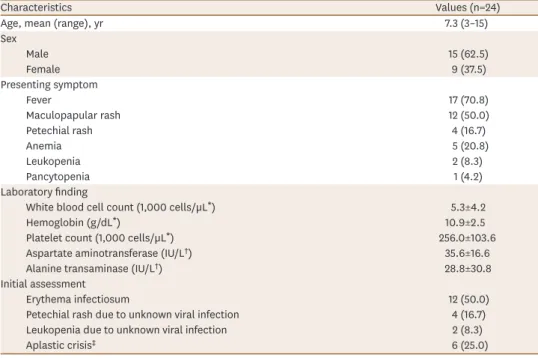
Of the 66 evaluated patients, parvovirus B19 was detected in 24 (36.3%; Table 1). Parvovirus B19 IgM was performed in 24 patients and was positive in 22 of these patients. Parvovirus B19 PCR was performed in 16 patients and was positive in all these patients. Among them, 14 patients yielded confirmed positive results for parvovirus B19 IgM and PCR. No patients received packed red blood cell transfusion or treated with immunoglobulin in the last three months. The mean age of the 24 patients was 7.3±2.6 years (range, 3 to 15 years) and 15 patients were men (62.5%). Twelve of the 24 patients (50%) presented with diffuse maculopapular rashes evolving to a reticular pattern, while four (16.7%) presented with a petechial rash on the arms, legs, neck, and trunk; 13 of 16 patients had both rashes and fever. Fever was observed in 17 of 24 patients (70.8%), and two patients had fever without any focus. Six patients (25%) were diagnosed with aplastic crisis, of whom three (50%) were previously diagnosed with hereditary spherocytosis and three were previously diagnosed with acute lymphoblastic leukemia (ALL). Their complete blood count was within a normal range before parvovirus B19 infection. The laboratory tests findings of patients with aplastic crisis showed median white blood cell count 2,680 cells/μL (range 2,340 to 11,610), median hemoglobin 7.1 g/dL (range 6.0 to 8.9), and median platelet count 305,000 cells/μL (range 83,000 to 372,000). Five (3 with hereditary spherocytosis, and 2 with ALL) of the six patients
(83.3%) received packed red blood cell transfusions due to anemia. None were treated with immunoglobulin. All the patients with aplastic crisis recovered after 4 weeks. Two of the 24 patients (8.3%) did not have detectable parvovirus B19 IgM, but had detectable parvovirus B19 DNA in their blood. One of these two patients had ALL, while the other patient was healthy. The reasons for parvovirus B19 testing in these two patients were anemia and leukopenia.
There was no patient with a laboratory-confirmed co-infection, such as bacteremia, respiratory virus infections, Epstein-Barr virus (EBV) infection, or cytomegalovirus (CMV) infection. Among the 24 patients, 11 (45.8%) underwent blood culture, three (12.5%) underwent respiratory virus multiplex PCR (BioFire, Salt Lake City, UT, USA), four (16.7%) underwent EBV IgM testing, and two (8.3%) underwent both CMV IgM and CMV PCR testing.
Among 24 patients, four (16.7%) were lost to follow-up, and the clinical courses of 20 (83.3%) patients were followed; 14 of these 20 patients (70.0%) were followed until 2 to 3 weeks after diagnosis, and the remaining six of these 20 patients with aplastic crisis (30.0%) were followed over 1 month. Three of the 24 patients (12.5%) developed erythema infectiosum after their petechial rashes resolved. In each case, the second rashes developed 2 to 3 weeks after the appearance of the first petechial rashes. Four (16.7%) of the 24 patients, developed symptoms approximately 1 to 2 weeks after the appearance of similar symptoms in their sibling. There were no epidemiological correlations in the 24 patients, such as attending the same day care center or school, or previous hospitalizations in same hospital. The symptoms of parvovirus B19 infection and laboratory findings, such as anemia, leukopenia, and thrombocytopenia recovered 2 to 4 weeks after diagnosis.
Table 1. Characteristics of patients with confirmed parvovirus B19 infection
Characteristics Values (n=24)
Age, mean (range), yr 7.3 (3–15)
Sex
Male 15 (62.5)
Female 9 (37.5)
Presenting symptom
Fever 17 (70.8)
Maculopapular rash 12 (50.0)
Petechial rash 4 (16.7)
Anemia 5 (20.8)
Leukopenia 2 (8.3)
Pancytopenia 1 (4.2)
Laboratory finding
White blood cell count (1,000 cells/µL*) 5.3±4.2
Hemoglobin (g/dL*) 10.9±2.5
Platelet count (1,000 cells/µL*) 256.0±103.6
Aspartate aminotransferase (IU/L†) 35.6±16.6
Alanine transaminase (IU/L†) 28.8±30.8
Initial assessment
Erythema infectiosum 12 (50.0)
Petechial rash due to unknown viral infection 4 (16.7)
Leukopenia due to unknown viral infection 2 (8.3)
Aplastic crisis‡ 6 (25.0)
Data are presented as mean ± standard deviation or number (%) of patients.
*White blood cell count, hemoglobin, and platelet count were examined in 22 patients. †Aspartate
aminotransferase and alanine transaminase were examined in 19 patients. ‡Three of 6 were previously diagnosed with hereditary spherocytosis and the other three were previously diagnosed with acute lymphoblastic leukemia.
DISCUSSION
Parvovirus B19 infection is not a notifiable disease in Korea, and neither clinical descriptive nor epidemiological data are readily available. Only a few reports have described aplastic crisis due to parvovirus B19 infection in children with hemolytic anemia.7-9) To our knowledge, this is the first study to describe the clinical characteristics of parvovirus B19 infection in children based on acute cases identified using the serologic and/or direct virologic methods in Korea.
There were various reasons for parvovirus B19 testing, including diffuse maculopapular rashes evolving to a reticular pattern, petechial rashes, leukopenia, anemia, and
pancytopenia. Most reports on the clinical characteristics of parvovirus B19 infection have emphasized specific symptoms or laboratory findings, such as generalized petechial rashes,6) erythema infectiosum,11) hemolytic anemia,7-9) or neutropenia and thrombocytopenia.12) Patients with parvovirus B19 infection in this study were heterogeneous including healthy children and those with underlying hematologic disease. There have been some reports of patients with ALL who were infected with parvovirus B19 during chemotherapy.10,13) One such report described a patient with ALL who presented with anemia and neutropenia during maintenance chemotherapy.10) The other report described 18 patients with ALL who presented with severe cytopenia.13) The present study included three patients with ALL who presented with aplastic crisis during chemotherapy.
Parvovirus B19 is difficult to isolate in culture. Diagnosis of parvovirus B19 infection in immunocompetent individuals presenting with erythema infectiosum or B19-induced arthropathy is usually based on the detection of parvovirus B19-specific antibody. Parvovirus B19 IgM appears after 10 to 12 days post-infection, coinciding with a peak in virus levels.
IgM usually persists in serum samples for approximately 3 months but may be found for several additional months.14) On the other hand, patients with congenital or acquired immunodeficiency, and lymphoproliferative disorders (especially ALL) and transplant recipients manifest persistent anemia associated with reticulocytopenia, absent or low levels of parvovirus B19−specific antibodies, and high concentrations of parvovirus B19 DNA in serum.15) In this study, two patients did not have detectable parvovirus B19 IgM, but did have detectable parvovirus B19 DNA. One of these patients was diagnosed with ALL, while the other patient was healthy. This finding indicates the importance of performing parvovirus B19 PCR, especially in hematology/oncology patients, such as those with hereditary spherocytosis or ALL, and of carefully monitoring such patients during an outbreak.
The highest risk for transmission of parvovirus B19 is by close contact within households and schools16); secondary infection rates approach 50% in households.17) Transmission is predominantly through the respiratory route, probably by droplet spread, and is highest at the time of viremia, before the onset of rashes or arthralgia. In this study, four patients developed symptoms approximately 1 to 2 weeks after the appearance of similar symptoms in their sibling.
This study has some limitations that should be noted. First, this study is retrospective, which has inherent biases. Second, the patients in this study were evaluated for parvovirus B19 IgM or parvovirus B19 PCR by clinical doctors who met the patients in the emergency room or outpatient room. Whether or not parvovirus B19 testing was performed was determined
by the doctor who first met the patient. For example, when the clinical doctors met patients with typical erythema infectiosum, they did not always recommend parvovirus B19 testing.
Therefore, we believe there may have been more patients with parvovirus B19 infection during this period.
Human parvovirus B19 infection has various clinical characteristics. In addition to erythema infectiosum, acute infection with parvovirus B19 can be associated with various petechial rashes, such as focal acral petechial eruption, or more generalized purpuric or petechial rashes. During a community outbreak of human parvovirus B19 infection, immunocompromised patients, such as those with hereditary spherocytosis or ALL, should be carefully monitored for aplastic crisis.
REFERENCES
1. Aydinöz S, Karademir F, Süleymanoglu S, Ozkaya H, Göçmen I. Parvovirus B19 associated papular- purpuric gloves-and-socks syndrome. Turk J Pediatr 2006;48:351-3.
PUBMED
2. Chinsky JM, Kalyani RR. Fever and petechial rash associated with parvovirus B19 infection. Clin Pediatr (Phila) 2006;45:275-80.
PUBMED | CROSSREF
3. Harms M, Feldmann R, Saurat JH. Papular-purpuric “gloves and socks” syndrome. J Am Acad Dermatol 1990;23:850-4.
PUBMED | CROSSREF
4. McNeely M, Friedman J, Pope E. Generalized petechial eruption induced by parvovirus B19 infection.
J Am Acad Dermatol 2005;52:S109-13.
PUBMED | CROSSREF
5. Conway SP, Cohen BJ, Field AM, Hambling MH. A family outbreak of parvovirus B19 infection with petechial rash in a 7-year-old boy. J Infect 1987;15:110-2.
PUBMED | CROSSREF
6. Edmonson MB, Riedesel EL, Williams GP, DeMuri GP. Generalized petechial rashes in children during a parvovirus B19 outbreak. Pediatrics 2010;125:e787-92.
PUBMED | CROSSREF
7. Song SA, Lee MY, Kim SH, Lee JY, Oh SH, Shin JH, et al. Autoimmune hemolytic anemia after aplastic crisis due to parvovirus B19 infection in a patient with hereditary spherocytosis. Lab Med Online 2012;2:166-9.
CROSSREF
8. Choi HJ, Lee JH, Lee KS. The aplastic crisis of hereditary spherocytosis due to parvovirus B19 infection.
Clin Pediatr Hematol Oncol 2006;13:22-31.
9. Park YJ, Koh DK, Oh JH. Aplastic crisis secondary to parvovirus B19 infection. J Korean Pediatr Soc 2003;46:1139-42.
10. Sung KW, Chang EJ, Jang WJ, Jeon IS. Parvovirus B19 infection in a child with acute lymphoblastic leukemia during maintenance chemotherapy. Clin Pediatr Hematol Oncol 2012;19:44-8.
11. Foti C, Bonamonte D, Conserva A, Grandolfo M, Casulli C, Martire B. Erythema infectiosum following generalized petechial eruption induced by human parvovirus B19. New Microbiol 2006;29:45-8.
PUBMED
12. Shin H, Park S, Lee GW, Koh EH, Kim HY. Parvovirus B19 infection presenting with neutropenia and thrombocytopenia: three case reports. Medicine (Baltimore) 2019;98:e16993.
PUBMED | CROSSREF
13. Lindblom A, Heyman M, Gustafsson I, Norbeck O, Kaldensjö T, Vernby Å, et al. Parvovirus B19 infection in children with acute lymphoblastic leukemia is associated with cytopenia resulting in prolonged interruptions of chemotherapy. Clin Infect Dis 2008;46:528-36.
PUBMED | CROSSREF
14. Anderson LJ, Tsou C, Parker RA, Chorba TL, Wulff H, Tattersall P, et al. Detection of antibodies and antigens of human parvovirus B19 by enzyme-linked immunosorbent assay. J Clin Microbiol 1986;24:522-6.
PUBMED | CROSSREF
15. Young NS. Hematologic manifestations and diagnosis of parvovirus B19 infections. Clin Adv Hematol Oncol 2006;4:908-10.
PUBMED
16. Melegaro A, Jit M, Gay N, Zagheni E, Edmunds WJ. What types of contacts are important for the spread of infections?: using contact survey data to explore European mixing patterns. Epidemics 2011;3:143-51.
PUBMED | CROSSREF
17. Chorba T, Coccia P, Holman RC, Tattersall P, Anderson LJ, Sudman J, et al. The role of parvovirus B19 in aplastic crisis and erythema infectiosum (fifth disease). J Infect Dis 1986;154:383-93.
PUBMED | CROSSREF
요약
목적: 인간 파르보바이러스 B19 감염은 무증상에서 생명을 위협하는 합병증에 이르기까지 광범위하고 다양한 증상을
나타낸다. 우리는 파르보바이러스 B19 감염의 지역사회 내 집단발생 시기 동안, 파르보바이러스 B19 감염의 다양한 임상 양상에 대해 조사하였다.
방법: 2017년 12월부터 2019년 4월까지 부산대학교 어린이병원에서 파르보바이러스 B19 면역 글로불린 M (IgM) 또는
중합효소 연쇄 반응(polymerase chain reaction, PCR)에 의해 검출된 파르보바이러스 B19 DNA를 가진 소아의 임상적 특징을 후향적 차트 분석을 통해 알아보았다.
결과: 24명의 어린이가 파르보바이러스 B19 감염으로 진단되었다. 24명의 환자 중 12명(50%)은 레이스 형태 발진이 있었고,
24명의 환자 중 4명(16.7%)은 점상출혈 발진, 24명의 환자 중 2명(8.3%)은 무병소 발열로 진단되었다. 24명 중 6명의 환자
(25%)는 골수무형성위기가 발생하였고, 이 중 3명은 이전에 유전 구형적혈구증, 3명은 이전에 급성 림프모구 백혈병으로
진단되었던 환자이다.
결론:감염홍반 외에도 파르보바이러스 B19 감염의 임상적 특징은 다양한 종류의 발진과 무병소 발열으로 나타날 수 있다.
또한, 혈액학적 증상으로 중성구 감소증, 골수무형성 위기와 같이 발생할 수 있다.