Vol. 18, No. 9 pp. 251-257, 2017
Business Model Change in Asset Management
HyunWook Ryu
Department of Global Trade and Management, Shinhan University
금융자산 관리모델의 변화에 관한 연구
류현욱
신한대학교 글로벌통상경영학과
Abstract Private banking, which is a part of the financial services industry, is an investment advisory business targeting high-net-worth individuals (HNWIs). The demand for asset management services, which isexpanding in the world market as well as in the Asia-Pacific region, is rapidly increasing in Korea as the low-growth, low-interest environment has stabilized. In Korea, the private banking business is ahead of growth, and the evaluation and compensation system of playing institutions remains a challenge. While the aging of the population increases the demand for services, the increasing competition and regulations have decreased the profit margins in the industry. In this paper, a business model is derived from a professional service quality model. Modular advisory services, value-proposition through sophisticated services, and investment expertise with increased clarity would help wealth management firms pursue their opportunities. By interviewing the experts of wealth management banks, this study constructsa business model with elements derived from a relevant literature review. The contribution of this research is to enable these institutions to understand the key factors affecting their financial performances, in order to improve them. This study is limited by one of the research models, and it will be necessary to conduct an empirical test in the future.
요 약 금융서비스의 한 부분으로 꼽히는 자산관리(Private banking)는 고액자산가(HNWI)를 대상으로 하는 투자자문업이다.
국내 자산관리서비스는 성장을 앞두고 있으나 평가체계 등 구조적 한계 등이 극복할 과제로 남아있다. 아·태지역을 필두로 전 세계적으로 해당시장의 규모가 확대되고 있는 자산관리서비스는 저성장 저금리 환경이 고착화됨에 따라 국내에서도 수요 가 급증하고 있다. 다만 고령화에 따른 대고객 관계의 장기화와 각종 규제 등은 보수체계를 압박하는 요인으로 꼽히는 가운 데 국내 기업들의 경쟁력 강화가 필요한 시점이다. 본 논문은 service quality model과 관련한 선행연구에서 DEMATEL 모형 을 고찰하고 전문가 인터뷰를 통해 Business model elements를 도출했다. 모듈식 자문서비스, 고객에 대한 정교하고 세련된 서비스, 부유층이 만족하는 투자전문성 및 투명성 제고 등을 도출했다. 상대적으로 높은 수익률을 제공하는 해외자산과 낮은 상관관계를 가진 대체투자자산에 대한 관심이 증대되는 여건 속에서 해당분야로의 본 연구는 시의적절한 부분을 연구의 기 여로 볼 수 있으며 실증분석을 통한 검증은 연구의 한계로 후속과제에서 다룰 예정이다.
Keywords : Business model, Financial performance, HNWI, Private banking, Wealth management
This work was supported by the Shinhan University Research Fund 2017.
*Corresponding Author : HyunWook Ryu(Shinhan University) Tel: +82-31-870-3556 email: [email protected] Received July 21, 2017
Accepted September 15, 2017
Revised (1st August 11, 2017, 2nd August 14, 2017, 3rd August 23, 2017) Published September 30, 2017
1. Introduction
Wealth management business is a segment of
financial industry that provides advisory services to the individuals with High Net Worth (HNW; defined as individuals with investablel assets of more than 1
million U.S. Dollars). These are different from retail clients in that their minimum investable wealths are larger (above 1 million U.S. Dollar). The individuals choose a private banker for several determinants.
Although those vary from regions investment expertise, client relationships and reputation are primary factors overall.
Global-wise, along with Latin America and Middle East, Asia has shown highest growth for private banks in 2012. HNW Individuals have asked for more support and sophisticated offers with increasing clarity while the private banks have faced higher constraints with worse profit structure.
In Korea, financial securities services companies provide private banking services since individuals are less familiar with discretionary mandates. This is similar in Asian countries as UBS set up a brokerage subsidiary to enter Chinese private banking market in the year 2006. As HNWIs will pay more attention on the midium risk of their money, Korean securities firms would have to make successful transition of the business structure.
As substantiality of firms are critical for the survival in the market, developing strategic direction with competitive elements is necessary. This study contributes to the research on business development model and concern with field-based view with performance perspectives by industry structures.
The problem on hands for domestic institutions of wealth management leads to undeveloped strategic direction without acknowledging
This paper study the effect of business model on wealth management industry and presents optimal elements derived from the experts in the industry. This study is structured as follows; (i) section two presents wealth management market in regional basis, (ii) section three introduces research model with previous researches, (iii) section four shows the model proposition, and (iv) section five summarizes the study.
2. Wealth management market
2.1 Worldwide
With total wealth reached 256 trillion dollars, global household wealth has been greater since the financial crisis in 2008, and notably non-financial assets have been increased the most. [5]Global population growth rate of HNW was 4.9% in 2015, and the growth rate of China is expected the highest 27.2% in 2025 as shown in Table 1.
Due to the economic growth over Asia-Pacific region, global wealth has been transferred and its share has been increased at an annual rate of 8.8% from 1996 to 2015. [4]Asia, Latin America and Middle East show the high potential by AuM (Asset under Management) while North America maintains solid growth. [14]
Table 1. Number of HNWIs by countries Country Number of HNWIs Growth to 2025
U.S.A. 4,458,000 21.8%
Japan 2,720,000 0.2%
Germany 1,199,000 3.2%
China 1,034,000 27.2%
U.K. 553,000 10.5%
From 2007 to 2012, Middle East, Asia and Latin America have shown the highest progressions in terms of AuM; where the growth in wealth management assets have grown to 20%, 29%, and 66% respectively.
Presented in Table 2, North America has maintained solid steady growth whereas Europe has suffered negative development in both AuM and revenue. [4]
Table 2. AuM by region (as of 2012)
Region AuM* Revenue**
Index Growth R 2007 2012
Europe 95 7% 100 79
N. America 110 12% 100 94
M. East 120 19% 100 128
Asia 129 20% 100 118
L. America 166 12% 100 115
*AuM Index is set to 100 for 2007 and growth rate is comparable figure to 2011; **Revenue development is the average figure wealth managers generate for each region.
2.2 Asia-Pacific
In 2015, Asia-Pacific region has, for the first-time, surpassed North America in HNW wealth, 90% of which growth rate comes from China and Japan. This regional attention has attracted wealth management firms to offer various products with professional advisory services. Shown in Table 3, overall percentage change in HNWI population between 2014 and 2015 was 9.5% while China and Japan recorded 16.2% and 10.9% respectively.
As China has made the best stock market performance in the region, and, together with Japan, both will reach 42 trillion U.S. dollars of HNWI wealth by 2025. [14]
In Asia-Pacific, private banking industry is not matured, and many HNWIs are not used to discretionary mandates service; thus private banks have made an effort in tune with the preference of the clients.
Table 3. Asia-Pacific HNWI population and wealth
Country Population Wealth
2010 2015 2010 2015
Japan 1,739 2,720 4,135 6,571
China 535 1,034 2,657 5,261
India 153 200 582 797
Korea 146 193 396 530
Taiwan 94 127 302 413
Singapore 99 104 453 527
*The population is expressed in thousands, and wealth in billion USD.
2.3 Korea
2.3.1 Economy and financial market
Since 2008, ‘New-normal’ has been observed in Korean economy; where stock market’s been dull and the interest rate kept downward trend. As the index trapped in box pattern leads investors pursue medium-risk products such as bonds and index-based derivatives. [15]
As of 2014, 65% of household assets is comprised of non-financial asset, and 73% of the remaining 2,674 trillion Korean Won is risk-free assets. [16] In 2016, alternative and overseas stock has become attractive
area of investment for households, where an expertise is required for such investment presented in Figure 1.
Fig. 1. Asset management market expansion (Data source: Korea Financial Investment Association)
2.3.2 Social issue and regulation
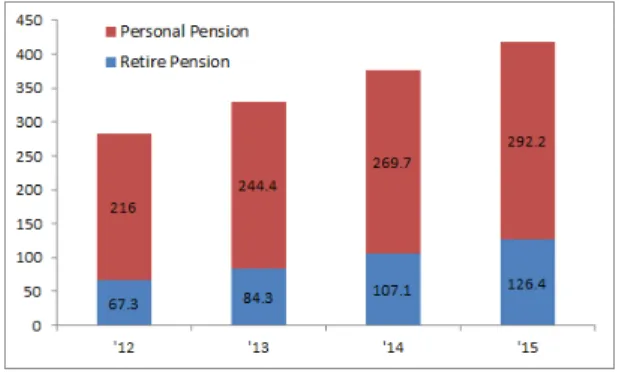
Aging society is another issue influencing asset management market. Speeding up the retirement age and longer post-retirement period means longer catering period over clients and investment horizon.
As advisory period lengthens and people need to make preparations for post-retirement cash-flow, varying needs at given age stage causes the increase in asset by management as shown in Figure 2.
Fig. 2. Pension fund trend (Data source: Financial Supervisory Service, Financial Statistics)
Government has kept on published its proposal for a financial consumer protection. While the wealth management institutions face decreased profit margin, adding compliance cost puts more pressure to the industry. Such policies include introducing IFA (Independent Financial Advisor), enlarging on-line platform, tightening financial consumer protection act, and strengthening posting regulations.
3. Previous literatures and research model
Exploring relevant ways to achieve sustainable growth in private banking business has long been a subject to academia. Many studies look into key success factors via additional information inflow from customers, and the improvement can be attained through customer relationships. [6, 10, 11, 18] As wealth management includes intangible participation in the process of service, the quality of service is critical to guarantee the institutions’ actual performance. [2, 9, 13] Others shed lights on overall value proposition with enterprise performance. [8, 12, 17] Several studies develop a hierarchical and multidimensional model to which this study refers. [1, 7] Descriptive research model is used for this paper, and the results are collected through expert interview. The subjects are chosen to represent the relevant industry and in-depth discussions took place to receive current information in the field. Two of five experts are the professionals experienced in wealth management firm in Europe, and provide strategic direction with insights towards relevant area. The rest are the professionals from two different domestic firms, working on development plan for its internal asset management function. Following previous researches, DEMATEL method is utilized to develop interrelations among factors for sustainable growth in wealth management business. The average matrix from experts is constructed as follows; where i and j are elements on each factor, influencing business model.
Concerning the matrix, service elements are derived from experts recommendations for relevant business model. In this study, the elements are developed prior to empirical analysis.
4. Elements of business model
Banks providing wealth management service are in time for offering all levels of advisory services from self-driven to comprehensive solutions. The banks find themselves in better position by offering clients the range of service that satisfy their requirements. And it could be broken down as the following structure of services.
4.1 Modular advisory service
There are three different layers of advisory management service. First, for those clients who do not have spare time, much interest, or expertise for making own investment decision(s), ‘discretionary mandate service’ provides customized solution(s). Second, for the ones who need professional advice but like to take lead in decision-making, an ‘partial advisory service’ is offered more of assisting function; the function reviews clients’ risk profile, long-term strategy, etc. Last level of client in terms of independence is ‘self-execution type’. The banks can respond by providing various kinds of research in needs and risk assessment that can help the clients making optimal decision(s).
Korean investors have become more interested in value-added discretionary mandates although cultural difference remains variable. Building
4.2 Collaboration and integration
The wealth management industry’s trend explains clients are interested more and more in collaboration and integration with their advisors. [accenture, 2015]
The institutions should understand their clients in what they need and how to come up with solutions(s). This requires strengthening relationship with clients as collecting clients’ data is crucial at its initial stage.
There are steps that need to be done in sequential manner; (i) reaching clients and (ii) collecting data.
When developing private banking business in certain area, one way getting close to clients is to build partnerships with independent advisors and/or local
networks. Tying with local players would make it strong local presence over the area. Having deep understanding of clients, such IT system as CRM (Customer Relationship Management) would be very useful; not to mention that optimizing sales organization is necessary for obtaining and updating data. By gathering and organizing the data, the system has to make the information available for the professionals in both front and back offices. It is important for the banks to understand inovative way(s) to get closer to their clients.
4.3 Specialized service
As HNWIs desire sophisticated and differentiated asset management service, the wealth managers would need to improve their asset management capabilities.
The reason HNWIs choose superior brand private banking firms is that it provides greater regional and global access to investment platform(s). A manager at foreign private banker states that an expertise is believed to be critical to successful investing so as to find a broad spectrum of investment vehicles to suit clients’ needs. The following are required to raise one’s capabilities; (i) open architecture investment such as multi-management solution and (ii) alternative investment access including real estate and global hedge fund platform. Internally, the banks with highly structured asset allocation process could stay competitive in the market.
Investment banking business services would have to remain strong as to meet the needs of HNWIs’
financing activities. The range of investment banking sector includes corporate advisory, structured deals, M&A advisory, private capital placements, etc.
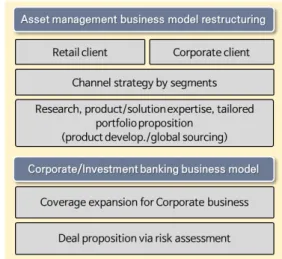
Implemented the tasks stated above, mid-to-long-term business model can be achieved by restructuring organization as shown in Figure 3. As far as HNWIs’
need for sophisticated services are concerned, value-added services should be developed such as inheritance advisory, tax planning, philanthropy.
Inheritance advisory is necessary particularly in Asian
countries. Considering collectively, investment advisory service is broader advisory offer including specialized information service, tax advisory service, real estate investment assistance.
Fig. 3. Private banking business structure
4.4 Improving clarity
Increasing clarity is directly related to firms’
competitiveness, and clarity begins with fee disclosed.
Fee clarity becomes important criteria for Mass HNWIs. It would be better off by keeping things simple as fees are normally comprised of administrative, custody fee, dealing costs, underlying costs, Value-Added-Tax, etc. Furthermore, foreign private banks have begun to formalize advisory fees and to remove anything unclear.
Last but not least, HNWIs expect more and better information and investment horizon from their private banks. They also demand the information from various technological channel. The banks would also have to expand the service package for so-called mass HNWIs whose investable assets are below five hundred U.S.
dollars.
5. Conclusion
In Europe, many HNWIs have turned their back on
discretionary mandate since the financial crisis in 2008, and gradually tend to show interest in advisory service or self-execution approach. Notwithstanding such macroeconomic incidents, the preference for wealth management service is up to how mature the industry is in regional perspective; U.S. has a commanding lead with the largest asset under management in discretionary mandates whereas less than 5% of Asian HNWs have such service area. Korean wealthy individuals have started to take interests in overseas and alternative investments while wealth management service market remains underdeveloped. Private banking service is provided through securities companies as in China. And, the evaluation criteria and incentive granting is activated as it suits traditional business function(s) such as brokerage transaction and/or trading basis. As the needs for private wealth management grows, the relevant institutions should find out the importance of critical factors influencing business success. This study designs a business model, and develop elements that follows competitive landscape; (i) constructing modular advisory service, (ii) collaboration and integration with more support, (iii) specialized service offers in investment, and (iv) increasing clarity by providing more and better information. This study shed lights on where to concentrate for competitiveness in the asset management industry. It provides meaningful findings benefiting domestic players to establish their own competitive strategies through capabilities lens;
however, along with a recent key element of technological adaptation, an empirical test should be conducted as future efforts.
References
[1] M. K. Brady, J. J. Cronin, “Some new thoughts on conceptualizing perceiving service quality: a hierarchical approach”, Journal of Marketing, vol. 65, no. 3, pp.
34-49, 2001.
DOI: https://doi.org/10.1509/jmkg.65.3.34.18334 [2] J. Burgstaller and T. D. Cocca, “Efficiency in private
banking: evidence from Switzerland and Liechtenstein”, Financial Markets and Portfolio Management, vol. 25, no. 1, pp. 75-93, 2011.
DOI: https://doi.org/10.1007/s11408-010-0147-5 [3] Capgemini, “Asia-Pacific Wealth Report”, 2016.
[4] Capgemini, “World Wealth Report”, 2016.
[5] Credit Suisse, “Global Wealth Report”, 2016.
[6] J. Deghton, “The Future of Interactive Marketing”, Harvard Business Review, vol. 74, no. 6, pp. 151-162, 1996.
[7] M. Fassnacht and I. Kose, “Quality of electronic services: conceptualizing and testing a hierarchical model”, Journal of Service Research, vol. 9, no. 1, pp.
19-37, 2006. pp. 19-39, 2006.
[8] P. Foehn, “Client Valuation in Private Banking: Results of A Case Study in Switzerland”, Managing Service Quality, vol. 14, no. 2, pp. 195-204, 2004.
DOI: https://doi.org/10.1108/09604520410528617 [9] G. A. Gelade, S. Young, “Test of a service profit chain
model in the retail banking sector”, Journal of Occupational and Organizational Psychology, vol. 78, no. 1, pp. 1-22, 2005.
DOI: https://doi.org/10.1348/096317904X22926
[10] H. Hansen, “Antecedent to Consumers: Disclosing Intimacy with Service Employees”, Journal of Services Marketing, vol. 17, no. 6, pp. 591-588, 2003.
DOI: https://doi.org/10.1108/08876040310495618 [11] A. K. Kohli, B. J. Jaworski, “Market Orientation:
Review, refinement and roadmap”, Journal of Market-Focused Management, vol. 1, no. 2, pp. 119-135, 1996.
DOI: https://doi.org/10.1007/BF00128686
[12] W. Lin, “An innovation diffusion perspective to establish a business strategy model for wealth management banking based on the MCDM model combining DEMATEL and ANP”, Journal of Accounting, Finance & Management Strategy, Vo. 11, no. 2, pp. 95-128, 2016.
[13] G. W. Loveman, “Employee satisfaction, customer loyalty, and financial performance”, Journal of Service Research, vol. 1, no. 1, pp. 18-31, 1998.
DOI: https://doi.org/10.1177/109467059800100103 [14] McKinsey, “Global Wealth Management Survey”, 2014.
[15] H. W. Ryu, “A Study on Dynamic Relation between Fund Flows and Returns”, Journal of Global Management, vol. 13, no. 4, pp. 69-84, 2016.
[16] H. W. Ryu and S. S. Keum, “A Study on the Tax Efficiency and Investment Activity”, International Interdisciplinary Journal, vol. 19, no. 12, 2016.
[17] C. R. Wu, C. T. Lin, P. H. Tsai, “Evaluating Business Performance of Wealth Management Banks”, European Journal of Operational Research, vol. 207, no. 2, pp.
971-979, 2010.
DOI: https://doi.org/10.1016/j.ejor.2010.04.034
[18] A. Zablah, D. N. Bellenger, D. W. Straub, W. J.
Johnston, “Performance Implications of CRM Technology Use: A Multilevel Field Study of Business Customers and their Providers in the
Telecommunications Industry”, Information Systems research, vol. 23, no. 2, pp. 418-435, 2012.
DOI: https://doi.org/10.1287/isre.1120.0419
Hyun Wook Ryu [Regular member]
•Aug. 2007 : Seoul National Univ., MBA
•Feb. 2013 : Konkuk Univ., Ph.D.
•Sept. 2014 ∼ Present : Shinhan Univ., Dep. of Global Trade and Mgmt., Professor
<Research Interests>
Finance, Real Estate study