The anterior cruciate ligament (ACL) is important for functional stability of the knee joint.1) ACL insufficiency accelerates meniscal injury and articular cartilage damage
and evolves into knee joint degeneration.2)
There are many autograft and allograft options for ACL reconstruction.3) Although the use of autografts is the gold standard, the use of allografts has recently increased due to the avoidance of donor site morbidity, less post- operative pain, availability of multiple grafts, faster reha- bilitation, and faster operating time.3) However, the use of autografts remains the most preferred option because of possible immunogenicity, delayed graft incorporation, and risk of disease transmission associated with the use of al- lografts.4)
Small Size Autograft versus Large Size Allograft in Anterior Cruciate Ligament Reconstruction
Alper Kurtoğlu, MD, Betül Başar, MD*, Gökhan Başar, MD
†, Ömer Gezginaslan, MD
†, Hakan Başar, MD
‡Department of Orthopaedics and Traumatology, Sakarya Training and Research Hospital, Sakarya,
*Department of Physical Medicine and Rehabilitation, Gaziosmanpasa Training and Research Hospital, University of Health Sciences, Istanbul,
†Department of Physical Medicine and Rehabilitation, Ümraniye Training and Research Hospital, University of Health Sciences, Istanbul,
‡Department of Orthopaedics and Traumatology, Gaziosmanpasa Training and Research Hospital, University of Health Sciences, Istanbul, Turkey
Background: A small autograft diameter negatively affects functional outcomes, knee stability, and the risk of rerupture after anterior cruciate ligament (ACL) reconstruction, whereas the strength of allograft decreases over time. Therefore, it is not clear whether the use of smaller autografts or the use of larger allografts in ACL yields better results. The aim of this study was to com- pare the outcome of smaller autografts and larger allografts for ACL reconstruction.
Methods: Fifty-one patients who underwent ACL reconstruction with hamstring tendon autografts (size ≤ 8 mm) and 21 patients who underwent ACL reconstruction with allografts (size ≥ 10 mm) were included in our study. All patients underwent the same aggressive early postoperative rehabilitation program. There were no significant differences between the autograft and allograft groups regarding the preoperative patient age, sex, time from injury to surgery, and average follow-up time.
Results: The mean diameter of the 4-stranded hamstring tendon grafts used as autografts was 7.48 ± 0.33 mm and the mean diameter of the allografts was 10.76 ± 0.67 mm. According to specific tests for the ACL (anterior drawer, Lachman, and pivot shift) and clinical evaluation tests (Lysholm knee scoring scale and International Knee Documentation Committee questionnaire), the final follow-up results were significantly better than the preoperative status in both autograft and allograft ACL reconstruction groups. Therefore, there were no significant differences between the autograft and allograft groups preoperatively and at the final follow-up.
Conclusions: The large size of the graft in ACL reconstruction has been reported to affect results positively. However, in our study, we could not find any significant differences between the smaller size autografts and larger size allografts in terms of inadequacy, rerupture, and final follow-up functional results. Although allografts were significantly larger than autografts, we did not have the positive effect of larger size grafts. Smaller size autografts were as effective as the larger size allografts.
Keywords: Anterior cruciate ligament injury, Graft size, Allograft, Autograft
Copyright © 2021 by The Korean Orthopaedic Association
This is an Open Access article distributed under the terms of the Creative Commons Attribution Non-Commercial License (http://creativecommons.org/licenses/by-nc/4.0) which permits unrestricted non-commercial use, distribution, and reproduction in any medium, provided the original work is properly cited.
Clinics in Orthopedic Surgery • pISSN 2005-291X eISSN 2005-4408 Received January 14, 2020; Accepted May 17, 2020
Correspondence to: Hakan Başar, MD
Department of Orthopaedics and Traumatology, Gaziosmanpasa Training and Research Hospital, University of Health Sciences, Karayolları mah. TEM Avrupa Konutları 30/34, Gaziosmanpasa/istanbul, Turkey
Tel: +90-505-441-86-08, Fax: +90-212-945-31-78 E-mail: [email protected]
Allografts and autografts are divided into 2 groups, bone containing and all soft tissue.5) All soft-tissue au- tografts are as effective as bone-containing autografts in terms of graft strength, stiffness, and functional outcomes.
Surgeons often prefer hamstring tendon grafts as all soft- tissue grafts.6-8) With the use of hamstring tendon grafts, complications such as donor site morbidity, anterior knee pain, and postoperative knee motion restriction, which are seen with bone-patellar tendon-bone grafts, are minimized.9,10) The size of the graft influences functional outcomes, knee stability, and the risk of rerupture. The smaller the grafts, the more negative the results.11-13) There- fore, anthropometric parameters are used to determine the hamstring tendon graft size preoperatively. If the graft size is small, a different graft type is recommended for ACL reconstruction or the small hamstring tendon should be augmented with an allograft or a graft from another part of the body.14,15)
There are many studies in the literature comparing the use of autografts and allografts in ACL reconstruc- tion. However, there is no study comparing a larger size allograft with a smaller size autograft in ACL reconstruc- tion, to the best of our knowledge. Allograft incorporation is slower than autograft incorporation. In the knees recon- structed with allografts, the strength of the grafts decreases in time compared to that of autografts. Therefore, rehabili- tation should be implemented in a more controlled setting and slowly for allograft-reconstructed knees.16)
The aim of this study was to compare the outcome of smaller size hamstring tendon autografts and larger size anterior tibial tendon (ATT) allografts for ACL re- construction. We sought to determine whether larger size allografts should be used instead of smaller size autografts considering the size of the graft used in ACL reconstruc- tion is important in terms of results.
METHODS
This study is a retrospective, non-drug, observational clin- ical trial. Local Ethics Committee approval was received from the Gaziosmanpasa Training and Research Hospital (2017), and consent form was obtained from the patients included in the study.
A total of 168 patients who underwent ACL recon- struction with autografts or allografts between 2013 and 2015 were retrospectively reviewed. Exclusion criteria were graft size above 8 mm for autografts and below 10 mm for allografts, the presence of additional fractures around the knee joint, multiligamentous knee injury, chondral lesions, and medial or lateral meniscus injuries. Fifty-one patients
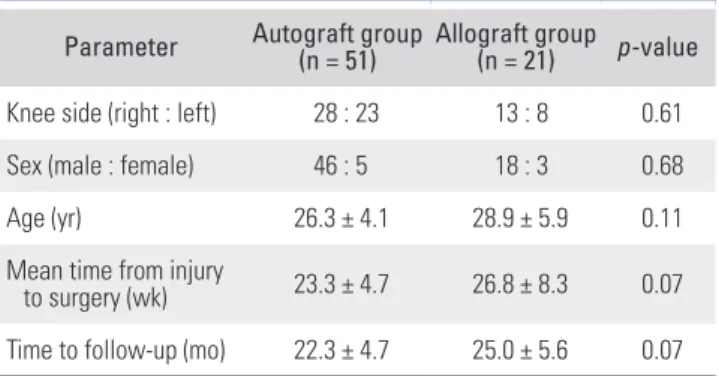
who underwent ACL reconstruction with hamstring tendon autografts (size ≤ 8 mm) and 21 patients who un- derwent ACL reconstruction with ATT allografts (size ≥ 10 mm) were included in our study. Patient’s preoperative age, sex, time from injury to surgery, and average follow- up time were evaluated and there were no significant dif- ferences between autograft and allograft groups (p < 0.05) (Table 1).
All surgical procedures were performed by the senior author (HB) at the same center. All knees were re- constructed with single-bundle ACL grafts. All grafts were fixed with EndoButton. Patients in both groups followed the same aggressive early postoperative rehabilitation program at the same center.17,18) The patients did not wear a postoperative knee brace or an immobilizer. Passive mo- tion exercises without restrictions on hyperextension were started immediately after surgery. At the same time, range of motion exercise was started with a continuous passive- motion machine from 0° to 50°. Patients began weight bearing as tolerated immediately after surgery and used bilateral axillary crutches. Phase 1 exercises were started to facilitate early motion and muscle activation in the first postoperative week. Mobilization began with full weight- bearing without an assistive device. The phase 1 exercises were continued in the second postoperative week. Phase 2 exercises were started in the fourth postoperative week, phase 3 exercises in the eighth postoperative week, and phase 4 exercises in the twelfth postoperative week.
Preoperative and final follow-up clinical evaluations were performed with the Lysholm knee scoring scale19) and International Knee Documentation Committee (IKDC) questionnaire.20) In addition, special tests for ACL (anterior drawer, Lachman, and pivot shift tests) were conducted preoperatively and at the final follow-up. The preoperative and final follow-up values were compared between groups and within each group. All patients were assessed by the
Table 1. Demographic Data
Parameter Autograft group
(n = 51) Allograft group (n = 21) p-value Knee side (right : left) 28 : 23 13 : 8 0.61
Sex (male : female) 46 : 5 18 : 3 0.68
Age (yr) 26.3 ± 4.1 28.9 ± 5.9 0.11
Mean time from injury
to surgery (wk) 23.3 ± 4.7 26.8 ± 8.3 0.07 Time to follow-up (mo) 22.3 ± 4.7 25.0 ± 5.6 0.07 Values are presented as mean ± standard deviation.
same evaluator at different centers.
For statistical analysis, patients’ mean age, mean time from injury to surgery, and mean follow-up period were compared with a 2-tailed independent sample t-test, whereas all other parameters were compared with a chi- square test. Statistical significance was set at p < 0.05.
RESULTS
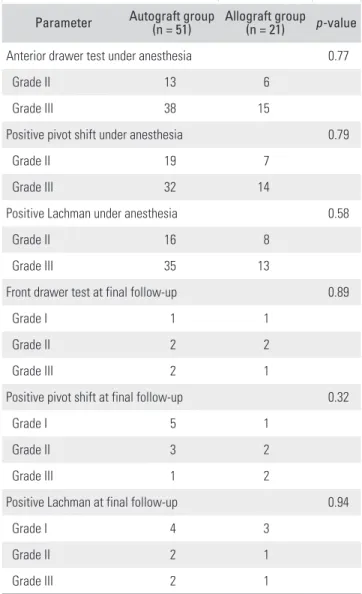
The patients were divided into 2 groups according to the graft type. There were no significant differences between the 2 groups regarding the men-to-women ratio, mean age, mean follow-up period, and mean time from injury to surgery (p > 0.05) (Table 1). The mean diameter of the autografts was 7.48 ± 0.33 mm and the mean diameter of the ATT allografts was 10.76 ± 0.67 mm. The diameter of the allografts was significantly larger than that of the auto- grafts (p < 0.001). The final follow-up results of the anteri- or drawer, Lachman, and pivot shift tests were significantly better than the preoperative test results in both autograft and allograft groups. Therefore, there were no significant differences between groups regarding the preoperative and final follow-up ACL test results (p > 0.05) (Table 2).
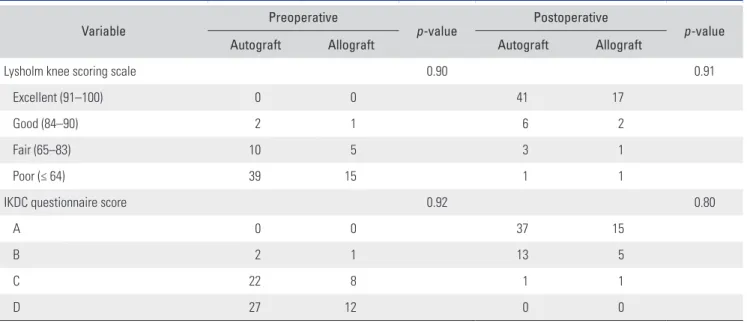
According to the Lysholm knee scoring scale and IKDC questionnaire, the final follow-up results were significantly better than the preoperative values in both autograft and allograft groups. When the groups were compared within them according to their preoperative and final follow-up results, statistically better results were obtained at the final follow-up in both groups (p < 0.001).
Therefore, there were no significant differences between groups preoperatively and at the final follow-up (p > 0.05) (Table 3). Infection developed in a patient in the allograft group at the third postoperative month. Allograft and all implants were extracted and she received antibiotic therapy for 3 weeks. In the autograft group, 2 patients were diagnosed with rerupture and revision surgery was per- formed.
DISCUSSION
There are many graft options for ACL reconstruction. Al- though the ideal graft for ACL reconstruction is still con- troversial, the autograft remains a popular graft choice.21) Graft tissue type, bone containing or all soft tissue, is also controversial among surgeons reconstructing the ACL.5) Bone-containing autografts (bone-patellar tendon-bone graft) were most preferred previously. However, recent studies have shown that all soft-tissue autografts are as effective as bone-containing autografts in terms of stiff-
ness, strength, and clinical outcomes.6,7) Nowadays, ham- string tendon grafts are the most preferred all soft-tissue autografts.6-8) In addition, the problems of bone-patellar tendon-bone autografts, such as donor site morbidity, postoperative knee motion restriction, and anterior knee pain, are minimized with the use of hamstring tendon au- tografts.9,10)
The use of allografts has become more common in ACL reconstruction than in the past. Although studies with allografts showed satisfactory results, complications such as longer vascularization time and potential risks including immune rejection and disease transmission are still unavoidable.22) The incorporation of allografts is slow- er than that of autografts. In a study by Jackson et al.,16) at a 6-month follow-up, the cross-sectional area of allografts was smaller than that of autografts and the graft strength
Table 2. Preoperative and Postoperative Physical Evaluation Outcomes Parameter Autograft group
(n = 51) Allograft group (n = 21) p-value
Anterior drawer test under anesthesia 0.77
Grade II 13 6
Grade III 38 15
Positive pivot shift under anesthesia 0.79
Grade II 19 7
Grade III 32 14
Positive Lachman under anesthesia 0.58
Grade II 16 8
Grade III 35 13
Front drawer test at final follow-up 0.89
Grade I 1 1
Grade II 2 2
Grade III 2 1
Positive pivot shift at final follow-up 0.32
Grade I 5 1
Grade II 3 2
Grade III 1 2
Positive Lachman at final follow-up 0.94
Grade I 4 3
Grade II 2 1
Grade III 2 1
was weaker for allografts. Therefore, the study suggested that rehabilitation should be implemented slowly in a more controlled setting in allograft reconstruction pa- tients.
In our study, we used all soft-tissue grafts for auto- grafts and allografts. We preferred the smaller size ham- string tendon graft as autografts and the larger size ATT as allografts. The same rehabilitation program was used for all patients who received autografts or allografts. Progres- sive rehabilitation was started in the early postoperative period in both groups. However, there was no significant difference between autograft and allograft groups in terms of final follow-up results and graft insufficiency.
The size of the graft is important in ACL recon- struction. One study showed that the larger graft diam- eter was associated with lower meniscal stress, decreased joint laxity, and less articular cartilage contact stress.12) In the study, 5-mm-diameter grafts exhibited 30% more anteroposterior translation than 9-mm grafts. The data of the study suggest that an increased graft size confers a biomechanical advantage in the ACL-reconstructed knees.
In addition, the smaller the graft size, the higher the rate of revision.13,23) Revision rate decreases 0.82 times per 0.5- mm graft diameter increase between 7-mm and 9-mm graft diameter.13) Small graft diameter also adversely af- fects clinical outcomes.11) Therefore, current studies sug- gest that increased graft size provides both biomechanical advantages and better functional and clinical outcomes in the ACL reconstructed knees.11,24)
ACL reconstruction with 8-mm and larger diameter
grafts reduces the risk of failure. In a study by Conte et al.,11) the failure rate was higher in reconstructions per- formed with grafts below 8 mm in diameter, especially in patients under 20 years of age.
Besides the higher revision rate, the smaller graft size was a predictor of poorer functional score at 2 years after primary ACL reconstruction in a study by Magnus- sen et al.23) There are not enough studies evaluating the effect of graft size on the results of ACL reconstruction in the literature. Some studies compared autografts with different diameters,11-13,24) but there is no study on the al- lograft size in the literature. Several studies have reported the average diameter of the 4-strand hamstring tendon grafts to be between 7.7 mm and 8.5 mm.14,25,26) The 4-strand hamstring tendon graft can be small in some pa- tients, which increases the risk of failure and worse results after reconstruction. Thus, surgeons apply various meth- ods to increase the graft size either by using the hamstring tendon of the other healthy extremity or by augmenting with the tendon graft from another part of the body. Some surgeons increase the size of these grafts by augmentation with allografts. However, it has been demonstrated in the literature that augmentation with allografts increases the risk of graft failure and retear rates.15)
In studies on autograft augmentation with al- lografts, it was found that the purity of the autograft was more important than the size. According to the KT-1000 test scores, autografts were significantly superior to hybrid grafts. It has been reported that increasing the size of auto- grafts with allografts is meaningless.27,28)
Table 3. Preoperative and Postoperative Clinical Evaluation
Variable Preoperative
p-value Postoperative
p-value
Autograft Allograft Autograft Allograft
Lysholm knee scoring scale 0.90 0.91
Excellent (91–100) 0 0 41 17
Good (84–90) 2 1 6 2
Fair (65–83) 10 5 3 1
Poor (≤ 64) 39 15 1 1
IKDC questionnaire score 0.92 0.80
A 0 0 37 15
B 2 1 13 5
C 22 8 1 1
D 27 12 0 0
IKDC: International Knee Documentation Committee.
The graft diameter can be determined preopera- tively in allograft ACL reconstruction. Surgeons prefer large diameter grafts to small diameter grafts in ACL re- construction. We included patients who underwent ACL reconstruction with 10 mm and 11 mm diameter ATT allografts. In the autograft group, we included patients who underwent ACL reconstruction with a 4-stranded hamstring tendon graft with a diameter of 8 mm or less.
However, we could not find any significant difference between the 2 groups in terms of inadequacy, rerupture, and final follow-up functional results. Although allografts were significantly larger than autografts, we did not see the positive effects of larger size grafts as described in the literature.
Studies have shown that allografts and autografts undergo a similar remodeling sequence, which consists of graft necrosis, cellular repopulation, revascularization, and collagen remodeling. Allografts and autografts have simi-
lar phases during their biologic incorporation, but these processes may proceed at a slower rate in allografts than in autografts.16,29) We think that this slow biological incor- poration in allografts causes negative effects on the results.
Therefore, smaller size autografts will give as good results as larger allografts.
We evaluated the early results of ACL reconstruc- tion with a small sample size in this retrospective study;
late results were not evaluated. If ACL reconstruction with larger size autografts and smaller size allografts had been included, the importance of this study would have been increased.
CONFLICT OF INTEREST
No potential conflict of interest relevant to this article was reported.
REFERENCES
1. Larson RL, Tailon M. Anterior cruciate ligament insuf- ficiency: principles of treatment. J Am Acad Orthop Surg.
1994;2(1):26-35.
2. Foster TE, Wolfe BL, Ryan S, Silvestri L, Kaye EK. Does the graft source really matter in the outcome of patients under- going anterior cruciate ligament reconstruction? An evalu- ation of autograft versus allograft reconstruction results: a systematic review. Am J Sports Med. 2010;38(1):189-99.
3. Mariscalco MW, Magnussen RA, Mehta D, Hewett TE, Fla- nigan DC, Kaeding CC. Autograft versus nonirradiated al- lograft tissue for anterior cruciate ligament reconstruction: a systematic review. Am J Sports Med. 2014;42(2):492-9.
4. Kan SL, Yuan ZF, Ning GZ, et al. Autograft versus allograft in anterior cruciate ligament reconstruction: a meta- analysis with trial sequential analysis. Medicine (Baltimore).
2016;95(38):e4936.
5. Edgar CM, Zimmer S, Kakar S, Jones H, Schepsis AA. Pro- spective comparison of auto and allograft hamstring tendon constructs for ACL reconstruction. Clin Orthop Relat Res.
2008;466(9):2238-46.
6. Goldblatt JP, Fitzsimmons SE, Balk E, Richmond JC. Recon- struction of the anterior cruciate ligament: meta-analysis of patellar tendon versus hamstring tendon autograft. Arthros- copy. 2005;21(7):791-803.
7. Herrington L, Wrapson C, Matthews M, Matthews H. An- terior cruciate ligament reconstruction, hamstring versus bone-patella tendon-bone grafts: a systematic literature re- view of outcome from surgery. Knee. 2005;12(1):41-50.
8. Spindler KP, Kuhn JE, Freedman KB, Matthews CE, Dittus RS, Harrell FE Jr. Anterior cruciate ligament reconstruc- tion autograft choice: bone-tendon-bone versus hamstring:
does it really matter? A systematic review. Am J Sports Med.
2004;32(8):1986-95.
9. Beard DJ, Anderson JL, Davies S, Price AJ, Dodd CA. Ham- strings vs. patella tendon for anterior cruciate ligament recon- struction: a randomised controlled trial. Knee. 2001;8(1):45- 50.
10. Feller JA, Webster KE. A randomized comparison of patel- lar tendon and hamstring tendon anterior cruciate ligament reconstruction. Am J Sports Med. 2003;31(4):564-73.
11. Conte EJ, Hyatt AE, Gatt CJ Jr, Dhawan A. Hamstring auto- graft size can be predicted and is a potential risk factor for anterior cruciate ligament reconstruction failure. Arthros- copy. 2014;30(7):882-90.
12. Westermann RW, Wolf BR, Elkins JM. Effect of ACL recon- struction graft size on simulated Lachman testing: a finite element analysis. Iowa Orthop J. 2013;33:70-7.
13. Spragg L, Chen J, Mirzayan R, Love R, Maletis G. The effect of autologous hamstring graft diameter on the likelihood for revision of anterior cruciate ligament reconstruction. Am J Sports Med. 2016;44(6):1475-81.
14. Mardani-Kivi M, Karimi-Mobarakeh M, Mirbolook A, et al.
Predicting the hamstring tendon diameter using anthropo- metric parameters. Arch Bone Jt Surg. 2016;4(4):314-7.
15. Perkins CA, Busch MT, Christino M, et al. Allograft aug-
mentation of hamstring anterior cruciate ligament auto- grafts is associated with increased graft failure in children and adolescents. Am J Sports Med. 2019;47(7):1576-82.
16. Jackson DW, Grood ES, Goldstein JD, et al. A comparison of patellar tendon autograft and allograft used for anterior cruciate ligament reconstruction in the goat model. Am J Sports Med. 1993;21(2):176-85.
17. Christensen JC, Goldfine LR, West HS. The effects of early aggressive rehabilitation on outcomes after anterior cruciate ligament reconstruction using autologous hamstring tendon:
a randomized clinical trial. J Sport Rehabil. 2013;22(3):191- 201.
18. Biggs A, Jenkins WL, Urch SE, Shelbourne KD. Rehabilita- tion for patients following ACL reconstruction: a knee sym- metry model. N Am J Sports Phys Ther. 2009;4(1):2-12.
19. Tegner Y, Lysholm J. Rating systems in the evaluation of knee ligament injuries. Clin Orthop Relat Res. 1985;(198):43-9.
20. Collins NJ, Misra D, Felson DT, Crossley KM, Roos EM.
Measures of knee function: International Knee Documenta- tion Committee (IKDC) Subjective Knee Evaluation Form, Knee Injury and Osteoarthritis Outcome Score (KOOS), Knee Injury and Osteoarthritis Outcome Score Physical Function Short Form (KOOS-PS), Knee Outcome Survey Activities of Daily Living Scale (KOS-ADL), Lysholm Knee Scoring Scale, Oxford Knee Score (OKS), Western Ontario and McMaster Universities Osteoarthritis Index (WOM- AC), Activity Rating Scale (ARS), and Tegner Activity Score (TAS). Arthritis Care Res (Hoboken). 2011;63 Suppl 11:S208-28.
21. Su M, Jia X, Zhang Z, et al. Medium-term (least 5 years) comparative outcomes in anterior cruciate ligament recon- struction using 4SHG, allograft, and LARS ligament. Clin J Sport Med. 2019 Mar 4 [Epub]. https://doi.org/10.1097/
JSM.0000000000000730.
22. Li H, Tao H, Cho S, Chen S, Yao Z, Chen S. Difference in graft maturity of the reconstructed anterior cruciate liga- ment 2 years postoperatively: a comparison between auto- grafts and allografts in young men using clinical and 3.0-T magnetic resonance imaging evaluation. Am J Sports Med.
2012;40(7):1519-26.
23. Magnussen RA, Lawrence JT, West RL, Toth AP, Taylor DC, Garrett WE. Graft size and patient age are predictors of early revision after anterior cruciate ligament reconstruction with hamstring autograft. Arthroscopy. 2012;28(4):526-31.
24. Mariscalco MW, Flanigan DC, Mitchell J, et al. The influence of hamstring autograft size on patient-reported outcomes and risk of revision after anterior cruciate ligament recon- struction: a Multicenter Orthopaedic Outcomes Network (MOON) Cohort Study. Arthroscopy. 2013;29(12):1948-53.
25. Thomas S, Bhattacharya R, Saltikov JB, Kramer DJ. Influence of anthropometric features on graft diameter in ACL recon- struction. Arch Orthop Trauma Surg. 2013;133(2):215-8.
26. Treme G, Diduch DR, Billante MJ, Miller MD, Hart JM.
Hamstring graft size prediction: a prospective clinical evalu- ation. Am J Sports Med. 2008;36(11):2204-9.
27. Xu H, Lin W, Jin G, et al. Graft choice for anatomic anterior cruciate ligament reconstruction: the comparison between thin autograft and thick hybrid graft: an observational study.
Medicine (Baltimore). 2018;97(30):e11597.
28. Xu H, Dong J, Xin D, Zhang J, Kang K, Gao S. Second-look arthroscopic evaluation and clinical outcomes of anatomic anterior cruciate ligament reconstruction with autograft and hybrid graft: a retrospective study. Med Sci Monit.
2017;23:5564-73.
29. Jackson DW, Corsetti J, Simon TM. Biologic incorporation of allograft anterior cruciate ligament replacements. Clin Orthop Relat Res. 1996;(324):126-33.