2012, Vol. 56, No. 4
Printed in the Republic of Korea
http://dx.doi.org/10.5012/jkcs.2012.56.4.473
Preparation and Drug-releasing Properties of Chitosan-based Thermosensitive Composite Hydrogel
Heping Li*, Tao Yu, Shan Li, Long Qin, and Jingheng Ning
School of Chemistry and Biological Engineering, Changsha University of Science and Technology, Changsha 410004, P. R. China. *E-mail: [email protected]
(Received April 8, 2012; Accepted May 30, 2012)
ABSTRACT. The novel chitosan-based thermosensitive hydrogels were prepared as control-releasing drug carriers. N-car- boxyethyl chitosan (ACS) was synthesized by microwave heating for 1 h through Michael addition of CS to acrylic acid in a grafting yield of 52.97%, which was proved to be a faster and more efficient way than ordinary methods. 5-Fu was modified with formaldehyde to synthesize N,N’-Bis(hydroxymethyl)-5-fluorouracil (5-Fu-OH). Then an esterification was performed using ACS and 5-Fu-OH to give 5-Fu-ACS. The new thermosensitive hydrogels were prepared by adding sodium glyc- erophosphate to the solution of compounds under a certain constant temperature. Simultaneously, the hydrogels’ swelling rate, in vitro drug release rate and thermosensitive were studied, and found that the 5-Fu-ACS composite hydrogel had more excel- lent releasing effect, higher drug loading and better thermosensitive.
Key words: Chitosan, Acrylic acid, Microwave heating, Thermosensitive hydrogel, Drug releasing
INTRODUCTION
5-Fluorouracil (5-Fu) has been widely used in cancer treatment for its potent curative effect. But it has many defects, such as short half-life, serious toxicity, low bio- availability and so on.1,2 To overcome these shortcom- ings, people prepare microspheres to form a new drug delivery system through entrapment of 5-Fu by polymer carrier, which can reduce the side effects of 5-Fu. Because of excellent biodegradability, biocompatibility and immune function, chitosan (CS) is reported as one of the best drug carriers.3-6
In the past years, many CS derivatives of with special chemical properties and physiological effects have been synthesized. These derivatives often prepared by cross- linking, then are made into oral medicine.7 The medicine made by this method can release drugs under a certain cir- cumstance, deliver drugs to the target organ and control drug release rate.8,9 However, there are lots of defects: i) can’t avoid digestive system damaging drugs; ii) the rate of drug release is instable; iii) low drug loading; iv) cross- linking agents used in the synthetic process would have some side effects.10
Hydrogels are formed with a three-dimensional net- work of polymer chains, where some parts are solvated by water molecules but the other parts are chemically or physically linked with each other. Hydrogel has been applied as a drug carrier because hydrogel can load and release a
drug effectively by swelling and shrinking effects, respec- tively. And hydrogel can also be environmental sensitive when they are formed by specific polymers, such as pH- sensitive polyelectrolyte and temperature-sensitive poly- mers. The drug release from these hydrogel much faster than chemical bond linking polymer-drug compounds and can be well controlled by changing of the external envi- ronment,11 which shows the potential applications as drug delivery system. Once the hydrogel have incorporated with these chemical bond linking drugs or free drugs, the composites hydrogel are formed. The obtained composi- tes are expected to meet the clinical requirements for con- trolling the release behaviors of specific drugs.12
In this work, the ACS hydrogel, 5-Fu-ACS hydrogel, ACS composite hydrogel and 5-Fu-ACS composite hydro- gel were prepared as novel thermosensitive hydrogels to meet the clinical requirements. The swelling rate of hydrogels, in vitro release and thermosensitive were also studied.
EXPERIMENTAL Materials
5-fluorouracil (5-Fu) was purchased from J&K Chemi- cal, Ltd. (Beijing, China), 1-(3-(dimethylamino)-propyl)-3- ethylcarbodiimide hydrochloride (EDC) and N,N-Dime- thylpyridin-4-amine (DMAP) from Sinopharm Chemical Reagent Co., Ltd. (Shanghai, China), Sodium Glycero-
phosphate from Shanghai Hongye Chemical Co., Ltd.
(Shanghai, China), and Chitosan (CS, Deacetylation degree98%) from Zhejiang Yuhuan Ocean Biochemistry Co., Ltd. (Zhejiang, China). All other chemicals were of analytical grade.
Instruments
Infrared (IR) spectra were obtained with a Nicolet Ava- tar FT/IR-360 spectrometer (Nicolet, USA). UV-Vis absorption spectra were recorded with a TU-1901 dual beam UV-Vis spectrophotometer (Purkinje General Instru- ment Co., Ltd., Beijing, China). pH of solution was detected by a PHS-3C pH instrument (Shanghai LIDA Instrument Factory, Shanghai, China). Microwave heating in reac- tion was used with MCR-3 microwave chemical reactor (Yuhua Instrument Co., Ltd., Henan, China).
Synthesis of N-carboxyethyl Chitosan (ACS)
According to the literature,13 CS (0.5000 g) was dis- solved in the solution of acrylic acid (10 mL) and distilled water (40 mL), stirred for 1 h at 60oC under microwave irradiation. Then put the mixture into dialysis membrane (MW cut-off 8 kDa) and dialyzed for 3 days, vacuum-dried, and the product was obtained. IR/cm-1: 3417 (-OH, -NH), 1717 (C=O), 1591 (-NH), 1195 (C-N), 1403 (-CH2), 1074 (C-O, C3), 1028 (C-O, C6).
The grafting rate of ACS was calculated by the follow- ing equation:
Grafting rate = (1)
V0 is the consumed volume of NaOH by CS; V is the con- sumed volume of NaOH by ACS; M is the molar con- centration of NaOH; m is the quality of ACS.
Synthesis of 1,3-Bis (hydroxymethyl)-5-fluorouracil (5-Fu-OH)
5-Fu-OH was obtained according to the literature.14 5- Fu (0.1300 g) was dissolved in 1 mL HCHO (36 %) and stirred for 0.5 h at room temperature. Then the solution was heated at 60oC and stirred for 6 h. The product was concentrated by rotary evaporator for further synthesis.
Synthesis of 5-Fu-ACS
ACS (0.1000 g) was dissolved in 0.1M HCl (10 mL), added with 5-Fu-OH (0.1000 g), stirred until it dissolved.
Then DMAP (0.0060 g) was added into the solution, stirred for 0.5 h and EDC (0.0600 g) was added later, adjust pH to 5 with NaOH and react for 24 h. The reaction
solution was diluted with water, lots of white flocculent precipitates obtained when the pH was adjusted to 7, fil- trated and vacuum-dried, a yellow solid was obtained. IR/
cm-1: 3357 (-OH, -NH), 1637 (C=C), 1559 (-NH), 1429 (-CH2), 1380 (C-F), 1071 (C-O).
Drug loading and entrapment efficiency of 5-Fu-ACS were calculated as follows:
Drug loading = ×100%
(2) Entrapment efficiency
= ×100% (3)
Preparation of Thermosensitive 5-Fu-ACS Hydrogel Thermosensitive 5-Fu-ACS hydrogel was prepared according to the literature.15 5-Fu-ACS (0.1000 g) was dissolved in 0.1 M HCl (1 mL) and cooled to 0oC. Sodium glycerophosphate (0.2000 g) was dissolved in distilled water and added to the solution of 5-Fu-ACS slowly until the pH was 7. The mixture was heated at 37oC. Then we detected whether the hydrogel was formed by reversing the test tube. If the mixture in the test tube didn’t flow after being reversed for 30 s, it could be judged that the hydro- gel had already been formed. And this heating time could be recorded as the gel - forming time.
Preparation of 5-Fu-ACS or ACS Composite Hydrogel 5-Fu-ACS (0.1000 g) and free 5-Fu (0.0173 g) were dis- solved in 0.1 M HCl (1 mL) and cooled to 0oC. Sodium glycerophosphate (0.2000 g) was dissolved in distilled water and then added to the solution slowly until pH was 7. The mixture was heated at 37oC. Then the formed hydrogel was detected by reversing the test tube over 30 s, and recorded heating time as the gel - forming time.
The preparation of ACS composite hydrogel was simi- lar to that of 5-Fu-ACS composite hydrogel, with the dif- ference was that the amount of ACS was 0.1000 g and free 5-Fu was 0.1000 g, respectively.
The Swelling Rate of Hydrogel
Accurately weigh a certain amount of dry gels of these hydrogel, and place them in buffer solution. The gels were taken out at each certain interval and draw the solution of surface with filter paper, then weighing them. The swell- ing rate of hydrogel was calculated as follows:
Swelling rate = (mt–m)/m×100% (4) In Eq. (4), mt is the quality of gel at time t; m is the quality m 233 V V– ( – 0)M
m 72 V V– ( – 0)M
--- 100%×
the content of 5-Fu in 5-Fu-ACS the amount of 5-Fu-ACS
the content of 5-Fu in 5-Fu-ACS the amount of 5-Fu
of dry gel before swelling.
The in vitro Releasing
A series of standard solutions of 5-Fu with different concentrations were prepared and measured at 265 nm. A standard curve was drawn according to the absorbency, and the equation of linear regression was obtained as fol- lows:
Abs = 0.00108c + 0.03197 (R = 0.9991) (5) Put the ACS composite hydrogel into dialysis mem- brane, kept it in phosphate buffer solution (PBS, pH=7.4) at 37oC with stirring. PBS (5 mL) was taken out from di- alyzator at each certain interval and the same volume of fresh PBS was supplemented into dialyzator. Their absor- bency was detected by the UV-Vis spectrophotometer and the data were substituted into Eq. (5) to calculate the drug release rate.
The drug release behavior of 5-Fu-ACS composite hydrogel was recorded similarly. Percentage of the cumul- ative release was calculated as follows:
Cumulative release % = (6)
In Eq. (6), V0 is the total volume of PBS medium at the beginning, Ct is the concentration of 5-Fu in PBS medium at the time t, C is the concentration of 5-FU in sample PBS medium, V is the volume of sample taken out at each cer- tain interval, W is the amount of testing products, and X is the drug loading of testing products.
RESULTS AND DISCUSSION Synthesis and Characterization
An esterification was performed using ACS and 5-Fu- OH to give 5-Fu-ACS. The drug loading of 5-Fu-ACS was 17.26%. 5-Fu-OH was prepared by grafting 5-Fu with formaldehyde, and ACS was prepared by an addi- tional reaction of CS and acrylic acid without any catalyst under microwave irradiation at 60oC. The whole synthe- sis process was showed in Scheme 1.
ACS was prepared by Michael addition of chitosan and acrylic acid. According to the literature method,13 the highest grafting rate was 30.94% after reacted for 3 d. In this work, the heating method was changed into micro- wave irradiation, the ratio of acrylic acid and CS was 2.0 mL/0.1 g, and the reaction temperature was 60oC, when the reaction time was 0.5 h, 1.0 h, 1.5 h or 2.0 h, the graft-
ing yield reached 43.46%, 52.97%, 54.24% and 55.46%, respectively. The results showed that the reaction rate was increased many times and the yield was also improved.
The microwave could heat at the molecular level, the tem- perature gradient was small and there was no lag effect.
Moreover, the microwave had a special physical effect which could reduce the energy of activation and increase the effective collision frequency of molecular. Thus, microwave heating was a faster and more efficient way than the ordinary methods. However, if the time of micro- wave irradiation was too long, the CS chain would be bro- ken off, which led to reduction of the molecular weight.
Therefore, the optimal time of microwave irradiation was considered as 1 h.
The structures of CS, ACS and 5-Fu-ACS were charac- terized by IR. The date of IR were listed in the experi- mental section. ACS had the broad absorption band at 3417 cm-1 was O-H and N-H stretching vibration, 1717 cm-1 was C=O stretching vibration of carboxyl groups, 1591 cm-1 was N-H bending vibration of amino, 1403 cm-1 was C-H and O-H bending vibration, 1195 cm-1 was due to C-N stretching vibration, 1074 cm-1 and 1028 cm-1 were due to C-O stretching vibration of hydroxyl. The peak at 1717 cm-1 showed that ACS had a new carboxyl, and the peak of C=C didn’t appear, we could conclude that C=C of acrylic acid had been added by CS. ACS was synthesized successfully.
Compared with ACS, The IR of 5-Fu-ACS display some V0×Ct V C
n 1= t 1–
∑
× + W X×
--- 100%×
Scheme 1. Synthesis of 5-Fu-ACS.
new absorption peaks at 1637 cm-1 and 1380 cm-1. which was due to C=C stretching vibration and C-F stretching vibration respectivelly. It could be proved that the target compound 5-Fu-ACS was successfully obtained.
Preparation of Thermosensitive Hydrogel
To produce the thermosensitive 5-Fu-ACS hydrogel, sodium glycerophosphate was added to the solution of 5- Fu-ACS under a certain constant temperature. In order to enlarge drug loading, under the same condition, free 5-Fu was added to the solution of ACS or 5-Fu-ACS, to pro- duce the other two hydrogel - ACS composite hydrogel and 5-Fu-ACS composite hydrogel, respectively. The fac- tors that affected the sol - gel transition were deacetyla- tion degree of CS, pH and temperature of solution. When sodium glycerophosphate was added to the solution (pH=7) at 37oC, The gel time of CS (deacetylation degree=90%) was 15 min and 5 min (deacetylation degree98%), and the gel time of 5-Fu-ACS reached 30 min. CS-sodium glyce- rophosphate system was able to change from sol to gel just because the electrostatic force, hydrophobic interaction and hydrogen bond. Compared with CS, 5-Fu-ACS had less free amino, so the interaction between free amino and phosphate of sodium glycerophosphate was reduced, and the gel rate would be much slower than CS.
The gel time of 5-Fu-ACS were studied 37oC, it showed that the solution had no change at pH was 6, the solution was gelled in 30 min at pH was 7, the gel time was reduced to 15 min when pH was 8. The solution of 5-Fu-ACS (pH=7) couldn’t be changed into hydrogel at 25oC, but it did at 37oC for 30 min and at 60oC only for 10 min, which exhibited excellent thermosensitivity.
Then, when free 5-Fu was added to the hydrogel of ACS was changed into a composite hydrogel, it could contain lots of 5-Fu. The maximum of the amount of contained 5- Fu could be determined via its solubility in the solution. In this article, the ACS composite hydrogel which contained both ACS and 5-Fu and their weight ratio was 1:1, its entrapment efficiency was 50%. When free 5-Fu was added to the hydrogel of 5-Fu-ACS so as to make a composite hydrogel, the 5-Fu-ACS composite hydrogel contained both free 5-Fu and grafted 5-Fu (their weight ratio were 1:1), and its drug loading was 29.44%, its entrapment effi- ciency was 33.84%.
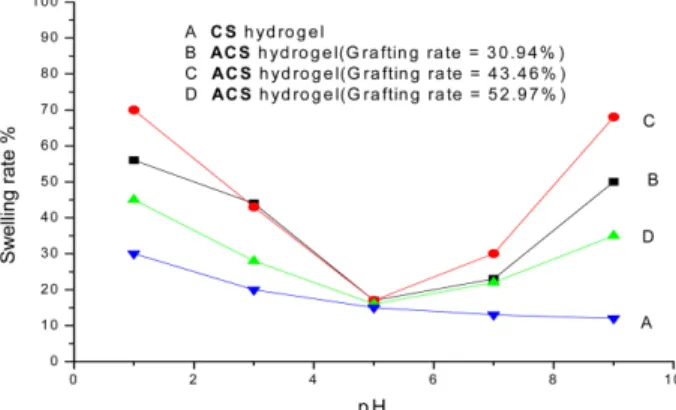
The Swelling Rate of Hydrogel in Buffer Solution The dry gels of CS hydrogel and ACS hydrogel were taken into buffer solution with different pH, such as pH was 1, 3, 5, 7 and 9. Weighing and calculating their swell-
ing rate after soaking for 12 h, the results were presented in Fig. 1.
Fig. 1 showed that compared with CS hydrogel, ACS hydrogel had a larger change in swelling rate at different pH. And from Fig. 1 we could find that swelling rate behavior of ACS hydrogel was different from CS hydro- gel, swelling rate would reduce when pH was increased from 1 to 5, and would increase just as pH was increased from 5 to 9. This showed the grafting of ACS changed the swelling behavior and pH sensitivity of hydrogel.
Furthermore, grafting rate of ACS could also affect swelling rate of ACS hydrogel. It was clear that with graft- ing rate increased from 30.94% to 43.46%, swelling rate of hydrogel would increase, but grafting rate increased from 43.46% to 52.97%, swelling rate of hydrogel would decrease. The reason was that the grafting of ACS increased the solubility of hydrogel, and enhanced the pH sensitivity of hydrogel. However, if grafted too many N-carboxy- ethyl, there would be many hydrogen bonds formed between N-carboxyethyl and amino of chitosan, which could reduce swelling rate of hydrogel.
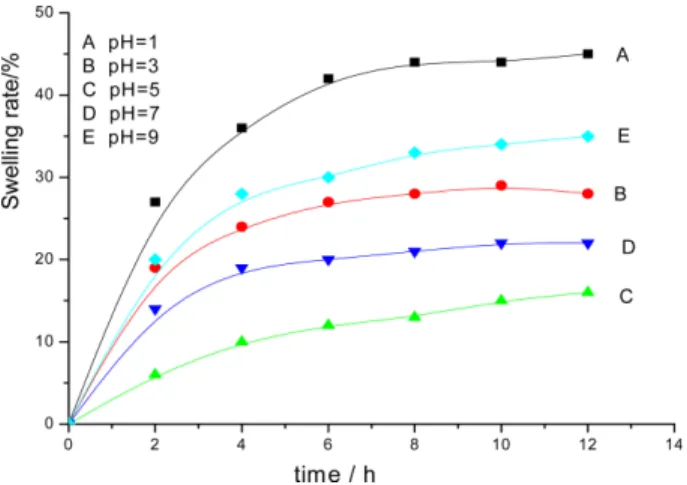
Put the dry ACS hydrogel (grafting rate=52.97%) into different buffer solutions, and weigh them for calculating swelling rate at each 2h, The results were given in Fig. 2.
In Fig. 2, swelling rate of ACS hydrogel was the lowest at pH=5, the reason was that the intramolecular hydrogen bonding of the free -NH2 and -COOH in ACS, contribu- ting to the formation of more compact and shrunk struc- ture. But when pH decreased from 5 to 1, -NH2 converted to -+NH3 gradually, intramolecular hydrogen bonding was destroyed partially. As the same reason, when pH increased from 5 to 9, -COOH converted to -COO- gradually, intramo- lecular hydrogen bonding was destroyed too. It induced that the loose networks in ACS hydrogel were formed, which swelling rate of ACS hydrogel exhibited increasing.
Fig. 1. swelling rate behavior of hydrogel in buffer solutions with different pH.
In vitro Drug Release
The in vitro drug release of ACS composite hydrogel, 5- Fu-ACS hydrogel and 5-Fu-ACS composite hydrogel in PBS (pH=7.4) were presented in Fig. 3.
From Fig. 3, the cumulative release rate of ACS com- posite hydrogel was 64.48% in the first 3 h with a slight burst releasing, complete releasing happened in 15 h, show- ing the fastest releasing. The reason was that 5-Fu was directly contained in hydrogel, while the structure pro- vided a higher drug loading. In 5-Fu-ACS hydrogel, with- out burst releasing, the cumulative release rate was 43.52%
in the first 8 h, and 94.76% in 7 d, showing the slowest releasing. The reason was that 5-Fu was bonded to CS and hydrolysis release slowly, which reaching the minimum effective therapy concentration will be difficult. The 5- Fu-ACS composite hydrogel prepared by both chemical- bonding and hydrogel-entrapping 5-Fu, so it has excellent releasing effect and high drug loading. The cumulative
release rate was 48.25% in the first 3 h and 60.16% in 8 h without apparent burst releasing, exhibiting more ideal releasing effect to meet applicable in clinic.
CONCLUSION
(1) ACS was prepared through the reaction between acrylic acid and chitosan by microwave heating, which was proved to be a faster and more efficient way than the ordinary methods.
(2) ACS hydrogel, 5-Fu-ACS hydrogel, ACS composite hydrogel and 5-Fu-ACS composite hydrogel were shown an excellent thermosensitive.
(3) The 5-Fu-ACS composite hydrogel was proved to have excellent releasing effect and high drug loading.
Acknowledgments. This work was supported by the national natural science foundation of China (No. 20775010), scientific research fund of Hunan provincial education department and the planned science and technology project of Human province, China (2010ck3021).
REFERENCES
1. Kumar, S.; Aninat, C.; Michaux, G.; Morel, F. J. Rep. Toxic.
2010, 29, 415.
2. van Kuilenburg, A. B. P. Eur. J. Cancer 2004, 40, 939.
3. Alvarenga, E. S.; Oliveiraa, C. P.; Bellatoa, C. R. Carbohydr.
Polym. 2010, 80, 1155.
4. Tayela, A. A.; Moussaa, S.; Knittelb, O.; Dierk, K.; Scholl- meyerb, E.; Nickisch-Hartfiel, A. Int. J. Bio. Mac. 2010, 47, 10.
5. Guo, Z. Y.; Xing, R. G.; Liu, S. Carbohydr. Polym. 2008, 73, 173.
6. Kandile, N. G.; Mohamed, M. I.; Zaky, H. T.; Nasr, A. S.;
Abdel-Bary, E. M. Carbohydr. Polym. 2009, 75, 580.
7. Zuniga, A.; Debbaudta, A.; Albertengoa, L.; Rodriguez, M. S.; Carbohydr. Polym. 2010, 79, 475.
8. Thanou, K. M. Adv. Drug. Del. Rev. 2010, 21, 3.
9. Li, R. H.; Cheng, Y. L. Journal of Beijing Union University (Natural Sciences) 2008, 22, 30.
10. Jiang, T. D. Chitosan; Chemical Industry Press: Beijing, China, 2006.
11. Fan, T. F.; Li, M. J.; Wu, X. M.; Li, M.; Wu, Y. Colloids and Surf., B: Biointerfaces 2011, 88, 593.
12. Wei, L.; Lin, J. P.; Cai, C. H.; Fang, Z. D.; Fu, W. G. Eur.
J. Pharm. Biopharm. 2011, 78, 346.
13. Zhang, L. Y.; Li, Z. W.; Li, M. L.; Zeng, Q. X. Chem. Ind.
Eng. Pro. 2008, 27, 585.
14. Li, H. P.; Wang, Z. D.; Yu, T. Med. Chem. Res. 2011, 20, 67.
15. Chenite, A.; Chaput, C.; Wang, D.; Combes, C.; Buschmann, M. D.; Hoemann, C. D.; Leroux, J. C.; Atkinson, B. L.;
Binette, F.; Selmani, A. Biomaterials 2000, 21, 2155.
Fig. 2. Swelling rate behavior of ACS hydrogel in different buffer solutions.
Fig. 3. Cumulative release behavior of hydrogel in PBS (pH=7.4) at 37±0.5oC.