460
Copyright © 2016 The Korean Society of Fisheries and Aquatic Science pISSN:0374-8111, eISSN:2287-8815
서 론
장염비브리오균
(Vibrio parahaemolyticus)
는해수및기수지 역에분포하고있는저도호염성해양세균으로계절에따라분 포가바뀌는데일반적으로여름에서초가을에가장많이검출 된다고알려져있으며,
이균에오염된어패류를생식하거나덜 익혀섭취하여나타나는식중독원인세균이다(Sakazaki et al., 1968; Honda and Iida, 1993).
최근우리나라식품위생수준이향상되고식품안전관리기
술이크게발전하고있지만
,
미생물에의한식중독사고는발생 빈도수나환자발생수가줄어들지않고있는실정이어서과학 적이고효과적인식중독예방기술개발이절실히필요하다.
현 재식품안전관리의과학화는전세계가지향하고있으나,
식중 독원인미생물에대한위해도평가는대단히어려운과제로서 선진국에서도아직완전히장착되지않은분야로이에대한광 범위한연구가진행중에있다(KFDA, 2005).
2002
년부터2013
년까지 우리나라에서 발생한 장염비브리오균에의한식중독사고는주로여름철에집중적으로발생하
남해안 패류양식장에서 분리한 Vibrio parahaemolyticus의 병원인자 분포 및 항균제 내성
박용수·박큰바위·권지영·유홍식
1·이희정
2·김지회
3·이태식·김풍호*
국립수산과학원 식품위생가공과, 1국립수산과학원 서해수산연구소, 2국립수산과학원 남해수산연구소, 3국립수산과학원 연구기획과
Antimicrobial Resistance and Distribution of Virulence Factors of Vibrio parahaemolyticus Isolated from Shellfish Farms on the Southern Coast
of Korea
Yong Soo Park, Kunbawui Park, Ji Young Kwon, Hong Sik Yu
1
, Hee Jung Lee2
, Ji Hoe Kim3
, Tae Seek Lee and Poong Ho Kim*Food Safety and Processing Research Division, National Institute of Fisheries Science, Busan 46083, Korea
1
West Sea Fisheries Research Institute, National Institute of Fisheries Science, Incheon 22383, Korea
2
South Sea Fisheries Research Institute, National Institute of Fisheries Science, Yeosu 59780, Korea
3
Research and Development Planning Department, National Institute of Fisheries Science, Busan 46083, Korea
From 2013 through 2015, we investigated the contamination status and antimicrobial resistance patterns of pathogenic Vibrio parahaemolyticus in commercially valuable seawater and shellfish (Oyster Crassostrea gigas , short-neck clam Venerupis philippinarum , ark shell Scapharca broughtonii and mussel Mytilus galloprovinciallis ) from the southern coast of Korea. The detection rate of V. parahaemolyticus was highest in short-neck clams (23.7%), followed by ark shells (19.2%), oysters (15.9%), mussels (13.6%), and seawater (8.6%). The following percentages of PCR assays of shellfish were positive for the thermostable direct hemolysin-related hemolysin gene ( trh ) : oysters (12.8%), short- neck clams(11.8%), and ark shells (3.4%). Similar assays for the thermostable direct hemolysin gene ( tdh ) resulted in positive results for short-neck clams (5.9%) and ark shells (3.4%). Antimicrobial resistance was present in 100%
of 8 tdh (+) and 2 trh (+) V. parahaemolyticus isolates challenged with ampicillin. However, all pathogenic V. para- haemolyticus were sensitive to 14 other antibiotics. To ensure the safety of shellfish consumption, the continuous monitoring of the prevalence and distribution of virulence factors of V. parahaemolyticus in shellfish farms is needed.
Key words: Antimicrobial resistance, Shellfish, Vibrio parahaemolyticus , Virulence factors
This is an Open Access article distributed under the terms of the Creative Commons Attribution Non-Commercial Licens (http://creativecommons.org/licenses/by-nc/3.0/) which permits unrestricted non-commercial use, distribution, and reproduction in any medium, provided the original work is properly cited.
http://dx.doi.org/10.5657/KFAS.2016.0460 Korean J Fish Aquat Sci 49(4) 460-466, August 2016
Received 19 July 2016; Revised 11 August 2016; Accepted 17 August 2016
*Corresponding author: Tel: +82. 51. 720. 2630 Fax: +82. 51. 720. 2619
E-mail address: [email protected]
며발생건수및환자수는전체세균성식중독사고의
16.5%
및8.2%
를차지하고있다(MFDS, 2014).
장염비브리오균에의한 식중독은급성위장염이며, 12-24
시간잠복기를거쳐발병하며 발열(37-39℃),
구토,
복통오한을보인다.
해수및어패류등해양생태계에서분리한대부분의장염비 브리오균은비병원성균주인반면에수산물기인식중독사고 의환자가검물에서분리한대부분의장염비브리오균에는내 열성용혈독소
(Thermostable direct hemolysin, TDH)
또는내 열성용혈독소유사독소(TDH-related hemolysin, TRH)
을생 성하는유전자를보유하고있으며,
이독소들이장염비브리오 균의주요한병원성인자로알려져있고(Sakazaki et al., 1968;
Shirai et al., 1990; Honda and Iida, 1993),
근래에는trh
유전자 를보유하는장염비브리오균이증가하고있는추세로알려져 있다(Kishishita et al., 1992).
한편
,
대부분의패류양식장은강우등의영향으로유입된오 염물질의영향을쉽게받을수있는연안해역에위치하고있으 며,
패류양식장으로유입된오염물질중에는항균제내성균들 도함유되어있는것으로알려져있으며,
패류양식장으로유입 된항균제내성균들은패류의안전성뿐만아니라장염비브리오 균등과같은해양상재세균의항균제내성획득에도영향을미 칠수있을것으로여겨지고있다(Park et al., 2013).
1940
년대에항생제가최초로개발된이래많은종류의항생제가임상
,
축산및수산분야에서감염질환치료제로널리사용 되어왔으며,
최근에는항생제의오남용에따른항생제내성균 증가가사회적문제로대두되고있다(Shanthini et al., 2004).
2003
년부터2012
년까지우리나라에서축산용및수산용으로판매된항생제는연간약
1,000-1,500
톤정도로2008
년부터판 매량이점차감소하는추세이나,
항생제내성균의출현빈도가 다른나라에비해상당히높은편이며임상,
식품,
환경등다양 한분야에서항생제내성균들이출현되고 있다(Chung et al., 2006; Hwang et al., 2008; Lim et al., 2014).
따라서우리나라주요패류의주생산지인남해안일원의패 류양식장에서의병원성장염비브리오균분포및항균제내성패 턴을조사하여장염비브리오균관리기술개발과항균제내성균 관리에필요한자료를제공하고자
2013
년1
월부터2015
년11
월까지남해안주요패류생산해역에서해수및양식패류(
굴,
바 지락,
피조개,
진주담치)
에서장염비브리오균검출특성,
병원성 인자보유유무및항균제내성을조사하였다.
재료 및 방법
해수 및 패류 시료
장염비브리오균분리를위하여
2013
년1
월부터2015
년11
월까지남해안패류양식장에서해수및패류를매월채취하여 시료로사용하였다.
굴(Crassostrea gigas),
피조개(Scapharca broughtonii),
바지락(Venerupis philippinarum)
및 진주담치(Mytilus galloprovinciallis)
는채취한후멸균된황동솔로표면에묻어있는이물질을세척한후멸균된용기에담아서
10℃
이하로유지하면서실험실로운반하여실험에사용하였다
.
해수시료는채수기를이용하여멸균된
1 L
채수병에채취하였으며채취시해수의수온과염분의농도는
YSI 566 multi-
probe system (Yellow Springs, YSI Life Sci-ence, OH, USA)
을사용하여현장에서측정하였다.
장염비브리오균의 분리 및 동정
장염비브리오균은
bacteriological analytical manual (Elliot et al., 1995)
에준하여3 tube MPN
법으로정량분석을실시하 였다.
패류는12
개체이상을1
회시험에사용하였으며,
패각을 제거한패육과패액200 g
에phosphate buffered saline (PBS:
140 mM NaCl, 5 mM anhydrous Na
2HPO
4and 1.5 mM KH-
2
PO
4pH 7.4)
을2
배비율로첨가하여균질화하고, 80 mL
의PBS
에균질액20 g
을첨가하여10
배희석액을만들어시료로 하였다.
희석액을이용하여100
배, 1,000
배등단계별추가희 석용액을만들어사용하였다.
해수시료는전처리없이바로실 험에사용하였다.
각희석단계별로
alkaline peptone water (pH 8.5±0.2, 2%
NaCl
함유)
가들어있는3
개의시험관에접종하고35±0.5℃
에 서18-24
시간배양하였다.
배양한후thiosulfate citrate bile salt agar (TCBS agar, Difco)
에획선도말하여35℃
에서24
시간배 양한후,
전형적인반응을나타내는균주를대상으로동정시험 을실시하였다.
동정시험에는 내염성시험
, 42℃
발육시험, ONPG (O- nitrophenyl-β-D-galacto-pyranoside)
시험등생화학시험이이용되었으며
VITEK system (Biomerieux, France)
으로확정 하였다.
정량분석의결과는최확수표를이용하여100 g
또는100 mL
당MPN
으로나타내었다.
병원성 인자 확인
분리된 장염비브리오균을 대상으로 식중독을 유발시키는 병원성 인자로알려진
tdh
및trh
유전자의 존재유무확인은PCR
기법을이용하였다. tdh
및trh
유전자검출을위해VPD- 1/VPD-2
및VPR-1/VPR-2 (Takara, Japan)
를사용하였다.
시 험균주를Tryptic Soy Broth (Difco, USA) 10 mL
에접종하 여37℃, 18-24
시간배양한다음DNA Isolation kit (MOBIO, USA)
를사용하여DNA
를추출한후PCR Master mix (Ta- kara, Japan) 12.5 μL,
각primer (10 pmol/μL) 0.2 μL,
추출한DNA 2 μL
로반응액을조성한후,
멸균증류수를첨가하여총25 μL
로조정하여Thermal Cycle (Takara, Japan)
로98℃
에서10
초, 55℃
에서30
초, 72℃
에서60
초의반응을30
회반복하 여PCR
을실시하였다.
증폭된PCR
산물은gel documentation
system G BOX (Syngene, UK)
를이용하여amplicon
크기(tdh
유전자, 251 bp; trh
유전자, 250 bp)
를확인하였다.
항균제 감수성 확인
분리
·
동정된 장염비브리오균의 항균제 감수성은Acar and Goldstein (1991)
의디스크확산법을이용하였다.
즉,
분리된 장염비브리오균을Muller Hinton Broth (Merck, Germany)
에접종하고
, 35℃, 18-24
시간배양한후장염비브리오균배양액의농도를
McFarland No. 0.5
로희석하였다.
각희석한균액을미리
1%
농도가되도록NaCl
를첨가한두 께4 mm
의Muller Hinton Agar (Merck, Germany)
평판에도 말하고, 5
분간방치하면서균액을흡수시킨후에항균제디스크(Φ 8 mm)
를평판에고착시켰다.
항균제디스크는균접종후
15
분이내에고착시켰으며,
시 험항균제는ampicillin (10 µg; AM), amikacin (30 µg; AN), amoxicillin/clavulanic acid (20 µg/10 µg; AMC), cefepime (30 µg; FEP), cefotaxime (30 µg; CTX), chloramphenicol (10 µg; C), ciprofloxacin (5 µg; CIP), erythromycin (5 µg; E), gentamicin (10 µg; GM), nalidixic acid (30 µg; NA), rifampin (5 µg; RA), streptomycin (10 µg; S), tetracycline (30 µg; TE), trimethoprim (5 µg; TMP), trimethoprim/sulfamethoxazole (1.25 µg/23.75 µg; SXT)
등15
종으로BBL (USA)
사제품 으로미국CLSI (Clinical and Laboratory Standards Institute, 2012)
의정도관리허용기준(Quality control range)
에부합됨을 확인한후항균제디스크를감수성시험에사용하였다.
항균제디스크를고착시킨
Muller Hinton Agar
평판은35℃, 16-18
시간배양한다음균의증식저해대(Inhibition zone)
의 크기를calipers
로측정하였으며,
감수성은미국CLSI (Clini- cal and Laboratory Standards Institute, 2012)
기준을근거로 판정하였다.
결과 및 고찰
해수 및 패류에서의 장염비브리오균 검출현황
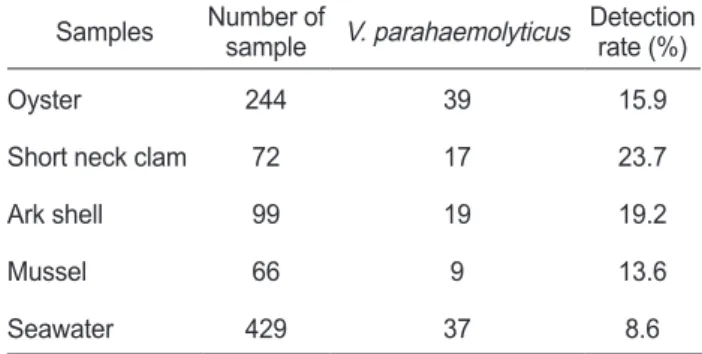
남해안주요패류생산해역의해수및양식패류에서의장염비 브리오균검출특성을알아보기위하여
2013
년1
월부터2015
년11
월까지해수429
개,
굴244
개,
바지락72
개,
피조개99
개,
진주담치66
개시료를대상으로장염비브리오균을분리하였으 며,
그결과를Table 1
에나타내었다.
시험대상 시료 중 바지락에서 장염비브리오균의 검출율이
23.7%
으로가장높게나타났으며,
다음으로는피조개(19.2%),
굴(15.9%),
진주담치(13.6%)
및해수(8.6%)
순이었다.
이러한경향은굴및진주담치는연승수하식으로양식되어 해수중에존재하는장염비브리오균만을체내에농축하는반면 에펄에서바닥식으로양식되는바지락과피조개는수하식양 식패류보다장염비브리오균을고농도로채내에농축할확률이 높으며
,
또한펄에파묻혀서양식되기때문에해수에의한자연 적인정화효과도기대하기힘든부분이있어굴과진주담치에 서보다는바지락및피조개에서의장염비브리오균의검출율이더높은것으로사료된다
.
Ju (1983)
에의하면제주,
거제,
남해,
욕지,
부산및마산지역 해수및펄에대한장염비브리오균분포조사결과,
해수시료 에서장염비브리오균검출율이9.8%
인반면에펄시료에서는18.8%
에이른다고보고하였으며, Yu et al. (2014)
는남해안굴 과서해안바지락에서의장염비브리오균검출율을조사한결 과,
굴(72.5%)
보다 바지락(97.5%)
에서장염비브리오균의 검 출율이높았다고보고하였다.
해수와패류의장염비브리오균의검출관계를살펴보면
,
해수 보다패류에서장염비브리오균의검출율이높았는데이러한이 유는패류는고착성생물로해수또는담수를여과하여먹이를 섭취하기때문에해수중의장염비브리오균의농도보다더많 은장염비브리오균가패류체내에축적되기때문이다. Angelo
et al. (1990)
는미국해안에서해수와굴의장염비브리오균의농도를비교한결과굴에서의장염비브리오균농도가해수에 비해
100
배정도더높았다고보고하였다.
한편
,
해수및패류에서분리된장염비브리오균의월별검출 현황을Fig. 1
및Fig. 2
에나타내었다.
해수및패류에서장염비 브리오균은주로수온이상승하는5
월부터검출되기시작하여 여름철(7
월부터9
월까지)
에집중적으로검출되었다. 2015
년에 는2013
년및2014
년에비해11
월까지장염비브리오균검출율 이높게검출되었는데,
이는엘리뇨현상으로인해기온이예년보다낮아지지않고유지된영향으로인해
2015
년수온이2013
년과
2014
년보다높게유지되면서장염비브리오균의검출율이증가된것으로사료된다
.
Haley et al. (2014)
는장염비브리오균은수온의상승에따라 검출율이증가된다고보고했으며,
페루에서엘리뇨현상이있었던
1991
년과1997
년에는장염비브리오균에인한장염비브
리오 식중독환자가 유행하였다고 보고되어 있다
(Martinez- Ultaza et al., 2008).
수온이낮은시기인
2015
년1
월해수에서장염비브리오균이검출되었는데이는
choi et al. (1997)
가한산거제만해역의겨 울철수온이5.4-10.8℃
이었고,
해수및패류에서장염비브리오 균이검출되었다고보고한연구결과와유사하였다.
Table 1. Detection rate of Vibrio parahaemolyticus isolated from seawater and shellfish farm in farms in the southern coast of Korea
Samples Number of
sample V. parahaemolyticus Detection rate (%)
Oyster 244 39 15.9
Short neck clam 72 17 23.7
Ark shell 99 19 19.2
Mussel 66 9 13.6
Seawater 429 37 8.6
한편
,
수온이비교적낮은시기인늦가을과겨울에패류에서 도장염비브리오균이검출이되었으며,
조사품종별로검출시 기를살펴보면바지락은2013
년2
월및2015
년11
월,
피조개 는2014
년1
월및2015
년1
월,
굴은2014
년11
월, 2015
년1
월및
11
월이었다.
장염비브리오균은성장가능한온도범위가
5-43℃
이며,
수 온이5℃
이상만되면생존이가능한것으로알려져있으며, Burnham et al. (2009)
은장염비브리오균을5℃, 8℃
및10℃
0 5 10 15 20 25 30 35 40
0 25 50 75 100
Jan Feb Mar Apr May Jun Jul Aug Sep Oct Nov Dec Jan Feb Mar Apr May Jun Jul Aug Sep Oct Nov Dec Jan Feb Mar Apr May Jun Jul Aug Sep Oct Nov
V.parahaemolyticus Temp. Salinity
2013 2014 2015
0 5 10 15 20 25 30 35 40
0 25 50 75 100
Jan Feb Mar Apr May Jun Jul Aug Sep Oct Nov Dec Jan Feb Mar Apr May Jun Jul Aug Sep Oct Nov Dec Jan Feb Mar Apr May Jun Jul Aug Sep Oct Nov
V.parahaemolyticus Temp. Salinity
2014
2013 2015
Salinity (psu) and Temperature ( ℃ ) Salinity (psu) and Temperature ( ℃ )
Detection rate (%) Detection rate (%)
Fig. 1. Monthly variation of Vibrio parahaemolyticus isolated from seawater in the southern coast of Korea.
0 5 10 15 20 25 30 35 40
0 25 50 75 100
Jan Feb Mar Apr May Jun Jul Aug Sep Oct Nov Dec Jan Feb Mar Apr May Jun Jul Aug Sep Oct Nov Dec Jan Feb Mar Apr May Jun Jul Aug Sep Oct Nov
V.parahaemolyticus Temp. Salinity
2013 2014 2015
0 5 10 15 20 25 30 35 40
0 25 50 75 100
Jan Feb Mar Apr May Jun Jul Aug Sep Oct Nov Dec Jan Feb Mar Apr May Jun Jul Aug Sep Oct Nov Dec Jan Feb Mar Apr May Jun Jul Aug Sep Oct Nov
V.parahaemolyticus Temp. Salinity
2014
2013 2015
Salinity (psu) and Temperature ( ℃ ) Salinity (psu) and Temperature ( ℃ )
Detection rate (%) Detection rate (%)
Fig. 2. Monthly variation of Vibrio parahaemolyticus isolated from shellfish farm in the southern coast of Korea.
로냉장보관한후성장과생존율을실험한결과
, 5℃
구간에서10
일이후에도장염비브리오균이생존하였으며, 8℃
및10℃
에서는장염비브리오균이성장하는것으로나타났다고보고하 였다
.
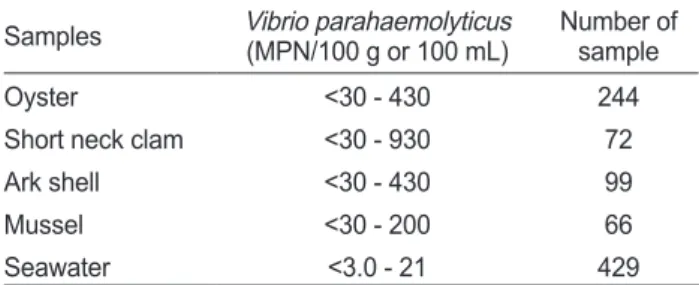
장염비브리오균수는바지락에서
<30-930 MPN/100 g
이었으 며,
굴및피조개에서는공히<30-430 MPN/100 g,
진주담치에 서는<30-200 MPN/100 g,
해수에서는<3.0-21 MPN/100 mL
으로검출되었다(Table 2).
병원성 인자 보유율
장염비브리오균에의한식중독은주요병원성인자인내열성 용혈독소
(Thermostable direct hemolysin, TDH)
및내열성용 혈독소유사독소(TDH-related haemolysin, TRH)
를생성하는 유전자를보유하고있는장염비브리오균에의해서발병한다고 알려져있다(Kanungo et al., 2012).
남해안해수및양식패류에서분리된장염비브리오균중병원
성인자보유유무를조사하였으며
,
그결과를Table 3
에나타내 었다. trh
유전자는굴에서분리된39
개장염비브리오균들중5
균주(12.8%)
에서확인되었으며,
바지락에서는2
균주(11.8%),
피조개에서는1
균주(3.4%)
에서 검출되었으며, tdh
유전자는 바지락(5.9%)
및피조개(3.4%)
에서만확인되었다.
진주담치(9
균주)
및해수(37
균주)
에서분리된장염비브리오균에서는병 원성인자가검출되지않았다.
일반적으로 해수에서 분리되는 대부분의 장염비브리오균 은 비병원성균으로알려져있으며
,
병원성인자를보유한장 염비브리오균은1%
미만으로 검출되고 있다고알려져있다(Thompson et al., 1976).
한편
, Yu et al. (2014)
는2014
년7
월부터11
월까지남해안굴 및서해안바지락에서분리한장염비브리오균에서는병원성인 자를보유한장염비브리오균은검출되지않았다고연구결과와는다소차이가있었으나
,
최근들어trh
유전자를보유하는장염비브리오균의출현이자주보고되고있으며
,
환자유래장염 Table 2. Detection range of Vibrio parahaemolyticus isolated fromseawater and shellfish farm in the southern coast of Korea.
Samples Vibrio parahaemolyticus
(MPN/100 g or 100 mL) Number of sample
Oyster <30 - 430 244
Short neck clam <30 - 930 72
Ark shell <30 - 430 99
Mussel <30 - 200 66
Seawater <3.0 - 21 429
Table 3. Detection rate of tdh or trh gene in Vibrio parahaemo- lyticus isolated from seawater and shellfish in the southern coast of Korea
Samples tdh gene trh gene
Oyster 0/39 (0.0%) 5/39 (12.8%)
Short neck clam 1/17 (5.9%) 2/17 (11.8%)
Ark shell 1/19 (3.4%) 1/19 (3.4%)
Mussel 0/9 (0.0%) 0/9 (0.0%)
Seawater 0/37 (0.0%) 0/37 (0.0%)
Table 4. Antimicrobial resistance of tdh(+) and trh(+) Vibrio parahaemolyticus isolated from shellfish farm in the southern coast of Korea Antimicrobial agents Drug amount (µg) /disk Diffusion zone break point (mm) No. of isolates (%)
Ampicillin 10 ≤13 10 (100)
Ampicillin/Clavulanic acid 30 ≤13 0 (0.0)
Cefepime 30 ≤14 0 (0.0)
Cefotaxime 30 ≤14 0 (0.0)
Streptomycin 10 ≤11 0 (0.0)
Gentamycin 10 ≤12 0 (0.0)
Amikacin 30 ≤14 0 (0.0)
Ciprofloxacin 5 ≤15 0 (0.0)
Nalidixic acid 30 ≤13 0 (0.0)
Trimethopenem/sulfamethoxazole 1.25/23.75 ≤10 0 (0.0)
Trimethoprim 5 ≤10 0 (0.0)
Chloramphenicol 10 ≤12 0 (0.0)
Tetracycline 5 ≤14 0 (0.0)
Rifampin 5 ≤17 0 (0.0)
Erythromycin 5 ≤13 0 (0.0)
비브리오균중에서
trh
유전자를보유하고있는장염비브리오 균이점점증가하고있다는연구결과가있다(Nishibuchi et al., 1989).
이상의결과
,
하절기중심으로생식을주로하는수산물의경 우에는병원성인자를보유한장염비브리오균에의한식중독 발생위험성이날로증가하고있기때문에지속적인병원성장 염비브리오균모니터링과더불어수산물에대한체계적인위생 관리가필요할것으로사료된다.
병원성 장염비브리오균의 항균제 내성 특성
남해안굴
,
바지락및피조개에서분리된tdh
및trh
유전자를 보유한장염비브리오균각각2
균주및8
균주에대하여15
종의 항균제에대하여감수성시험을실시하였으며,
그결과를결과 를Table 4
에나타내었다.
병원성인자를보유하고있는모든장염비브리오균은
ampi- cillin
에대해서만항균제내성을가지고있었으며,
그외14
종 의항생제에서는모두감수성을나타내어tdh
및trh
유전자를 보유한장염비브리오균간의항균제내성차이는없었다.
한편
, Yu et al. (2014)
에따르면한국연안산굴과바지락의 비병원성장염비브리오의항균제내성을조사한결과, ampi- cillin
에대한내성율이79%
로높게나타내었고, trimethoprim, streptomycin
에대한내성율은각각3.1%
및1.6%,
그외의항 생제에대해서는내성균비율이1%
미만이라고보고한연구결 과하고는다소차이는있었으나, Lee et al. (2010)
는서해안해 수에서분리한비병원성장염비브리오균의항생제감수성조사결과
, ampicillin
에는모든균주가항생제내성을나타내었다는연구결과하고는유사하였다
.
이상의연구결과를종합해보면
,
지구온난화등이상기후변화 로인한연안해역의수온상승으로장염비브리오균의출현기 간연장및병원성인자를보유한장염비브리오균증가는국민 보건위생을위협하는요인이될수있으므로연안해역패류양 식장에서의장염비브리오균의출현양상및병원성장염비브리 오균의증가유무를지속적으로모니터링을실시할필요가있으 며
,
특히수온이상승하는시기(5
월부터11
월까지)
에수확되는 수산물의경우에는다른시기때보다철저한수확후온도·
시간 관리가필요한것으로여겨진다.
사 사
이 논문은
2016
년도 국립수산과학원 수산과학연구사업(R2016059)
의지원으로수행된연구이며연구비지원에감사드립니다
.
References
Acar JF and Goldstein FW. 1991. Disk susceptibility test. In:
antibiotics in laboratory medicin. Lorian V, ed. Williams &
Wilkins, Baltimore, U.S.A., 17-52.
Angelo D, Linda H, James T, Barry and Roland M. 1990. Inci- dence of Vibrio parahaemolyticus in U.S Coastal Water and Oysters. Appl Environ Microbiol 8, 2299-2302.
Burnham VE, Janes ME, Jakus LA, Supan J, Depaola A and Bell J. 2009. Growth and Survival Differences of Vibrio
vulnificus and Vibrio parahaemolyticus Strains during Cold
Storage. J Food Soc 74, 314-318. http://dx.doi.org/10.1111/j.1750-3841.2009.01227.x.
Choi WJ, Chun YY, Park JH and Park YC. 1997. The Influence of Environmental Characteristics on the Fatness of Pacific Oyster, Cassostrea gigas in Hansan-Koje Bay. J Korean Fish Soc 30, 794-803.
Chung YH, Jeoung HH, Kwon YI and Kim HR. 2006. The monitoring of antibiotic resistant bacteria from environment (River and Downstream). Ann Report KFDA 10, 1022- 1023.
CLSI 2012. Performance standards for antimicrobial suscep- tibility testing. CLSI document M100-S22. Clinical and Laboratory Standard Institute. Wayne, Pa. U.S.A., 44-128.
Elliot EL, Kaysner CA, Jackson L and Tamplin ML. 1995. Vib-
rio cholera, V. parahaemolyticus, V. vulnificus and other Vib- rio spp. IN: Bacteriological Analytical Manual. Association
of Offical Analytical Chemists ed . FDA, Arlington, U.S.A., 9.01-9.27.Haley B, Kokashvili T, Taskshvediani A, Janelidze N, Mitaish- vil N, Grim C, Magny G, Chen A, Taviani E, Eliashvili T, Tediashvili M, Whitehouse C, Colwell R and Huq A. 2014.
Molecular diversity and predictability of Vibrio parahae-
molyticus along the Georgian coastal zone of the Black
Sea. Front Microbial 5, 1-9. http://dx.doi.org/10.3389/fmicb.2014.00045.
Honda T and Iida T. 1993. The pathogenicity of Vibrio parahae-
molyticus and the role of the thermostable direct haemolysin
and related haemolysin. Rev Med Microbiol 4, 106-113.Hwang IG, Kwak HS, Kim MK, Han JA, Park YC, Kim EJ, Lee GY, Yoon HS, Lee JS and Cho JH. 2008. Monitoring and evaluation of antimicrobial resistance of foodborne patho- genic bacteria. Ann Report KFDA 12, 191-192.
Ju JW. 1983. Studies on Vibrio parahaemolyticus on the south- ern seas of Korea on the isolation of Vibrio parahaemolyti-
cus from sea water, sea mud and marine products in Jeju,
Koeje, Namhae, Yockji, Busan and Masan. J Korea Soc Microbiol 18, 1-9.Kanungo S, Sur D, Ali M, You Y.A, Pal D, Manna B. 2012.
Clinical, epidemiological and spatial characteristics of
Vibrio parahaemolyticus diarrhea and cholera in the urban
slums of Kolfata, India. BMC Public Health 12, 1-9. http://dx.doi.org/10.1186/1471-2458-12-830.
Kishishita M, Matsuoka N, Kumagai K, Yamasaki S, Takeda Y and Nishibuchi M. 1992. Sequence variation in the ther- mostable direct hemolysin-related hemolysin (trh) gene of
Vibrio parahaemolyticus. Appl Environ Microbiol 58, 2449-
2457.Lee KW and Park KS. 2010. Antibiotic resistance profiles and the identification of the ampicillin-resistance gene of
Vibrio parahaemolyticus isolated from seawater. Korean
J Fish Aquat Sci 43, 637-641. http://dx.doi.org/10.5657/KFAS.2010.0637.
Lim SK, Lee JE, Lee HS, Nam HM, Moon DC, Jang GC, Park YJ, Jung YG, Jung SC and Wee SH. 2014. Trends in anti- microbial sales for livestock and fisheries in Korea during 2003-2012. Korean J Vet Res 54, 81-86.
Martinez-Urtaza J, Huapaya B, Gavilan RG, Blanco-Abad V, Ansede-Bermojo J, Cadarwo-Suarez, C, Figueiras A, and Trinanes J. 2008. Emergence of Asiatic Vibrio diseases in South America in phase with El Nino. Epidemiology 19, 829- 837. http://dx.doi.org/10.1097/EDE.0b013e3181883d43.
Ministry of Food and Drug Safety (MFDS). 2014. Korea food code. Retrieved from http://www/mfds.go.kr/e-stat/
indexdo?nMenuCode=20 on February 6.
Nishibuchi M, Taniguchi T, Misawa T, Khaeomanee-lam V, Honda T and Miwatani T. 1989. Cloning and nucleotide sequence of the gene (trh) encoding the hemolysin related to the thermostable direct hemolysin related to the thermo- stable direct hemolysin of Vibrio parahaemolyticus. Infect Immun 57, 2691-2697.
Park K, Park JY, Jo MR, Yu HS, Lee HJ, Kim JH, Oh EG, Shin SB, Kim YK and Lee TS. 2013. Antimicrobial resistance in Escherichia coli isolated from the shellfish farms in the southern coast of Korea. Korean J Fish Aquat Sci 46, 528- 533. http://dx.doi.org/2013.KFAS.0528.
KFDA. 2005. Quantitative microbial risk assessment of food- borne pathogens for scientific food safety management.
1-69.
Sakazaki R, Tamura K, Kato T, Obara Y and Yamai S. 1968.
Studies on the enteropathogenic, facultatively halophilic bacterium, Vibrio parahaemolyticus. 3Entropathogenicity.
Jpn J Med Sci Biol 21, 325-331.
Shirai H, Ito H, Hirayama T, Nakamoto Y, Nakabayashi N, Kumagai K, Takeda Y and Nishibuchi M. 1990. Molecular epidemiological evidence for association of thermostable direct hemolysin (TDH) and TDH-related hemolysin of Vib-
rio parahaemolyticus with gastroenteritis. Infect Immun 58,
3568-3573.Shanthini CF, Kumar PA and Patterson J. 2004. Incidence and antibiotic susceptibility of Vibrio parahaemolyticus from sea foods of Tuticorin. Indian J Fish 51, 42-47.
Thompson CA, Vanderzant C and Ray SM. 1976. Serological and hemolytic characteristics of Vibrio parahaemolytic from marine sources. J Food Sci 41, 204-205.
Yu HS, Oh EG, Shin SB, Park YS, Lee HJ, Kim JH and Song KC. 2014. Distribution and Antimicrobial Resistance of Vib-
rio parahaemolyticus Isolated from Korean Shellfish. Kore-
an J Fish Aquat Sci 57, 508-515. http://dx.doi.org/10.5657/
KFAS.2014.0508.