한수지 48(5), 712-718, 2015
712
Copyright © 2015 The Korean Society of Fisheries and Aquatic Science pISSN:0374-8111, eISSN:2287-8815
Korean J Fish Aquat Sci 48(5),712-718,2015
Original Article
서 론
환경변화에따른해양생물의생리·생태학적변동특성은생 태계내생물의반응및적응정도를이해하는중요한정보를제 공한다(Ai-li et al., 2008). 많은환경요인들중염분은해양생물 의생존, 분포특성및체내생리적반응에직접적인영향을미 치며(Romo et al., 2010), 단기간내급격한염분변화또는원래 의서식염분범위를벗어난장기적노출의경우폐사를유발하 거나성장지연및대사율변화등다양한형태의스트레스반응 으로나타난다(Partridge and Jenkins, 2002; Lim et al., 2005;
Oh et al., 2014).
어류의삼투압조절능력은각대상어종이가지는생리적특 성인광염성(euryhaline) 또는협염성(stenohaline)에따라달라 지지만, 염분변화에따른체내이온과삼투압조절을위한대 사에너지를소비하며, 이를통해항상성(homeostasis) 유지를 하게된다(Abud, 1992; Shi et al., 2011; Oh et al., 2014). 즉, 삼투압조절을위한어체내대사반응은에너지소비를수반 (Imsland et al., 2008)하기때문에이의측정을통한생체반응 의정도를파악할수있다. 산소소비율은수서생물의체내대 사및스트레스반응과연관된에너지이용을조사하기위해널 리이용되는대사율지표로서(Pérez-Robles et al., 2012; Oh et al., 2014), 염분변화에따른다양한어종의생리적변화연구에
쥐노래미(Hexagrammos otakii)의 생존율, 산소 소비율과 혈액 성상에 미치는 염분의 영향
오승용1,2·명정구3·박진우3*
1한국해양과학기술원 통영해상과학기지, 2과학기술연합대학원대학교 해양생물학과, 3한국해양과학기술원 생태기반연구센터
Effects of Salinity on Survival, Oxygen Consumption, and Hematological Response of Greenling Hexagrammos otakii
Sung-Yong Oh1,2, Jung-Goo Myoung3 and Jin Woo Park3*
1Tongyeong Marine Science Station, Korea Institute Ocean Science and Technology, Ansan 15627, Korea
2Department of Marine Biology, Korea University of Science and Technology, Daejeon 34113, Korea
3Marine Ecosystem and Biological Research Center, Korea Institute Ocean Science and Technology, Ansan 15627, Korea The effects of salinity on survival, oxygen consumption, and hematological response of greenling Hexagrammos otakii, mean body weight 147.1±3.8 g, were investigated under salinity conditions of 33.4 (control), 33.1, 32.8, 32.2, 31.0, 28.7, 23.9, 14.5, and 3.8 psu, to evaluate physiological effects in relation to changes in salinity. The sur- vival and hematological responses of fish were measured at each salinity after 96- and 24-h exposures. The oxygen consumption rate (OCR) of fish was measured in triplicate under conditions of stepwise salinity exposure (33.4→3 3.1→32.8→32.2→31.0→28.7→23.9→14.5→3.8 psu) with an interval of 24 h at each salinity, using a continuous flow-through respirometer. No fish mortality was observed in the range of 33.4 to 14.5 psu, but the survival rate was reduced to 53.3% at 3.8 psu after 96 h of exposure. The OCRs did not significantly differ in the range between 33.4 to 28.7 psu (P>0.05), but significantly increased at 23.9 and 14.5 psu, and then dramatically decreased at 3.8 psu compared to the control (P<0.05). Hematological variables, such as glucose, glutamic pyruvic transaminase (GPT), hematocrit, and Na+, were affected by reduced salinity. This result may be applicable for habitat and culture manage- ment of greenlings.
Key words: Hexagrammos otakii, Salinity, Oxygen consumption, Blood physiology
This is an Open Access article distributed under the terms of the Creative Commons Attribution Non-Commercial Licens (http://creativecommons.org/licenses/by-nc/3.0/) which permits unrestricted non-commercial use, distribution, and reproduction in any medium, provided the original work is properly cited.
http://dx.doi.org/10.5657/KFAS.2015.0712 Korean J Fish Aquat Sci 48(5) 712-718, October 2015
Received 31 August 2015; Revised 12 October 2015; Accepted 21 October 2015
*Corresponding author: Tel: +82. 31. 400. 7732 Fax: +82. 31. 406. 2882 E-mail address: [email protected]
이용되어져왔다(Mosser and Hettler, 1989; Abud, 1992; Kang et al., 2004; Shi et al., 2011; Oh et al., 2014). 이와아울러혈 액내화학성상의변화역시염분변화로유발된어류의스트 레스정도와건강도를평가하는지표중의하나로알려져있다 (Imsland et al., 2008; Imanpoor et al., 2012; Oh et al., 2014).
그러나염분변화가미치는해산어의생리적영향정도는제한 적으로알려져있으며(Árnason et al., 2013), 특히염분변화가 빈번히일어날수있는연안서식종에대한연구가요구된다.
쥐노래미(Hexagrammos otakii Jordan et Starks)는쏨뱅이목 (Scorpaeniforms), 쥐노래미과(Hexagrammidae)에속하는연 안정착성어류로서, 우리나라동해안과남해연안, 일본각지 연안의암초지대에널리분포한다(Masuda et al., 1988). 쥐노 래미의주서식지인연안지역은태풍, 장마및육상담수유입 에의한저염분현상(http://sms.khoa.go.kr/koofs)이나타나고 있지만, 이에따른쥐노래미의생리적영향에대해보고된바가 없다. 따라서본연구에서는염분변화가미치는쥐노래미의생 존율, 산소소비율그리고혈액성상변화정도의조사를통해 삼투압조절을위한체내에너지이용변화및스트레스반응정 도를파악함으로써향후저염분현상에대응하기위한기초자 료를수집하였다.
재료 및 방법
실험어
실험어는통영연안에서통발로어획한쥐노래미(평균무게
130.2±25.9 g)를 해상가두리에서 2개월 이상사육한 후실
내소형순환여과식시스템으로옮긴뒤 2주동안순치시킨다 음사용하였다(평균무게 147.1±3.8 g). 순치기간동안먹이 는시판용해산어상품사료(E-hwa Feed Co., Korea, 단백질함 량 46.7%)를공급(일간어체중의 1-2%)하였으며, 히터와냉
각기를이용하여수온은 20.0±0.1℃를유지하였고, 광주기는
32-W 형광등을이용하여 12L:12D으로조절하였다. 순치기간 동안용존산소는 6.9 mg/L 이상을유지하였으며, 평균 pH와염 분은각각 7.5±0.5 와 33.4±0.1 psu이었다.
실험 장치
염분에따른쥐노래미의생존율과혈액성상에미치는영향은
Oh et al. (2014)의소형순환여과시스템을이용하여조사하였
다. 이시스템은침지식생물여과조(0.7×1.3×1.1 m, 1,000 L) 와포말분리기(직경 0.4 m, 높이 2.1 m) 그리고 PVC 재질의사 육조(0.4×0.6×0.4 m, 96 L)로이루어진순환여과식시스템 으로, 사육조내에에어레이션을통해용존산소를공급하였고, 수온은히터(용량 2 kW)와냉각기[DA-3000W, 3마력, 대일냉 각기(주)]를생물여과조내에설치하여조절하였다. 수조내유
량은 2-3 L/min로유지하면서지속적인노폐물의배출과용존
산소를보충하였다.
염분에따른쥐노래미의산소소비율변화는 Oh et al. (2006) 의폐쇄순환호흡측정시스템을사용하여측정하였다. 호흡측 정시스템은공급탱크(용량 500 L), 저수탱크(용량 700 L), 호 흡실(0.4×0.4×0.4 m, 64 L), 용존산소측정실(원통투명아크 릴, 두께 8 mm, 직경 8 cm, 길이 20 cm), 유량계(Korea flow, 최대 3 L/min) 그리고 Multi Data Logger로구성된폐쇄순환 형장치로서, 측정실내형광용존산소 probe (MPA-48 Multi- Parameter Analyzer, Insite IG, USA)를이용하여용존산소를 측정하며측정된값은컴퓨터와연결된 GigaLog E Data Log- ger system을이용하여컴퓨터에실시간저장하였다. 시스템내 설치된냉각기[DA-100B, 1마력, 대일냉각기(주)]와히터(용량 2 kW)를이용하여실험기간동안일정한수온(20.1±0.2℃)을 유지하였다.
실험 방법
실험염분농도의결정및방법은 Oh et al. (2014)의방법을따 랐다. 즉, 24시간이상생존가능한최저염분농도파악을위한 예비실험결과(3.5 psu와 4.0 psu)를통해조사된평균농도 3.8 psu를최저농도로, 일반해수농도인 33.4 psu를초기농도로 설정한뒤희석비율에따라각각 33.4 (대조구, 희석비율 0%), 33.1 (1%), 32.8 (2%), 32.2 (4%), 31.0 (8%), 28.7 (16%), 23.9 (32%), 14.5 (64%) 그리고 3.8 (100%) psu로, 총 9개농도로설 정하였다. 염분에따른쥐노래미의생존율과혈액성상변화를 조사하기위해각실험염분농도별로조절된소형순환여과시 스템내사육조에쥐노래미를 5마리씩 4반복수용하여, 이중 세사육조에수용된쥐노래미는 96시간동안 24시간간격으로
생존율(n=3)을조사하였고, 나머지하나의사육조에수용된쥐
노래미(n=5)는 24시간유지시킨후각각채혈하여혈액내변
화를조사하였다. 실험어는스트레스를최소화하기위해수용 전 48시간절식한뒤 2-phenoxyethanol (150 mg/L)로마취시 켜무게를측정한다음실험사육조에수용하였고, 먹이에의한 영향을배제하기위해실험기간동안절식시켰다. 혈액은헤파
린으로처리된주사기(용량 1 mL)를이용하여미부동맥으로부
터채취한후 4℃에서 5분간방치한후 hematocrit, hemoglobin (Hb)을측정하였고, 12,000 rpm에서 5분간원심분리하여혈 장을추출한다음 glutamic oxaloacetic transaminase (GOT), glutamic pyruvic transaminase (GPT), glucose (GLU) 그리고 Na+, K+, Cl-를 FUJI DRY- CHEM 4000i (Fujifilm Co., Japan) 를사용하여측정하였다.
산소소비율실험은섭취에따른소화와배설등의대사작용 에의한영향을최소화하기위해실험시작 48시간동안절식 시킨후스트레스를최소화하기위해 2-phenoxyethanol (150 mg/L)로마취시켜무게를측정한다음초기염분 33.4 psu로유 지된시스템내호흡실에각각 5마리씩, 3반복수용하여실험을 실시하였다. 호흡실에수용한후 handling에의한영향을배제 하기위하여 24시간동안안정시킨후매 24시간간격으로다음
오승용ㆍ명정구ㆍ박진우 714
단계의실험염분농도(즉, 33.4→33.1→32.8→32.2→31.0→2 8.7→23.9→14.5→3.8 psu)로 1시간이내에조절하였다. 염분 변화에따른쥐노래미의산소소비율은염분농도변경직전 6 시간동안측정하였다. 즉, 각염분농도별영향을충분히받도 록하기위해산소소비율측정전 18시간동안유지시킨다음 마지막 6시간동안(즉, 각염분농도별총 24시간) 산소소비율 을 30초간격으로측정한후다음염분농도로조절하였다(Oh et al., 2014).
산소소비율(oxygen consumption rate, OCR)은아래와같은 방법에따라구하였다(Jobling, 1982).
OCR (mg O2 kg-1 h-1) = (Ci - Co) × Q / W
여기서, Ci = 어류호흡실유입수의용존산소농도(mg/L)
Co = 어류호흡실배출수의용존산소농도(mg/L)
Q=어류호흡실을지나가는시간당유량(L/h)
W = 호흡실수용어체중(kg)
자료 분석
모든자료의통계처리는 SPSS 11.5 (SPSS Inc., USA) 통계 프로그램을이용하여분산분석(ANOVA)를실시하였다. 분산 분석이전에 자료의동질성(homogeneity)과정규성(normal- ity)을검정하였고, 자료가동질성과정규성가정에위배될경 우 ANOVA의비모수통계인 Kruskal-Wallis test를실시하였 다. 분산분석결과유의한차이가있을경우 Tukey's multiple range test로평균간유의성을 95% 신뢰수준에서검정하였다. 각염분별시간당평균산소소비율의경우반복구별로 pooling 하여분산분석을수행하였다.
결 과 생존율
염분농도에따른쥐노래미의생존율변화를 Table 1에나타 내었다. 실험이이루어진 96시간동안염분 33.4-14.5 psu 범위 의경우쥐노래미의폐사가발생하지않은반면, 3.8 psu에서는 48시간후생존율이 86.7%로감소하였고, 72시간과 96시간후 에는각각 66.7%와 53.3%로감소하였다.
산소 소비율
염분농도에따른쥐노래미의산소소비율변화는 Fig. 1에나 타내었다. 실험이이루어진염분 33.4-3.8 psu의범위에서쥐노 래미의산소소비율은 86.3-436.7 mg O2 kg-1 h-1범위이었으며, 3.8 psu (86.3-117.6 mg O2 kg-1 h-1)와 33.1 psu (133.8-436.7 mg O2 kg-1 h-1)에서각각최소와최대변동폭을보였다. 쥐노래 미의산소소비율은높은변동폭을보인(즉, 33.4-32.2 psu 범 위) 후비교적일정한산소소비패턴을나타낸(즉, 31.0-28.7 psu 범위) 다음, 23.9 psu에서급격히증가한뒤 14.5 psu에서소 폭감소하고 3.8 psu에서는급격히감소하는경향을보였다. 염 분농도에따른쥐노래미의시간당평균산소소비율은 Fig. 2에 나타내었다. 염분 33.4, 33.1, 32.8, 32.2, 31.0, 28.7, 23.9, 14.5
그리고 3.8 psu에서쥐노래미의시간당평균산소소비율은각
각 281.4, 279.8, 279.6, 279.0, 280.0, 279.6, 387.8, 334.4 그리 고 99.8 mg O2 kg-1 h-1이었으며, 33.4-28.7 psu 범위에서는염 분간유의한차이가없었지만(P>0.05), 23.9-14.5 psu에서전
농도에비해유의하게증가한뒤 3.8 psu에서가장낮은시간당
평균산소소비율을보였다(P <0.05).
혈액 성상
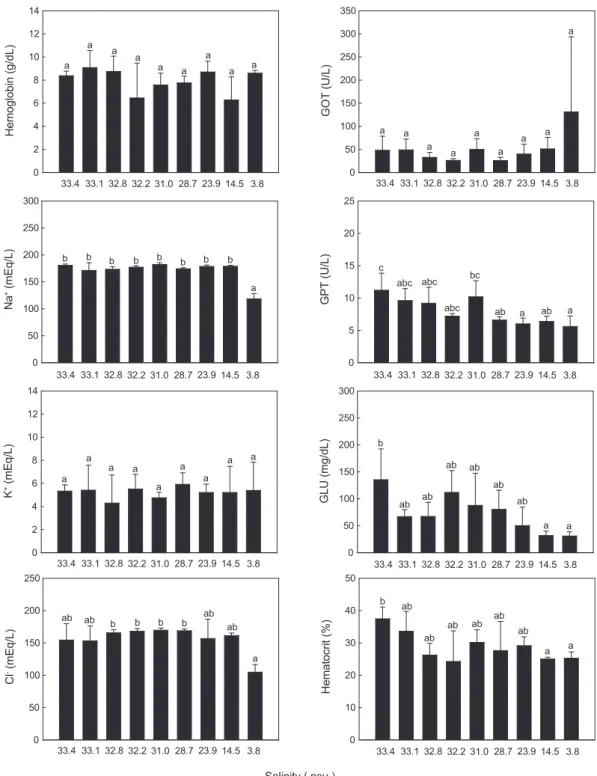
염분농도에따른쥐노래미의혈액성상변화는 Fig. 3에나타
Table 1. Survival rate (mean±SD) of greenling Hexagrammos otakii exposed to nine different salinities for 96 hours Salinity (psu)
Elapsed time (h)
33.4 33.1 32.8 32.2 31.0 28.7 23.9 14.5 3.8
Survival rate (%)1
24 100 100 100 100 100 100 100 100 100
48 100 100 100 100 100 100 100 100 86.7±11.5
72 100 100 100 100 100 100 100 100 66.7±11.5
96 100 100 100 100 100 100 100 100 53.3±30.6
1Values represent mean±SD (n=3).
Fig. 1. Changes of oxygen consumption rate in fasted greenling Hexagrammos otakii exposed to nine different salinities.
0 100 200 300 400 500
33.4 33.1 32.8 32.2 31.0 28.7 23.9 14.5 3.8 Oxygen comption rate (mg O2 kg-1 h-1)
Salinity (psu)
0 100 200 300 400 500 600
b b
b b b
d c
a b
33.4 33.1 32.8 32.2 31.0 28.7 23.9 14.5 3.8 Oxygen comption rate (mg O2 kg-1 h-1)
Salinity (psu)
염분에 따른 쥐노래미의 생리학적 영향 715
내었다. 염분 33.4-3.8 psu의범위에서 24시간노출된쥐노래미 혈액내 Hb, GOT, K+ 그리고 Cl-농도는염분농도에따라유의 한차이를보이지않거나초기농도인 33.4 psu(대조구)와차이 가나타나지않았다(P >0.05). 반면, 혈액내 GPT 농도의경우 28.7-3.8 psu 범위에서, 그리고 GLU와 hematocrit의농도의경 우 14.5-3.8 psu 범위에서대조구보다유의하게낮은값을보였 다(P <0.05). 또한 Na+농도의경우염분농도 33.4-14.5 psu 구
간에서는유의한차이가없었지만, 3.8 psu에서유의하게감소
하였다(P <0.05).
고 찰
염분변화는쥐노래미의생존율, 산소소비율과혈액성상에 유의한영향을미쳤다. 일반적으로사육수의염분변화는어류 체내삼투압조절을위한많은대사에너지의소비와스트레스 를유발하며항상성유지한계를넘어설경우결국폐사에이르 게된다(Woo and Fung, 1981; Chang et al., 2002; Kim et al., 2009, Oh et al., 2014). 본실험의경우염분 33.4-14.5 psu 범 위에서는 96시간동안폐사가발생하지않았지만, 3.8 psu에서 는 96시간후생존율은 53.3%까지감소하였다. 어류의생존율 에미치는염분의영향은어류의생리·생태학적특성에따라 달라진다(Martin, 1990; Boeuf and Payan, 2001; Kim et al., 2004). Kang et al. (2000, 2004)은기수역에서식하는날개망 둑(Favonigobius gymnauchen)과두줄망둑(Tridentiger trigo- nocephalus)을대상으로 10.1-33.6 psu 범위에서 40일간사육 하였을경우 90% 이상의생존율을보이고, 3.4 psu에서도두어
종모두 70.0% 이상의생존율을보고하였다. 또한광염성어종
으로알려져있는넙치(Paralichthys olivaceus)의경우 20 psu 와 5 psu에서 14주간사육시모두 86.0% 이상의높은생존율이 보고된바있다(Kim et al., 2004). 반면연안정착성어종이자
해상가두리에서주로양식이이루어지고있는조피볼락(Se- bastes schlegelii)의경우염분 3.8 psu에서 96시간후 26.7%까 지생존율이감소하는것(Oh et al., 2014)으로볼때쥐노래미 의경우광염성어종으로알려져있는날개망둑, 두줄망둑그리 고넙치에비해낮은염분저항성을보이며, 유사한연안서식 지분포를보이는조피볼락보다는높은염분저항성을가지는 것으로생각된다.
산소소비율은염분변화로유발된체내삼투압조절및항상 성유지를위해소비되는대사에너지를측정하는유용한방법 (Brown and Terwillinger, 1999; Altinok and Grizzle, 2003)으 로서, 염분변화에따른산소소비율은어종에따라다양하게 나타난다(Dalla Via et al., 1998; Kang et al., 2004; Shi et al., 2011; Oh et al., 2014). 본실험의경우실험염분 33.4-28.7 psu 범위에서는 염분농도간산소소비율의차이를보이지않고 23.9 psu에서급격히증가한다음감소하는경향을보였다. Oh et al. (2014) 역시조피볼락을대상으로한실험에서 33.4-28.7 psu 범위에서는염분간산소소비율의차이가없지만, 23.9- 14.5 psu에서급격히증가한뒤 3.8 psu에서감소하는결과를보 여본실험과유사한경향을보고하였다. Dalla Via et al. (1998) 는 sea bass (Dicentrarchus labrax)의경우염분을단계적으로 감소시킬경우일시적으로산소소비율이증가한뒤감소한다 고하였으며, 날개망둑(Kang et al., 2000)과두줄망둑(Kang et al., 2004)은일정염분범위내(33.6-20.2 psu) 산소소비율은 차이가없었지만, 일반적인서식환경범위를벗어난낮은염분
(10.1-0.0 psu)에서는산소소비율이유의하게감소하는것으로
나타났다. 이밖에 tawny puffer (Takifugu flavidus) 치어의경
우 5-25 psu 범위에서는염분증가에따라산소소비율이증가
한뒤 30-35 psu 범위에서는감소하는포물선(parabolic) 형태 를보인(Shi et al., 2011) 반면, 등삼투압(iso-osmotic) 조건에 서가장낮은산소소비율을보이는 croacker (Micropogonias furnieri) (Abud, 1992) 등과같이각어종마다염분변화에대 한반응이다르게나타남을알수있다. 일반적으로광염성어종 일경우장기간의염분순치가이루어진다면염분변화에의한 대사율의변동은매우적은것으로알려져있다(Claireaux and Lagardère, 1999). 이와같은대사율의변화는삼투압조절에 따른이온평형시 catecholamine과 corticosteroid와같은체내 호르몬분비와연관이있기(Wedemeyer, 1996) 때문에향후이 에대한연구가필요하다.
내성한계를벗어나는염분변화는어류에게스트레스요인 (Árnason et al., 2013)으로작용하며어종에따라혈액내다양 한인자에영향을미친다(Imsland et al., 2008; Oh et al., 2014).
Imsland et al. (2008)은 Atlantic halibut (Hipplglossus hippo- glossus)를대상으로 15, 25 그리고 32 psu 조건에서 4개월사 육시혈액내 Na+, GLU 그리고 hematocrit의농도는염분이낮 아질수록감소하지만, K+와 Hb 농도는영향이없는결과를보 고해본실험과유사한결과를보였다. 본실험에서나타난 Na+ Fig. 2. Mean oxygen consumption rates of fasted greenling
Hexagrammos otakii exposed to nine different salinities. Values (mean±SD, n=3) with different letter are significantly different.
0 100 200 300
33.4 33.1 32.8 32.2 31.0 28.7 23.9 14.5 3.8 Oxygen comption rate (mg O2 kg-1 h-1)
Salinity (psu)
0 100 200 300 400 500 600
b b
b b b
d c
a b
33.4 33.1 32.8 32.2 31.0 28.7 23.9 14.5 3.8 Oxygen comption rate (mg O2 kg-1 h-1)
Salinity (psu)
오승용ㆍ명정구ㆍ박진우 716
0 5 10 15 20 25
0 50 100 150 200 250 300
Salinity ( psu ) Na+ (mEq/L)
b
GPT (U/L)
c 0
2 4 6 8 10 12 14
a
Hemoglobin (g/dL) a a a
a a
a
a a
0 50 100 150 200 250 300 350
GOT (U/L)
a a
a a
a
a a a
a
0 50 100 150 200 250 300
0 2 4 6 8 10 12 14
a K+ (mEq/L)
a
a a
a a
a a a
GLU (mg/dL) b
0 10 20 30 40 50
0 50 100 150 200 250
ab
Cl- (mEq/L) ab a Hematocrit (%)
b
b b b b b b b
a abc abc
abc bc
ab a ab a
ab ab ab ab
ab ab
a a
a ab b b b b ab
ab
ab ab ab
a ab ab
a a
33.4 33.1 32.8 32.2 31.0 28.7 23.9 14.5 3.8 33.4 33.1 32.8 32.2 31.0 28.7 23.9 14.5 3.8
33.4 33.1 32.8 32.2 31.0 28.7 23.9 14.5 3.8 33.4 33.1 32.8 32.2 31.0 28.7 23.9 14.5 3.8
33.4 33.1 32.8 32.2 31.0 28.7 23.9 14.5 3.8 33.4 33.1 32.8 32.2 31.0 28.7 23.9 14.5 3.8
33.4 33.1 32.8 32.2 31.0 28.7 23.9 14.5 3.8 33.4 33.1 32.8 32.2 31.0 28.7 23.9 14.5 3.8
Fig. 3. Changes of the concentration of hemoglobin, Na+, K+, Cl-, GOT, GPT and glucose (GLU) in the blood plasma and hematocrit in the blood of greenling Hexagrammos otakii exposed to nine different salinities. Values (mean±SD, n=5) with different letter are significantly different.
농도의감소는 turbot (Scophthalmus maximus) (Gaumet et al., 1994), coho salmon (Oncorhynchus kisutch) (Morgan and Iwama, 1998), spotted wolffish (Anarhichas minor) (Magnus-
sen et al., 2008) 그리고조피볼락(Oh et al., 2014) 등다양한 어종에서관찰되었다. Oh et al. (2014)은해산어의서식환경 내염분농도의감소시 Na+와 Cl-농도유지를위한고삼투압
(hyper-osmoregulation) 조절을하지못할경우폐사의한원 인이될수있다고고찰하고있어쥐노래미역시저염분조건 에서의낮은 Na+농도는삼투압조절실패에따른폐사원인 중의하나로생각된다. 이밖에넙치(Hur et al., 2006)와농어 (Lateolabrax japonicus) (Han et al., 2003) 그리고조피볼락 (Oh et al., 2014)을급격한저염분에노출하였을때 GPT 농도
에는영향이없었지만, GOT의농도는증가하는결과를나타내
본실험과차이를보였다. 이러한관점에서볼때어종과염분 변화조건등에따라혈액내다양한인자들의반응정도가달 라짐을알수있다.
이상의결과에서염분의감소는쥐노래미의생존, 산소소비 율그리고혈액내화학성상에유의한영향을미치며, 28.7 psu 이하에서는삼투압조절을위한유의한생리적반응이나타남을 알수있었다. 이와같은결과는쥐노래미의서식지변화, 성장 및생존에대한영향을예측할수있는기초자료를제공하며, 사육시스템내사육밀도및용존산소관리를위한중요한정보 를제공할수있어쥐노래미양식을위한자료로활용할수있을 것이다. 향후쥐노래미의염분별에너지이용효율을구명할수 있는장기사육실험이필요하며, 이를통해염분저항성에대한 쥐노래미의생리적특성확인이요구된다.
사 사
본연구는한국해양과학기술원연구비(과제번호: PN66370, PO01215, PE99317) 지원에의해수행되었으며, 이에감사드 립니다. 실험기간중어류사육과관리, 자료정리에도움을주 신정유경연구원께도감사드립니다.
References
Abud EOA. 1992. Effects of salinity and weight on routine me- tabolism in the juvenile croacker, Micropogonias furnieri (Desmarest 1823). J Fish Biol 40, 471-472.
Ai-li J, Jin-li G, Wen-gui C and Chang-hai W. 2008. Oxygen consumption of the ascidian Sttyela clava in relation to body mass, temperature and salinity. Aquac Res 39, 1562-1568.
Altinok I and Grizzle JM. 2003. Effect of low salinities on oxy- gen consumption of selected euryhaline and stenohaline freshwater fish. J World Aquacult Soc 34, 113-117.
Árnason T, Magnadóttir B, Björnsson B, Steinarsson A and Björnsson BT. 2013. Effects of salinity and temperature on growth, plasma ions, cortisol and immune parameters of ju- venile Atlantic cod (Gadus morhua). Aquaculture 380-383, 70-79.
Boeuf G and Payan P. 2001. How should salinity influence fish growth? Comp Biochem Physiol 130C, 411-423.
Brown AC and Terwillinger NB. 1999. Developmental changes in oxygen uptake in Cancer magister (Dana) in response to changes in salinity and temperature. J Exp Mar Biol Ecol
241, 179-192.
Martin TJ. 1990. Osmoregulatory in three species of Ambassi- dae (Osteichthyes: Perciformes) from estuaries in Natai. S Afr J Zool 25, 229-234.
Chang YJ, Min BH, Chang HJ and Hur JW. 2002. Compari- son of blood physiology in juvenile black seabream (Acan- thopagrus schlegeli) reared in converted freshwater from seawater and seawater from freshwater. J Korean Fish Soc 35, 595-600.
Claireaux G and Lagardère JP. 1999. Influence of temperature, oxygen and salinity on the metabolism of the European sea bass. J Sea Res 42, 157-168.
Dalla Via J, Villani P, Gasteiger E and Niederstatter H. 1998.
Oxygen consumption in sea bass fingerling Dicentrachus labrax exposed to acute salinity and temperature changes:
metabolic basis for maximum stocking density estimations.
Aquaculture 169, 303-313.
Gaumet F, Boeuf G, Severe A, Le Roux A and Mayer-Gostan N.
1994. Effects of salinity on the ionic balance and growth of juvenile turbot. Journal of Fish Biology 47, 865-876.
Han H-K, Kang D-Y, Jun C-Y and Chang Y-J. 2003. Effect of salinity change on physiological response and growth of yearling sea bass, Lateolabrax japonicus. J Aquaculture 16, 31-36.
Hur JW, Lee JY, Kim YH, Park I-S and Jang YJ. 2006. Effects of salinity on hematological changes and survival of cultured olive flounder, Paralichthys olivaceus. Korean J Environ Biol 24, 380-389.
Imanpoor MR, Najafi E and Kabir M. 2012. Effects of different salinity and temperature on the growth, survival, haemato- crit and blood chemistry of goldfish (Carassius auratus).
Aquac Res 43, 332-338.
Imsland AK, Gústavsson A, Gunnarsson S, Foss A, Árnason J, Arnarson I, Jónsson AF, Smáradóttir H and Thorarensen H.
2008. Effects of reduced salinities on growth, feed conver- sion efficiency and blood physiology of juvenile Atlantic halibut (Hippoglossus hippoglossus L.). Aquaculture 274, 254-259.
Jobling M. 1982. A study of some factors affecting rates of oxy- gen consumption of plaice, Pleuronectes platessa L. J Fish Biol 20, 501-516.
Kang J-C, Chin P, Lee J-S, Shin Y-K and Cho K-S. 2000. Ef- fects of salinity on survival, growth and oxygen consump- tion rates of the juvenile gobiid, Favonigobius gymnauchen.
J Korean Fish Soc 33, 408-412.
Kang J-C, Lee J-H, Kim S-G, Park GS and Park SY. 2004. Tol- erance of juvenile gobiidae, Tridentiger trigonocephalus exposed to various salinity. Korean J Environ Biol 22, 153- Kim MJ, Chung SC, Song CB (2004) Effects of salinity on 158.
growth and survival of olive flounder, Paralichthys oliva- ceus. Korean J Ichthyol 16,100-106.
오승용ㆍ명정구ㆍ박진우 718
Lim HK, Han H-K, Lee J-H, Jeong MH and Hur JW. 2005. Ef- fects of gradual change of salinity on physiological response in hybrid striped bass (Morone chrysops×M. saxatilis). J Aquaculture 17, 43-48.
Magnussen AB, Imsland AK and Foss A. 2008. Interactive ef- fects of different temperatures and salinities on growth, feed conversion efficiency, and blood physiology in juvenile spotted wolffish, Anarhichas minor Olafen. J. World Aqac Soc 39, 804-811.
Masuda H, Amaoka K, Araga C, Uyeno T and Yoshino T. 1988.
The fishes of the Japanese archipelago. Tokai university press. 2nd ed, 305-306.
Morgan JD and Iwama GK. 1998. Salinity effects on oxygen consumption, gill Na+, K+-ATPase and ion regulation in ju- venile coho salmon. J Fish Biol 53, 1110-1119.
Mosser ML and Hettler WF. 1989. Routine metabolism of ju- venile spot, Leiostomus xanthurus. J Fish Biol 35, 703-707.
Oh S-Y, Kim C-K, Jang Y-S, Choi H-J and Myoung J-G. 2014.
Effect of salinity on survival, oxygen consumption and blood physiology of Korean Rockfish Sebastes schlegelii.
Ocean Polar Res 36, 135-143.
Oh S-Y and Noh CH. 2006. Effects of water temperature and photoperiod on the oxygen consumption rate of juvenile dark-banded rockfish, Sebastes inermis. J Aquaculture 19, 210-215.
Partridge GJ and Jenkins GI. 2002. The effect of salinity on growth and survival of juvenile black bream (Acanthopagrus butcheri). Aquaculture 210, 219-230.
Pérez-Robles J, Re AD, Giffard-Mena I and Díaz F. 2012. Inter- active effects of salinity on oxygen consumption, ammoni- um excretion, osmoregulation and Na+/K+-ATPase expres- sion in the bullseye puffer (Sphoeroides annulatus, Jenyns 1842). Aquac Res 43, 1372-1383.
Romo ZM, Re AD, Diaz F and Mena A. 2010. Physiological responses of pink abalone Haliotis corrugata (Gray, 1828) exposed to different combinations of temperature and salin- ity. Aquac Res 41, 953-960.
Shi Y, Zhang G, Liu J and Zang W. 2011. Effects of temperature and salinity on oxygen consumption of tawny puffer Takifu- gu flavidus juvenile. Aquac Res 42, 301-307.
Wedemeyer GA. 1996. Physiology of fish in intensive culture systems. Chapman & Hall, New York, 232 p.
Woo NYS and Fung ACY. 1981. Studies on the biology of red sea bream. 2. Salinity adaptation. Comp Biochem Physiol 69A, 237-242.