Regular Paper 110
J. Korean Inst. Electr. Electron. Mater. Eng.Vol. 29, No. 2, pp. 110-113 February 2016 DOI: http://dx.doi.org/10.4313/JKEM.2016.29.2.110 ISSN 1226-7945 (Print), 2288-3258 (Online)
존멜팅법으로 제조한 (YNdSm)-Ba-Cu-O계 고온복합초전도체의 미세구조 및 전기적 특성
김소정1,a, 이상헌2
1 한중대학교 전기전자공학과
2 선문대학교 전자공학과
Microstructure and Electrical Properties of (YNdSm)-Ba-Cu-O High T c Composite Superconductors by Zone Melting Process
So-Jung Kim
1,aand Sang-Heon Lee
21 Department of Electrical and Electronic Engineering, Hanzhong University, Donghae 25800, Korea
2 Department of Electronic Engineering, Sunmoon University, Asan 31460, Korea
(Received January 18, 2016; Accepted January 24, 2016)
Abstract: (YNdSm)-Ba-Cu-O system high T
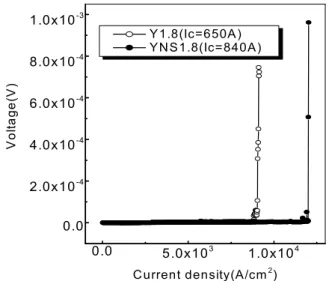
c composite superconductors were directionally grown by zone melting process, having large temperature gradient, in air atmosphere. Cylindrical green rods of (YNdSm)1.8Ba2.4Cu3.4Ox[(YNS)1.8]composite oxides by CIP (cold isostatic pressing) method using rubber mold were fabricated. The microstructure and superconducting properties were investigated by XRD, TEM and SQUID magnetometer. The size of nonsuperconducting (YNdSm)2BaCuO5 inclusions of the melt-textured (YNS)1.8 sample with CeO2 additive were remarkably reduced and uniformly distributed within the superconducting (YNS)1.8 matrix. (YNS)1.8 samples, with / without CeO2 additive, showed an onset Tc ≥ 90 K and sharp superconducting transition. The critical current density Jc value of the (YNdSm)1.8 superconductor with CeO2 additive were 840 A, 1.2×10⁴ A/cm2 in 77 K, 0 Tesla by direct current transport method.
Keywords: (YNS)-B-C-O, Composites, CIP, CeO
2, Zone melting process
1. 서 론
1987년에 산화물계 YBCO 고온초전도체가 발견된 이래 활성화된 고온초전도체에 관한 연구는, 현재 초전 도응용기기를 중심으로 응용 및 실용화를 위한 연구가 한창이다. 이러한 산화물계 고온초전도체를 실용화하기
a. Corresponding author; [email protected]
Copyright ©2016 KIEEME. All rights reserved.
This is an Open-Access article distributed under the terms of the Creative Commons Attribution Non-Commercial License (http://creativecommons.org/licenses/by-nc/3.0) which permits unrestricted non-commercial use, distribution, and reproduction in any medium, provided the original work is properly cited.
위해서는 고자기장 영역에서 높은 임계전류밀도 값이 요구된다. 이와 함께 실용화를 위해 요구되는 사항으로 초전도재료의 공정분야에 대한 개선을 들 수 가 있다.
고전적인 세라믹 공정법으로 제조한 다결정급 고온초
전도체의 경우에는 입계에서 weak link가 전류흐름의
큰 장해요인으로 작용하고 있다. 초전도재료의 외적특
성에 기인하는 결정립간의 grain boundary weak
link 문제를 해결하기 위해 여러가지 제조 공정법이
도입되고 있는데, 이러한 방법 중의 하나가 고온초전도
체를 국부적으로 용융가열시켜 입계간의 각도를 저각
입계로 하는 국부용융성장공정법(zone melt textured
growth method)이다 [1]. 이에 의하 면, 초전도체내의
전기전자재료학회논문지, 제29권 제2호 pp. 110-113, 2016년 2월: 김소정 등 111
입계들을 한 방향으로 배열, 성장시켜서 초전도체 전체 적으로 단결정급의 매우 높은 임계전류밀도 값을 갖는 고온초전도체의 제조가 가능한 것으로 보고되고 있다 [2,3]. 이와 같은 맥락에서 고자기장하에서 높은 임계 전류밀도를 얻을 목적으로 현재 많은 연구가 시도되고 있는 것이 YBCO계 고온초전도체의 Y자리에 희토류계 원소(RE : Nd, Sm, Gd 등)를 치환시켜 얻어진 희토류 계 고온초전도체(RE-B-C-O)이다 [4]. 따라서 본 연구 에서는 YBCO계 고온초전도체의 전기적 특성을 향상시 킬 목적으로 희토류계 원소인 Nd와 Sm을 치환한 (YNdSm)-B-C-O계 고온복합초전도체를 합성해 제조 하였으며, 이를 국부용융성장로(zone melting furnace) 를 이용해 대기중에서 한방향으로 용융 성장시켰다. 또 한 이렇게 얻어진 고온복합초전도체의 미세구조 및 초 전도 특성을 평가하였다.
2. 실험 방법
순도 99.9% 이상의 초전도 분말을 초기조성 (YNdSm)
1.8Ba
2.4Cu
3.4O
x(이하 (YNS)1.8이라 칭함)가 되 도록 평량한 후, 850
oC의 온도에서 24시간 3번에 걸쳐 하소를 하였고, 분말의 미세화를 기할 목적으로 attrition milling을 분당 450 rpm의 회전속도로 하였 다. 또한 고온복합초전도체의 비초전도상인 (YNdSm) 211 inclusion의 크기가 초전도특성에 미치는 영향을 고찰하기 위해 첨가제로 CeO
2를 1 wt% 첨가시킨 고 온복합초전도체의 분말도 함께 준비하였다. 이러한 초 기조성의 분말은 이후 국부용융성장실험을 행하기 위 해 내, 외경이 각각 7 mm 와 5 mm 그리고 길이 약 10 cm 정도의 원통형상을 갖는 green rod로 제조되 었으며, green rod의 제조 조건은 고무몰드(rubber mold)를 이용해 600 MPa의 압력하에서 냉간정수압성 형(cold isostatic pressing, CIP)법을 통해 얻어졌다.
이렇게 제조되어 얻어진 green rod는 950
oC에서 5시간 열처리를 거쳐 온도구배 약 300
oC/cm를 갖는 국부용융성장로(zone-melting furnace)에서 온도 1,090
oC, 시간당 2~4 mm의 성장속도로 성장 실험을 행하였다. 용융 성장이 끝난 고온복합초전도체는 500
oC 의 온도에서 약 50~100시간에 걸쳐 산소 확산 열처리 를 행하였고, 이후 XRD, TEM을 이용해 초전도체의 재료 특성을 평가하였으며, SQUID magnetometer와 직접전류수송법(direct transporting current method) 을 이용해 초전도체의 전기적 특성을 평가하였다.
up down
Secondary heater Zone heater Al2O3holder
Quartz tube Sample
Coolant inlet (-5 ℃) outlet
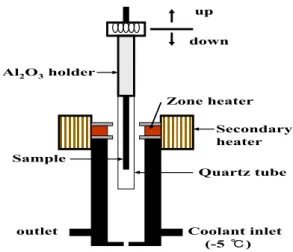
Fig. 1. Schematic apparatus for directional crystal growth using zone melting process.
그림 1은 본 실험에 사용된 국부용융성장로의 장치 도를 보여준다. 그림에서 보는 것과 같이 hot zone부 위에서 높은 온도구배를 얻을 목적으로 hot zone의 상, 하부에 chiller를 통해서 약 5℃의 냉각수를 순환 하도록 고안, 설계되었다.
3. 결과 및 고찰
950℃에서 5시간 열처리 한 고온복합초전도체 green rod는 국부용융성장로에서 한방향 용융 성장 실험을 하였다.
Growth direction
1cm
Fig. 2. Photograph of the (YNS)1.8 composite sample grown by zone melting process.
그림 2는 hot zone온도가 1,090
oC 이고, 성장속도
3 mm/hr로 고온복합초전도체 green rod를 국부용융
성장시킨 것으로, 외관상 양호하게 성장된 모습을 보여
주고 있다.
112 J. Korean Inst. Electr. Electron. Mater. Eng., Vol. 29, No. 2, pp. 110-113, February 2016: S.-J. Kim et al.
100 nm
211
twins
Fig. 3. TEM micrograph of the as grown (YNS)1.8 composite crystals with CeO
2additive
.123 211
5 nm
Fig. 4. HR-TEM image and SAED patterns of the as grow n (YNS)1.8 composite crystal.
그림 3의 TEM 사진에서 보는 것과 같이, sub-micron 크기의 211 inclusion이 123 matrix내 쌍정(twins)과 함께 잘 성장된 모습이 관측되었다.
그림 4는 한방향으로 성장된 (YNS)1.8 고온복합초 전도체의 HR-TEM 및 SAED(selected-area electron diffraction patterns)분석 결과로, 깨끗한 123 / 211 계면의 모습을 보여주고 있으며, 211 inclusion 및 123 matrix상 모두 거의 단결정급으로 성장되고 있음 을 보이고 있다. 이는 온도구배가 매우 큰 용융성장로 의 사용과 최적의 성장속도가 이루어낸 결과라고 볼 수가 있다.
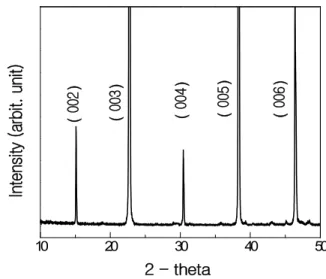
그림 5는 복합고온초전도체의 용융성장 이후의 단결 정 정도를 고찰하기 위해 XRD회절분석을 나타낸 것 으로, 거의 단결정급 c-축(00L)으로 잘 성장된 결과를
10 20 30 40 50
In te ns ity ( ar bi t. u ni t)
2 - theta
( 00 6 )
( 00 5 )
( 00 4 )
( 00 3 )
( 00 2 )
Fig. 5. XRD pattern of the as grown (YNS)1.8 composite crystal, showing the near perfect c-axis orientation.
5 0 6 0 7 0 8 0 9 0
Z F C H / / c - a x i s
( Y N S ) 1 . 8 ( Y N S ) 1 . 8 + C e O2 Y 1 . 8
Normalized M(emu/g)
T e m p e r a t u r e ( K )
Fig. 6. Temperature dependence of magnetic susceptibility of the directionally melt-textured Y1.8 and (YNS)1.8 sample.
보여주고 있다. 그림 6은 한방향으로 성장된 (YNS)1.8 고온복합초전도체의 zero field cooling 상태하에서 임계온도를 측정한 것으로 onset T
c가 90 K 이상을 보이고 있다.
그림 7은 Y1.8 및 (YNS)1.8 고온복합초전도체의 인
가 자계에 따른 대자율의 정도를 측정한 값으로, 77 K
에서 c-축으로 평행하게 10 Gauss의 자계를 인가해서
얻어졌다. 그림에서 보듯이 자계가 인가된 전 영역에
걸쳐 (YNS)1.8이 Y1.8보다 우수하게 나타났으며 특히
CeO
2가 첨가된 (YNS)1.8의 경우 시편에서의 대자율이
전기전자재료학회논문지, 제29권 제2호 pp. 110-113, 2016년 2월: 김소정 등 113
-2x10⁴ -1x10⁴ 0 1x10⁴ 2x10⁴
-80 -60 -40 -20 0 20 40 60
80 Y 1.8
(Y N S )1.8 (Y N S )1.8+ C eO2
M (emu/cm3 )
Applied field(gauss)
Fig. 7. M-H curves of the as grown Y1.8 and (YNS)1.8 c omposite crystal.
0.0 5.0x10³ 1.0x10⁴
0.0 2.0x10⁻⁴ 4.0x10⁻⁴ 6.0x10⁻⁴ 8.0x10⁻⁴ 1.0x10⁻³
Y 1.8(Ic=650A ) Y N S 1.8(Ic= 840A )
Voltage(V)