Vol. 24, No. 11 (2014)
599
Microwave Sol-Gel Preparation of NaLa(MoO
4)
2:Eu
3+/Yb
3+Particles and Their Upconversion Photoluminescence Properties
Chang Sung Lim †
Department of Advanced Materials Science & Engineering, Hanseo University, Seosan 356-706, Korea (Received August 14, 2014 : Received in revised form September 21, 2014 : Accepted October 7, 2014)
Abstract
NaLa1-x(MoO4)2:Eu3+/Yb3 phosphors with doping concentrations of Eu3+ and Yb3+ (x = Eu3++ Yb3+, Eu3+= 0.05, 0.1, 0.2 and Yb3+= 0.2, 0.45) were successfully synthesized by the microwave-modified sol-gel method, and the upconversion and spectroscopic properties were investigated. Well-crystallized particles showed a fine and homogeneous morphology with particle sizes of 2-5µm. Under excitation at 980 nm, NaLa0.5(MoO4)2:Eu0.05Yb0.45 particles exhibited a strong 525-nm emission band and a weak 550-nm emission band in the green region, and a very weak 665-nm emission band in the red region. The strong 525-nm emission in the green region corresponds to the 7F1→5D1 transition and the weak 550-nm emission in the green region corresponds to the 7F0→5D2 transition, while the very weak emission 665-nm band in the red region corresponds to the5D0→7F3 transition. The Raman spectra of the doped particles indicated the domination of strong peaks at higher frequencies of 762, 890, 1358 and 1430 cm−1 and weak peaks at lower frequencies of 323, 388 and 450 cm−1 induced by the disorder of the [MoO4]2− groups with the incorporation of the Eu3+ and Yb3+ elements into the crystal lattice or by a new phase formation.
Key words
microwave sol-gel, double molybdate, upconversion, Raman spectroscopy.1. Introduction
The photoluminescence particles have evolved in their applications, such as fluorescent lamps, cathode ray tubes, solid-state laser, amplifiers for fiber optics communi- cation and new optoelectronic devices, which show high luminescence quantum yields, since usually more than one metastable excited state exists, multiple emissions are observed. 1,2) Rare-earth activated upconversion(UC) particles can convert near infrared radiation of low energy into visible radiation of high energy. Recently, the synthesis and the luminescence properties of UC particles have attracted considerable interest since they are con- sidered as potentially active components in new opto- electronic devices and luminescent labels for imaging and biodetection assays, which overcome the current limitations in traditional photoluminescence materials. 3)
Most of MR(MoO 4 ) 2 (M = Li + , Na + , K + ; R = La 3+ , Gd 3+ , Y 3+ ) possess the tetragonal scheelite structure with the space group I4 1/a , and belong to the family of double tungstates compounds. It is possible for the structure of MR(MoO 4 ) 2 to be transformed to a highly disordered
tetragonal scheelite structure from the monoclinic struc- ture. It is possible for the trivalent rare earth ions in the disordered tetragonal-phase to be partially substituted by Eu 3+ and Yb 3+ ions. These ions are effectively doped into the crystal lattices of the tetragonal phase due to the similar radii of the trivalent rare-earth ions in R 3+ , which results in the excellent UC photoluminescence properties. 4-6) Among rare-earth ions, the Eu 3+ ion is suitable for converting infrared to visible light through the UC process due to its appropriate electronic energy level configuration. The co-doped Yb 3+ ion and Eu 3+ ion can remarkably enhance the UC efficiency for the shift from infrared to visible light due to the efficiency of the energy transfer from Yb 3+ to Eu 3+ . The Yb 3+ ion, as a sensitizer, can be effectively excited by an incident light source energy. This energy is transferred to the activator from which radiation can be emitted. 7-9)
Rare-earth activated double molybdates have attracted great attention because of spectroscopic characteristics and excellent upconversion photoluminescence properties.
Several processes have been developed to prepare the rare-earth doped double molybdates. 10-15) The sol-gel
†
Corresponding author
E-Mail : [email protected] (C. S. Lim, Hanseo Univ.)
© Materials Research Society of Korea, All rights reserved.
This is an Open-Access article distributed under the terms of the Creative Commons Attribution Non-Commercial License (http://creative-
commons.org/licenses/by-nc/3.0) which permits unrestricted non-commercial use, distribution, and reproduction in any medium, provided the
original work is properly cited.
process provides some advantages over the conventional solid-state method, including good homogeneity, low calcination temperature, small particle size and narrow particle size distribution optimal for good luminescent characteristics. However, the sol-gel process has a disadvantage in that it takes a long time for gelation.
Compared with the usual methods, microwave synthesis has the advantages of a very short reaction time, small- size particles, narrow particle size distribution, and high purity of final polycrystalline samples. Microwave heating is delivered to the material surface by radiant and/or convection heating, which is transferred to the bulk of the material via conduction. 16,17) A microwave sol-gel route is a cost-effective method that provides high homo- geneity and is easy to scale-up, and it is emerging as a viable alternative approach for the quick synthesis of high- quality luminescent materials. However, the synthesis of NaLa(MoO 4 ) 2 :Eu 3+ /Yb 3 phosphors by the microwave sol- gel method has not been reported.
In this study, NaLa 1-x (MoO 4 ) 2 :Eu 3+ /Yb 3+ phosphors with doping concentrations of Eu 3+ and Yb 3+ (x = Eu 3+ + Yb 3+ , Eu 3+ = 0.05, 0.1, 0.2 and Yb 3+ = 0.2, 0.45) were prepared by the microwave sol-gel method followed by heat treat- ment. The synthesized particles were characterized by X- ray diffraction(XRD), scanning electron microscopy(SEM), and energy-dispersive X-ray spectroscopy (EDS). The optical properties were examined comparatively using photoluminescence(PL) emission and Raman spectroscopy.
2. Experimental Procedure
Appropriate stoichiometric amounts of Na 2 MoO 4 ·2H 2 O (99 %, Sigma-Aldrich, USA), La(NO 3 ) 3 ·6H 2 O (99 %, Sigma-Aldrich, USA), (NH 4 ) 6 Mo 7 O 24 ·4H 2 O (99 %, Alfa Aesar, USA), Eu(NO 3 ) 3 ·5H 2 O (99.9 %, Sigma-Aldrich, USA), Yb(NO 3 ) 3 ·5H 2 O (99.9 %, Sigma-Aldrich, USA), citric acid (99.5 %, Daejung Chemicals, Korea), NH 4 OH (A.R.), ethylene glycol(A.R.) and distilled water were used to prepare NaLa(MoO 4 ) 2 , NaLa 0.8 (MoO 4 ) 2 :Eu 0.2 , NaLa 0.7 (MoO 4 ) 2 :Eu 0.1 Yb 0.2 and NaLa 0.5 (MoO 4 ) 2 :Eu 0.05 Yb 0.45 com- pounds with doping concentrations of Eu 3+ and Yb 3+
(Eu 3+ = 0.05, 0.1, 0.2 and Yb 3+ = 0.2, 0.45). To prepare NaLa(MoO 4 ) 2 , 0.2 mol% Na 2 MoO 4 ·2H 2 O and 0.114 mol%
(NH 4 ) 6 Mo 7 O 24 ·4H 2 O were dissolved in 20 mL of ethylene glycol and 80 mL of 5M NH 4 OH under vigorous stirring and heating. Subsequently, 0.4 mol% La(NO 3 ) 3 ·6H 2 O and citric acid(with a molar ratio of citric acid to total metal ions of 2:1) were dissolved in 100 mL of distilled water under vigorous stirring and heating. Then, the solutions were mixed together under vigorous stirring and heating at 80-100 o C. At the end, highly transparent solutions were obtained and adjusted to pH = 7-8 by the addition of 8M NH 4 OH. In order to prepare NaLa 0.8 (MoO 4 ) 2 :Eu 0.2 ,
the mixture of 0.32 mol% La(NO 3 ) 3 ·6H 2 O with 0.08 mol% Eu(NO 3 ) 3 ·5H 2 O was used for the creation of the rare earth solution. In order to prepare NaLa 0.7 (MoO 4 ) 2 : Eu 0.1 Yb 0.2 , the mixture of 0.28 mol% La(NO 3 ) 3 ·6H 2 O with 0.04 mol% Eu(NO 3 ) 3 ·5H 2 O and 0.08 mol% Yb(NO 3 ) 3 ·5H 2 O was used for the creation of the rare earth solution. In order to prepare NaLa 0.5 (MoO 4 ) 2 :Eu 0.05 Yb 0.45 , the rare earth containing solution was generated using 0.2 mol%
La(NO 3 ) 3 ·6H 2 O with 0.02 mol% Eu(NO 3 ) 3 ·5H 2 O and 0.18 mol% Yb(NO 3 ) 3 ·5H 2 O.
The transparent solutions were placed into a micro- wave oven operating at a frequency of 2.45 GHz with a maximum output-power of 1250 W for 30 min. The working cycle of the microwave reaction was controlled very precisely using a regime of 40 s on and 20 s off for 15 min, followed by further treatment of 30 s on and 30 s off for 15 min. The samples were treated with ultrasonic radiation for 10 min to produce a light yellow transparent sol. After this, the light yellow transparent sols were dried at 120 o C in a dry oven to obtain black dried gels.
The black dried gels were grinded and heat-treated at 900 o C for 16 h with 100 o C intervals between 600-900
o C. Finally, white particles were obtained for NaLa(MoO 4 ) 2 and pink particles for the doped compositions.
The phase composition of the synthesized particles was identified using XRD(D/MAX 2200, Rigaku, Japan). The microstructure and surface morphology of the NaLa (MoO 4 ) 2 , NaLa 0.8 (MoO 4 ) 2 :Eu 0.2 , NaLa 0.7 (MoO 4 ) 2 :Eu 0.1 Yb 0.2 and NaLa 0.5 (MoO 4 ) 2 :Eu 0.05 Yb 0.45 particles were observed using SEM/EDS(JSM-5600, JEOL, Japan). The PL spectra were recorded using a spectrophotometer(Perkin Elmer LS55, UK) at room temperature. Raman spectroscopy measurements were performed using a LabRam Aramis (Horiba Jobin-Yvon, France). The 514.5-nm line of an Ar ion laser was used as an excitation source, and the power on the samples was kept at 0.5 mW.
3. Results and Discussion
Fig. 1 shows the X-ray diffraction patterns of the (a) JCPDS 24-1103 data of NaLa(MoO 4 ) 2 , the synthesized (b) NaLa(MoO 4 ) 2, (c) NaLa 0.8 (MoO 4 ) 2 :Eu 0.2 , (d) NaLa 0.7 (MoO 4 ) 2 :Eu 0.1 Yb 0.2 , and (e) NaLa 0.5 (MoO 4 ) 2 :Eu 0.05 Yb 0.45 particles. The diffraction patterns of the products can be mostly consistent with the standard data of NaLa (MoO 4 ) 2 (JCPDS 24-1103). NaLa(MoO 4 ) 2 as a member of double molybdate family has a sheelite structure with the lattice constants of a = 5.345 Å and c = 11.790 Å, 18) which is tetragonal with space group I4 1/a . The impurity phase peaks were detected at 24.5 o and 32 o in Fig. 1(e). The foreign reflexes are marked with asterisk in Fig. 1(e) when the doping concentration of Eu 3+ /Yb 3+ is 0.05/
0.45 mol%. Earlier, similar impurity phases were also
observed in the case of Er 3+ /Yb 3+ doped CaMoO 4 and SrMoO 4 phosphors when the doping concentration of Er 3+ /Yb 3+ is 0.02/0.18 mol%. 17,18) In NaLa(MoO 4 ) 2 matrix, Na + and La 3+ are randomly arranged and form a dis- ordered structure. Eu 3+ and Yb 3+ ions can be effectively doped in the NaLa(MoO 4 ) 2 lattice by partial substitution of La 3+ site due to the similar radii of La 3+ and by Eu 3+
and Yb 3+ . Post heat-treatment plays an important role in a well-defined crystallized morphology. To achieve a well-defined crystalline morphology, NaLa(MoO 4 ) 2, NaLa 0.8 (MoO 4 ) 2 :Eu 0.2 , NaLa 0.7 (MoO 4 ) 2 :Eu 0.1 Yb 0.2 , and NaLa 0.5 (MoO 4 ) 2
:Eu 0.05 Yb 0.45 phases need to be heat treated at 900 o C for 16 h. It is assumed that the doping amount of Eu 3+ /Yb 3+
has a great effect on the crystalline cell volume of the NaLa(MoO 4 ) 2 , because of the different ionic sizes and energy band gaps.
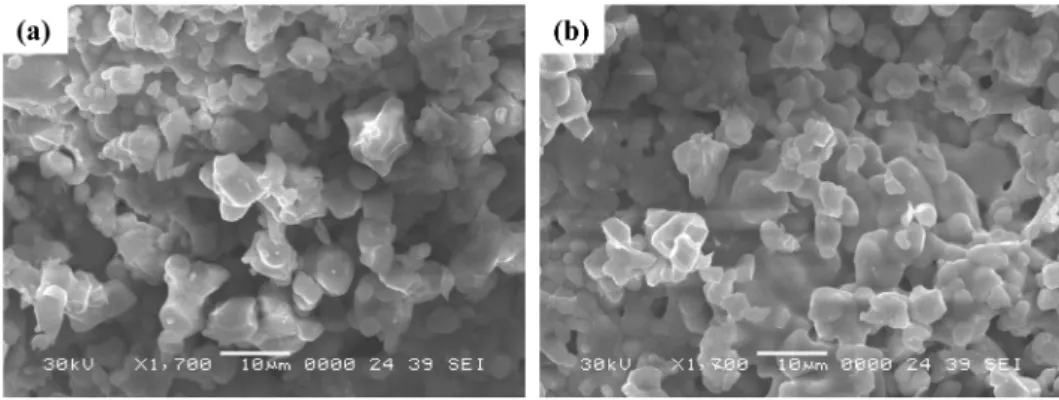
Fig. 2 shows SEM images of the synthesized (a) NaLa 0.8 (MoO 4 ) 2 :Eu 0.2 and (b) NaLa 0.5 (MoO 4 ) 2 :Eu 0.05 Yb 0.45 particles. The as-synthesized samples show similar mor- phologies, which are well crystallized with a fine and homogeneous morphology and particle size of 2-5 µm. It
is noted that the obtained sample possesses a partial substitution of La 3+ by Eu 3+ and Yb 3+ ions, and the ions are effectively doped into crystal lattices of the NaLa (MoO 4 ) 2 phase due to the similar radii of La 3+ and by Eu 3+ and Yb 3+ . During the cyclic microwave-modified sol- gel process, the ethylene glycol was evaporated slowly at its boiling point. Ethylene glycol is a polar solvent at its boiling point of 197 o C, this solvent is a good candidate for the microwave process. If ethylene glycol is used as the solvent, the reactions proceed at the boiling point temperature. When microwave radiation is supplied to the ethylene-glycol-based solution, the components dissolved in the ethylene glycol can couple. The charged particles vibrate in the electric field interdependently when a large amount of microwave radiation is supplied to the ethylene glycol. The microwave sol-gel process of double molyb- dates provides the energy to synthesize the bulk of the material uniformly, so that fine particles with controlled morphology can be fabricated in short time periods. The method is a cost-effective way to provide highly homo- geneous products with easy scale-up and is a viable alternative for the rapid synthesis of UC particles. This suggests that the cyclic microwave-modified sol-gel route is suitable for the growth of NaLa 1-x (MoO 4 ) 2 :Eu 3+ /Yb 3+
crystallites.
Fig. 3 shows the energy-dispersive X-ray spectroscopy patterns of the synthesized (a) NaLa(MoO 4 ) 2 , (b) NaLa 0.8 (MoO 4 ) 2 :Eu 0.2 , (c) NaLa 0.7 (MoO 4 ) 2 :Eu 0.1 Yb 0.2 and (d) NaLa 0.5 (MoO 4 ) 2 :Eu 0.05 Yb 0.45 particles, and quantitative composi- tions of (e) NaLa(MoO 4 ) 2 , (f) NaLa 0.8 (MoO 4 ) 2 : Eu 0.2 , (g) NaLa 0.7 (MoO 4 ) 2 :Eu 0.1 Yb 0.2 and (h) NaLa 0.5 (MoO 4 ) 2 :Eu 0.05 - Yb 0.45 particles. The EDS pattern shows that the (a) NaLa(MoO 4 ) 2 , (b) NaLa 0.8 (MoO 4 ) 2 :Eu 0.2 , (c) NaLa 0.7 (MoO 4 ) 2
:Eu 0.1 Yb 0.2 and (d) NaLa 0.5 (MoO 4 ) 2 :Eu 0.05 Yb 0.45 particles are composed of Na, La, Mo, O for NaLa(MoO 4 ) 2 , Na, La, Mo, O and Eu for NaLa 0.8 (MoO 4 ) 2 :Eu 0.2 , Na, La, Mo, O, Eu and Yb for NaLa 0.7 (MoO 4 ) 2 :Eu 0.01 Yb 0.02 , and Na, La, Mo, O, Eu and Yb for NaLa 0.5 (MoO 4 ) 2 :Eu 0.05 Yb 0.45 particles. The quantitative compositions of (e)-(h) are in good relation with nominal compositions of the particles.
Fig. 1. X-ray diffraction patterns of the (a) JCPDS 24-1103 data of NaLa(MoO
4)
2, the synthesized (b) NaLa(MoO
4)
2,(c) NaLa
0.8(MoO
4)
2:Eu
0.2, (d) NaLa
0.7(MoO
4)
2:Eu
0.1Yb
0.2, and (e) NaLa
0.5(MoO
4)
2:Eu
0.05- Yb
0.45particles.
Fig. 2. SEM images of the synthesized (a) NaLa
0.8(MoO
4)
2:Eu
0.2and (b) NaLa
0.5(MoO
4)
2:Eu
0.05Yb
0.45particles.
The relation of Na, La, Mo, O , Eu and Yb components exhibit that the pure and doped particles can be suc- cessfully synthesized using the microwave-modified sol-gel method. The microwave-modified sol-gel process of double molybdates provides the energy to synthesize the bulk of the material uniformly, so that fine particles with con- trolled morphology can be fabricated in a short time period.
Fig. 4 shows the UC photoluminescence emission spectra of the as-prepared (a) NaLa(MoO 4 ) 2, (b) NaLa 0.8 (MoO 4 ) 2 :Eu 0.2 , (c) NaLa 0.7 (MoO 4 ) 2 :Eu 0.1 Yb 0.2 and (d) NaLa 0.5 (MoO 4 ) 2 :Eu 0.05 Yb 0.45 particles excited under 980 nm at room temperature. The UC intensities of (c) NaLa 0.7 (MoO 4 ) 2 :Eu 0.1 Yb 0.2 and (d) NaLa 0.5 (MoO 4 ) 2 :Eu 0.05 - Yb 0.45 particles particles exhibited a strong 525-nm and a weak 550-nm emission bands and in the green region, and a very weak 665-nm emission band in the red region. The strong 525-nm emission and the weak 550- nm in the green region correspond to the 7 F 1 → 5 D 1 transition and 5 D 1 → 7 F J transition, respectively. The very weak emission 665-nm band in the red region corresponds to the 5 D 0 → 7 F 3 transition. The UC intensities of (a) NaLa(MoO 4 ) 2 were not detected and the UC intensities of (b) NaLa 0.8 (MoO 4 ) 2 :Eu 0.2 shows a very weak 525-nm and 550-nm emission bands and in the green region, and a very weak 665-nm emission band in the red region. The UC intensity of (d) NaLa 0.5 (MoO 4 ) 2 :Eu 0.05 Yb 0.45 is much higher than that of (c) NaLa 0.7 (MoO 4 ) 2 :Eu 0.1 Yb 0.2 particles.
The doping amounts of Eu 3+ /Yb 3+ had a great effect on the morphological features of the particles and their UC fluorescence intensity. The Yb 3+ ion sensitizer can be effectively excited by the energy of an incident light source, this energy is transferred to the activator where radiation can be emitted. The Eu 3+ ion activator is the
luminescence center for these UC particles, and the sen- sitizer Yb 3+ enhances the UC luminescence efficiency. 19,20)
Fig. 5 shows the Raman spectra of the synthesized Raman spectra of the synthesized (a) NaLa(MoO 4 ) 2 (NLM), (b) NaLa 0.5 (MoO 4 ) 2 :Eu 0.05 Yb 0.45 (NLM:Eu), (c) NaLa 0.7 (MoO 4 ) 2 :Eu 0.1 Yb 0.2 (NLM:EuYb) and (d) NaLa 0.5 (MoO 4 ) 2 :Eu 0.05 Yb 0.45 (NLM:EuYb#) particles excited by the 514.5-nm line of an Ar ion laser at 0.5 mW. The internal modes for the (a) NaLa(MoO 4 ) 2 (NLM) particles were detected at 220, 228, 318, 332, 375, 835, 906 and 938 cm −1 , respectively. The well-resolved sharp peaks for the NaLa(MoO 4 ) 2 (NLM) particles indicate a high crystal- linity state of the synthesized particles. The internal Fig. 3. EDS patterns of the synthesized (a) NaLa(MoO
4)
2, (b) NaLa
0.8(MoO
4)
2:Eu
0.2, (c) NaLa
0.7(MoO
4)
2: Eu
0.1Yb
0.2and (d) NaLa
0.5(MoO
4)
2: Eu
0.05Yb
0.45particles, and quantitative compositions of (e) NaLa(MoO
4)
2, (f) NaLa
0.8(MoO
4)
2:Eu
0.2, (g) NaLa
0.7(MoO
4)
2:Eu
0.1Yb
0.2and (h) NaLa
0.5(MoO
4)
2:Eu
0.05Yb
0.45particles.
Fig. 4. Upconversion photoluminescence emission spectra of (a)
NaLa(MoO
4)
2,(b) NaLa
0.8(MoO
4)
2:Eu
0.2, (c) NaLa
0.7(MoO
4)
2:Eu
0.1-
Yb
0.2and (e) LiLa
0.5(MoO
4)
2:Eu
0.05Yb
0.45particles excited under
980 nm at room temperature.
vibration mode frequencies are dependent on the lattice parameters and the degree of the partially covalent bond between the cation and molecular ionic group [MoO 4 ] 2− . The Raman spectra of the synthesized (b) NaLa 0.5 (MoO 4 ) 2 :Eu 0.05 Yb 0.45 (NLM:Eu), (c) NaLa 0.7 (MoO 4 ) 2 :Eu 0.1- Yb 0.2 (NLM:EuYb) and (d) NaLa 0.5 (MoO 4 ) 2 :Eu 0.05 Yb 0.45 (NLM:EuYb#) particles indicated the domination of strong peaks at higher frequencies of 762, 890, 1358 and 1430 cm −1 and weak peaks at lower frequencies of 323, 388 and 450 cm −1 . The doped particles prove that the doping ions can influence the structure of the host materials. The combination of a heavy metal cation and the inter-ionic distance for Eu 3+ and Yb 3+ substitutions in La 3+ sites in the lattice result in a high probability of UC and phonon-splitting relaxation in NaLa 1-x (MoO 4 ) 2 :Eu 3+ / Yb 3+ crystals. It is assumed that these very strong and strange effects are generated by the disorder of the [MoO 4 ] 2− groups with the incorporation of the Eu 3+ and Yb 3+ elements into the crystal lattice or by a new phase formation. 17,21)
4. Conclusions
NaLa 1-x (MoO 4 ) 2 :Eu 3+ /Yb 3 phosphors with doping con- centrations of Eu 3+ and Yb 3+ (x = Eu 3+ + Yb 3+ , Er 3+ = 0.05, 0.1, 0.2 and Yb 3+ = 0.2, 0.45) were successfully synthe- sized by the microwave sol-gel method showing a fine and homogeneous morphology with particle sizes of 2- 5 µm. The UC intensities of NaLa 0.7 (MoO 4 ) 2 :Eu 0.1 -Yb 0.2 and NaLa 0.5 (MoO 4 ) 2 :Eu 0.05 Yb 0.45 particles exhibited a strong 525-nm emission band, a weak 550-nm emission band in the green region, and a very weak 665-nm emission band in the red region. The strong 525-nm emission in the green region corresponds to the 7 F 1
→ 5 D 1 transition and the weak 550-nm emission in the green region corresponds to the 7 F 0 → 5 D 2 transition, while the very weak emission 665-nm band in the red region corresponds to the 5 D 0 → 7 F 3 transition. The UC intensity of NaLa 0.5 (MoO 4 ) 2 :Eu 0.05 Yb 0.45 is much higher than that of NaLa 0.7 (MoO 4 ) 2 :Eu 0.1 Yb 0.2 particles. The Raman spectra of the doped particles indicated the domination of strong peaks at higher frequencies of 762, 890, 1358 and 1430 cm −1 and weak peaks at lower fre- quencies of 323, 388 and 450 cm −1 induced by the disorder of the [MoO 4 ] 2− groups with the incorporation of the Eu 3+ and Yb 3+ elements into the crystal lattice or by a new phase formation.
References
1. M. Lin, Y. Zho, S. Wang, M, Liu, Z. Duan, Y. Chen, F.
Li, F. Xu and T. Lu, Biol. Adv., 30, 1551 (2012).
2. M.Wang, G. Abbineni, A. Clevenger, C. Mao, S. Xu and Nanomedicine, Nanotech. Biology, and Medicine, 7, 710 (2011).
3. A. Shalav, B. S. Richards and M. A. Green, Sol. Ener.
Mater. Sol. Cells, 91, 829 (2007).
4. C. Guo, H. K. Yang and J. H. Jeong, J. Lumin., 130, 1390 (2010).
5. J. Liao, D. Zhou, B. Yang, R. liu, Q. Zhang and Q. Zhou, J. Lumin., 134, 533 (2013).
6. J. Sun, J. Xian and H. Du, J. Phys. Chem. Solids, 72, 207 (2011).
7. T. Li, C. Guo, Y. Wu, L. Li and J. H. Jeong, J. Alloys Compd., 540, 107 (2012).
8. M. Nazarov and D. Y. Noh, J. Rare Earths, 28, 1 (2010).
9. J. Sun, W. Zhang, W. Zhang and H. Du, Mater. Res.
Bull., 47, 786 (2012).
10. H. Du, Y. Lan, Z. Xia and J. Sun, Mater. Res. Bull., 44, 1660 (2009).
11. Z. Wang, H. Liang, M. Gong and Q. Su, J. Alloys Compd., 432, 308 (2007).
12. M. Haque and D. K. Kim, Mater. Lett., 63, 793 (2009).
13. C. Zhao, X. Yin, F. Huang and Y. Hang, J. Sol. State.
Chem., 184, 3190 (2011).
14. L. Qin, Y. Huang, T, Tsuboi and H. J. Seo, Mater. Res.
Bull., 47, 4498 (2012).
15. Y. L. Yang, X. M. Li, W. L. Feng, W. L. Li and C. Y.
Tao, J. Alloy Compd., 505, 239 (2010) .
16. C. S. Lim, Mater. Chem. Phys., 140, 154 (2013).
17. C. S. Lim, Mater. Res. Bull., 47, 4220 (2013).
18. J. Zhang, X. Wang, X, Zhang, X. Zhao, X. Liu and L.
Peng, Inog. Chem. Commun., 14, 1723 (2011).
19. J. Sun, J. Xian, X. Zhang and H. Du, J. Rare Earths, 29, 32 (2011).
20. Q. Sun X. Chen, Z. Liu, F. Wang, Z. Jiang and C. Wang, J. Alloys & Compd., 509, 5336 (2012).
21. C. S. Lim, Mater. Res. Bull., 48, 3805 (2013).