옥수수 수염의 항산화 활성과 기능성분 분석
구강모, 김순권, 강영화*
경북대학교 농업생명과학대학 식물생명과학부
Antioxidant Activity and Functional Components of Corn Silk(Zea mays L.)
Kang Mo Ku, Soon Kwon Kim and Young Hwa Kang*
Division of Plant Biosciences, College of Agriculture and Life Science, Kyungpook National University, Daegu 702-701, Korea
Abstract - In order to find out superior corn line which has a strong antioxidant activity in the corn silk, antioxidant compounds and antioxidant activity were measured from various inbred and F1 lines. As a result, the contents of phenolic and flavonoid compounds range from 532 mg/100 g to 3,274 mg/100 g and from 980 mg/100 g to 2,420 mg/100 g respectively. Absorbance at 517 nm for contents of anthocyanins ranges from 0.05 to 0.76. Correlation coefficients between antioxidant compounds and various antioxidant assays such as DPPH, ABTS and FRAP were analyzed.
Correlation coefficients between antioxidant activity and phenolic compounds and anthocyanin were significantly high in ABTS and FRAP assays. Considering acidic extraction condition and intervention between anthocyanins and DPPH solution, ABTS assay and FRAP assay are more suitable methods to evaluate antioxidant activity of corn silks.
Especially, ABTS assay is thought to be the best method among three assays because the antioxidant activity in ABTS assay showed high correlation with phenol, flavonoid and anthocyanin compounds respectively. Among the samples, S15 which showed the highest contents of total phenolic compounds and the most potent antioxidant activity in ABTS and FRAP assay will be a good source for functional material.
Key words -Antioxidant activity, Corn silk, Functional substances
*
교신저자(E-mail) : [email protected]서 언
옥발, 옥미발, 옥촉서예라고도 불리우는 옥수수(Zea mays L.) 수염은 예로부터 민간에서는 고혈압, 강혈당, 토 혈, 지혈, 비출혈, 평간, 설열, 각기, 축농증, 이담작용, 이 뇨작용 등에 효능이 있다고 보고되어 왔다. 옥수수 수염의 효능으로는 이뇨작용(Velazquez et al., 2005), 당뇨억제 효과(Rau et al., 2006), COX-2 저해효과(Kim et al., 2005), Nitric oxide synthase 유도효과(Kim et al., 2004), 간보호 효과(Katikova et al., 2002) 등이 보고되 고 있다.
생체는 물질의 대사와 에너지 생산을 위하여 필수적으로 산소를 이용하고 있으며 정상적으로는 물과 이산화탄소를 배출하게 된다. 그러나 이중 약 4% 가량은 완전히 환원되
지 못하여 반응성이 강하고 유해한 활성산소가 된다 (Halliwell and Gutteridge, 1993). 활성산소는 생체의 각 성분과 빠르게 반응하여 산화시킴으로써 정상적인 체내대 사를 저해하여 각종 질병과 노화 등을 촉진하게 된다 (Beckman and Ames, 1998). 따라서 농산물 및 그것들의 부산물로부터 활성산소를 효과적으로 소거해 줄 수 있는 항산화물질의 탐색이 활발히 진행되고 있다.
옥수수 수염 유래의 플라보노이드로는 maysin, apimaysin, methoxymaysin이 있으며 이중 maysin은 옥 수수 수염에 가장 많이 함유되어 있는 대표적인 기능성 물 질로 corn earworm의 생육 억제활성, 종양 세포주에 대한 세포독성 효과 및 라디컬 소거활성 등이 보고되어 있다 (Lee et al., 1998; Kim et al., 2003). Maksimovic와 Kovaccevic(2003)는 시기별로 옥수수 수염을 채취하여 실 험한 결과, 성숙한 옥수수 수염의 항산화능이 미성숙한 것 보다 높았고 TLC를 수행한 결과, 성숙한 옥수수 수염에서
의 페놀성 물질과 플라보노이드 물질이 미성숙한 것보다 많았다고 보고하였다. 기존의 옥수수 수염의 생리활성 성 분연구에 있어서는 maysin을 중심으로 한 플라보노이드와 페놀 화합물이 주요한 연구 대상이었다. 그러나 Fossen 등 (2001)에 의하면 옥수수 수염에는 cyanidin 3-glucoside, cyanidin 3-(6''-malonylglucoside), cyanidin 3-(3'', 6''-dimalonylglucoside), peonidin 3-glucoside, peonidin 3-(6''-malonylglucoside) 및 peonidin 3-(dimalonylglucoside) 과 같은 다양한 안토시아닌이 존재한다고 한다.
옥수수 수염의 항산화능과 주요 기능성분인 안토시아닌, 플라보노이드, 페놀 화합물 간의 상관관계에 대한 연구는 아직 시행되지 않았다. 따라서 본 연구에서는 다양한 국내 산 옥수수 계통의 항산화 활성을 평가하고 대표적인 항산 화 물질인 플라보노이드, 페놀 화합물 및 안토시아닌 함량 을 측정하여 항산화 활성이 우수한 계통을 찾고, 옥수수 수 염의 항산화 활성과 항산화 물질과의 상관관계를 조사하고 자 하였다.
재료 및 방법
옥수수 수염
옥수수 수염 18종은 2007년 3월, 4월경에 경북대학교 군위 농장 온실에서 재배된 국내산 옥수수로부터 수집하였 다. 옥수수의 수염은 옥수수가 성숙한 후 수집 하였다. 시 료는 자식계통, F1 및 품종에 대해 실험용 종자 번호를 임 의로 부여하여 실험에 사용하였다(Table 1).
시약 및 기구
Naringin, diethylene glycol, sodium carbonate, gallic acid, Folin Ciocalteu's phenol 시약, potassium persulfate, DPPH(1,1-diphenyl-2-picrylhydrazyl), Trolox, FeCl3・6H2O, K2S2O8, ABTS[2,2'-azinobis (3-ethylbenzothiazoline-6-sulfonic acid)] diammonium salt, TPTZ(2,4,6-tripyridyl-s-triazine) 등의 시약은 Sigma 사에서 구입하였다. 추출용 유기용매류는 특급시약 을 사용하였고 흡광도 측정을 위한 spectrometer는 DI Biotek사의 Power Wave XS를 사용하였다.
옥수수 수염의 추출물 제조
옥수수 수염 5 g을 상업용 믹서기로 마쇄하여 300 mL
No. Pedigree Generation
S1 601-110 F1
S2 601-313 F1
S3 601-320 F1
S4 601-322 F1
S5 Chengdo waxy F1
S6 Wx-7 x sh8-c F1
S7 Chengdo white house F1
S8 70B Inbred line
S9 NKE5 Inbred line
S10 NKE3a Inbred line
S11 69B1 Mulpule Inbred line
S12 72B2 Inbred line
S13 70A1 Inbred line
S14 72A Inbred line
S15 NKE3b Inbred line
S16 66A1 Inbred line
S17 66B2 Inbred line
S18 KNU silage 1 Cultivar Table 1. The list of eighteen Korean corn silks
의 1% HCl가 포함된 60% MeOH을 추출용 장치에 넣어 3 시간 동안 가열하였고 추출물은 감압 여과 장치를 이용하 여 여과하였다. 여과된 추출물은 분석 전까지 냉암소에 보 관하였다.
총 페놀 함량의 측정
총 페놀함량의 측정은 Folin-Denis법을 변형하여 실험 하였다. 96 well plate에 시료와 Folin-Ciocalteu's phenol 시약을 넣고 혼합하였다. 실온에서 3분 동안 반응시킨 후, 포화 sodium carbonate 용액을 넣고 20분 동안 반응시킨 뒤, 반응용액을 760 nm에서 흡광도를 측정하였다. 옥수수 수염의 페놀 함량은 옥수수 수염 건물 중 100 g에 해당하 는 gallic acid의 용량(mg)으로 표시 하였다.
총 플라보노이드 함량 측정
총 플라보노이드 함량 측정은 Davis의 방법을 변형 하여 사용하였다. 96 well plate에 시료와 90% diethylene glycol 용액을 넣고 3분 동안 microplate agitater (Titamax 101, Heidolph)를 이용하여 흔들어 주었다. 1 N NaOH 용액을 각 well에 넣고 1시간 후에 427 nm에서 흡 광도를 측정하였다. 옥수수 수염의 총 플라보노이드 함량 은 옥수수 수염 건물 중 100 g에 해당하는 naringin의 용 량(mg)으로 표시 하였다.
총 안토시아닌 함량 측정
안토시아닌의 최고 파장을 알아보기 위해 300-950 nm 사이의 가시광선 영역의 파장을 측정하였다. 최고 파장인 517 nm에서의 추출물의 O.D. 값을 측정하여 총 안토시아 닌 함량을 비교하였다.
항산화 시약의 spectrum 분석
옥수수 수염의 안토시아닌의 최고흡광 영역과 DPPH, ABTS 및 FRAP 실험에 사용하는 파장간의 간섭작용을 알 아보기 위해 300-950 nm 사이의 가시광선 영역의 파장을 측정하여 비교하였다.
DPPH(1,1-diphenyl-2-picrylhydrazyl) 실험 DPPH assay는 Dietz et al.(2005)의 방법을 이용하였 다. 옥수수 수염 추출물과 400 μM DPPH 용액을 30분간 반응시킨 후 515 nm에서 ELISA reader 사용하여 흡광도 를 측정하였다. 항산화능은 추출용매인 1% HCl이 포함된 60% MeOH을 대조군으로 하여 대조군에 대한 라디칼 소거 능을 백분율로 나타내었다.
DPPH radical scavenging activity = (1 - Atest / Acontrol) * 100
ABTS[2,2'-azinobis(3-ethylbenzothiazoline-6- sulfonic acid)] 실험
ABTS assay 방법은 Re et al.(1999)의 방법을 변형하 여 실험하였다. ABTS용액은 7.4 mM ABTS와 2.45 mM K2S2O8을 포함하는 ABTS용액에 시료를 혼합하여 실온에 서 6분간 반응시킨 후, 734 nm에서 흡광도를 측정하였다.
항산화능은 추출용매인 1% HCl이 포함된 60% MeOH을 대 조군으로 하여 대조군에 대한 라디칼 소거능을 백분율로 나타내었다.
ABTS radical scavenging activity = (1 - Atest / Acontrol) * 100
FRAP(Ferric Reducing Antioxidant Power) 실험 FRAP assay는 Pulido et al.(2000)의 방법을 사용하였 다. FRAP 실험을 위해 반응액은 acetate buffer(pH 3.6, 300 mM) : 10 mM의 TPTZ(2,4,6-tripyridyl-s-triazine)
: 20 mM의 FeCl3・6H2O를 10 : 1 : 1 의 비율로 섞어 실험 직전에 만들어 사용하였다. 반응용액과 추출물을 혼합한 후 4분후 593 nm에서 측정하였다. 시료의 환원력은 Trolox를 표준품으로 이용하여 만든 표준곡선에 대입하여 옥수수 수염 건물 중 100 g에 해당하는 Trolox의 용량 (mg)으로 표시하였다.
통계처리
옥수수 수염의 기능성 성분, 항산화능 및 상관성 분석은 SAS 통계 프로그램(Version 9.1, 2003)을 사용하여 분석 하였다. 유의성 검정을 위해 ANOVA 검정을 실시한 후, Duncan's multiple range test를 실시하였다(p<0.05).
모든 실험결과는 3회 이상 실시하여 얻어진 평균값과 표준 편차로 나타내었다.
결과 및 고찰
총 페놀 함량
옥수수 수염의 총 페놀성 화합물의 함량은 1,532~
3,274 mg·100 g-1의 범위를 보였으며 옥수수 수염의 페놀 성 함량의 평균은 2,017 mg·100 g-1이었다(Table 2). 가장 높은 페놀성 화합물의 함량을 보여준 계통은 S15, S17, S16 순으로 각각 3,274, 2,612, 2,398 mg·100 g-1의 함량 을 나타내었다.
총 플라보노이드 함량
옥수수 수염의 플라보노이드 화합물 함량은 980~2,420 mg·100 g-1의 범위를 보였다(Table 2). Maksimovic 등 (2005)에 의해 보고된 플라보노이드 함량의 범위가 0~
1,205 mg·100 g-1인데 비해 전체적으로 높은 플라보노이 드 함량을 나타내었다. 이는 Maksimovic 등(2005) 옥수 수 계통에 의한 함량의 차이라고 추정된다. 본 실험에서 총 플라보노이드 함량이 가장 많은 계통은 S9으로 2,420 mg·100 g-1을 나타내었으며 18개 시료의 평균 플라보노이 드 함량이 1,290 mg·100 g-1으로 Maksimovic 등(2005) 에 의해 보고된 옥수수 수염의 평균 플라보노이드 함량이 544 mg·100 g-1임을 감안할 때 매우 높은 수치였다.
총 안토시아닌 함량
안토시아닌의 상대적인 함량을 알아보기 위해 가시광선
NO. Total anthocyanin contents1)
Total flavonoid contents2)
Total phenol
contents3) DPPH4) ABTS5) FRAP6) S1 0.16±0.007)h 1180±198efg 1732±158ef -1.3± 5.4cd 39.6±1.7def 37.5±2.6fgh S2 0.19±0.00g 1315±106def 1820± 79def 22.7± 6.4a 44.3±2.0c 53.9±3.5b S3 0.05±0.00m 991±221g 2105±281cde -0.8± 5.1cd 41.2±1.8cde 41.5±4.9def S4 0.10±0.01j 1091± 19fg 1925±150def -0.6± 1.6cd 40.8±1.0de 42.0±4.1de S5 0.08±0.00k 1146±109efg 1532±163f -11.5± 4.0efgh 38.2±2.0efg 32.3±2.4ij S6 0.24±0.01ef 1190± 59efg 1803± 61def -8.1± 2.3dh 39.5±2.8def 37.3±3.6fgh S7 0.09±0.00jk 1117±231fg 2109± 14cde 0.5± 6.5cd 40.5±1.3def 39.0±1.8efg S8 0.25±0.00e 1087±145fg 1673±194f -16.0± 6.4h 41.3±1.4cde 31.8±2.2j S9 0.35±0.01c 2420±295a 2178±107cd -12.7± 3.7fgh 47.6±0.6b 42.4±2.2de S10 0.07±0.00kl 1442± 53bcd 1872±206def -2.3± 3.0cde 38.8±2.0efg 38.8±3.9efg S11 0.14±0.01i 1365±106cde 2069±409cde -5.8± 7.3efg 37.3±3.3fg 36.6±2.4gh S12 0.18±0.01g 1270± 51def 1615± 64f -15.1± 6.9gh 35.6±0.5g 36.1±3.5ghi S13 0.37±0.04b 1291± 27def 2173±177cd -4.0± 8.2cdef 42.5±1.4dc 46.6±5.4c S14 0.22±0.01f 1013±100g 1635±433f -14.0± 2.4gh 38.0±0.5efg 33.8±1.1hij S15 0.76±0.02a 1594± 93b 3274±154a 12.1± 2.9b 53.3±2.1a 66.1±3.8a S16 0.32±0.01d 1168± 16efg 2398±284bc -3.8± 8.0cd 47.9±2.1b 45.1±4.9cd S17 0.31±0.02d 1568±135bc 2612±306b -6.1±15.1bc 44.3±1.8c 40.9±3.6ef S18 0.06±0.00lm 980± 80g 1783±107def -1.0± 2.5cd 35.8±1.1g 42.9±2.7cde
P.C.8) -40.6± 2.7i 50.2±1.1b 40.1±0.3efg
MEAN 0.217 1290 2017 -3.8 41.5 41.4
CV % 78.4 25 21 -253.3 11.1 19.8
1) Absorbance at 517 nm in 1% HCl 60% methanol extract of corn silk.
2) Expressed as mg naringin·100 g-1 of dry corn silk.
3) Expressed as mg gallic acid·100 g-1 of dry corn silk.
4) Expressed as scavenging activity of DPPH radical(%).
5) Expressed as scavenging activity of ABTS radical(%).
6) Expressed as mM trolox·100 g-1 of dry corn silk.
7) Mean±SD(n=3).
8) Gallic acid was used as a positive control(P.C.). Final concentration: DPPH (20 μg/mL), ABTS(1.25 μg/mL), FRAP(40 μg/mL).
Same letters in each column are not significantly different at the 5% level by DMRT.
Table 2. The contents of total anthocyanin, flavonoid, phenolic compounds and antioxidant activities of eighteen corn silks
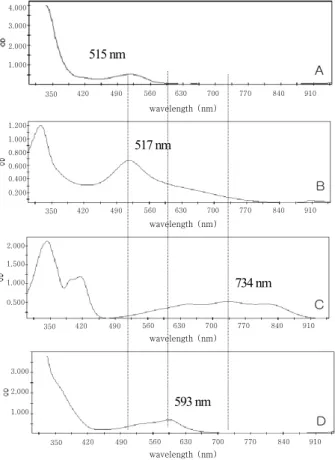
영역에서의 파장을 측정한 결과, 가시광선 영역에서의 최 대파장은 Fig. 1과 같이 517 nm에서 최고흡광도를 보였다.
Abdel-Aal 등(2006)은 안토시아닌을 함유하고 있는 여러 곡류에서 안토시아닌을 분리 동정하였는데 cyanidin 3-glucoside의 최고흡광도가 517 nm에서 나타난다고 보 고하였다. 이는 옥수수 수염 중 cyanidin 3-glucoside가 전체 안토시아닌의 49%를 차지한다는 Fossen 등(2001)의 연구결과와 종합할 때, 517 nm에서의 흡광도 측정으로 옥 수수 수염의 상대적인 총 안토시아닌 함량을 비교할 수 있 다고 생각된다. 최고파장인 517 nm에서의 O.D. 값을 측정 한 결과, Table 2와 같이 0.05에서 0.76까지의 넓은 범위 를 나타내어 시료간의 총 안토시아닌 함량(CV %: 78.4)은
총 플라보노이드(CV %: 25.9)와 총 페놀 함량(CV %:
21.0)에 비해 큰 변이가 있었다. 안토시아닌 함량이 높은 시료는 S15, S13, S9, S16 순으로 O.D. 값은 각각 0.76, 0.37 0.35 0.32 이었다(Table 2).
DPPH 실험결과
추출용매인 1% HCl이 포함된 60% MeOH을 대조군으로 하여 대조군에 대한 DPPH 라디칼 소거능을 계산한 결과 옥수수 수염 시료 중 S2, S7, S15를 제외한 모든 시료에서 음(-)의 활성이 나타났다. 또한 양성대조군으로 사용한 gallic acid에서도 -40.6%를 보여 항산화 효과가 없는 것 으로 나타났다(Table 2). 본 실험에서는 옥수수 수염을 1%
Total anthocyanin
contents
Total flavonoid contents
Total phenol
contents ABTS FRAP DPPH Total anthocyanin contents 1
Total flavonoid
contents 0.478* 1
Total phenol
contents 0.770*** 0.420NS 1
ABTS 0.813*** 0.533* 0.825*** 1
FRAP 0.687** 0.294NS 0.760*** 0.760*** 1
DPPH 0.192NS -0.027NS 0.404NS 0.423NS 0.788*** 1
*, **, *** : Significant at p=0.05, 0.01, or 0.001, respectively. NS : Non significant
Table 3. Correlation coefficient between the contents of functional substances and antioxidant effects by ABTS, DPPH and FRAP assay from 18 different corn silk extracts
염산을 포함한 60% 메탄올로 추출을 하여 추출물의 pH가 1 이었다. Abdel-Aal과 Hucl(2003)의 실험에서 안토시아 닌이 pH 1에서 가장 안정하다고 보고하여 본 실험에서 사 용한 추출법이 안토시아닌을 포함한 항산화 물질을 측정할 때 합리적인 방법으로 생각되나, DPPH를 이용한 실험에서 는 시료의 낮은 pH로 인하여 항산화능을 정확하게 측정할 수 없었으며 이는 DPPH 실험법이 pH에 영향을 받는다고 보고한 Brand-Williams 등(1995)의 결과와 일치하였다.
DPPH assay는 간편하고 비용이 저렴한 항산화 실험법으 로 가장 널리 이용되며 DPPH 라디컬의 소거활성을 측정하 는 방법이지만 이 방법은 DPPH가 pH, 빛 그리고 온도에 민감하게 영향을 받는 것이 단점으로 알려져 있다(Yoo et al. 2007). 또한 Arnao 등(1999)은 안토시아닌의 최대 흡 광영역과 DPPH의 최대 흡광영역이 비슷하여 안토시아닌 의 항산화능을 과소평가하게 된다고 보고 하였다. 옥수수 수염의 추출물과 DPPH 용액의 spectrum을 얻어 분석한 결과, Fig. 1에서 보는 것 같이 DPPH 실험에 사용되는 515 nm 파장이 옥수수 수염의 추출물의 최고 흡광도(517 nm) 와 매우 근접하여 결과에 영향을 줄 수 있음을 본 실험에서 도 확인할 수 있었다. 따라서 옥수수 수염의 주요한 항산화 물질 중 하나인 안토시아닌의 항산화능을 측정하기 위해서 는 DPPH 방법이 적절하지 않을 것으로 생각된다.
ABTS 실험결과
ABTS 실험을 수행한 결과, 높은 항산화능을 보여준 계 통은 S15, S16, S9, S17, S2로 안토시아닌의 함량에 의존 하는 경향이 높았다(Table 2). DPPH 실험은 pH에 민감하
게 반응하는 실험인데 비해, Lemanska 등(2001)은 ABTS 실험은 넓은 범위의 pH에 적용될 수 있는 항산화 측정 방 법이라고 보고 하였고 본 실험을 통해서도 시료의 pH에 영 향을 받지 않고 항산화능을 측정할 수 있는 것을 확인하였 다. 또한 ABTS 실험에 사용되는 734 nm 파장은 옥수수 수염 추출물의 가시영역에 영향을 받지 않는 파장임을 spectrum의 비교를 통해 확인하였다(Fig. 1).
FRAP 실험결과
FRAP 실험에서 높은 항산화능을 보여준 계통은 S15, S2, S13, S16 순이었으며 ABTS 실험에서 높은 항산화능 을 보였던 S15, S16, S2은 FRAP에서도 높은 항산화능을 보였다(Table 2). FRAP 실험은 시료가 3가철을 2가철로 환원시킬 때 2가철이 나타내는 흡광도를 측정하여 항산화 능을 평가하는 방법으로 라디컬의 소거활성을 측정하는 DPPH, ABTS 실험방법과는 다른 메커니즘의 항산화 측정 법이다(Yoo et al., 2007). FRAP 실험방법도 ABTS 실험 방법과 같이 옥수수 수염 추출물이 최대흡광도를 나타내는 517 nm에서 떨어진 593 nm에서 측정하므로 FRAP 실험 또한 안토시아닌의 항산화능을 정확하게 측정할 수 있는 실험법이라고 생각된다.
옥수수 수염의 기능 성분과 항산화 활성간의 상관관계 분석
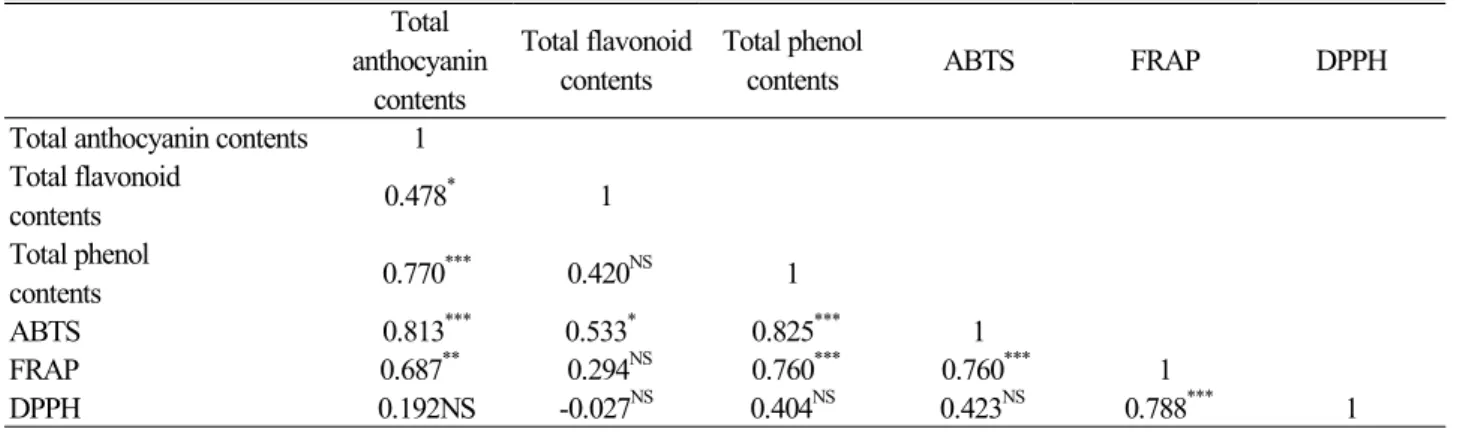
ABTS 실험에서의 항산화능, 총 안토시아닌 함량 (r=0.813)과 총 페놀 함량(r=0.825)간에는 고도로 고도로 유의한 상관관계가 있었다(Table 3). 이는 검은 수수의
wavelength (nm) wavelength (nm) wavelength (nm)
350 420 490 560 630 700 770 840 910
350 420 490 560 630 700 770 840 910
350 420 490 560 630 700 770 840 910
4.000
3.000
2.000
1.000
1.200 1.000 0.800 0.600 0.400 0.200
2.000
1.500
1.000
0.500
3.000
2.000
1.000
515 nm
734 nm
593 nm 517 nm
wavelength (nm)
350 420 490 560 630 700 770 840 910
Fig. 1. Spectra of the extract of corn silk and DPPH, ABTS and FRAP solutions.
A : The extract of corn silk.
B : DPPH solution.
C : ABTS solution.
D : FRAP solution after reaction with gallic acid.
ABTS 실험결과와 안토시아닌 함량사이에 강한 상관관계 (r=0.970)가 있다는 이전 연구와 일치했다(Awika et al., 2004). ABTS 실험결과와 총 플라보노이드 성분 간에도 고 도로 유의한 상관관계가 있었다(r=0.533). 본 실험에서 높 은 총 안토시아닌 함량을 보여주었던 S15, S13, S9, S16이 ABTS 실험에서도 S15, S9, S16, S17, S2 순으로 높은 항 산화능을 보여 주어 옥수수 수염 유래의 안토시아닌이 주 요 항산화 성분일 것으로 추정된다. FRAP 실험에서의 항 산화능 결과와 총 안토시아닌의 함량(r=0.687) 및 총 페놀 함량(r=0.760)간에는 고도로 유의한 상관관계가 있었으며 총 플라보노이드 함량과의 상관관계는 유의성이 없었다.
본 실험의 FRAP 실험결과와 총 페놀 함량간의 유의한 상 관관계가 나타난 결과는 다양한 차를 대상으로 실험한 Benzie와 Szeto(1999)의 결과(r=0.956)와 일치한다.
적 요
기능성 옥수수 수염을 가지는 옥수수 계통을 선발하기 위해 다양한 자식계통과 F1을 대상으로 옥수수 수염의 항 산화 성분과 항산화능을 측정하였다. 측정결과, 총 페놀 함 량, 총 플라보노이드 함량의 경우 각각 980~2,420 mg·100 g-1, 1,532~3,274 mg·100 g-1의 범위를 나타내 었다. 안토시아닌의 고유영역인 517 nm에서의 흡광도는 0.05에서 0.76까지의 범위를 보였다. 옥수수 수염의 항산 화 성분과 DPPH, ABTS, FRAP assay에서 얻어진 항산화 능간의 상관관계를 분석한 결과, ABTS와 FRAP assay에 서 옥수수 수염의 항산화 활성과 페놀성물질 및 안토시아 닌간의 상관계수가 유의하게 높았다. 옥수수 수염의 안토 시아닌을 추출하는 용매가 산성이라는 점과 안토시아닌의 DPPH 용액과의 가시영역 파장에서의 간섭을 고려할 때, DPPH 보다는 ABTS assay나 FRAP assay가 더 적합한 항산화능 측정 방법이 될 것이다. 이들 중 특히 ABTS assay는 옥수수 수염의 주요한 기능성 성분인 안토시아닌 과 플라보노이드 및 페놀성 물질과 모두 높은 상관성을 보 여 옥수수 수염의 종합적인 항산화능을 평가하고 우수 계 통을 선발하는데 적합한 측정 방법이 될 것으로 사료된다.
본 실험에서 안토시아닌 함량과 페놀 함량이 높고 ABTS assay와 FRAP assay에서 모두 높은 항산화능을 보여준 S15은 고 기능성 품종 육종 및 옥수수 수염을 이용한 기능 성 소재 개발에 이용될 수 있을 것이다. 또한 옥수수 수염 의 항산화능 측정에 대한 항산화 실험의 적합성 연구는 우 수한 옥수수 수염을 선발하는데 도움이 될 것이다.
인용문헌
Abdel-Aal, el-S.M. and P. Hucl. 2003 Composition and stability of anthocyanins in blue-grained wheat. J. Agric.
Food Chem. 51:2174-80.
Abdel-Aal, el-S.M., J.C. Young and I. Rabalski. 2006 Anthocyanin composition in black, blue, pink, purple, and red cereal grains. J. Agric. Food Chem. 54:4696-4704.
Arnao, M.B., A. Cano and M. Acosta. 1999 Methods to measure the antioxidant activity in plant material. A comparative discussion. Free Radical Res. 31:S89-S96.
Awika, J.M., L.W. Rooney and R.D. Waniska. 2004 Anthocyanins from black sorghum and their antioxidant
properties. Food Chem. 90:293-301.
Beckman, K.B. and B.N. Ames. 1998 The free radical theory of aging matures. Physiol. Rev. 78:547-581.
Brand-Williams, W., M.E. Cuvelier and C. Berset. 1995 Use of a free radical method to evaluate antioxidant activity.
Lebensm. -Wiss. Technol. 28:25-30.
Dietz BM, Kang YH, Liu G, Eggler AL, Yao P, Chadwick LR, Pauli GF, Farnsworth NR, Mesecar AD, van Breemen RB. and Bolton JL 2005 Xanthohumol isolated from Humulus lupulus Inhibits menadione-induced DNA damage through induction of quinone reductase. Chem Res Toxicol. 18:1296-1305.
Fossen, T., R. Slimestad and O.M. Andersen. 2001 Anthocyanins from maize(Zea mays) and reed canary- grass(Phalaris arundinacea). J. Agric. Food Chem.
49:2318-2321.
Halliwell, B. and J.M.C. Gutteridge. 1993 Free Radicals in Biology and Medicine, 2nd ed., Glarendon Press, Oxford, UK, pp. 86-133.
Katikova, O.Iu., Ia.V. IKostin and V.S. Tishkin. 2002 Hepatoprotective effect of plant preparations. Eksp. Klin.
Farmakol. 65:41-43.
Kim, K.A., S.K. Choi and H.S. Choi. 2004 Corn silk induces nitric oxide synthase in murine macrophages.
Exp. Mol. Med. 36:545-550.
Kim, K.A., H.H. Shin, S.K. Choi and H.S. Choi. 2005 Corn silk induced cyclooxygenase-2 in murine macrophages.
Biosci. Biotechnol. Biochem. 69:1848-1853.
Kim, S.L., M.E. Snook and J.O. Lee. 2003 Radical Scavenging Activity and Cytotoxicity of Maysin (C-glycosylflavone) isolated from Silks of Zea mays L.
Korean J. Crop Sci. 48:392-396.
Lee, E.A., P.F. Byrne, M.D. McMullen, M.E. Snook, B.R.
Wiseman, N.W. Widstrom and E.H. Coe. 1998 Genetic
mechanisms underlying apimaysin and maysin synthesis and corn earworm antibiosis in maize(Zea mays L.).
Genetics. 149:1997-2006.
Lemanska, K., H. Szymusiak., B. Tyrcowska., R. Zielinski., A.E.M.F. Soffer and I.M.C.M. Rietjens. 2001 The influence of pH on the antioxidant properties and the mechanisms of antioxidant action of hyrooxyflavones.
Free Radical Biological Medicine. 31:869-881.
Maksimovic, Z.A. and N. Kovacevic. 2003 Preliminary assay on the antioxidative activity of Maydis stigma extracts. Fitoterapia. 74:144-147.
Maksimovic, Z., D. Malencic. and N. Kovacevic. 2005 Polyphenol contents and antioxidant activity of Maydis stigma extracts. Bioresour. Technol. 96:873-877.
Pulido R., L. Bravo and F. Saura-Calixto 2000 Antioxidant activity of dietary polyphenols as determined by a modified ferric reducing/antioxidant power assay. J Agric Food Chem. 48:3396-3402.
Rau, O., M. Wurglics, T. Dingermann, M. Abdel-Tawab and M. Schubert-Zsilavecz. 2006 Screening of herbal extracts for activation of the human peroxisome proliferator- activated receptor. Pharmazie. 61:952-956.
Re R., N. Pellegrini, A. Proteggente, A. Pannala, M. Yang and C. Rice-Evans 1999 Antioxidant activity applying an improved ABTS radical cation decolorization assay. Free Radic Biol Med. 26:1231-1237.
Velazquez, D.V., H.S. Xavier, J.E. Batista and C. de Castro-Chaves. 2005 Zea mays L. extracts modify glomerular function and potassium urinary excretion in conscious rats. Phytomedicine. 12:363-369.
Yoo, K.M., D.O. Kim and C.Y. Lee. 2007 Evaluation of different methods of antioxidant measurement. Food Sci.
Biotechnol. 16:177-182.
(접수일 2008.9.29; 수락일 2009.6.23)