* 본 연구는 2016년도 한국과학기술정보연구원의 국가 R&D 정보의 공유/협력 강화로 국가과학기술가치 극대화 사업으로 수행되었습니다.
접수일자 : 2016년 08월 19일 수정일자 : 2016년 09월 07일
심사완료일 : 2016년 09월 08일
교신저자 : 이병희, e-mail : [email protected]
국내 공공정보시스템의 국제기술이전 사례연구 및 NTIS 제언
A Case Study on International Technology Transfer of Korean Public Information Systems and Recommendations for NTIS
이은지
*
, 강인제*
, 임철수**
, 최기석**
, 이병희**
과학기술연합대학원대학교
*
, 한국과학기술정보연구원**
Eunji Lee([email protected])
*
, Inje Kang([email protected])*
, Chulsu Lim([email protected])**
, Kiseok Choi([email protected])**
,Byeong-Hee Lee([email protected])
**
요약
국제기술이전은 이해관계 불일치, 기술수준, 문화 등 여러 거시적 환경여건의 차이로 국내기술이전보다 더 어려운 점이 많은 것으로 알려져 있다. 본 연구에서는 정보마케팅의 관점에서 국내 공공정보시스템의 국제기술이전 사례연구를 통해 미래창조과학부 NTIS의 해외진출에 관해 제언하고자 한다. 국내 공공정보 시스템 국제기술이전의 대표적 성공사례로 평가되는 관세청, 특허청, 조달청의 국제기술이전을 성공시키기 까지의 과정을 분석하여 국가과학기술지식정보서비스(NTIS)의 국제기술이전 촉진을 위한 정보마케팅 관 점에서 사전준비전략을 제시한다.
■ 중심어 :∣국제기술이전∣정보 마케팅∣NTIS∣해외진출∣공공정보시스템∣
Abstract
It is well known that international technology transfer(ITT) is relatively more difficult than the domestic technology transfer because of the difference in interest, technology level, culture and other various macro-environmental conditions. This study aims to derive recommendations for ITT of National Science and Technology Information Service(NTIS) of Ministry of Science, ICT and Future Planning(MSIP) by conducting case study of ITT in domestic public information systems. The cases are the national agencies that performed successfully in ITT. The cases are Korea Customs Service(KCS)’s customs administration system(UNI-PASS), Public Procurement Service(PPS)’s Korea On-Line E-Procurement System(KONEPS), and Korean Intellectual Property Office(KIPO). After studying on how the cases proceeded ITT, this paper suggests proper preparation strategies in the view point of information marketing.
■ keyword :∣International Technology Transfer∣Information Marketing∣NTIS∣Overseas Expansion∣Public Information System∣
I. Introduction
The demand for exporting various public information systems have been recently increasing since 2000 due to the strengthened status of e-government in the world. Korea is considered to administrate e-government most efficiently and is increasing the export of the systems. Korea exported
$150million in 2010, $240million in 2011, and
$340million in 2012. Recently, Korea is also diversifying export products by exporting electronic resident registration certificates as well as ICT training center or electronic customs systems, which has been continuously exported from the past[1].
National Science and Technology Information Service(NTIS), providing public information system regarding national R&D information, is also trying to transfer its system overseas in order to meet increasing export demand of public information system. Therefore, this study aims to derive meaningful implications and suggestions for NTIS to promote international technology transfer(ITT) of the system by conducting case study on ITT of public information systems. From an information marketing perspective, this study examined three cases that succeeded in ITT of public information systems, and the cases are Korea Customs Service(KCS)’s customs administration system(UNI-PASS), Public Procurement Service(PPS)’s Korea On-Line E-Procurement System(KONEPS), and Korean Intellectual Property Office(KIPO)’s KIPOnet. Then, we derived and suggested recommendations for NTIS to secure foundation of success by properly proceeding from the preparation step.
Ⅱ. Theoretical Backgrounds
1. International Technology Transfer
ITT is conducted when a nation or an enterprise transfers its technology to otherswith lower level of technology[2]. It is a trade of technology among two or more countries[3]. Therefore, a nation or an enterprise can be considered as a unit of analysis and it is categorized into providing country, receiving country, providing enterprise and receiving enterprise[2].
ITT is conducted in various ways, however, it is generally categorized as foreign direct investment(FDI), joint venture, and licensing[3]. In the view point of FDI, ITT occurs when implementing green field investment and transferring technology to subsidiaries. If a company possesses exclusive and high-tech technology, it generally prefers transferring technology directly. Joint venture determines technology transfer according to mutual consent among participants. Licensing defines technology transfer as a product, and a licensor determines which technology will be transferred or sold[3].
According to Davidson[4], in ITT, national factor is considered as environmental or situational factor, and enterprise is considered as the representative of internal factor. Thus, Lim[2] classified the influencing factors of ITT into situational factors and internal factors and then classified again into promoting factors and constricting factors. [Table 1] shows how ITT is classified and variables of each factor.
Many preceding researches seek to determine methods to foster technology transfer[5]; however, the researches are mainly about transferring tangible assets. To imply suggestions appropriate to NTIS, of which duty is mainly related to intangible assets such as software, this paper conducted case study from the view point of information marketing.
ITT Promoting factors Constricting factors
Situational Factors
Providing countries
·domestic competition increase
·rising production factors cost
·developing country support system
·offering products and services to developing country
·potential competition with developing country
·potential risk for national security
Receiving countries
·FDI promotion
·Controllability
·geographic proximity
·support system for foreign technology introduction
·cooperation with other domestic subjects
·high trade barriers
·experience in international technology cooperation
·overseas technology introduction restriction policy
·inadequate economic level
·located at a long distance
·unstable political, economic environment
·cultural difference
·inadequate institutional protection for intellectual property right
·appearance of replacement
Internal Factors
Technology positioning (features)
·obsolete technology
·a generalpurpose technology
·past experience of technology transfer
·original technology
·exclusive technology
·high technology
·core technology
·excessive cost of technology transfer Technology absorptive
capacity
·technology manpower
·experience of technology introduction
·inadequate infrastructure
·lack of manpower
·lack of technology capacity Table 1. Influencing Factor of International Technology Transfer by Lim[2] revised
2. Information Marketing
Rowley[6] defines information marketing as the marketing about the information based products and services which recognizes knowledge infrastructure such as technology and information as a product
1)
. The information marketing focuses on consumer-oriented level such as establishing strategy of information commercialization, distribution, or promotion.Aspects Details
Variety ·each consumer values the system differently
Acceptance
·the system needs to be flexible enough to make an amendment according to the consumers’ requests
Relationship ·values are dependent on relationship
·familiar perception is required to gain support Table 2. Aspects of Values of Information
System
source: Soh et al.[7] and Robinson[8] revised
1) Because the goal of this study is to derive implications for NTIS to spur ITT of public information systems, we focused on marketing information systems.
Because information marketing is to promote trade of services based on information, the marketing needs to reflect the aspects of information systems to increase the value. [Table 2] implies what to consider when implementing information marketing in accordance with the aspects of information systems.
Likewise, information marketing has the following features in order to reflect the aspects of the systems they are trying to trade. First one is feedback. If suppliers of the information systems do not properly embrace feedback from the consumers, it is difficult to raise the market share.
The needs for information systems is changeable, and if the suppliers fail to improve their systems according to the feedback, consumers might not use the systems anymore, as shown in [Fig. 1].
Second one is differentiation. Different information system needs to be provided to satisfy different consumers with different level of participation[10].
Therefore, suppliers need to decide how to provide systems to whom[11].
Fig. 1. Interaction between consumers and services by Seo et al.[9] revised
Third one is perception. As the value of information system is dependent on how consumers perceive, information marketing also needs to be aware to promote familiarity of the system[5][9].
3. Overview and Features of NTIS
NTIS of the Ministry of Science, ICT and Future Planning(MSIP) and Korea Institute of Science and Technology Information(KISTI) services the world’s first national R&D information portal which compiles and provides comprehensive national R&D information such as the programs, researchers, research facilities & equipment and research outcome of 17 ministries or agencies. The primary purpose of NTIS is to avoid redundant investments which have been administered separately by the ministries and agencies and to maximize the utilization of national R&D program information.
After the NTIS 1.0(2006∼2009) aimed to build the ground for the promotion of programs such as an inter-ministerial cooperation system, NTIS 2.0(2010∼
2012) secured the ground for information integration, and NTIS 3.0(2013∼2015) targeted to improve the joint utilization of information. NTIS 4.0 has been promoted since 2016 for the following purposes:
sharing & diffusing science & technology knowledge or research outcomes through the utilization;
improvement of assistance to national R&D planning and management[12].
In addition, NTIS is performing Global Commercialization for the improvement of the
Korea's ICT reputation by supporting on foreign national R&D management systems and on the improvement of science & technology innovation competence in the corresponding country. However, since NTIS system is an intangible goods, it has characteristics which make it difference in features between intangible goods and tangible goods.
Sim[13], said software has features of deformability, reproducibility, and uncertainty as being intangible goods and information goods and it has various risks at each level such as overseas marketing, contracting, or exporting since software is the typical electronic intangible assets.
Ⅲ. Case Study on ITT of Public Information System
This study conducted case study on ITT of public information system in the view point of information marketing. Three cases were studied, KCS’s UNI-PASS, PPS’ KONEPS, and KIPO’s KIPOnet.
KCS is evaluated to perform ITT of public information systems most successfully among national agencies. PPS and KIPO conducted ITT of software systems, similar with NTIS.
1. International Technology Transfer of KCS
In 1990, KCS launched an electronic newspaper organization, ‘information management office’, which fostered the development of informatization of customs administration and resulted in the first governmental agencies to develop ‘export customs systems without documents’.
As shown in [Table 3], KCS has succeeded in exporting 12 cases to 10 countries in $335.6million since 2005. The agency made international trade with
Tanzania in 2012, Cameroon in 2015, Ecuador in 2010, Uzbekistan in 2014, and still, planning to expand customs administration system to other neighbor countries.
Nation Program Contract
year Expense Finance
Kazakhstan UNIPASS
Consulting 2005 $0.42 Kazakhstan Kyrgyzstan UNIPASS
Consulting 2008 $0.47 Kyrgyzstan Dominican
Republic
UNIPASS
Construction 2008 $28.5 EDCF
Mongolia UNIPASS
Construction 2009 $5.54 KOICA,ADB
Guatemala
Risk Management
System Construction
2009 $3.0 KOICA
Ecuador
UNIPASS
Construction 2010 $21.63 Ecuador Single Window
Construction 2011 $15.82 Ecuador
Nepal UNIPASS
Construction 2011 $3.83 KOICA
Tanzania
RM and Cargo Management
System Construction
2011 $2.66 KOICA
New Customs
Systmem 2012 $19.61 ICF
Uzbekistan Single Window
Construction 2012 $4.12 KOICA Cameroon UNIPASS
Construction 2015 $230 Cameroon Table 3. Export Record of UNI-PASS
unit: million
source: KCS internal data
In the viewpoint of information marketing, ITT of KCS’ UNI-PASS shows three features. First, KCS formed long-term relationship with Tanzania by promising additional support to improve the system in the country. As mentioned above, the suppliers need to improve or modify information systems continuously when the users ask for some changes or give feedback. Hence, KCS promoted follow-up projects by participating in Korea International Cooperation Agency(KOICA)’s programs. As part of KOICA program, KCS implemented invitational workshops and introduced how they have operated
the system. In addition, KCS built human networks which would be great advantage when practically preparing for projects. The establishment of human networks leads to preferable situation during preparation because it allows KCS to examine the situation in Tanzania more swiftly and accurately.
Moreover, to successfully conduct ITT, KCS constructed detailed plans to identify political or economical issues. KCS’s ex-post evaluation report implies that verifying how it can support Tanzania was one factor to success ITT[14]. KCS had evaluated whether the contents of the projects would correspond with the political goals of the demanding countries, and whether the goals or performance of the projects coincide with the demands or requests from the countries. The agency also examined how economically Tanzania needed to reform its custom administration system. It examined trade ratio to GDP to evaluate how international trade influences national economic growth.
2)
In addition to economical analysis, the main contents of feasibility study(F/S) contained analysis of political or administrative environment such as environment analysis, current situation analysis, technological planning or execution planning.As abovementioned, Tanzania government had been putting effort to modernize administrative performance including customs systems
3)
.Lastly, KCS endeavored to raise the profile of the system. The process of raising the system’s profile was necessary because African countries, including
2) In 2007 when the ITT began, international trade was increasing in Tanzania. While the value of export goods were $752.65 and the one of import goods were $1,336.69 in 1997, each value of export and import goods increased to $1,735.76 and $4,246.22. For the last 10 years, it has increased 8% and 12% a year on average[15].
3) There were request of improving government administration in Tanzania [16-18]. Also, from 2000, real GDP has increased 6.3%
on average, and endeavored to increase the efficiency of public
sectors[16]. In 2000, Tanzania emphasized “public service reform
programme[17]”, and 26 government ministries’ websites were
opened between 2000 and 2003[18].
Tanzania, were not familiar with the system.
Considering that it takes time to actually implement the projects after identifying the intention to participate, KCS kept focusing on sustaining relationship with Tanzania and promoting the system for the country to get familiar with it before the implementation. Also, KCS invited government officials and exports or assigned specialists to help them understand clearly about the system. Moreover, KCS gave faith in the system to Tanzania by systematically operating workforce and allocating budget for customers management. Due to its professional ability and attitude, it was possible for KCS to support Tanzania to get familiar with the system.
2. International Technology Transfer of PPS and KIPO
In Korea, other national agencies also developed public information systems as to follow the global trend of reforming into e-government administration.
PPS developed KONEPS while KIPO constructed KIPOnet.
4)
Both public information systems proved the improvement of the efficiency of administration works or reduction of the cost and had successfully transferred to foreign countries.To successfully perform ITT of public information systems, PPS kept close relationship for a long period to actively reflect the requirements from the demanding countries. The agency also maintained sustainable relationship with the countries that already has the system to identify whether the countries need improved or modified system. In addition, by investigating detailed sectors of foreign
4) In 2013, the framework of e-government was applied to the KOSEP, and it was opened to the public. KOSEP reduced the process of administrative documents and the cost of procurement trade[19]. KIPO saved more than ₩1.46trillion with KIPOnet by providing all fields of information including patent application or examinations[20].
countries, it tried to provide each country differentiated system to satisfy the demand of whether a country needs the system with basic functions or with advanced functions. Moreover, PPS cooperated with third parties such as foreign official institutes or private IT companies to make the system more familiar by enhancing the international marketing.
KIPO also constructed strategies based on information marketing to perform ITT of KIPOnet.
First, with the cooperation with KOICA, the agency differentiated methods of tranferring the system. For example, it transferred the system with the support of KOICA funding to countries that do not have enough budget. Moreover, KIPO invested on the system consulting programs to allow foreign countries to easily approach to the system and get familiar with it.
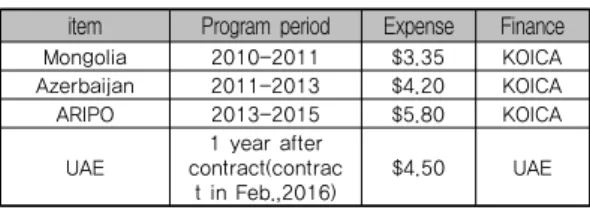
[Table 4] and [Table 5] demonstrate how KONEPS and KIPOnet had succeeded in ITT. KPNEPS was transferred to 7 countries in $35.3 million, while KIPOnet was transferred to 4 countries in $17.85 million.
Nation Program period Expense Finance
Vietnam 2008-2010 $2.3 KOICA
Costa Rica 2009-2010 $9.5 Costa Rica
Mongolia 2010-2012 $4.3 KOICA
Tunisia 2011-2013 $5.5 KOICA
Cameroon 2013-2014 $1.2 KOICA
Jordan 2015-2017 $7.5 KOICA
Rwanda 2015-2016 $5.0 Rwanda
Table 4. Export Record of KONEPS
unit: million
source: PPS internal data
item Program period Expense Finance
Mongolia 2010-2011 $3.35 KOICA
Azerbaijan 2011-2013 $4.20 KOICA
ARIPO 2013-2015 $5.80 KOICA
UAE
1 year after contract(contrac
t in Feb.,2016)
$4.50 UAE
Table 5. Export Record of KIPOnet
unit: million
source: KIPO internal data
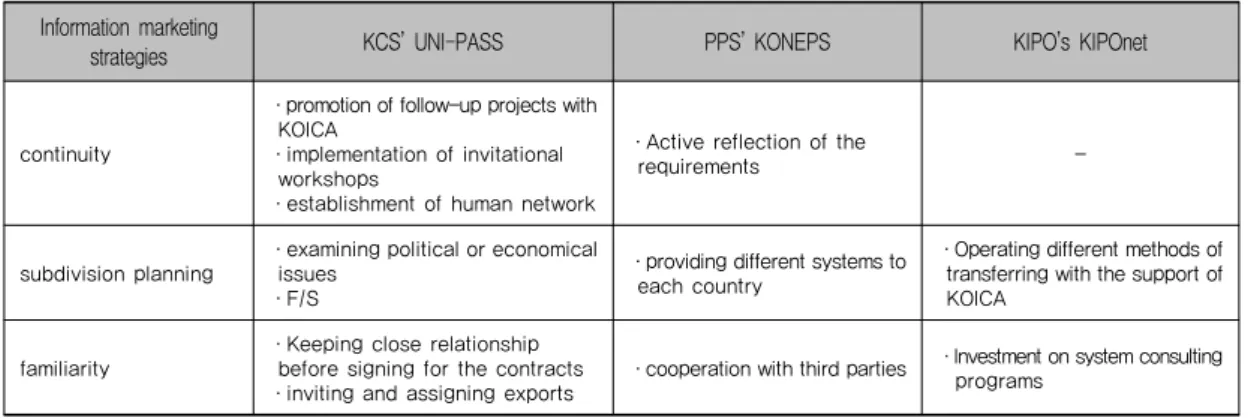
Information marketing
strategies KCS’ UNI-PASS PPS’ KONEPS KIPO’s KIPOnet
continuity
·promotion of follow-up projects with KOICA
·implementation of invitational workshops
·establishment of human network
·Active reflection of the
requirements -
subdivision planning
·examining political or economical issues
·F/S
·providing different systems to each country
·Operating different methods of transferring with the support of KOICA
familiarity
·Keeping close relationship before signing for the contracts
·inviting and assigning exports
·cooperation with third parties ·Investment on system consulting programs
Table 6. Summary of Information Marketing of the Three National Agencies.
3. Research Findings
The implemented strategies of the three national agencies in Korea, KCS, PPS, and KIPO, imply how information marketing of public information systems should be conducted in preparation phase.
First, information marketing needs to continuously implement for long period. As abovementioned, the success of information systems is influenced by the relationship between suppliers and demanders.
Because the demanders ask for modified or improved systems, suppliers need to form sustainable relationship with them by actively reflecting their requests. Successful ITT does not mean a successful case of trading. Rather it can be evaluated successful if the suppliers can continuously satisfy the consumers’ needs.
Second, information marketing needs to prepare subdivided and detailed planning strategies as it assumes that each consumer has different preference of the public information systems. Therefore, differentiate performance is needed to attract or satisfy each one of them. For example, suppliers need to verify whether the functions of the systems can compile with policy paradigms or economical situation in demanding countries. Even if the system is highly advanced, it is worthless if it can not operate properly
because of technical or political issues.
Third, information marketing should attract consumers to feel familiar with the services. The value of information systems is closely related to the perception of the consumers. The value increases when they are more familiar with the systems. It’s because the familiarity of an information system determines the capacity to utilize it more efficiently, which would gradually influence on the satisfaction.
[Table 6] categorized information marketing strategies in three features, continuity, subdivision, and familiarity and summarized how the national agencies performed information marketing.
IV. Recommendations for NTIS
This paper aims to imply recommendations for NTIS to promote success in ITT by conducting case study of ITT of the public information system in the view point of information marketing. Therefore, we examined how currently NTIS is preparing ITT and suggest recommendations to foster the transfer.
1. Preparation Phase of Exporting NTIS
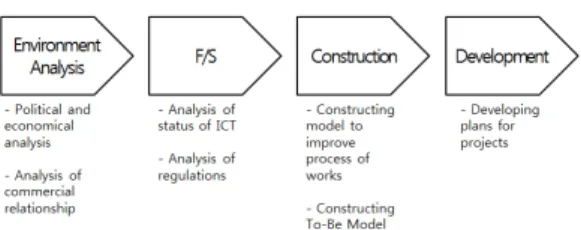
NTIS has been preparing to export its publicinformation systems abroad for three years. Until 2016, NTIS has put effort to export to Vietnam, Kazakhstan, and Costa Rica. NTIS constructed the process of preparation phases as shown in [Fig. 2].
First, environment analysis is required to examine political or economical situation. Then, F/S is conducted to identify the applying capacity. After F/S, to-be model is constructed to reflect the result of examinations conducted in previous steps. Lastly, specific plans for projects are developed. Yet, NTIS could not properly evaluated the appropriateness of the constructed process as there is few cases that NTIS has ITT.
Fig. 2. Process of preparation phase
1.1 Vietnam
In 2013, as a follow-up action of the Korea-Vietnam Science & Technology High-level Meeting, an implementation plan designed to construct Vietnam National Science and Technology Information Service System (VTIS) was developed.
In the same year, a preliminary F/S program for the integration of Vietnamese R&D program database and process standardization was implemented. Nex year,
Vietnamese Ministry Science and
Technology(MOST) requested MSIP for support on the construction of VTIS at the Korea-Vietnam Vice-ministerial Science & Technology Joint Committee’s Meeting. Then, government-led cooperation was launched, and there has been collaboration with MOST and local office of KOICA.
[Table 7] shows how NTIS first performed ITT with Vietnam. Based on the four phases in [Fig. 2], NTIS constructed 6 steps to prepare ITT.
Process Details Period
(month)
Environment
Analysis
Preparation 2
Environment Analysis 1
F/S Domestic Study 3
Construction Constructing To-Be
Model 3
Development Field Study 2
Final Report 0.5
Table 7. Plans for preparation in Vietnam
1.2 Kazakhstan
In 2013, this program was launched after the Korea-Kazakhstan Technology Cooperation Center officially requested the technology transfer of NTIS’
knowhow. Since the signing of the cooperation agreement between the KISTI and National Agency for Technological Development(NATD)/ National Center of Science and Technology Evaluation (NCSTE) in Kazakhstan.
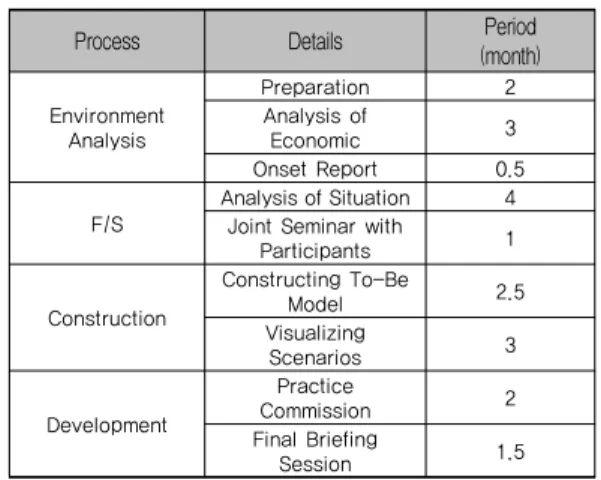
In 2013, the agenda for the Korea-Kazakhstan Summit was adopted, and business agreement between the MSIP and Ministry of Education and Science (Kazakhstan) was signed in 2014. After performing international cooperation program titled ‘A Study on Kazakhstan National R&D Information Management System Construction Plan’ from 2015 to 2016, a direction for Kazakhstan NTIS information systm was suggested, and major scenarios were visualized based on Kazakhstan national R&D survey and analysis. Then, NTIS’ technology and knowhow were transferred to foster local staff.
[Table 8] is the steps that NTIS constructed when preparing for ITT with Kazakhstan. The steps are subdivided in details compared to [Table 7]. NTIS
Aspects of Information Marketing NTIS Information Marketing
Continuity · Establishing human network
· Cooperation with third parties
subdivision
· Examining how much national R&D is funded
· Examining how national R&D is leaded
· Examining the capacity of operating the system
· Examining how national ministries operate with others
· Feasibility Study
· Ex-post evaluation
familiarity
· Conducting research on economical benefit of NTIS
· Demonstrating detailed methods of how to apply
· Mutual exchange of work force Table 9. NTIS information Marketing
increased the steps from 6 steps to 9 steps for preparation because NTIS identified the necessity of more detailed steps after the experience with Vietnam.
It summarizes how NTIS needs to perform IM according to the aspects of IM performed by the three national agencies. The agencies conducted ITT while concerning to keep continuous relationship, establish subdivided and detailed examination, and promote the partners to get familiar with the systems.
Process Details Period
(month)
Environment
Analysis
Preparation 2
Analysis of
Economic 3
Onset Report 0.5
F/S
Analysis of Situation 4 Joint Seminar with
Participants 1
Construction
Constructing To-Be
Model 2.5
Visualizing
Scenarios 3
Development
Practice
Commission 2
Final Briefing
Session 1.5
Table 8. Plans for preparation in Kazakhstan
1.3 Costa Rica
In 2016, Embassy of Costa Rica in Seoul, Korea visited KISTI and requested for cooperation in
construction of NTIS Costa Rica. At a ministerial meeting of Costa Rican Minister of Science, Technology and Communication and MSIP, Costa Rica requested cooperation in the construction of Costa Rica NTIS. Currently, Costa Rica’s current national R&D information management and cooperation plan are under review, and yet there is no official reports.
2. NTIS Information Marketing
KCS, PPS, and KIPO were able to succeed in transferring public information systems to foreign countries with the consideration of information marketing. Therefore, this research aims to derive how information marketing needs to be performed in preparation phase for NTIS to foster successful ITT.
[Table 9] summarizes how NTIS needs to perform IM according to the aspects of IM performed by the three national agencies. The agencies conducted ITT while concerning to keep continuous relationship, establish subdivided and detailed examination, and promote the partners to get familiar with the systems.
First, it is important to sustain close relationship for the long period. For example, NTIS can promote long-term relationship by building human network or implementing invitational workshops in preparation phase. One example method of building human
network is allowing third parties such as private companies to participate in the ITT programs, which can support market entry. The long-term relationship can also be promised if NTIS and demanding countries keep preparing for follow-up projects.
Second, each phase needs to construct detailed and subdivided planning to accurately examine related sectors and proceed to next steps. To make it possible, it is important to precisely examine institutional regulations to reduce error when constructing national R&D information management system. Moreover, it can provide consumer-oriented consultation regarding ongoing projects. Therefore, it is important to identify what demanding countries can achieve by evaluating whether the performance satisfies their needs, or whether the projects coincide with political goals. To be more specific, it is important to examine on how much the national R&D funded for understanding how ministries administer the national R&D of each country. In addition, to have thorough examination on how national R&D is leaded and how national ministries operate with others is important because only thorough understanding on their current state of organization and regulation is able to lead the most adequate planning for each country.
Third, NTIS needs formal or informal ways to train or educate demanding countries to learn the advantages of NTIS system and to make the system more familiar. For example, Park[21] suggested that NTIS has 1.49 times of economic impact on effect on production inducement for the last 10 years since 2006. The result implies that NTIS performance had greater impact on value added inducements or employment inducements than any other industry[21].
It is difficult to conclude the impact based on one research. However, it can be used as a resource material to improve cognition of ITT to suggest that
it is possible for the demanding countries to improve enhancement of efficiency of national R&D and development of ICT by constructing comprehensive national R&D information system developed from Korea ICT. In addition, by introducing NTIS, they can realize that they can construct technology cooperation system, develop international collaboration items, and gain economic impact through cooperation among companies.
3. Recommendations
It is becoming global trend to construct and provide efficient public information systems, and Korea has been increasingly exporting the systems. NTIS also constructed the first comprehensive national R&D information system in the world. However, yet, there has been few studies on ITT of public information systems. Therefore, this research focused on deriving suggestions to provide information on how to operate in preparation phase during ITT by conducting case study on the national agencies that successfully transferred their public information systems to foreign countries. According to the result of the case study, three features of information marketing needs to be considered in priority.
First, building constant relationship to fulfill demanders changeable needs is required. It is because if the information systems do not satisfy instable demands from the consumers, they tend to use another one that services preferable functions.
Second, detailed examination should be conducted in subdivided process. NTIS needs to confirm whether it can provide services that compiles with current situation or the needs of demanding countries.
For example, NTIS needs to identify the needs of country like which item or sub-item is adequate for the ideally customized system for each country.
Third, NTIS needs to provide ways to train or
educate the demanding countries to closer to the transferring service to make it more preferable.
V. Conclusion
Even though trade of ITT of public information systems is increasing, there are few studies focused on transferring intangible assets including information systems. Therefore, this study aimed to suggest recommendations for NTIS by and conducting the case study of the national agencies that succeeded in ITT of public information systems. The cases for the study were KCS’s UNI-PASS, PPS’ KONEPS, and KIPO’s KIPOnet. This paper examined how the agencies could succeed in ITT in the view point of information marketing because NTIS is also trying to transfer information based systems.
According to the study, there were three primary information marketing strategies to consider. First, continuous relationship between NTIS and demanding countries needs to be formed to constantly apply the feedback or requirements from them. Second, detailed planning is necessary to reflect aspects of the countries in various view points. Third, NTIS needs to promote the countries to get familiar with the system to have reduce the error or risk.
As it takes long period to apply NTIS to the countries with poor R&D funding, it is important to spend time and keep close relationship with those countries until they show interest and have capability in investing national R&D. NTIS needs to imply the advantages they will be able to get in the future by applying NTIS. Also, by providing some part of the system to those countries’ main facilities, NTIS needs to promote them to establish and manage comprehensive national R&D information system.
Further studies need to examine more cases on ITT
of products related to softwares for NTIS to analyze and benchmark as NTIS operates its function of managing information on national R&D based on softwares, intangible asset.
참 고 문 헌
[1] Information International Cooperation Office,
Increase of Exporting E-government.
$34million Accomplished, News Release of
Ministry of Security and Public Administration, 2013(7).[2] S. M. Lim and J. C. Park, “Global Catch-up in Strategic Item Technologies: Combining International Technology Transfer, Network Absorptive Capacity, and Mutual Development - The Case of KAI’s T-50 and AIDC’s IDF,” J. of Strategic Management, Vol.15, No.1, pp.89-112, 2012.
[3] J. H. Park, “Development and Application of Checklist for the Evaluation of International Technology Transfer : From the Viewpoint of Licensor,” J. of Economics and Management, Vol.26, No.2, pp.57-82, 2008.
[4] W. H. Davidson and D. G. McFetridge, “Key Characteristics in the Choice of International Technology Transfer Mode,” J. of International Business Studies, Vol.16, No.2, pp.5-21, 1985.
[5] S. K. Kim, S. M. Yen, I. J. Kang, and B. H. Lee,
“Analysis of the Determinants Influencing Technology Transfer in Government Funded Research Institutes: Focusing on features of National R&D Projects,” J. of Contents Association, Vol.16, No.8, pp.624-639, 2016.
[6] J. Rowley, “Information Marketing: Seven Questions,” Library Management, Vol.24, No.1/2, pp.13-19, 2003.
[7] Y. J. Soh et al., Information Society and
Information Policy, Nanam Pub, 1998.
[8] L. Robinson, “Six Golden Rules for Marketing Your Information Service Successfully,”
Business Information Review, Vol.17, No.3, pp.119-124, 2000.
[9] S. H. Seo et al., Performance Analysis of R&D
Information Usage by Customer Value Indicator and Strategy for Information Marketing, Korean Institute of Science and
Technology Information, 2014.[10] S. Evan-Wang and C. de Freitas, “Marketing an Information Service: A Case Study of the OECD Economic Affairs Secretariat Documentation Centre,” Information Service &
Use, Vol.15, No.2, pp.117-130, 1995.
[11] G. Oestreicher-Singer and L. Zalmanson,
“Content or Community? A Digital Business Strategy for Content Providers in the Social Age,” MIS Quarterly, Vol.37, No.2, pp.591-616.
2013.
[12] http://www.ntis.go.kr
[13] S. R. Sim, “A Study on the Risk Factors in the Export Software,” J. of Management and Economics, Vol.33, No.2, pp.223-251, 2011.
[14] Korea Customs Service,
A Study on Economical and Social Impact of Customs Administration System and Overseas Expansion, 2015.
[15] http://data.imf.org/regular.aspx?key=60998117 [16] IMF, United Republic of Tanzania: 2007
Article IV Consultation and First Review Under the Policy Support Instrument—Staff Report; Staff Supplement; Public Information Notice and Press Release on the Executive Board Discussion; and Statement by the Executive Director for the United Republic of Tanzania, IMF Country Report, No.07/246, 2007.
[17] R. M. Davison, C. Wagner, and L. Ma, “From
Government to E-Government: A Transition Model,” Information Technology & People, Vol.18, No.3, pp.280-299, 2005.
[18] J. Kaaya, “Implementing e-government services in East Africa: Assessing Status Through Content Analysis of Government Websites,” Electronic J. of E-Government, Vol.2, No.1, pp.39-54, 2004.
[19] http://www.g2b.go.kr/gov/koneps/pt/intro/
intro_03.html
[20] Digital Times,
Constructing Standard Framework for 3rd KIPOnet, 2013.
[21] S. Park, “Analysis of Economic Impact of NTIS,” Spring Conference of Korea Technology Innovation Society, pp.230-240, 2016.
저 자 소 개
이 은 지(Eunji Lee) 준회원
▪2014년 3월 : University of Santo Tomas, Travel Management(문학사)
▪2014년 9월 ∼ 현재 : 과학기술
연합대학원대학교 과학기술경
영정책 석사과정
<관심분야> : 과학기술경영정책, 사업화, 국제기술이 전, 대외협력
강 인 제(Inje Kang) 준회원
▪2016년 2월 : 한동대학교 경영경 제학부(문학사)
▪2016년 3월 ∼ 현재 : 과학기술
연합대학원대학교 과학기술경
영정책 석사과정
<관심분야> : 과학기술경영정책, 성과분석, R&D 경제
임 철 수(Chulsu Lim) 정회원
▪1994년 2월 : KAIST 전산학과 (공학석사)
▪2005년 2월 : KAIST 전산학과 (공학박사)
▪2005년 5월 ∼ 현재 : 한국과학
기술정보연구원 NTIS센터
R&D정보융합실장, 책임연구원
▪2016년 9월 ∼ 현재 : 과학기술연합대학원대학교 과 학기술경영정책 교수
<관심분야> : 자연어 처리, 데이터마이닝, 과학기술정 보서비스, 과학기술경영정책
최 기 석(Kiseok Choi) 정회원
▪1997년 2월 : KAIST정보 및 통 신공학과(공학석사)
▪2013년 2월 : 충남대학교 대학원 컴퓨터 공학과(공학박사)
▪1988년 1월 ∼ 현재 : 한국과학 기술정보연구원 센터장
▪2016년 9월 ∼ 현재 : 과학기술연합대학원대학교 과 학기술경영정책 교수
<관심분야> : 데이터베이스, 네트워크, 정보시스템
이 병 희(Byeong-Hee Lee) 종신회원
▪1994년 2월 : 충남대학교 컴퓨터 공학과(공학석사)
▪2002년 2월 : 충남대학교 컴퓨터 공학과(공학박사)
▪2002년 9월 ∼ 현재 : 한국과학기 술정보연구원 NTIS센터 R&D정 보융합실 책임연구원
▪2012년 9월 ∼ 현재 : 과학기술연합대학원대학교 과 학기술경영정책 교수
<관심분야> : 과학기술경영정책, 시맨틱기반 검색, 과 학기술정보서비스, R&D효율성지표
![Fig. 1. Interaction between consumers and services by Seo et al.[9] revised](https://thumb-ap.123doks.com/thumbv2/123dokinfo/5343721.395694/4.799.98.377.154.225/fig-interaction-consumers-services-seo-et-al-revised.webp)