• 검색 결과가 없습니다.

Relationship Between Obesity and N-Terminal Brain Natriuretic Peptide Level as a Prognostic Value After Acute Myocardial Infarction

N/A
N/A
Protected

Academic year: 2021

Share "Relationship Between Obesity and N-Terminal Brain Natriuretic Peptide Level as a Prognostic Value After Acute Myocardial Infarction"

Copied!
7
0
0

로드 중.... (전체 텍스트 보기)

전체 글

(1)

558

Open Access

Relationship Between Obesity and N-Terminal Brain Natriuretic Peptide Level as a Prognostic Value

After Acute Myocardial Infarction

Seon Gyu Choi, MD

1

, Myung Ho Jeong, MD

2

, Youngkeun Ahn, MD

2

, Jeong Gwan Cho, MD

2

, Jung Chaee Kang, MD

2

, Shung Chull Chae, MD

3

, Seung Ho Hur, MD

4

, Taek Jong Hong, MD

5

, Young Jo Kim, MD

6

, In Whan Seong, MD

7

, Jei Keon Chae, MD

8

, Jay Young Rhew, MD

9

, In Ho Chae, MD

10

, Myeong Chan Cho, MD

11

, Jang Ho Bae, MD

12

, Seung Woon Rha, MD

13

, Chong Jin Kim, MD

14

, Donghoon Choi, MD

15

, Yang Soo Jang, MD

15

,

Junghan Yoon, MD

16

, Wook Sung Chung, MD

17

, Ki Bae Seung, MD

17

, Seung Jung Park, MD

18

and Other Korea Acute Myocardial Infarction Registry Investigators

1

Department of Internal Medicine, Yeosu Chonnam Hospital, Yeosu,

2

Department of Internal Medicine, The Heart Center of Chonnam National University Hospital, Gwangju,

3

Department of Internal Medicine, Kyungpook National University College of Medicine, Daegu,

4

Department of Internal Medicine,

Keimyung University College of Medicine, Daegu,

5

Department of Internal Medicine, Pusan National University Schoool of Medicine, Busan,

6

Department of Internal Medicine, Yeungnam University College of Medicine, Daegu,

7

Department of Internal Medicine, Chungnam National University College of Medicine, Daejeon,

8

Department of Internal Medicine, Chonbuk National University College of Medicine, Jeonju,

9

Department of Internal Medicine, Jeonju Presbyterian Medical Center, Jeonju,

10

Department of Internal Medicine, Seoul National University College of Medicine, Seongnam,

11

Department of Internal Medicine, Chungbuk National College of Medicine, Cheongju,

12

Department of Internal Medicine, Konyang University College of Medicine, Daejeon,

13

Department of Internal Medicine, Korea University College of Medicine, Seoul,

14

Department of Internal Medicine, Kyunghee University College of Medicine, Seoul,

15

Department of Internal Medicine, Yonsei University College of Medicine, Seoul,

16

Department of Internal Medicine, Yonsei University Wonju College of Medicine, Wonju,

17

Department of Internal Medicine, The Catholic University of Korea College of Medicine, Seoul,

18

Department of Internal Medicine,

University of Ulsan College of Medicine, Seoul, Korea

ABSTRACT

Background and Objectives: Recently, the prognostic value of N-terminal brain natriuretic peptide (NT-proBNP) in acute coronary syndrome has been demonstrated in many studies. However, NT-proBNP levels are influenced by various factors such as sex, age, renal function, heart failure severity, and obesity. NT-proBNP concentrations tend to decrease with higher body mass index (BMI). The aim of this study was to examine the influence of obesity on NT-proBNP as a predictive prog- nostic factor in acute myocardial infarction (AMI) patients. Subjects and Methods: Using data from the Korea Acute Myocardial Infarction Registry (January 2005 to September 2008), 2,736 AMI patients were included in this study. These pa- tients were divided into men (n=1,972, 70%) and women (n=764, 30%), and were grouped according to their BMIs. Major ad- verse cardiac events (MACE) during 1 year clinical follow-up were evaluated. Results: NT-proBNP was significantly higher in lower BMI (p<0.001). Mean NT-proBNP levels of each obesity group were 2,393±4,022 pg/mL in the lean group (n=875), 1,506±3,074 pg/mL in the overweight group (n=724) and 1,100±1,137 pg/mL in the obese group (n=1,137) (p<0.01). NT- proBNP was an independent prognostic factor of AMI in obese patients by multivariative analysis of independent risk fac- tors of MACE (p=0.01). Conclusion: NT-proBNP is lower in obese AMI patients than in non-obese AMI patients, but NT- proBNP is still of independent prognostic value in obese AMI patients. (Korean Circ J 2010;40:558-564)

KEY WORDS: Brain natriuretic peptide; Obesity; Myocardial infarction.

Received: January 22, 2010 / Revision Received: March 9, 2010 / Accepted: April 13, 2010

Correspondence: Myung Ho Jeong, MD, Principal Investigator of Korea Acute Myocardial Infarction Registry, The Heart Research Center of Chonnam National University Hospital, 671 Jaebong-ro, Dong-gu, Gwangju 501-757, Korea

Tel: 82-62-220-6243, Fax: 82-62-228-7174, E-mail: [email protected]

cc
This is an Open Access article distributed under the terms of the Creative Commons Attribution Non-Commercial License (http://creativecommons.org/licens-

es/by-nc/3.0) which permits unrestricted non-commercial use, distribution, and reproduction in any medium, provided the original work is properly cited.

(2)

Introduction

There are many clinical predictors of adverse outcomes af- ter acute myocardial infarction (AMI). Although various kinds of risk scores

1)2)

and individual risk factors are already in use in clinical practice, many research centers are searching for better predictive tools. Recently, the prognostic value of N- terminal brain natriuretic peptide (NT-proBNP) in acute cor- onary syndrome (ACS) has been demonstrated in many stu- dies.

3)4)

In one of the largest NT-proBNP studies on ACS, NT- proBNP had a stronger correlation with mortality than any other markers studied, including cardiac troponin T and C- reactive protein.

4)

NT-proBNP is released from myocardial cells in response to volume expansion in heart failure (HF) and is therefore used for early diagnosis of symptomatic or asymptomatic HF.

5)

In addition, NT-proBNP is released in stressed cardiac walls in ACS before myocardial necrosis, so the measurement of NT-proBNP can provide an early estimate of the risk of ACS.

6)7)

However, a diagnostic NT-proBNP cut-off value in ACS has proved difficult to establish as NT-proBNP levels are influ- enced by various factors including sex, age, renal function, HF severity and obesity. The normal values tend to increase with age and to be higher in women than in men.

8)

NT-pro- BNP is cleared by the kidney, so its plasma concentration is elevated in decreased renal function states.

9)

Furthermore, NT- proBNP levels decrease with higher body mass index (BMI).

10)11)

With the lowering effect of obesity on NT-proBNP levels in mind, we investigated the influence of obesity on the prog- nostic value of NT-proBNP in ACS.

Subjects and Methods

Patient population and study design

This study included the 2,736 patients with AMIs among 12,841 patients registered at the Korean Acute Myocardial In- farction Registry (KAMIR) from January 2005 to September 2008. The KAMIR is a prospective, multi-center, observational registry designed to examine current epidemiology, in-hospi- tal management, and outcome of patients with AMIs in Ko- rea for the commemoration of the 50th anniversary of the Korean Circulation Society.

12)

To focus on NT-proBNP and obe- sity in AMI patients, we excluded: patients less than 20 or more than 90 years of age, patients with previous HF, patients with renal insufficiency (elevated serum creatinine level above 2.0 mg/dL) and missing or uncertain data. This left 2,736 patients for final analysis. Major adverse cardiac events (MACE) for one year clinical follow-up were evaluated and defined as the com- posite of 1) cardiac death, 2) non-fatal myocardial infarction (MI), 3) re-percutaneous coronary intervention, 4) coronary artery bypass graft. We analyzed baseline demographic and

clinical characteristics, and related laboratory results includ- ing NT-proBNP (pg/mL) which was measured on arrival. In order to investigate the relationship between NT-proBNP and MACE, we defined AMI patients free of MACE as group I and patients who developed MACE as group II. Each group was further divided into men (n=1,972, 70%) and women (n=

764, 30%), and were grouped as follows based on BMI (kg/m

2

) in accordance with the World Health Organization (WHO) BMI cut-off values for overweight and obesity in Asians

13)

: 1) Lean (BMI ≤22.9 kg/m

2

, 2) Overweight (BMI between 23.0 kg/m

2

and 24.9 kg/m

2

), 3) Obese (BMI ≥25.0 kg/m

2

).

Statistical analysis

We compared the NT-proBNP levels between patients free of MACE (group I) and patients with MACE (group II) dur- ing 1 year of clinical follow-up among the lean, overweight, and obese groups. We used the Statistical Package for the So- cial Sciences (SPSS) for Windows, version 15.0 (SPSS, Inc., Chicago, IL, USA), for analysis. Continuous variables with nor- mal distributions were expressed as the mean±standard de- viation and compared with the Student’s t-test. Because NT- proBNP and the logarithm of NT-proBNP were not normally distributed in this study, we used the Mann Whitney U test to compare the means of NT-proBNP between groups I and II.

Categorical variables were compared with the chi-square test, where appropriate. Multiple linear regression was used to an- alyze the strength of association between NT-proBNP and BMI after adjusting for age, sex, and renal function. We compared the means of NT-proBNP among the obesity groups by Krus- kal-Wallis test. We finally evaluated the prognostic value of NT-proBNP in each obesity group (lean, overweight, obese) by binary logistic regression.

Results

Baseline clinical characteristics of the study population

Among the 2,736 AMI patients who were followed-up for one year, there were 1,977 male patients (72.4%), 1,703 ST-seg- ment elevation myocardial infarction patients (62.2%) and 258 patients with MACE (9.4%). There were 978 (41.6%) obese AMI patients. Baseline clinical characteristics and laboratory findings of the study population are described in Table 1. Pa- tients in group II were older (p=0.015), more likely to have di- abetes mellitus (DM) (p=0.011) and had a higher NT-proB- NP level (p<0.001) than patients in group I.

Influencing factors of N-terminal brain natriuretic peptide

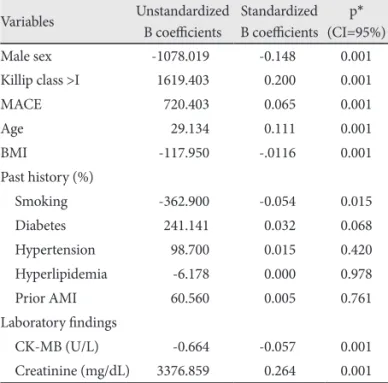
As analyzed by multiple regression (Table 2), significantly

influencing factors of NT-proBNP were sex, creatinine level,

creatine kinase-MB level, Killip clsass, MACE, age, and BMI.

(3)

Table 2 demonstrates that NT-proBNP was higher in men, in older patients, with elevated creatinine levels and with lower BMIs (p<0.001 in each case). Fig. 1 shows a box-plot of NT-

proBNP and Killip class. NT-proBNP was higher in the Killip class II, III, IV groups than in the Killip class I group (3,353±

5,329 pg/mL vs. 1,174±2,240 pg/mL, p<0.001). Fig. 2 shows a box-plot of NT-proBNP in patients with (group II) and with- out (group I) MACE. NT-proBNP was higher in group II than in group I (2,548±4,469 pg/mL vs. 1,530±3,088 pg/mL, p=

0.001).

Obesity and N-terminal brain natriuretic peptide Fig. 3 shows a box-plot of NT-proBNP and three obesity gr- oups as categorized by BMI. The level of NT-proBNP de- Table 1. Patient characteristics

Group I (n=2,478) Group II (n=258) p (CI=95%)

Mean age (years)* 065.6±12.4 067.1±12.2 0.015

Male (%)

1,795 (72.4) 177 (68.6) 0.192

STEMI (%)

1,538 (62.1) 165 (64.0) 0.552

Systolic BP (mmHg)

Diastolic BP (mmHg) 127.6±32.6 128.9±26.7 0.497

Heart rate (beats/min) 078.6±20.8 078.8±16.0 0.903

Past history (%)

078.4±22.6 076.0±18.4 0.056

Smoking 1,522 (61.5) 162 (62.8) 0.684

Diabetes 0,627 (25.5) 084 (32.8) 0.011

Hypertension 1,104 (44.8) 115 (44.9) 0.963

Hyperlipidemia ,178 (7.2) 13 (5.0) 0.198

Prior myocardial infarction ,220 (8.9) 027 (10.5) 0.400

Laboratory findings

CK-MB (U/L)* 128.11±232.3 150.41±283.9 0.223

NT-proBNP (pg/mL)

01,530±3,088 02,548±4,469 <0.001

Creatinine (mg/dL)* 01.01±0.29 01.00±0.25 0.244

Obesity

Lean (BMI <23 kg/m

2

) ,0924 (37.3) 104 (40.3) 0.454

Overweight (BMI 23.0-24.9 kg/m

2

) 0,670 (27.0) 060 (23.3) 0.200

Obese (BMI >24.9 kg/m

2

) 0,884 (35.7) 094 (36.4) 0.797

*By Chi-square test for dichotomous variables,

By Student t-test for continuous variables,

By Mann Whitney U test. MACE: major adverse cardiac events, CI: confidence interval, STEMI: ST-segment elevation myocardial infarction, BP: blood pressure, CK-MB: creatine kinase- myocardial band isoenzyme, NT-proBNP: N-terminal brain natriuretic peptide, BMI: body mass index

Table 2. Independent variables of NT-proBNP in AMI patients Variables Unstandardized

B coefficients

Standardized B coefficients

p*

(CI=95%)

Male sex -1078.019 -0.148 0.001

Killip class >I 1619.403 0.200 0.001

MACE 720.403 0.065 0.001

Age 29.134 0.111 0.001

BMI -117.950 -.0116 0.001

Past history (%)

Smoking -362.900 -0.054 0.015

Diabetes 241.141 0.032 0.068

Hypertension 98.700 0.015 0.420

Hyperlipidemia -6.178 0.000 0.978

Prior AMI 60.560 0.005 0.761

Laboratory findings

CK-MB (U/L) -0.664 -0.057 0.001

Creatinine (mg/dL) 3376.859 0.264 0.001

*By multiple linear regression model. NT-proBNP: N-terminal brain natriuretic peptide, CI: confidence interval, MACE: major adverse cardiac events, BMI: body mass index, AMI: acute myocardial in- farction, CK-MB: creatine kinase-myocardial band isoenzyme

Fig. 1. Box-plot of NT-proBNP and Killip class. NT-proBNP was lo- wer in the Killip class I group than in the Killip class II, III, IV groups (1,174±2,240 pg/mL vs. 3,353±5,329 pg/mL, p<0.001). NT-proB- NP: N-terminal brain natriuretic peptide.

4,000 3,000 2,000 1,000 0

p<0.001

N T- pr oB N P (p g/ m L)

Killip class I Killip class II, III, IV 1,774±2,240

n=2,139

3,353±5,329

n=565

(4)

creased as obesity increased (p=0.001). Table 3 shows the means NT-proBNP levels of each sub-group, divided by sex, obe- sity degree, and MACE/non-MACE. A notable finding was that the mean NT-proBNP of male obese MACE patients was much lower than the mean NT-proBNP of female lean non-

MACE patients (1,134±2,310 vs. 3,121±4,349, p<0.001). Mul- tivariate regression analysis identified BMI as an indepen- dent negative correlate of NT-proBNP level (p<0.001) (Table 2).

Prognostic value of N-terminal brain natriuretic peptide related with obesity

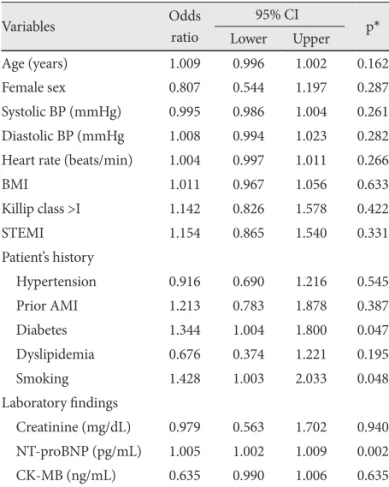
For investigation of independent prognostic factors of AMI, we performed multivariate analysis and the results showed that DM, smoking, and NT-proBNP were independent prog- nostic factors of AMI (Table 4). To focus on the influence of obe- sity, we evaluated the prognostic value of NT-proBNP in each weight group (lean, overweight, obese) by binary logistic re- gression (Table 5). NT-proBNP was still an independent prog- nostic factor of AMI in obese patients (odds ratio=1.009, p=

0.01) (Table 5).

Discussion

NT-proBNP is a natriuretic hormone released primarily from the heart ventricles. NT-proBNP is released from myocardial cells in response to volume expansion in HF. Therefore, NT- proBNP has been used for diagnosis of symptomatic or asymp- tomatic HF.

14)

However, NT-proBNP is also thought to be re- leased from ischemic myocardial cells due to an unknown me- Fig. 3. Box-plot of NT-proBNP and three weight groups categorized

by BMI. p=0.001 calculated by Kruskal-Wallis test. NT-proBNP: N- terminal brain natriuretic peptide, BMI: body mass index.

3,000

2,000

1,000

0

p=0.001

N T- pr oB N P (p g/ m L)

Lean Overweight Ovese 2,393±4,022

n=875

1,506±3,074

n=724 1,100±1,137 n=1,137 Fig. 2. Box-plot of NT-proBNP in patients with and without MACE.

NT-proBNP was lower in patients without MACE (group I) than in patient with MACE (group II) (1,519±3,088 pg/mL vs. 2,548±4,469 pg/mL, p=0.001). NT-proBNP: N-terminal brain natriuretic peptide, MACE: major adverse cardiac events.

4,000 3,000 2,000 1,000 0

p=0.001

N T- pr oB N P (p g/ m L)

Group I Group II 1,519±3,088

n=2,478

2,548±4,469 n=258

Table 3. The mean NT-proBNP levels of each sub-group divided by sex, obesity degree, and MACE (group II)/non-MACE (group I)

Group I mean NT-proBNP

Group II mean

NT-proBNP p

Male (n)

Lean 1,865±3,597 (540) 2,998±4,712 (55) 0.03 Overweight 1,135±2,765 (485) 1,268±1,943 (45) 0.75 Obese 0,770±1,705 (770) 1,134±2,310 (77) 0.09 Female (n)

Lean 3,121±4,349 (248) 4,643±5,177 (32) 0.07 Overweight 2,192±3,362 (171) 4,693±5,484 (23) 0.01 Obese 1,859±3,265 (264) 3,530±7,374 (26) 0.03 NT-proBNP: N-terminal brain natriuretic peptide, MACE: major adverse cardiac events

Table 4. Multivariative analysis of independent risk factors of MACE in all patients

Variables Odds

ratio

95% CI Lower Upper p*

Age (years) 1.009 0.996 1.002 0.162

Female sex 0.807 0.544 1.197 0.287

Systolic BP (mmHg) 0.995 0.986 1.004 0.261 Diastolic BP (mmHg 1.008 0.994 1.023 0.282 Heart rate (beats/min) 1.004 0.997 1.011 0.266

BMI 1.011 0.967 1.056 0.633

Killip class >I 1.142 0.826 1.578 0.422

STEMI 1.154 0.865 1.540 0.331

Patient’s history

Hypertension 0.916 0.690 1.216 0.545

Prior AMI 1.213 0.783 1.878 0.387

Diabetes 1.344 1.004 1.800 0.047

Dyslipidemia 0.676 0.374 1.221 0.195

Smoking 1.428 1.003 2.033 0.048

Laboratory findings

Creatinine (mg/dL) 0.979 0.563 1.702 0.940 NT-proBNP (pg/mL) 1.005 1.002 1.009 0.002

CK-MB (ng/mL) 0.635 0.990 1.006 0.635

*By binary logistic regression model. MACE: major adverse cardiac events, CI: confidence interval, BP: blood pressure, BMI: body mass index, STEMI: ST-segment elevation myocardial infarction, AMI:

acute myocardial infarction, NT-proBNP: N-terminal brain natriure-

tic peptide, CK-MB: creatine kinase-myocardial band isoenzyme

(5)

chanism. For this reason, many recent studies have demon- strated the prognostic value of NT-proBNP in ACS patients

15)16)

Because NT-proBNP levels rise rapidly after the onset of ACS symptoms, NT-proBNP can be used as a good independent prognostic indicator in the early evaluation of ACS patients.

17)

However, there are many variables which influence NT- proBNP levels. NT-proBNP is a biologically inert 76 amino acid N-terminal proBNP, produced by cleavage of the prohor- mone (proBNP) from biologically active 32 amino acid BNP.

17)

It is cleared by the kidney, with its plasma concentration therefore increased by renal failure.

9)

The half-life of NT-pro- BNP is about 120 minutes with normal kidney function.

18)

We thus excluded renal insufficiency patients (Cr. >2.0 mg/

dL) in this study to minimize the influence of kidney func- tion. The plasma concentrations of NT-proBNP are higher in older individuals and in women than in men.

8)

According to our results, and as expected, NT-proBNP concentrations of women and older patients were significantly higher than those of young and male patients. Another influencing factor is HF. We excluded patients with previous HF history from the study population. The Killip classification categorizes AMI pa- tients based upon the presence or absence of simple physical examination findings that suggest left ventricular (LV) dys- function (HF).

19)

Killip class I means no evidence of HF, with increasing Killip class number indicating increasing severity of HF. Our results showed significantly higher NT-proBNP

levels with Killip class II-IV (HF) than with Killip class I (non- HF). Finally, another factor strongly influencing NT-proB- NP concentration is obesity. Many studies have shown that obese patients tend to have lower plasma NT-proBNP con- centrations than nonobese patients.

20)21)

One study recently an- nounced that BNP levels cannot be used as a marker of LV wall stress in obese individuals.

22)

The aim of this study was to examine the influence of obe- sity on NT-proBNP as a prognostic value in AMI patients of the KAMIR during 12 months of follow-up. We hypothesized that NT-proBNP in obese AMI patients could not be used as a prognostic factor of AMI due to the influence of obesity. Our results demonstrated that obese AMI patients have a lower level of NT-proBNP than lean or overweight AMI patients. The lowest mean NT-proBNP value was seen in male, obese, non- MACE patients (Table 3). Notably, the mean NT-proBNP of male obese MACE patients was markedly lower than the mean NT-proBNP of female lean non-MACE patients. However, NT-proBNP still had an independent prognostic value for AMI among obese patients. This result suggests that obese AMI pa- tients with higher NT-proBNP have worse prognoses.

The mechanism of negative correlation of NT-proBNP and obesity is not yet known. Some authors have suggested that reduced secretion of natriuretic peptides from either dimin- ished myocardial hormone release

23)

or impaired synthesis

24)

is the major cause of the inverse relationship between natri- Table 5. Multivariative analysis of independent risk factors of MACE in each weight group

Variables Lean Overweight Obese

p* OR p* OR p* OR

Age (years) 0.043 1.023 0.396 1.012 0.563 0.994

Female sex 0.116 0.625 0.866 0.931 0.846 1.074

Systolic BP (mmHg) 0.851 0.999 0.122 0.984 0.369 0.993

Diastolic BP (mmHg 0.989 1.000 0.143 1.025 0.295 1.013

Heart rate (beats/min) 0.587 1.003 0.135 1.010 0.988 1.000

BMI 0.336 0.940 0.333 0.780 0.714 1.018

Killip class >I 0.169 1.402 0.531 1.239 0.532 0.821

STEMI 0.910 0.974 0.872 0.950 0.040 1.669

Patient’s history

Hypertension 0.165 0.713 0.664 1.138 0.743 1.081

Prior AMI 0.124 1.664 0.894 0.926 0.988 0.994

Diabetes 0.546 1.166 0.014 2.096 0.236 1.332

Dyslipidemia 0.446 0.658 0.226 0.402 0.742 0.870

Smoking 0.038 1.827 0.095 1.852 0.794 0.925

Laboratory findings

Creatinine (mg/dL) 0.810 0.903 0.203 0.427 0.238 1.767

CK-MB (ng/mL) 0.518 1.004 0.954 1.001 0.061 0.987

NT-proBNP (pg/mL) 0.113 1.004 0.078 1.006 0.013 1.009

*By binary logistic regression model. MACE: major adverse cardiac events, OR: odds ratio, BP: blood pressure, BMI: body mass index, STE-

MI: ST-segment elevation myocardial infarction, AMI: acute myocardial infarction, CK-MB: creatine kinase-myocardial band isoenzyme,

NT-proBNP: N-terminal brain natriuretic peptide

(6)

uretic peptides and BMI.

There are several limitations to this study. First, our study was a multi-center prospective registry, and it was not a ran- domized, controlled study. Thus, there was probably a selec- tion bias when enrolling patients into both study groups.

Second, we divided our groups according to BMI based on the World Health Organization cut-off values for overweight and obesity in Asians. This will inevitably make it difficult to directly compare our results with those of similar studies of non- Asian patients. Third, the period of our study was relatively short as it was a comparison of MACE during 1 year clinical follow-up. Fourth, we were not able to include the follow-up NT-proBNP or BMI data. Another study demonstrated that early phase NT-proBNP (measured at 2-6 days after AMI) was a better prognostic factor than acute phase NT-proBNP (meas- ured on arrival).

25)

In conclusion, NT-proBNP is lower in obese AMI patients than in non-obese AMI patients, but NT-proBNP is still of independent prognostic value for obese AMI patients. Fur- ther study will be necessary to investigate the complex rela- tionships between MACE, BMI, sex, and NT-proBNP.

Acknowledgments

This study was performed with the support of The Korean Society of Circulation in celebration of the 50th Anniversary of The Korean Society of Circulation.

Korea Acute Myocardial Infarction Registry (KAMIR) Study Group of Korean Society of Cardiology

Myung Ho Jeong, MD, Youngkeun Ahn, MD, Shung Chull Chae, MD, Jong Hyun Kim, MD, Seung Ho Hur, MD, Young, Jo Kim, MD, In Whan Seong, MD, Dong Hoon Choi, MD, Jei Keon Chae, MD, Taek Jong Hong, MD, Jae Young Rhew, MD, Doo Il Kim, MD, In Ho Chae, MD, Jung Han Yoon, MD, Bon Kwon Koo, MD, Byung Ok Kim, MD, Myoung Yong Lee, MD, Kee Sik Kim, MD, Jin Young Hwang, MD, Myeong Chan Cho, MD, Seok Kyu Oh, MD, Nae Hee Lee, MD, Kyoung Tae Jeong, MD, Seung Jea Tahk, MD, Jang Ho Bae, MD, Seung Woon Rha, MD, Keum Soo Park, MD, Chong Jin Kim, MD, Kyoo Rok Han, MD, Tae Hoon Ahn, MD, Moo Hyun Kim, MD, Ki Bae Seung, MD, Wook Sung Chung, MD, Ju Young Yang, MD, Chong Yun Rhim, MD, Hyeon Cheol Gwon, MD, Seong Wook Park, MD, Young Youp Koh, MD, Seung Jae Joo, MD, Soo Joong Kim, MD, Dong Kyu Jin, MD, Jin Man Cho, MD, Byung Ok Kim, MD, Sang-Wook Kim, MD, Jeong Kyung Kim, MD, Tae Ik Kim, MD, Deug Young Nah, MD, Si Hoon Park, MD, Sang Hyun Lee, MD, Seung Uk Lee, MD, Hang-Jae Chung, MD, Jang Hyun Cho, MD, Seung Won Jin, MD, Yang Soo Jang, MD, Jeong Gwan Cho, MD and Seung Jung Park, MD

REFERENCES

1) Granger CB, Goldberg RJ, Dabbous O, et al. Predictors of hospital

mortality in the global registry of acute coronary events. Arch Intern Med 2003;163:2345-53.

2) Antman EM, Cohen M, Bernink PJ, et al. The TIMI risk score for unstable angina/non-ST elevation MI: a method for prognostication and therapeutic decision making. JAMA 2000;284:835-42.

3) Richards AM, Nicholls MG, Yandle TG, et al. Plasma N-terminal pro-brain natriuretic peptide and adrenomedullin: new neurohormon- al predictors of left ventricular function and prognosis after myocar- dial infarction. Circulation 1998;97:1921-9.

4) James SK, Lindahl B, Siegbahn A, et al. N-terminal pro-brain natri- uretic peptide and other risk markers for the separate prediction of mortality and subsequent myocardial infarction in patients with unsta- ble coronary artery disease: a Global Utilization of Strategies To Open occluded arteries (GUSTO)-IV substudy. Circulation 2003;108:275-81.

5) Iwanaga Y, Nishi I, Furuichi S, et al. B-type natriuretic peptide strongly reflects diastolic wall stress in patients with chronic heart failure: com- parison between systolic and diastolic heart failure. J Am Coll Cardiol 2006;47:742-8.

6) Goetze JP, Christoffersen C, Perko M, et al. Increased cardiac BNP ex- pression associated with myocardial ischemia. FASEB J 2003;17:

1105-7.

7) de Lemos JA, Morrow DA, Bentley JH, et al. The prognostic value of B-type natriuretic peptide in patients with acute coronary syndromes.

N Engl J Med 2001;345:1014-21.

8) Raymond I, Groenning BA, Hildebrandt PR, et al. The influence of age, sex and other variables on the plasma level of N-terminal pro brain na- triuretic peptide in a large sample of the general population. Heart 2003;

89:745-51.

9) Anwaruddin S, Lloyd-Jones DM, Baggish A, et al. Renal function, con- gestive heart failure, and amino-terminal pro-brain natriuretic peptide measurement: results from the ProBNP Investigation of Dyspnea in the Emergency Department (PRIDE) Study. J Am Coll Cardiol 2006;47:

91-7.

10) Das SR, Drazner MH, Dries DL, et al. Impact of body mass and body composition on circulating levels of natriuretic peptides: results from the Dallas Heart Study. Circulation 2005;112:2163-8.

11) Mehra MR, Uber PA, Park MH, et al. Obesity and suppressed B-type natriuretic peptide levels in heart failure. J Am Coll Cardiol 2004;43:

1590-5.

12) Lee KH, Jeong MH, Ahn YK, et al. Gender differences of success rate of percutaneous coronary intervention and short term cardiac events in Korea Acute Myocardial Infarction Registry. Int J Cardiol 2008;130:

227-34.

13) Low S, Chin MC, Ma S, Heng D, Durenberg-Yap M. Rationale for redefining obesity in Asians. Ann Acad Med Singapore 2009;38:66-9.

14) Kim SH, Kim JS, Baek KK, et al. Role of NT-proBNP in evaluation of functional status in congestive heart failure. Korean Circ J 2004;34:

894-9.

15) Baek KK, Jeon ES, Rhee I, et al. N-terminal pro-B-type natriuretic peptide as a prognostic marker in acute coronary syndrome. Korean Circ J 2004;34:1070-81.

16) Kim KS, Han HS, Hwang KK, Youn TJ, Kim DW, Cho MC. The pla- sma level of N-terminal pro B-type natriuretic peptide (NT-proBNP) for severity of coronary artery stenosis and early risk stratification in patients with non-ST elevation acute coronary syndrome. Korean Circ J 2004;34:133-41.

17) Jernberg T, Stridsberg M, Venge P, Lindahl B. N-terminal pro brain natriuretic peptide on admission for early risk stratification of patients with chest pain and no ST-segment elevation. J Am Coll Cardiol 2002;

40:437-45.

18) de Lemos JA, McGuire DK, Drazner MH. B-type natriuretic peptide in cardiovascular disease. Lancet 2003;362:316-22.

19) Killip T 3rd, Kimball JT. Treatment of myocardial infarction in a coro- nary care unit: a two year experience with 250 patients. Am J Cardiol 1967;20:457-64.

20) Wang TJ, Larson MG, Levy D, et al, Impact of obesity on natriuretic

peptide levels. Circulation 2004;109:594-600.

(7)

21) McCord J, Mundy BJ, Hudson MP, et al. Relationship between obesity and B-type natriuretic peptide levels. Arch Intern Med 2004;164:

2247-52.

22) Tosa S, Watanabe H, Iino K. Usefulness of plasma BNP levels as a marker of left ventricular wall stress in obese individuals. Int Heart J 2009;50:173-82.

23) Licata G, Volpe M, Scaglione R, Rubattu S. Salt-regulating hormones in young normotensive obese subjects: effects of saline load. Hyper- tension 1994;23(1 Suppl):I20-4.

24) Morabito D, Vallotton MB, Lang U. Obesity is associated with im- paired ventricular protein kinase C-MAP kinase signaling and altered ANP mRNA expression in the heart of adult Zucker rats. J Investig Med 2001;49:310-8

25) Choe HM, Yoo BS, Ryu HY, et al. The early changing pattern of the B-type natriuretic peptide concentration and its significance as a prog- nostic marker after acute myocardial infarction. Korean Circ J 2006;

36:526-34.

수치

Fig. 1. Box-plot of NT-proBNP and Killip class. NT-proBNP was lo- lo-wer in the Killip class I group than in the Killip class II, III, IV groups  (1,174±2,240 pg/mL vs
Table 4. Multivariative analysis of independent risk factors of  MACE in all patients

참조

관련 문서

Third, the analysis of the body-centered vertical speed between male.. and female students showed that male students appeared faster than female students at

At the mean draft between forward and after perpendicular, the hydrostatic data show the ship to have LCF after of midship = 3m, Breadth = 10.47m, moment of inertia of the

As a result of comparing with the temperature change, the coldest month mean temperature (January, February, December) showed positive value in the whole

Among the sub-factors of self-esteem, positive, male was higher than female, and on the contrary, negative In this study, females were higher than males,

Mean thickness of palate including bone and soft tissue according to Level at 2 and 4 mm laterally from antero-posterior reference line in

Comparison of mean and standard deviation of capnographic I:E ratio between normal breathing status and respiratory depression status in 21 patients experienced

23 23 23 Standard 23 Standard Standard deviation, Standard deviation, deviation, mean deviation, mean mean mean for for for for the the the the power power

• The mean of linear combination of random variables equals the linear combination of the means because the mean is a linear statistic.. • The variance is not