논문 16-41-12-37 The Journal of Korean Institute of Communications and Information Sciences '16-12 Vol.41 No.12 https://doi.org/10.7840/kics.2016.41.12.1925
Link Quality Based Transmission Power Control in IEEE 802.15.4 for Energy Conservation
Samrachana Nepali
, Seokjoo Shin
°ABSTRACT
One of the major challenges in the design of wireless sensor network (WSN) is to reduce the energy consumption of sensor nodes for prolonging the network lifetime. In the sensor network, communication is the most energy consuming event. Therefore, most of the energy saving techniques conserve energy by adjusting different parameters of the trans-receiver. Among them, one of the promising methods is the transmission power control (TPC). In this paper, we investigated the effects of the link quality based TPC scheme employed to the IEEE 802.15.4 standard for energy saving. The simulation results demonstrated that the link quality based TPC scheme works effectively in conserving energy as compared to the conventional IEEE 802.15.4.
Key Words : communication, signal processing, Neutral systems, Communication Sciences, Network
※ 이 논문은 2015학년도 조선대학교 학술연구비의 지원을 받아 연구되었습니다.
First Author : Chosun University, Department of Computer Engineering, [email protected], 학생회원
° Corresponding Author : Chosun University, Department of Computer Engineering, [email protected], 종신회원 논문번호:KICS2016-08-212, Received August 29, 2016; Revised November 14, 2016; Accepted November 16, 2016
Ⅰ. Introduction
Wireless Sensor Network (WSN) consists of low-powered devices capable of sensing and computing. As these small, inexpensive devices are battery powered, sensor nodes must be energy efficient
[1-7]. The radio on a sensor node is usually the component that uses the most energy. The legacy MAC protocols of WSN conserve energy by introducing the concept of duty cycling where a node periodically alternates between active and inactive mode. However, there is a tradeoff between energy consumption and the latency in duty cycling MAC protocols. Radio-triggered power management is another alternative for energy conservation
[8]. In radio-triggered power management, a special hardware component, a radio-triggered circuit, is connected to sensor node which wakes up the sensor node whenever it senses communication in the vicinity. The radio-triggered circuit prevents sensor nodes from duty cycling. Similarly, power control scheme is also an alternative to adjust transmit
power for energy conservation. Besides saving energy, power control also improves spatial reuse of the wireless channel
[9].
IEEE 802.15.4 standard uses fixed default power for transmission. Even though the commercial trans-receivers are programmable, the standard has not defined any power control mechanism. In this paper, we present the link quality based TPC algorithm which can be easily implemented into the IEEE 802.15.4 standard. The idea is to dynamically adjust the transmission power to discover and maintain a quality of the link between a pair of nodes instead of transmitting data at a full power capacity.
The rest of this paper is organized as follows.
Section II provides reviews on the legacy TPC
schemes applied for WSN and introduces the
motivation of this study. Section III presents the
proposed TPC algorithm. Similarly, experimental
results are shown in Section IV and finally, we
conclude our paper in Section V.
Ⅱ. Related Works and Motivation
Several MAC approaches on transmission power control for WSNs are reviewed in this section. The common procedure is monitoring the current link quality by broadcasting messages to neighbors and determining the incoming acknowledgements. In some proposed schemes, a table storing network topology is required. A transmission power control in MAC protocols for wireless sensor networks is proposed in [10]. To adjust the transmission power in WSNs, two approaches are presented in the paper. The first approach employs dynamic adjustments by the exchange of information among nodes, and the second one calculates the ideal transmission power according to the signal attenuation of the link. In the first approach, the transmission power is divided into a few levels and nodes adjust its transmission power level according to the number of consecutive Acknowledgement (ACK) packets it received successfully. However, using packet reception rate (PRR) for power control may not be practical in actual applications especially when the channel is shared with other wireless technologies. In the second approach, Received Signal Strength Indicator (RSSI) readings were found to be extremely dependent on environmental conditions in WSN, thus calculation of the ideal transmission power is imprecise.
PSMAC (transmission Power control in SMAC) is SMAC based transmission power control protocol for WSNs
[1,11]. PSMAC selects the minimum amount of transmitting energy required to exchange messages between any pair of neighboring nodes.
The necessary power for the transmission is calculated using the RSSI of received SYNC packet.
To record the required transmission power for communication for the individual neighbor, each node maintains a neighbor list. However, broadcast messages are transmitted with the maximal transmission power. In order to assign a minimum and workable transmission power to each communication link, Adaptive Transmission Power Control (ATPC) for Wireless Sensor Networks was designed based on the concept of changing a
pairwise transmission power level over time
[12]. Two main ideas behind its design are a neighbors table which is maintained by each node and a closed loop for transmission power control which runs between each pair of sensors. The closed loop feedback is used to obtain the minimum transmission power by gradually adjusting the power. Similarly, in [13]
authors showed that transmission power levels adjusted per link give the higher network lifetime than single power level for all links. In [14], it is shown that reconfiguring transmission power levels are an effective way of saving energy in WSNs. The relation between the signal strength and the packet delivery is studied in [15] and concluded that the signal-to-noise ratio (SNR) of 15-20 dB is enough for the successful delivery of most of the data packets.
Although there have been various works discussing the TPC mechanism, no previous work has discussed the possibility of using TPC in IEEE 802.15.4 standard. In this paper, we will show how IEEE 802.15.4 standard can be enhanced by implementing TPC mechanism.
In a typical WSN, sensor nodes are randomly deployed in the interested region. Thus, the distance between any two nodes is variable. In some cases, the nodes may be very close to each other, whereas in other cases, the distance between the nodes may be farther. In this kind of scenario, using the same transmission power by all sensor nodes might not be an effective solution. The nodes which are close to each other can communicate easily by using lower transmission power. Using full transmission power, even though the reliable communication can be done with lesser power, is just the waste of energy.
The IEEE 802.15.4 standard for Low-Rate
Wireless Personal Area Network (LR-WPANs) is
becoming a de-facto standard for WSN applications
due to its low energy consumption, low cost, and
small size. The CC2420 is a single-chip 2.4 GHz
IEEE 802.15.4 compliant RF module and is used in
most of the commercial sensor motes
[16]. In CC2420,
the transmission power is programmable; therefore,
we can change the transmission power of the sensor
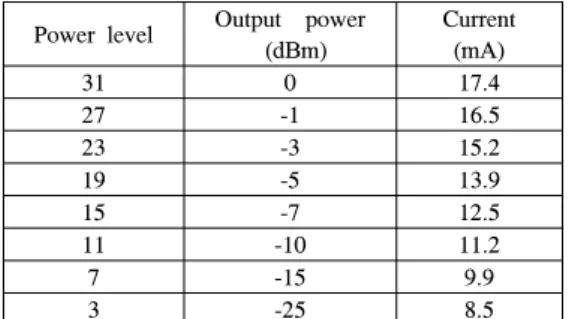
node according to our requirement. Table 1 shows
Power level Output power (dBm)
Current (mA)
31 0 17.4
27 -1 16.5
23 -3 15.2
19 -5 13.9
15 -7 12.5
11 -10 11.2
7 -15 9.9
3 -25 8.5
Table 1. CC2420 transmission power level
5 6 7 8 9 1 0 11 12 1 3 1 4 1 5
12 0 13 0 14 0 15 0 16 0 17 0 18 0 19 0 20 0 21 0 22 0 23 0 24 0 25 0 26 0
LQI
Dist ance (m )
Fig. 1. Change in LQI with distance the different transmission power level of CC2420.
However, the benefit of this programmable power level is exploited by IEEE 802.15.4 standard. Thus, we proposed to dynamically adjust the transmission power according to the link quality measurement in order to conserve energy.
Ⅲ. Proposed Link Quality based TPC Scheme for IEEE 802.15.4
The aim of the proposed algorithm is to lower transmission power to a level which maintains acceptable packet success rate.
In order to reduce the energy consumption, the proposed method adjusts the transmission power corresponding to the distance between a sender and a receiver. Link Quality Indication (LQI) value is used to estimate the distance between sensor nodes, which is feedback in the ACK frame. In IEEE 802.15.4, every MAC frame contains LQI value, which ranges from 0 to 255. The LQI measurement is a characterization of the strength and/or quality of a received packet. However, the calculation of the LQI is not specified in the IEEE 802.15.4 standard.
Thus, the receiver Energy Detection (ED), Signal-to-Noise ratio (SNR), or the combination of these methods can be used in commercial IEEE 802.15.4 modules to calculate the LQI
[16].
In order to observe the change in LQI with respect to distance, we conducted a simple experiment as described below. The simulation was performed in NS-2
[17]. Two nodes, Node 1 and Node 2, were placed next to each other. Node 2 transmitted data to Node 1 at 2 kbps. Node 1 was
fixed and Node 2 was slowly moved away from Node 1 at the speed of 0.5m/s. Transmission range was set to 15m. The LQI value of data received at Node 1 is shown in Figure 1. In NS-2, the LQI is calculated based on the received signal strength and the signal to noise ratio. A packet is only received if its LQI is equal or greater than 128. Thus, LQI obtained ranged from 128 to 255 because the packets whose LQI is below 128 were dropped.
Also, the LQI value of 255 was observed when the distance between two nodes is less than 12m, and the gradual decrease in the LQI was observed once the distance between nodes exceeded 12m. In [18]
and [19], authors also obtained similar LQI result.
Also from the NS-2 experiment, we observed that the LQI value between 140 and 170 is sufficient for the reliable communication between nodes. Thus, based on the NS-2 experiment, we proposed the following algorithm for estimating distance and adjusting the transmission power.
At the beginning of the network, nodes use the
default transmission power, which is the highest
power level (level 31 in Table 1). As the nodes
communicate, they estimate the distance (or link
quality) between them and adjust the transmission
power accordingly. During data transmission, the
receiving node calculates the LQI value of the
received packet. However, for adjusting the
transmission power, the sender should know about
the LQI at the receiver. Thus, as a feedback, the
LQI of the received data packet is piggybacked and
sent to the sender in the ACK packet. From the
Fig. 3. Topology used in the simulation.
Parameter Value
Power Supply 3 V
Sleep Power 30 uw
Idle Power 2.76 mw
Data traffic CBR
Radio rate 250 Kbps
Routing protocol DumpAgent / AODV
Data rate Variable
Transmission range 15 m
Packet size Variable
LQIlow 140
LQIhigh 170
Table 2. Network Parameters.
Power level
Tx. power (mw)
Tx. Range (m)
31 52.2 15
27 49.5 13
23 45.6 11
19 41.7 9
15 37.7 7
11 33.6 5
7 29.7 3
3 25.5 1
Table 3. Transmission power and range.
ACK, the sender knows about LQI of its sent packet at receiver, adjusts its transmission power such that the LQI at the receiver is in the range between LQI
lowand LQI
high. For filtering the noise in LQI, the running average of LQI is calculated, i.e., the LQI is normalized by averaging the multiple LQI received from the receiver. The normalized LQI, denoted by LQI
avg, is used for adjusting the transmission power. Figure 2 shows the flowchart for adjusting the transmission power. All the nodes maintain a table called transmission power table, which records the required transmission power for each neighbor. However, in the case a node needs to broadcast, the maximum power level is used.
Fig. 2. Flowchart for link quality based TPC algorithm.
Ⅳ. Experimental Results
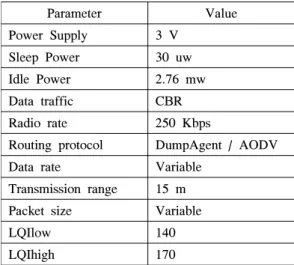
For the performance evaluation, we implemented the proposed link quality based TPC method on IEEE 802.15.4 and SMAC protocols in the NS-2 simulator. Note that the IEEE 802.15.4 and SMAC is readily available in the NS-2 simulator. A Simulation study has been performed for the proposed TPC and compared it with the original protocols. For the simulation, nodes are deployed in a 100×100m field with the given topology shown in Figure 3. Similarly, the parameters used for the simulation are shown in Table 2. The parameters of Table 2 are taken from CC2420 datasheet
[15]. In the case of IEEE 802.15.4, BO=SO=3 was used.
Similarly, in SMAC, duty cycling was not used so as to be comparable with BO=SO (no inactive
period) of IEEE 802.15.4. In Figure 3, node 1, node 2, node 3, and node 4 transmits data to the node 0.
Similarly, node 6, node 7, and node 8 transmit data
to the node 5. The distance between sender and
receiver is variable. Table 3 shows the transmission
power and range of different power levels used in
the simulation. Therefore, using Table 3, the
transmission powers of source node were set.
1 2 3 4 90
91 92 93 94 95 96 97 98 99 100
PDR(%)
Mes sage arrival period (sec) Conventional IEEE 802.15.4 IEEE 802.15.4 with the proposed TPC Conventional SMAC
SMAC with the proposed TPC
Fig. 4. Average packet delivery ratio.
1 2 3 4
1 2 3 4 5 6 7
Energy (Joule)
Message arrival period (sec) Convent ional IE EE 802.15.4 IEEE 802.15.4 with the proposed TPC Convent ional S MA C
S MA C with the proposed TPC
Fig. 5. Average energy consumption.
5 0 7 5 10 0
90 91 92 93 94 95 96 97 98 99 1 00
PDR(%)
packet size (bytes) Conventional IE EE 802. 15.4 IE EE 802. 15.4 with the proposed TP C Conventional SMA C
SMA C with the proposed TP C
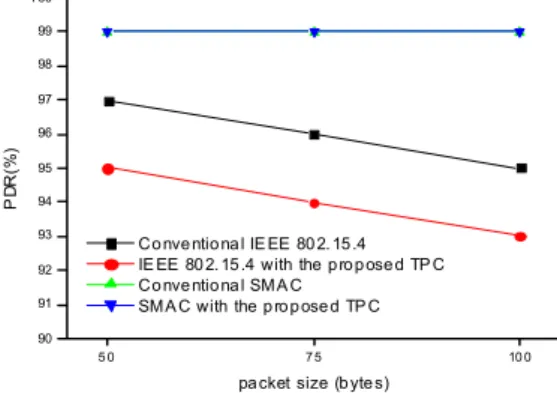
Fig. 6. Average packet delivery ratio.
Different experiments were performed to test the performance of the proposed TPC algorithm.
In the first experiment, message inter arrival period is varied from 1 to 4 seconds. Packet size was fixed to 50 bytes. The simulation was carried for 500 seconds. Figure 4 and Figure 5 show the average Packet Delivery Ratio (PDR) and average energy consumption of network obtained from the simulation. It is observed that at the message interval of 1-second, PDR of the conventional IEEE 802.15.4 is higher than the proposed TPC. The reason for this is that, whenever there is a collision, at the same power level, the receiver was successful in decoding the data packet from the node which is near to it, which is generally referred to as the capture effect. However, in the case of applying TPC, since power was adjusted based on the distance, in the case of collision, all transmitted data
packets were dropped as a receiver is unable to decode any data packet. Conversely, PDR for IEEE 802.15.4 is almost same in both protocols for higher message intervals. Furthermore, PDR in SMAC is almost same for all message intervals, which can be explained by the fact that SMAC is not employing duty cycling, hence significantly reducing overheads associated with network synchronization giving more bandwidth for data communication. As expected, in Figure 5, proposed TPC is able to save energy in the network. As the message inter-arrival period increases, the traffic load in the network decreases.
Therefore, the energy consumption decreased as the message inter-arrival period increased. Furthermore, since SMAC does not go into power saving mode, the energy conservation in SMAC is significantly high in compared with the IEEE 802.15.4.
In the econd experiment, the message inter arrival
period is fixed to 1 second while packet size was
varied from 50 to 100 bytes. The simulation was
carried for 500 seconds. Figure 6 and Figure 7 show
the average PDR and average energy consumption
of network obtained from Experiment 2,
respectively. It was observed that PDR of the
conventional IEEE 802.15.4 was higher than the one
with the proposed TPC whereas the PDR for SMAC
is same for all cases. The reason for this is same as
with the first experiment. It was also observed that
as the packet size was increased, the PDR decreased
because as the packet size increases, more power is
consumed. Therefore, as expected, in Figure 7, the
energy consumption increased with the increase in
Protocols PDR (%)
Energy (joule) Conventional IEEE 802.15.4 98 1.45 IEEE 802.15.4 with the proposed TPC 98 1.4
Conventional IEEE SMAC 99 2.85
SMAC with the proposed TPC 99 2.12 Table 4. Comparison results.
5 0 75 10 0
1 2 3 4 5 6 7
Energy (Joule)
pa cket size (b yte s) C o nve nt io n al IE EE 80 2 .15 .4 IE EE 8 02 .15 .4 w ith th e p rop ose d TPC C o nve nt io n al S MA C
S MA C w ith th e p rop ose d TPC
Fig. 7. Average energy consumption.
1 2 3 4
1 2 3 4 5
Energy (Joule)
Nu m be r of ho ps
Co n ven tion al IEE E 8 02 .1 5.4 IEE E 8 02 .1 5. 4 with th e pro po sed TPC Co n ven tion al SM AC
SM AC with th e prop o sed TPC
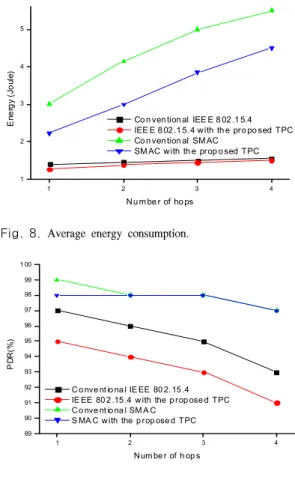
Fig. 8. Average energy consumption.
1 2 3 4
89 90 91 92 93 94 95 96 97 98 99 1 00
PDR(%)
Num be r of h op s Co nve nt io na l IE EE 80 2. 15 .4 IE EE 80 2 .15 .4 with the p rop ose d TPC Co nve nt io na l SM A C
S MA C with the p rop ose d TPC