1Department of Animal Science, Chonbuk National University, Jeonju, 561-756, Korea
2Department of Animal Science, University of Zimbabwe, P.O. Box MP 167, Mt. Pleasant, Harare, Zimbabwe
3Bioenergy Crop Research Center, National Institute of Crop Science, RDA, Muan, 534-833, Korea
4Department of Oral Pharmacology, School of Dentistry and Institute of Dental Bioscience, Chonbuk National University, Jeonju, 651-756
Corresponding author : Prof. Nag-Jin Choi, Department of Animal Science, Chonbuk National University, Jeonju, 561-756, Korea. Tel: 82-63-270-2579, Fax: 82-63-270-2612, E-mail: [email protected] David Tinotenda Mbiriri equally contributed
Effect of Mature Miscanthus sacchariflorus var. No. 1 on In Vitro Rumen Fermentation Characteristics and Its Dry Matter
Digestibility
Sang Buem Cho
1, David Tinotenda Mbiriri
1,2, Sung Jin Oh
1, A Reum Lee
1, Jin Ho Yang
1, Chae Hwa Ryu
1, Chang Min Park
1, Yun Ho Moon
3, Jung-Il Chae
4and Nag-Jin Choi
1생육 후기 거대억새의 In vitro 반추위 발효특성 및 건물 소화율
조상범
1⋅David Tinotenda Mbiriri
1,2⋅오성진
1⋅이아름
1⋅양진호
1⋅유채화
1⋅박창민
1⋅ 문윤호
3⋅채정일
4⋅최낙진
1요 약
본 연구는 반추동물의 조사료 자원으로서 거대억새를 개발하기 위한 목적으로 수행되었다. 우리나 라에서 새롭게 개발된 품종인 거대억새 1호를 완숙기 이후에 채취하여 in vitro 반추위 발효를 이용해 반추위내 pH, 암모니아태 질소, 가스발생량, 휘발성 지방산 생성량 및 건물소화율을 조사하였으며, 볏짚과 비교하여 평가하였다. 거대억새는 볏짚에 비하여 유의적으로 높은 반추위내 pH를 나타내었다 (p<0.01). 암모니아태 질소의 경우 배양 12시간 이후에는 두 처리구간의 유의적인 차이를 나타내지 않 았다(p>0.05). 배양 6시간 이후 부터는 거대억새의 가스발생량이 볏짚에 비하여 유의적으로 낮게 나 타났다(p<0.05). 휘발성 지방산 생성량에 있어 acetate, propionate, butyrate, valerate 및 총생상량에서 볏 짚이 거대억새보다 높게 나타났다. 그러나 iso-butyrate와 iso-valerate에서는 두 조사료원별 차이는 발견 되지 않았다. 건물소화율에 있어 배양 12~24시간 사이의 거대억새 소화율이 볏짚에 비하여 유의적으 로 나타났다. 결론적으로 거대억새의 이용성은 볏짚의 약 80% 수준인 것으로 나타났다.
(Key words : Miscanthus sacchariflorus var., In vitro rumen fermentation, Rice straw, Roughage, Digestibility)
Ⅰ. INTRODUCTION
Forage production in Korea is not sufficient to supply enough roughage needed for ruminant livestock production, hence most of forage
requirements have to be met by imports (Kook
et al., 2011). For this reason, the cost of animal
production, particularly beef and dairy products,
is highly dependent on the feed cost (Park et al.,
2011). The insecure trend of world forage or
feedstuff markets has negatively influenced on the domestic animal industry. Historically, rice straw has comprised an important roughage source (Ramirez et al., 1994) because rice is the staple food in Korea. However, it retains insufficient nutrient contents, low utilization rate and poor palatability, and the situation is made worse by the fact that the production of rice straw is getting lower. Therefore, the development of a new roughage resource that is suited for domestic production is regarded as an urgent need.
In the past, the main target of animal production focused on its productivity. However, the recent goal of animal production considers its impact on the environment as well as productivity because the awareness of environmental issues has increased (Heather and Somerville, 2012). Reduction of greenhouse gases including carbon dioxide has been made a priority globally. Even more, the animal products with low carbon dioxide production are preferred.
Therefore, production systems that ensure the production of low-carbon and environmentally- friendly animal products must be developed.
Miscanthus is a perennial plant that can grow on barren land. It is regarded as a carbon neutral plant because it returns its nitrogen, stored during growing stage in its leaf or stem, back to soil after maturity for new shoots in following year (Lewandowski et al., 2000). This is the reason Miscanthus is regarded as carbon neutral plant. On the basis of its palatability to domestic ruminants it has the potential of being used as a forage source (Bae et al., 1983).
In the present study, the effect of Miscanthus sacchariflorus var. No 1, newly developed in
Korea (Moon et al., 2010), on in vitro rumen fermentation characteristics and dry matter digestibility were investigated to develop it as new roughage resources.
Ⅱ. MATERIALS AND METHODS 1. Roughage sources
Rice straw was obtained from an experiment farm located at Chonbuk National University.
Miscanthus sacchariflorus var. No 1 at mature stage was obtained from Bioenergy Crop Research Center (Muan, Chonnam). A concentrate mix formulated for early fattening period of beef cattle was purchased from a local feed company and used as the concentrate in this study. Roughage sources and concentrate diet were ground using a laboratory grinder (cutter mill, ICA MF10.1, Staufen, Germany).
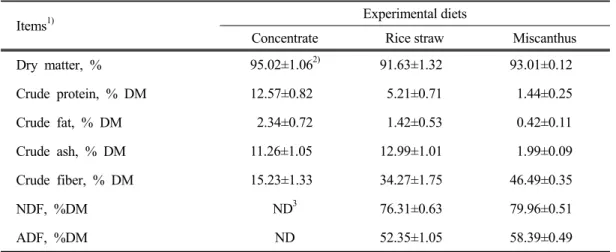
Chemical analysis of Miscanthus was performed according to A.O.A.C (1995) and fiber fractions (NDF and ADF) were analyzed according to Van Soest (2006). Chemical compositions of experimental diets were shown in Table 1.
2. Rumen fluid
Rumen fluid for in vitro rumen fermentation was collected from a Hanwoo steer (body weight, 350 ± 0.5 kg) fed commercial TMR with twice a day feeding frequency (08:00, 17:30). The steer was housed in a metabolic stall individually.
Rumen fluid was collected via the rumen
cannula before morning feeding. It was
contained in a thermos bottle filled with N
2gas
previously. The flask and its contents were
Table 1. Chemical composition of experimental diets
Items
1)Experimental diets
Concentrate Rice straw Miscanthus
Dry matter, % 95.02±1.06
2)91.63±1.32 93.01±0.12
Crude protein, % DM 12.57±0.82 5.21±0.71 1.44±0.25
Crude fat, % DM 2.34±0.72 1.42±0.53 0.42±0.11
Crude ash, % DM 11.26±1.05 12.99±1.01 1.99±0.09
Crude fiber, % DM 15.23±1.33 34.27±1.75 46.49±0.35
NDF, %DM ND
376.31±0.63 79.96±0.51
ADF, %DM ND 52.35±1.05 58.39±0.49
1)NDF: Neutral detergent fiber, ADF: Acid detergent fiber.
2)Mean±standard deviation.
3)ND: not determined.
transferred to the laboratory within an hour. And then it was squeezed through four layers of cheese cloth under streaming of O
2-free CO
2and diluted by four times with modified Mcdougall’s buffer (pH 6.5) consisted of 9.8 g of NaHCO
3, 4.62 g of Na
2HPO
4․2H
2O, 0.57 g of KCl, 0.47 g of NaCl, 0.12 g of MgSO
4․7H
2O and 0.04 g of CaCl
2in 1,000 mL of O
2-free distilled water. After dilution, 50 mL of rumen fluid was transferred to 125 mL of serum bottle containing 0.5 g of diet (0.3 g of roughage + 0.2 g of concentrate). The bottles were sealed using aluminum caps with silicon stoppers and placed in incubator at 39℃. Three bottles were allocated to each of the sample times for 0, 3, 6, 9, 12, 24, 48 and 72 h.
3. Analysis
Used chemicals were purchased from Sigma Chemical Co. (St. Louis, Mo. USA), unless otherwise stated. At each sampling time,
production of gas was determined by glass syringe. The pH was measured in culture fluid after the vial was opened using pH meter (Orion 3 star, Thermo Fisher Scientific, Beverly, USA). Dry matter digestibility was analyzed according to Moore (1970). Whole fluid in serum bottle was drained and filtered using Whatman filter paper No. 541, previously dried and weighed. And then the filter cake and paper were dried at 65℃ in an oven for 48 h. The filtrate was collected and centrifuged at 6,800 g for 10 min at 4℃ and the supernatant was used for the analysis of VFA and ammonia nitrogen.
VFA analysis was performed according to Erwin et al. (1961) and briefly, 1 mL aliquot of 25%
meta-phosphoric acid was added to 5 mL of the
culture supernatant and centrifuged (6,800 g for
10 min at 4℃). Prepared samples were injected
to gas chromatography (HP6809, Hwellet-Packard,
CA. USA) equipped with Econo-Cap
TMEC
TM-
Wax column (0.25 mm i.d. × 0.25 μm film × 30 m
length, Alltech, USA). For operating conditions,
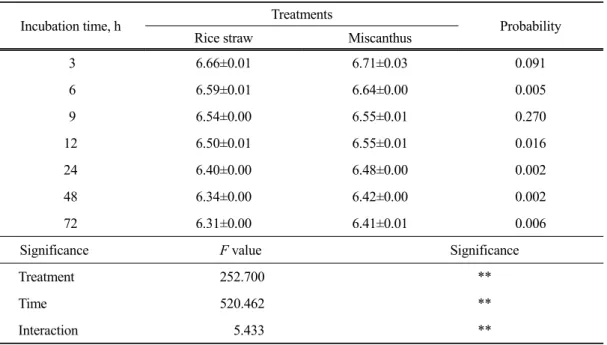
Table 2. Effect of Miscanthus and rice straw on rumen pH
Incubation time, h Treatments
Probability
Rice straw Miscanthus
3 6.66±0.01 6.71±0.03 0.091
6 6.59±0.01 6.64±0.00 0.005
9 6.54±0.00 6.55±0.01 0.270
12 6.50±0.01 6.55±0.01 0.016
24 6.40±0.00 6.48±0.00 0.002
48 6.34±0.00 6.42±0.00 0.002
72 6.31±0.00 6.41±0.01 0.006
Significance F value Significance
Treatment 252.700 **
Time 520.462 **
Interaction 5.433 **
Mean ± standard deviation (n=3).
Significance codes for **, * and NS mean p<0.01, p<0.05 and non significance, respectively.
oven, injector and detector temperatures were 150℃, 200℃ and 250℃, respectively. Ammonia nitrogen concentration in culture supernatant was determined according to Chaney and Marbach (1962). Briefly, 0.02 mL of culture supernatant was mixed with 1 mL of phenol color regent and 1 mL of alkali-hypochlorite reagent and then it was incubated at 37℃ water bath for 15 min.
After incubation, 8 mL of distilled water was added and the optical density was determined at 630 nm using spectrophotometer (Optizen, Daejeon, Korea).
4. Statistical analysis
For the analysis of the effects of treatment, incubation time and their interaction, analysis of variance with general linear model was employed. All of data analysis was performed
using SPSS program (version 18, IBM, New York, USA).
Ⅲ. RESULTS AND DISCUSSION 1. In vitro rumen fermentation characteristics
The effect of different roughage sources on in vitro ruminal pH is shown in Table 2.
Roughage sources had a significant effect (p<
0.01), and significantly different pH profile
trends were observed (p<0.01). Rice straw
showed significantly low pH value (p<0.05)
compared to Miscanthus with overall incubation
times, except initial (0 h) and 9 h of incubation
(p>0.05). During the incubation of both roughage
sources, pH values did not drop below the
critical value (pH 6.3) related to rumen function
especially cellulolytic degradation. In fact they
maintained pH within optimum range for normal
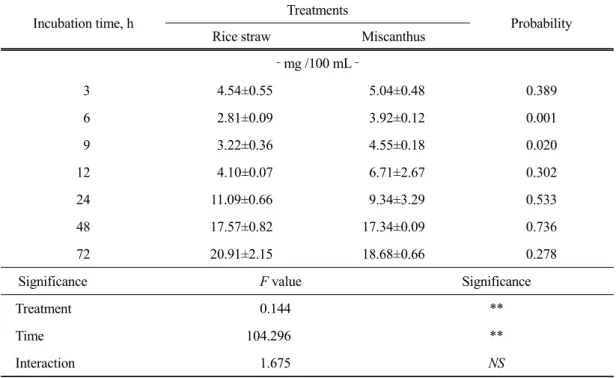
Table 3. Ammonia nitrogen concentration in in vitro rumen fermentation with Miscanthus and rice straw
Incubation time, h Treatments
Probability Rice straw Miscanthus
‐ mg /100 mL ‐
3 4.54±0.55 5.04±0.48 0.389
6 2.81±0.09 3.92±0.12 0.001
9 3.22±0.36 4.55±0.18 0.020
12 4.10±0.07 6.71±2.67 0.302
24 11.09±0.66 9.34±3.29 0.533
48 17.57±0.82 17.34±0.09 0.736
72 20.91±2.15 18.68±0.66 0.278
Significance F value Significance
Treatment 0.144 **
Time 104.296 **
Interaction 1.675 NS
Mean ± standard deviation (n=3).
Significance codes for **, * and NS mean p<0.01, p<0.05 and non significance, respectively.
rumen function, 6.0 to 6.7 (Hiltner and Dehority, 1983; Stewart, 1977).
Ammonia nitrogen is an important nitrogen source for the growth of rumen micro-organisms, and this microbial nitrogen is essential for the animal’s protein requirements. For the maintenance of animal productivity, about 20 mg/100 mL of ammonia nitrogen content is required (Perdok and Leng, 1989). Ammonia nitrogen (NH
3-N) concentration profiles for the two kinds of roughages are shown in Table 3. Effects of type of roughage and incubation time represent significant (p<0.01) whereas two roughages showed that they shared NH
3-N production patterns.
Though the significance was found in between treatments effect, NH
3-N productions over 12 h of incubation were not significantly different. In
gas production, the significance was found in treatment, incubation time and their interaction (p<0.05) (Table 4).
Gas production in rice straw was significantly higher than that of Miscanthus in overall incubation time after 6 h of incubation. Gas production can be used as a reference for the degradation and fermentation of substrate in rumen. The results in present study showed that the utilization rate of Miscanthus in rumen was seemed to be approximately 80% of that of rice straw.
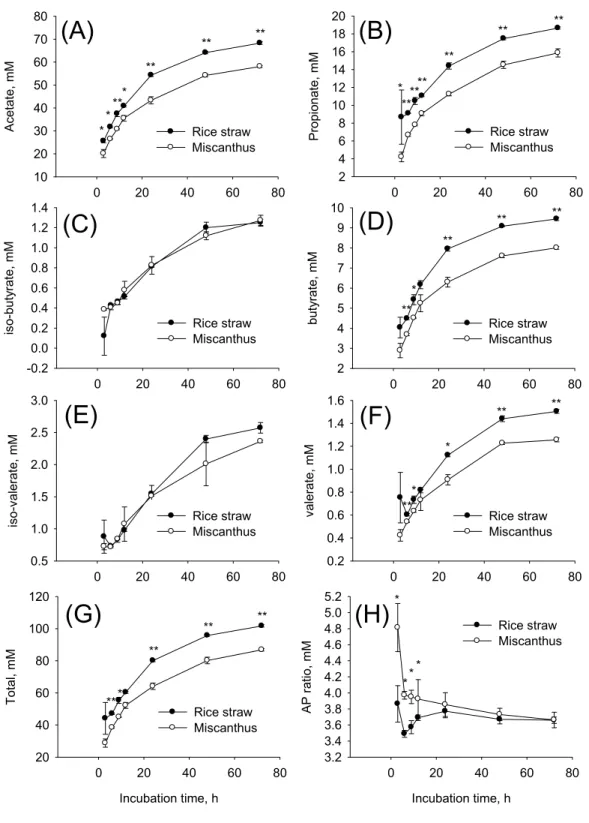
VFA production from rice straw and
Miscanthus is shown in Fig. 1. Acetate and
propionate productions in rice straw were
significantly higher than those of Miscanthus in
all incubation time (p<0.05) (Fig. 1A and 1B).
0 20 40 60 80
Acetate, mM
10 20 30 40 50 60 70 80
Rice straw Miscanthus
0 20 40 60 80
Propionate, mM
2 4 6 8 10 12 14 16 18 20
Rice straw Miscanthus
0 20 40 60 80
iso-butyrate, mM
-0.2 0.0 0.2 0.4 0.6 0.8 1.0 1.2 1.4
Rice straw Miscanthus
0 20 40 60 80
butyrate, mM
2 3 4 5 6 7 8 9 10
Rice straw Miscanthus
0 20 40 60 80
iso-valerate, mM
0.5 1.0 1.5 2.0 2.5 3.0
Rice straw Miscanthus
0 20 40 60 80
valerate, mM
0.2 0.4 0.6 0.8 1.0 1.2 1.4 1.6
Rice straw Miscanthus
Incubation time, h
0 20 40 60 80
Total, mM
20 40 60 80 100 120
Rice straw Miscanthus
Incubation time, h
0 20 40 60 80
AP ratio, mM
3.2 3.4 3.6 3.8 4.0 4.2 4.4 4.6 4.8 5.0 5.2
Rice straw Miscanthus
(A) (B)
(C) (D)
(E) (F)
(G) (H)
*
***
**
** **
*
*
******
**
** **
**
*
**
** **
**
*
*
** **
*** **
**
** **
*
*
Fig. 1. VFA production in in vitro rumen fermentation with Miscanthus and rice straw.
Asterisk marks, * and ** mean significance in levels of p < 0.05 and p < 0.01,
respectively.
Table 4. Gas production in in vitro rumen fermentation with Miscanthus and rice straw
Incubation time, h Treatments
Probability
Rice straw Miscanthus
‐ mL ‐
3 19.67±3.68 10.67±0.94 0.066
6 23.33±3.09 17.67±0.47 0.119
9 35.67±0.94 27.67±1.70 0.009
12 45.00±0.82 35.67±3.09 0.043
24 63.33±1.70 49.33±1.70 0.001
48 81.00±1.41 58.33±0.47 0.001
72 79.67±2.62 64.00±2.94 0.005
Significance F value Significance
Treatment 230.248 **
Time 473.46 **
Interaction 7.683 **
Mean ± standard deviation (n=3)
Significance codes for **, * and NS mean p<0.01, p<0.05 and non significance, respectively.
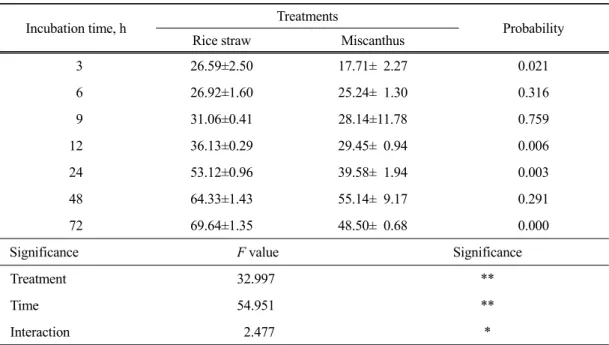
Table 5. In vitro dry matter digestibility (%) of Miscanthus and rice straw
Incubation time, h Treatments
Probability Rice straw Miscanthus
3 26.59±2.50 17.71± 2.27 0.021
6 26.92±1.60 25.24± 1.30 0.316
9 31.06±0.41 28.14±11.78 0.759
12 36.13±0.29 29.45± 0.94 0.006
24 53.12±0.96 39.58± 1.94 0.003
48 64.33±1.43 55.14± 9.17 0.291
72 69.64±1.35 48.50± 0.68 0.000
Significance F value Significance
Treatment 32.997 **
Time 54.951 **
Interaction 2.477 *
Mean ± standard deviation (n=3).
Significance codes for **, * and NS mean p<0.01, p<0.05 and non significance, respectively.
Butyrate and valerate productions were also significantly higher in rice straw in all incubation time (p<0.05), except 12 h of incub- ation for butyrate and 3 h of incubation for valerate (Fig. 1D and 1F). Whereas there were no significant difference in between two forage sourcese for iso-butyrate and iso-valerate productions (p>0.05) (Fig. 1C and 1E). Total VFA production in Miscanthus was approximately 80% of rice straw (Fig. 1G). Miscanthus showed high AP ratio during early incubation periods, however it was coincided at the end of incubation (Fig. 1H).
2. Dry matter digestibility
Dry matter digestibility (DMD) showed similar patterns with gas production (Table 5). Significant differences were found between treatments (p<
0.01), incubation time (p<0.01) and their interaction (p<0.05). Half disappearance of rice straw found at 24 h of incubation and Miscanthus showed a 24 h delay to achieve half disappearance. At 72 h of incubation DMD of Miscanthus was 48.6%
and it was lower than DMD at 48 h (55.1%).
This difference seemed to be an analytical error.
In the study of Bae et al. (1983), they reported in vitro rumen DMD of Miscanthus sinensis at late maturity stage (full bloom) as 54.2% at 72 h of incubation and it was similar with the result in this study. In vitro DMD of Miscanthus sinensis in goat was reported as 57.6% (Lee and Lee, 2008). DMD in rice straw at 72 h of incubation was also not greatly increased.
Therefore, DMD in both roughages was seemed to have reached its plateau at 48 h of incubation and digestibility of Miscanthus was
about 85% that of rice straw. This was similar with the pattern of gas production.
Ⅳ. CONCLUSION
In the present study, Miscanthus sacchariflorus var. No 1, a newly developed germtype in Korea, was firstly investigated on its digestibility in rumen and its effects on ruminal parameters using in vitro rumen fermentation. Miscanthus showed lower bioavailability compared to rice straw in all ruminal parameters. Fifty percent of DMD of Miscanthus in rumen was shown as its maximum. As a result, the availability of Miscanthus can be concluded as approximately 80% of rice straw. However, if it is partially substituted with rice straw, Miscanthus can be used as a good roughage resource. For more useful information for the use of Miscanthus as roughage, further studies such as in vivo palatability, determination of substitution rate and effects on animal performances are required.
Ⅴ. ABSTRACT
This study was conducted to develop Miscanthus as a new roughage resource for ruminant animals. Miscanthus sacchariflorus var.
No 1, a newly developed germtype in Korea,
was harvested at late maturity stage and its
effect on rumen pH, ammonia nitrogen, gas
production, volatile fatty acid (VFA) production
and digestibility were evaluated using in vitro
rumen fermentation. The effects of Miscanthus
were compared with rice straw. Miscanthus
showed significantly higher pH compared to rice
straw (p<0.01). As for ammonia nitrogen, there
was no significant difference after 12 h of
incubation (p>0.05). Gas production in Miscanthus was significantly lower than that of rice straw in overall incubation time (p<0.05) after 6 h of incubation. In VFA production, acetate, propionate, butyrate, valerate and total VFA production in Miscanthus were lower than those in rice straw.
However, production of iso-butyrate and iso- valerate were not different in between two forage materials. Dry matter digestibility of Miscanthus was significantly lower than rice straw (p<0.05) during 12~24 h of incubation. As a result, the availability of Miscanthus as roughage source showed approximately 80% that of rice straw.
Ⅵ. ACKNOWLEDGEMENT
This work was supported by “Cooperative Research Program for Agriculture Science &
Technology Development (Project No. PJ007963)”
Rural Development Administration, Republic of Korea.
Ⅶ. REFERENCES
1. A.O.A.C. 1995. Official methods of analysis 16th edition. Association of official analytical chemist (Washington, D.C).
2. Bae, D.H., B.E. Gilman, J.G. Welch and R.H.
Palmer. 1983. Quality of forage from Miscanthus sinensis. J. Dairy Sci. 66:630-633.
3. Chaney, A.L. and E.P. Marbach. 1962. Modified reagents for determination of urea and ammonia.
Clin. Chem. 8:130-132.
4. Erwin, E.S., G.J. Marco and E.M. Emery. 1961.
Volatile fatty acid analyses of blood and rumen fluid by gas chromatography. J. Dairy Sci. 44:
1768-1771.
5. Heather, Y. and C. Somerville. 2012. Development of feedstocks for cellulosic biofuels. F1000 Reports Biology 02: doi:10.3410/B4-10.
6. Hiltner, P. and B.A. Dehority. 1983. Effect of soluble carbohydrates on digestion of cellulose by pure cultures of rumen bacteria. Appl. Environ.
Microbiol. 46:642-648.
7. Kook, K., B.C. Lee, W.H. Kim, K.Y. Jang, K.S.
Back, S.J. Moon and G. H. Kim. 2011. Effects of whole crop barley silage (WBS) supplementation on growth performance and meat quality of Hanwoo steers. Korean J. Food Sci. Anim.
Resour. 31:107-114.
8. Lee, I.D. and H.S. Lee. 2008. Study on the food habits of Korean native goats (Capra hircus) fed with various roughage sources. J. Kor. Grassl.
Forage Sci. 28:119-128.
9. Lewandowski, I., J.C. Clifton-Brown, J. M. O.
Scurlock and W. Huisman. 2000. Miscanthus:
European experience with a novel energy crop.
Biomass Bioenergy 19: 209-227.
10. Moon, Y.H., B.C. Koo, Y.H. Choi, S.H. Ahn, S.
T. Bark, Y.L. Cha, G.H. An, J.K. Kim and S.J.
Suh. 2010. Development of “Miscanthus” the promising bioenergy crop. Kor. J. Weed Sci. 30:
330-339.
11. Moore, J.E. 1970. Procedures for the two-stage in vitro digestion of forages. 3. In L.E. Harris (ed) Vol. 1. Nutrition research techniques for domestic and wild animlas (Utah State Univ., Logan, UT).
12. Park, J.K., D.H. Lim, S.B. Kim, K.S. Ki, H.J.
Lee, E.G. Kwon, W.M. Cho and C.H. Kim. 2011.
Effects of partial replacement of corn grain and soybean meal with agricultural by-product feed on in vitro rumen fermentation chracteristics and optimum levels of mixing ratio. J. Anim. Sci. &
Technol. (Kor.) 53:441-450.
13. Perdok, H. and R.A. Leng. 1989. Rumen ammonia requirements for efficient digestion and intake of straw by cattle. In: The Role of Protozoa and Fungi in Ruminant Digestion (Ed.
J.V. Nolan and R.A. Leng) (Penambul Books, Armidale, Australia).
14. Ramirez, C.E., H. Kumagai, E. Hosoi, F. Yano, H. Yano, K.K. Jung and S.W. Kim. 1994.
Mineral concentration in rice straw and soil in
Kyongbuk Province, Korea. Asian-Aust. J. Anim.
Sci. 7:125-129.
15. Stewart, C.S. 1977. Factors affecting the cellulolytic activity of rumen contents. Appl.
Environ. Microbiol. 33: 497-502.
16. Van Soest, P.J. 2006. Rice straw, the role of silica and treatments to improve quality. Anim.
Feed Sci. Technol. 130:137-171.
(Received May 31, 2012/Accepted June 18, 2012)