유방암의 접선조사 시 Field-in-Field Intensity Modulated Radiation Therapy와 Conventional Radiation Therapy의 전산화 치료계획에 관한 고찰
서울아산병원 방사선종양학과
유순미ㆍ염미숙ㆍ김대섭ㆍ백금문ㆍ권경태
목 적: 유방암의 접선조사 시 쐐기필터를 이용한 Conventional RT 기법과 정적다엽조리개를 이용한 FiF-IMRT 기법을 이용하 여 전산화 치료계획 시 발생하는 선량분포의 차이를 환자의 유방 크기와 형태에 따라 분류하여 비교 분석하고자 한다.
대상 및 방법: 유방암 환자 30명을 대상으로 Eclipse treatment planning system (VarianTM, USA, V8.0)을 사용하여 전산화 치료 계획을 시행하여 유방의 크기와 형태에 따라 분류하고, Dose Volume Histogram (DVH)을 이용하여 Conformity Index (CI)와 Homogeneity Index (HI)를 비교 분석하였다.
결 과: CI값은 ±1.2%의 차이를 나타냈으며 FiF-IMRT의 경우 Conventional RT보다 HI값이 평균 1.67% 낮은 값으로 유방의 크 기와 형태에 따른 분류값과 △HI (%)값의 상관관계를 알아본 결과 단면길이와 부피에서 높은 상관관계를 보였으며 통계적으 로 유의(P<0.01)하였다.
결 론: 유방의 단면 길이와 부피가 증가할수록 Conventional RT의 경우보다 FiF-IMRT로 전산화 치료계획 시 유방 내의 선량 균등성이 향상되었으며 유방의 크기에 따라 그 효과가 다르므로 유방의 크기에 따른 적절한 치료계획이 필요할 것으로 생각 된다.
핵심용어: 유방암, FiF-IMRT, 전산화 치료계획, DVH
이 논문은 2009년 12월 1일 접수하여 2010년 2월 16일 채택되었음.
책임저자:유순미, 서울아산병원 방사선종양학과 Tel: 02)3010-2785, Fax: 02)3010-6950 E-mail: [email protected]
서 론
유방보존수술(Breast Conserving Operation, BCO) 후 방사 선 치료(Radiotherapy, RT)는 국소부위 제어와 생존율 향상 에 기여할 수 있다는 결과가 여러 연구에서 보고되었으며, 이에 따라 현재 유방암 환자에 대한 수술 후 방사선 치료는 일반적으로 시행되고 있다.1) 조기 유방암 환자에 대한 수술 후 방사선 치료는 주위 인접한 정상조직인 폐, 심장, 반대측 유방에 최소한의 선량을 주면서 원하는 부위에 충분한 선량 을 효과적으로 조사할 수 있는 유방 및 전흉벽의 접선조사면 (tangential field technique) 기법을 이용하며 유방의 형태로 인해 발생하는 불균등한 선량분포를 보정하기 위해 필요에 따라 쐐기필터(Wedge)를 이용하는 것이 일반적인 방사선치 료(Conventional RT)로 시행되고 있다. 하지만 Conventional RT로 전산화 치료계획을 수행할 경우 쐐기필터의 형태로 인 하여 선량보상에 한계가 있어,2) 정적다엽조리개(static multi- leaf collimator)를 이용한 조사면 내 선량보상기법(Field-
in-Field Intensity Modulated Radiotherapy, FiF-IMRT)이 제 시되었으며,3) 이에 의한 선량분포의 균등성 향상에 관하여 여러 연구에서 보고되고 있다.4-13) 두 기법 모두 유방의 크기 나 형태에 따라 나타나는 불균등한 선량분포를 보정하기 위 한 것으로 환자의 특성에 따라 향상정도가 다르게 나타날 수 있지만 이와 관련된 연구는 아직 이루어지지 않았다.
이에 본 연구에서 환자의 특성과 치료 기법에 따른 선량분 포의 균등성 향상과의 상호관계를 알아보고자, 쐐기필터를 치료계획에 적용한 Conventional RT 기법과 static multileaf collimator를 이용한 FiF-IMRT 기법을 이용하여 전산화 치료 계획 시 발생하는 선량분포의 차이를 환자의 유방 크기와 형 태에 따라 분류하여 비교 분석하였다.
대상 및 방법 1. 대상
본 연구는 유방보존수술(BCO)을 받은 후 방사선치료를 받 는 30명의 환자를 대상으로 하였다. 모든 환자는 CT-simu- lation 후 전산화 치료 계획을 세우고 정확한 치료를 위하여 모의치료계획을 확인하고 치료를 수행한 후 방사선치료를
Fig. 1. Scheme of axial image for breast tangential irradiation.
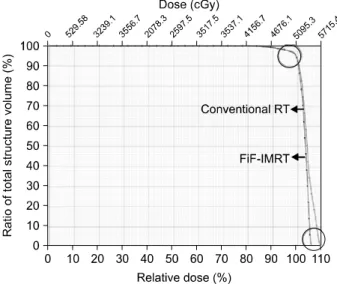
Fig. 2. DRR image of anterior field. Fig. 3. DVH of conventional RT and FiF-IMRT.
시행하였다.
전산화 치료계획은 Eclipse treatment planning system (VarianTM, USA, V8.0)을 이용하였으며 치료 계획 시 산란에 의해 반대쪽 유방과 폐에 들어갈 수 있는 선량을 최소화하기 위하여 접선 조사면 기법을 이용하여 의료용 선형가속기 (Clinac-6EX, VarianTM, USA)에서 발생되는 6 MV 에너지의 광자선으로 치료계획을 시행하였다. 치료계획의 처방선량은 일일 1.8 Gy 조사되도록 FiF-IMRT와 Conventional RT 방법 으로 전산화 치료계획을 하였다.
2. 분석
첫 번째 유방의 변수(parameter)에 따른 분류를 알아보기 위하여 전산화 치료계획 시 치료 기법에 따른 선량분포의 차
이를 환자의 유방 크기와 형태에 따라 분석하기 위하여, 각 환자의 유방 부피(Volume), 길이(Length), 높이(Height), 단 면 길이(Separation), 흉벽에서 폐까지의 거리(Chest wall to lung distance), 유방의 상연에서 하방 3 cm 길이(A)와 유방 의 하연에서 상방 3 cm 길이(B)의 차이를 측정하여 분류하 였다. 또한, 전산화 치료계획 후 선량분포가 107% 이상 되는 부피(>107% volume)를 구하여 분류하였다(Fig. 1, 2).
두 번째 선량분포를 비교 평가하기 위하여 Conventional RT와 FiF-IMRT로 각각 전산화 치료계획 후 선량분포의 차 이를 정량적으로 분석하고자 선량 체적 히스토그램(Dose Volume Historgram, DVH) (Fig. 3)을 이용하였으며(식 1∼4) 을 이용하여 Conformity Index (CI)와 Homogeneity Index (HI)를 평가하여 비교하였다.14) 두 기법의 차이는 SPSSTM을 이용하여 통계적 유의성을 평가하였다.
CIICRU62=
---(식 1) VTV: 처방선량이 포함하는 유방부피, VPTV: 유방의 총 부피 △CI (%)=
×100 (%)---(식 2) CIC: Conventional RT의 CI값, CIF: FiF_IMRT의 CI값 HI=
---(식 3) D5%: PTV의 5% 부피가 받는 선량, D95%: PTV의 95% 부피 가 받는 선량△HI (%)=
×100 (%)---(식 4) HIC: Conventional RT의 HI값, HIF: FiF_IMRT의 HI값Minimum Maximum Average Deviation Breast volume (cm3) 108.2 1,527 466.1 ±350.9 Breast separation
(cm) 14 27 19.1 ±3.5 Breast X length (cm) 10.4 20.2 14.4 ±2.6 Breast Y length (cm) 4.2 19.5 15.4 ±2.8 Breast height (cm) 1.8 7.6 4.0 ±1.6 Chest wall to lung
distance (cm)
1.2 2.5 2.0 ±0.4
Breast upper margin, lower (cm)
−1.6 12 1.1 ±2.4
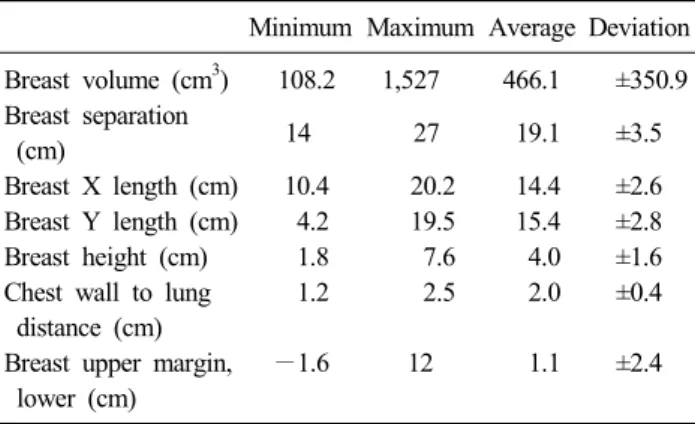
Table 1. Physiology information and geometrical parameter
Average of CI Average of HI
Conventional RT 0.953 1.089
FiF-IMRT 0.955 1.072
Table 2. Comparison of CI and HI
Fig. 4. Correlation analysis between breast separation and
△HI%.
Fig. 5. Correlation analysis between breast volume and △HI%.
결 과
유방암 환자 30명의 환자를 대상으로 유방의 크기와 형태 에 따라 분석한 결과 유방 부피의 평균값이 466.1 cm3 (범위 108.2∼1,527 cm3)이며, 유방 단면 길이와 흉벽에서 폐까지 의 거리의 평균값은 19.1 cm (범위 14∼27 cm), 1.8 cm (범 위 1.2∼2.5 cm)이며 유방의 X길이, Y길이, 높이, 유방의 상 연에서 하방 3 cm 길이와 유방의 하연에서 상방 3 cm 길이
의 차이에 대한 분석값은 Table 1과 같다.
CI값은 Conventional RT에서 0.885∼0.992로 평균 0.953이 었으며, FiF-IMRT에서는 0.907∼0.993으로 평균 0.955로 CI 값의 차이는 ±1.2%였다. Conventional RT와 FiF-IMRT의 CI 값의 상관관계를 알아본 결과 P=0.187로 통계적으로 유의할 만한 차이가 없어 전산화 치료계획에 따른 CI값의 차이는 없 었다. HI값은 Conventional RT에서 1.062∼1.137로 평균 1.089였으며, FiF-IMRT에서는 1.041∼1.122로 평균 1.072로 HI값은 FiF-IMRT의 경우에 Conventional RT보다 평균 1.67% 낮았다. Conventional RT와 FiF-IMRT의 HI값의 상관 관계를 알아본 결과 P<0.001로 통계적으로 유효하였고 FiF- IMRT의 경우에 선량 균등성이 더 향상되었다(Table 2).
유방의 크기와 형태에 따른 분류값과 △HI (%)값의 상관 관계를 알아보기 위해 Pearson의 상관관계분석을 실시한 결 과 단면 길이와 △HI (%)값의 상관계수가 0.55로 높은 상관 관계를 보였으며 통계적으로 유의(P<0.01)하였다. Fig. 4에 서와 같이 단면 길이가 증가할수록 △HI (%)값이 증가함을 알 수 있었다(HIC>HIF). 또한 유방 부피와 △HI (%)값의 상 관관계분석을 실시한 결과 상관계수 0.73으로 가장 높은 상 관관계를 보였으며 통계적으로 유의(P<0.01)하였다. Fig. 5 에서와 같이 부피가 증가할수록 △HI (%)값이 증가하였다 (HIC>HIF).
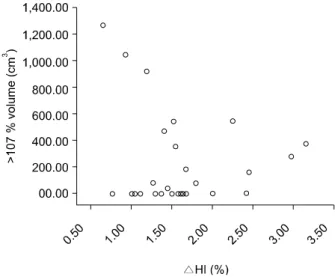
유방의 단면 길이와 부피를 제외한 나머지 parameter는
△HI%와의 상관관계에서 통계적으로 유의하지 않았으며, 이 는 선량 균등성과 관계가 없었다(Fig. 6, 7).
Fig. 6. Correlation analysis between breast height and △HI%.
Fig. 7. Correlation analysis between >107% volume and △HI%.
고안 및 결론
유방암의 접선조사 시 유방의 크기와 형태에 따라 분류한 결과 유방의 단면 길이가 16∼18 cm일 때보다 20∼22 cm일 때 Conventional RT와 FiF-IMRT의 HI값의 차이가 커짐을 알 수 있었다. 그리고 유방의 부피가 300 cm3 이상일 경우에 Conventional RT와 FiF-IMRT의 HI값의 차이가 더 커짐을 알 수 있었다. CI값은 Conventional RT와 FiF-IMRT에서 ±1.2%
로 나타나 전산화 치료계획에 따른 차이가 없었다. HI값은 FiF-IMRT의 경우에 Conventional RT보다 평균 1.67% 낮은 값으로 FiF-IMRT의 경우에 선량 균등성이 더 향상되었다.
또한 유방의 크기와 형태에 따른 전산화 치료계획과의 상관 관계를 알아본 결과 유방의 단면 길이와 부피가 증가할수록
△HI (%)값이 증가하며 이는 Conventional RT의 경우보다 FiF-IMRT에서 선량 균등성 향상에 더 유리함을 알 수 있었 으며, 유방의 단면 길이와 부피를 제외한 나머지 parameter는 선량 균등성과의 관계가 없음을 알 수 있었다.
이와 같은 결과를 통하여 FiF-IMRT로 전산화 치료계획 시 유방 내의 선량 균등성이 향상되었으며 유방의 크기에 따라 그 효과가 다르므로 유방의 크기에 따른 적절한 치료계획이 요구되어진다. 그러나 이와 같은 전산화 치료계획은 치료계 획의 시간 증가 및 업무과중과 치료비 증가로 인한 환자의 경제적 부담이 될 수 있는 단점이 있지만 유방의 단면 길이 와 부피가 증가할 경우 FiF-IMRT로 전산화 치료계획 시 이 점이 더 크게 작용할 수 있다. 현재 여러 논문에서는 에너지 및 주위 정상조직인 폐, 심장, 반대측 유방에 대한 연구가 이 루어지고 있는데 본 연구의 유방의 크기와 형태에 따른 변수 도 함께 고려되어야 할 것으로 생각된다.
참고문헌
1. Barnett GC, Wilkinson J, Moody AM, et al.: A randomized controlled trial of forward-planned radiotherapy (IMRT) for early breast cancer: Baseline characterisitics and dosimetry results. Radiother Oncol 2009;92:34-41
2. Neal AJ, Torr M, Helyer S, Yarnold JR: Correlation of breast dose heterogeneity with breast size using 3D CT planning and dose-volume histograms. Radiother Oncol 1995;34:210-218 3. Yerko OB, Mohammad S, Marsha D. MN, et al.: Multileaf
field-in-field forward-planned intensity-modulated dose com- pensation for whole-breast irradiation is associated with reduced contralateral breast dose: A phantom model com- parison. Radiothe Oncol 2007;82:324-328
4. Chang SX, Deschesne KM, Cullip TJ, et al.: A comparison of different intensity modulation treatment techniques for tangential breast irradiation. Int J Radiat Oncol Biol Phys 1999;45:1305-1314
5. Vicini FA, Sharpe M, Kestin L, et al.: Optimizing breast cancer treatment efficacy with intensity-modulated radio- therapy. Int J Radiat Oncol Biol Phys 2002;54:1336-1344 6. Hong L, Hunt M, Chui C, et al.: Intensity-modulated tangential
beam irradiation of the intact breast. Int J Radiat Oncol Biol Phys 1999;44:1155-1164
7. Lo YC, Yasuda G, Fitzgerald TJ, et al.: Intensity modulation for breast treatment using static multi-leaf collimators. Int J Radiat Oncol Biol Phys 2000;46:187-194
8. Kestin LL, Sharpe MB, Frazier RC, et al.: Intensity modu- lation to improve dose uniformity with tangential breast radiother- apy: Initial clinical experience. Int J Radiat Oncol Biol Phys 2000;48:1559-1568
9. Donovan EM, Johnson U, Shentall G, et al.: Evaluation of
compensation in breast radiotherapy: A planning study using multiple static fields. Int J Radiat Oncol Biol Phys 2000;46:671-679
10. Evans PM, Donovan EM, Partridge M, et al.: The delivery of intensity modulated radiotherapy to the breast using multiple static fields. Radiother Oncol 2000;57:79-89
11. van Asselen B, Raaijmakers CP, Hofman P, et al.: An im- proved breast irradiation technique using three-dimensional geometrical information and intensity modulation. Radiother Oncol 2001;58:341-347
12. Lee JW, Hong SM, Choi KS, et al.: Performance evaluation of field-in-field technique for tangential breast irradiation. Jpn J Clin Oncol doi;10.1093/jjco/hym167
13. 제영완, 김찬용, 박흥득 등: Irregular Surface Compensator (ISC)를 이용한 유방암치료계획에 대한 고찰. 대한방사선치료 기술학회지 2007;19:131-141
14. Loic Feuvret, Georges Noel et al. CONFORMITY INDEX: A REVIEW. Int J Radiation Oncology Biol Phys 2006;64:
333-342