The Relationship between the Salivary IgA against AgⅠ/Ⅱof S. mutans and Dental Caries Experience among Children and Adults
임수민∙김재곤∙백병주 ∙양연미∙김수경∙이경열 전북대학교 치과대학 소아치과학교실 및 구강생체과학연구소
AgI/II of Streptococcus mutans(S. mutans) is an important virulence factor that contributes to the pathogene- sis of S. mutans-induced dental caries.
In oral cavity, salivary IgA antibodies act as safeguards against enormous challenges from oral bacteria. IgA antibodies inhibit adherence of cariogenic microorganisms to hard surfaces.
Analysis of salivary IgA against AgI/II can be very useful diagnostic and powerful communication tools to the dental caries
The purpose of this study was to investigate correlation between salivary AgI/II specific IgA and incidence of dental caries among children and young adults. Subjects consisted of 28 children and 18 adults. They were as- signed to four groups : Group Ⅰ(deft index ≤ 3), Group Ⅱ(deft index ≥ 4), Group Ⅲ(DMFT index ≤ 3), Group
Ⅳ(DMFT index ≥ 4) and they was divided two groups into caries resistant group and caries susceptible group.
The study group were examined caries activity and their salivary IgA was evaluated by enzyme-linked im- munosorbent assay.
The results are as follows :
1. There was a positive correlation between the number of S. mutans and caries activity.
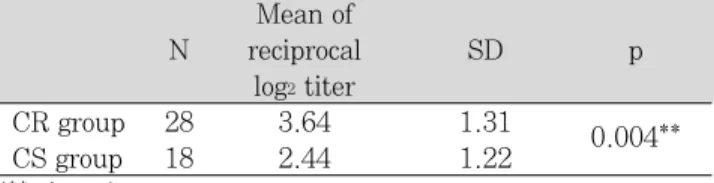
2. The titer of salivary IgA against the AgI/II was significantly higher in caries resistant group than caries susceptible group(p<0.01).
3. The titer of salivary IgA against the AgI/II in Group Ⅲ was significantly higher than GroupⅡ(p<0.05).
Key words: Dental Caries, AgI/II, Salivary IgA, ELISA 영문초록
Ⅰ. Introduction
Streptococcus mutans(S. mutans) has been implicated as the principal causative agent of human dental caries1,2,3). As well as acid production, adherence and col- onization of S. mutans to the teeth are also important for its virulence4,5). The processes of S. mutans to adhere and accumulate on tooth surfaces involve the adhesin antigen I/II(AgI/II)4,6-9), glucosyltransferases(GTF) and glucan-binding protein(GbpB). It has been reported that
AgI/II is an important virulence factor that contributes to the pathogenesis of S. mutans-induced dental ca ries 6,10). Both S. mutans and its cell surface protein anti- gen(Ag)I/Ⅱ bind selectively to saliva-coated hydroxyap- atite11), which simulates pellicle-coated enamel, but iso- genic AgI/II-deficient mutants of S. mutans lack the protein fuzzy coat on the cell surface and bind poorly to saliva-coated hydroxyapatite compared with the parent strains12,13). These findings suggest that AgI/II can func- tion as major adhesin in mediating the initial adherence
교신저자 : 김 재 곤
전북 전주시 덕진구 금암동 634-18 / 전북대학교 치과대학 소아치과학교실 / 063-250-2121 / [email protected] 원고접수일: 2008년 6월 21일 / 원고최종수정일: 2008년 9월 09일 / 원고채택일: 2008년 9월 17일
of S. mutans to salivary pellicle-coated tooth surfaces, although may not be the only mechanism14,15).
Secretory IgA(sIgA) is the principal immunoglubulin isotype in body’s external secretion and is the main hu- moral element of the secretory immune system. IgA neu- tralizes viruses, bacterial exotoxins, and enzymes that contribute to disease process. In oral cavity, sIgA anti- bodies act as safeguards against enormous challenges from oral bacteria. The sIgA antibodies in saliva inhibit adherence of cariogenic microorganisms to hard surfaces and may inhibit the activity of glucosyltransferases16,17). The principle role of AgI/II specific salivary IgA is to re- duce the chance of colonization of pathogens at mucosal surfaces18).
The correlation salivary IgA levels specific for S. mu- tans between and caries activity have been reported in many studies. Several investigators have found a nega- tive correlation between caries activity and salivary S.
mutans specific IgA levels19-20), while others reported no correlation21).
AgI/II is involved in many key steps of caries develop- ment and many previous reports suggested that induc- tion of antibodies against mutans streptococci in oral cavity effectively prevent dental caries22-24). Therefore, studies for the development of a caries vaccine have fo- cused on the use of immunization regimens which stimu- late the induction of IgA responses in saliva. And analy- sis of salivary IgA against AgI/II is considered to become very useful diagnostic and powerful communication tools to the dental caries.
The purpose of this study was to investigate correla- tion between salivary AgI/II specific IgA and incidence of dental caries among children and young adults.
Ⅱ. Materials and Methods Subjects
46 healthy people were included in the study. They consisted of 28children and 18 adults. They were as- signed to four groups : Group Ⅰ(deft index ≤ 3), Group
Ⅱ(deft index ≥ 4), Group Ⅲ(DMFT index ≤ 3), Group
Ⅳ(DMFT index ≥ 4). Subjects were divided two groups into caries resistant(CR, DMFT index or deft index ≤ 3) group and caries susceptible(CS, DMFT or deft index ≥ 4) group (Table 1).
Saliva samples
For the microbiological analysis, whole saliva which was stimulated by paraffin chewing was collected. For the immunologic tests, samples of stimulated saliva were placed into plastic tube and stored at -20℃ until analy- sis.
Bacterial analysis
Saliva was diluted 1:10 in sterile saline and appropri- ate dilutions were spread on MS-MUTV plates as de- scribed by Takada & Hiraswa25). Incubation at 37℃ for 2 days was done in 95% nitrogen-5% carbon dioxide. CFU with morphology characteristic of S. mutans were count- ed and expressed as numbers of CFU per milliliter of saliva.
Expression and purification of AgI/II-N
Transformants harboring pQE-AgI/II-N plasmid were cultured in 5ml LB broth containing 50ug/ml of ampi- cillin and incubated at 37�C for overnight with shaking at 200rpm. When cultures have an initial OD550 of ap- proximately 0.5, they were transferred into the fresh 500ml LB broth and further grown at 37�C with vigor- ous shaking until an optical density of 0.6 was reached.
To obtain recombinant AgI/II-N protein, we induced the expression of AgI/II-N protein using isopropyl-b-D-thio- galactopyrano side(IPTG) by final concentration 1 mM.
After culture for another 3hr at 30�C, bacteria were har- vested using centrifugation and the pellet was resus- pended in 20mM Tris-HCl containing 0.5M NaCl and 5 mM imidazole(pH 8.0). To obtain soluble recombinant AgI/II-N, we disrupted the pellet using ultrasonic dis- Table 1. Number and mean of deft index or DMFT index in subjects
Mean of Group N deft(DMFT)
index
Children Ⅰ 17 0.8
(6years old)
N=28 Ⅱ 11 7
Adults Ⅲ 10 1.9
(20-30years old)
N=18 Ⅳ 8 8
CR 27 1.3
CS 19 7.5
ruptor, and then the supernatants were loaded into the nickel-chelated agarose(Ni-NTA, Qiagen). The column was washed 3times with 20mM Tris (pH 8.0), 5mM im- idazol, and 0.5M NaCl and eluted with 20 mM Tris(pH 8.0), 0.2M imidazol, and 0.1 M NaCl. Eluted sample was dialyzed against PBS and quantified in SDS-PAGE gel using known amounts of bovine serum albumin as standards.
Salivary IgA to AgI/II determination
Titer of salivary IgA anti-AgⅠ/Ⅱ were evaluated by the ELISA method. Polystyrene microplates(NUNC, Denmark) were coated with 100ng recombinant AgⅠ/Ⅱ in carbonate-bicarbonate buffer, pH 9.6 for overnight at 4℃. The plates were washed with PBS and blocked with 1% skim milk. After washing with PBS, 100 ul of saliva samples were added to the plates in duplicate for 1hr at 37℃. The plates were washed and incubated with perox- idase-conjugated anti-IgA antibody(Sigma, St. Louis) for 2h at 37℃. After additional washing, alkaline phos- phatase substrate(Sigma, St. Louis) dissolved in 10%
diethanolamine buffer was added to the plates. The plates were read at 405nm with μQuant ELISA plate reader(Bio-Tek, USA).
Ⅲ. Results Culture of Streptococcus mutans
Table 2 shows the numbers of S. mutans colony-form- ing units in saliva samples of four groups. Group Ⅱ had significantly higher numbers of CFU of S. mutans/ml in saliva than Group Ⅰ and Group Ⅲ. Group Ⅳ had signif- icantly higher numbers of CFU of S. mutans/ml in saliva than Group Ⅰ and Group Ⅲ. There are no significant difference in S. mutans counts between Group Ⅰ and Ⅲ, and between Group Ⅱ and Group Ⅳ(Table 3).
Titer of salivary IgA anti-AgⅠ/Ⅱ
Salivary IgA against the AgⅠ/Ⅱ was present in saliva of all adults and 6 year old children. The titer of salivary IgA against the AgⅠ/Ⅱ in adults was higher than that in children(Table 2), but there was no significant differ- ence between adults and children(p>0.05).
The titer of salivary IgA against the AgⅠ/Ⅱ was higher in GroupⅠthan Group Ⅱ in children. In adults, the titer of salivary IgA against AgⅠ/Ⅱ was higher in GroupⅢ than Group Ⅳ(Table 2). But no significant dif- ferences were observed between Group Ⅰ and Group Ⅱ, and between Group Ⅲ and Group Ⅳ. Only Group Ⅲ
Table 2. Mean of S. mutans counts and reciprocal log2
titer of salivary IgA anti-AgⅠ/Ⅱ
Group S. mutans counts Reciprocal log2
in saliva(CFU/ml) titer of salivary IgA anti-AgⅠ/Ⅱ
Group Ⅰ 1.36×10⁵ 3.41
Group Ⅱ 8.45×10⁵ 2.09
Group Ⅲ 1.31×10⁵ 4
Group Ⅳ 5.58×10⁵ 3
Table 3. Multiple comparison of the number of S.
mutans between four groups(1-way ANOVA)
Comparison Group Ⅰ Group Ⅱ Group Ⅲ Group Ⅳ
Group Ⅰ S(***) NS S(**)
Group Ⅱ S(***) S(***)
Group Ⅲ NS S(***) S(*)
Group Ⅳ S(**) NS S(*)
S: statically significant difference(*p<0.05, **p<0.01
***p<0.001)
NS: no statically significant difference
Table 4. Multiple comparison of reciprocal log2 titer of salivary IgA anti-AgⅠ/Ⅱ between 4 group(1-way ANOVA)
Comparison Group Ⅰ Group Ⅱ Group Ⅲ Group Ⅳ
Group Ⅰ NS NS NS
Group Ⅱ NS S(**) NS
Group Ⅲ NS S(**) NS
Group Ⅳ NS NS NS
S: statically significant difference(**p<0.01) NS: no statically significant difference
Table 5. Comparison of reciprocal log2 titer of salivary IgA anti-AgⅠ/Ⅱ between CR group and CS group- (independent t test)
Mean of
N reciprocal SD p
log2titer
CR group 28 3.64 1.31 0.004**
CS group 18 2.44 1.22
(**p<0.01)
was significantly higher than group Ⅱ(Table 4).
The titer of salivary IgA against the AgⅠ/Ⅱ was sig- nificantly higher in caries resistant group than caries susceptible group(Table 5).
Ⅳ. Discussion
S. mutans is a major etiologic agent in human dental caries. Our data showed positive correlation between the number of Streptococcus mutans and caries activity among children and adults.
AgⅠ/Ⅱ of S. mutans is considered a virulence factor because it mediates initial attachment of S. mutans to tooth surfaces. Thus, inhibiting AgⅠ/Ⅱ is predicted to provide protection against caries. Experimental immu- nization with AgⅠ/Ⅱ has suggested that the presence of antibody to this antigen in the oral cavity can decrease mutans streptococci infection and disease1). Several au- thors reported that the recombinant DNA vaccine of Ag
Ⅰ/Ⅱ could induce anti-caries immune response in gno- tobiotic rat26).
Naspitz et al. reported salivary IgA against the AgⅠ/
Ⅱ was present in all adults and in only one of 3-5 year old children studied. The absence of antibodies to the Ag
Ⅰ/Ⅱ in 3-5 year old children was suggested a specific immunologic immaturity27). In our study salivary IgA against the AgⅠ/Ⅱ was present in all adults and all 6 year old children. The titer of salivary IgA against the AgⅠ/Ⅱ was higher in adults than children. But there was no significant difference between adults and chil- dren.
Salivary IgA against AgⅠ/Ⅱ is predicted to protect caries development. Some authors postulated protective role for IgA antibody in caries development and revealed negative correlation between S. mutans specific salivary IgA levels and caries activity19-20). The results of our in- vestigation were no significant difference of titer of sali- vary IgA against AgⅠ/Ⅱ between groups of children.
Also our data did not show significant correlation be- tween salivary IgA against AgⅠ/Ⅱ and caries activity in adults. The statistical insignificance may be due to the small number of research participants per group. But our data showed caries resistant group had significantly higher titer of salivary IgA against the AgⅠ/Ⅱ than caries susceptible group. And the titer of salivary IgA against the AgⅠ/Ⅱ of Group Ⅲ with less than 3DMFT had significantly higher than Group Ⅱ with more than
tween caries activity and the titer of salivary IgA against the AgⅠ/Ⅱ. Therefor salivary IgA against AgⅠ/Ⅱ is considered to protect the caries development and vaccine development against the AgⅠ/Ⅱ will be promising.
Ⅴ. Conclusion
Forty six healthy people consisted of 28 children and 18 adults were included in this study. They were as- signed to four groups : Group Ⅰ(deft index ≤ 3), Group
Ⅱ(deft index ≥ 4), Group Ⅲ (DMFT index ≤ 3), Group
Ⅳ(DMFT index ≥ 4). Subjects were divided two groups into caries resistant group(DMFT or deft index ≤ 3) and caries susceptible group(DMFT or deft index ≥ 4). The stimulated whole saliva was collected and Streptococcus mutans was cultured. Salivary IgA against AgⅠ/Ⅱ were evaluated by the ELISA method.
The results are as follows :
1. There was positive correlation between the number of S. mutans and caries activity.
2. Salivary IgA against the AgⅠ/Ⅱ was present in all adults and all 6 year old children.
3. The titer of salivary IgA against the AgⅠ/Ⅱ was higher in adults than in children. But there was no significant difference between adults and children(p>0.05).
4. The titer of salivary IgA against the AgI/II was sig- nificantly higher in caries resistant group than in caries susceptible group(p<0.01).
5. The titer of salivary IgA against the AgI/II was higher in Group Ⅰ(deft index ≤ 3) than Group Ⅱ (deft index ≥ 4) in children , was higher in Group
Ⅲ(DMFT index ≤ 3) than Group Ⅳ(DMFT index
≥ 4) in adults. But the difference was not signifi- cant. Only the value of Group Ⅲ was only signifi- cantly higher than GroupⅡ(p<0.05).
Reference
1. Michalek SM, Childers NK : Development and out- look for a caries vaccine. Crit Rev Oral Biol Med, 1:37-54, 1990.
2. Loesche WJ, Rowan LH, Staraffon LH, et al. : Association of Streptococcus mutans with human dental decay. Infec Immun, 11:1253-1260, 1975.
3. Losesche WJ, Straffon LH : Longitudinal investiga- tion of the role of Streptococcus mutans in tissue de-
4. Loesche WJ : Role of Streptococcus mutans in hu- man dental decay. Microbiol Rev, 50:353-380, 1986.
5. Kuramitsu HK : Virulence factors of mutans strep- tococci ; role of molecular genetics. Crit Rev Oral Biol Med, 4:159-176, 1993.
6. Russell MW, Lehner T : Characterization of anti- gens extracted from cells and culture fluid of Streptococcus mutans serotype c. Arch Oral Biol, 23:7-15, 1978.
7. Russell MW, Bergmeier LA, Zanders ED, et al. : Protein antigen of Streptococcus mutans ; purifica- tion and properties of a double antigen and its pro- tease-resistant component. Infect Immun, 28:486- 493, 1980.
8. Forester H, Hunter N, Knox KW : Characteristics of a high molecular weight extracellular protein of Streptococcus mutans. J Gen Microbiol, 129:2779- 2788, 1983.
9. Ji-Hye Han, Jae-Gon Kim, Byeong-Ju Baik, et al. : Generation of antibodies against N-terminus frag- ment of AgI/II protein from Streptococcus mutans GS-5. J KAPD, 33:515-519, 2006.
10. Saito M, Otake S, Ohmura M, et al. : Protective im- munity to Streptococcus mutans induced by nasal vaccination with surface protein antigen and mutant cholera toxin adjuvant. J Infect Dis, 183:823-826, 2001.
11. Russel MW, Mansson-Rahemtulla B : Interaction between surface protein antigens of Streptococcus mutans and human salivary components. Oral Microbiol Immunol, 4:106-111, 1989.
12. Koga T, Okahashi N, Takahashi I, et al. : Surface hydrophobicity, adherence, and aggregation of cell surface protein antigen mutans of Streptococcus mu- tans serotype c. Infect Immun, 58:289-296, 1990.
13. Lee SF, Progulske-Fox A, Erdos GW, et al.:
Construction and characterization of isogenic mu- tants of Streptococcus mutans deficient in major sur- face protein antigen P1(AgI/II). Infect Immun, 57:3306-3313, 1989.
14. Bowen WH, Schilling K, Giertsen E, et al. : Role of a cell surface associated protein in adherence and dental caries. Infect Immun, 59:4406-4609, 1991.
15. Schilling KM, Bowen WH : Glucans synthesized in situ in experimental salivary pellicle function as spe- cific binding sites for Streptococcus mutans. Infect Immun, 60:284-295, 1992.
bition of Streptococcus mutans ; An assay reflection a possible role of antibody in dental caries prophy- laxis. Infect Immun, 5:419-427, 1972.
17. Evans RT, Genco RJ : Inhibition of glucosyltrans- ferase activity by antisera to known serotypes of Streptococcus mutans. Infect Immun, 7:237-241, 1973.
18. Ogra PL, Mestecky J, Lamm ME, et al. : Handbook of mucosal immunology. Academic Press, 127-137, 1994.
19. Camling E, Kohler B : Infection with the bacterium Streptococcus mutans and salivary IgA antibodies in mothers and their children. Arch Oral Biol, 32:817- 23, 1987.
20. Chalocombe SJ : Serum and salivary antibodies to Streptococcus mutans in relation to the development and treatment of human dental caries. Arch Oral Biol, 25:495-502, 1980.
21. Tenovuo J, Laine M, Lehtonen O-PJ : Salivary IgA antibodies reaction with Streptococcus mutans in re- lation to changes in salivary S. mutans counts ; a longitudinal study in humans. Proc Finn Dent Soc, 83:55-59, 1987.
22. Bwen WH : A vaccine against dental caries. A pilot experiment in monkeys. Br Dent J, 126:159-160, 1969.
23. Lehner T, Challacombe SJ, Caldwell J : Immunological and bacteriological basis for vaccina- tion against dental caries in rhesus monkeys.
Nature, 254:517-520, 1975.
24. McGhee JR, Michalek SM, Webb J, et al. : Effective immunity to dental caries ; protection of gnotobiotic rats by local immunization with Streptococcus mu- tans. J Immunol, 114:300-305, 1975.
25. Takada K, Hirasawa M : A novel selective medium for isolation of Streptococcus mutans. J Microbiol Method, 60:189-193, 2005.
26. Fan MW, Bian ZX, Peng Y, et al : A DNA vaccine encoding a cell-surface protein antigen of Streptococcus mutans protects gnotobiotic rats from caries. J Dent Res, 81:784-787, 2002.
27. Naspitx GMCC, Nagao AT, Mayer MPA : Anti- Streptococcus mutans antibodies in saliva of children with different degrees of dental caries. Pediatr Allergy Immunol, 10:143-148, 1999.
Abstract
소아와 성인의 타액 내 AgⅠ/Ⅱ 특이 IgA 와 우식경험도의 관계
Su-Min Lim, Jae-Gon Kim, Byeong-Ju Baik, Yeon-Mi Yang, Su-Kyung Kim, Kyung-Yol Lee
Department of Pediatric Dentistry and Institute of Oral Bioscience, School of Dentistry, Chonbuk National University
치아 우식증은 감염성 질환의 하나로 치아우식의 원인균은Streptococcus mutans(S. mutans)와 같은 mutans stepto- cocci로 알려져 있다. S. mutans가 치면에 접착하여 군집을 형성하는 능력은 균독성에 중요한 역할을 하는데, AgⅠ/Ⅱ와 같 은 세포 표면의 섬유성 단백질을 매개로 한다.
Secretory IgA는 타액이나 누∙비액, 초유, 그리고 폐나 소화기관의 분비액에서 선택적으로 다량 발견되는데 타액에서 se- cretory IgA는S. mutans의 대사활동을 억제하고 치면으로의 부착을 방해한다. 이전의 몇몇 연구에서 S. mutans에 특이적 인 타액 내 IgA와 우식경험도는 역상관관계를 보인다고 발표하였다. 그러나 다른 연구에서 통계적 유의성이 없다고 보고하기 도 하였다.
본 연구의 목적은 소아, 성인의 치아우식증과S. mutans의 AgⅠ/Ⅱ에 특이적인 타액 내 IgA와의 관계를 알기위한 것이 다. 이를 위해 소아(평균6세) 28명, 성인(20-30세) 18명을 대상으로 Group Ⅰ(deft index ≤ 3), Group Ⅱ(deft index ≥ 4), Group Ⅲ(DMFT index ≤ 3), Group Ⅳ(DMFT index ≥ 4)로 분류하였다. 그리고 caries resistant group(CR group, deft or DMFT index ≤ 3)과 caries susceptible group(CS group, deft or DMFT index ≥ 4)으로 분류하였다.
S. mutans 수와 우식경험도 간에는 통계적으로 유의한 상관관계를 나타냈다. AgⅠ/Ⅱ 특이 salivary IgA titer는 Group
Ⅲ이 Group Ⅱ보다 통계적으로 유의하게 더 컸으며 , CR group이 CS group보다 유의하게 크게 나타났다.
주요어 : 치아 우식증, AgⅠ/Ⅱ, Salivary IgA, 효소면역측정법