RAPID PALATAL EXPANSION FOR THE TREATMENT OF AN ECTOPICALLY ERUPTING MAXILLARY CANINE: CASE REPORTS
Su-Young Jang, Ji-Yeon Kim, Ki-Tae Park
Department of Pediatric Dentistry, Samsung Medical Center, Sungkyunkwan University School of Medicine
Maxillary canine impaction is an anomaly often encountered in children. Although it has been reported that the incidence of palatally impacted canines is higher than that of labially impacted ones, it has been found that labial impaction of canines is more common than palatal impaction in Asian populations. In the cases presented here, maxillary canines were guided normally after rapid palatal expansion, followed by modification of root an- gulation of neighboring lateral incisors in 8-10-year-old children who had maxillary canines suspected of labial impaction. Consequently, the method of modifying the root angulation of the maxillary lateral incisor, combined with rapid palatal expansion, is effective in preventing impaction of an ectopically erupting maxillary canine without resorting to surgical methods.
Key words:Maxillary canine, Impaction, Rapid palatal expansion
Abstract
Ⅰ. Introduction
After third molars, the most frequently impacted tooth is the maxillary permanent canine, and this occurs in 1- 2% of the population1-3). Ericson and Kurol estimated the incidence in the Swedish population at 1.7%, and im- pactions were twice as common in females(1.17%) as in males (0.51%)4). It has been reported that the incidence of palatally displaced canines is higher than that of labi- ally displaced canines. However, it has also been found that labial impaction is more common than palatal im- paction in Asian people5-7).
The etiology of canine impaction is still unclear.
Whereas arch length discrepancy is thought to be the main cause of labial impaction, several causative factors have been suggested for palatal impaction, including trauma, a peg-shaped or missing lateral incisor, delayed exfoliation of the deciduous canine, and genetic factors8,9).
An ectopically erupting canine can lead to unwanted movement of neighboring teeth, dental crowding, root re- sorption in neighboring teeth, cyst formation, infection, referred pain, and combinations of the above sequelae10). In cases where the permanent maxillary canines are possibly impacted, the preventive treatment of choice is extracting the deciduous canines when the patients are 10-13 years old. However, extraction of the deciduous canines does not guarantee correction of the problem.
The success rate of early interceptive treatment for im- pacted maxillary canines is influenced by the degree of impaction. Ericson and Kurol reported the resolution of palatal impaction in 91% of cases in which the crown of the canine is distal to the midline of the lateral incisor.
However, the success rate was decreased to 64% in cas- es where the crown of the canine is located mesial to the midline of the lateral incisor11). If this early intervention fails, alternative treatments, such as surgical exposure with or without orthodontic force, should be considered.
교신저자 : 박 기 태
서울특별시 강남구 일원동 50 / 성균관대학교 의과대학 삼성서울병원 치과진료부 소아치과 / 02-3410-2409 / [email protected] 원고접수일: 2010년 07월 02일 / 원고최종수정일: 2010년 09월 13일 / 원고채택일: 2010년 09월 18일
1. Case 1
An 8-year, 8-month-old boy was first examined for a chief complaint of crooked front teeth and deep bite. His
not necessary for his chief complaint. However, the bi- lateral ectopically erupting canines were a concern, and immediate intervention was recommended for possible labial canine impactions.
Fig. 1. Pretreatment intraoral photographs.
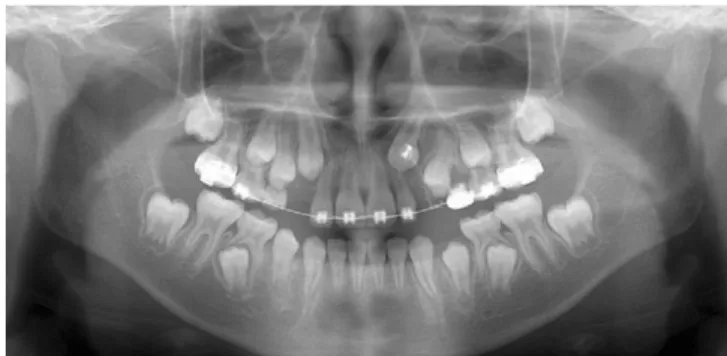
Fig. 2. a) Pretreatment panoramic radi- ograph. Eruption paths of both maxil- lary canines were inclined too far mesially and overlapped the neighbor- ing lateral incisors. b) Part of a cephalometric radiograph: both canines were erupting labially to the incisors.
The following treatment plans were devised:
1. Extract the upper deciduous canines on both sides, 2. Follow the eruption path of the upper permanent
canines on both sides, and
3. Start orthodontic intervention if the eruption path of the canines were not improved.
Panoramic radiographs were taken at 3 and 6 months after the extraction of both deciduous canines(Fig. 3, 4).
Although the upper left permanent canine was expected to erupt spontaneously, orthodontic intervention was necessary to improve the eruption path of the upper right permanent canine. It was decided to use a hyrax expander for rapid palatal expansion, and then, the four
upper incisors were moved mesially (Fig. 5, 6).
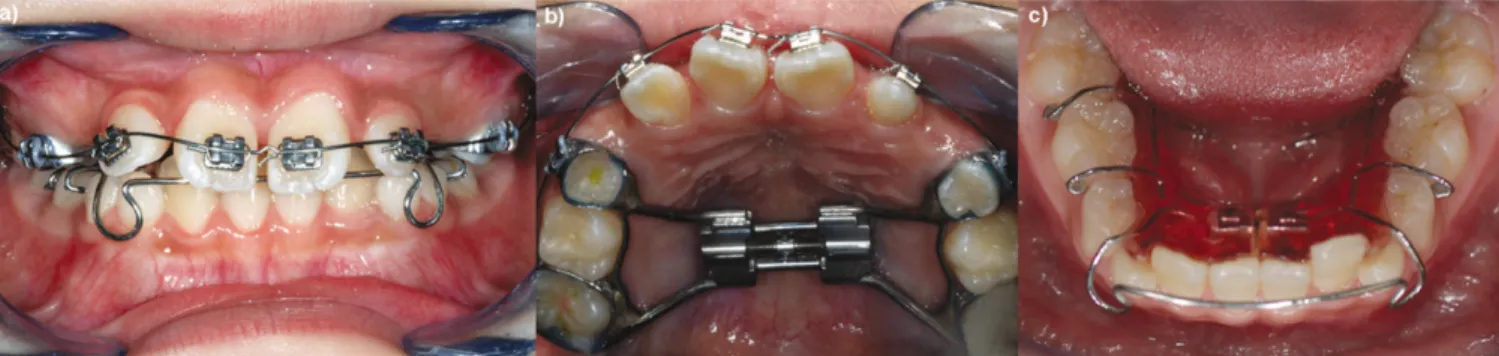
The hyrax expander was retained for 3 months after the expansion (1/4 turn twice a day for 2 weeks). A Schwarz expander was used in the lower arch to allow more expansion of the upper arch. One month later, standard edgewise brackets were bonded on the upper four incisors. To obtain mesial root angulation, the bracket of the upper lateral incisor was tipped distally.
After alignment of the upper four incisors, the incisors were gathered together mesially with the power chains.
Consequently, the right upper canine was guided to erupt following the distal surface of the root of lateral in- cisor. After 6 months, the right maxillary canine was Fig. 3. 3 months after extraction of the upper deciduous canines. The
positions of both canines had improved.
Fig. 4. 6 months after extraction of the upper deciduous canines.
Although the eruption path of upper left canine was normalized, the erup- tion path of upper right canine was not corrected.
Fig. 5. a, b) Root angulation of the upper right lateral incisor was modified after rapid palatal expansion by hyrax expander. c) A Schwarz expander in the lower arch was used to allow more expansion of the upper arch.
Fig. 6. After the four upper incisors were moved mesially, the eruption path of the upper right canine was corrected. The root of upper right lateral incisor was tipped mesially, and this procedure allowed the upper right canine to erupt following the distal surface of the root of upper right lateral incisor.
confirmed to be erupting normally. Then, the case was completed and retained with an upper Hawley retainer alone(Fig. 7).
2. Case 2
A 10-year, 11-month-old girl was referred to the Dept.
of Pediatric Dentistry, Samsung Medical Center, for an impacted upper left permanent canine. Her medical his- tory was noncontributory(Fig. 8). Panoramic radi- ographs and 3-D computed tomography showed that both upper canines were impacted labially and may have caused root resorption of the neighboring lateral in- cisors(Fig. 9). Immediate orthodontic intervention was decided, and the following treatment plans were de- vised:
1. Extract the upper deciduous canines on both sides, 2. Perform rapid palatal expansion with a hyrax ex-
pander,
3. Move the upper four incisors mesially and angulate the roots of the lateral incisors mesially, and 4. Perform surgical orthodontic forced eruption if no
spontaneous improvement of the eruption path of the upper permanent canines occurred.
The hyrax expander was cemented on the upper arch, and the screw was turned twice a day for 2 weeks.
Alignment of the upper incisors was begun using flipped bracket positions on the upper right and left lateral in- cisors with preadjusted brackets(Fig. 10).
After the alignment, the upper four incisors were moved mesially with power chains. In 6 months, although the eruption path of right maxillary canine was correct- Fig. 7. Posttreatment intraoral photographs and panoramic radiograph.
ed, the impaction of the left lateral incisor was not com- pletely corrected. Therefore, a surgical orthodontic forced eruption was performed for the left maxillary canine(Fig.
11). Finally, the upper left maxillary canine was aligned with fixed appliances, and the upper right maxillary ca- nine was expected to erupt normally(Fig. 12).
Fig. 8. Pretreatment intraoral photographs.
Fig. 9. Panoramic radiograph and 3-D computed tomography showed that upper both canines were impacted labi- ally and may have caused root resorp- tion of neighboring lateral incisors.
Fig. 10. A hyrax expander was used for rapid palatal expansion. Flipped bracket position was used for both upper lateral incisors.
Ⅲ. Discussion
To prevent permanent maxillary canine impaction,
modification of the root angulation of the lateral incisors was used after rapid palatal expansion. This procedure allows preventive treatment of possible canine impaction Fig. 11. Orthodontic forced eruption was used for the upper left canine.
Fig. 12. The upper left maxillary canine was erupted by orthodontic forced eruption, and the upper right maxillary canine is expected to be erupted normally.
without resorting to surgical exposure or orthodontic forced eruption in certain cases. When an ectopically erupting canine is found, the treatment of choice may be extraction of the relevant deciduous canine. However, in the case where a certain degree of canine impaction has progressed, this treatment alone cannot correct the ca- nine impaction. Usually, surgical orthodontic forced eruption can be attempted, but there may be no option but to apply autotransplantation12). These treatments have the disadvantage of needing an additional surgical approach, and periodontal problems, such as loss of at- tached gingiva and gingival recession, may occur. Our case 2 showed that the amount of attached gingiva on the erupted canine that was treated with surgical ortho- dontic forced eruption seemed to be insufficient for the adjacent teeth(Fig. 12). Thus, the technique of arch ex- pansion combined with root angulation modification was a significantly less traumatic approach for canine im- paction.
Generally, it has been reported that palatal canine im- paction is more common than labial impaction, but in Asian people, the reverse has been shown. Oliver et al.
explained that labial canine impaction was more com- mon in Asian people because the incidence of class III malocclusion, associated with reduced maxilla size, is higher in Asian people. They also mentioned that crowd- ing related to the early loss of deciduous canines in Asians contributed to a higher prevalence of labial ca- nine impaction6). Peck et al. estimated that the preva- lence of palatal displaced canines in European groups was five times higher than in Asian groups7). Zhong et al. reported the ratio between canines impacted labially and palatally to be 2.1:18). However, it was reported that the treatment method for maxillary impacted ca- nines was not different between cases of palatal and labial impaction7).
The present cases showed displaced canines on the labial side. In case 1, the labiopalatal relationship of the displaced canine could be judged through cephalometric radiography, and the same result was achieved with 3D- CT in case 2. Of course, we could see the labiolingual re- lation of the canine through lateral radiographic views, such as by cephalography and tomography. However, it is difficult to determine the precise position of impacted teeth in three dimensions. 3D-CT has been suggested to be a useful tool for the diagnosis of ectopic canine im- paction, especially where resorption of the root of lateral incisors is suspected, as this condition would not readily
be found by any two-dimensional radiographic tech- nique13). In case 2, 3D-CT was conducted to confirm a more detailed positions of ectopically erupting canines, and both labially displaced canines were located adjacent the roots of lateral incisors, and root resorption was sus- pected.
McConnell et al. found an association between maxil- lary canine impaction and maxillary transverse deficien- cy. They investigated intermolar width and intercanine width in subjects with impacted maxillary canines and controls without impacted canines14). No difference was detected between the groups’in intermolar widths, but patients with maxillary canine impactions had trans- verse deficiencies in intercanine arch width compared with controls. They concluded that maxillary orthopedic expansion would be an interceptive modality in treating patients with palatally displaced canines. However, Langberg and Peck concluded that maxillary arch width was not a primary contributory factor in the genesis of the palatal displaced canine15). Jacoby also reported that 83% of arches with labial displacement of maxillary ca- nine displayed arch length deficiency, however he con- cluded that arch length deficiency was not associated with palatal displaced canines16).
Although the present cases could not confirm whether the cause of the canine impaction was due to a maxillary transverse discrepancy, rapid palatal expansion and in- creased space for erupting canines allowed the displaced canines to move towards their normal positions. In case 2, the degree of canine impaction of the upper left canine was too severe to be treated without surgical orthodontic forced eruption. After rapid palatal expansion, however, the displaced canine occupied an improved position, and this result facilitated the process of orthodontic forced eruption using a fixed appliance.
Even when this method is used, the results would be different according to the degree of impaction. Thus, it is essential to check the eruption path using serial radi- ographs.
Ⅳ. Conclusions
In appropriately selected cases, modification of the root angulation of the maxillary lateral incisor, combined with rapid palatal expansion, can be effective for pre- venting impaction of an ectopic maxillary canine without resorting to surgical methods.
3. 이상호 : 매복 상악 견치의 진단과 치료. 대한소아치과학회 지, 33:534-547, 2006.
4. Ericson S, Kurol J : Radiographic assessment of maxillary canine eruption in children with clinical signs of eruption disturbance. Eur J Orthod, 8:133- 140, 1986.
5. Oliver RG, Mannion JE, Robinson JM : Morphology of the maxillary lateral incisor in cases of unilateral impaction of the maxillary canine. Br J Orthod, 16:9-16, 1989.
6. Peck S, Peck L, Kataja M : The palatally displaced canine as a dental anomaly of genetic origin. Angle Orthod, 64:249-256, 1994.
7. Zhong YL, Zeng XL, Jia QL et al. : Clinical investi- gation of impacted maxillary canine. Zhonghua Kou Qiang Yi Xue Za Zhi, 41:483-485, 2006.
8. Brin I, Becker A, Shalhav M : Position of the maxil- lary permanent canine in relation to anomalous or
11. Ericson S, Kurol J : Early treatment of palatally erupting maxillary canines by extraction of the pri- mary canines. Eur J Orthod, 10:283-295, 1988.
12. 안병덕, 김영재, 장기택 등 : 매복견치의 치료: 증례보고.
대한소아치과학회지, 35: 151-158, 2008.
13. Ericson S, Kurol J : CT diagnosis of ectopically erupting maxillary canines-a case report. Eur J Orthod, 10:115-121, 1988.
14. McConnell TL, Hoffman DL, Forbes DP et al. : Maxillary canine impaction in patients with trans- verse maxillary deficiency. ASDC J Dent Child, 63:190-195, 1996.
15. Langberg BJ, Peck S : Adequacy of maxillary dental arch width in patients with palatally displaced canines. Am J Orthod Dentofacial Orthop, 118:220- 223, 2000.
16. Jacoby H : The etiology of maxillary canine impactions. Am J Orthod, 84:125-132, 1983.
주요어: 상악 견치, 매복, 급속 구개 확장
급속 구개확장을 이용한 상악 견치의 이소맹출 치료: 증례보고
장수영∙김지연∙박기태
성균관대학교 의과대학 삼성서울병원 치과진료부 소아치과
상악 견치 매복은 소아 청소년기 환자들에게서 흔하게 발견되는 문제이다. 일반적으로 구개측 매복이 순측 매복 보다 더 흔한 것으로 알려져 있지만 서양에서는 오히려 순측 매복이 더 많은 것으로 보고되고 있다. 본 보고에서는 파노라마 방사선 사진상 상악 견치의 순측매복이 의심되는 8-10세의 혼합치열기 아동을 대상으로 급속 구개확장(rapid palatal expansion) 을 시행하였으며, 이를 통하여 상악 측절치의 근원심 치근각도를 조절하여 매복 가능성이 있는 견치의 정상맹출을 유도할 수 있었기에 보고하는 바이다.
국문초록