105
"J. Korean Soc. Radiol., Vol. 14, No. 2, April 2020"
Verification of Clinical Usefulness of Jaw Tracking in IMRT
Jin-young Kim,
1Ki-Hwan Kim
2,*1
Department of Radiation Oncology, Dongnam Institute of Radiological and Medical Sciences, Busan, Republic of Korea
2
Department of Radiation Oncology, Chungnam National University, Daejeon, Republic of Korea
Received: March 27, 2020. Revised: April 23, 2020. Accepted: April 30, 2020
ABSTRACT
Intensity-modulated radiotherapy(IMRT) has disadvantages such as increasing the low doses of irradiation to normal tissues and accumulated dose for the whole volume by leakage and transmission of the Multi Leaf Collimator (MLC). The accumulated dose and low dose may increase the occurrence of secondary malignant neoplasms. For this reasons, the jaw tracking function of the TrueBeam (Varian Medical Systems, Palo Alto, CA) was developed to reduce the leakage and transmission dose of the MLC with existing linear accelerators. But quantitative analysis of the dose reduction has not been verified. Therefore, in the present study, we intended to verify the clinical possibility of utilizing the jaw tracking function in brain tumor with comparison of treatment plans. To accomplish this, 3 types of original treatment plans were made using Eclipse11 (Varian Medical Systems, Palo Alto, CA): 1) beyond 2 cm distance from the Organs At Risk (OARs); 2) within 2 cm distance from the OARs; and 3) intersecting with the OARs. Jaw tracking treatment plans were also made with copies of the original treatment planning using Smart LMC Version 11.0.31 (Varian Medical Systems, Palo Alto, CA). A comparison between the 2 types of treatment planning methods was performed using the difference of the mean dose and maximum dose to the OARs in cumulative Dose Volume Histogram (DVH). In the DVH comparison, the maximum difference of 0.5 % was observed between the planning methods in the case of over 2 cm distance, and the maximum of 0.6 % was obtained for within the 2 cm distance. For the case intersecting with the OAR, the maximum difference of 2 % was achieved. According to these results, it could be realized that the differences of mean dose and maximum dose to the OARs was larger when the OARs and PTV were closer. Therefore, treatment plans with the jaw tracking function consistently affected the dose reduction and the clinical possibility could be verified.
Keywords: Intensity-modulated radiotherapy, Multi Leaf Collimator(MLC), Jaw tracking
Ⅰ. INTRODUCTION
CT의 개발에 따라 환자 내부 장기의 표적을 정 확하게 그리는 것이 가능해짐에 따라 선량균일도 와 종양에 인접한 주변장기 보호의 장점을 가지는 입체조형방사선 치료가 널리 쓰여왔다.
[1]세기조절 방사선 치료는 치료범위의 선량분포를 향상시키고 주변 정상조직을 보호한다는 점에서 두경부, 전립 선, 뇌와 같은 부위에 널리 쓰이나 입체조형방사선 치료에 비해 많은 방사선량으로 인해 누적선량이
증가하고 다엽 콜리메이터의 누설선량이나 투과선량 으로 인한 저선량이 증가하는 단점을 지닌다. 이로 인해 누적선량이나 저선량의 증가는 악성 종양의 재 발생율을 증가시킨다.
[2,3]일례로 정상조직에 1.5 Gy 의 낮은 평균 선량으로도 gliomas, meningiomas, and schwannoma의 발생 위험도가 증가하는 것으로 보 고되고 있다.
[4]이러한 단점을 보완하기 위해 개발 된 Varian TrueBeam 의 Jaw Tracking 기능은 빔 조 사되는 동안 다엽 콜리메이터가 움직일 때 오픈된 다엽 콜리메이터의 최대 사이즈만큼 다엽 콜리메 https://doi.org/10.7742/jksr.2020.14.2.105
* Corresponding Author: Ki-Hwan Kim E-mail: [email protected] Tel: +82- 10-5485-5185
이터 끝에 맞춰 콜리메이터가 이동하게 됨으로써 다엽 콜리메이터 누설 및 투과선량을 감소시켜준 다. 그러나 이러한 선량의 감약이 얼마나 영향을 미치는 지에 대한 검증은 미비한 실정이다. 따라서 본 논문에서는 TrueBeam을 이용하여 Jaw Tracking 기능을 사용한 치료계획과 기존 치료계획과의 비 교를 통해 Jaw Tracking 기능의 유용성을 검증하고 자 하였다.
Ⅱ. MATERIAL AND METHODS
본 논문에서는 뇌종양에 한정하여 수행하였으며 1) OAR에 2 cm 이상 떨어진 경우 2) OAR에 2 cm 이하로 떨어진 경우 3) OAR를 포함하는 경우 3가 지의 치료계획을 통해 검증하였다.
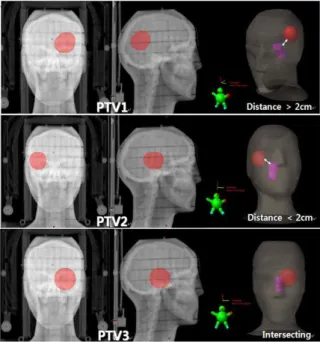
치료용 DICOM CT이미지를 얻기 위해 Fig. 1과 같이 CIRS ATOM® phantoms 702 Model 에 CIVICO사의 Uni-frame® Perforated Mask인 MTAPU2.4로 set-up하였으며 획득된 치료용 CT슬 라이스는 SIEMENS사의 CT Sensation Open을 통해 2 mm를 기준으로 얻어졌다. 치료계획을 위해 이용 된 치료계획시스템은 Varian사의 Eclipse 11을 이용 하였다. PTV는 Fig. 2와 같이 동일한 CT 이미지에 1) OAR에 2 cm 이상 떨어진 경우 2) OAR에 2 cm 이하로 떨어진 경우 3) OAR를 포함하는 경우로 총 3가지의 PTV를 통해 다양한 경우를 가정하였다.
치료계획은 Eclipse dose volume optimizer 11.0.1 을 이용하여 각각의 원본 치료계획을 만들었다. 다음 으로 원본치료계획을 복사한 후 Smart LMC Version 11.0.31을 이용하여 Jaw Tracking 기능을 추 가한 치료계획을 만들었다. 각각의 치료계획은 6 MV 광자선으로 2 Gy씩 20번으로 40 Gy의 처방선 량을 가지며 7 개의 Beam으로 0°를 기준으로 360°
를 균등 분할하여 사용하였다. PTV 영역의 평균선 량 값을 처방선량 값으로 Normalization 하였다. 치 료계획의 평가는 각각 전체체적에 처방선량의 5
%, 10 %, 50 %, 90 % (D5, D10, D50, D90)를 받는 볼륨과 OAR의 평균선량 및 최대선량으로 평가하 였다. 모든 치료계획에 대한 평가는 Cumulative DVH histogram에서 확인하였다.
[5]Fig.1. Anthropomorphic phantom setup for CT image acquisition.
Fig. 2. Frontal CT images (left) and sagittal CT images (middle) of the virtual targets’ location and 3D relationship(Right) with OAR:
(top) beyond 2 cm distance from the OAR;
(middle) within 2 cm distance from the OAR (bottom) interSecting with the OAR.
Ⅲ. RESULT
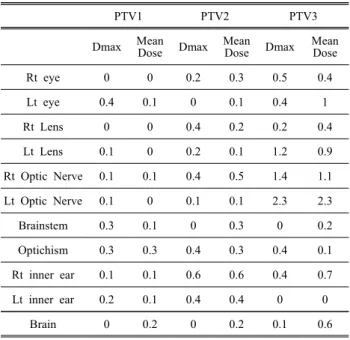
Table 1은 각각의 OAR의 D5, D10, D20, D50,
D90, 평균선량 및 최대선량 에 있어 원본 치료계획
과 Jaw Tracking과의 차를 보여준다. 두 치료계획
"J. Korean Soc. Radiol., Vol. 14, No. 2, April 2020"
간의 DVH 비교 결과 PTV가 OAR에 2cm 이상로 떨어진 경우 두 치료계획 간의 차는 최대 0.5 % 로 차이, 2 cm 이하로 떨어진 경우 최대 0.6 %로 차 이, PTV가 OAR을 포함하는 경우 최대 2.3 %로 차 이를 가졌다. 결과에서 보듯이 OAR과 PTV 간의 거리가 가까워짐에 따라 인접해있는 OAR 평균선 량 및 최대선량에 있어 두 치료계획간 차가 커짐을 알 수 있다. 또한 표면 선량 측정에 있어 필드 안의 경우 처방선량의 최대 2 %이내 필드 밖의 경우 최 대 0.1 %이내에 미세한 값의 차이를 보였다.
Table 1. Differences in average doses and maximum doses to the OARs between the original treatment plan and jaw tracking treatment plan
PTV1 PTV2 PTV3
Dmax Mean
Dose Dmax Mean
Dose Dmax Mean Dose
Rt eye 0 0 0.2 0.3 0.5 0.4
Lt eye 0.4 0.1 0 0.1 0.4 1
Rt Lens 0 0 0.4 0.2 0.2 0.4
Lt Lens 0.1 0 0.2 0.1 1.2 0.9
Rt Optic Nerve 0.1 0.1 0.4 0.5 1.4 1.1
Lt Optic Nerve 0.1 0 0.1 0.1 2.3 2.3
Brainstem 0.3 0.1 0 0.3 0 0.2
Optichism 0.3 0.3 0.4 0.3 0.4 0.1
Rt inner ear 0.1 0.1 0.6 0.6 0.4 0.7
Lt inner ear 0.2 0.1 0.4 0.4 0 0
Brain 0 0.2 0 0.2 0.1 0.6
Ⅳ. DISCUSSION
본 결과에서 보듯이 치료 계획의 비교에 따라, OAR과 PTV 사이의 거리가 가까워질수록 OAR의 평균 용량과 최대 용량 사이의 차이가 커지는 것으 로 알 수 있었다. 이러한 Jaw Tracking 기능에 관하 여 몇 가지 연구가 보고되어져 왔다.
조이의 논문에서는 Step and Shoot IMRT가 세 개의 세그먼트 및 Jaw Tracking 기능으로 수행 될 때 작은 용량 감소가 있었다고 보고하였다.
[6]그들 은 선량 감소가 임상 환경에 영향을 주기에 충분하 지 않다고 보고하였다. 그러나 해당 논문의 결과는 Step and Shoot IMRT를 임의로 3개의 Segment를 조
정하여 얻은 결과로 본 논문에서 사용한 Sliding Window IMRT에 비해 다엽 콜리메이터의 움직임이 매우 제한적이서 본 연구내용과의 비교는 어렵다.
또한 김의 논문에서도 Jaw Tracking 기능을 VMAT (Volumetric- Modulated Arc Therapy) 계획에서 구현 할 때 OAR에 대한 용량 감소에 대해 제시하였다.
[7]그러나 해당 논문을 통해 치료계획의 변화 (OAR에 따른 제약)에 따른 결과를 유추하긴 어렵다. 따라 서 본 논문에서는 치료계획의 변화에 따른 선량감 소 비교를 통해 치료계획이 Jaw Tracking에 영향을 주는지 확인하고자 하였다.
다른 연구와 마찬가지로 본 연구의 결과 또한 OAR에 대한 선량 감소를 보여 주었다. 그러나 3가 지 치료 계획의 비교는 방사선 치료 계획의 최적화 및 제약이 OAR에 대한 선량 감소에 영향을 줄 수 있음을 보여 주었다. 인접한 OAR로 인해 치료계획 이 복잡해지면 다엽 콜리메이터의 움직임이 증가 하고 이로 인해 두 방사선 치료계획 간에 선량 차 이가 더 커진다. 따라서 PTV의 위치와 주변 OAR 에 따라 선량 감소가 달라지는 것을 보인다. 그 감 소량은 그다지 크지 않으나 뇌종양의 경우 최대선 량에 제약을 받는 OAR이 많은 것으로 볼 때 이는 큰 장점으로 나타날 수 있다. 또한 보다 정확한 정 량적 선량 감축의 분석을 위해서는 다양한 추가 방 사선 치료 계획을 수행하고 비교해야 할 것으로 보 인다.
Ⅴ. CONCLUSION
본 논문에서는 TrueBeam의 Jaw Tracking 기능을 사용한 치료계획과 기존 치료계획과의 비교를 통 해 임상적 유용성을 검증하고자 하였다. Jaw Tracking을 사용한 치료계획을 통해 OAR 및 전체 체적에 있어 선량감소가 있음을 확인하였다. 또한 감소의 정도는 OAR과 PTV간의 거리가 가까워짐 에 따라 인접해있는 OAR 평균 선량 및 최대선량에 있어 두 치료계획간 차가 커짐을 확인할 수 있다.
따라서 Jaw Tracking을 사용한 경우 일관성 있게
선량 감소가 이루어짐을 통해 임상적인 유용성을
검증할 수 있었다.
Acknowledgement
This work was supported by the National Research Foundation of Korea (NRF) grant funded by the Kore an government (MSIP) (NRF-2019R1C1C1008911).
Reference
[1]
H. Aoyama, D. C. Westerly, T. R. Mackie, G. H.
Olivera, et al., "Integral radiation dose to normal structures with conformal external beam radiation,"
International Journal of Radiation Oncology Biology Physics, Vol. 64, No. 3, pp. 962-369, 2006.
https://doi.org/10.1016/j.ijrobp.2005.11.005
[2]
M. Ding, F. Newman, B. D. Kavanagh, K. Stuhr, T.
K. Johnson, L. E. Gaspar, "Comparative dosimetric study of three-dimensional conformal, dynamic conformal arc, and intensity-modulated radiotherapy for brain tumor treatment using Novalis system,"
International Journal of Radiation Oncology Biology Physics, Vol. 66, No. 4, pp. 82-26, 2006.
https://doi.org/10.1016/j.ijrobp.2005.09.009
[3]
L. Fenkell, I. Kaminsky, S. Breen, S. Huang, M. V.
Prooijen, J. Ringash, "Dosimetric comparison of IMRT vs. 3D conformal radiotherapy in the treatment of cancer of the cervical esophagus,"
Radiotherapy and Oncology, Vol. 89, No. 3, pp.
287-378, 2008.
https://doi.org/10.1016/j.radonc.2008.08.008
[4]
U. Hermanto, E. K. Frija, M. J. Lii, E. L. Chang, A. Mahajan, S. Y. Woo, "Intensity-modulated radiotherapy (IMRT) and conventional three-dimensional conformal radiotherapy for
high-grade gliomas: Does IMRT increase the integral dose to normal brain?," International Journal of Radiation Oncology Biology Physics, Vol. 67, No. 4, pp. 1135-1144, 2007.
https://doi.org/10.1016/j.ijrobp.2006.10.032
[5]
Q. Wu, R. Mohan, "Algorithms and functionality of an intensity modulated radiotherapy optimization system," Medical Physics, Vol. 27, No. 4, pp. 701, 2000. https://doi.org/10.1118/1.598932
[6]
S. Joy, G. Starkschall, S. Kry, M. Salehpour, et al.,
"Dosimetric effects of jaw tracking in step‐and‐shoot intensity‐modulated radiation therapy," Journal of
Applied Clinical Medical Physics, Vol. 13, No. 2, pp. 136-145, 2012.
https://doi.org/10.1120/jacmp.v13i2.3707
[7]
J. I. Kim, J. M. Park, S. Y. Park, C. H. Choi, H.
G. Wu, S. J. Ye, "Assessment of potential jaw‐
tracking advantage using control point sequences of VMAT planning," Journal of Applied Clinical Medical Physics, Vol. 15, No. 2, pp. 160-168, 2014.
https://doi.org/10.1120/jacmp.v15i2.4625
"J. Korean Soc. Radiol., Vol. 14, No. 2, April 2020"
IMRT에 있어 Jaw Tracking 의 임상적 유용성 검증
김진영,
1김기환
2,*1
동남권원자력의학원 방사선종양학과
2