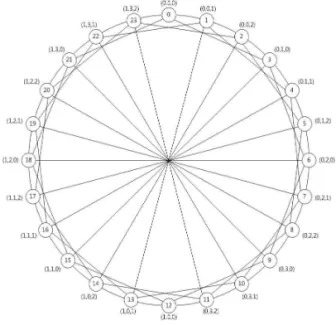
1. INTRODUCTION
A generalized recursive circulant network(GR) [1] is widely used in the design and implementation of local area networks and parallel processing architectures.
This network denoted by
has
vertices where
≥ for ≤ ≤ . Index I is a dimension of the labeling system while
is the base of dimension . Each vertex in the network can be expressed as an -tuple
with
≤
≤
for . The number of edges at a node is
, if
, then
, else
.
The routing of message is thus a key to per- formance of networks. We look for algorithms that are capable of handling, multiple data items simul-
taneously transmitted from a starting node to a destination node. There are a few algorithms on the hypercube-like network that allow us to locate n disjoint paths such as the Hamiltonian path Algorithm[2], the Rotation Algorithm using Tree Structure[3], the Disjoint Path Algorithm[3], and the Routing Algorithms[4]. Node-disjoint paths can be categorized into three classes-one-to-one, one-to- many, and many-to-many. The first class considers the disjoint paths from a source node to a destination node, the second from a source node to k destination nodes and the third from k source nodes to k destination nodes. One-to-one disjoint paths were constructed on several networks such as hypercubes[5], k-ary n-cubes[6] and star graphs[7]. One-to-many disjoint paths were de- signed on hypercubes [8,9] and star graphs [8]. For
Application of the Hamiltonian circuit Latin square to a Parallel Routing Algorithm on Generalized
Recursive Circulant Networks
Dongmin Choi
†, Ilyong Chung
††ABSTRACT
A generalized recursive circulant network(GR) is widely used in the design and implementation of local area networks and parallel processing architectures. In this paper, we investigate the routing of a message on this network, that is a key to the performance of this network. We would like to transmit maximum number of packets from a source node to a destination node simultaneously along paths on this network, where the i
thpacket traverses along the i
thpath. In order for all packets to arrive at the destination node securely, the i
thpath must be node-disjoint from all other paths. For construction of these paths, employing the Hamiltonian Circuit Latin Square(HCLS), a special class of (n x n) matrices, we present O(n
2) parallel routing algorithm on generalized recursive circulant networks.
Key words: Node-disjoint Paths, Generalized Recursive Circulant Networks, Hamiltonian Circuit Latin Square
※ Corresponding Author : Ilyong Chung, Address: Dept.
of Computer Engineering, Chosun University, Seosoeg- Dong, Dong-Gu, Gwangju, 501-759, Korea, TEL : +82- 62-230-7712, FAX : +82-62-230-7754, E-mail : iyc@chosun.
ac.kr
Receipt date : Apr. 30, 2015, Revision date : July 20, 2015
Approval date : July 28, 2015
††
Division of Undeclared Majors, Chosun University (E-mail : [email protected])
††
Dept. of Computer Engineering, Chosun University
※ This study was supported by research funds from
Chosun University, 2015
the generation of many-to-many disjoint paths some work has been done [10,11].
In this paper, we propose an algebraic approach to routing of messages on
. As described above, maximum number of packets are simultaneously transmitted from a starting node to a destination node, where the
packet is sent along the i
thpath. In order for all packets to arrive at a destination node quickly and securely, the i
thpath must be node-disjoint from all other paths.
To accomplish this, we employ the operations of nodes presented in Cayley Graph[12] and the spe- cial matrix called as Hamiltonian Circuit Latin Square(HCLS)[5], which was used to find a set of node-disjoint paths on hypercube network[5], cir- culant networks[13] and recursive cube of rings networks[14].
2. DESIGN OF THE SHORTEST PATH
Let A and B be any two nodes on
. The paper’s objective is to find algorithms that will facilitate the transmission of data from a source node to a desired node on gen- eralized recursive circulant networks. In order for the data to traverse to a desired node, it must cross, successively, intermediate nodes along a path.
Definition 1.
is defined as follows:
Each vertex in the network can be expressed as an -tuple
with ≤
≤
for
and the edge set E is {
,
±
±
, where
, if
, then
and if
, then
,
.
The number of edges at a node is
, if
, then
, else
. It means that if
, then
has two edges at dim- ension
and
,
else it has one edge
. When the operations occur at the leftmost dimension
, since
is invisible, addition and subtraction to
are neglected. This means that vertices
and
are adjacent (see Fig. 1).
Researches on generalized recursive circulant networks(GR) are actively performed in graph- ic-theoretical areas such as embedding and fault- tolerance. As mentioned earlier, a node on Cayley Graph can traverse to another node by performing a certain operation. We now employ these oper- ations to GR.
Definition 2. The Routing function R for
±is as follows:
±
±mod , where A is an address of a node
Node A is physically connected to k neighboring nodes and these paths are node-disjoint. Data is transmitted from a source node along the
path.
The path above is selected by the routing function described in Definition 2. To do this, the relative address of two nodes can be obtained below.
Fig. 1. GR (2,4,3).
Definition 3. Let A and B be
and
, respectively. The relative address of nodes A and B is computed as the difference between each dimension of two nodes.
Let A and B be (1,2,1) and (3,2,2) on GR(4, 5, 3). The relative address is (2,0,1), which can be described as a sequence of operations
since
and
. Also,
is interchangeable to and is .
Definition 4. Let T(A,S) be a logical trans- mission path starting form node A to a destination node, where r is a multiset and a sequence of oper- ations, via which data can reach at a destination node. T(A,S) is determined by the order of ele- ments in S.
Given node A and multiset S on GR(4,5,3), we would like to transmit to a destination node via in- termediate nodes. Let node A and set S be (1,2,1) and <3,3,1>, respectively. Operations in S are ap- plied to the routing function sequentially and then the traversal of data is (1, 2, 1) → (2, 2, 1) → (3, 2, 1) → (3, 2, 2).
Since the paper’s objective is to find an algo- rithm that will facilitate the secure transmission of data from a starting node to a destination node, those operations should be appropriate for this objective. Given S, a size of this sequence must be minimized since a routing distance is equal to a size of a sequence.
For example, supposed that S =
on GR(4,5,3). then S can be minimized to
since
mod
and a carry 1 is added to
.
3. Application of the Hamiltonian Circuit Latin Square to the Parallel Routing Algorithm on Generalized Recursive Circulant Networks
The k packets are transmitted from a source node to a destination node on
. In this section, we would like to construct a set of k node-disjoint paths in order to transmit these packets safely. First, k packets residing at a node are sent to its neighboring nodes along a set of disjoint paths. These paths are generated by em- ploying k different operations at the beginning step and by performing k different operations at the last step in order to arrive at a destination node. The figure below illustrates the operations applied to generate k paths from a source node to a destina- tion node.
The
packet is transmitted along the
path, the first intermediate node of which is obtained from applying operation
at a starting node and the last intermediate node transmits this packet to a destination node by applying operation
. In some cases,
and
can be the same.
Definition 5. Let
be a set of operations oc- curring at a starting node when k packets are transmitted simultaneously and Let
be a set of operations occurring at the last k intermediate no- des in order for k packets to arrive at a destination node. These sets are defined as follows:
{
}
{
}
We now apply the HCLS(Hamiltonian Circuit Latin Square) to find a set of m shortest and node-disjoint paths. A latin square is a square ma- Fig. 2. The operations applied at the first step and the
last step.
trix with
entries of m different elements, none of the elements occurring twice within any row or column of the matrix. The integer m is called the order of latin square. The next definition describes the HCLS.
Definition 6. The HCLS
is constructed as follows: Given distinct m points
, a Hamiltonian circuit
→
→→
→
is randomly selected. On the circuit each row of
can be ob- tained from the Hamiltonian path. starting at any position ≤ ≤ , under the condition that no two rows begin at the same position. If a Hamiltonian path is
→
→→
, then the row ob- tained from it is
.
From the HCLS given in Definition 6, the MHCM(Modified Hamiltonian Circuit Matrix) is constructed below.
Definition 7. Given the HCLS
, the MHCM
is constructed as follows:
∈
≤ ≤ ≤ ≤ . The following example will provide a better un- derstanding of Definition 6 & 7.
Example 1. If the Hamiltonian path is 2 → 3
→ 1 → 4, then the HCLS
and the MHCM
are constructed as follows.
Definition 8. Call
the MGNDP(Matrix for Generating Node-Disjoint Paths). No two entries of this matrix are the same. It satisfies the follow- ing conditions.
⊂ {
∪ { }},
≤ ≤ ≤ ≤ means “stay at the cur- rent node”.
(1)
(2)
≠
i f≠
(3)
⊂
(4)
∪ { }, if ∈
Referring to [5], the MHCM satisfies the con- ditions of the MGNDP(Matrix for Generating Node-Disjoint Paths), which constructs a set of node-disjoint paths on the hypercube network.
Since The HCLS belongs to the latin square, a set of elements in the first column is the same as that of the last column. On generalized recursive circu- lant networks, an element in the HCLS is repre- sented as an operation. Also,
and
in Definition 5 are described as all the elements in the first column and all the elements in the last column, respectively. We, intuitively, realize that a set of m node-disjoint paths is generated if the number of distinct sequences of operations for arriving at an arbitrary node in a short time is ≤ . The remaining operations excluding these distinct op- erations from
and
, should be performed.
Example 2. Let A and B be (1,2,1) and (3,2,2) on . According to Definition 4, sequence S is computed as < 3, 3, 1 > and a set of node-dis- joint paths is generated as follows. A set of distinct operations in S is < 1, 3 >. Using these operations, (2 × 2) HCLS can be obtained from Definition 6.
Operations in the
row of the HCLS generated above are performed for traversal of the
packet and the remaining operation is also executed at the point except the first and the last points. In order to assure that these paths are node-disjoint, the remaining operation should be executed at the same time. In this example, the running point of the remaining operation is the second. Physical transmission paths from node A to node B are de- scribed below.
Path 1 : T(A,< 1, 3, 3 >) : A → (1, 2, 2) → (2, 2, 2) → B
Path 2 : T(A,< 3, 3, 1 >) : A → (2, 2, 1) → (3,
2, 1) → B
From Definitions 1 and 6,
and
are ob- tained, that is,
{
}. Excluding the operations 1 and 3, which are performed in the first and the last steps, from
and
,
and
become {
}. Recall that we deal with design of six node-disjoint paths, out of which two node-disjoint paths are now constructed. Examin- ing Definition 2, when a packet traverses in a pos- itive direction on the
dimension and then tra- verses in a reverse direction on the same di- mension, a packet comes back to its original position. This idea is applied to generation of dis- joint paths. If {
} exists as a subset of
and
, these operations are executed at the first and the last steps and the operations obtained from de- sign of the shortest distance at the middle steps.
Path 3 and Path 4 are constructed below.
Path 3 :
: A → (1, 3, 1) → (1, 3, 2) → (2, 3, 2) → (3, 3, 2) → B Path 4 :
: A → (1, 1, 1) → (1,
1, 2) → (2, 1, 2) → (3, 1, 2) → B Excluding {
} from
and
,
and
become {
}. While operations working at the first and the last steps are not the same, operations performing at the remaining steps are the same.
As described earlier for Path 3 and Path 4, a packet traverses in a positive direction on the
di- mension and then traverses in a reverse direction on the same dimension. Likewise a packet tra- verses twice in the same direction on the
di- mension and then traverses twice in the reverse direction on the same dimension, and then this packet comes back to its original position. A se- quence of operations for a path is now obtained.
Firstly, two operations traversed in the same di- rection are chosen for the first and the last steps.
Secondly, two operations in reverse direction and the operations for the shortest distance would be executed at the middle steps. However, these oper- ations must be minimized in order to be a shortest
path and then the minimal operations are executed.
Paths 5 and 6 are generated by handling cases of {
} and {
}, respectively.
Path 5 :
: A
→ (1, 2, 0) → (1, 3, 0) → (2, 3, 0) → (3, 3, 0) → B Path 6 :
: A → (0, 2, 1) → (0, 2, 2) → B
The process to find a set of node-disjoint paths is described above. We now propose a parallel routing algorithm that generates a set of node-dis- joint paths on generalized recursive circulant networks. In this paper, we will use the term
“distance” between two nodes to refer to the num- ber of routing steps(also called hopcounts) needed to send a message from one node to another.
GR_Routing_Algorithm
A ← an address of a starting node A B ← an address of a destination node B
← a set of operations occurring at a starting node A
← a set of operations requisite for reaching to a destination node B
begin
(1) Compute the relative address r of nodes A and B
(2) Using the relative address r, a sequence S of operations to arrive at node B in a short time are produced.
(3) In order to design a set of node-disjoint paths, find a sequence
of distinct elements in S. A set of
shortest and node-disjoint paths are generated. Each path of length is | S |,
(3-1) Using
, (n × n) HCLS is constructed, where n =
.
(3-2) Operations in the
row of the HCLS
are performed for traversal of the
packet and
the remaining operations in S should be executed
at the point except the first and the last points.
(3-3)
←
−
and
←
−
(4) Construct two node-disjoint paths, each path has length .
(4-1) If
= , the process is finished.
(4-2) If a set of {
} is found in
, then these operations are performed at the first and the last steps, and the operations in S at the middle steps, otherwise go to (5).
(4-3)
←
- {
},
←
- {
} and go to (4-1).
(5) Generate the remaining paths.
(5-1) If
= , the process is finished.
(5-2) For ∈
, produce
of mini- mum number of operations by reducing the size of S ∪ {
},
= {i, min(S ∪ {
}), i}
(5-3) Operation i is performed at the first and the last steps and the remaining operations of
are executed at the middle steps.
(5-4)
←
- { },
←
- { } and go to (5-1).
end.
GR_Routing_Algorithm is thus fairly straight- forward. The time involved in performing Steps (1), (2) and (4) is small compared to the remaining steps. The first, second and fourth steps of this al- gorithm does not, therefore, contribute to an ob- jectionable overhead.
Theorem 1. The construction of a set of k node-disjoint paths can be performed in O(n
2) time.
Proof: Applying the Algorithm above to generate k node-disjoint paths. Important steps for de- termining time complexity requisite for the Algorithm are two things. One is to design the HCLS, which requires O(n). The other is to run Step (5) of GR_Routing_Algorithm. In Step (5), in order to run in
at the first and the last steps in transmission, a sequence of operations is de-
termined to S ∪{
}, and is reduced. Since the reduction process requires O(n) time and the num- ber of elements in
is less than n, Step (5) can be computed in O(n
2). Therefore, a set of k node-disjoint paths can be created in O(n
2) time.
The paper’s objective is to find a set of k node-disjoint paths between two nodes. The major topological characteristics of the generalized re- cursive circulant network is considered and the property of k paths obtained from the Algorithm is proven below.
Theorem 2. The k transmission paths produced by GR_Routing_Algorithm are node-disjoint.
Proof: The k packets residing at node A are now transmitted at time
. These packets reach to its k neighboring nodes at time
. Then, each packet traverses to a neighboring node along a shortest path. Suppose that two packets arrive at the same node except a destination node during transmission.
In order for this case to occur, the following con- dition should be satisfied. Let
and
be two se- quences of operations for sending two packets from a starting node to two arbitrary nodes at time
, where
means that one packet arrives at time
and the other arrives at time
. Then,
and
should be the same. In other words, if these se- quences do not appear, a set of node-disjoint paths can be constructed. According to the Algorithm described above, three classes of paths are gen- erated on this network. We now consider three cases.
Case 1: Let
and
be two sequences of oper- ations obtained from design of the shortest distance. Then
and
must not be the same due to the properties of the MGNDP.
Case 2: Let
and
be two sequences of oper- ations acquired by running Algorithm-(4). Then
and
must not be the same because the first elements of
and
are
and