Journal of Internet Computing and Services(JICS) 2016. Feb.: 17(1): 01-06 1
비-가우시안 잡음하의 적응 시스템을 위한 바이어스된 영-오차확률의 반복적 추정법
Recursive Estimation of Biased Zero-Error Probability for Adaptive Systems under Non-Gaussian Noise
김 남 용1* Namyong Kim
요 약
바이어스된 영-오차확률 (biased zero-error probability)과 이에 관련된 알고리듬은 매 반복시간마다 합산과정을 지니고 있어 많은 계산상의 부담을 요구한다. 이 논문에서는 바이어스된 영-오차확률에 반복적 접근법을 적용한 알고리듬을 제안하였고 천해역 통신채 널과 충격성 잡음 및 바이어스된 가우시안 잡음이 혼재한 실험 환경에서 성능을 비교하였다. 샘플 사이즈에 비례하는 계산 복잡도를 지닌 기존 알고리듬과 달리 제안한 반복적 방식은 샘플 사이즈와 무관하여 계산량의 부담을 크게 줄였다. 이러한 계산효율 특성을 지닌 제안한 알고리듬은 블록 처리방식의 기존 알고리듬과 비교하여 다중경로 페이딩, 바이어스된 잡음 및 충격성 잡음에 대한 강인 성에서 동일한 성능을 나타냈다.
☞ 주제어 : 반복적 확률, 바이어스된 영-오차, 바이어스된 가우시안, 충격성, 수중통신
ABSTRACT
The biased zero-error probability and its related algorithms require heavy computational burden related with some summation operations at each iteration time. In this paper, a recursive approach to the biased zero-error probability and related algorithms are proposed, and compared in the simulation environment of shallow water communication channels with ambient noise of biased Gaussian and impulsive noise. The proposed recursive method has significantly reduced computational burden regardless of sample size, contrast to the original MBZEP algorithm with computational complexity proportional to sample size. With this computational efficiency the proposed algorithm, compared with the block-processing method, shows the equivalent robustness to multipath fading, biased Gaussian and impulsive noise.
☞ keyword : recursive probability, biased zero-error, biased Gaussian, impulsive, underwater communication
1. INTRODUCTION
Multipath and ambient noise in communication channels cause unreliable performance to many communication systems [1]. In indoor radio channels and underwater acoustic channels, the ambient noises are known to be non-Gaussian [2][3][4].
In shallow water environment the channel conditions induces more complicated distortions and noise characteristics. Field experiments in the work [5] on shallow water channel
1Division of Electronics, Information & Communication Engineering, Kangwon National Unversity, Samcheok, Gangwon-Do, 245-711, Republic of Korea
* Corresponding author ([email protected])
[Received 5 August 2015, Reviewed 14 October 2015, Accepted 22 December 2015]
characteristics reveal severe multipath effects. Field tests for ambient noise have established that it is predominantly non-Gaussian due to the various noise generating sources [6][7].
The noise composed of the Gaussian and non-Gaussian noise is referred to as biased-Gaussian, and impulsive interferers, timing phase error are examples of such non-Gaussian noise sources [8].
Among non-Gaussian noises, biased Gaussian and impulsive noise are discussed in this paper as the ambient noise which commonly occurs in underwater communications [9]. Recently, a new criterion of biased zero-error probability employing a bias term has been proposed [10]. Also its related equalizer algorithm derived through maximization of the criterion has been shown to be superior in the shallow water communication environments.
ISSN 2287-1136 (Online) http://www.jksii.or.kr
As one of the drawbacks of the biased zero-error probability and its related algorithms, a great deal of computations hinders the efficient implementation of the algorithm. For the purpose of reducing the computational complexity for efficient applications, in this paper, a recursive approach to the biased zero-error probability and its related algorithms is proposed and compared in the same simulation environment of shallow water communication channels with ambient noise of biased Gaussian and impulsive noise.
2. BIASED ZERO- ERROR PROBABILITY
The difference between the desired symbol diand an output sample yiof the system involved is usually defined as an error sample ei, that is, ei=di−yi of the system at the sample time i. The distribution information of the error samples eican be found through the error probability density function fE(e). The well known kernel density estimate approximates the true density for continuous random variables with a set of given data samples [11].
When the Gaussian kernel Gσ(⋅) with a kernel size σand N error samples {ek−N+1,ek−N+2,...,ei,...,ek}are used, the probability density function for error samples can be expressed as
∑− +
=
−
= k
N k i
i
E G e e
e N f
1
) 1 (
)
( σ
∑− +
=
−
= k −
N k i
ei
e
N 1 2
2
2 ] ) exp[ ( 2 1 1
π σ
σ (1)
Then fE(e+τ) with bias termτ can be a more appropriate expression for error samples shifted by some sort of DC-bias noise.
∑− +
=
− +
≅
+ k
N k i
i
E G e e
e N f
1
) ) 1 ((
)
( τ σ τ
(2) Defining ei,biased=ei−τ, we have
∑− +
=
−
≅
+ k
N k i
biased i
E G e e
e N f
1
, )
1 ( )
( τ σ
(3) On the other hand, the criterion of zero-error probability
∑=
≅ M
i i
E G e
f M
1
) 1 ( ) 0
( σ
which has well been established for supervised
learning is maximized to move the error samples e close to i
zero, compensating intersymbol interference (ISI) and noise effect [12]. Similar to this approach, a new criterion of the biased zero-error PDF fE(e+τ)e=0=fE(τ) has been introduced in the work [10] as
∑− +
=
−
= k
N k i
biased i
E G e
f N
1
, )
1 ( )
(τ σ
(4) When the biased zero-error probability is maximized the error samples are forced to be congregated at around zero compensating the bias τ which is estimated in adaptive algorithms appropriately designed for the criterion (4).
3. RECURSIVE ESTIMATION OF BIASED ZERO- ERROR PROBABILITY
The biased zero-error PDF at time k-1 is
∑−
−
−1= 1 = 1 (− , )
)
( k
N k i
biased i k
E G e
f τ N σ
(5) This can be rewritten as
⎜⎝
⎛ −
= ∑
+
−
− =
k N k i
biased i k
E G e
f N
1 ,
1 1 ( )
)
(τ σ
)
) (
)
( ek,biased G ek N,biased
G − + − −
− σ σ (6)
) 1
( )
( k = E k−
E f
f τ τ
) 1 (
) 1 (
,
,biased k Nbiased
k G e
e N
NG − − − −
+ σ σ
(7) This indicates that the biased zero-error PDF can be estimated recursively.
For the maximization of the criterion fE(τ)k we apply the steepest descent method using the gradient of (7) with respect to weight of the adaptive system in use. For this purpose, firstly the adaptive system employed needs to be specified.
Assuming the same tapped delay line (TDL) structure is used as in [10], that is, the system weight vector is
T k L k k k
k=[w0,,w1, ,w2, ,...,w, ]
W and input is Xk=[xk,xk−1,...,
T L
k b
x−+1, ] where bis a constant, the system output becomes
b w y
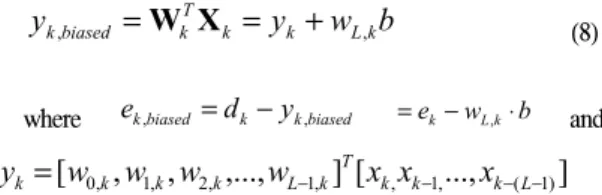
yk,biased =WkTXk = k + L,k (8)
where ek,biased =dk−yk,biased =ek−wL,k⋅b and ] ..., [
] ,..., , ,
[ 0, 1, 2, −1, , −1, −( −1)
= k k k L
T k L k k k
k w w w w x x x
y
This structure ensures that the bias τ can be controlled by wL,k and b .
Based on this adaptive system, the steepest descent method leads to the following weight adjustment equation.
W W
W ∂
+ ∂
+ = E k
k k
f ()
1 μ τ (9)
When the biased zero-error PDF (4) which is based on block-processing estimation is employed, the gradient for (9) can be expressed as
∑−+
= − ⋅
∂ =
∂ k
N k i
i biased i biased i k
E e G e
N f
1
,
2 , ( )
1 )
( X
Wτ σ σ
(10)
On the other hand, the proposed recursive estimation of the biased zero-error PDF (7) leads to the recursive gradient (11).
W W ∂
=∂
∂
∂fE(τ)k fE(τ)k−1
)] (
) [ (
1 , ,
W
W ∂
−
−∂
∂
−
+ ∂G ekbiased G ek− biasedN
N
σ σ
k biased k biased k k
E e G e
N
f X
W − ⋅ ⋅
∂
= ∂ ( ) − 1 ( )
, 2 ,
1 σ σ
τ
N k biased N k biased N
k G e
Ne− ⋅ − ⋅ −
+ 1 ( ) X
,
2 , σ
σ (11)
It is noticeable that the weight update equation using the block-processing gradient (10) which is referred to as MBZEP (Maximization of Biased Zero-Error Probability) algorithm in [10] requires a summation operation at each iteration time.
However, the proposed gradient (11) does not demand any summation operations.
4. RESULTS AND DISCUSSION
The aim of this section is to show that the proposed algorithm ((9) and (11)) with a computationally efficient estimation of biased zero-error probability and its gradient yields the same MSE learning performance as the block-processing based MBZEP algorithm ((9) and (10)) which has much higher computational complexity under the simulation environment used in the study [10]. That is, the multipath channel H(z)is from the shallow-water communication experiment carried out in the work [10].
0 2000 4000 6000 8000 10000 12000
-22 -20 -18 -16 -14 -12 -10 -8 -6 -4 -2 0
M B ZEP proposed
10 log of MSE
num ber of sam ples
Fig. 1. MSE performance under impulsive and time-varying DC bias noise in underwater communication environment.
8 6
4 0.543 0.259
798 . 0 )
(z = z− + z− + z−
H (12)
The non-Gaussian noise comprises impulsive and slowly time-varying DC-bias. The impulsive noise model and DC-bias noise are the same ones as used in [10]. Likewise, the equalizer parameters for this simulation are L=11, b=2, the sample size N=4, μ=0.01, and the kernel size σ=1.0.
The immunity against the non-Gaussian noise has been proven to be superior in the work [10] removing slowly changing DC noise completely as well as showing stable convergence without weight perturbation under severe impulsive noise. Figure 1 shows that these properties under the environment are completely preserved in the proposed method as well.
Besides the slowly time-varying DC-bias noise, in this section, an abrupt DC noise added in middle of the convergence
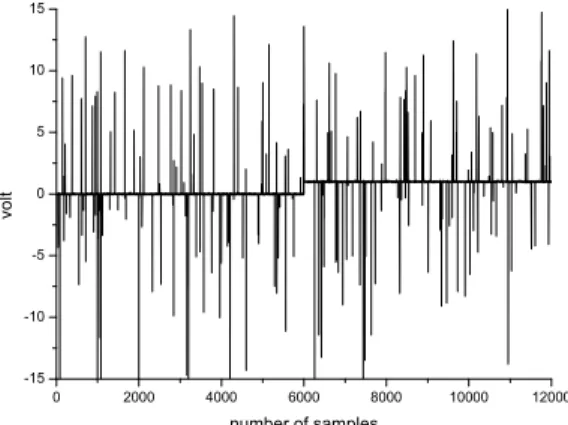
process to the impulsive noise is studied. It is added at k=6000 and kept on as depicted in Fig. 2. Figure 3 shows that after initial convergence the MSE learning curve has a spiky sudden rise at sample time 6000 caused by the static DC-bias noise added from the sample time 6000 and on. Both algorithms successfully cancel the static DC noise at a very rapid rate reaching the steady state MSE within 500 samples. For a more clear
0 2000 4000 6000 8000 10000 12000
-15 -10 -5 0 5 10 15
volt
number of samples
Fig. 2. Impulsive noise with 1 volt DC bias abruptly added from the sample time 6000.
0 2000 4000 6000 8000 10000 12000
-22 -20 -18 -16 -14 -12 -10 -8 -6 -4 -2 0 2 4
10 log of MSE
Iterations (number of samples) LMS MBZEP Proposed
Fig. 3. MSE performance under impulsive plus DC bias noise abruptly added from the sample time 6000.
performance comparison, the LMS (least mean algorithm) in [1] is also compared.
From the observations of Fig.1 and 3, we can be convinced that the original MBZEP algorithm and the proposed algorithm both have the ability to cope with any types of DC-bias noise
as well as impulsive noise, where more importantly, the proposed one has no computational burden with respect to sample size Ncontrast to the original MBZEP algorithm.
As the main figure of merit for this study, the extent of computational complexity in multiplication is investigated for the proposed recursive method compared with the original
0 2 4 6 8 10 12 14 16 18 20
0 10 20 30 40 50 60
number of multiplications
sample size MBZEP proposed
Fig. 4. Number of multiplications with respect to sample size N.
MBZEP algorithm. For the sake of convenience of comparison, the Gaussian kernel Gσ(ei) and 1σ2N which are commonly included in both methods are treated as constants.
The block-processing method (10) demands 3N multiplications at each iteration time while the proposed method (11) requires 5 multiplications. It is particularly important that the computational complexity of the proposed one is constant without any relationship with the sample sizeN since a large sample size is preferable in order to guarantee a desired level of accuracy [13]. Therefore, the property of the computational complexity being independent of the sample sizeNensures the proposed method to achieve more accurate PDF estimation by increasing Nwithout any limit of computational cost. Figure 4 for comparisons of computational burden shows apparently that the proposed method is more appropriate to practical implementations.
5. CONCLUSION
The biased zero-error probability and its related algorithms have been developed for multipath channels with non-Gaussian noise. Despite its superior performance in ambient noise of biased Gaussian and impulsive noise, the algorithm requires
heavy computational burden so that efficient implementation is hindered. For the purpose of reducing the computational complexity, in this paper, a recursive approach to the biased zero-error probability and its related algorithms is proposed. The proposed method has no computational burden with respect to sample size contrast to the original MBZEP algorithm with computational complexity proportional to sample size. From this computational efficiency and the simulation results showing equivalent ability to cope with DC-bias and impulsive noise, we conclude that the proposed recursive method can be a good candidate for practical signal processing applications in the environments of impulsive and biased non-Gaussian noise.
6. REFERENCES
[1] J. Proakis, Digital Communications, McGraw-Hill, 2nd ed, 1989.
[2] Y. Yao and H. Poor, “Blind detection of synchronous CDMA in non-Gaussian channels,” IEEE Trans. Signal Processing, vol. 52, no. 1, pp. 271-279, Jan. 2004.
https://www.ece.uic.edu/~yyao/papers/robust.pdf [3] J. Park, C. Yu, Y. Lee and S. Yoon, “Blind estimation
schemes for frequency offset of OFDM systems in non-Gaussian noise environments”, Proc. of ICWMC 2012, pp. 13-16, 2012.
https://www.thinkmind.org/download.php?articleid...1 [4] J. Park, G. Shevlyakov and K. Kim, “Distributed detection
and fusion of weak signals in fading channels with non-Gaussian noises,” IEEE Communications Letters, vol.
16, no. 2, pp. 220-223, 2012.
ieeexplore.ieee.org/iel5/4234/6146702/06109195.pdf?arnu mber
[5] S. Kim, S. Kim, C. Youn, and Y. Lim, "Performance analysis of receiver for underwater acoustic communications using acquisition data in shallow water", Journal of Acoustical Society of Korea, vol. 29, no. 5, pp. 303-313, May 2010.
www.koreascience.or.kr/article/ArticleFullRecord.jsp?cn...
[6] A Das, A Kumar and R Bahl, “Realistic ambient noise analysis for passive surveillance algorithm design,” Proc.
of 2011 IEEE Symposium on Underwater Technology and Workshop on Scientific Use of Submarine Cables and Related Technologies, pp.1–8, 2011.
https://www.infona.pl/resource/bwmeta1...ieee.../summary?...
[7] L. Wang and X. Liu, “Research on underwater target signal detection and recognition processing algorithm,”
International journal of smart sensing and intelligent systems, vol. 7, no. 4, pp. 1753-1772, Dec. 2014.
search.ebscohost.com/login.aspx?direct=true&profile...
[8] H. Sedarat, K. Fisher, “Multicarrier communication in presence of biased-Gaussian noise sources,” Signal Kevin Fisher Remove suggestion Processing, vol. 88, No. 7, July, 2008, pp. 1627-1635.
www.sciencedirect.com/science/article/pii/S01651684070 03957
[9] Z. Daifeng and Q. Tianshuang, “Underwater sources location in non-Gaussian impulsive noise environments,”
Digital Signal Processing, vol. 16, pp. 149-163, March, 2006.
www.freepaperdownload.us/1752/FullText7545263.htm [10] N. Kim, “Biased zero-error probability for adaptive systems
under non-Gaussian noise,” Journal of Internet Computing and Services, vol. 14, no. 1, pp. 9-14, Feb. 2013.
www.jksii.or.kr/upload/1/968_1.pdf
[11] E. Parzen, “On the estimation of a probability density function and the mode,” Ann. Math. Stat. vol. 33, p. 1065, 1962.
http://ssg.mit.edu/cal/abs/2000_spring/np_dens/density-est imation/parzen62.pdf
[12] N. Kim, “Decision feedback equalizer based on maximization of zero-error probability,” Journal of KICS, vol. 36, no. 8, pp. 516-521, Aug. 2011.
www.koreascience.or.kr/article/ArticleFullRecord.jsp?cn...
[13] Y. Zheng, J. Jestes, J. Phillips, and F. Li, “Quality and efficiency for kernel density estimates in large data,” Proc.
of the 2013 ACM SIGMOD International Conference on Management of Data, pp. 433-444, 2013.
dl.acm.org/citation.cfm?id=2465319
◐ 저 자 소 개 ◑
김 남 용 (Namyong Kim) 1986년 연세대학교 전자공학과 졸업(학사) 1988년 연세대학교 대학원 전자공학과 졸업(석사) 1991년 연세대학교 대학원 전자공학과 졸업(박사) 1992-1998년 관동대학교 전자통신공학과 부교수
1998~현재 강원대학교 공학대학 전자정보통신공학부 교수 관심분야 : Adaptive Equalization, RBFN Odour Sensing Systems E-mail : [email protected]