Research Report
브로콜리 품종 및 부위에 따른 항균활성과 항산화 효과
박미영, 윤무경, 곽정호*
농촌진흥청 국립원예특작과학원 채소과
Antimicrobial and Antioxidant Activities in Different Parts and Cultivars of Broccoli
Mi Young Park, Moo Kyung Yoon, and Jung-Ho Kwak
*Vegetable Research Division, National Institute of Horticultural & Herbal Science, Rural Development Administration, Suwon 440-706, Korea
Abstract: The antimicrobial and antioxidant activities of different cultivars and parts of broccoli were investigated. The screening of antimicrobial activities for the floret and leaf extracts of 11 cultivars against selected gram positive (Staphylococcus aureus and Listeria monocytogenes) and gram negative bacteria (Escherichia coli O157:H7 and Salmonella enteritidis) were conducted.
The AMG cultivar showed the highest antimicrobial activity against S. aureus with the floret and leaf extracts (12.83 and 13.00 mm). Antibacterial activity against L. monocytogenes was strongest with floret extract of NJ cultivar (13.58 mm) and leaf extract of YDR cultivar (13.92 mm). Moreover, the size of inhibition zone against L. monocytogenes was bigger than those of 4 kinds of pathogenic bacteria. Both floret and leaf extracts of Grd cultivar showed the highest antimicrobial activity against E. coli O157: H7, but there was no difference between floret and leaf extracts. Floret extract of NJ cultivar and leaf extract of NY and 0c cultivars were effective against S. enteritidis whereas leaf extract exhibited better antimicrobial effect than floret extract.
These results showed that floret extract of NJ and leaf extract of 0c had the highest antioxidant activity which was 39.90 and 43.64%, respectively. The antioxidant activity of leaf extract was 1.5 times higher than that of floret extract. All cultivars except NJ showed that electron donating ability of leaf extract was higher than that of floret extract.
Additional key words: Brassica oleracea var. italica, DPPH, Escherichia coli O157:H7, Listeria monocytogenes, Salmonella enteritidis, Staphylococcus aureus
*Corresponding author: [email protected]
※ Received 17 November 2013; Revised 29 January 2014; Accepted 5 February 2014. 본 연구는 농림축산식품부, 해양수산부, 농촌진흥청, 산림청 Golden Seed 프로젝트 사업(원예종자사업단, 과제번호 : 213003-04-1-SB410)에 의해 이루어진 것임.
Ⓒ 2014 Korean Society for Horticultural Science
서 언
최근 인간수명의 연장으로 식품의 섭취가 단지 영양원으 로 신체유지라는 제한된 역할에서 벗어나 건강한 삶을 오 래 유지하기 위한 보건 기능성식품의 역할로 주목 받고 있 으며, 이에 노화억제와 건강유지를 위한 연구가 광범위하게 이루어지고 있다(Granato et al., 2010). 그 중 채소와 과일의 섭취는 항암, 항노화, 항당뇨, 항세균력을 증진시키는 역할 을 하고 있으며(Khaw et al., 2001), 이러한 작용을 하는 생 리활성 물질에 관한 연구가 미생물과 식물분야에서 활발히 진행되고 있다(Fyhrquist et al., 2002; Rauha et al., 2000;
Stangeland et al., 2009).
노화와 질병은 인체 내의 활성산소에 의해 생체 내에서 단백질의 불활성화, 세포막 분해, 세포구조 손상, DNA 합성 억제, 지방 산화 등 생리적인 장애에 의해 유발된다(Gardner and Fridovich, 1991; Imlay and Linn, 1988). 인체 내에서는 SOD(superoxide dismutase), catalase, glutathione reductase 등 의 항산화 효소와 천연 항산화제 등이 존재하여 활성산소를 제거해 생체를 보호하는 방어시스템을 가지고 있지만, 여러 요인들에 의해 항산화 방어시스템의 균형이 깨져 노화와 각 종 질병을 일으키게 된다(Yildirim et al., 2001). 따라서 항노 화와 질병의 예방을 위해 효과적인 항산화제의 섭취가 필요
Table 1. List of strains and media used for antimicrobial experiments.
Strain KCCM no. Media
Gram positive bacteria Staphylococcus aureus KCCM 11335 TSA (BBL)
Listeria monocytogenes KCCM 40307 BHA (DIFCO)
Gram negative bacteria Escherichia coli O157:H7 KCCM 40406 TSA (BBL)
Salmonella enteritidis KCCM 12021 NA (DIFCO)
한 것이다. 이에 tocopherols, vitamin C, carotenoids, catechins 등과 같은 천연 항산화제와 BHT(butylated hydroxytoluene), BHA(butylated hydroxyanisole), PG(propyl gallate), TBHQ (tert-butylhydroquinone)등의 합성 항산화제가 이용되고 있 지만, tocopherols의 높은 가격과 BHT, BHA의 독성에 대한 안전성 문제로 인해 천연물로부터 안전성과 항산화력이 높 은 물질을 이용하려는 연구가 이루어 지고 있다(Cha et al., 2000; Hatano, 1995; Masaki et al., 1995).
주요 식중독 원인균으로 황색포도상구균(Staphylococcus aureus), 살모넬라균(Salmonella enteritidis), 리스테리아균 (Listeria monocytogenes), 병원성 대장균(Escherichia coli O157:H7) 등이 있는데, 이들을 억제하기 위해 사용되어지 는 화학 합성 보존제의 사용에 대한 기피현상 또한 나타나 고 있어, 이 균들에 대한 항균 물질을 식물로부터 찾기 위한 연구도 진행되고 있다(Jayaprakasha et al., 2003; Kim et al., 2011; Lee and Shin, 1991). 배추과 작물 또한 식물성 이차 대사물질인 glucosinolates, flavonoids, polyphenols 등의 물질 이 풍부하게 존재함이 밝혀져(Fenwick and Heaney, 1983), 항산화, 항균 활성에 관한 연구가 활발하게 진행되어 왔다 (Andarwulan et al., 2010; Ayaz et al., 2008; Dasgupta and Bratati, 2007; Kyung and Fleming, 1994). 배추과 작물 중 브로콜리(Brassica oleracea var. italica)에는 항산화 활성을 가진 ß-carotene, ascorbic acid, rutin, glutathione, quercetin, selenium 등이 다량 함유되어 있으며(Sok et al., 2003), glu- cosinolates의 효소적 가수분해 산물 중의 하나로서 고혈압 예방, 심혈관 질환예방, 암세포의 증식을 억제하는 등의 역 할을 하는 sulforaphane이 많이 함유되어 있는데(Zhang et al., 1992), 그 함량이 브로콜리, 순무, 무, 무잎, 흰색 양배추, 자색 양배추, 케일, 콜리플라워, 배추, 청경채, 갓, 돌산갓, 무순, 배추뿌리 등의 배추과 채소들 중에서 가장 높았다는 보고가 있다(Kim et al., 1997).
이러한 기능성 채소로서의 특성들로 인하여 브로콜리는 세계적으로 큰 시장을 형성하고 있으며, 2000년대 이후 국 내에서도 소비가 급증하고 있으나 작은 꽃봉오리가 다발로
이루어진 화뢰(floret) 부위만을 식용하기 때문에 잎 부위는 모두 버려지고 있다. 따라서 본 연구에서는 브로콜리의 품 종 및 화뢰와 잎 부위로 나누어 주요 식중독균에 대한 항균 효과와 항산화 활성을 비교 분석함으로써 추후 고기능성 품 종의 육성과 폐기되는 잎 부위를 활용하기 위한 기초자료를 얻고자 수행되었다.
재료 및 방법
실험 재료
본 실험에 사용된 시료는 경기도 수원시 국립원예특작과 학원 재배포장에서 재배한 브로콜리 11개 품종을 화뢰, 잎 부 분으로 나누어 동결 건조한 후 분쇄하여 분말을 사용하였다.
추출물 제조
동결건조한 브로콜리 분말시료에 10배의 70% 메탄올을 첨가한 후, 상온에서 24시간 교반 추출한 추출액은 여과지 (Whatman No. 6)로 여과한 다음 회전감압농축기(N-1NW, EYELA, Japan)로 감압농축 후 동결 건조하여 -20°C에서 냉 동보관하면서 본 실험의 시료로 사용하였다.
사용균주 및 배양조건
실험에 사용한 균주는 식중독을 유발하는 대표적인 균주 로 그람 양성균 Staphylococcus aureus subsp. aureus KCCM 11335, Listeria monocytogenes KCCM 40307 2종과 그람 음 성균 Escherichia coli O157:H7 KCCM 40406, Salmonella enteritidis KCCM 12021 2종을 한국미생물보존센터(KCCM, Seoul, Korea)에서 분양 받아 사용하였으며 사용된 배지의 조건은 Table 1과 같다. 각 배지는 121°C에서 20분간 멸균하 였으며 멸균된 petri dish에 약 20mL씩 분주하여 사용하였다.
항균활성 측정
브로콜리 품종 및 부위별 추출물의 항균활성은 paper disc
Table 2. Extraction yields of cultivars and parts for broccoli by 70% methanol.
Cultivar Yield (%)
Floret Leaf
NY 13.7 18.3
JN 17.8 26.0
YDR 14.4 19.7
0c 15.2 21.1
NJ 16.6 18.0
BRD 14.5 14.0
CJ 6.8 20.5
AMG 13.2 20.8
Grd 14.7 18.5
Gra 15.3 13.5
TS 13.3 15.0
Mean 14.1 18.7
확산법으로 측정하였다(Bauer et al., 1966). 해당 평판배지 에 균주를 streaking하여 배양된 균주 1 백금이를 취해 10mL 의 균 생육배지에 접종하고 37°C에서 24시간 배양하여 활 성화시킨 후 3일간 배양 후 spectrophotometer(ND-1000, Nano Drop Technologies, Inc., USA)를 이용하여 600nm에서 균 현탁액의 흡광도가 0.3이 되게 하였다. 각 균주 배양액을 평 판배지에 200µL씩 고르게 도말한 후 배지의 표면 위에 멸균 된 paper disc(8mm, Toyo Roshi Kaisha, Ltd., Japan)를 올려 놓고 추출물을 disc에 50µL씩 주입하여 완전히 흡수시킨 후 37°C incubator에서 24시간 배양시켜 paper disc 직경을 포함 한 주위의 저해환(inhibition zone, mm)의 직경을 측정하였다.
항산화효과 측정
브로콜리 부위별 항산화 효과의 측정은 DPPH(2,2-Diphenyl- 1-pikryl-hydrazyl) 라디칼 소거 방법을 사용하였다. 80% 메 탄올을 이용하여 400µM의 DPPH 용액을 제조 후, 96 well plate를 사용하여 80% 메탄올에 1mg・mL-1농도로 녹인 100µL 의 시료와 100µL의 DPPH 용액을 첨가하였다. 30분 후, micro plate reader(EON-C, BioTek Instruments., USA)를 이용하여 517nm에서 흡광도를 측정하였다. 대조구의 흡광도도 같은 조 건에서 3회 반복측정하였으며, 이들 측정값을 다음의 electron donating ability(EDA%) 식에 대입하여 DPPH 라디칼 소거 활성을 계산하였다.
EDA(%) = (BCONTROL-ASAMPLE)/BCONTROL × 100 ASAMPLE: 실험구(분획 첨가)의 흡광도
BCONTROL: 음성대조구(분획 미첨가)의 흡광도
통계처리
실험결과는 3회 반복 측정 후 SAS 통계패키지(ver. 9.2, Cory, NC, USA)를 이용하여 평균 ± 표준편차로 나타내었으 며, 통계적 유의성은 Duncan’s multiple test로 검정하였다.
결과 및 고찰
추출수율
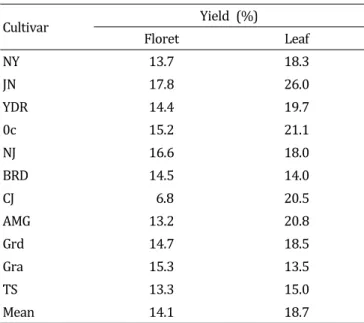
동결건조한 브로콜리 분말로부터 70% 메탄올 추출물의 추출 수율은 Table 2와 같다. JN 품종의 추출수율이 화뢰와 잎 부위 모두 17.8%, 26.0%로 가장 높게 나타났으며, 품종마 다 추출수율의 차이를 보였는데 이는 각 품종마다 가지고 있 는 수분의 함량, 조직 치밀도, 물질 성분 등의 차이에 따른 것
으로 사료된다. 부위별 평균값은 화뢰는 14.1%, 잎은 18.7%
의 추출수율을 나타내었다.
항균활성
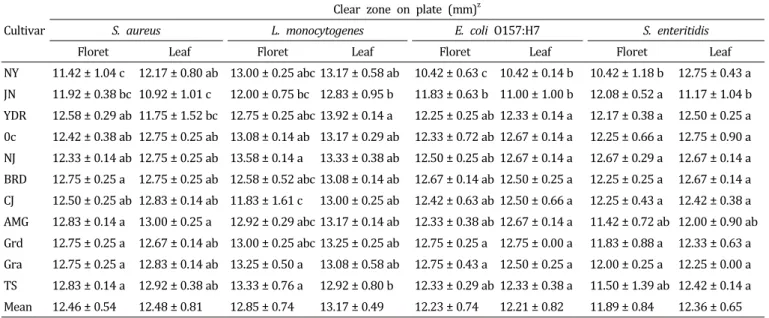
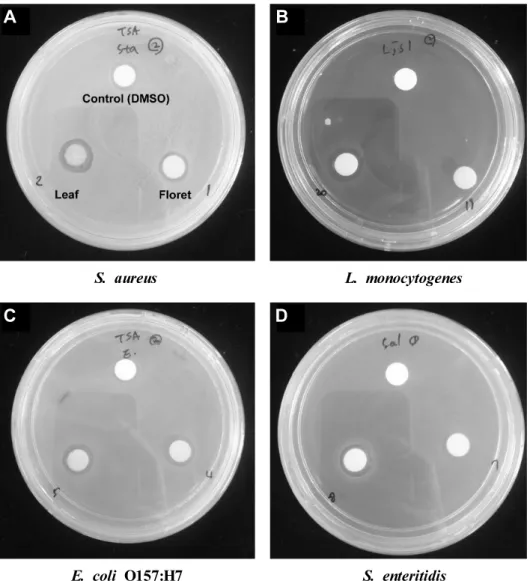
브로콜리 메탄올 추출물의 항균활성을 국내 주요 식중독 원인균 4종에 대해 비교하였다(Table 3 and Fig. 1). 그람 양 성균인 S. aureus는 황색 색소를 생성하여 황색포도상구균 으로 불리며 식중독 뿐만 아니라 화농성 감염증, 폐렴, 골 관절염 등을 유발하는 유해 세균이다(Kim et al., 2010). S.
aureus에 대한 항균력을 살펴보면, AMG 품종에서 화뢰 추 출물 12.83mm, 잎 추출물 13.00mm의 가장 높은 항균활성 을 보였으나, 부위별로는 큰 차이를 보이지 않았으며, 대조 군으로 사용한 DMSO도 저해환을 나타냄으로서 DMSO가 S. aureus에 대해 생물학적 독성이 있는 것으로 판단되었다.
L. monocytogenes는 리스테리아증(listeriosis)을 일으켜 면 역이 낮은 환자, 유아, 임산부 등에 패혈증, 뇌수막염, 유산 등을 일으키며, 사망에까지 이를 수 있는 식중독균으로 낮 은 온도에서도 생육이 가능하여 냉장식품에 문제가 되고 있 는 균이다(Farber and Peterkin, 1991). L. monocytogenes의 경우, 화뢰 추출물은 NJ 품종이 13.58mm, 잎 추출물은 YDR 품종이 13.92mm의 항균활성을 보임으로서 가장 항균력이 뛰어났다. 부위별로는 각 품종마다 항균활성의 차이는 보였 으나, 저해환의 평균 값이 화뢰 추출물 12.85mm, 잎 추출물 13.17mm로 다른 4종의 균 중에서 가장 높은 값을 보였다.
Table 3. Antimicrobial activities of methanol extracts of 11 cultivars and parts of broccoli.
Cultivar
Clear zone on plate (mm)
zS. aureus L. monocytogenes E. coli O157:H7 S. enteritidis
Floret Leaf Floret Leaf Floret Leaf Floret Leaf
NY 11.42± 1.04 c 12.17 ± 0.80 ab 13.00 ± 0.25 abc 13.17 ± 0.58 ab 10.42± 0.63 c 10.42± 0.14 b 10.42± 1.18 b 12.75 ± 0.43 a JN 11.92 ± 0.38 bc 10.92 ± 1.01 c 12.00 ± 0.75 bc 12.83 ± 0.95 b 11.83 ± 0.63 b 11.00 ± 1.00 b 12.08 ± 0.52 a 11.17 ± 1.04 b YDR 12 .58 ± 0.2 9 ab 11.75 ± 1.52 bc 12 .75 ± 0.2 5 abc 13.92 ± 0.14 a 12 .2 5 ± 0.2 5 ab 12 .33 ± 0.14 a 12 .17 ± 0.38 a 12 .50 ± 0.2 5 a 0c 12 .42 ± 0.38 ab 12 .75 ± 0.2 5 ab 13.08 ± 0.14 ab 13.17 ± 0.2 9 ab 12 .33 ± 0.72 ab 12 .67 ± 0.14 a 12 .2 5 ± 0.66 a 12 .75 ± 0.90 a NJ 12 .33 ± 0.14 ab 12 .75 ± 0.2 5 ab 13.58 ± 0.14 a 13.33 ± 0.38 ab 12 .50 ± 0.2 5 ab 12 .67 ± 0.14 a 12 .67 ± 0.2 9 a 12 .67 ± 0.14 a BRD 12 .75 ± 0.2 5 a 12 .75 ± 0.2 5 ab 12 .58 ± 0.52 abc 13.08 ± 0.14 ab 12 .67 ± 0.14 ab 12 .50 ± 0.2 5 a 12 .2 5 ± 0.2 5 a 12 .67 ± 0.14 a CJ 12 .50 ± 0.2 5 ab 12 .83 ± 0.14 ab 11.83 ± 1.61 c 13.00 ± 0.2 5 ab 12 .42 ± 0.63 ab 12 .50 ± 0.66 a 12 .2 5 ± 0.43 a 12 .42 ± 0.38 a AMG 12.83 ± 0.14 a 13.00 ± 0.25 a 12.92 ± 0.29 abc 13.17 ± 0.14 ab 12.33 ± 0.38 ab 12.67 ± 0.14 a 11.42 ± 0.72 ab 12.00 ± 0.90 ab Grd 12 .75 ± 0.2 5 a 12 .67 ± 0.14 ab 13.00 ± 0.2 5 abc 13.2 5 ± 0.2 5 ab 12 .75 ± 0.2 5 a 12 .75 ± 0.00 a 11.83 ± 0.88 a 12 .33 ± 0.63 a Gra 12 .75 ± 0.2 5 a 12 .83 ± 0.14 ab 13.2 5 ± 0.50 a 13.08 ± 0.58 ab 12 .75 ± 0.43 a 12 .50 ± 0.2 5 a 12 .00 ± 0.2 5 a 12 .2 5 ± 0.00 a TS 12 .83 ± 0.14 a 12 .92 ± 0.38 ab 13.33 ± 0.76 a 12 .92 ± 0.80 b 12 .33 ± 0.2 9 ab 12 .33 ± 0.38 a 11.50 ± 1.39 ab 12 .42 ± 0.14 a Mean 12.46 ± 0.54 12.48 ± 0.81 12.85 ± 0.74 13.17 ± 0.49 12.23 ± 0.74 12.21 ± 0.82 11.89 ± 0.84 12.36 ± 0.65
z
Mean separation within columns by Duncan’s multiple range test at p ≤ 0.05.
Jaiswal et al.(2012)은 브로콜리, brussel sprouts, 백색 양 배추에 대하여 L. monocytogenes, Pseudomonas aeruginosa, Salmonella abony, Enterococcus faecalis에 대한 항균활성을 살펴본 결과, 브로콜리 추출물이 4종의 균에 대해 항균력이 가장 높았음을 보고하였다.
그람 음성균인 E. coli O157:H7은 다양한 식품과 물을 통해 사람에게 감염되며 사람간 전이가 가능한 것으로 보 고되어 있으며, 일본에서 1996년 1만명 이상의 환자가 발생 한 대표적인 식중독 균으로 국내에서도 지속적으로 발병 사례가 일어나고 있는 추세로서(Lim et al., 2008), 브로콜리 추출물의 항균활성을 살펴보면 Grd 품종이 화뢰와 잎 부위 모두 가장 높은 항균활성을 보였으나 부위별로는 차이가 나타나지 않았다. S. enteritidis는 장내세균과에 속하는 그 람 음성균으로 가금류와 돼지에 널리 분포하며, 사람을 포함 한 모든 동물에 감염하여 장염과 패혈증을 일으킬 수 있는데, 미국, 캐나다, 유럽 등의 국가에서 S. enteritidis가 사람에 감 염된 경우가 급격히 증가해 왔으며, 국내에서도 Salmonella 속 균 가운데 S. enteritidis에 의한 감염증이 현저히 증가하 고 있다(Kang, 2012). S. enteritidis에 대한 항균활성을 살펴 보면, 화뢰 추출물은 NJ 품종이 12.67mm, 잎 추출물은 NY, 0c 품종이 12.75mm의 저해환을 보였으며, 부위별로는 잎 추출물이 12.36mm로 화뢰 추출물 11.89mm 비해 높은 항균 활성을 보여주었다.
Lee and Park(2005)은 브로콜리 부위별 추출물을 10%
농도로 제조하여 121°C에서 15분간 고온・고압처리한 후 항 균성 검정을 한 결과, E. coli와 Salmonella typhimurium에서 는 전혀 항균성을 보이지 않았고, 그람 양성균 중 Bacillus amyloliquefaciens에서 꽃과 꽃-줄기 추출물이 가장 두드러 진 항균성을 보였고 잎 추출물에서도 항균성이 크지는 않지 만 항균활성을 관찰할 수 있다고 하였는데 이는 가열에 의 해 그 활성이 감소한 것으로 판단된다.
항산화 효과
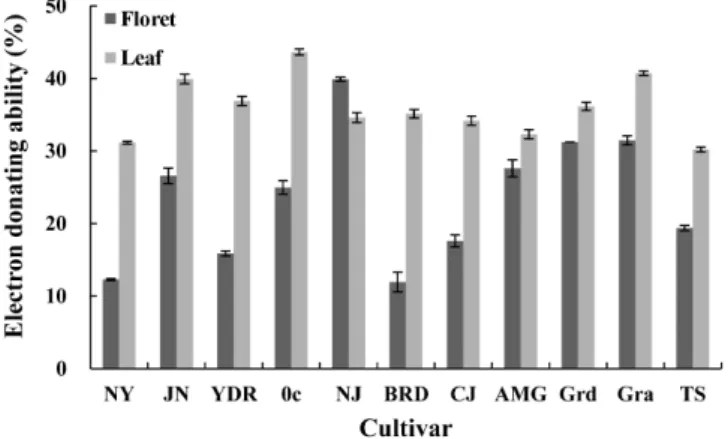
전자공여능(EDA, %) 측정에 사용된 DPPH는 비교적 안 정한 free radical로서 아스코르빈산, 토코페롤, 방향족 아민 류 등에 의해 환원되어 짙은 자색이 탈색됨으로써 전자공 여능의 차이 측정이 가능하여 항산화 효과를 평가하는데 많이 이용되고 있다(Shin et al., 2008). 브로콜리 품종 및 부위별 DPPH 라디칼 소거활성을 측정한 결과는 Fig. 2와 같다. 품종별로 살펴보면 화뢰 추출물은 NJ 품종이 39.90%, 잎 추출물은 0c 품종이 43.64%로 가장 높은 항산화 활성을 보였으며, 부위별 평균값은 화뢰 추출물 23.53%, 잎 추출물 35.91%를 나타내어 잎 추출물의 항산화 효과가 약 1.5배 높 음을 볼 수 있었다. NJ 품종을 제외하고 모든 품종에서 잎 추출물의 전자공여능이 화뢰 추출물보다 높은 값을 나타내 었다.
Jaiswal et al.(2011)은 브로콜리와 york cabbage, 백색 양 배추, brussel sprouts의 배추과 작물과의 항산화 효과를 비
A B
S. aureus L. monocytogenes
C D
E. coli O157:H7 S. enteritidis
Fig. 1. Antimicrobial activities of the methanol extract of different cultivars and parts of broccoli against pathogenic bacteria.
A, cultivar NY; B, cultivar CJ; C, cultivar JN; D, cultivar YDR.
교한 결과, 브로콜리 추출물이 가장 높은 항산화 효과가 있 음을 보고하였고, Kim et al.(1999)의 연구에서 케일 및 브로 콜리 잎즙의 Vitamin C 함량을 비교한 결과, 케일에는 101 mg%이었는데, 브로콜리 잎 8품종 모두 125-179mg%로 케 일보다 많았다는 연구 결과가 있다.
이상의 결과를 종합해 볼 때, NJ 품종의 화뢰 추출물이 L. monocytogenes, S. enteritidis에 대해 가장 높은 항균활 성을 나타내었으며, 항산화 활성도 가장 뛰어남으로 항균, 항산화 효과를 가진 기능성 품종으로 판매 가능할 것으로 여겨졌다. 부위별 차이를 살펴보면, 품종마다 차이를 보이 지만 잎 추출물이 화뢰 추출물보다 L. monocytogenes, S.
enteritidis에 대해 높은 항균활성을 보였다. 항산화 효과 역 시 잎 추출물의 전자공여능이 화뢰 추출물보다 약 1.5배 높
음을 알 수 있었다. 이를 통해 브로콜리의 화뢰뿐만 아니라 잎의 항균력, 항산화 효과 또한 뛰어남을 알 수 있었고, 이 는 현재 버려지고 있는 브로콜리 잎을 쌈채 혹은 녹즙으로 식용함으로써 국민의 보건 향상은 물론, 농가의 새로운 부 수입원으로서 소득 증대에 기여 가능 할 것으로 기대된다.
더불어 이러한 신속, 간편 항균력 측정법과 항산화능 측정 법은 기능성 브로콜리 품종 육성에 있어 대량의 후보 계통 중, 유망 계통만의 신속 선발에도 큰 도움이 될 것으로 판단 된다.
초 록
본 연구에서는 브로콜리 품종 및 부위에 따른 항균활성
Fig. 2. Electron donating ability in the methanol extract of different cultivars and parts of broccoli. Values are mean
± standard deviation of triplicate experiments.
및 항산화 효과를 조사하였다. 브로콜리 11개 품종에 대해 그람 양성균 Staphylococcus aureus, Listeria monocytogenes 2종과 그람 음성균 Escherichia coli O157:H7, Salmonella enteritidis 2종에 대한 항균활성을 조사한 결과, S. aureus에 대해 AMG 품종의 화뢰 추출물이 12.83mm, 잎 추출물 13.00 mm로 가장 높은 항균활성을 보였으나 부위별로는 큰 차이 를 보이지 않았다. L. monocytogenes의 경우, 화뢰 추출물은 NJ 품종이 13.58mm, 잎 추출물은 YDR 품종이 13.92mm로 가장 큰 항균활성을 보였으며, 저해환의 평균값이 화뢰는 12.85mm, 잎은 13.17mm로 다른 4종의 균 중에서 가장 높 은 값을 보였다. E. coli O157:H7에 대해서는 Grd 품종의 화뢰와 잎 추출물 모두 가장 높은 항균활성을 보였으나, 부 위별로는 차이가 나타나지 않았으며, S. enteritidis는 화뢰 추출물은 NJ 품종이 12.67mm, 잎 추출물은 NY, 0c 품종이 12.75mm의 저해환을 보였으며, 잎 추출물이 화뢰 추출물에 비해 높은 항균활성을 보여주었다. 품종별 항산화 효과를 살펴보면, 화뢰 추출물은 NJ 품종이 39.90%, 잎 추출물은 0c 품종이 43.64%로 가장 높았으며, 부위별 평균값은 화뢰 추출물 23.35%, 잎 추출물 35.91%를 나타내어 잎 추출물의 항산화 효과가 약 1.5배 높게 나타났다. NJ 품종을 제외하고 모든 품종에서 잎 추출물의 전자공여능이 화뢰 추출물보다 높은 값을 나타내었다.
추가 주요어 : Brassica oleracea var. italica, DPPH, Escherichia coli O157:H7, Listeria monocytogenes, Salmonella enteritidis, Staphylococcus aureus