• 검색 결과가 없습니다.

Anisotropic Acorn-like Particle Fabrication Via a Dynamic Phase Separation Method

N/A
N/A
Protected

Academic year: 2021

Share "Anisotropic Acorn-like Particle Fabrication Via a Dynamic Phase Separation Method"

Copied!
5
0
0

로드 중.... (전체 텍스트 보기)

전체 글

(1)

DOI: https://doi.org/10.14579/MEMBRANE_JOURNAL.2019.29.1.61

1. Introduction 1)

Polymeric nano-/microparticles have been widely stud- ied in a variety of fields such as electronics, drug de- livery, fluids with respect to the size[1-3]. With the ad-

ditional functions, many groups have tried to create core/shell as well as Janus particles with more attrac- tive physical properties[4]. Thus, if advanced functional structures in particle morphology/structure can be found, novel physical properties could be unveiled for the next

Corresponding author(e-mail: [email protected], http://orcid.org/0000-0001-6676-5549)

동적 상분리법을 이용한 이방성 도토리형상 입자 제조

박 철 호*,†

⋅백 일 현**

*한국에너지기술연구원 제주글로벌연구센터, **한국에너지기술연구원 온실가스연구실 (2019년 2월 12일 접수, 2019년 2월 26일 수정, 2019년 2월 26일 채택)

Anisotropic Acorn-like Particle Fabrication Via a Dynamic Phase Separation Method

Chul Ho Park*

,†

and Il-hyun Baek**

*Jeju Global Research Center (JGRC), Korea Institute of Energy Research (KIER), 200, Haemajihaean-ro, Gujwa-eup, Jeju Specific Self-Governing Province 63357, South Korea

**Green gas Research centerKorea Institute of Energy Research (KIER), 152, Gajeong-ro, Yeseong-gu, Daejeon 34129, South Korea

(Received February 12, 2019, Revised February 26, 2019, Accepted February 26, 2019)

요 약: 이방성 입자는 독특한 물리적 특성 때문에 다양한 분야에서 발표되고 있다. 여기서, 이방성 도토리구조 나노 입자 를 제조하기 위해 새로운 동적 상분리 방법이 도입된다. 동적 상분리 방법은 용제 증발 및 무용제에 의한 침전으로 구성된다.

하부층은 비용매 희석제로서 물을 공급함으로써 제어되며, 상부층의 상분리는 휘발성 용매의 확산 및 증발에 의존한다. 이 상 태에서, 도토리 형 입자가 제조되었다. 물이 채워진 밀폐된 상자(자발적 상분리)하에서, 단분산 폴리스틸렌 입자가 합성되었 다. 동적 상분리와 자발적 상분리가 공존할 때, 캡과 입자의 크기가 변경되었다. 또한, 폴리스틸렌 용액의 부피는 입자 형상에 영향을 미친다. 독특한 구조가 다양한 응용 분야에 활용될 수 있기 때문에 멤브레인 기반의 제어된 물 공급과 같은 첨단 기 술이 개발되면 단분산의 도토리와 같은 입자가 제조될 수 있을 것이다.

Abstract: Anisotropic particles have been issued in various fields due to their unique physical properties. Herein, a novel dynamic phase separation method (DPS) is introduced to fabricate anisotropic acorn-like nanoparticles. DPS consists of two dynamic conditions; solvent evaporation and nonsolvent induced precipitation. The bottom layer is controlled by feeding the water as a non-solvent diluent, and the phase separation of the upper layer relies on the diffusion and evaporation of a volatile good solvent. At this condition, the acorn-like particles were fabricated. Under a closed box filled with water (spontaneous phase separation), monodisperse polystyrene (PS) particles were synthesized. At the coexistence between DPS and spontaneous phase separation, the sizes of cap and particle were changed. Also, the volume of PS solutions influences on the particle shape. Since the unique structures could be utilized into various applications, if advanced techniques such as membrane-based controlled water feeding is developed, monodisperse acorn-like particles could be tuned.

Keywords: anisotropic particle, acorn-like particle, phase separation, polystyrene

(2)

generation of functional materials[5]. Recently, those particles were used for precise pore size membrane.

For example, Qiugen et al. reported the free-standing nanoporous membrane using PS nanoparticles[6]. The nanoparticles could be used for pore formation agents after removal so that it could be also microfiltration membrane[7]. When Breath-Figure method is combined with assembly nanoparticles, three-dimensional inherent membrane can be synthesized[8]. Those intrinsic unique structure could be used as supports for interfacial poly- merization[9-12].

Traditionally, methods for fabricating polymeric par- ticles could be subdivided into two groups: top-down and bottom-up methods. The bottom-up method (e.g., emulsion and suspension polymerization) is generally selected to synthesize narrow size distribution in the nano-size[13]. However, it might have some drawbacks in terms of the kind of the polymer (limited selection in the monomers). Top-down methods can be relatively simply achieved by preparing polymer solutions with good solvents, based on its phase diagram. Thus, it holds great potential for commercialization[14].

To induce the phase separation for nucleation/growth, there are two major methods; precipitation methods through miscible non-solvent additions and evaporation method of atomized droplets. Typically, spraying meth- ods is preferentially considered for particle generation because the method is simple and cost-efficient. Also, interesting particle structures (e.g. torus, hollow, or core/

shell) can be generated by controlling the consolidation mechanism with complicated evaporation of good sol- vents on/in the size-restricted droplets[15].

In other methods, polymers are prepared with good solvents at a certain concentration at the first stage. And then, the solution is dropped into a non-solvent[16]. If the composition ratios of three components passes beyond a binodal point (at a certain critical concent- ration) in phase diagram, the polymeric chains are aggregated (nucleation step) and then polymer chains in the thermal fluctuation attaches and grows on the nuclear (growth step). Typically, it is difficult to well control the kinetic aspect because of fast mixing rate

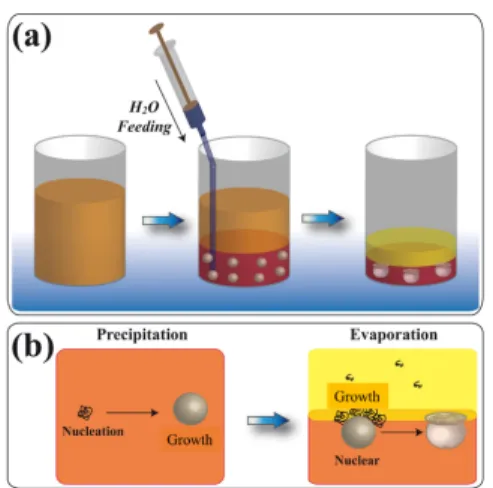
Fig. 1. Schematic illustration of a dynamic phase separa- tion method.

between the good solvent and poor-solvent. Recently, as one of the developed method to solve the limitation, Shimomura et al. reported an improved method to syn- thesize monodisperse nano-/microparticles[17]. Further- more, as controlling both kinetic and thermodynamic aspect, they produced various interesting structures such as stacked lamellar, onion, Janus and core/shell struc- tures, which is called the phase-separated technology [17-19].

Thus, current developed methods provide us some of ideas how to create novel functional particles. Herein, we introduce the novel combination method, which is referred as to a novel dynamic phase separation meth- od (DPS) as shown in Fig. 1.

The polymeric solutions with organic good solvents

have density lower than water density of 1 kg/m

3

. Let’s

consider the precipitation method. When the miscible

non-solvent is added into the polymer solution, it is

diffused and polymer chains are aggregated at a certain

critical concentration. However, we can observe a lay-

ered structure anywhere when a solvent with different

density is very carefully pumped on/under a solution

without any vigorous stirring. Thus, a heavier miscible

non-solvent is pumped into a polymer solution, we can

introduce separated two layers and the polymer particle

might be generated at the bottom layer. The particles

hold specific ability to stabilize the interface[20]. In

other hands, synthesized particles might move into the

(3)

interface between different density layers, and then the diffusion rate is probably decreased. At this time, if there is no any external energy to mix the solution, the two layers might be stable even though a non-solvent is miscible. After that, if a non-solvent have volatile properties, we can expect the phase-separated methods as introduced by Shimomura group[17-19]. Thus, as controlling the kinetic of the upper layer as well as the precipitation at the bottom layer, various structures could be produced. Therefore, this study is to prove the possibility of our suggestion for the next generation of functional material as a simple process to be comm- ercialized.

2. Experimental

As one of a model polymer, polystyrene (PS, Mw = 350,000 g/mol, PDI = 1.05) was purchased from Sigma- Aldrich (USA). Tetrahydrofuran (THF) as a HPLC grade was received from J.T. Baker (Germany). The second distilled water was used as a miscible non-solvent. The polymer was dissolved with THF at 0.1 wt%.

For very careful feeding, a KD100 science pump (KDS Science Co.) was used at a proper feeding rate to generate the two-layered structure. The stainless steel nozzle (I.D. = 0.2 mm, O.D. = 0.41 mm, Ban Seok, South Korea) was connect to the syringe (5 mL, Becton, Dickinson and Company, USA), and the tip was lo- cated the bottom of a container (1 × 1 × 4, W × L × H cm

3

) with 2 mL of polymer solutions. To control the evaporation rate of THF, the ambient temperature was controlled in a home-made closed box at 25°C.

After the feeding of distilled water at various feed- ing speed, the container was deposited for 24 hours to remove the volatile solvent of THF. Synthesized par- ticles were collected on the slide glass and dried in the vacuum oven at an ambient temperature ( ~ 25°C).

The scanning electron microscopy (SEM) images of the particles were obtained using S-4800 (Hitachi, Japan) at 4 kV. All the samples were sputter-coated with plat- inum (Pt) at 3 nm thickness.

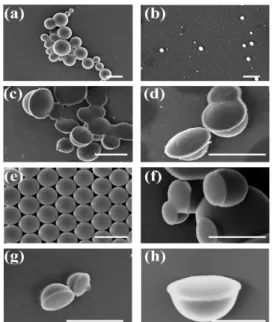
Fig. 2. SEM images of PS particles produced (a) at the feeding rate (5 mL/h) with vigorous stirring (b) at the feeding rate (0.04 mL/h) with vigorous stirring into 2 mL PS solution, (c), (d) at the slower feeding rate (0.04 mL/h) without vigorous stirring into 2 mL PS solution, (e) in a home-made closed box with external water environment, (f) at feeding rate (0.04 mL/h) and in a home-made closed box into 2 mL PS solution, (g) at feeding rate (0.04 mL/h) and in a home-made closed box into 1.5 mL PS solution, and (h) at feeding rate (0.04 mL/h) and in a home-made closed box into 1 mL PS solution. The scale bar respond to 500 nm.

3. Results and discussion

One of the simplest methods to generate polymeric particles is the precipitation methods using a non-sol- vent based on a phase diagram. The conventional meth- od is relatively well described in previous results[16].

The current results also show the similar trend that the

feeding of non-solvent water for PS can induce the nu-

clear at a certain critical concentration and generate

particles. The nucleation relies on the feeding rate be-

cause of unsteady-state non-equilibrium. In other hands,

the number of nuclear might increase with increase the

feeding rate so that the particle size can be controlled

by the feeding rate. At the relatively fast feeding rate

(5 mL/h) with vigorous stirring, the particle size is

about 400 nm (Fig. 2(a)). However, at the slower feed-

(4)

ing rate (0.04 mL/h), the particle size is below 100 nm (Fig. 2(b)).

As mentioned before, if the non-solvent is feed into the good solvent under different density without any external energy to mix, the nucleation/growth at the mixing bottom layer might be produced. Herein, 0.1 mL of non-solvent water (0.04 mL/h) was inserted at the bottom. At that time, the Brownian diffusion was observed. Especially, the bottom layer became clear.

During feeding, the reactor was under an open system.

Thus, THF was evaporated continuously at a certain rate. After 24 hours, almost particles wear the caps as shown in Fig. 2(c, d).

The results give us more questions if the evaporation is well controlled as suggested by Shimomura. Without water feeding, the THF solution was exposed in a home-made closed box with external water environment.

This system might be a good well-controlled condition for the fabrication of the homogeneous particle because THF can be diffused into external water, and gaseous water can also be diffused into PS solution. Similar to Shimomura, PS particles ( ~ 250 nm) have homogeneous size distribution as shown in Fig. 2(e). Thus, our sys- tem can be combined with Shimomura method. The water-feed solution was combined with the home-made closed box. When non-solvent water (0.04 mL/h) was feed into PS solution, the particle size (Fig. 2(f)) is larger and the cap size is smaller than PS particle pro- duced as Fig. 2(c, d). When the volume of PS solution was reduced up 1.5 mL, the PS particles (Fig. 2(g)) have oval structure with cap. When the volume of PS sol- ution (Fig. 2(h)) was reduced up to 1 mL, the PS par- ticle has hemisphere structure with cap.

Unfortunately, we could not supply the clearly de- tailed explanation about the dynamic phase separation mechanism that combines between evaporation and precipitate phase separation. However, we could sug- gest a possible mechanism; PS particles produced in the bottom layer are floated around the interface be- cause an absorbed good solvent (tetrahydrofuran) re- duces the density of particles. Therefore, PS particles act as the nuclear. Herein, the PS particles do not have

any Brownian motion and PS chains could not diffuse into bottom layer. From this interesting phenomenon, the secondary PS chains are growing on the PS par- ticles existing at the interface zone.

The structures of synthesized PS particles are un- doubtedly very unique. There are many chance to ob- serve and tune the structure. For example, if the water semipermeable membrane is assembled into the dynam- ic phase separation mechanism instead of needle feed- ing, we could expect to produce the homogeneous and monodisperse capped particles. Also, a certain material is simultaneously feed with water, the composite par- ticles can be synthesized.

4. Conclusion

This study exhibit how to produce asymmetric poly- meric particles via dynamic phase separation mechanism.

When the non-solvent water vapor is supplied into PS solutions, the particles has monodisperse shape. When the non-solvent water is supplied into PS solutions through needles at a certain feeding rate, the PS par- ticles wear the cap. When the size of cap seem to be reduced. More interestingly, as reducing the volume of PS solutions, the structure of PS particles change into semi-sphere.

Acknowledgements

This work was conducted under the Research and Development Program of the Korea Institute of Energy Research (KIER) (B9-244-01).

Reference

1. H. Yue and G. Ma, “Polymeric micro/nanoparticles:

Particle design and potential vaccine delivery ap- plications”, Vaccine, 33, 5927 (2015).

2. G. Paramasivam, N. Kayambu, A. M. Rabel, A. K.

Sundramoorthy, and A. Sundaramurthy, “Anisotropic

noble metal nanoparticles: Synthesis, surface func-

tionalization and applications in biosensing, bio-

(5)

imaging, drug delivery and theranostics“, Acta Biomaterialia, 49, 45 (2017).

3. L. C. Bradley, W.-H. Chen, and D. Lee, in Anisotropic Particle Assemblies, N. Wu, D. Lee, and A. Striolo, Eds., Elsevier, Amsterdam, 201-231 (2018).

4. R. Deng, S. Liu, F. Liang, K. Wang, J. Zhu, and Z. Yang, “Polymeric janus particles with hierarchical structures”, Macromolecules, 47, 3701 (2014).

5. C. H. Park, N.-o. Chung, and J. Lee, “Monodisperse red blood cell-like particles via consolidation of charged droplets”, J. Coll. Interf. Sci., 361, 423 (2011).

6. Q. Zhang, S. Ghosh, S. Samitsu, X. Peng, and I.

Ichinose, “Ultrathin freestanding nanoporous mem- branes prepared from polystyrene nanoparticles”, J.

Mater. Chem., 21, 1684 (2011).

7. W. J. Stark, P. R. Stoessel, W. Wohlleben, and A.

Hafner, “Industrial applications of nanoparticles”, Chem. Soc. Rev., 44, 5793 (2015).

8. S. Chen, S. Gao, J. Jing, and Q. Lu, “Designing 3D biological surfaces via the breath-figure meth- od”, Adv. Health. Mat., 7, 1701043 (2018).

9. P. Marchetti, M. Mechelhoff, and A. G. Livingston,

“Tunable-porosity membranes from discrete nano- particles”, Sci. Reports, 5, 17353 (2015).

10. P. Chul Ho, “Change of surface morphology with the spreading rate of organic solution during inter- facial polymerization for polyamide-based thin film composite membrane manufacturing process”, Membr.

J., 27, 506 (2017).

11. C. H. Park, H. Bae, W. Choi, K. Lee, D.-g. Oh, J.

Lee, and J.-H. Lee, “Thin film composite mem- brane prepared by interfacial polymerization as an ion exchange membrane for salinity gradient pow- er”, J. Indus. Eng. Chem., 59, 362 (2018).

12. C. H. Park, H. Bae, S. J. Kwak, M. S. Jang, J.-H.

Lee, and J. Lee, “Interconnection of electrospun nanofibers via a post co-solvent treatment and its

open pore size effect on pressure-retarded osmosis performance”, Macromol. Res., 24, 314 (2016).

13. I. Lesov, Z. Valkova, E. Vassileva, G. S. Georgiev, K. Ruseva, M. Simeonov, S. Tcholakova, N. D.

Denkov, and S. K. Smoukov, “Bottom-up synthesis of polymeric micro- and nanoparticles with regular anisotropic shapes”, Macromol., 51, 7456 (2018).

14. T. J. Merkel, K. P. Herlihy, J. Nunes, R. M. Orgel, J. P. Rolland, and J. M. DeSimone, “Scalable, shape-specific, top-down fabrication methods for the synthesis of engineered colloidal particles”, Langmuir, 26, 13086 (2010).

15. C. H. Park and J. Lee, “Electrosprayed polymer particles: Effect of the solvent properties”, J. Appl.

Poly. Sci., 114, 430 (2009).

16. A. G. Luque-Alcaraz, J. Lizardi-Mendoza, F. M.

Goycoolea, I. Higuera-Ciapara, and W. Argüelles- Monal, “Preparation of chitosan nanoparticles by nanoprecipitation and their ability as a drug nano- carrier”, RSC Adv., 6, 59250 (2016).

17. H. Yabu, T. Higuchi, K. Ijiro, and M. Shimomura,

“Spontaneous formation of polymer nanoparticles by good-solvent evaporation as a nonequilibrium proc- ess”, Chaos: An Interdisciplinary J. Nonlinear Sci.,

15, 047505 (2005).

18. H. Yabu, M. Kanahara, M. Shimomura, T. Arita, K.

Harano, E. Nakamura, T. Higuchi, and H. Jinnai,

“Polymer janus particles containing block-copoly- mer stabilized magnetic nanoparticles”, ACS Appl.

Material. & Interf., 5, 3262 (2013).

19. T. Higuchi, A. Tajima, H. Yabu, and M. Shimomura,

“Spontaneous formation of polymer nanoparticles with inner micro-phase separation structures”, Soft Matter, 4, 1302 (2008).

20. M. Cui, T. Emrick, and T. P. Russell, “Stabilizing

liquid drops in nonequilibrium shapes by the inter-

facial jamming of nanoparticles”, Science, 342, 460

(2013).

수치

Fig. 1. Schematic illustration of a dynamic phase separa- separa-tion method.
Fig. 2. SEM images of PS particles produced (a) at the  feeding rate (5 mL/h) with vigorous stirring (b) at the  feeding rate (0.04 mL/h) with vigorous stirring into 2 mL  PS solution, (c), (d) at the slower feeding rate (0.04 mL/h) without vigorous stirri

참조

관련 문서

Different composition between parent and product (Ex. The growth of the B-rich phase into the A-rich α-phase) Growth of the new phase will require long-range diffusion

• Mechanism of boundary layer growth on a smooth flat plate - Boundary layer flow: laminar → transition → turbulent - Velocity of the fluid particle at the body wall is

[r]

Because the free surface and interface are out of phase, between them a quasi- bottom exists where there is no vertical flow.. The LHS and RHS are imaginary

 The simplest method of storing a raster layer in the memory of the computer is using a data structure called an array..  We consider alternative methods for searching through

출처 : IAEA 발표 자료(Comprehensive inspection exercise at bulk handling facilities, “U-235 Enrichment measurements by gamma-ray spectroscopy”) 13.  Uranium

▪ This equation provides a handy rule of thumb for estimating the thickness of a diffusion layer (e.g., how far product molecules have moved, on the average, from an electrode

The feed is commonly a solution in a solvent like ethanol or t-butanol, and the nonsolvent is water..