Vol. 19, No. 7 pp. 207-213, 2018
우리나라 중 ·고등학생의 다문화 수용성에 영향을 미치는 요인에 관한 체계적 문헌고찰
차슬기1, 변해원2*
1
호남대학교 대학원 재활과학과 언어치료전공
2
호남대학교 보건과학대학 언어치료학과
A Systematic Review on Factors Influencing Multicultural Acceptance in Korean Adolescents
Seulki Cha
1, Haewon Byeon
2*1
Department of Rehabilitation, Graduate School, Honam University
2
Department of Speech Language Pathology, Honam University
요 약 청소년들의 다문화 수용성을 증가시키기 위해서는 일반 청소년들의 다문화 인식 개선 교육이 필요하며, 이를 위해서 는 다문화 수용성에 영향을 미치는 요인에 대한 파악이 필요하다. 본 연구는 우리나라 청소년의 다문화 수용성에 영향을 미치는 요인에 관한 연구 동향을 체계적으로 분석하여 청소년들의 다문화 수용성 증진을 위한 향후 연구에 기초자료를 제공 하였다. 2008년부터 2017년까지 ‘다문화’, ‘수용성’, ‘청소년’, ‘중학생’, ‘고등학생’ 키워드를 조합하여 검색된 6,435건의 논문 중 영향요인을 분석한 종적연구 6편을 분석하였다. 논문의 질적 평가는 미국 질병관리센터의 Community Guide와 STROBE 의 질적 평가 기준을 참고하였다. 연구 결과 개인요인에서 성별, 해외방문경험, 삶의 만족도, 가정요인에서 부모의 양육방식 중 방임과 학대, 부모의 학력, 학교 및 지역사회요인에서 교우관계, 교사관계, 지역사회 관계, 공동체의식이 다문화 수용성에 영향을 미치는 요인으로 조사되었다. 청소년의 다문화 수용성은 일부 요인에만 영향을 받지 않으며 개인, 가정, 학교, 지역사 회와 같은 여러 요인에 영향을 받으며 이러한 영향 요인은 학년이 바뀌면서 함께 변화하는 것으로 확인되었다. 따라서 본 연구 결과를 기초로 학년별 영향요인을 파악하여 다문화 수용성을 증진시킬 수 있는 환경조성과 교육의 지원이 요구된다.
Abstract To increase the acceptance of multicultural youth, it is necessary to grasp the factors influencing multicultural acceptance. This study was conducted to provide basic data for a future study for the promotion of multicultural acceptance of adolescents by systematically analyzing research trends in factors affecting the multicultural acceptance of Korean adolescents. From 2008 to 2017, we searched 6,435 papers combining the keywords 'multicultural,''acceptability,' 'teenager,''middle school' and 'high school,' and analyzed six articles. The qualitative evaluation refers to Community Guide and STrengthening the Reporting of OBservational studies in Epidemiology(STROBE). The results revealed that factors influencing multicultural acceptance include gender, experience of overseas visits, life satisfaction, parental neglect and abuse, parent education, school and community factors, and community awareness. Multicultural acceptance of adolescents in Korea was influenced not only by specific factors, but also by various factors such as individual, family, school, and community. These factors were also found to change with age. Based on the results of this study, it is necessary to provide an environment and education that promote multicultural acceptance.
Keywords : Multiculture, Acceptability, Multicultural education, Adolescent, Qualitative evaluation
*
Corresponding Author : Haewon Byeon(Honam Univ.) Tel: +82-62-940-5521 email: [email protected]
Received April 24, 2018 Revised (1st May 21, 2018, 2nd May 25, 2018)
Accepted July 6, 2018 Published July 31, 2018
1. 서론
세계화가 진행되면서 우리나라도 외국인 이민자가 증 가하고 있는 추세이다. 출입국‧외국인정책본부에 따르 면 체류 외국인은 2013년 1,576,034명에서 2016년 2,049,441명으로 급증하였으며[1] 결혼이민자 또한 2013년 150,865명에서 2016년 152,374명으로 증가하였 다[1].
국내 외국인 이민자가 증가하면서 외국인 등록 청소 년을 포함한 다문화 가정 청소년도 증가하고 있다. 2013 년55,780명이었던 다문화가정 청소년은 2016년 99,186 명으로 증가하였으며2016년도는 전년대비 20.2% 증가 한 것으로 확인되었다[2].
이처럼 현대 사회에서 다문화 가정 청소년의 증가는 불가피한 사항이 되었지만 아직까지 다문화 가정 청소년 들은 학교 내에서 차별을 경험한 것으로 조사되었다 [3,4]. 선행연구에서는 다문화 가정 청소년의 20.8%는 차별을 경험하였으며 출신국이나 외모에 따라 차별경험 이 달라지는 것으로 조사되었다[5].
이러한 차별 경험은 다문화 청소년의 학교생활에도 부정적인 영향을 미친다. 선행연구에 따르면 친구들과의 관계가 긍정적일수록 학교 부적응이 줄어드는 것을 확인 할 수 있었다[6].
다문화 가정 청소년이 겪는 갈등을 해결하기 위해 현 재 우리나라 정부에서는 다문화 인식 개선에 대한 대상 별 교육을 실시하고 있다. 그 중에서도 특히 청소년기는 가치관을 형성하게 되는 시기로 다문화와 관련된 교육을 통해 올바른 다문화에 대한 가치관을 형성할 필요가 있 다. 선행연구에 따르면 다문화 교육을 경험한 일반 청소 년은 다문화 수용성의 유의미한 정적 영향력을 보이는 것으로 밝혀졌다[7]. 이는 청소년들의 다문화 수용성을 증가시키기 위해 다문화 학생의 한국사회 적응 프로그램 지원뿐만 아니라 일반 청소년들의 다문화 인식 개선 교 육이 필요함을 시사한다. 또한 교육뿐만 아니라 청소년 들의 다문화 수용성에 직·간접적으로 영향을 미치는 요 인들을 파악하여 다문화의 수용적 태도를 함양할 수 있 도록 지속적인 연구 또한 필요하다. 선행연구는 대부분 한국 아동청소년패널조사(Korean Children & Youth Panel Survey)를 이용하였기 때문에 다문화 수용성과 관 련된 요인이 제한적이고 중복적이라는 한계를 지닌다.
따라서 본 연구에서는 우리나라 청소년의 다문화 수
용성에 영향을 미치는 요인에 대한 연구 동향을 체계적 으로 분석하여 청소년들의 다문화 수용성 증진을 위한 기초자료를 제공하였다.
2. 연구방법
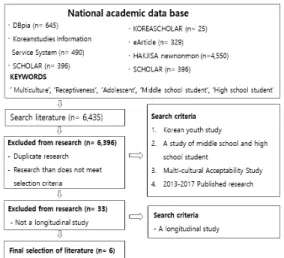
2008년부터 2017년까지 지난 10년간 발표된 우리나 라 청소년의 다문화 수용성에 영향을 미치는 요인에 관 한 문헌을 선정하여 체계적 문헌고찰을 실시하였다. 국내 학술데이터베이스인DBpia, Koreanstudies, Information Service System, 스콜라, 코리아 스칼라, 학술교육원, 학 지사 뉴논문을 통해 문헌 검색을 실시하였다. 문헌 검색 시‘다문화’, ‘수용성’, ‘청소년’, ‘중학생’, ‘고등학생’ 5 개의 주요단어를 선정한 후‘다문화’ and '수용성‘ and ' 청소년’ or ‘중학생’ or ‘고등학생’로 조합하여 검색을 실시한 결과 6,435편의 문헌이 검색되었다. 분석 대상 문헌의 선정 기준은 다음과 같다. 첫째, 한국 청소년을 대상으로 진행한 연구, 둘째, 청소년 중 중학생과 고등학 생을 포함한 연구, 셋째, 다문화 수용성에 영향을 미치는 요인을 파악한 종단연구 세 가지 기준이 포함되어야 한 다. 선정 기준에 따라 일차적으로 논문 제목과 초록을 검 토하였으며 이차적으로 논문 내용을 검토하여 대상자 또 는 주제를 포함하지 않은 논문, 중복된 논문, 석사‧박사 학위논문을 제외하였다. 총 검색된 논문 6,435건 중 기 준에 충족되지 않은 논문을 제외한 6편의 논문이 분석 대상 논문으로 선정되었다[Fig 1].
Fig. 1. Flow Chart of Six Selected Papers for Analysis
6편의 논문의 질적 평가는 미국 질병관리센터의 Community Guide와 STrengthening the Reporting of OBservational studies in Epidemiology(STROBE)의 질 적 평가[8] 기준을 참고하였다[Table 1].
Contents Has selection bias been minimized?
1. Sample selection
1. random participants, selected population 2. random sample, representative, general
population 2. Study
population 1. community based, 2.institutionalized Is the sample size sufficient?
3. Sample size 1. <500, 2.
≥500, 3.
≥1000 Was follow-up for final outcomes adequate?
4. Follow-up rate 0. Not marked 1. 70-79%, 2. 80%
5. Follow-up
period 1.
≥2y;, 2.
≥3y;. 3.
≥4y Has measurement bias been minimized?
6. Outcome 1. self-reported, 2. objctive measures 7. Predictor 1. self-reported, 2. objctive measures
Has confounding been avioded?
8. Confounders
1. demographics only 2. Compensation to other potential
confusions variables Table 1. Category of Quality evaluation standards
3. 결과
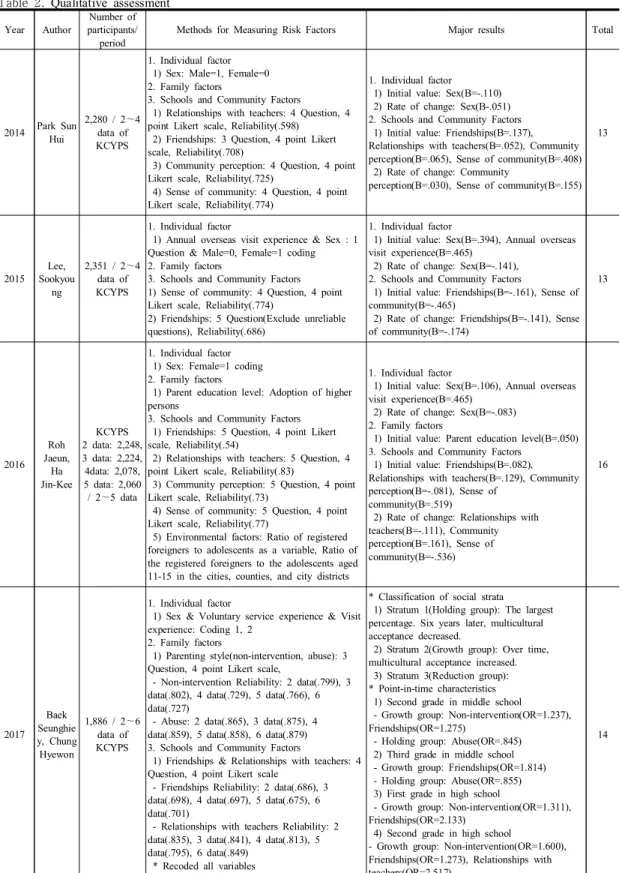
우리나라의 청소년 다문화 수용성에 영향을 미치는 요인을 파악하기 위하여6편의 논문을 분석한 결과 개인 요인, 가정요인, 학교 및 지역사회요인으로 분류할 수 있 었다. 각 요인별 구체적 결과는 아래 결과에 제시하였으 며 분석 대상 연구에서 혼란변수는 모든 요인을 포함하 고 있으므로 모든 변수를 보정하였다. 분석된 논문의 질 적 평가는Table 2에 제시하였다.
3.1 개인요인
우리나라 청소년의 다문화 수용성에 영향을 미치는 개인요인은 성별, 해외방문경험, 삶의 만족도 3가지 하 위요인으로 분류되었다. 성별은 3편의 연구에서 초기와 변화율에 모두 유의미한 영향력을 보이는 것으로 조사되 었다[9,10,11]. 해외방문경험은 1편의 연구에서 초기에 만 영향력을 보였으며[10]계층과 학년을 통해 분석한 연구에서 유지집단계층에 속하면서 고등학교 2학년인 대상자에게 영향력을 보이는 것으로 밝혀졌다[4]. 삶의
만족도는1편의 연구에서 중학교 1학년에게만 영향력을 보였다[13].
3.2 가정요인
우리나라 청소년의 다문화 수용성에 영향을 미치는 가정요인은 부모의 양육방식(방임‧학대), 부모의 학력 2 가지 하위요인으로 분류되었다.
부모의 양육방식 중 방임은 계층과 학년을 통해 분석 한 연구에서 증가집단계층에 속한 중학교2학년, 고등학 교1학년, 2학년, 3학년의 다문화 수용성에 영향력을 보 이는 논문1편과 4개의 잠재집단과 학년을 통해 분석한 연구에서 최저-증가 잠재집단에 속한 중학교 1학년에 영 향을 미치는 논문1편으로 2편의 논문에서 영향력을 보 이는 것으로 조사되었다. 부모의 양육방식 중 학대는 계 층과 학년을 통해 분석한 연구1편에서 유지집단계층에 속한 중학교2학년, 3학년에 영향력을 보였다[12]. 부모 의 학력은1편의 연구에서 다문화 수용성의 초기에만 영 향력을 보이는 것으로 밝혀졌다[11].
3.3 학교요인 및 지역사회요인
우리나라 청소년의 다문화 수용성에 영향을 미치는 학교 및 지역사회 요인에서 학교요인은 교사관계와 교우 관계, 지역사회요인에서는 지역사회관계와 공동체의식 으로 각2개의 요인이 영향력을 보이는 것으로 밝혀졌다.
학교요인에서 교사관계는4편의 연구가 다문화 수용 성에 영향력을 보이는 것으로 확인되었다. 초기에만 영 향력을 보이는 연구1편[9], 초기와 변화율에 모두 영향 력을 보이는 연구1편[11], 4개의 잠재집단과 학년을 통 해 분석한 연구에서 최저-증가 잠재집단에 속한 중학교 3학년에 영향력을 보이는 연구 1편[14]이었으며 계층과 학년을 통해 분석한 연구에서 증가집단계층에 속한 고등 학교2학년, 유지집단에 속한 고등학교 3학년에 영향력 을 보이는1편의 연구가 조사되었다[12]. 교우관계는 초 기에만 영향력을 보이는 연구2편[9,11]과 초기와 변화 율에 모두 영향력을 미치는 연구 1편[10], 계층과 학년 을 통해 분석한1편의 연구에서 증가집단계층에 속한 중 학교2학년, 3학년, 고등학교 1학년, 2학년, 3학년 모든 학년에 영향력을 보였다[12].
지역사회요인에서 지역사회관계는4편의 연구 중 초 기와 변화율에 모두 영향력을 보이는 연구2편[9,11], 중 학교1학년과 3학년에 영향력을 보이는 연구 1편이 조
Table 2. Qualitative assessment Year Author
Number of participants/
period
Methods for Measuring Risk Factors Major results Total
2014 Park Sun Hui
2,280 / 2〜4 data of KCYPS
1. Individual factor 1) Sex: Male=1, Female=0 2. Family factors
3. Schools and Community Factors
1) Relationships with teachers: 4 Question, 4 point Likert scale, Reliability(.598)
2) Friendships: 3 Question, 4 point Likert scale, Reliability(.708)
3) Community perception: 4 Question, 4 point Likert scale, Reliability(.725)
4) Sense of community: 4 Question, 4 point Likert scale, Reliability(.774)
1. Individual factor 1) Initial value: Sex(B=-.110) 2) Rate of change: Sex(B-.051) 2. Schools and Community Factors
1) Initial value: Friendships(B=.137), Relationships with teachers(B=.052), Community perception(B=.065), Sense of community(B=.408)
2) Rate of change: Community
perception(B=.030), Sense of community(B=.155) 13
2015 Lee, Sookyou
ng
2,351 / 2〜4 data of KCYPS
1. Individual factor
1) Annual overseas visit experience & Sex : 1 Question & Male=0, Female=1 coding 2. Family factors
3. Schools and Community Factors 1) Sense of community: 4 Question, 4 point Likert scale, Reliability(.774)
2) Friendships: 5 Question(Exclude unreliable questions), Reliability(.686)
1. Individual factor
1) Initial value: Sex(B=.394), Annual overseas visit experience(B=.465)
2) Rate of change: Sex(B=-.141), 2. Schools and Community Factors
1) Initial value: Friendships(B=-.161), Sense of community(B=-.465)
2) Rate of change: Friendships(B=-.141), Sense of community(B=-.174)
13
2016 Roh Jaeun,
Ha Jin-Kee
KCYPS 2 data: 2,248, 3 data: 2,224, 4data: 2,078, 5 data: 2,060 / 2〜5 data
1. Individual factor 1) Sex: Female=1 coding 2. Family factors
1) Parent education level: Adoption of higher persons
3. Schools and Community Factors 1) Friendships: 5 Question, 4 point Likert scale, Reliability(.54)
2) Relationships with teachers: 5 Question, 4 point Likert scale, Reliability(.83)
3) Community perception: 5 Question, 4 point Likert scale, Reliability(.73)
4) Sense of community: 5 Question, 4 point Likert scale, Reliability(.77)
5) Environmental factors: Ratio of registered foreigners to adolescents as a variable, Ratio of the registered foreigners to the adolescents aged 11-15 in the cities, counties, and city districts
1. Individual factor
1) Initial value: Sex(B=.106), Annual overseas visit experience(B=.465)
2) Rate of change: Sex(B=-.083) 2. Family factors
1) Initial value: Parent education level(B=.050) 3. Schools and Community Factors
1) Initial value: Friendships(B=.082), Relationships with teachers(B=.129), Community perception(B=-.081), Sense of
community(B=.519)
2) Rate of change: Relationships with teachers(B=-.111), Community perception(B=.161), Sense of community(B=-.536)
16
2017 Baek Seunghie y, Chung
Hyewon
1,886 / 2〜6 data of KCYPS
1. Individual factor
1) Sex & Voluntary service experience & Visit experience: Coding 1, 2
2. Family factors
1) Parenting style(non-intervention, abuse): 3 Question, 4 point Likert scale,
- Non-intervention Reliability: 2 data(.799), 3 data(.802), 4 data(.729), 5 data(.766), 6 data(.727)
- Abuse: 2 data(.865), 3 data(.875), 4 data(.859), 5 data(.858), 6 data(.879) 3. Schools and Community Factors
1) Friendships & Relationships with teachers: 4 Question, 4 point Likert scale
- Friendships Reliability: 2 data(.686), 3 data(.698), 4 data(.697), 5 data(.675), 6 data(.701)
- Relationships with teachers Reliability: 2 data(.835), 3 data(.841), 4 data(.813), 5 data(.795), 6 data(.849)
* Recoded all variables
* Classification of social strata
1) Stratum 1(Holding group): The largest percentage. Six years later, multicultural acceptance decreased.
2) Stratum 2(Growth group): Over time, multicultural acceptance increased.
3) Stratum 3(Reduction group):
* Point-in-time characteristics 1) Second grade in middle school
- Growth group: Non-intervention(OR=1.237), Friendships(OR=1.275)
- Holding group: Abuse(OR=.845) 2) Third grade in middle school - Growth group: Friendships(OR=1.814) - Holding group: Abuse(OR=.855) 3) First grade in high school
- Growth group: Non-intervention(OR=1.311), Friendships(OR=2.133)
4) Second grade in high school
- Growth group: Non-intervention(OR=1.600), Friendships(OR=1.273), Relationships with teachers(OR=2.517)
14
- Holding group: Overseas visit experience(OR=.664)
5) Third grade in high school
- Growth group: Non-intervention(OR=1.742), Friendships(OR=4.195),
- Holding group: Relationships with teachers(OR=.613)
2017 Lee, Sookyou ng, Lee, Yeong-Ju
2,339 / 2, 4, 6 data of
KCYPS
1. Individual factor 1) Sex: Male, Female
2) Satisfaction in life: 3 Question, 4 stage scale, Reliability: First grade in middle school(.837), Third grade in middle school(.823)
3) Self-respection: 10 Question, 4 stage scale, Reliability: First grade in middle school(.838), Third grade in middle school(.839)
4) Visit Overseas Experience: Yes / No 2. Family factors
1) Friend preference of parents: 4 stage scale 2) Brother or sister: Yes / No
3) Father's level of education: Final academic background: 5 stage scale
4) Mother's educational level: Final academic background: 5 stage scale
5) Household income: Yearly household income: Subjective item
3. Schools and Community Factors 1) Friendships: 5 Question, 4 stage scale, Reliability: First grade in middle school(.612), Third grade in middle school(.655)
2) Peer attachment(communication): 3 Question, 4 stage scale, Reliability: First grade in middle school(.812), Third grade in middle school(.807) 3) Peer attachment(trust): 3 Question, 4 stage scale, Reliability: First grade in middle school(.843), Third grade in middle school(.830)
4) Peer attachment(alienation): 3 Question, 4 stage scale, Reliability: First grade in middle school(.740), Third grade in middle school(.757)
5) Community perception: 6 Question, 4 stage scale, Reliability: First grade in middle school(.741), Third grade in middle school(.755)
6) Sense of community: 4 Question, 4 stage scale, Reliability: First grade in middle school(.802), Third grade in middle school(.783)
1. Individual factor
1) First grade in middle school: Satisfaction in life(=10.092)
2) Third grade in middle school 2. Schools and Community Factors
1) First grade in middle school: Sense of community(=105.016), Community perception(=4.024))
2) Third grade in middle school: Sense of community(=87.602), Community perception(=4.450)
13
2017 Jeon, HyeonJe
ong, Chung, HyeWon
2,378 / 2〜6 data of KCYPS
1. Individual factor
1) Sex: Male=0, Female=1 coding 2) Self-respection: 5 Question, 4 point Likert scale, Reliability(.801)
2. Family factors
1) Parenting style(non-intervention, abuse): 4 Question, 4 point Likert scale
- Non-intervention Reliability(.769), Abuse Reliability(.809)
3. Schools and Community Factors 1) School life(Friendships, Learning activity, Relationships with teachers, School rules)
- Friendships: 4 Question, 4 point Likert scale, Reliability(.705)
- Learning activity: 4 Question, 4 point Likert scale, Reliability(.727)
- Relationships with teachers: 5 Question, 4 point Likert scale, Reliability(.858)
- School rules: 5 Question, 4 point Likert scale, Reliability(.784)
2) Peer attachment: 6 Question, 4 point Likert scale, Reliability(.893)
* Recoded all variables
* Analyze through two types of opposing groups among the four potential groups of multicultural acceptability (lowest-increase,
high-middle-maintain, moderate-increase, highest-decrease)
1. Family factors
1) Lowest-increase group: First grade in middle school(Non-intervention: =-.181)
2. Schools and Community Factors 1) Lowest-increase group: Third grade in middle school(Relationships with teachers:
=.210)
14
사되었다[13]. 공동체의식은 4편의 연구에서 영향력을 보이는 것으로 밝혀졌으며 이 중에서3편의 연구는 초기 와 변화율에 모두 영향력을 보였으며1편의 연구에서 중 학교1학년과 3학년에 영향력을 보이는 것으로 조사되 었다[13]. 보였으며 1편의 연구에서 중학교 1학년과 3학 년에 영향력을 보이는 것으로 조사되었다[13].
4. 논의 및 결론
우리나라 청소년의 다문화 수용성에 영향을 미치는 요인에 관한 종단연구6편을 분석한 결과 성별, 교우관 계, 교사관계, 지역사회관계, 공동체의식이 주요 영향요 인으로 분류되었다. 그 중에서도 교사관계와 공동체의식 이 가장 많은 연구에서 청소년의 다문화 수용성에 영향 을 미치는 요인으로 확인되었다. 청소년기에 접어들면서 가정보다 학교에서 지내는 시간이 길어진다. 뿐만 아니 라 부모의 역할을 대신하는 교사와 긍정적 관계 형성과 지지는 청소년의 긍정적인 가치관 형성에 도움을 주며 이는 나아가 다문화 수용성에도 영향을 미치는 것으로 예상할 수 있다. 또한 개인이 중심이 되어 생활하던 유 년기와 달리 청소년기는 학교에서 서로 다른 가치관을 가진 친구들과 관계를 맺으며 공동체 의식을 형성하게 된다. 이러한 공동체의식은 다문화 수용성의 초기와 변 화율에 모두 영향을 미치는 것으로 확인되었다[9, 10, 11]. 즉, 공동체 의식이 긍정적으로 형성된 경우 다문화 수용성에 정적인 영향력을 이끌어 낼 수 있을 것으로 판 단할 수 있다. 교사관계와 공동체 의식 모두 청소년의 학 교생활에서 형성될 수 있는 가치관으로 학교생활을 통해 다문화 수용성을 증진시킬 수 있도록 학교 내 공동체 의 식 증진 활동 프로그램의 지원이 필요하다.
대부분 청소년의 다문화 수용성을 증진시키기 위한 과제는 주로 학교생활에 초점을 두고 진행되었다. 그러 나 본 연구 결과를 통해 청소년의 다문화 수용성은 학교 뿐만 아니라 개인, 가정, 지역사회 등 다양한 환경에 영 향을 받는 것으로 확인되었다. 따라서 청소년의 다문화 관련 교육을 지원할 때는 학교생활뿐만 아니라 청소년들 의 개인, 가정, 지역사회 요인 등 여러 환경적 요인을 포 괄적으로 고려한 교육 및 참여 활동을 개발해야 할 것이다. 마지막으로 청소년의 다문화 수용성에 영향을 미치는 요인들은 학년에 따라 변화하는 것으로 확인할 수 있었
다. 이는 청소년기 다문화 수용성은 일부 요인에 지속적 으로 영향을 받지 않으며 연령이 증가함에 따라 영향을 받는 요인이 변화하는 것으로 볼 수 있다. 따라서 대상자 들에 대한 종단연구를 통해 청소년들의 다문화 수용성에 영향을 미치는 학년별 요인이 무엇인지 확인하고 어떻게 변화하는지에 대한 연구가 필요할 것이다.
본 연구는 추적 연구를 통해 청소년의 연령에 따른 다 문화 수용의 영향 요인에 대한 변화 양상을 파악할 수 있다는 의의를 가진다. 연구의 제한점은 첫째, 분석된 종 적 연구의 대상자가 특정패널조사에 국한되었다. 이는 패널조사에 참여하지 않은 대상자의 다문화 수용성을 파 악하기 어렵다는 제한점이 있다. 따라서 참여 대상자의 범위를 확대하여 패널조사를 진행할 필요가 있다. .둘째, 다문화 수용성의 영향 요인을 탐색한 대부분의 국내 종 적 연구들은 대부분 잠재성장모형을 이용하였다. 잠재성 장모형은 개인들의 공통적인 변화 패턴을 가정했기 때문 에 정성적이고 이질적일 수 있는 개인의 다문화 수용성 에 관한 변화를 해석하기에 부적합할 수 있다. 셋째, 본 연구에서 조사된 영향요인 외에도 다문화 수용성과 관련 된 잠재적 영향요인이 존재할 가능성이 있다. 본 연구 결 과를 통해 확인할 수 있듯이 다문화 수용성은 일부 요인 에만 영향을 받지 않기 때문에 추적조사를 통해 청소년 들의 다문화 수용성 변화 양상을 확인해야 한다.
본 연구에서 도출된 다문화 수용성 영향요인을 기초 로 향후 우리나라 청소년의 다문화 수용성을 증진시키기 위한 방안의 모색이 필요하다.
References
[1] Ministry of Justice, Korea Immigrarion Service Statistics 2016, pp. 38-55, Ministry of Justice, 2017.
[2] Statistics Korea, Ministry of Gender Equality and Family, 2017 Youth statistics, pp. 14, Statistics Korea, Ministry of Gender Equality and Family, 2017.
[3] Ministry of Gender Equality and Family, The National Survey of Multicultural Families 2015, pp. 460-469, Ministry of Gender Equality and Family, 2016.
[4] A. L. LEE, “A Study on the application of multicultural policies in Korea, Japan and violence in school maladjustment solution of multicultural families", Korean Journal of Qualitative Research in Social Welfare, vol. 9, no. 2 pp.111-142, September, 2015.
[5] K. S. Jun, M. K. Song, “A Research on the Differences
of Adjustment Level by Multicultural Children`s
Nationality", Korean Journal of Youth Studies, vol. 18,
no. 11 pp. 305-330, November, 2011.
[6] D. H. Jang, H. S. Shin, “The Environmental Factors on the School Maladjustment of Children from Multicultural Families", Korean Journal of Youth Studies, vol. 17, no. 3 pp, 123-147, March, 2010.
[7] S. W. Chung, J. C. Jung, “The Effects of Multicultural Educational Experience and Social Distance on the Multicultural Acceptance of Adolescents", Multicultural Education Studies, vol. 5, no. 1 pp. 51-68, June, 2012.
[8] Centers for Disease Control and Prevention, STROBE Statement, Centers for Disease Control and Prevention, 2007.
[9] S. H. Park, “A longitudinal analysis on multicultural perception of young people using Latent Growth Model", Multiculturalism and Human, vol. 3, no. 2 pp.
99-131, December, 2014.
[10] S. K. Lee, “Longitudinal Changes and Determinants of Adolescents` Acceptability toward Multiculture", Korean Journal of Youth Studies, vol. 22, no. 10 pp. 27-48, October, 2015.
[11] J. Roh, J. K. Ha, “The Factor of Longitudinal Change in Adolescents’ Multicultural Acceptance - The Use of Latent Growth Modeling", Culture technology research institute, vol. 21, pp. 243-270, April, 2016.
[12] S. Baek, H. Chung, “The developmental trajectories of multicultural acceptance and the changing community spirit as determined by means of growth mixture modeling", Studies on Korean Youth, vol. 28, no. 1 pp.
151-182, February, 2017.
DOI: https://doi.org/10.14816/sky.2017.28.1.151 [13] S. K. Lee, Y. J. Lee, “An Analysis of Annual Changes
on the Determining Factors Multicultural Acceptability for Using Data Mining", Korean Journal of Youth Studies, vol. 24, no. 4 pp. 1-26, April, 2017.
[14] H. J. Jeon, H. W, Chung. “Relationship between the Latent Class of Community Spirit and Multicultural Acceptance using the Sequential Process Growth Mixture Model" The Journal of Learner-Centered Curriculum and Instruction, vol. 17, no. 9 pp. 335-360, May, 2017.
DOI: https://doi.org/10.22251/jlcci.2017.17.9.335
차 슬 기(Seulki Cha) [정회원]
•2013년 2월 : 대림대학교 언어재활
과 (언어치료학사)
•2017년 9월 ~ 현재 : 호남대학교 대학원 재활과학과 언어치료전공 석사
<관심분야>
노년기 의사소통장애, 체계적 문헌고찰, 메타연구
변 해 원(Haewon Byeon) [종신회원]