Print ISSN: 2288-4637 / Online ISSN 2288-4645 doi:10.13106/jafeb.2021.vol8.no2.0475
Customer Engagement with Digital Social Responsibility in Social Media:
A Case Study of COVID-19 Situation in Thailand
Wilert PURIWAT
1, Suchart TRIPOPSAKUL
2Received: November 05, 2020 Revised: December 30, 2020 Accepted: January 08, 2021
Abstract
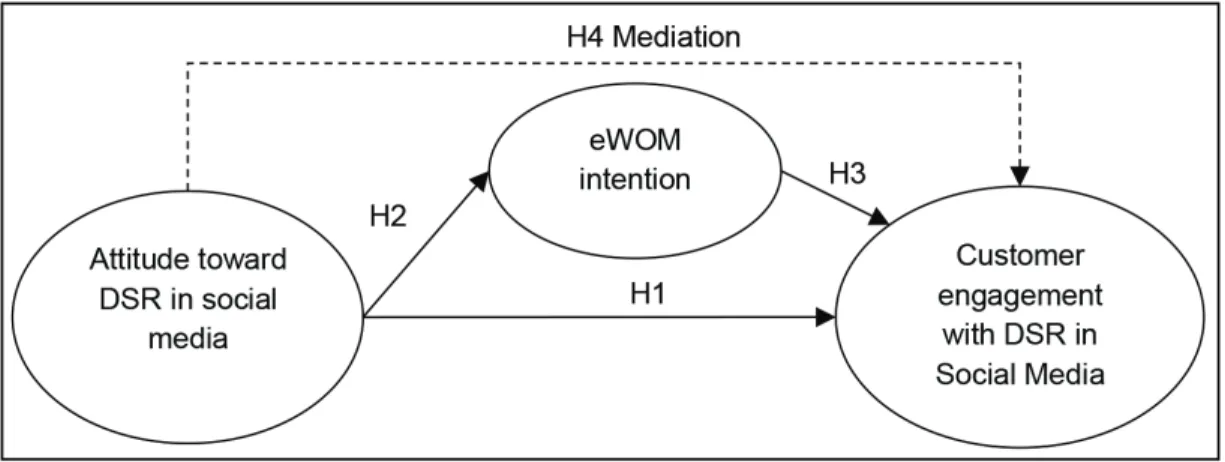
COVID-19 pandemic has affected the lives of people and has forced businesses to develop different ways of doing businesses. Several businesses have implemented social responsibility activities. With social distancing keeping many people at home, online and digital platforms have become one of the most important mechanisms for businesses undertakings and implementing those social responsibility initiatives and activities – digital social responsibility (DSR). The purpose of this study is to examine the relationships of electronic word- of-mouth (eWOM) intentions and customer engagement with DSR in social media with attitude toward DSR as the antecedent during COVID-19 social distancing situation in Thailand. The study employs a quantitative research method where sampling method is followed by convenience sampling technique, and study data is collected through survey questionnaire with social media users who have experiences with firms’ online social responsibility initiatives. Based the samples of 123 respondents, Structural Equation Modelling (SEM) has been used for analysis. The results show that attitudes toward DSR in social media significantly influence electronic word-of-mouth (eWOM) intentions and have a significant effect on customer engagement with DSR in social media. The mediation analysis also revealed that eWOM intention partially mediated the relation between attitudes toward DSR in social media and customer engagement.
Keywords: Digital Social Responsibility, Customer Engagement, Electronic Word-Of-Mouth (eWOM), COVID-19, Thailand JEL Classification Code: M10, M14, M31, M37
browsing has increased by 70%, followed by TV viewing increasing by 63% and social media engagement increasing by 61% over normal usage rates. As a result of social distancing, lockdown, and curfew in some countries, people spend more of their time using social media. WhatsApp has seen a 51% increase in usage. Facebook usage has increased 37%. And, China experienced a 58% increase in usage of local social media apps including Wechat and Weibo (Kantar, 2020). In Thailand, during the COVID-19 crisis, use of LINE Call has increased 236% while LINE VDO Call use has increased 270%. Moreover, LINE Call via PC increased 264% in March (Bangkokpost, 2020).
Several businesses and brands were stepping up to take part in the relief effort. And consumers also expected some actions and communications form those businesses and brands. Based on the survey of 1,000 consumers on March, 2020 by 4A’s Research Company (Pelosi & Calabrese, 2020), 43% of survey respondents said it is reassuring to hear from brands they know and trust, whereas 40% want to hear what brands are doing in response to the COVID-19 pandemic. Only 15% said they do not want to hear from brands at this time. This survey result showed consumers
1
First Author. Associate Professor, Chulalongkorn Business School, Chulalongkorn University, Thailand. Email: [email protected]
2
Corresponding Author. Assistant Professor, School of Entrepreneurship and Management, Bangkok University, Thailand [Postal Address: 119 Rama 4 Road, Klong-Toei, Bangkok 10110, Thailand] Email: [email protected]
© Copyright: The Author(s)
This is an Open Access article distributed under the terms of the Creative Commons Attribution Non-Commercial License (https://creativecommons.org/licenses/by-nc/4.0/) which permits unrestricted non-commercial use, distribution, and reproduction in any medium, provided the original work is properly cited.