Print ISSN: 2288-4637 / Online ISSN 2288-4645 doi:10.13106/jafeb.2021.vol8.no1.927
The Effect of Product Knowledge and Service Quality on Customer Satisfaction
Salim AL IDRUS
1, Abdussakir ABDUSSAKIR
2, Muhammad DJAKFAR
3, Shofiyah AL IDRUS
4Received: September 30, 2020 Revised: November 30, 2020 Accepted: December 14, 2020
Abstract
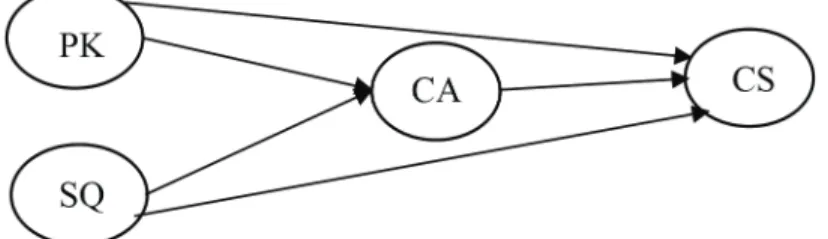
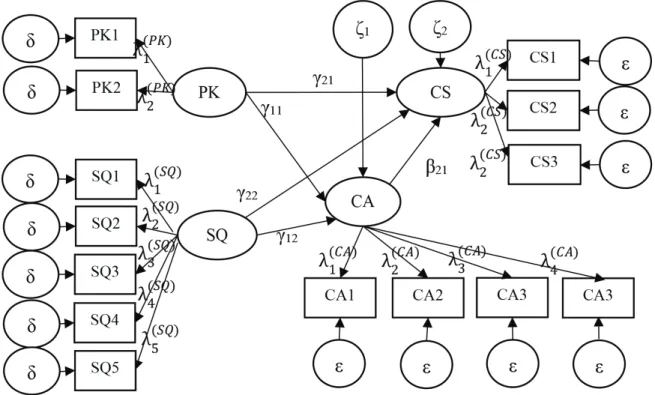
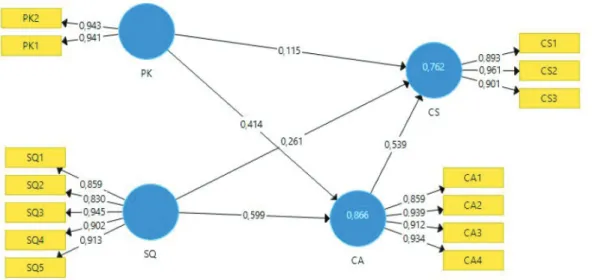
Small and Medium Enterprises (SMEs) is one of several activators that drives the economy of Indonesia because SMEs provide jobs, increase Gross Domestic Product (GDP), and assure the delivery of products and services. However, Indonesian SMEs are not very competitive in the industrial world, and one of the causes is the low quality of products that undermine customer satisfaction. There are several factors presumed as influencing customer satisfaction, which among others include product knowledge, service quality, and competitive advantage. The objective of this research is to reveal the contribution of product knowledge and service quality to customer satisfaction with competitive advantage as the mediation variable. This research used a quantitative approach. The causal relationship across variables was examined with Structural Equation Modeling-Partial Least Squares (SEM-PLS). The sample of this research involved 140 respondents. Data was collected through a questionnaire and the items in the questionnaire were processed with a software called SmartPLS version 3.3.2. Results of this research indicate (1) product knowledge and service quality can increase competitive advantage and customer satisfaction in East Java SMEs; (2) competitive advantage can act as a mediator in the effect of service quality on customer satisfaction (3) product knowledge can increase customer satisfaction but the increase is not significant statistically.
Keywords: Product Knowledge, Service Quality, Customer Satisfaction, Competitive Advantage, Small and Medium Enterprises JEL Classification Code: A12, A2, B16, B21, P13
Yanah et al., 2018). The presence of SMEs can accelerate economic growth because SMEs provide jobs, increase Gross Domestic Product (GDP), and assure the delivery of products and services (Lapian, 2018; Tobing et al., 2018).
Therefore, as one of the vital objects that drive Indonesia’s economy, SMEs have absorbed more than 70% of workers in Indonesia (Ratnawati, 2020).
However, Indonesian SMEs are not competitive in the industrial world, and one of the causes is the poor quality of SMEs’ products, which make those products overpowered by the products from large industry (Rahadi, 2016; Sudarmiatin, 2016). The consequence of less competitive products is that customers are no longer satisfied with the enterprises (Lekhanya & Dlamini, 2017; Tulung et al., 2017).
Customer satisfaction is one factor that determines business performance (Naveed et al., 2017). Customers who are satisfied with the company will be loyal and willing to contribute to the long-term profitability of the company (Azigwe et al., 2016). Current profits are usually used to reduce production costs, and in the future, low-cost production can deliver more profits (Gure & Karugu, 2018).
Production financing structure at SMEs must always be
1
First Author and Corresponding Author. Lecturer, Department of Management, Faculty of Economics, Universitas Islam Negeri Maulana Malik Ibrahim Malang, Indonesia [Postal Address: Jl.
Gajayana 50 Kota Malang, Jawa Timur, 65144, Indonesia]
Email: [email protected]
2
Lecturer, Department of Mathematics Education, Faculty of Teacher Training and Education, Universitas Islam Negeri Maulana Malik Ibrahim Malang, Indonesia. Email: [email protected]
3
Lecturer, Department of Management, Faculty of Economics, Universitas Islam Negeri Maulana Malik Ibrahim Malang, Indonesia.
Email: [email protected]
4
Lecturer, Department of Electrical Engineering, Faculty of Informatics Engineering Education, Universitas Negeri Malang, Indonesia. Email: [email protected]
© Copyright: The Author(s)
This is an Open Access article distributed under the terms of the Creative Commons Attribution Non-Commercial License (https://creativecommons.org/licenses/by-nc/4.0/) which permits unrestricted non-commercial use, distribution, and reproduction in any medium, provided the original work is properly cited.