Print ISSN: 2288-4637 / Online ISSN 2288-4645 doi:10.13106/jafeb.2020.vol7.no8.395
1
First Author. Senior Lecturer, Former Vice Rector, National Economics University, Vietnam. E-mail: [email protected]
2
Corresponding Author. Lecturer, National Economics University, Vietnam [Postal Address: No. 207 Giai Phong Street, Dong Tam Ward, Hai Ba Trung District, Hanoi, 10000, Vietnam]
3
Associate Professor, National Economics University, Vietnam.
4
Dean of Banking, Finance and Business Administration Department, Quy Nhon University, Vietnam.
© Copyright: The Author(s)
This is an Open Access article distributed under the terms of the Creative Commons Attribution
Non-Commercial License (http://Creativecommons.org/licenses/by-nc/4.0/) which permits
unrestricted noncommercial use, distribution, and reproduction in any medium, provided the
original work is properly cited.
Impact of Service Quality, Customer Satisfaction and Switching Costs on Customer Loyalty
Do Thanh NGUYEN
1, Van Thanh PHAM
2, Dung Manh TRAN
3, Duyen Bich T. PHAM
4
Received: May 13, 2020 Revised: June 14, 2020 Accepted: July 09, 2020
Abstract
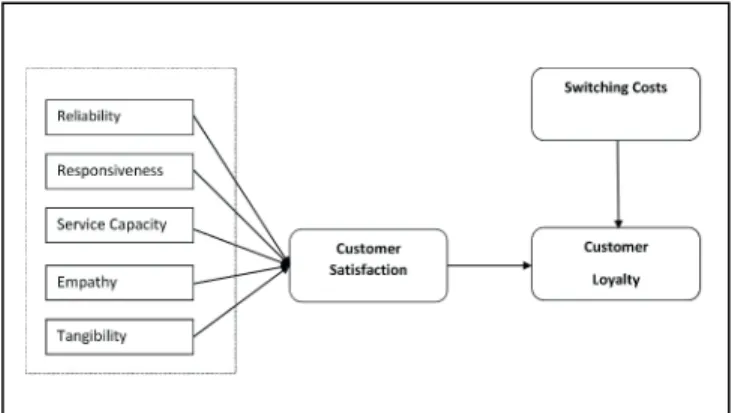
This study examines the relationships and the impacts of service quality, customer satisfaction and switching costs on customer loyalty of e-banking in commercial banks. This study uses questionnaires with 7-point Likert scale to collect data from 227 e-banking users, who are mainly students and paid employees in Hanoi City, Vietnam. The collected data are analyzed by using multivariate linear regression method.
The results show that all five factors of service quality in e-banking – reliability, responsiveness, service capacity, empathy and tangibility – have positive correlations with customer satisfaction. Among these determinants, service capacity and tangibility have the strongest impact.
It means that, by increasing the quality of their services through five above factors, especially through improving capacity and tangibility, commercial banks can satisfy their customer better. In addition, customer satisfaction is strongly and positively correlated to customer loyalty. It means that, if customers are satisfied with e-banking services of one bank, they not only continue to do more businesses with this bank, but also recommend this bank to other people. Lastly, customer loyalty also has a strong and positive correlation with switching costs, which means customers tend to be loyal to one bank if the barriers to switching banks increase.
Keywords: E-banking, Customer Loyalty, Customer Satisfaction, Service Quality JEL Classification Code: M10, M15, G21, N25
1. Introduction
Today, information technology has become one of the most important drivers of economy development. It has profoundly transformed many sectors of the economy and created hypercompetitive markets. In many industries,
like banking, the power has migrated from the producers and sellers to customers who can define what they want in terms of specific goods and services, prices, distribution channels, and even promotions (Calik & Balta, 2006). As a result, in order to survive and develop in such competitive industry, each bank is not only required to increase their service quality, but also satisfy non-financial needs of the customers to remain their trust and loyalty (Hsu & Nguyen, 2016).
According to Kolodinsky, Hogarth and Hilgert (2004), e-banking includes a wide ranges of different services, such as automatic teller machines (ATMs), direct transaction for bill payment, electronic money transfers, and so on. It is an increasingly important service in bank activities by providing more advantages than traditional bank distribution channels.
E-banking allows customers to access their accounts anytime at anywhere with more complicated transactions, like housing loan, online trading and managing stock investment in a safer, faster and more convenient way.
In Vietnam, the trend of using e-banking services has
a great potential development. According to The World
Factbook, Vietnam ranks 14 out of 20 countries with the