Print ISSN: 2288-4637 / Online ISSN 2288-4645 doi:10.13106/jafeb.2021.vol8.no3.0585
Relationships between Service Quality, Brand Image, Customer Satisfaction, and Customer Loyalty
Sao Mai DAM
1, Tri Cuong DAM
2Received: November 20, 2020 Revised: January 26, 2021 Accepted: February 03, 2021
Abstract
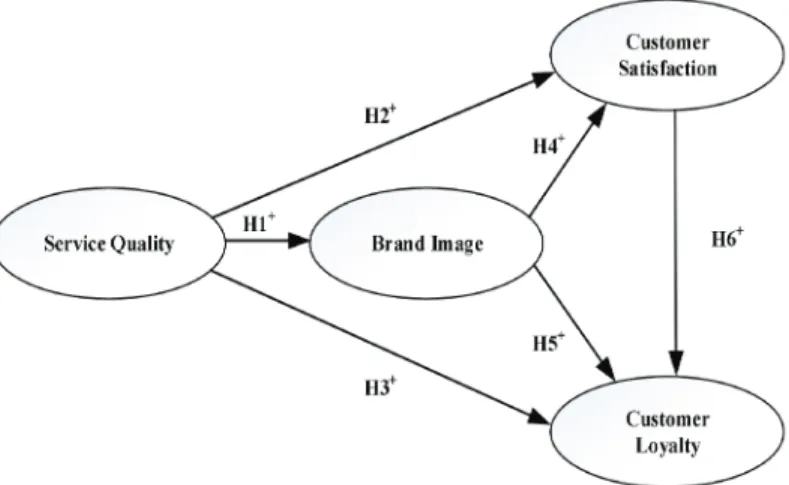
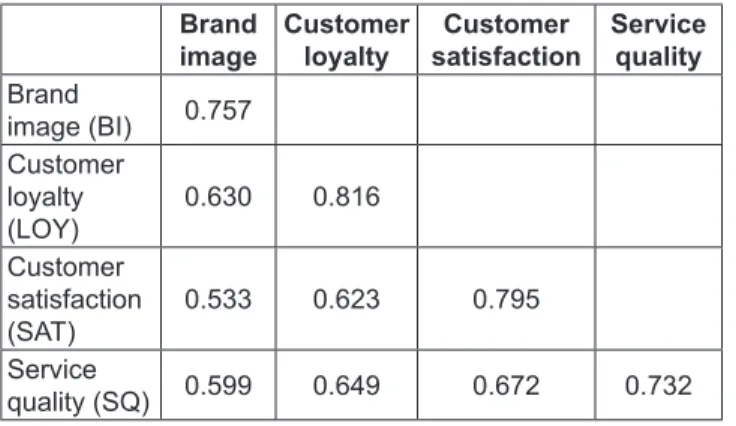
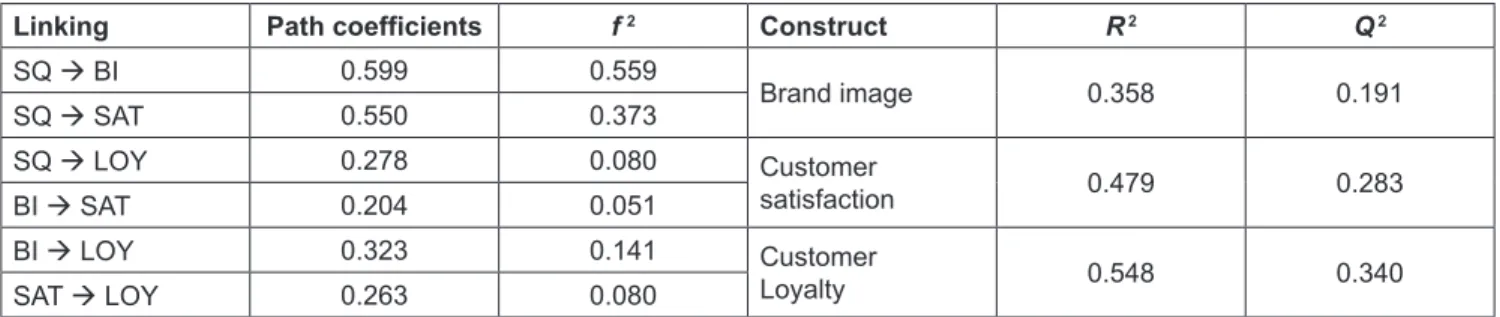
The service industry has become the driving force of economic development in recent years. With the current fierce competitive situation, competing businesses have continually provided a superior quality of service, and an excellent perceived brand image to gain customer satisfaction and customer loyalty. This study’s current purpose is to empirical research the linking between service quality, brand image, customer satisfaction, and customer loyalty. We collect research data from 299 consumers who bought goods at supermarkets in Ho Chi Minh City, Vietnam, using a convenient sampling technique. We proposed the conceptual model from prior studies and considered it in Vietnam’s context. PLS-SEM was conducted to test the relationships in the conceptual model. We have estimated the scale’s reliability by Cronbach’s alpha values and composite reliability values. Moreover, we have evaluated discriminant validity by the Fornell-Larcker standard. The findings showed that service quality positively affects the brand image, customer satisfaction, and customer loyalty. Likewise, the results also confirmed brand image had a positive impact on customer satisfaction and customer loyalty. Moreover, the outcomes also disclosed that customer satisfaction had a positive relationship with customer loyalty. The research suggested implications for managers, limitations, and directions for future research from the above findings.
Keywords: Service Quality, Brand Image, Customer Satisfaction, Customer Loyalty JEL Classification Code: C38, M30, M31, M37
customer satisfaction, and customer loyalty (Srivastava
& Sharma, 2013). Besides, Dick, and Basu (1994) stated that the central drive of a company’s marketing activities was often having a perspective in terms of development, maintenance, or enhancement of clients’ loyalty toward its products/services (Dick & Basu, 1994).
Some studies have demonstrated the significant positive effect of service quality on customer satisfaction and customer loyalty (Anwar et al., 2019; Dimyati & Subagio, 2016; Shpetim, 2012). Related studies have revealed that service quality positively affected the catering services industries (Hsieh et al., 2018) and the hotel industry (Malik et al., 2011). Besides, prior studies also indicated the positive impact of brand image on customer satisfaction and customer loyalty in medical insurance (Wu et al., 2011) and the banking industry (Anwar et al., 2019).
Furthermore, scholars in the retail field also showed that service quality and perceived value were crucial to customer satisfaction (Shpetim, 2012; Veloso et al., 2017).
Likewise, service quality, trust, perceived value, and customer satisfaction affected behavioral intention or store loyalty (Shpetim, 2012; Veloso et al., 2017). However, few
1. Introduction
The service industry has become the driving force of economic development in recent years. With the current fierce competitive situation, competing businesses have continually provided a superior quality of service and an excellent perceived brand image to gain customer satisfaction and customer loyalty. The service industry is even more significant, so practitioners and scholars should attempt to understand how clients perceive service quality, brand image,
1
First Author. Vice Principal, Industrial University of Ho Chi Minh City, Ho Chi Minh City, Vietnam. Email: [email protected]
2
Corresponding Author. Lecturer, Faculty of Business Administration, Industrial University of Ho Chi Minh City, Ho Chi Minh City, Vietnam [Postal Address: 12 Nguyen Van Bao Street, Ward 4, Go Vap District, Ho Chi Minh City, 700000, Vietnam]
Email: [email protected]
© Copyright: The Author(s)
This is an Open Access article distributed under the terms of the Creative Commons Attribution Non-Commercial License (https://creativecommons.org/licenses/by-nc/4.0/) which permits unrestricted non-commercial use, distribution, and reproduction in any medium, provided the original work is properly cited.