Print ISSN: 2288-4637 / Online ISSN 2288-4645 doi:10.13106/jafeb.2021.vol8.no5.0157
The Impact of Green Corporate Identity and Green Personal-Social Identification on Green Business Performance: A Case Study in Thailand
Suraporn ONPUTTHA1, Chalermporn SIRIWICHAI2
Received: January 15, 2021 Revised: March 21, 2021 Accepted: April 01, 2021
Abstract
This study aims to investigate the impact of green corporate identity and employees’ green identification on green business performance of international automobile manufacturers in Thailand. It involves 400 employees from the target study area, using questionnaires to collect data from January to February 2021, with purposive and convenient sampling methods. Data analysis employed structural equation modeling (SEM). The results show that green corporate identity has a significant impact on employees’ green personal-social identification and green business performance; meanwhile, employees’ green social identification has a significant impact on green business performance.
However, employees’ green personal identification has a significant impact on green business performance only through employees’ green social identification. Green corporate identity can increase the corporate’ green business performance via economic, environmental and social aspects through employees’ green personal-social identification. The findings suggest that green corporate communication through visual identity, employee behaviors, culture, policy products and services in response to environmental forces and drivers to create the green corporate identity is deemed to systematically work. Furthermore, the findings also suggest that employees’ green identification on both personal and social levels can be a significant issue that the managers in automobile manufacturers should pay attention as well.
Keywords: Automobile Manufacturers, Business Performance, Green Identification, Thailand JEL Classification Code: M14, M16, M31, Q56
If they cannot achieve these objectives, businesses may not be able to survive and prosper in an era of environment-focused markets. A number of other reasons are driving business entrepreneurs’ recent approaches to green business performance: green business performance itself can significantly and positively improve economic performance, such as increases in revenues and profits (Zampese et al., 2016; Banihashemi et al., 2019); increases in market share and sales growth (Leonidou et al., 2017);
increased organizational competitiveness (Banihashemi et al., 2019); environmental performance, such as improving an organization’s environmental image (Leonidou et al., 2017; Rawashdeh, 2018); better environment-friendly production and processes (Kafa et al., 2013); social performance, such as social satisfaction (Banihashemi et al., 2019); social participation and social collaboration (Kafa et al., 2013); social relationships (Çankaya & Sezen, 2019); and social life-quality matters and social services (Banihashemi et al., 2019; Fernando et al., 2019). If all companies can achieve these aspects of green business performance, they can be continuously sustainable in the market (Chienwattanasook & Jermsittiparsert, 2019).
1 First Author and Corresponding Author. Silpakorn University International College (SUIC), Silpakorn University, Thailand [Postal Address: 72 CAT Tower, 8-9 Floor, Charoen Krung Road, Bangrak, Bangkok 10500, Thailand] Email: [email protected]
2 Silpakorn University International College (SUIC), Silpakorn University, Thailand.
Email: [email protected]; [email protected]
© Copyright: The Author(s)
This is an Open Access article distributed under the terms of the Creative Commons Attribution Non-Commercial License (https://creativecommons.org/licenses/by-nc/4.0/) which permits unrestricted non-commercial use, distribution, and reproduction in any medium, provided the original work is properly cited.
1. Introduction
Achieving green business performance in association
with economic, environmental and social aspects, has
become the goal of various companies and industries
in recent years because they were forced by external
factors such as industrial involvers, competitive pressure,
internationalization, technology innovation, governmental
matters, society, and customers’ changing behaviors relevant
to environmental concerns (Maditati et al., 2018; Alhamali,
2019; Chidchob & Pianthong, 2020; Soewarno et al., 2020).
For these reasons, it is necessary to identify factors that can help bring a step closer and near the green business performance. Various researchers used green business strategies by employing organizational resources and organizational capability as well as green supply chain management and quality management to build companies’
advantages and green business performance (Fonseca &
Jabbour, 2012; Yang et al., 2013; de Sousa Jabbour et al., 2014). Recent researchers recommend using green technology, service innovation, and service innovation capability to create competitive advantage and business sustainability in long-term objectives by employing a resource-based view and a knowledge-based view (Chen et al., 2006; Fernando et al., 2019). Moreover, to allow green innovation to positively link to environmental performance, the green transformational leadership and green human resource management should be considered and managed (Singh et al., 2020). Similarly, Gardazi et al., (2020) additionally advocated that board of directors can have a significant relationship with the commitment to achieve the environment performance.
Another important way to increase the green performance of an organization is through its green corporate identity, which refers to the way the organization attempts to communicate its green commitment in the form of corporate communications, directly and indirectly, to both internal and external stakeholders (Foroudi, 2015; Balmer, 2017).
Accordingly, the organization’s corporate identity can be visualized by all stakeholders by utilizing graphic design, color, symbol, logo and typography through possible ways such as product, location, vehicle, printing and other media channels (Dowling, 1994; Baker & Balmer, 1997;
Melewar, 2003; Tourky, 2013). Moreover, the organization that can respond to external forces and drivers in relation to environmental concerns (Maditati et al., 2018; Alhamali, 2019; Chidchob & Pianthong, 2020), as well as provide green products and service quality (Balmer & Stotvig, 1997; Melewar & Wooldridge, 2001) can be identified as green corporate identity. However, to create green corporate identity, the organization should motivate employees’
environmental behavior related to in-role and extra-role working behaviors (Iqbal et al., 2018; Yang et al., 2019) as well as create corporate culture and policy to guide them for working (Mohamad et al., 2007; Küçükoğlu & Pınar, 2015).
Consequently, it is believed that green corporate identity can create employees’ green personal and social identification and finally create the green business performance, which can, in turn, result in organizational growth, improvements in reputation and international standard acceptance.
This paper, therefore, aims to study the impact of green corporate identity and employees’ identification with the green business performance of international automobile manufacturers. Automobile manufacturers were selected
for study because they have a huge impact on a country’s economy as well as being at the forefront of national trends to be built as the next-generation automotive base oriented for environmental concerns, economic development, and social improvement.
2. Literature Review and Hypothesis 2.1. Green Corporate Identity
Green corporate identity management is based on positively communicating an organization’s management- related environmental concerns to the internal and external stakeholders (Balmer, 1995; Alessandri, 2001; Podnar, 2005;
Balmer, 2017). To identify the greenness of the organization, its green corporate communications need to be considered.
Tourky (2013), Maurya et. al. (2015), Foroudi (2015) and Balmer (2017) suggested that businesses directly and indirectly communicate with their internal and external stakeholders about the environmental concerns, management, and protection in order to better the stakeholder relationship and understanding toward the distinguished identity of the corporate. Visual messaging is another important consideration in terms of presenting green corporate identity through product, location, vehicle, printing, and other media channels to all stakeholders (Dowling, 1994; Baker &
Balmer, 1997; Melewar, 2003; Tourky, 2013) by means of graphic design, color, symbol, logo and typography.
Additionally, the behavior of employees in the organization can also help reflect the environmental management adopted by the organization. Employees’ behavior related to green concepts is dependent on in-role and extra-role working behaviors, presenting corporate’s shared values, culture, structure, and strategy related to environmental concerns, management, and protection (Chun, 1994; Sukortprommee, 2013; Norton et al., 2014; Iqbal et al., 2018; Yang et al., 2019). Literally, Melewar, and Akel (2005), Podnar (2005), and Mohamad et al. (2007) argued that patterns of behavior, achievement and learning in the corporate by the corporate members in the organization can also contribute toward green corporate identity. Policies guiding green management are necessary in order to facilitate employees’ ability to carry out environmental work (Denison & Mishra, 1995; Podnar, 2005; Küçükoğlu, & Pınar, 2015).
Furthermore, Balmer (2017) recommended that analysis
of the business environment can be one of many aspects
representing green corporate identity. Maditati et al. (2018),
Alhamali (2019), and Chidchob and Pianthong (2020)
maintained that external forces concerning the environmental
issues from industrial involvers, internationalization,
technology innovation, governmental matters, and society
require the corporates’ situation confrontation. Moreover,
relevant research stresses that product and service quality
should be an integral part of green corporate identity since this displays the match between the customers’ expectations and perceptions, maintaining customer satisfaction, experience and loyalty through products and services that conserve and protect the environment (Gronroos, 1984; Balmer &
Stotvig, 1997; Melewar & Wooldridge, 2001). This literature review finds that green corporate identity comprises seven dimensions: green corporate communication, green corporate visual identity, green corporate culture, green employee behavior, green policy, green forces and drivers, and green products and service quality. Linked to employees’
identification, the studies by Lassar et al. (1995), Carroll and Ahuvia (2006) and Sukortprommee (2013) found that employees can perceive the explicit and implicit messages given by the corporate and identify themselves in terms of personality, values, attitudes, image and practices, as well as identify themselves to their society in terms of social acceptance, social status and social role.
After employees’ identification in either individual level or social level, employees will then know how to perform a particular task to increase the business competitiveness (Balmer & Gray,1999) and green business performance benefiting organization itself, community and society as well as natural environment (Zhu et al., 2008; Green et. al., 2012; Kafa et. al, 2013; Ngniatedema & Li, 2014;
Zampese et al., 2016; Leonidou et. al., 2017; Banihashemi et al., 2019; Çankaya & Sezen, 2019; Chienwattanasook &
Jermsittiparsert, 2019; Alqirem et al., 2020). Based on this literature review, it can be concluded that green corporate identity is linked to green business performance. Therefore, hypotheses can be constructed as follows:
H1: Green corporate identity has a positive impact on
employees’ green personal identification.H2: Green corporate identity has a positive impact on
employees’ green social identification.H3: Green corporate identity has a positive impact on
green business performance.2.2. Employees’ Green Personal-Social Identification
The concept of employees’ green identification was employed to define the employees’ identification with the green corporate and whether they perceived themselves as ‘green’ in the way the corporate is attempting to achieve. Literally, ‘green employee identification’ refers to individuals’ perception that they are a good fit with an organization and society, meaning that an individual’s personality, values, attitudes, image and practices match with the organization in terms of culture, values, practices and match with society in terms of social acceptance, social
status, social role (Lassar et al., 1995; Carroll & Ahuvia, 2006; Sukortprommee, 2013).
Two sub-dimensions of employees’ green identification – green personal identification and green social identification – are included in this research. ‘Green personal identification’
refers to whether employees feel a sense of belonging to the organization in the way that the organization’s identity and management of environmental awareness and protection match their personality, attitudes, values, and practices (Lassar et al., 1995; Sukortprommee, 2013).
‘Green social identification’ refers to the employees’
expression identifying with the organization’s way of considering environmental awareness, protection and management influence them, in terms of status, role and image, to be matched and accepted by the group of people or society intending to conform the management related to environmental concerns and protection (Carroll & Ahuvia, 2006; Sukortprommee, 2013). Abrams and Hogg (1988) advocated that individuals would look forward to becoming a member of the group when they see something similar matching their characteristics, in line with the study by Ashforth and Mael (1989). Employees can share similarity in the group (Kuenzel & Halliday, 2008; Tafjel, 1981; Turner, 1975). Meanwhile, Turner (1985) indicated that individuals likely viewed themselves as “the interchangeable exemplars of a social category” rather than having unique attributes.
Additionally, social identity is seen as the process that changes personal beliefs and attitudes interactively to inter-group behavior (Turner et al., 1987). Accordingly, through employees’ personal and social identification, they will therefore feel that they can become a citizenship of the organization and after that they will have more commitments and increase their performance to reach the organization objectives and finally link to the business performance with emphasis on economic, environmental and social perspectives. In line with this, it is evidenced by Hermawan et al. (2020) who found that the employees with organizational citizenship behavior can have positive effect on employees’ engagement and employees’ performance, which the organization should highly focus on developing employees’ organizational citizenship behavior. Therefore, it is assumed that employees’ green identification can improve both employee performance and, in turn, green business performance. Accordingly, the hypotheses can be constructed as follows:
H4: Employees’ green personal identification has a
positive impact on employees’ green social identification.H5: Employees’ green personal identification has a
positive impact on green business performance.H6: Employees’ green social identification has a positive
impact on green business performance.3. Research Methodology
The population in this study was approximately 50,000 employees working in international automobile manufacturers, including Asian and European brand-name automobile producers that have international transactions in various countries. The samples were calculated by Krejcie and Morgan (1970) and a sample of 400 employees was chosen for a confidence level of 95%. This 400-sample size was suggested as appropriate by Yuan and Bentler (2000) as well as Savalei and Bentler (2005) who mentioned that there should be at least 400 samples for data analysis via the structural equation model (SEM). The data were collected through questionnaires via purposive sampling method to identify the target samples and followed by convenient sampling method to distribute the questionnaires. The questionnaire was tested by content validity index values and Cronbach’s alpha (Hair, 2006; Polit & Beck, 2006;
Halek et al., 2017; Rodrigues et al., 2017). For data analysis, structural equation modeling (SEM) was employed. The model should align with good-fit indices (Tabachnick &
Fidell, 2007; Hooper et al., 2013). Nevertheless, the modification indices were considered when the model did not fit (Knekta et al., 2019). Finally, the results were presented in tabulated and descriptive forms.
4. Results
4.1. Study of Respondents’ General Information The study found that the respondents were mostly male (265 persons, accounting for 66.3 percent); aged 21–30 (187 persons, accounting for 46.8 percent); bachelor’s degree graduates (251 persons, accounting for 62.8 percent);
working in their organization for 1–5 years (127 persons, accounting for 31.8 percent); working as operational employees (204 persons, accounting for 51.0 percent);
and working in the production department (191 persons, accounting for 47.8 percent).
4.2. Study of Green Corporate Identity, Employees’ Green Identification, and Green Business Performance
Table 1 shows that green corporate communication has the highest mean, followed in order by size of mean by green corporate policy, green corporate culture, green corporate forces and drivers, green corporate products and service, green employee behavior and green corporate visual identity.
Meanwhile, green personal identification yields a higher mean value compared to green social identification. In addition,
Table 1: Study of Green Corporate Identity, Employees’ Green Identification, and Green Business PerformanceItems Skewness Kurtosis Mean S.D. Interpretation
Green Corporate Identity
Green Corporate Communication −0.820 0.783 4.328 0.570 Extremely High
Green Corporate Visual Identity −0.642 0.778 4.077 0.713 High
Green Employee Behavior −0.722 1.392 4.122 0.626 High
Green Corporate Culture −0.656 0.626 4.269 0.645 Extremely High
Green Corporate Policy −0.634 0.536 4.284 0.618 Extremely High
Green Corporate Forces and Drivers −0.451 0.052 4.250 0.629 Extremely High
Green Corporate Products and Service −0.533 0.437 4.203 0.643 Extremely High
Employees’ Green Personal-Social Identification
Green Personal Identification −0.875 2.508 4.033 0.663 High
Green Social Identification −0.424 0.187 3.996 0.691 High
Green Business Performance
Economics Performance −0.366 −0.196 4.154 0.667 High
Environmental Performance −0.653 0.345 4.300 0.612 Extremely High
Social Performance −0.672 0.320 4.290 0.652 Extremely High
the study also reveals that the skewness values were in good number, which they are higher than average. Also, the kurtosis values are between −3 and +3, meaning that all data are distributed normally and appropriate in using for constructing the structure.
Nevertheless, before employing SEM, the multiple correlation of the variables is tested to avoid multi- collinearity. The results show that the variables had a coefficient (r) within the acceptable values (not higher than 0.90) as recommended by Tabachnick and Fidell (2007).
4.3. Final Model
Sig Not sig Green Business Performance Employees’
Green Personal Identificatio CoM
ViS Beh Cul
PaS Pol FaD
EnP
SP 0.735***
0.133**
0.671***
0.169*
0.618***
EnP
Green Corporate
Identity
Employees’
Green Social Identification
-0.018
* refers to 0.05, ** refers to 0.01, *** refers to 0.000
Figure 1: Adjusted Model
Remark: CoM, Green Corporate Communication; ViS, Green Corporate Visual Identity; Beh, Green Employee Behavior; Cul, Green Corporate Culture; Pol, Green Corporate Policy; FaD, Green Corporate Forces and Drivers; PaS, Green Corporate Products and Service; EP, Economics Performance; EnP, Environmental Performance; SP, Social Performance
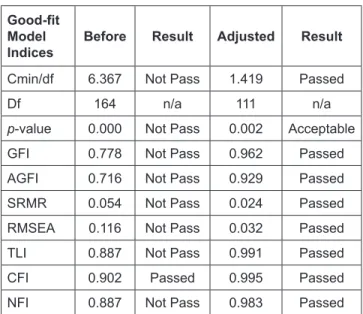
4.4. Good-Fit Model Analysis and Modification In Table 2, the model-fit indices show the values both before and after being adjusted according to the acceptability of good-fit model. Before adjustment, the model revealed only one acceptable index (CFI = 0.902). As a result, there should be model adjustment by employing modification indices. After model adjustment, the model has improved value of each indices, except for p-value, which is lower than 0.05. However, this meets Sukortprommee’s (2013) recommendation.
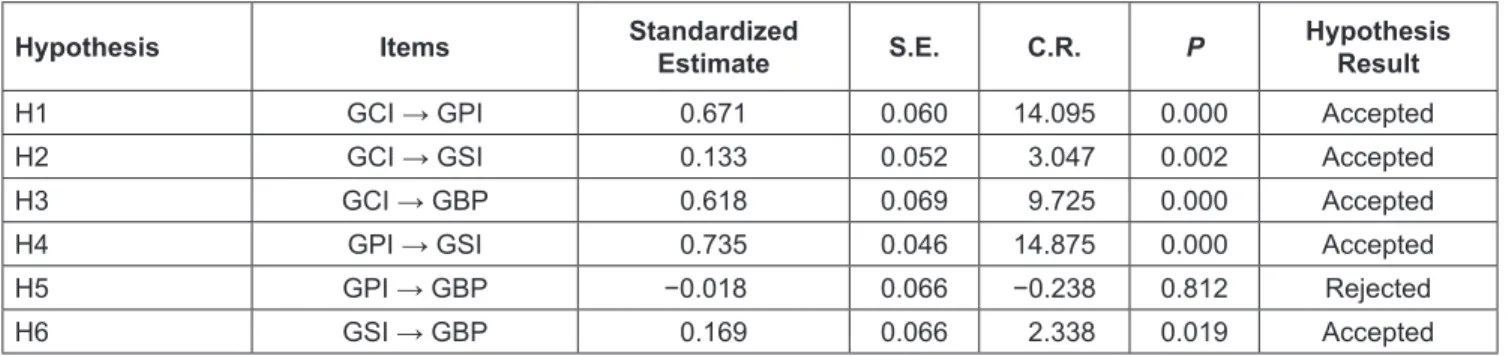
4.5. Summary of Standardized Estimate, Standard Error, Critical Value and Hypotheses Result In Table 3, associated with Figure 1, the results of the tested model indicated the summary of standardized estimate, standard error and critical value (t). All underlying
Table 2: Good-Fit Model Analysis and Modification Good-fit
Model
Indices Before Result Adjusted Result
Cmin/df 6.367 Not Pass 1.419 Passed
Df 164 n/a 111 n/a
p-value 0.000 Not Pass 0.002 Acceptable
GFI 0.778 Not Pass 0.962 Passed
AGFI 0.716 Not Pass 0.929 Passed
SRMR 0.054 Not Pass 0.024 Passed
RMSEA 0.116 Not Pass 0.032 Passed
TLI 0.887 Not Pass 0.991 Passed
CFI 0.902 Passed 0.995 Passed
NFI 0.887 Not Pass 0.983 Passed
variables are in the acceptable range with statistically significant levels lower than 0.05 (p-value ranged from 0.000–0.019). Also, the standard error values are between 0.046–0.069. In addition, the critical value displays between 2.338–14.875. Nevertheless, one underlying GPI-GBP variable is not accepted since the p-value is higher than 0.05 (namely 0.812). These values are employed for hypothesis investigation.
4.6. Standardized Total Effect, Standardized Direct Effect, and Standardized
Indirect Effect
In Table 4, associated with Figure 1, the standardized effect advocates three aspects:1) the study shows that green corporate identity has a standardized total effect on green personal identification, employees’ green social identification and green business performance with standardized estimates of 0.671, 0.626 and 0.711, respectively; 2) green corporate identity has a standardized direct effect on green personal identification, employees’ green social identification and green business performance with standardized estimates of 0.671, 0.133 and 0.618, respectively; 3) green corporate identity has a standardized indirect effect on employees’ green social identification and green business performance with standardized estimates of 0.493 and 0.093, respectively. For the second aspect, the results indicate that employees’ green personal identification had a standardized total effect on employees’
green social identification and green business performance with standardized estimates of 0.735 and 0.106, respectively.
In addition, employees’ green personal identification has
Table 3: Summary of Standardized Estimate, Standard Error and Critical Value
Hypothesis Items Standardized
Estimate S.E. C.R. P Hypothesis
Result
H1 GCI → GPI 0.671 0.060 14.095 0.000 Accepted
H2 GCI → GSI 0.133 0.052 3.047 0.002 Accepted
H3 GCI → GBP 0.618 0.069 9.725 0.000 Accepted
H4 GPI → GSI 0.735 0.046 14.875 0.000 Accepted
H5 GPI → GBP −0.018 0.066 −0.238 0.812 Rejected
H6 GSI → GBP 0.169 0.066 2.338 0.019 Accepted
Remark: GCI, Green Corporate Identity; GPI, Employees’ Green Personal Identification; GSI, Employees’ Green Social Identification;
GBP, Green Business Performance.
standardized direct effect on employees’ green social identification with standardized estimates as of 0.735. Lastly, green personal identification has standardized indirect effect on green business performance with standardized estimates of 0.124. For the last aspect, the study reveals that employees’
green social identification has a standardized total direct effect and direct effect on green business performance with standardized estimates of 0.169.
5. Discussion and Recommendations 5.1. Discussion
Green Corporate Identity has A Positive Impact on Employees’ Green Personal Identification, Employees’
Green Social Identification and Green Business Performance
The study found that green corporate identity has a positive impact on employees’ green personal identification, employees’ green social identification and green business performance. This is because an organization needs to communicate with its employees what they are doing with the organization recently. An organization communicates with its employees in various ways, including internal communication indicating what the employees should do and should not do. Especially, in terms of environmental
issues where extra specifications regarding how employees are required to perform in the workplace, the organization should inform employees explicitly and clearly about the green corporate policy guiding an increase in employees’
green performance. Notably, Foroudi (2015) and Balmer (2017) recommended that corporate should directly and indirectly communicate with internal stakeholders about the environmental concerns, management, and protection in order to improve the relationship and understanding toward the distinguished identity of the corporate.
Indeed, external communication toward organization’s stakeholders (customers, suppliers, governors, as well as community) can be directly and indirectly communicating with employees of the organization because the employees need to work in order to respond to the needs of the customers and others. This study results align with those Melewar and Akel (2005), Podnar (2005), and Mohamad et al. (2007), which indicated that employees behave, accomplish, and learn the corporate culture through their corporate member, vision, shared value, history, philosophy, principles, and guidelines in order to correspond to external adaptation and internal integration.
Therefore, when the corporate can be identified as green, it can have a positive impact on employees’ green personal identification, their green social identification and green business performance.
Table 4: Standardized Effect of Green Corporate Identity, Employees’ Green Identification and Green Business Performance
Item Total Effect Direct Effect Indirect Effect
GPI GSI GBP GPI GSI GBP GPI GSI GBP
GCI 0.671 0.626 0.711 0.671 0.133 0.618 − 0.493 0.093
GPI − 0.735 0.106 − 0.735 − − − 0.124
GSI − − 0.169 − − 0.169 − − −
Remark: GCI, Green Corporate Identity; GPI, Employees’ Green Personal Identification; GSI, Employees’ Green Social Identification;
GBP, Green Business Performance.
Employees’ Green Personal Identification had A Positive Impact on Employees’ Green Social Identification, but did not have A Positive Impact on Green Business Performance
This study indicated that employees’ green personal identification had a positive impact on employees’ green social identification. This is because when employees individually perceived the messages and identity from the organization, especially, in terms of green matters, which are something quite new and difficult to manage, they will look for the group of employees and oversee what can be different and similar between themselves and their colleagues (Abrams & Hogg, 1988). If there is something similar, they will feel more confident and inclined to perform the task because they feel that they are accepted as well as respected by their co-workers. Researcher suggests that whether individuals categorize themselves and identify with a certain group and classification sharing a similar identity could predict the likelihood of group members performing the assigned tasks (Kuenzel & Halliday, 2008;
Tafjel, 1981; Turner, 1975). Nevertheless, employees’ green personal identification does not have a positive impact on green business performance. This is because employees who identify themselves individually with an organization cannot directly increase green business performance. The individual perception relates to what the organization is doing and attempting to identify cannot be braved enough to lead to the employees’ performing for the organizational level such as organization market growth, profit increase, organizational image as well as community satisfaction.
In addition, not only just to match employees’ sense of self, values, characteristics and personality with their organization, the employees need to be from an identical social level, corresponding to the study of Ashforth and Mael (1989). In additional, social identity is seen as the process that changes personal belief and attitude interactively to inter-group behavior (Turner et al., 1987).
Employees’ Green Social Identification has Positive Impact on Green Business Performance
The study found that employees’ green social identification has a positive impact on green business performance. This is because when employees who entered and became members of the group can help perform the better works. In addition, individual employees accepted by the collective group understand about their roles and works to match themselves with the organization’s goals, policies, and culture. Based on the literature review, green social identification additionally refers to the employees’
expression identifying the organization in the way of considering environmental awareness, protection, and management influences, in terms of status, role, and image, to be matched and accepted by the group of people or society
intending to conform the management (Carroll & Ahuvia, 2006; Sukortprommee, 2013). When employees understand their roles at the social level, perceiving that they belong to the organization, they will better performance the task, which improves organizational performance, in turn (Zhu et al., 2008; Green et al., 2012; Kafa et al., 2013; Ngniatedema &
Li, 2014; Zampese et al., 2016; Leonidou et al., 2017;
Çankaya & Sezen, 2019; Banihashemi et al., 2019).
5.2. Recommendations
Multiple international organizations recently aim to achieve the green business performance that can improve organizational reputation, market growth, and acceptance toward domestic and international forces such as governmental policy, severe competition from the same industry as well as customer requirements. Managers should consider both organizational management such as policy settings and work guidelines and activities to promote employee behavior.
Firstly, the organization should create a coherent green corporate identity through internal and external green corporate communication, clear policy and guidance and a commitment to all stakeholders, including employees, in the organization.
Secondly, the organization should promote employees’ in-role and extra-role behavior by creating employees’ mindsets and attitudes to perform the tasks and jobs according to described assignments as well as the willingness to work beyond their job description in order to collaboratively accomplish the organization’s goals and mission. In addition, the organization should provide some related environmental management training in order to increase employees’ green knowledge as well as organizational practices, values and standards, guiding employees to work productively in the organization. Thirdly, the organization should be responsive to green forces and drivers including industrial involvers, internationalization, technology innovation, governmental and societal matters that require the corporate to encounter and concern for corporate management. This is because the external forces and drivers can positively influence the employees’ green behavior. Lastly, the organization should encourage employees to identify themselves socially toward the green corporate identity.
When employees collectively feel the sense of belonging to the organization, they tend to become more effective at work.
Therefore, this study affirms that managing green corporate identity and enhancing employees’ green identification will strengthen an international organization’s business performance economically, socially, and environmentally.
Since this study employs quantitative research to develop
the model, future research can utilize a qualitative approach
or mixed methods to gain more insights. Secondly, this study
uses the automotive industry as a case study, specifically on
automotive manufacturing; therefore, the results can have
the limited generalization to the related fields of industries
and productions. As a result, the future research can extend to other industry and compare the relevant findings. Since the degree of influencing factors associated with employees’
green identification on green business performance is quite lower than other factors; green corporate identity, employees’
green identification, and green business performance. The future study can also compare the different degrees of green corporate identity with the different degrees of employees’
green identification and green business performance in order to evaluate the influences of the organization’s degree of green corporate identity on the employees’ green identification and green business performance.
6. Conclusion
It can be concluded from this study that the green corporate identity in terms of green corporate communication, green corporate visual identity, green employee behavior, green corporate culture, green corporate policy, green corporate forces and drivers, green corporate products and service, can influence the green business performance regarding economic, environmental and social aspects. In addition, the findings indicate that employees’
green personal-social identifications acting as the mediated role of green corporate identity can result in the higher level of green business performance. In order to achieve the green business performance, the automotive manufacturers can emphasize on creating green corporate identity as well as employees’ identification. In consequence, achieving green performance can increase the organization’s reputation, obtain international standard accreditation, and social acceptance.
References
Abrams, D., & Hogg, M. A. (1988). Comments on the motivational status of self‐esteem in social identity and intergroup discrimination. European Journal of Social Psychology, 18(4), 317–334. https://doi.org/10.1002/ejsp.2420180403
Alessandri, S. W. (2001). Modeling corporate identity: a concept explication and theoretical explanation. Corporate Communi
cations: An International Journal, 6(4), 173–182. https://doi.
org/10.1108/EUM0000000006146
Alhamali, R. M. (2019). Critical success factors for green supply chain management practices: An empirical study on data collected from food processing companies in Saudi Arabia.
African Journal of Business Management, 13(5), 160–167.
https://doi.org/10.5897/AJBM2018.8709
Alqirem, R., Abu Afifa, M., Saleh, I., & Haniah, F. (2020).
Ownership Structure, Earnings Manipulation, and Organizational Performance: The Case of Jordanian Insurance Organizations. Journal of Asian Finance, Economics and Business, 7(12), 293–308. https://doi.org/10.13106/jafeb.2020.
vol7.no12.293
Ashforth, B. E. & Mael, F., 1989. Social identity theory and the organization. Academy of Management Review, 14(1), 20–39.
https://doi.org/10.5465/amr.1989.4278999
Baker, M. J. & Balmer, J. M. T. (1997). Visual Identity: Trappings or Substance. European Journal of Marketing, 31(5/6), 366–382. https://doi.org/10.1108/eb060637
Balmer, J. M., & Stotvig, S. (1997). Corporate identity and private banking: a review and case study. International Journal of Bank Marketing, 5(5), 169–184. https://doi.
org/10.1108/02652329710175370
Balmer, J. M., & Gray, E. R. (1999). Corporate identity and corporate communications: creating a competitive advantage.
Corporate Communications: An International Journal. 4(4), 171–177. https://doi.org/10.1108/EUM0000000007299 Balmer, J. M. (1995). Corporate branding and connoisseurship.
Journal of General management, 21(1), 24–46. https://doi.
org/10.1177/030630709502100102
Balmer, J. M. (2017). The corporate identity, total corporate communications, stakeholders’ attributed identities, identifications and behaviours continuum. European Journal of Marketing, 51(9/10), 1472–1502. https://doi.org/10.1108/EJM- 07-2017-0448
Banihashemi, T. A., Fei, J., & Chen, P. S. L. (2019). Exploring the relationship between reverse logistics and sustainability performance. Modern Supply Chain Research and Applications, 1(1), 2–27. https://doi.org/10.1108/MSCRA-03-2019-0009 Çankaya, S. Y., & Sezen, B. (2019). Effects of green supply chain
management practices on sustainability performance. Journal of Manufacturing Technology Management, 30(1), 98–121.
https://doi.org/10.1108/JMTM-03-2018-0099
Carroll, B. A., & Ahuvia, A. C. (2006). Some antecedents and outcomes of brand love. Marketing Letters, 17(2), 79–89.
https://doi.org/10.1007/s11002-006-4219-2
Chen, Y. S., Lai, S. B., & Wen, C. T. (2006). The influence of green innovation performance on corporate advantage in Taiwan.
Journal of Business Ethics, 67(4), 331–339. https://doi.
org/10.1007/s10551-006-9025-5
Chidchob, T., & Pianthong, N. (2020). Effect of Driving Force, Knowledge Management, Green Supply Chain Management on Competitiveness and Business Performance of Manufacturing Industries in Thailand. International Journal of Environmental Science, 5, 63–73.
Chienwattanasook, K., & Jermsittiparsert, K. (2019). Effect of Technology Capabilities on Sustainable Performance of Pharmaceutical firms in Thailand with moderating role of Organizational Culture. Systematic Reviews in Pharmacy, 10(2), 188–197. https://doi.org/10.5530/srp.2019.2.27
Chun, D. M. (1994). Using computer networking to facilitate the acquisition of interactive competence. System, 22(1), 17–31.
https://doi.org/10.1016/0346-251X(94)90037-X
De Sousa Jabbour, A. B. L., Jabbour, C. J. C., Latan, H., Teixeira, A. A., & de Oliveira, J. H. C. (2014). Quality management, environmental management maturity, green supply chain
practices and green performance of Brazilian companies with ISO 14001 certification: Direct and indirect effects.
Transportation Research Part E: Logistics and Transportation Review, 67, 39–51. https://doi.org/10.1016/j.tre.2014.03.005 Denison, D. R., & Mishra, A. K. (1995). Toward a theory of
organizational culture and effectiveness. Organization Science, 6(2), 204–223. https://doi.org/10.1287/orsc.6.2.204
Dowling, G. R. (1994). Corporate reputations: strategies for developing the corporate brand. London, UK: Kogan Page.
Fernando, Y., Jabbour, C. J. C., & Wah, W. X. (2019). Pursuing green growth in technology firms through the connections between environmental innovation and sustainable business performance: does service capability matter?. Resources, Conservation and Recycling, 141, 8–20. https://doi.org/10.
1016/j.resconrec.2018.09.031
Fonseca, S. A., & Jabbour, C. J. C. (2012). Assessment of business incubators’ green performance: A framework and its application to Brazilian cases. Technovation, 32(2), 122–132. https://doi.
org/10.1016/j.technovation.2011.10.006
Foroudi, M. M. (2015). The corporate identity, architecture, and identification triad: theoretical insights. London: Doctoral dissertation, Brunel University. Brunel University Research Archive. http://bura.brunel.ac.uk/handle/2438/13799
Gardazi, S. S. N., Hassan, A. F. S., & Johari, J. B. (2020). Board of Directors Attributes and Sustainability Performance in the Energy Industry. Journal of Asian Finance, Economics and Business, 7(12), 317–328. https://doi.org/10.13106/jafeb.2020.
vol7.no12.317
Green, K. W., Zelbst, P. J., Meacham, J., & Bhadauria, V. S.
(2012). Green supply chain management practices: impact on performance. Supply Chain Management: An International Journal, 17(3), 290–305. https://doi.org/10.1108/135985412 11227126
Grönroos, C. (1984). A service quality model and its marketing implications. European Journal of Marketing, 18(4), 36–44.
https://doi.org/10.1108/EUM0000000004784
Hair, J. F., Black, W. C., Babin, B. J., Anderson, R. E., & Tatham, R. L. (2006). Multivariate data analysis (6th ed.). Upper Saddle River, NJ: Prentice Hall
Halek, M., Holle, D., & Bartholomeyczik, S. (2017). Development and evaluation of the content validity, practicability and feasibility of the Innovative dementia-oriented Assessment system for challenging behaviour in residents with dementia.
BMC Health Services Research, 17(1), 1–26. https://doi.
org/10.1186/s12913-017-2469-8
Hermawan, H., Thamrin, H., & Susilo, P. (2020). Organizational Citizenship Behavior and Performance: The Role of Employee Engagement. Journal of Asian Finance, Economics and Business, 7(12), 1089–1097. https://doi.org/10.13106/
jafeb.2020.vol7.no12.1089
Hooper, D., Coughlan, J., & Mullen, M. R. (2013). The servicescape as an antecedent to service quality and behavioral intentions.
Journal of Services Marketing, 27(4), 271–280. https://doi.
org/10.1108/08876041311330753
Iqbal, Q., Hassan, S. H., Akhtar, S., & Khan, S. (2018). Employee’s green behavior for environmental sustainability: a case of banking sector in Pakistan. World Journal of Science, Technology and Sustainable Development, 15(2), 118–130.
https://doi.org/10.1108/WJSTSD-08-2017-0025
Kafa, N., Hani, Y., & El Mhamedi, A. (2013). Sustainability performance measurement for green supply chain management. IFAC Proceedings, 46(24), 71–78. https://doi.
org/10.3182/20130911-3-BR-3021.00050
Knekta, E., Runyon, C., & Eddy, S. (2019). One size doesn’t fit all: Using factor analysis to gather validity evidence when using surveys in your research. CBE—Life Sciences Education, 18(1), 1–17. https://doi.org/10.1187/cbe.18-04-0064
Krejcie, R. V., & Morgan, D. W. (1970). Determining sample size for research activities. Educational and Psychological Measurement, 30(3), 607–610. https://doi.
org/10.1177/001316447003000308
Küçükoğlu, M. T., & Pınar, R. İ. (2015). Positive influences of green innovation on company performance. Procedia
Social and Behavioral Sciences, 195, 1232–1237. https://doi.
org/10.1016/j.sbspro.2015.06.261
Kuenzel, S., & Halliday, S. V. (2008). Investigating antecedents and consequences of brand identification. Journal of Product & Brand Management, 17(5), 293–304. https://doi.
org/10.1108/10610420810896059
Lassar, W., Mittal, B., & Sharma, A. (1995). Measuring customer‐
based brand equity. Journal of Consumer Marketing, 12(4), 11–19. https://doi.org/10.1108/07363769510095270
Leonidou, L. C., Christodoulides, P., Kyrgidou, L. P., &
Palihawadana, D. (2017). Internal drivers and performance consequences of small firm green business strategy: The moderating role of external forces. Journal of Business Ethics, 140(3), 585–606. https://doi.org/10.1007/s10551-015-2670-9 Maditati, D. R., Munim, Z. H., Schramm, H. J., & Kummer, S.
(2018). A review of green supply chain management: From bibliometric analysis to a conceptual framework and future research directions. Resources, Conservation and Recycling, 139, 150–162. https://doi.org/10.1016/j.resconrec.2018.08.004 Maurya, U. K., Mishra, P., Anand, S., & Kumar, N. (2015).
Corporate identity, customer orientation and performance of SMEs: Exploring the linkages. IIMB Management Review, 27(3), 159–174. https://doi.org/10.1016/j.iimb.2015.05.001 Melewar, T.C. and Akel, S., 2005. The role of corporate identity
in the higher education sector: A case study. Corporate Communications: An International Journal, 10(1), 41–57.
https://doi.org/10.1108/13563280510578196
Melewar, T. C., & Wooldridge, A. R. (2001). The dynamics of corporate identity: a review of a process model. Journal of Communication Management, 5(4), 327–340. https://doi.
org/10.1108/13632540110806866
Melewar, T. C. (2003). Determinants of the corporate identity construct: a review of the literature. Journal of Marketing Communications, 9(4), 195–220. https://doi.
org/10.1080/1352726032000119161
Mohamad, B., Bakar, H. A., & Rahman, N. A. A. (2007).
Relationship between corporate identity and corporate reputation: A case of a Malaysian higher education sector.
Jurnal Manajemen Pemasaran, 2(2), 81–89. https://doi.
org/10.9744/pemasaran.2.2
Ngniatedema, T., & Li, S. (2014). Green operations and organizational performance. International Journal of Business and Social Science, 5(3), 50–58.
Norton, T. A., Zacher, H., & Ashkanasy, N. M. (2014).
Organisational sustainability policies and employee green behaviour: The mediating role of work climate perceptions.
Journal of Environmental Psychology, 38, 49–54. https://doi.
org/10.1016/j.jenvp.2013.12.008
Podnar, K. (2005). Corporate identity in Slovenia. Corporate Communications: An International Journal, 10(1), 69–82.
https://doi.org/10.1108/13563280510578213
Polit, D. F., & Beck, C. T. (2006). The content validity index:
are you sure you know what’s being reported? Critique and recommendations. Research in Nursing & Health, 29(5), 489–497. https://doi.org/10.1002/nur.20147
Rawashdeh, A. (2018). The impact of green human resource management on organizational environmental performance in Jordanian health service organizations. Management Science Letters, 8(10), 1049–1058. https://doi.org/10.5267/j.
msl.2018.7.006
Rodrigues, I. B., Adachi, J. D., Beattie, K. A., & MacDermid, J. C.
(2017). Development and validation of a new tool to measure the facilitators, barriers and preferences to exercise in people with osteoporosis. BMC Musculoskeletal Disorders, 18(1), 1–9. https://doi.org/10.1186/s12891-017-1914-5
Savalei, V., & Bentler, P. M. (2005). A statistically justified pairwise ML method for incomplete nonnormal data: A comparison with direct ML and pairwise ADF. Structural Equation Modeling, 12(2), 183–214. https://doi.org/10.1207/s15328007sem1202_1 Singh, S. K., Del Giudice, M., Chierici, R., & Graziano, D. (2020).
Green innovation and environmental performance: The role of green transformational leadership and green human resource management. Technological Forecasting and Social Change, 150, 119762. https://doi.org/10.1016/j.techfore.2019.119762 Soewarno, N., Tjahjadi, B., & Permatanadia, D. (2020). Competitive
Pressure and Business Performance in East Java Batik Industry.
The Journal of Asian Finance, Economics, and Business, 7(12), 329–336. https://doi.org/10.13106/jafeb.2020.vol7.no12.329 Sukortprommee, S. (2013). The effect of corporate brand
personality on customercontact employee’s prosocial behavior and the mediating effect of brand identification in Japanese automotive service sector [Doctoral dissertation, Rajamangala
University of Technology Thanyaburi. Faculty of Business Administration. Business]. Rajamangala University of Technology Thanyaburi, DSpace. http://www.repository.rmutt.
ac.th/dspace/handle/123456789/2197
Tabachnick, B. G., & Fidell, L. S. (2007). Experimental designs using ANOVA. Belmont, CA: Thomson/Brooks/Cole.
Tafjel, H., 1981. Human groups and social categories: Studies in social psychology. CUP Archive, Cambridge, UK: Cambridge University Press.
Tourky, M. (2013). Determining corporate identity in UK corporations: an empirical analysis and evaluation [Doctoral dissertation, University of Hull]. University of Hull, EThOS.
https://ethos.bl.uk/OrderDetails.do?uin=uk.bl.ethos.739422 Turner, B. S. (1985). Religion and social theory. Religious Studies,
21(4), 625–626.
Turner, J. C. (1975). Social comparison and social identity:
Some prospects for intergroup behaviour. European Journal of Social Psychology, 5(1), 1–34. https://doi.org/10.1002/
ejsp.2420050102
Turner, J. C., Hogg, M. A., Oakes, P. J., Reicher, S. D., &
Wetherell, M. S. (1987). Rediscovering the social group:
A selfcategorization theory. London: Basil Blackwell.
Yang, L., Jiang, Y., Zhang, W., Zhang, Q., & Gong, H. (2019). An empirical examination of individual green policy perception and green behaviors. International Journal of Manpower, 41(7), 1021–1040. https://doi.org/10.1108/IJM-09-2019-0455 Yang, C. S., Lu, C. S., Haider, J. J., & Marlow, P. B. (2013). The
effect of green supply chain management on green performance and firm competitiveness in the context of container shipping in Taiwan. Transportation Research Part E: Logistics and Transportation Review, 55, 55–73. https://doi.org/10.1016/
j.tre.2013.03.005
Yuan, K. H., & Bentler, P. M. (2000). 5. Three likelihood-based methods for mean and covariance structure analysis with nonnormal missing data. Sociological methodology, 30(1), 165–200. https://doi.org/10.1111/0081-1750.00078
Zampese, E. R. D. S., Moori, R. G., & Caldeira, A. (2016). Green marketing as a mediator between supply chain management and organizational performance. RAM. Revista de Administração Mackenzie, 17(3), 183–211. https://doi.org/10.1590/1678- 69712016/administracao.v17n3p183-211
Zhu, Q., Sarkis, J., & Lai, K. H. (2008). Confirmation of a measurement model for green supply chain management practices implementation. International Journal of Production Economics, 111(2), 261–273. https://doi.org/10.1016/j.ijpe.
2006.11.029