Print ISSN: 2288-4637 / Online ISSN 2288-4645 doi:10.13106/jafeb.2021.vol8.no3.0629
Institutional Strengthening and Capacity Building:
A Case Study in Indonesia
Wibisono POESPITOHADI
1, Soesilo ZAUHAR
2, Bambang Santoso HARYONO
3, Fadillah AMIN
4Received: August 20, 2020 Revised: January 25, 2021 Accepted: February 03, 2021
Abstract
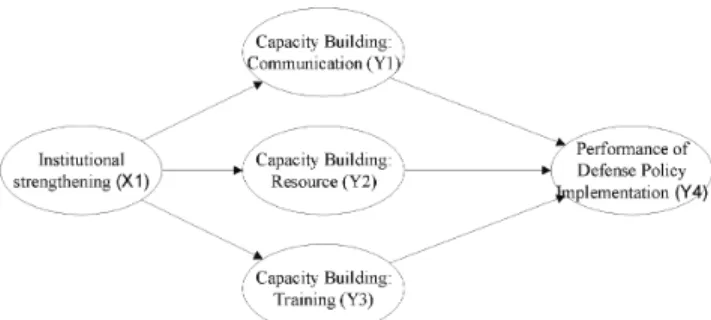
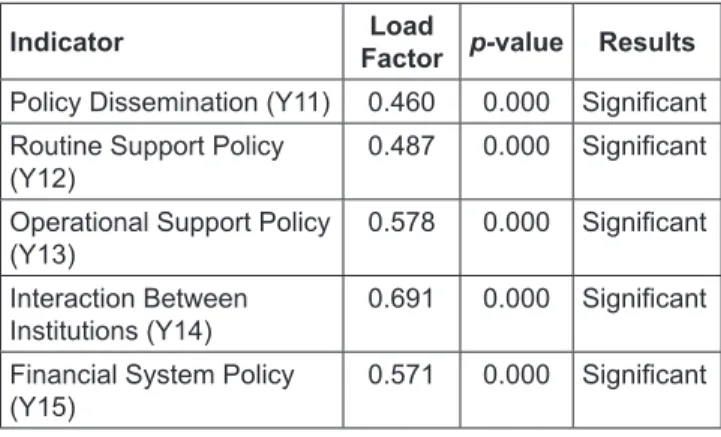
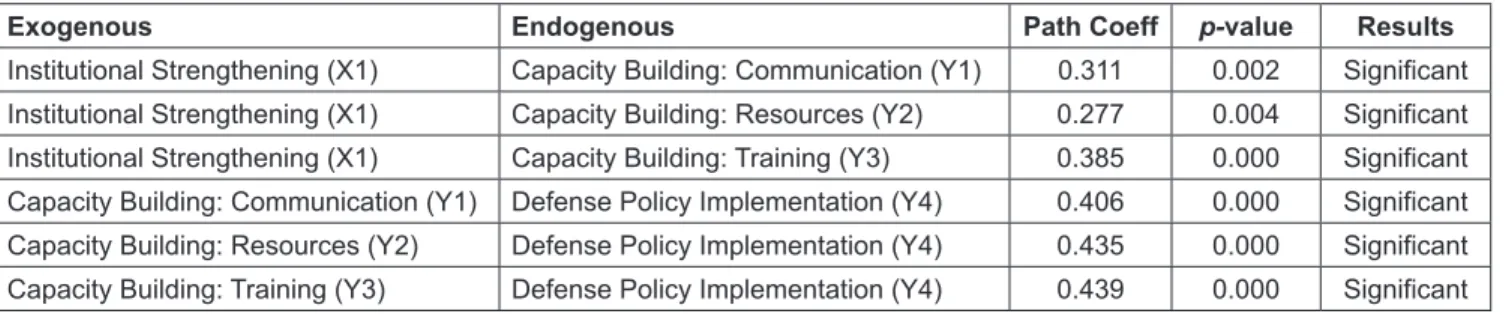
This study seeks to examine and analyze the influence of institutional strengthening factors, and capacity building – communication, resources, and training – on the performance of defense policy implementation. This study conducted a quantitative analysis related to the implementation of the institutional strengthening policy. The data used are primary data with a research instrument in the form of a questionnaire. The population in this study were all people in the city of Bandung, Indonesia. The sample of this study consisted of 200 respondents consisting of civilians and soldiers who served in the city of Bandung. Data analysis uses the Structural Equation Model (SEM) measurement model. The results of this study reveals that institutional strengthening (X1) influences positively and significantly capacity building’s communication (Y1), resources (Y2), and training (Y3). On the other hand, the performance of defense policy implementation (Y4) is positively and significantly affected by capacity building’s communication (Y1), resources (Y2), and training (Y3). The interaction between institutions, consumption support, role of the healthcare sector, and effectiveness are the most important indicators reflecting capacity building (communication, resources, training) and the performance of defense policy implementation. Essentially, this study analyzes the performance of defense policy implementation based on capacity building.
Keywords: Policy Implementation, Institutional Strengthening, Capacity Building, Territorial Area JEL Classification Code: C38, J0, L5
countries that want to go from one place to another by land, sea or air, so that they are also vulnerable to various threats. For this reason, the Indonesian government and all Indonesian citizens are obliged to maintain the sovereignty of the territory of the Republic of Indonesia, defend and protect it.
National defense and security is a strategic area in the national development plan. Apart from being carried out with a universal defense system, national defense efforts are also carried out by structuring the defense areas throughout the Republic of Indonesia starting from the provincial level up to the district/city level. Institutions in the regions have their respective duties, functions and roles.
Java is the main island in Indonesia because it is not only the center of the Indonesian economy, but the most developed island as well (Widarjono, Anto, & Fakhrunnas, 2020). One of the urban areas where the defense structure policy is implemented is the city of Bandung, the capital of West Java province, with an area of 16,729.65 hectares. Furthermore, based on the Republic of Indonesia Government Regulation Number 68 of 2014, the arrangement of the defense in the Bandung City area is carried out in an integrated manner
1
First Author and Corresponding Author. Faculty of Administrative Sciences, Brawijaya University, Indonesia [Postal Address:
St. Veteran, Ketawanggede, Malang, East Java, 65145, Indonesia]
Email: [email protected]
2
Faculty of Administrative Sciences, Brawijaya University, Indonesia.
Email: [email protected]
3
Faculty of Administrative Sciences, Brawijaya University, Indonesia.
Email: [email protected]
4
Faculty of Administrative Sciences, Brawijaya University, Indonesia.
Email: [email protected]
© Copyright: The Author(s)
This is an Open Access article distributed under the terms of the Creative Commons Attribution Non-Commercial License (https://creativecommons.org/licenses/by-nc/4.0/) which permits unrestricted non-commercial use, distribution, and reproduction in any medium, provided the original work is properly cited.