Print ISSN: 2288-4637 / Online ISSN 2288-4645 doi:10.13106/jafeb.2021.vol8.no4.0475
The Effect of Service Quality and Customer Satisfaction on Purchasing Intention: A Case Study in Indonesia*
Adelheid Rinny MAHARSI1, Rosemarie Sutjiati NJOTOPRAJITNO2, Bram HADIANTO3, Jessica WIRAATMAJA4
Received: September 30, 2020 Revised: February 22, 2021 Accepted: March 02, 2021
Abstract
This research intends to examine and analyze the service quality effect on petrol buying intention through satisfaction when the Maranatha Christian University lecturers spend their money in the Pertamina-affiliated gas stations in Bandung. To attain this goal, we develop four relevant hypotheses to be tested. Furthermore, we use simple random sampling to acquire samples by denoting a sample size set by the Slovin formula. To collect the responses, we use the online survey and fruitfully yield a 53.54% rate with a total of 106 lecturers participating in completing the distributed questionnaire link. This number is near 100; hence, we employ a structural equation model with a variance basis to analyze them. After examining the data and conferring the results, we conclude three things. First, service quality does not affect purchasing intention, but customer satisfaction positively does. Second, service quality has a positive impact on customer satisfaction.
Finally, consumer satisfaction successfully mediates the effect of service quality on the intention to buy. Based on these conclusions, this paper finds the superior service to the petrol buyers is the key driver for the gas stations under Pertamina control to effectively compete with their rivals in the marketplace, especially in Bandung.
Keywords: Customer Satisfaction, Gas Station, Intention to Buy, Service Quality, Perception JEL Classification Code: I23, L95, M30, M31
1. Introduction
Pertamina is an Indonesian state-owned oil and natural gas corporation based in Jakarta that is responsible for producing and distributing petrol and supervising its distribution to society (Kuncoro et al., 2009). By understanding the customer perspective, this corporation can deliver an exceptional experience. Hence, the customer focus can be the priority in every decision made to beat the competition. Nationally, Pertamina has six competitors having gas stations: Vivo Energy (VE), Total Oil Indonesia (TOI), Aneka Retroindo Raya (ART), Exxon Mobil Indonesia (EMI), AKR Corporindo (AKRC), and Shell Indonesia (SI) (Mustika, 2019). In Bandung, Pertamina only has two competitors. They are TOI and SI affiliated with the French and Malaysian companies (Mustika, 2019). By observation of the Google Map, Pertamina has 147 affiliated gas stations providing petrol. Conversely, TOI and SI own one and three stations, individually.
*Acknowledgements:
We appreciate Maranatha Christian University for the supporting fund of this study.
1 First Author. Lecturer, Management Department, Faculty of Economics, Maranatha Christian University, Bandung, Indonesia.
Email: [email protected]
2 Lecturer, Management Department, Faculty of Economics, Maranatha Christian University, Bandung, Indonesia.
Email: [email protected]
3 Corresponding Author. Lecturer, Management Department, Faculty of Economics, Maranatha Christian University, Bandung, Indonesia [Postal Address: Jl. Prof. Drg. Suria Soemantri, MPH. No. 65, Bandung 40164, Indonesia] Email: [email protected]
4 Management Department, Faculty of Economics, Maranatha Christian University, Bandung, Indonesia.
Email: [email protected]
© Copyright: The Author(s)
This is an Open Access article distributed under the terms of the Creative Commons Attribution Non-Commercial License (https://creativecommons.org/licenses/by-nc/4.0/) which permits unrestricted non-commercial use, distribution, and reproduction in any medium, provided the original work is properly cited.
According to Directorate for Human Resource Internal data, Maranatha Christian University (MCU) has 441 lecturers in the nine faculties: medicine, engineering, psychology, letters-and-culture, economics, art-and-design, information technology, law, and dentistry as of March 2020. Based on the information from the head of security and parking in MCU, Buddy Supriadi, 391 of them register their vehicles to get free parking in the working days. This total consists of 73 car owners and 318 motorcycle owners. MCU is located on Jl.
Prof. Drg. Suria Soemantri, MPH No.65, Bandung; hence, its lecturers prefer buying petrol in the two gas stations affiliated with Pertamina near their workplace. Therefore, this research is relevant to reveal the determinants of their buying intention in the Pertamina-affiliated gas stations.
As the least possible, two determinants of buying intention exist based on the previous research evidence:
service quality and customer satisfaction. However, based on the initial research, their impact is not consistent. For service quality as the first antecedent, Aptaguna and Pitaloka (2016), Banjarnahor (2017), Murwanti and Pratiwi (2017), Widyastuti et al. (2017), Octaviana and Nugrahaningsih (2018), Alharthey (2019), Wiyadi and Ayuningtyas (2019), and Naveed et al. (2019) confirm its positive presence.
Unfortunately, other scholars find no impact (Mambu, 2015;
Widajanti & Suprayitno, 2017; Wonggotwarin & Kim, 2017).
For customer satisfaction as the second determinant of buying intention, this positive impact is demonstrated by Iskandar et al. (2015), Salem et al. (2015), Banjarnahor (2017), Nodira and Přemysl (2017), Murwanti and Pratiwi (2017), Putri and Astuti (2017), Widajanti and Suprayitno (2017), Alharthey (2019), Hong et al. (2020), Lamai et al. (2020), and Tran and Le (2020). Conversely, another researcher, Octaviana and Nugrahaningsih (2018), shows no effect.
Besides, customer satisfaction can be positively affected by service quality, as shown by Kim (2013), Iskandar et al.
(2015), Banjarnahor (2017), Putri and Astuti (2017), Murwanti and Pratiwi (2017), Dawi et al. (2018), Octaviana and Nugrahaningsih (2018), Alharthey (2019), and Tjahjaningsih et al. (2020). On the other hand, the study by Naik et al. (2010) shows no impact.
Additionally, the previous scholars attempt to prove that customer satisfaction is the mediating factor of the service quality effect on buying intention (Kalia et al., 2016;
Murwanti & Partiwi, 2017; Putri & Astuti, 2017; Octaviana
& Nugrahaningsih, 2018). However, the findings of these studies are also inconsistent. In their research, Kalia et al.
(2016), Murwanti and Pratiwi (2017), and Putri and Astuti (2017) succesfully prove this mediating effect, but Octaviana and Nugrahaningsih (2018) do not.
Based on the above inconsistent findings of different researcher investigations, this study attempts to prove and analyze three things. The first is the effect of service quality (SQ) and consumer satisfaction (CS) on buying intention.
The second is the impact of SQ on CS. The third is the CS mediating role on the service quality impact on the purchase intention in Pertamina-affiliated gas stations in Bandung, indeed, based on the perception of the lecturers working at MCU.
2. Literature Review
When studying the service quality effect on store visitor purchase intention, Kim (2013) found a positive relationship. Furthermore, Aptaguna and Pitaloka (2016) showed that service quality positively contributed to the user intention of Go-Ojek. This positive contribution was also supported by Banjarnahor (2017), who analyzed the effects of service quality on purchase intention of internet services in West Jakarta. Likewise, the same result was confirmed by Murwanti and Pratiwi (2017), who investigated the effect of service quality on utilizing the garage of the motorcycle.
After studying the impact of service quality on the dealer user intention, Widyastuti et al. (2017) summarized a positive sign. Similarly, Alharthey (2019) proved a positive effect of service quality on grocery buying intention. Also, Naveed et al. (2019) confirmed a similar impact when investigating the canteen products. Likewise, Wiyadi and Ayuningtyas (2019) verified that service quality positively affects purchasing a motorcycle. Hence, the first hypothesis is stated as follows:
H1: Service quality has a positive effect on the intention to buy.
In their study, Iskandar et al. (2015) showed a positive influence of customer satisfaction on durian soup buying intention. Consistently, Salem et al. (2015) found this impact on the college students becoming the users of the Dell-branded laptop, Banjarnahor (2017) and Nodira and Přemysl (2017) on the fruit juice users; Murwanti and Pratiwi (2017), and Putri and Astuti (2017) on the users of pasta and chocolate blends;
Widajanti and Suprayitno (2017) on the steak consumers.
Also, Alharthey (2019) affirmed this influence when learning about grocery buyers, and so did Hong et al. (2020) and Lamai et al. (2020) when surveying the auto maintenance and repair service users and the restaurant visitors, respectively.
Additionally, Tran & Le (2020) found the same tendency when researching convenience store customers. Hence, the second hypothesis is stated as follows:
H2: Customer satisfaction has a positive effect on the intention to buy.
When investigating the service quality effect on store visitor satisfaction, Kim (2013) displayed a positive association.
Similarly, Iskandar et al. (2015) found that all the service quality dimensions positively influence customer satisfaction.
Likewise, the study of Bajarnahor (2017), Putri and Astuti (2017), Murwanti and Pratiwi (2017), Dawi et al. (2018),
Alharthey (2019), and Tjahjaningsih et al. (2020) confirmed that customer satisfaction was positively affected by service quality. Hence, the third hypothesis is stated as follows.
H3: Service quality has a positive effect on customer satisfaction.
When investigating online purchasing behavior in India, Kalia et al. (2016) showed that service quality was a mediating variable in the relationship between electronic service quality and buying intention in the future. Similarly, after using the Sobel test, the study of Murwanti and Pratiwi (2017) and Putri and Astuti (2017) exhibited that customer satisfaction acted as a mediator in the relationship between service quality and buying intention in Indonesia. Hence, the fourth hypothesis is stated as follows.
H4: Customer satisfaction mediates the effect of service quality on the intention to buy.
3. Research Method
3.1. Variables and Operationalization
The employed variables are latent in the two models: the first order and the second one. In the first-order model, the latent variable only has items. Meanwhile, in the second- order model, the latent has dimensions and items. Based on the position, the variable can be divided into two types:
exogenous and endogenous. The exogenous has a role in explaining the outcome. However, the endogenous has a function to be described.
The exogenous variable is service quality, where its dimensions and their items are adopted from Tjiptono et al.
(2004) (see Table 1).
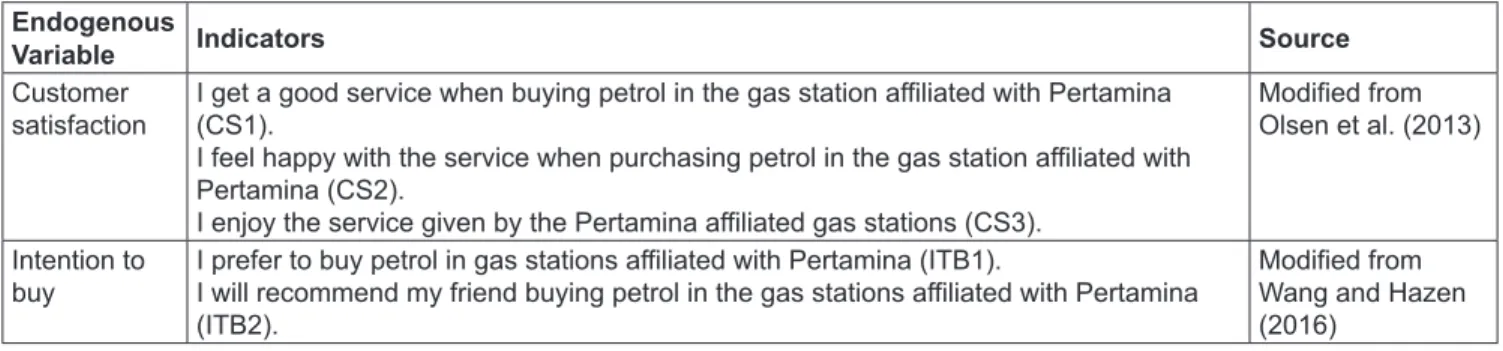
The endogenous variable is customer satisfaction and intention to buy, where the items are adopted from Olsen et al.
(2013) and Wang and Hazen (2016) (see Table 2).
3.2. Population, Samples, and Method to Accumulate Data
This study population is 391 lecturers working at MCU having registered vehicles with free parking at the MCU.
Moreover, to estimate the sampling size, the Slovin formula is utilized. According to Suliyanto (2009), this formula involves the margin of error and the population size, as seen in the first equation.
n N
Ne
1 2 (1) In the first equation, n and N show the sample number and population size, respectively. Furthermore, e is the error margin decided by the researchers. By utilizing a 5% margin of error, we get the total samples
( )n *( %) .
391
1 391 5 2 197 72 198. Table 1: The Dimensions of Service Quality and their Indicators
Dimension Symbol Indicators
Tangibility T1 Pertamina affiliated-gas stations provide the modern means of payment of petrol.
T2 Gas stations affiliated with the Pertamina provide visually attractive facilities.
T3 The staff at the gas station affiliated with Pertamina are dressed neatly.
T4 Information about the type of petrol available is written around the station.
Reliability REL1 There is an accurate filling of petrol always in Pertamina-affiliated gas stations.
REL2 Pertamina-affiliated gas stations always open and close according to their schedule.
Responsiveness RES1 The staff at the Pertamina-affiliated gas station serve their customers quickly.
RES2 Pertamina-affiliated gas station’s staff always remind vehicle drivers to put out/extinguish their cigarette or not smoke and turn off the engine during petrol purchase.
RES3 Pertamina-affiliated gas station’s staff always remind both the driver and passengers in the vehicle to turn off their cellular phones during petrol purchase.
Assurance A1 The staff at the Pertamina-affiliated gas station are polite.
A2 The Pertamina-affiliated gas station staff can answer customers’ questions, like vehicle drivers, owners, passengers.
Empathy EMP1 Operating hours of Pertamina–affiliated gas station make its customers calm.
EMP2 The staff at the Pertamina-affiliated gas station prioritize their customer interest.
Then, we distributed questionnaires to 198 lecturers through the online mode. Likewise, to measure their response, we employed a 5-point Likert scale, where “1” means strongly disagree, and “5’’ means strongly agree (Sugiyono, 2019).
3.3. Validity and Reliability Test
Validity and reliability test are utilized to measure the instrument quality, taking the form of the questionnaire.
• The validity measures the respondent response accuracy. Furthermore, we use confirmatory factor analysis (CFA) to execute it by loading factor (LF) and average variance extracted (AVE). According to Sholihin and Ratmono (2013), if the LF and AVE exceed 0.5, the respondent answer on the question items is convergently and discriminantly valid, respectively.
• The reliability measures the response consistency.
Moreover, we employ the composite reliability coefficient to inspect the reliable condition, as explained by Sholihin and Ratmono (2013). If this coefficient exceeds 0.7 as its cut-off point, the valid answer on the question items is consistent.
3.4. Method for Analyzing Data
This study employs the structural equation model based on variance. It is because the total number of lecturers who responded to the questionnaires was 106. This number is close to Ghozali (2008), who stated 100 as the maximum.
The research model is shown in Figure 1.
Contrasting the probability of t-statistic for the path coefficient of γ1, γ2, and β1 from the WarpPLS7 output, a 5%
significant level (α) is essential to test the first, second, and third null hypotheses. If the probability is lower than α, the null hypothesis becomes accepted, and vice versa.
Additionally, this study uses the Sobel test. This test utilizes the path coefficients and their standard error based on the model estimation output to prove the mediating effect of consumer satisfaction. The formula is in the second equation.
Z-statistic for Sobel = 2SE* 1
(2) where SE = SQRT((γ22)*(SE32) + (β12)*(SE22) + (SE22 * SE32)) Moreover, the probability (2-tailed) of the Z-statistic for Sobel is calculated by the Microsoft Excel formula as shown in equation 3.
NORM.DIST (Z-statistic; 0;1; FALSE) (3) To prove the mediating effect of CS, we follow the following rule:
a. If the probability of the Z-statistic is lower than 5%, the mediating effect exists.
b. If the Z-statistic probability is similar to or higher than 5%, the mediating effect is not present.
4. Results and Discussion 4.1. Descriptive Statistics
This survey was held in April 2020. Of 198 lecturers, only 106 participated. Thus, the response rate was
106
198 100% 53 54. %. Fortunately, this rate is still acceptable because of above 20%, as Sugiyanto et al. (2018) suggest.
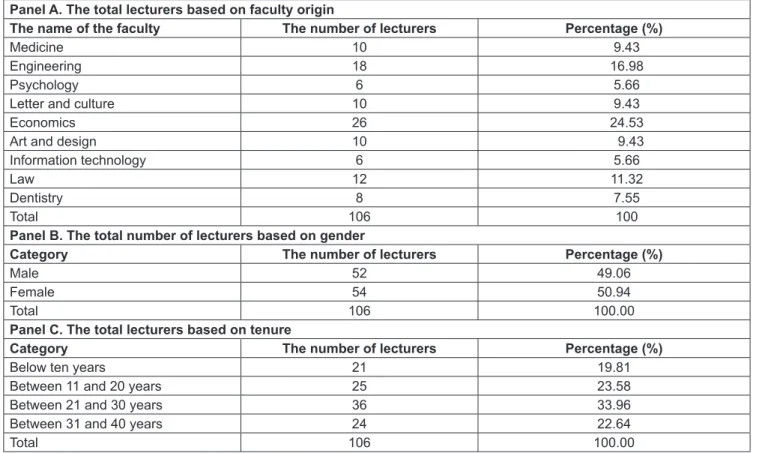
Furthermore, 106 lecturers are from nine faculties, with the total detailed in Panel A of Table 3. Their other features: gender and tenure, are also presented in Panels B and C.
Table 2: Customer Satisfaction, Intention to Buy, and their Indicators Endogenous
Variable Indicators Source
Customer
satisfaction I get a good service when buying petrol in the gas station affiliated with Pertamina (CS1).
I feel happy with the service when purchasing petrol in the gas station affiliated with Pertamina (CS2).
I enjoy the service given by the Pertamina affiliated gas stations (CS3).
Modified from Olsen et al. (2013)
Intention to
buy I prefer to buy petrol in gas stations affiliated with Pertamina (ITB1).
I will recommend my friend buying petrol in the gas stations affiliated with Pertamina (ITB2).
Modified from Wang and Hazen (2016)
Figure 1: Research Model
Table 3: The Total Lecturers Based on Faculty Origin, Gender, and Tenure Panel A. The total lecturers based on faculty origin
The name of the faculty The number of lecturers Percentage (%)
Medicine 10 9.43
Engineering 18 16.98
Psychology 6 5.66
Letter and culture 10 9.43
Economics 26 24.53
Art and design 10 9.43
Information technology 6 5.66
Law 12 11.32
Dentistry 8 7.55
Total 106 100
Panel B. The total number of lecturers based on gender
Category The number of lecturers Percentage (%)
Male 52 49.06
Female 54 50.94
Total 106 100.00
Panel C. The total lecturers based on tenure
Category The number of lecturers Percentage (%)
Below ten years 21 19.81
Between 11 and 20 years 25 23.58
Between 21 and 30 years 36 33.96
Between 31 and 40 years 24 22.64
Total 106 100.00
Table 4: Cross-loading Factors, AVE, the Composite Reliability Coefficient
TANG EMP REL RES AS CS ITB
T1 0.694 –0.315 0.247 –0.164 0.113 –0.139 0.518
T2 0.764 0.005 –0.367 0.078 –0.18 –0.346 0.128
T3 0.669 0.259 –0.139 –0.261 0.653 0.062 –0.116
T4 0.722 0.057 0.28 0.317 –0.524 0.443 –0.527
EMP1 –0.066 0.795 0.005 0.262 –0.119 –0.256 0.022
EMP2 0.066 0.795 –0.005 –0.262 0.119 0.256 –0.022
REL1 0.047 –0.368 0.84 0.086 –0.108 0.607 –0.087
REL2 –0.047 0.368 0.84 –0.086 0.108 –0.607 0.087
RES2 –0.111 0.06 –0.043 0.919 –0.226 0.338 –0.038
RES3 0.111 –0.06 0.043 0.919 0.226 –0.338 0.038
A1 –0.135 0.016 0.089 –0.067 0.91 0.228 –0.04
A2 0.135 –0.016 –0.089 0.067 0.91 –0.228 0.04
CS1 –0.19 –0.04 0.111 –0.045 0.014 0.946 0.031
CS2 –0.251 0.056 0.074 –0.088 0.105 0.948 0.042
CS3 0.552 –0.02 –0.232 0.167 –0.15 0.757 –0.091
ITB1 –0.125 0.177 –0.218 –0.041 –0.085 0.403 0.906
ITB2 0.125 –0.177 0.218 0.041 0.085 –0.403 0.906
AVE 0.508 0.633 0.706 0.844 0.828 0.789 0.822
Composite reliability coefficient 0.805 0.775 0.827 0.916 0.906 0.918 0.902
4.2. Validity and Reliability Test Result
Table 4 presents the relevant loading factor for consumer satisfaction, intention to buy, and the dimension of tangibility, empathy, reliability, responsiveness, assurance items (see the grey-highlighted value). All the highlighted loading factor values exceed 0.5; hence, the respondent answer achieves convergent validity. Also, AVE goes beyond 0.5 so that their response fulfills the discriminant validity. The composite reliability coefficient is over 0.7. Therefore, their response is consistent or accomplishes the reliability test.
4.3. Estimation Result of Structural Equation Model
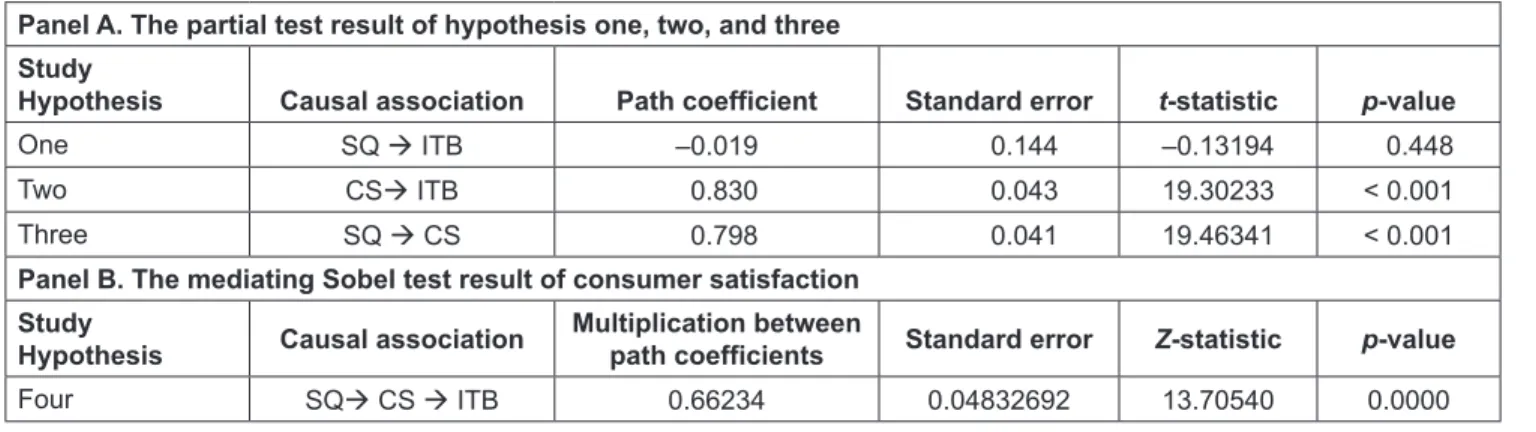
Table 5 exhibits the estimation result of the structural equation model. In this table, the path coefficient, standard error, t-statistic, and probability value to test hypotheses one, two, and three are available (see Panel A) and parameters related to the Sobel test (see Panel B).
To prove the first, second, and third null hypotheses, we liken the probability of t-statistic with a 5% significance level. In Table 5 of Panel A, this value is 0.448 for SQ ITB. Because this value is higher than 5%, we accept the null hypothesis declaring that service quality does not influence the intention to buy.
In the same panel, the probability is < 0.0001 for SQ CS and CS ITB. Because this probability is lower than 5%, we accept the alternative hypothesis declaring that service quality positively affects customer satisfaction, and customer satisfaction positively impacts the intention to buy.
To verify consumer satisfaction as the mediating effect, we employ the Sobel test, where the result is shown in Panel B of Table 5. In this panel, the probability of Z-statistic is 0.0000, which is lower than 5%. Consequently, consumer satisfaction mediates the effect of service quality on the intention to buy.
4.4. Discussion
From the prior section, it can be revealed that service quality does not directly affect the buying intention, but it indirectly affects this intention through customer satisfaction. Hence, customer satisfaction can mediate the service quality influence on purchase/buying intention. The absence of the service quality effect on this intention supports the study of Mambu (2015), Widajanti and Supriyatno (2017), and Wonggotwarin and Kim (2017). Furthermore, a positive influence of customer service on the purchase/buying intention is in line with the studies of Iskandar et al. (2015), Salem et al. (2015), Banjarnahor (2017), Nodira and Přemysl (2017), Murwanti and Pratiwi (2017), Putri and Astuti (2017), Widajanti and Suprayitno (2017), Alharthey (2019), Hong et al. (2020), Lamai et al. (2020), and Tran and Lee (2020). Meanwhile, a positive impact of service quality on customer satisfaction confirms the earlier research of Kim (2013), Iskandar et al. (2015), Banjarnahor (2017), Putri and Astuti (2017), Murwanti and Pratiwi (2017), Dawi et al. (2018), Octaviana and Nugrahaningsih (2018), Alharthey (2019). Additionally, the mediating effect of customer satisfaction confirms the work of Kalia et al. (2016), Murwanti and Pratiwi (2017), and Putri and Astuti (2017).
Hence, from the above results, we can conclude that MCU lecturers prefer gas stations affiliated with Pertamina.
To be attractive, the owners of a gas station, through their staff members on duty giving the service to customers, must conform to the Pertamina regulations regarding safety, quality, and reliability. The members have to remind the drivers or passengers to turn off their engine and cellphones during refueling. This rule is useful to avoid static electricity leading to a spark of flame. As the worst consequence, it can explode the petrol station. Besides, ease of payment is also a positive point; for example, customers can pay online via an electronic data capturing machine. Additionally, the staff members must be polite, dress neatly, wear the proper uniform, answer customer questions patiently and correctly, and be accurate and honest when refueling their vehicles.
Table 5: The Estimation Result of the Structural Equation Model Based on Variance Panel A. The partial test result of hypothesis one, two, and three
Study
Hypothesis Causal association Path coefficient Standard error t-statistic p-value
One SQ ITB –0.019 0.144 –0.13194 0.448
Two CS ITB 0.830 0.043 19.30233 < 0.001
Three SQ CS 0.798 0.041 19.46341 < 0.001
Panel B. The mediating Sobel test result of consumer satisfaction Study
Hypothesis Causal association Multiplication between
path coefficients Standard error Z-statistic p-value
Four SQ CS ITB 0.66234 0.04832692 13.70540 0.0000
5. Conclusion
As the answer to this research goal, we infer three points.
First, the purchase intention is not determined by service quality but positively affected by customer satisfaction.
Second, customer satisfaction is positively influenced by service quality. Last, the service quality impact on the intention to buy is successfully mediated by consumer satisfaction.
By concerning the limitations of this study, such as utilizing the respondents in the narrow population scope: the lecturers working at Maranatha Christian University and using one determinant factor of customer satisfaction and intention to purchase, the future scholars are expected to overcome these two things based on the following suggestions.
• They can utilize the lecturers from the higher education from the private and public institutions in West Java to represent their perspective and the sub-group analysis testing to prove the institution types as the moderating variable.
• They can use the other determinants of customer satisfaction and intention to buy. For customer satisfaction antecedents, the customer experience and product quality become the proposed alternative. Meanwhile, they can apply the perceived value, customer trust, brand image, and price for purchasing intention determining factors.
References
Alharthey, B. K. (2019). Impact of service quality on customer trust, purchase intention, and store loyalty, with mediating role of customers’ satisfaction on customer trust and purchase intention: Study of grocery shopping. British Journal of Marketing Studies, 7(2), 40–61. https://www.eajournals.org/
wp-content/uploads/Impact-of-Service-Quality-on-Customer- Trust-Purchase-Intention-and-Store-Loyalty.pdf
Aptaguna, A., & Pitaloka, E. (2016). The impact of service quality and price on the intention to use the Go-Jek services. Widyakala, 3, 49–56. https://doi.org/10.36262/widyakala.v3i0.24
Banjarnahor, J. (2017). The antecedent of customer satisfaction and its effect on purchase intention. Jurnal Manajemen dan Pemasaran Jasa, 10(1), 141–156. https://doi.org/10.25105/jmpj.v10i1.1680 Dawi, N. M., Jusoh, A., Streimikis, J., & Mardani, A. (2018).
The influence of service quality on customer satisfaction and customer behavioral intentions by moderating the role of switching barriers in the satellite pay-TV market. Economics and Sociology, 11(4), 198–218. https://doi.org/10.14254/2071- 789X.2018/11-4/13
Ghozali, I. (2008). The structural equation modeling: The alternative method by partial least square. Semarang: Badan Penerbit Universitas Diponegoro.
Hong, J. P., Kim, B. Y., & Oh, S. H. (2020). The perceived experiential value and service quality of auto maintenance and
repair service. Journal of Distribution Science, 18(1), 59–69.
https://doi.org/10.15722/jds.18.1.202001.59
Iskandar, D., Nurmalina, R., & Riani, E. (2015). The effect of service, product quality, the perceived value on consumer purchase intention. Indonesian Journal of Business and Entrepreneurship, 1(2), 51–62. https://doi.org/10.17358/
IJBE.1.2.51
Kalia, P., Arora, R., & Kumalo, S. (2016). Service quality, consumer satisfaction, and future purchase intentions in e-retail.
E-Service Journal, 10(1), 24–41. https://doi.org/10.2979/
eservicej.10.1.02
Kim, G. C. (2013). A study on the effects of super-supermarket service quality on satisfaction in-store selection. Journal of Industrial Distribution & Business, 4(2), 41–49. https://doi.
org/10.13106/jidb.2013.vol4.no2.41.
Kuncoro, M., Tandelilin, E., Ancok, D., Basuki, H., Purbasari, D. P., Adji, A., Wulandaru, D. R., Jurnasin, E., Purwoto, H., Sulistyaningrum, E., & Fitradi, A. (2009). A transformation of Pertamina: The Dilemma between business and public service orientations. Yogyakarta: Penerbit Galangpress.
Lamai, G. H., Thavorn, J., Klongthong, W., & Ngamkroeckjoti, C. (2020). Critical factors influencing revisit intention of large restaurant chains in Myanmar. Journal of Distribution Science, 18(12), 31–43. https://doi.org/10.15722/jds.18.12.
202012.31
Mambu, E. (2015). The influence of brand image and service quality on the customer intention to use Blue Bird Taxi Manado.
Jurnal Riset Ekonomi, Manajemen, Bisnis, dan Akuntansi, 3(4), 645–653. https://media.neliti.com/media/publications/2861- EN-the-influence-of-brand-image-and-service-quality-toward- consumer-purchase-intent.pdf
Murwanti, S., & Pratiwi, A. P. (2017). The impact of service quality and promotion on the using intention by customer satisfaction as mediating variable: A study in a motorcycle garage of Ahass at branch UMS. Proceeding of National Seminar of Management and Business Research: The Development Concept and E-business Studies in Indonesia (pp. 207–227). Surakarta:
Muhammadiyah University Press. https://publikasiilmiah.ums.
ac.id/handle/11617/8984
Mustika, N. (2019). The competitors threaten Pertamina in the gas station business. https://www.finansialku.com/pertamina- terancam-pesaing
Naik, C. N., Gantasala, S. B., & Prabhakar, G. V. (2010). Service quality and its effect on customer satisfaction in retailing.
European Journal of Social Sciences, 16(2), 231–243. https://
pdfs.semanticscholar.org/d124/e866687313a05a8ae38c2cd8d7 f49e257830.pdf
Naveed, R. T., Ahmad, N., Albassami, A. M., & Moshfegyan, M.
(2019). The impact of store image and store service quality on purchase intentions: A study from armed forces operated canteen stored (CSD), Pakistan. Pacific Business Review International, 11(8), 84–95. http://www.pbr.co.in/2019/2019_
month/Feb/7.pdf
Nodira, Z., & Přemysl, P. (2017). The effects on purchase intention:
The case of fruit juice. Journal of Competitiveness, 9(3), 111–128.
https://doi.org/10.7441/joc.2017.03.08
Octaviana, R. A., & Nugrahaningsih, H. (2018). The impact of experiential marketing and service quality on the purchasing intention through customer satisfaction as the intervening variable: A case study in PT. Meratus Line Jakarta. Media Manajemen Jasa, 6(2), 57–72. http://journal.uta45jakarta.
ac.id/index.php/MMJ/article/view/1406/973
Olsen, S., Tudoran, A. A., Brunsø, K., & Verbeke, W. (2013).
Extending the prevalent consumer loyalty modeling: The role of habit strength. European Journal of Marketing, 47(1/2), 303–323. https://doi.org/10.1108/03090561311285565 Putri, A., & Astuti, S. R. (2017). The factors affecting satisfaction
and its impact on the customer purchasing intention: Study in the Blends Pasta & Chocolate at branch Unika Semarang.
Diponegoro Journal of Management, 6(2), 73–82. https://
ejournal3.undip.ac.id/index.php/djom/article/view/17481 Salem, A., Ghafar, A., Ibrahim, M., Yousuf, M., & Ahmed, N. (2015).
Product perceived quality and purchase intention with consumer satisfaction. Global Journal of Management and Business Research: E-Marketing, 15(1), 21–27. https://globaljournals.
org/GJMBR_Volume15/3-Product-Perceived-Quality.pdf Sholihin, M., & Ratmono, D. (2013). The analysis of SEM-PLS by
the WarpPLS 3.0. Yogyakarta: Penerbit ANDI.
Sugiyanto, C., Nahartyo, E., Misra, F., Bastian, I., Hartono, J., Saputro, J. A, Sholihin, M., Sivilokonom, N. I., Almahendra, R., Winardi, R. D., Rostiani, R., Warsono, S., Ciptono, W. S., &
Widyaningsih, Y. A. (2018). Business research strategy.
Yogyakarta: Penerbit ANDI.
Sugiyono, S. (2019). The method of quantitative and qualitative studies and research & development (2nd ed.). Bandung: Alfabeta.
Suliyanto, S. (2009). Business research methods. Yogyakarta:
Penerbit ANDI.
Tjahjaningsih, E. T., Ningsih, D. H. U., Utomo, A. P. (2020). The effect of service quality and product diversity on customer loyalty: The role of customer satisfaction and word of mouth.
Journal of Asian Finance, Economics, and Business, 7(12), 481–490. https://doi.org/10.13106/jafeb.2020.vol7.no12.481 Tjiptono, F., Chandra, Y., & Diana, A. (2004). Marketing scale.
Yogyakarta: Penerbit ANDI.
Tran, V. D., & Le, N. M. T. (2020). Impact of service quality and perceived value on customer satisfaction. Journal of Asian Finance, Economics, and Business, 7(9), 517–526. https://doi.
org/10.13106/jafeb.2020.vol7.no9.517
Wang, Y., & Hazen, B. T. (2016). Consumer product knowledge and intention to purchase remanufactured products. International Journal of Production of Economics, 181(B), 460–469. https://
doi.org/10.1016/j.ijpe.2015.08.031
Widajanti, E., & Suprayitno, S. (2017). The analysis of the influence of price, service quality, and satisfaction on buying intention:
The study of the customers purchasing Steak Moen Moen in Surakarta. Eksplorasi, 29(2), 117–193. http://ejurnal.unisri.
ac.id/index.php/Exsplorasi/article/view/1585/1392
Widyastuti, S., Prasetyo, H., & Gustari, I. (2017). An investigating on the purchase intention: Developing dealers’ reputation through customer trust and service quality. European Journal of Social Sciences, 54(3), 316–331. http://dosen.univpancasila.
ac.id/dosenfile/1192211017153922778511October2018.pdf Wiyadi, W., & Ayuningtyas, N. (2019). Product aspects of
marketing effort and purchase intention. Humanities & Social Sciences Reviews, 7(3), 541–547. https://doi.org/10.18510/hssr.
2019.7380
Wonggotwarin, T., & Kim, S. (2017). The products’ factors affecting purchase intention: A case study of a condominium in Bangkok, Thailand. AU-GSB E-Journal, 10(1), 223–331.
http://www.assumptionjournal.au.edu/index.php/AU-GSB/
article/view/2875