J. Kor. Soc. Fish. Tech., 44(3), 174 183, 2008 DOI:10.3796/KSFT.2008.44.3.174
Fluorescent characteristics of baits and bait cages for swimming crab Portunus trituberculatus pots
Ho Young CHANG*, Jae Geun KOO1, Keun Woo LEE1, Bong Kon CHOand Byung Gon JEONG2
Marine Science & Production Major, Kunsan National University, Jeonbuk 573-701, Korea
1Food Science & Biotechnology Major, Kunsan National University, Jeonbuk, 573-701, Korea
2Environmental Engineering Major, Kunsan National University, Kunsan, Jeonbuk, 573-701, Korea
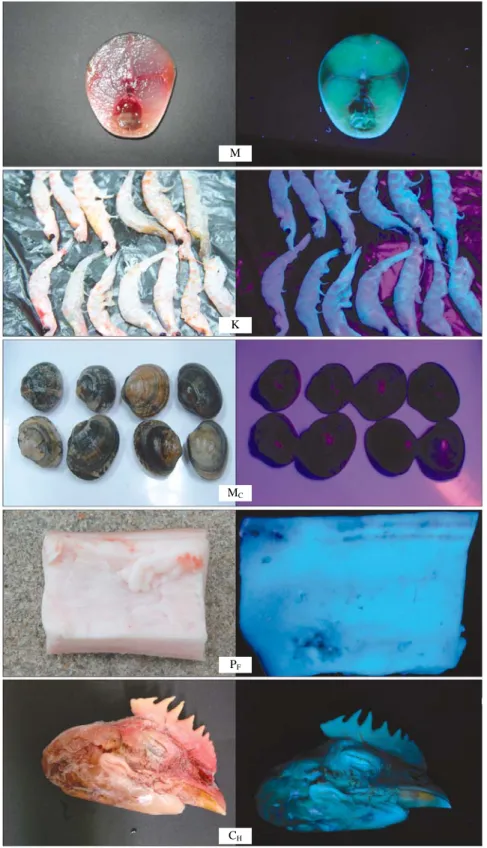
In order to develop the substitutive materials for natural baits of swimming crab pots, the fluorescent characteristics of the baits were analyzed, and the preference of fluorescent dyes were investigated by the mean entrapped catch number to the pots through the water tank experiments and fishing experiments. On the investigation of fluorescent characteristics by the 5 kinds of baits, mackerel, krill, manila clam, pig s fat and chicken s head which were used in substitutive baits for test in the UV long wave(365nm) area, it showed clear blue fluorescence in the skin of mackerel, shell of krill, manila clam and bill of chicken s head, and green fluorescence in the mackerel s muscle and internals, and yellow fluorescence in the pig s fat and chicken s head. On the investigation of fluorescent characteristics by the bait cages in the UV short wave(254nm) and long wave(365nm) area, it showed each green, red and blue fluorescence in the cylinderical or hexahedral red plastic bait cages which were painted each green, red and blue fluorescence dyes, but it showed yellowish green flourescence in the cylinderical or hexahedral red plastic bait cage which was painted yellow fluorescent dye. On the preference investigation of the fluorescent dyes of swimming crabs by the 5 kinds of the bait cages which were put the mackerel in the non-fluorescent red plastic cage(RFN), red, yellow, green and blue fluorescent plastic cages(RF, YF, GF, BF) each, non- fluorescent red plastic cage(RFN) was entrapped mean 2.0(6.7%), but blue fluorescent plastic cage(BF) was mean 5.0(16.7%) and it was more 2.5 times comparing to RFN, and red fluorescent cage(RF) was same level and green fluorescent cage(GF) was 50% of catch number comparing to RFN, and yellow fluorescent cage(YF) was entrapped nothing(F 46.324, P 0.05). On the investigation of the entrapped catch number
*Corresponding author: [email protected], Tel: 82-63-469-1819, Fax: 82-63-469-1811
(Chang et al., 2007),
.
Umezu(1966), Hara(1982) , Miyazaki et al.(1967)
,
. , Hara(1982), Carr and Thompson(1983), Takeda et al.(1984), Carr and Derby(1986), Harada(1986), Zimmer Faust(1989), Johnstone et al.(1990), Takaoka et al.(1990)
, .
,
. ,
,
.
(254nm)
(365nm) (Vilber Loubmat,
VL 6.LC)
.
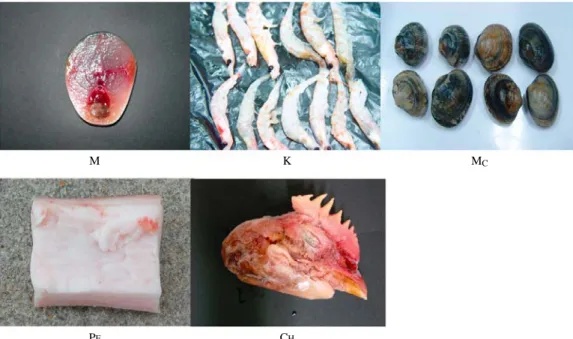
(M), (K), (MC), (PF),
(CH) 5 (Fig. 1),
, , ,
4 (Fig. 2) .
2005 10 26 31 2006
6 3 10
(φ64,000 10,600Hmm) .
Chang et al.(2007)
.
2005 10 26
31 136 170g,
61 70cm, 125 147cm ,
to the pots which were put the mackerel in the blue fluorescent hexahedral plastic cage(HP) and blue fluorescent silicon mackerel model cage(SM), HP was mean 3.4(11.3%) and it was a little more comparing to SM which was entrapped mean 3.2(10.7%)(t 0.775, P 0.05). Fishing experiments on the preference investigation of swimming crabs by the pots which were put in the non-fluorescent red plastic cage(RFN) and blue fluorescent plastic cage(BF) were conducted 3 times. Mean catching number and weight of RFN
were 71.7 ind.(18.3%) and 16.9kg(64.3%), and those of BF were 93.0 ind.(23.1%) and 19.8kg(64.5%), respectively.
Key words : Fluorescent characteristics, Swimming crab pots, Baits, Bait cage, Fishing experiments
16 18 . 2006 6 3 10 145 263g, 68 84cm,
147 174cm , 22 24 .
30 ,
10 6
.
,
4 ( , ,
, )
(Fig. 2) 5
. , Fig. 3
(HP) (SM) Fig. 1. Type of baits used in analysis of fluorescent characteristics.
M: mackerel, K: krill, MC: manila clam, PF: pig s fat, CH: chicken s head.
Fig. 2. Plastic bait cages painted by the fluorescent dye of four colors(red, yellow, green and blue).
M K MC
PF CH
. ,
(ANOVA) ,
T test .
(7.93G/T) 2008 5 23 25
(RFN)
(BF) 2 (Fig. 4)
3 .
590 250Hmm
35mm 135 1 2
. 1
, Fig. 5
30 40m .
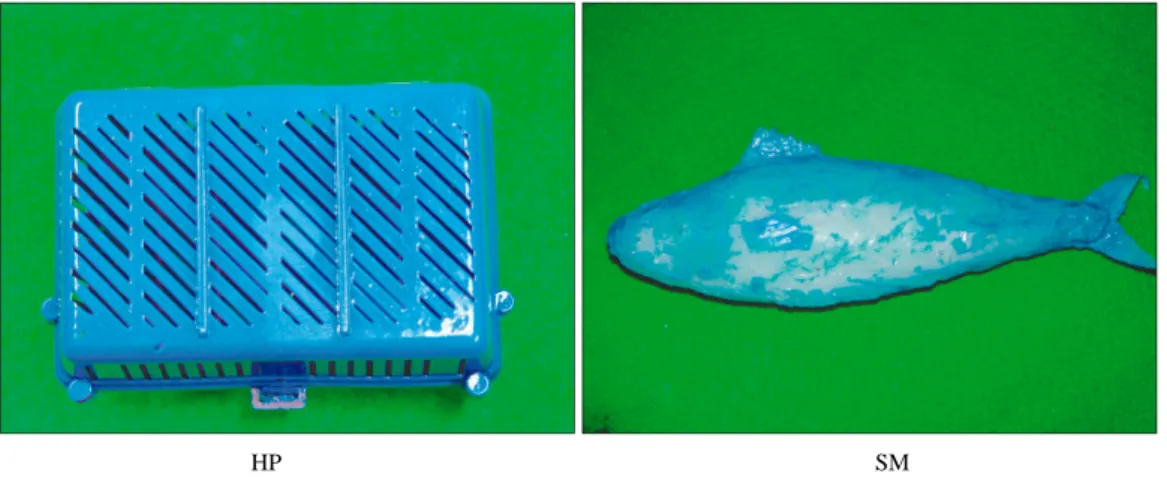
Fig. 3. Type of bait cages used in experiments of shape recognition to the bait cage.
HP: hexahedral plastic cage painted by blue fluorescent dye, SM: silicon mackerel model cage painted by blue fluorescent dye.
HP SM
Fig. 4. Non-fluorescent red bait cage(left) and fluorescent blue bait cage(right) used in fishing experiment.
Fig. 5. Map shows the location of fishing experiments
126 E KOREA
Kwanmaedo Maenggoldo
Chindo
Hajodo Maemuldo
Uido Hauido
Fishing ground of
swimming crab Haenam
34 N
Fig. 6. Images of the baits under the day light(left) and UV light(right).
M: mackerel, K: krill, MC: manila clam, PF: pig s fat, CH: chicken s head.
M
K
MC
PF
CH
(M), (K), (MC), (PF),
(CH) 5 UV (365nm)
( ) Fig. 6 .
, ,
, ,
. ,
, ,
,
,
. , UV
, UV
. ,
,
, , UV
(254nm) (365nm)
Fig. 7 . UV
(Fig. 7, left),
(Fig. 7, right). ,
,
.
.
(Fig. 6), Fig. 7. Images of bait cages painted by the fluorescent dye of four colors(red, yellow, green and blue) under the short wave(left) and long wave(right) UV light.
4 ( , ,
) (Fig.
2) 5
(M)
Table 1 .
(RFN) 2.0
(6.7%) , (BF)
5.0 (16.7%) RFN 2.5
,
(RF) RFN ,
(GF) 50%,
(YF)
(F 46.324, P 0.05).
Chang et al.(2007)
,
, (mantis shrimp)
(Mazel et al., 2003; Wikipedia, 2006).
,
. ,
Table
2 .
(HP) 3.4 (11.3%)
(SM) 3.2
(10.7%)
(t 0.775, P 0.05).
An and Arimoto(2007)
,
. , HP
, SM
.
(RFN) (BF)
2 3
Table 3 . RFN
Table 1. Results of the preference examination of swimming crab to the bait cage painted by the fluorescent dye
Table 2. Results of the shape recognition examination of swimming crab to the bait cage Type of bait cages
Type of bait cages Entrapped number (Entrapped rate, %)
Hexahedral plastic bait cage (HP)
Silicon mackerel model cage (SM)
3.4 (11.3)
3.2 (10.7) Entrapped number
(Entrapped rate, %)
*: red non-flourescent bait cage, **: yellow flourescent bait cage, ***: red flourescent bait cage, ****: green flourescent bait cage, *****: blue flourescent bait cage. F 46.324, P 0.05.
t 0.775, P 0.05.
RFN* YF** RF*** GF**** BF*****
2.0 (6.7)
0.0 (0.0)
2.0 (6.7)
1.0 (3.3)
5.0 (16.7)
392.3
26.3kg , 71.7
(18.3%) 16.9kg(64.3%) . BF
403.3 30.7kg ,
93.0 (23.1%) 19.8kg(64.5%)
. 3
,
30%
, 20%
. ,
20 30%
.
,
.
,
, , 5
UV (365nm)
, ,
, , ,
. ,
, , Table 3. Results of fishing experiment used in red non-flourescent bait cages and blue flourescent bait cages
Swimming crab Portunus trituberculatus Ovalipes punctatus Shore swimming crab Charybdis japonica Conger eel Conger myriaster Robust tonguesole Cynoglossus robustus Bartail flathead Platycephalus indicus Blackmouth goosefish Lophiomus setigerus
Anomura Prawn
Snail Others
Total
Species 23rd
May, 2008 24th May, 2008
25th
May, 2008 Mean 23rd
May, 2008 24th May, 2008
25th
May, 2008 Mean
RFN* BF**
66 (16.1)
6 (0.4)
6 (1.5)
3 (0.5)
2 (0.9)
194 (3.0) 64 (0.2)
5 (0.3)
43 (2.7)
71 (16.4)
8 (0.5)
3 (0.3)
7 (1.7)
4 (0.6)
1 (0.4)
176 (2.7) 57 (0.2)
5 (0.3)
44 (2.5)
78 (18.2)
5 (0.4)
3 (0.4)
4 (1.0)
3 (0.5)
2 (0.7)
189 (2.9) 69 (0.2)
8 (0.6)
51 (2.8)
71.7 (16.9)
6.3 (0.4) 2.0 (0.2) 5.7 (1.4) 3.3 (0.5) 0.7 (0.2) 1.0 (0.4) 186.3 (2.9) 63.3 (0.2) 6.0 (0.4) 46.0 (2.7)
90 (18.7)
6 (0.3)
4 (0.4)
8 (2.0)
6 (0.7)
3 (1.5)
1 (0.2)
181 (3.0)
32 (0.1)
8 (0.6)
49 (2.8)
88 (18.4)
9 (0.5)
2 (0.3)
5 (1.3)
2 (0.2)
2 (0.8)
173 (2.9)
48 (0.2)
11 (0.8)
45 (2.5)
101 (22.2)
7 (0.3)
4 (0.4)
5 (1.2)
3 (0.3)
3 (1.4)
2 (0.4)
196 (3.3) 39 (0.2)
15 (1.0)
62 (3.2)
93.0 (19.8) 7.3 (0.4) 3.3 (0.4) 6.0 (1.5) 3.7 (0.4) 2.7 (1.2) 1.0 (0.2) 183.3 (3.1) 39.7 (0.2) 11.3 (0.8) 52.0 (2.8) 389
(25.6)
376 (25.6)
412 (27.7)
392.3 (26.3)
388 (30.3)
385 (27.9)
437 (33.9)
403.3 (30.7)
*: red non-flourescent bait cage, **: blue flourescent bait cage, ( ): catching weight(kg).
UV
(254nm) (365nm)
, UV ,
. ,
,
.
.
4
( , , )
5
,
2.0
(6.7%) ,
5.0 (16.7%)
2.5 ,
, 50%,
(F 46.324, P 0.05).
,
,
, (HP) 3.4 (11.3%)
(SM) 3.2 (10.7%)
(t 0.775), P 0.05).
(RFN)
(BF) 2
3 ,
RFN
71.7 (18.3%) 16.9kg(64.3%)
, BF 93.0
(23.1%) 19.8kg(64.5%) .
( : F10400506
A210000110) . ,
.
An, Y.I., and T. Arimoto, 2007. Development of artificial bait for octopus drift line. Jour. Kor. Soc. Fish.
Tech., 43(4), 291 300.
Carr, W.E.S. and C.D. Derby, 1986. Chemically stimulated feeding behavior in marine animals. J.
Chem. Ecol., 12: 989 1011.
Carr, W.E.S. and H.W. Thompson, 1983. Adenosine 5- monophoshpate, an internal regulatory agent, is a potent chemoattractant for a marine shrimp. J.
Comp. Phsiol., 153, 47 53.
Chang, H.Y., J.G. Koo, K.W. Lee and B.K. Cho, 2007.
Attracting effect of baits used in trap for swimming crab. Jour. Kor. Soc. Fish. Tech., 43(4), 301 309.
Hara, J.J., 1982. Chemoreception in fishes. (ed. by J.J.
Hara). Elsevier Sci. Pub. Co., Amsterdam. pp. 433.
Harada, K., 1986. Feeding attraction activities of nucleic acid related compounds for abalone, oriental weather fish and yellowtail. Bull. Japanese Soc. Sci.
Fish., 52(11), 1961 1968.
Johnstone, A.D.F. and A.M. Mackie, 1990. Laboratory investigations of bait acceptance by the cod, Gadus morthua L.: investigations of feeding stimulants.
Fish. Res., 9, 219 230.
Mazel, C.H., T.W. Cronin, R.L. Caldwell and N.J.
Marshall, 2003. Fluorescent enhancement of signaling in a mantis shrimp, Science Express (online). 2003.11.13: ENS. 2003.11.14, pp. 1.
Miyazaki, C., S. Yazima, T. Koyama and S. Mitsugi, 1967. Fishing efficiency of feed stuff containing chemical stimulant. Bull. Tokai Reg. Fish. Res.
Lab., No. 49, 99 103.
Takaoka, O., K. Takii, M. Nakamura, H. Kumai and M.
Takeda, 1990. Identification of feeding stimulants for marbled rockfish. Bull. Japanese. Soc. Sci. Fish., 56(2), 345 351.
Takeda, M., K. Takii and K. Matsui, 1984. Identification of feeding stimulants for juvenile eel. Bull. Japanese
Soc. Sci. Fish., 50: 645 651.
Umezu, T., 1966. Behavioral response of fishes to chemical stimuli. Bull. Japanese Soc. Sci. Fish., 32(3), 352 376.
Wikipedia, 2006. The free encyclopedia. http://en.
wikipedia.org/wiki/Mantis_shrimp, pp. 1.
Zimmer-Faust, Richard K., 1989. The relationship between chemoreception and foraging behavior in crustaceans. Limnol. Oceanogr., 34(7), 1367 1374.
2008 7 2
2008 7 22 1
2008 8 14