• 검색 결과가 없습니다.

Development of a Wearable Inertial Sensor-based Gait Analysis Device Using Machine Learning Algorithms -Validity of the Temporal Gait Parameter in Healthy Young Adults-

N/A
N/A
Protected

Academic year: 2021

Share "Development of a Wearable Inertial Sensor-based Gait Analysis Device Using Machine Learning Algorithms -Validity of the Temporal Gait Parameter in Healthy Young Adults-"

Copied!
10
0
0

로드 중.... (전체 텍스트 보기)

전체 글

(1)

| Abstract |

Purpose: The study aims were to develop a wearable inertial sensor-based gait analysis device that uses machine learning algorithms, and to validate this novel device using temporal gait parameters.

Methods: Thirty-four healthy young participants (22 male, 12 female, aged 25.76 years) with no musculoskeletal disorders were asked to walk at three different speeds. As they walked, data were simultaneously collected by a motion capture system and inertial measurement units (Reseed®). The data were sent to a machine learning algorithm adapted to the wearable inertial sensor-based gait analysis device. The validity of the newly developed instrument was assessed by comparing it to data from the motion capture system.

Results: At normal speeds, intra-class correlation coefficients (ICC) for the temporal gait parameters were excellent (ICC [2, 1], 0.99∼0.99), and coefficient of variation (CV) error values were insignificant for all gait parameters (0.31∼1.08%). At slow speeds, ICCs for the temporal gait parameters were excellent (ICC [2, 1], 0.98∼0.99), and CV error values were very small for all gait parameters (0.33∼1.24%). At the fastest speeds, ICCs for temporal gait parameters were excellent (ICC [2, 1], 0.86∼0.99) but less impressive than for the other speeds. CV error values were small for all gait parameters (0.17∼5.58%).

Conclusion: These results confirm that both the wearable inertial sensor-based gait analysis device and the machine learning algorithms have strong concurrent validity for temporal variables. On that basis, this novel wearable device is likely to prove useful for establishing temporal gait parameters while assessing gait.

Key Words: Gait, Machine learning, Wearable electronic devices, Motion

†Corresponding Author : Chang-Ho Song ([email protected])

Original Article Open Access

Development of a Wearable Inertial Sensor-based Gait Analysis Device Using Machine Learning Algorithms -Validity of the Temporal Gait Parameter in Healthy Young Adults-

Pyong-Wha Seol, M.D.⋅Heung-Jong Yoo, B.S.

1

⋅Yoon-Chul Choi, B.S.

1

⋅Min-Yong Shin, B.S.

1

⋅ Kwang-Jae Choo, Ph.D.

1

⋅Kyoung-Shin Kim, B.S.

1

⋅Seung-Yoon Baek, P.T.⋅

Yong-Woo Lee, P.T., Ph.D.⋅Chang-Ho Song, P.T., Ph.D.

1)

Department of Physical Therapy, Sahmyook University

1
Bodit Inc Received: June 18, 2020 / Revised: June 28, 2020 / Accepted: June 29, 2020

ⓒ 2020 Journal of Korea Proprioceptive Neuromuscular Facilitation Association

This is an Open Access article distributed under the terms of the Creative Commons Attribution Non-Commercial License

(http://creativecommons.org/licenses/by-nc/3.0) which permits unrestricted non-commercial use, distribution, and reproduction

in any medium, provided the original work is properly cited.

(2)

Ⅰ. Introduction

The wearable inertial measurement unit (IMU), which combines an accelerometer and a gyroscope, has developed rapidly, opening up a significant scientific and applicable breakthrough in many research fields. Due to its many positive properties such as light weight, small size, low power consumption, portability and low cost, inertial sensors are also increasingly used in human motion analysis as they are more and more commonly used. In particular, since walking ability is one of the essential functions that have an important influence on quality of life, many studies on walking analysis using inertial sensors have been conducted (Sprager & Juric, 2015).

The gait study using the inertial sensor, rather than the gait study using the 3D motion analyzer, which was mainly available only in the laboratory, was able to continuously analyze in the clinical environment inside and outside the laboratory (Shull et al., 2014). In addition, due to the integration of smart devices (e.g. smartphones and tablets) and inertial sensors, it is used in various areas such as sports walking speed estimation (Yang & Li, 2012) and health condition evaluation (Yamada et al., 2012), fall detection (Sposaro & Tyson, 2009).

However, analysis of the spatiotemporal variables of gait using Wearable IMU has been conducted (Caldas et al., 2017; Chen et al., 2016). Few are used to meet clinical assessment needs (Mancini & Horak, 2016). One of them is the APDM sensor, which allows clinicians to perform gait evaluation in a simple and fast manner.

A sensor is placed on the ankle or foot to evaluate gait parameters. However, he noted that this sensor has strengths and weaknesses such as improved wear-ability due to placement on the ankle, increased data volume along with the placement of the foot, as well as a study on validity and repeatability (Washabaugh et al., 2017).

Many studies have analyzed gait using one or two

sensors (Bertoli et al., 2018; Kluge et al., 2017; Schwesig et al., 2011). However, these studies measured spatial parameters for one leg. The calculation of the factors (step length, and step width) for the spatial relationship of both legs is complicated and there is still insufficient research on this problem (Bertuletti et al., 2017; Kose et al., 2012;

Takeda et al., 2014).

In a comparative study on the spatial and temporal gait analysis between the standard stationary treadmill and the inertial sensor attached to the body, which is commonly used in gait analysis, the speed and stride of slow gait in temporal gait characteristics It showed a slight difference except length. The study was conducted in healthy elderly people (Donath et al., 2016).

While the wearable IMU can be applied in various forms and has numerous advantages, it is technically difficult to assess gait speed from accelerometry data, and there are some inaccuracies in obtaining and analyzing the data. To improve this, machine learning techniques can be used to significantly improve accuracy (Potluri et al., 2019). Machine learning is the process of solving tasks for which it is difficult to design or to program explicit algorithms (Lee et al., 2017). Machine learning is the process of affording computers the ability to learn without writing explicit programs. (Samuel, 1959). The purpose of machine learning is to learn data prediction values after training with existing data. To this end, a machine learning algorithm is validated by training and testing processes. The core of the training process is to generate the model by learning the initial data and that of the test process is to derive the result by comparing and verifying the data with that of the learning model (Lee et al., 2017).

Therefore, in this study, the data collected using the

wearable IMU is analyzed by machine learning and the

result is compared with the gait analysis result using the

3D gait analysis system to increase the validity of the

(3)

temporal gait parameter through the wearable IMU.

Ⅱ. Methods 1. Subjects

Thirty-four healthy young participants (25.76 ± 4.09 years old; 12 women, 22 men; height 170.14 ± 10.07cm;

weight 66.47 ± 13.61kg) from S University in Seoul were recruited for this study. None of the participants had any disabilities or history of musculoskeletal, neurological, or equilibrium sensory dysfunctions that could affect gait on a level surface. Subjects were given detailed information about the study prior to the experiment.

Written consent was obtained from all subjects prior to participation in accordance with the ethical principles of the Helsinki Declaration.

2. Procedures

This study was conducted in three stages. The first stage was the data collection process, in which data was collected by simultaneously using the infrared camera and inertial measurement unit (Reseed® 1.2.0, Bodit, Korea).

The second stage was the machine learning process, in which the data collected and processed by the infrared camera, was learned and verified through a training process and testing process. The third stage was the validity verification process, in which the data collected by the infrared camera was compared with the data calculated through machine learning. Data obtained from 3570 steps executed at 3 speeds were used for machine learning and data from 3642 steps executed at 3 speeds were used to validate the wearable inertial sensor-based gait analysis device using a machine learning algorithm.

3. Motion capture and data collection

An infrared camera motion analysis system (Miqus 3, Qualisys, Sweden) was used to measure temporal gait data. 16 infrared cameras were used and the sample rate was 100 frames/sec. For the infrared cameras to track motion reflective markers, clusters were attached to the thigh and shin to measure movement. To collect image data, four cameras were installed at the front, four cameras at the back and four cameras each on the left and right sides. All subjects wore leggings and a total of 52 markers were attached to the joints and segmental surfaces of the entire body and a resting calibration was performed. After removing the static marker, sufficient practice was conducted to induce a natural gait motion. The walking speed was regulated to 3 modes; slow and fast walking was performed based on the subject’s self-selected speed.

The walking distance was more than 5 meters and 3 strides were measured for each foot. The measurement program used Qualisys Track Manager version 2020. The speed measurements were made 5 times and averaged for each trial, and the data were compared 5 times without being averaged.

Matlab (MATLAB Student R2020a, MatWorks, USA) was used to extract the temporal gait parameters from the collected data the lowest point of the z-axis trajectory of the heel marker was used to define the heel strike, and the XY angle value of the vertical segment of the heel marker and 1st metatarsal marker was used to define the toe-off.

4. Machine learning

An inertial measurement unit (Reseed® 1.2.0, Bodit,

Korea) was used to collect basic data for the machine

learning stage. The inertial sensor was calibrated to detect

angular velocity along 3-axes for acceleration and 3-axes

(4)

for rotation (Fig. 1). The inertial sensor measured the change in the rotational angular velocity due to acceleration and linear rotation generated when walking.

Inertial sensors were attached to each ankle, the right anterior superior iliac spine, and half way toward the navel. The sensor attached to the ankle was used to detect heel contact and toe-off, which are difficult to infer from pelvic movement. The three inertial sensors were synchronized by simultaneously receiving the start/end signals, but the measurements from the infrared camera and inertial sensor were unsynchronized.

Fig. 1. Inertial measurement unit (Reseed

®

1.2.0, Bodit, Korea).

The heel contact and toe-off actions acquired from the inertial sensor worn on the ankle were synchronized with the motion analyzer to synchronize the signal from the sensor attached to the pelvis and the signal from the infrared camera. By processing the acceleration and angular velocity data collected from the inertial sensor attached to the pelvis, 127 features were extracted to be used for machine learning.

To extract features for machine learning from the signals, the 6-axes signals of the most basic signals Ax, Ay, Az, Gx, Gy, and Gz, filtered signals, and the Euler angles that could be extracted using them, were used to represent the temporal domain. A total of 145 features were extracted from factors such as the integral value

of ± based on the window size and zero-crossing point.

To improve the model, the highly correlated features were first identified through feature-based correlation analysis.

Because highly correlated features were duplicated, the performance of the model could have been affected thus requiring their removal. In addition, features with low importance were classified using a feature importance scale calculated by using the Light GBM algorithm. A total of 127 features were selected through this feature selection process.

For the machine learning stage of this study, a regression learning model was used. Gradient Boosting, one of the tree-based machine learning algorithms, was used to create a predictive model for regression analysis.

Before training the model, the training dataset was divided into training / validation datasets and the model was tuned.

For model tuning, the coarse-to-fine search method was used to find model parameters quickly over a wide range and reduce the range again to find the optimal model parameters. To train the model, we divided it into a training dataset and a testing dataset using 5-fold cross-validation. The model was trained using the training dataset and the model was validated with the testing dataset. Jupyter notebook software (v.2.3, Project Jupyter, USA) was used for machine learning and the language was Python.

5. Data Analysis

The temporal gait parameters include the right step

time, left step time, right stride time, left stride time,

cadence, double limb support (%), single limb support

(%), left stance phase (%), left swing phase (%), right

stance phase (%), and right swing phase (%). Statistical

analysis was performed using MedCalc version 19.3

(MedCalc Software Ltd, Belgium). All measured data

were expressed by their mean and standard deviation (SD).

(5)

The level of agreement between motion capture using an infrared camera and a wearable inertial sensor-based gait analysis device was analyzed using an in-class correlation coefficient (ICC [2, 1]) [21]. The coefficient of variation (CV) described by Bland and Altman, and 95% limits of agreement (LOA) were calculated to compare absolutely the parameters obtained in both sessions [23]. The CV values between the results obtained through the two devices were converted to percentages by calculating the CV obtained using the SD of the difference score (Sd) (ME = Sd / √2, CVME = 2ME / (X1 + X2) × 100%). The ICC’s point estimates were rated excellent (0.9 to 1), good (0.74 to 0.9), moderate (0.4 to 0.73), and poor (0 to 0.39). The statistical significance was set to p <0.05 for all procedures.

Ⅲ. Results

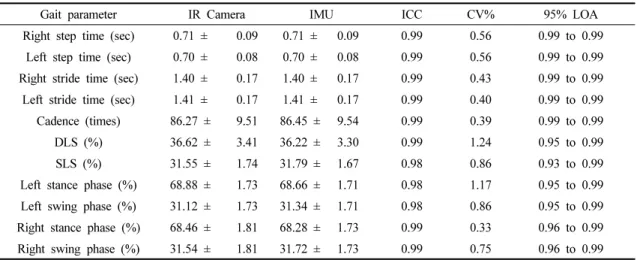
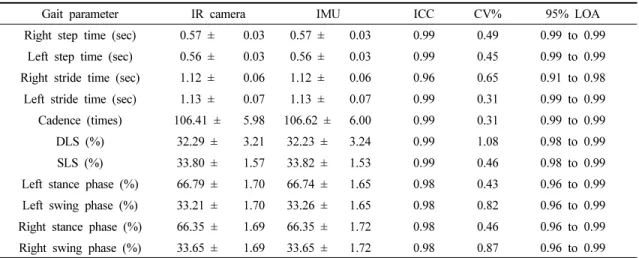
Table 1 lists the level of agreement between the infrared camera and IMU with machine learning for each gait variable. For normal speed, the ICCs for the temporal gait parameters were excellent (ICC [2, 1], 0.99∼0.99).

The CV values were very small for all gait parameters (0.31∼1.08%) (Table 1). For slow speed, the ICCs for the temporal gait parameters were also excellent (ICC [2, 1], 0.98∼0.99). The error values for the coefficients of variation method were very small for all gait parameters (0.33∼1.24%) (Table 2). For fast speeds, the ICCs for temporal gait parameters were excellent (ICC [2, 1], 0.86

∼0.99) but at fast speeds, the ICCs were of a lower standard than those at the other speeds. The error values for the coefficients of variation method were small for all gait parameters (0.17∼5.58%) (Table 3). Scatter plots and Bland-Altman plots of the main spatial and temporal gait parameters obtained from the infrared camera against the IMU with machine learning are presented in Fig. 2.

Ⅳ. Discussion

In this study, we developed a wearable inertial sensor-based gait analysis device using a machine learning algorithm and confirmed the validity of the temporal gait parameters’ evaluation. Many errors have been caused in using the data obtained from the wearable inertial sensor

Gait parameter IR camera IMU ICC CV% 95% LOA

Right step time (sec) 0.57 ± 0.03 0.57 ± 0.03 0.99 0.49 0.99 to 0.99 Left step time (sec) 0.56 ± 0.03 0.56 ± 0.03 0.99 0.45 0.99 to 0.99 Right stride time (sec) 1.12 ± 0.06 1.12 ± 0.06 0.96 0.65 0.91 to 0.98 Left stride time (sec) 1.13 ± 0.07 1.13 ± 0.07 0.99 0.31 0.99 to 0.99 Cadence (times) 106.41 ± 5.98 106.62 ± 6.00 0.99 0.31 0.99 to 0.99

DLS (%) 32.29 ± 3.21 32.23 ± 3.24 0.99 1.08 0.98 to 0.99

SLS (%) 33.80 ± 1.57 33.82 ± 1.53 0.99 0.46 0.98 to 0.99

Left stance phase (%) 66.79 ± 1.70 66.74 ± 1.65 0.98 0.43 0.96 to 0.99 Left swing phase (%) 33.21 ± 1.70 33.26 ± 1.65 0.98 0.82 0.96 to 0.99 Right stance phase (%) 66.35 ± 1.69 66.35 ± 1.720.98 0.46 0.96 to 0.99 Right swing phase (%) 33.65 ± 1.69 33.65 ± 1.720.98 0.87 0.96 to 0.99 ICC: intra correlation coefficient, CV: coefficients of variation, LOA: limits of agreement, SLS: single limb support, DLS:

double limb support

Table 1. Level of agreement of the temporal gait parameters for subjects at normal speed

(6)

which attached to one side of the pelvis for evaluating gait parameter. However, using the machine learning technique produced a lower error rate and the utility of this equipment for gait analysis was confirmed.

Machine learning techniques have the potential to process nonlinearity more efficiently and are easier to implement than assumption-laden traditional methods and linear modeling, thereby demonstrating higher

performance. Among the various machine learning techniques, artificial neural networks have been utilized to detect very accurately the stance-swing phase that cannot be effected with traditional methods such as peak and valley detection (Rhudy & Mahoney, 2018). The machine learning technique used in this study for the regression machine learning model, The Gradient Boosting Algorithm, is one of the tree-based machine

Gait parameter IR Camera IMU ICC CV% 95% LOA

Right step time (sec) 0.71 ± 0.09 0.71 ± 0.09 0.99 0.56 0.99 to 0.99 Left step time (sec) 0.70 ± 0.08 0.70 ± 0.08 0.99 0.56 0.99 to 0.99 Right stride time (sec) 1.40 ± 0.17 1.40 ± 0.17 0.99 0.43 0.99 to 0.99 Left stride time (sec) 1.41 ± 0.17 1.41 ± 0.17 0.99 0.40 0.99 to 0.99 Cadence (times) 86.27 ± 9.51 86.45 ± 9.54 0.99 0.39 0.99 to 0.99

DLS (%) 36.62 ± 3.41 36.22 ± 3.30 0.99 1.24 0.95 to 0.99

SLS (%) 31.55 ± 1.74 31.79 ± 1.67 0.98 0.86 0.93 to 0.99

Left stance phase (%) 68.88 ± 1.73 68.66 ± 1.71 0.98 1.17 0.95 to 0.99 Left swing phase (%) 31.12 ± 1.73 31.34 ± 1.71 0.98 0.86 0.95 to 0.99 Right stance phase (%) 68.46 ± 1.81 68.28 ± 1.73 0.99 0.33 0.96 to 0.99 Right swing phase (%) 31.54 ± 1.81 31.72 ± 1.73 0.99 0.75 0.96 to 0.99 ICC: intra correlation coefficient, CV: coefficients of variation, LOA: limits of agreement, SLS: single limb support, DLS:

double limb support

Table 2. Level of agreement of the temporal gait parameters for subjects at slow speed

Gait parameter IR Camera IMU ICC CV% 95% LOA

Right step time (sec) 0.51 ± 0.04 0.51 ± 0.04 0.99 0.98 0.98 to 0.99 Left step time (sec) 0.51 ± 0.03 0.51 ± 0.03 0.98 0.97 0.97 to 0.99 Right stride time (sec) 1.00 ± 0.06 1.00 ± 0.06 0.99 0.17 0.99 to 0.99 Left stride time (sec) 1.01 ± 0.07 1.01 ± 0.07 0.95 0.39 0.90 to 0.98 Cadence (times) 119.35 ± 8.20 119.10 ± 8.17 0.99 0.34 0.99 to 0.99

DLS (%) 29.76 ± 4.82 29.31 ± 3.56 0.86 5.58 0.70 to 0.93

SLS (%) 35.31 ± 1.89 35.24 ± 1.84 0.99 0.51 0.98 to 0.99

Left stance phase (%) 65.18 ± 1.91 65.26 ± 1.83 0.99 0.29 0.98 to 0.99 Left swing phase (%) 34.82 ± 1.91 34.74 ± 1.83 0.99 0.55 0.98 to 0.99 Right stance phase (%) 64.84 ± 2.07 64.82 ± 2.05 0.99 0.43 0.97 to 0.99 Right swing phase (%) 35.16 ± 2.07 35.18 ± 2.05 0.99 0.79 0.97 to 0.99 ICC: intra correlation coefficient, CV: coefficients of variation, LOA: limits of agreement, SLS: single limb support, DLS:

double limb support

Table 3. Level of agreement of the temporal gait parameters for subjects at fast speed

(7)

learning algorithms, used to create a predictive model for regression analysis. It is a prediction model that performs regression analysis or classification analysis and among the ensemble methodologies belongs to the boosting series of prediction models that perform variable selection and have the advantage of being computationally fast and easy to use. Known as AdaBoost, it was first proposed by Freund and Schapire (1996), is widely used, and exhibits high prediction accuracy. In the case of Gradient Boosting, there is no need to standardize or

normalize the features. In particular, it shows excellent performance in predicting the results using the tabular form of standardized data (matrix data) (Gonzalez-Recio et al., 2013).

The significance of using machine learning in this experiment is not simply comparing the agreement with the motion analyzer, but finding a meaningful signal through machine learning and recognizing it as a gait among the many significant signals that come into the sensor attached to one side of the pelvis. Polturi et al Fig. 2. Relationship between infrared camera and IMU with machine learning for main temporal gait parameters in

speed changes.

(8)

(Potluri et al., 2019) also tried to build an automated gait parameter estimation system related to gait analysis applications in various fields such as clinical and sports using machine learning in gait analysis. To further illustrate, machine learning provides timely access to accurate and reliable knowledge of a person’s gait characteristics and provides an opportunity to track progress or decrease in gait quality, enabling early diagnosis of gait-related pathologies. And can help you find the right treatment for illness.

In the study of Sebastijan and Matjaz (Sprager & Juric, 2015) suggested a new model of machine learning. The group-based model, which is the same method as in this study, may be effective in identifying clinically relevant differences in gait between individuals, but it is difficult or unrealistic to test a large number of experimenters or some clinical groups. Therefore, it is said that it is possible to identify gait patterns using a subject-specific model and track changes within a single patient. It is said that using this model has the advantage of defining the current state of the subject’s gait pattern and identifying changes or outliers in the original pattern.

In the results of this study, the ICC for DLS was the lowest with 86.46, which is different from other studies that directly attached the sensor to the ankle (Donath et al., 2016; Teufl et al., 2018), attaching the sensor to the pelvis (middle between ASIS and the navel). In these studies, the difference was most pronounced when measuring slow gait, which is why sensors that were not directly attached to the skin would have more movement at a slower pace. In our experiment, this may be because there will be fewer signals coming into the sensor during the DLS period when both legs are touching the ground.

Several studies have been conducted using wearable inertial sensors and the placement of the device has varied from the head (Menz et al., 2003), to the wrist, ankle, waist (Park et al., 2016), and shin (Howcroft et al., 2016).

The most common attachment location has been at lumbar L3-L5 approximately at the center of mass (Auvinet et al., 2002; Menz et al., 2003; Senden et al., 2012) In this experiment, it was designed to be attached centrally at the waistline between the navel and ASIS without a strap for ease of use during daily activities.

The limitation of this study was that the experiment was conducted only for normal adults without spatial gait parameters. It is necessary to extend the validity of these findings by conducting research on participants with various diseases and from varying age groups.

Ⅴ. Conclusion

In conclusion, this study revealed the validity of the wearable inertial sensor on temporal parameters for gait analysis. It is thought that gait analysis will be more convenient under various conditions through a cost- effective wearable inertial sensor. Therefore, this new method provides an objective and evidence-informed way for effectively integrating machine learning and wearable technology to analyze human movement patterns to give and understand clinically important meanings.

Acknowledgements

This work was supported by the Seoul Business Agency (SBA) R&BD program grant funded by the Seoul Metropolitan Government (No. IC190001).

References

Auvinet B, Berrut G, Touzard C, et al. Reference data for

normal subjects obtained with an accelerometric

(9)

device. Gait and Posture. 2002;16(2):124-134.

Bertoli M, Cereatti A, Trojaniello D, et al. Estimation of spatio-temporal parameters of gait from magneto- inertial measurement units: multicenter validation among Parkinson, mildly cognitively impaired and healthy older adults. Biomedical Engineering Online.

2018;17(1):58.

Bertuletti S, Cereatti A, Comotti D, et al. Static and dynamic accuracy of an innovative miniaturized wearable platform for short range distance measurements for human movement applications. Sensors (Basel).

2017;17(7):1492.

Caldas R, Mundt M, Potthast W, et al. A systematic review of gait analysis methods based on inertial sensors and adaptive algorithms. Gait Posture. 2017;57:

204-210.

Chen S, Lach J, Lo B, et al. Toward pervasive gait analysis with wearable sensors: a systematic review. IEEE Journal of Biomedical and Health Informatics.

2016;20(6):1521-1537.

Donath L, Faude O, Lichtenstein E, et al. Validity and reliability of a portable gait analysis system for measuring spatiotemporal gait characteristics: comparison to an instrumented treadmill. Journal of Neuroengineering and Rehabilitation. 2016;13:6.

Donath L, Faude O, Lichtenstein E, et al. Mobile inertial sensor based gait analysis: validity and reliability of spatiotemporal gait characteristics in healthy seniors.

Gait Posture. 2016;49:371-374.

Gonzalez-Recio O, Jimenez-Montero JAAlenda R. The gradient boosting algorithm and random boosting for genome-assisted evaluation in large data sets. Journal of Dairy Science. 2013;96(1):614-624.

Howcroft J, Kofman J, Lemaire ED, et al. Analysis of dual-task elderly gait in fallers and non-fallers using wearable sensors. Journal of Biomechanics. 2016;49(7):

992-1001.

Kluge F, Gassner H, Hannink J, et al. Towards mobile gait analysis: concurrent validity and test-retest reliability of an inertial measurement system for the assessment of spatio-temporal gait parameters. Sensors (Basel).

2017;17(7):1622.

Kose A, Cereatti ADella Croce U. Bilateral step length estimation using a single inertial measurement unit attached to the pelvis. Journal of Neuroengineering and Rehabilitation. 2012;9:9.

Mancini MHorak FB. Potential of APDM mobility lab for the monitoring of the progression of Parkinson’s disease. Expert Review of Medical Devices.

2016;13(5):455-462.

Menz HB, Lord SRFitzpatrick RC. Age-related differences in walking stability. Age and Ageing. 2003;32(2):

137-142.

Park JH, Mancini M, Carlson-Kuhta P, et al. Quantifying effects of age on balance and gait with inertial sensors in community-dwelling healthy adults. Experimental Gerontology. 2016;85:48-58.

Potluri S, Chandran AB, Diedrich C, et al. Machine learning based human gait segmentation with wearable sensor platform. Conference Proceedings of the Annual International Conference of the IEEE Engineering in Medicine and Biology Society. 2019;2019:588-594.

Rhudy MBMahoney JM. A comprehensive comparison of simple step counting techniques using wrist- and ankle-mounted accelerometer and gyroscope signals.

Journal of Medical Engineering & Technology.

2018;42(3):236-243.

Schwesig R, Leuchte S, Fischer D, et al. Inertial sensor based reference gait data for healthy subjects. Gait Posture.

2011;33(4):673-678.

Senden R, Savelberg HH, Grimm B, et al. Accelerometry-based gait analysis, an additional objective approach to screen subjects at risk for falling. Gait and Posture.

2012;36(2):296-300.

(10)

Shull PB, Jirattigalachote W, Hunt MA, et al. Quantified self and human movement: a review on the clinical impact of wearable sensing and feedback for gait analysis and intervention. Gait and Posture. 2014;40(1):11-19.

Sposaro FTyson G. iFall: an android application for fall monitoring and response. Conference of the IEEE Engineering in Medicine and Biology Society.

2009;2009:6119-6122.

Sprager SJuric MB. Inertial sensor-based gait recognition: a review. Sensors (Basel). 2015;15(9):22089-22127.

Takeda R, Lisco G, Fujisawa T, et al. Drift removal for improving the accuracy of gait parameters using wearable sensor systems. Sensors (Basel). 2014;14(12):23230-23247.

Teufl W, Lorenz M, Miezal M, et al. Towards inertial sensor

based mobile gait analysis: event-detection and spatio-temporal parameters. Sensors (Basel). 2018;

19(1):38.

Washabaugh EP, Kalyanaraman T, Adamczyk PG, et al. Validity and repeatability of inertial measurement units for measuring gait parameters. Gait Posture. 2017;55:

87-93.

Yamada M, Aoyama T, Mori S, et al. Objective assessment of abnormal gait in patients with rheumatoid arthritis using a smartphone. Rheumatology International.

2012;32(12):3869-3874.

Yang SLi Q. Inertial sensor-based methods in walking speed estimation: a systematic review. Sensors (Basel).

2012;12(5):6102-6116.

수치

Table 1 lists the level of agreement between the infrared  camera  and  IMU  with  machine  learning  for  each  gait  variable
Table  2.  Level  of  agreement  of  the  temporal  gait  parameters  for  subjects  at  slow  speed

참조

관련 문서

Experimental alveolar ridge augmentation by distraction osteogenesis using a simple device that permits secondary implant placement. Anteroinferior distraction of

Sometimes called a direct neural interface or a brain-machine interface, is a direct communication pathway between a brain (or brain cell culture) and an external device..

The purpose of this study is to develop and apply a program that can develop and expand SW-based AI education by proving the effectiveness of

Because a car black box device saves information about situations that occur while a car in question with the on-board black box travels to allow analysis of car accidents

The purpose of the study is to develop a sensor data collection and monitoring system with database using IoT techrology and to apply the ststem to three

data mining - process of applying machine learning, visualization, statistical analysis. knowledge discovery &amp; construction - evaluation &amp; interpretation of the extracted

This study aims to analyze the process and the features of corporate e-Learning as a form of informal learning. For this purpose, the concept of

In this chapter, we introduce unsupervised pattern recognition using a spiking neural network (SNN) based on the proposed synapse device and neuron circuit.. Unsupervised