• 검색 결과가 없습니다.

Successful treatment with vedolizumab in an adolescent with Crohn disease who had developed active pulmonary tuberculosis while receiving infliximab

N/A
N/A
Protected

Academic year: 2021

Share "Successful treatment with vedolizumab in an adolescent with Crohn disease who had developed active pulmonary tuberculosis while receiving infliximab"

Copied!
7
0
0

로드 중.... (전체 텍스트 보기)

전체 글

(1)

Introduction

Crohn disease (CD) is an inflammatory bowel disease (IBD) char- acterized by ulcers and inflammation that develop anywhere throughout the gastrointestinal (GI) tract [1]. Approximately 25%

of patients with CD are diagnosed at <20 years of age, in whom a more aggressive disease course occurs compared with adult-onset disease. Hence, an earlier introduction of immunomodulators and/or anti-tumor necrosis factor (TNF) agents is required [1-3].

Vedolizumab (VDZ) is a humanized monoclonal antibody act- ing on α4β7 integrin that is present on the surface of lymphocytes and binds to MadCAM-1 on the intestinal endothelium. VDZ se-

Successful treatment with vedolizumab in an adolescent with Crohn disease who had developed active pulmonary tuberculosis while receiving infliximab

Sujin Choi 1,2 , Bong Seok Choi 1 , Byung-Ho Choe 1,2 , Ben Kang 1,2

1

Department of Pediatrics, School of Medicine, Kyungpook National University, Daegu, Korea

2
Crohn’s and Colitis Association in Daegu-Gyeongbuk (CCAiD), Daegu, Korea

Vedolizumab (VDZ) has been approved for the treatment of inflammatory bowel diseases (IBDs) in patients aged ≥18 years. We report a case of a pediatric patient with Crohn disease (CD) who was successfully treated with VDZ. A 16-year-old female developed severe active pulmonary tu- berculosis (TB) during treatment with infliximab (IFX). IFX was stopped, and TB treatment was started. After a 6-month regimen of standard TB medication, her pulmonary TB was cured; how- ever, gastrointestinal symptoms developed. Due to the concern of the patient and parents regard- ing TB reactivation on restarting treatment with IFX, VDZ was started off-label. After the second dose of VDZ, the patient was in clinical remission and her remission was continuously sustained.

Ileocolonoscopy at 1-year after VDZ initiation revealed endoscopic healing. Therapeutic drug monitoring conducted during VDZ treatment showed negative antibodies to VDZ. No serious ad- verse events occurred during the VDZ treatment. This is the first case report in Korea demonstrat- ing the safe and effective use of VDZ treatment in a pediatric CD patient. In cases that require recommencement of treatment with biologics after recovery of active pulmonary TB caused by anti-tumor necrosis factor agents, VDZ may be a good option even in pediatric IBD.

Keywords: Child; Inflammatory bowel diseases; Infliximab; Tuberculosis; Vedolizumab

Yeungnam Univ J Med 2021;38(3):251-257 https://doi.org/10.12701/yujm.2020.00878

Received: December 17, 2020 Revised: January 15, 2021 Accepted: January 20, 2021 Corresponding author:

Ben Kang, MD

Department of Pediatrics, School of Medicine, Kyungpook National University, 680 Gukchaebosang-ro, Jung-gu, Daegu 41944, Korea Tel: +82-53-200-2749 Fax: +82-53-200-2029 E-mail: [email protected]

lectively inhibits the transmigration of lymphocytes into the in- flamed intestinal tissue [4]. This gut-selective mechanism of action of VDZ is advantageous in terms of safety compared to other bio- logics. VDZ is currently approved for use only in adults with CD and ulcerative colitis (UC) [5,6]. Anti-TNF agents, such as inflix- imab (IFX) and adalimumab, are the only biological agents ap- proved for use in pediatric IBD, whereas VDZ can be administered only off-label [7,8]. Herein, we report a rare case of a pediatric CD patient who successfully achieved and maintained remission with VDZ after developing severe active pulmonary tuberculosis (TB) during treatment with IFX.

Copyright © 2021 Yeungnam University College of Medicine

This is an Open Access article distributed under the terms of the Creative Commons Attribution Non-Commercial License (http://creativecommons.org/licenses/by-nc/4.0/)

which permits unrestricted non-commercial use, distribution, and reproduction in any medium, provided the original work is properly cited.

(2)

Case

A 16-year-old female was admitted to Kyungpook National Uni- versity Children’s Hospital with complaints of abdominal pain, di- arrhea, and hematochezia for 2 months. The past medical history of the patient was unremarkable. She had completed Bacillus Calmette–Guérin (BCG) vaccination and had no past or family history of pulmonary TB. Initial laboratory tests showed a white blood cell count of 4,500/μL, hemoglobin level of 6.2 g/dL, plate- let count of 532,000/μL, albumin level of 3.0 g/dL, erythrocyte sedimentation rate (ESR) of 110 mm/hr, and C-reactive protein (CRP) level of 8.0 mg/dL. The fecal immunochemical test (FIT) was positive, and fecal calprotectin (FC) was >2,000 mg/kg. No

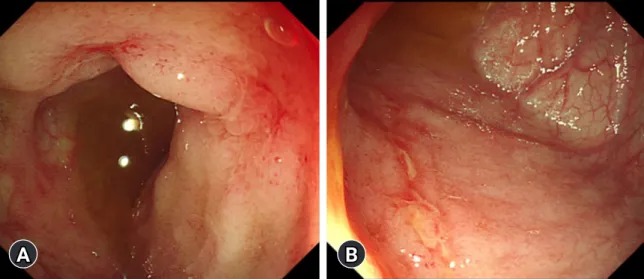
pathogens were detected in the stool culture and stool polymerase chain reaction (PCR). Chest X-ray showed no abnormal findings in the lungs, and the interferon-gamma release assay (IGRA) was negative. Ileocolonoscopy showed multifocal ulcers throughout the terminal ileum and colon (Fig. 1). Cryptitis, crypt abscesses, and non-caseating granulomas were observed throughout the ter- minal ileum and colon on histology; however, the acid-fast bacillus smear and culture and PCR for TB were negative. Upper GI en- doscopy revealed ulcers in the duodenum (Fig. 2A). Magnetic res- onance enterography showed multisegmental wall thickening in the ileum (Fig. 2B). The patient was diagnosed with CD with a phenotype of A1b, L3+L4ab, B1, G0 according to the Paris classifi- cation. Her Pediatric Crohn’s Disease Activity Index (PCDAI)

Fig. 2. Images at the diagnosis of Crohn disease. (A) Upper gastrointestinal endoscopy shows multiple ulcers in the duodenum. (B) Magnetic resonance enterography shows multisegmental wall thickening in the ileum.

Fig. 1. Images of ileocolonoscopy at the diagnosis of Crohn disease. Multifocal aphthous ulcers are observed in the (A) terminal ileum and (B) colon.

B A

B

A

(3)

score was 50, and the Simple Endoscopic Score for Crohn’s Dis- ease (SES-CD) was 22.

Treatment began with exclusive enteral nutrition (EEN), mesal- azine, and azathioprine, which were effective. One month after treatment, her PCDAI score had decreased to 10. However, 1 month after finishing her 8-week treatment with EEN, the disease relapsed and her PCDAI score elevated to 42.5; hence, predniso- lone was started per oral at a dose of 50 mg/day. Despite cortico- steroid treatment, symptoms persisted, and IFX was administered.

Chest X-ray before the administration of IFX showed no abnormal findings in the lungs, and the IGRA was negative. Symptoms re- solved after the second dose of IFX infusion, and her PCDAI score decreased to 7.5. However, during her visit for the third IFX infu- sion, she complained of fever, cough, and dyspnea on exertion for a week. Radiologic examination of the chest revealed a left pleural ef- fusion with mild pleural thickening and nodularities indicating TB pleurisy on chest X-ray and computed tomography (Fig. 3). Tho- racentesis was conducted, and pulmonary TB was confirmed by a positive TB PCR test of the pleural effusion specimen and a posi- tive IGRA test. IFX treatment was discontinued and the standard TB treatment regimen consisting of isoniazid, ethambutol, rifamp- in, and pyrazinamide for 2 months, followed by isoniazid, etham- butol, and rifampin for 4 months, was started. EEN was restarted and maintained for 8 weeks. Subsequently, mesalazine was admin- istered to treat CD.

Her pulmonary TB was completely cured after 6 months of TB treatment. However, symptoms such as hematochezia, diarrhea, and weight loss began by the end of TB treatment. Laboratory tests

showed a white blood cell count of 7,010/μL, hemoglobin level of 6.8 g/dL, platelet count of 477,000/μL, albumin level of 3.1 g/dL, ESR of 45 mm/hr, and CRP of 2.2 mg/dL. FIT was positive, and FC was >2,000 mg/kg. No pathogens were detected in the stool culture and stool PCR. Her PCDAI score was 47.5, and the exacer- bation of CD was confirmed by ileocolonoscopy (Fig. 4A). There- fore, we planned to restart IFX. However, due to the fear of another severe disease course of active TB when IFX were to be restarted, the patient and parents preferred to start VDZ off-label instead of restarting IFX. Before starting VDZ, the patient’s weight was 57 kg.

VDZ was administered according to the regular regimen approved in adults of 300 mg per dose at weeks 0, 2, and 6 for induction and 8-week intervals for maintenance treatment thereafter. The patient showed a fast response to VDZ treatment. At the week 6 visit for her third VDZ infusion, she was in clinical remission, and inflam- matory markers were normalized (Table 1, Fig. 5). Ileocolonosco- py at the 1-year follow-up after VDZ treatment revealed endoscop- ic healing (Fig. 4B). Therapeutic drug monitoring (TDM) using commercialized enzyme-linked immunosorbent assay kits (Im- mundiagnostik AG, Bensheim, Germany) was conducted during VDZ treatment. An anti-drug antibody level of ≤10 AU/mL was defined as negative, according to the manufacturer’s manual. TDM results during VDZ treatment showed negative antibodies to VDZ (Table 1). The patient is currently in her second year of VDZ treat- ment and is maintaining clinical and biochemical remission. No se- rious adverse events, including TB reactivation, have occurred.

Fig. 3. Radiologic images at the diagnosis of active pulmonary tuberculosis during infliximab treatment. (A) Chest X-ray shows a marked amount of left pleural effusion. (B) Chest computed tomography shows left pleural effusion with mild pleural thickening and nodularities (arrow).

B

A

(4)

Fig. 4. Images of ileocolonoscopy before and after treatment with vedolizumab. (A) Multiple ulcers with mucosal friability are observed throughout the colon before treatment with vedolizumab. (B) Endoscopic healing is observed 1 year after treatment with vedolizumab.

A B

Table 1. Crohn disease activity, laboratory results, and therapeutic drug monitoring during treatment with VDZ

Week VDZ PCDAI CRP (mg/dL) ESR (mm/hr) Albumin (g/dL) VDZ TL (μg/mL) ATV (AU/mL)

0 #1 40.0 2.20 45 3.1

2 #2 12.5 0.04 47 4.1 25.25 1.91

6 #3 5.0 0.12 19 4.1 14.35 4.56

14 #4 0 0.05 15 4.1 3.36 1.76

22 #5 2.5 0.08 24 4.0 3.19 1.62

30 #6 0 0.02 16 4.2 3.59 2.06

38 #7 0 0.03 17 4.4 5.31 2.06

46 #8 2.5 0.09 33 4.5 5.18 1.76

54 #9 0 0.02 8 4.2 4.15 2.06

VDZ, vedolizumab; PCDAI, Pediatric Crohn’s Disease Activity Index; CRP, C-reactive protein; ESR, erythrocyte sedimentation rate; TL, trough level; ATV, antibody to VDZ.

2,000

1,500

1,000

500

0

FIT (ng/mL) 959.6 193.7 17.6 0.5 0.1 0.7 0.3 0 1.7

FC (mg/kg) 2,000 785 674.1 521.7 18.2 23.6 51.8 11.5 8.8

Fig. 5. Fecal immunochemical test (FIT) and fecal calprotectin (FC) results during vedolizumab treatment.

2 6 14 22 30 38 46 54

Time (weeks)

FIT (ng/mL), FC (mg/kg)

(5)

Discussion

With the introduction of anti-TNF agents in the treatment of CD, there is no doubt that treatment outcomes have improved. Howev- er, anti-TNF agents are known to increase the risk of serious infec- tions, including TB [9]. It has been reported that anti-TNF agents are associated with a 2- to 8-fold increased risk of developing active TB [9]. Reactivation of latent TB infections (LTBI) rather than a new infection is considered to be the primary cause of active TB, as most of the active TB cases have been reported to occur within 3 to 4 months after starting anti-TNF treatment [9]. Therefore, screening for LTBI prior to anti-TNF treatment is strongly recom- mended worldwide, and especially in Asia, where the prevalence of LTBI is higher than that of Western countries [9]. In this case re- port, the patient had completed TB vaccination, did not have any history or exposure to active TB, and TB screening was negative with both chest X-ray and IGRA at both times of diagnostic evalu- ation of CD and before the commencement of IFX. However, the patient, unfortunately, developed symptoms of active pulmonary TB 5 weeks after starting IFX treatment, indicating that the active TB was probably due to the reactivation of LTBI, which was missed on TB screening.

It is well known that when active TB is diagnosed during an- ti-TNF treatment, the anti-TNF agent should be withheld, and an- ti-TB therapy should be started [10]. Regarding when to restart an- ti-TNF treatment, it is considered safe to delay the resumption of anti-TNF therapy until the completion of anti-TB treatment [10].

However, if an early resumption of anti-TNF treatment is required, anti-TNF treatment may be restarted as early as 2 months after an- ti-TB treatment in patients who did not have an initially severe ac- tive TB, demonstrated a favorable response to anti-TB treatment, and when drug susceptibility was proven [10]. In this case report, the patient’s symptoms of CD were fortunately well controlled without IFX until the end of TB medication. According to the treatment guidelines, she could have restarted IFX when CD re- lapsed at the end of TB medication. However, because she had suf- fered a severe active TB and due to the fear of another severe dis- ease course of active TB when IFX were to be restarted, the patient and parents preferred to start VDZ instead.

VDZ is effective for achieving both clinical remission and muco- sal healing in adult patients with UC and CD [5,6,11]. Regarding safety, according to the integrated safety data from six trials, VDZ did not increase the risk of serious infections, progressive multifo- cal leukoencephalopathy, or malignancy [12]. Among 2,830 pa- tients with 4,811 person-years (PYs) exposure to VDZ, TB was re- ported in only four patients (0.14%) with an estimated incidence of 0.1/100 PYs [12]. Meanwhile, the estimated incidence of TB

during treatment with anti-TNF agents has been reported as 1.34/100 PYs and 0.79/100 PYs for IFX and adalimumab, respec- tively [13].

Compared with adults, there is limited experience with VDZ therapy in pediatric IBD. In children, VDZ is only available off-la- bel and is used for patients who have already exhausted other treat- ment options, including anti-TNF agents. According to the ECCO/ESPGHAN (European Crohn’s and Colitis Organisation and the European Society of Pediatric Gastroenterology, Hepatol- ogy and Nutrition) guideline, VDZ should be considered in chron- ically active or steroid-dependent pediatric UC patients as a sec- ond-line biologic therapy after anti-TNF failure, even though it has not yet been approved for use in children [7]. In addition, in pedi- atric CD patients who fail to maintain clinical remission on an- ti-TNF agents despite dose optimization and immunomodulator use, VDZ can be considered off-label [8]. A multicenter retrospec- tive study showed that VDZ was safe and effective in pediatric IBD patients [14]. In this study, 64 children with IBD who had been previously treated with anti-TNF agents were included. During a median follow-up period of 24 months, corticosteroid-free remis- sion was 37% in UC and 14% in CD at week 14, and 39% in UC and 24% in CD at the last follow-up [14]. Another retrospective study on 52 children with IBD showed clinical remission rates of 76% and 42% for UC and CD, respectively, at week 14 [15]. No se- rious adverse events were reported in either study [14,15].

In the GEMINI 3 trial, VDZ was not more effective than place- bo in inducing clinical remission at week 6 among patients with CD who had failed previous treatment with anti-TNF agents [16].

The clinical benefits of VDZ in these patients were detectable later at week 10 [16]. This slow induction rate of VDZ was also ob- served in pediatric patients with CD [14]. Contrary to these find- ings, the patient in this case report showed a fast response to VDZ.

Additionally, according to the clinical decision support tool devel- oped for predicting the probability of response to VDZ in adult CD patients [17], the patient’s score in this case report was 16, which applies to an intermediate response probability. However, the patient continuously maintained clinical and biochemical re- mission, and endoscopic healing was observed at 1-year treatment with VDZ. One reason for this swift and favorable response to VDZ in this case report may be that the patient had not failed IFX due to poor response, but because discontinuation of IFX was in- evitable due to active TB infection.

Data regarding TDM in VDZ are limited. An exposure-efficacy

relationship does not seem as straightforward as they are for an-

ti-TNF agents, and robust target VDZ trough levels are not

well-defined [18]. However, according to data from a TDM study

in adult IBD, VDZ trough levels of >30 μg/mL at week 2, >24

(6)

μg/mL at week 6, and >14 μg/mL during maintenance therapy have been proposed for achieving clinical remission [19]. In anoth- er study in pediatric-onset IBD patients treated with VDZ, the mean VDZ trough level was 29.9 μg/mL at week 6 and 11.5 μg/

mL during maintenance therapy [20]. In this case report, VDZ trough levels were lower than the proposed threshold targets; how- ever, the patient responded well. This may be due to variability in the yet to be revealed association between individual pharmacoki- netics and the degree of response to VDZ.

In conclusion, we report a case of a pediatric patient with CD who successfully achieved and maintained remission with VDZ af- ter developing active pulmonary TB during treatment with IFX. In cases that require recommencement of treatment with biologics af- ter recovery of active pulmonary TB caused by anti-TNF agents, VDZ may be a good option even in pediatric IBD.

Notes

Ethical statements

This study was approved by the Institutional Review Board (IRB) of Kyungpook National University Chilgok Hospital (IRB No:

2020-09-013). Informed consent was obtained from the patient and her parents.

Conflicts of interest

No potential conflict of interest relevant to this article was report- ed.

Funding

This work was supported by the National Research Foundation of Korea (NRF) grant funded by the Korean government (MSIT) (No. 2017R1C1B5076980).

Author contributions

Conceptualization, Formal analysis, Investigation: SC, BK; Data curation: All authors; Funding acquisition, Methodology, Resourc- es, Software, Supervision, Validation: BK; Project administration, Visualization: SC; Writing-original draft: SC; Writing-review & ed- iting: BSC, BHC, BK.

ORCID

Sujin Choi, https://orcid.org/0000-0001-8894-8127 Bong Seok Choi, https://orcid.org/0000-0002-2129-7232 Byung-Ho Choe, https://orcid.org/0000-0001-9899-9120 Ben Kang, https://orcid.org/0000-0002-8516-9803

References

1. Rosen MJ, Dhawan A, Saeed SA. Inflammatory bowel disease in children and adolescents. JAMA Pediatr 2015;169:1053–60.

2. Kang B, Choe YH. Early biologic treatment in pediatric Crohn’s disease: catching the therapeutic window of opportunity in ear- ly disease by treat-to-target. Pediatr Gastroenterol Hepatol Nutr 2018;21:1–11.

3. Kang B, Choi SY, Kim HS, Kim K, Lee YM, Choe YH. Mucosal healing in paediatric patients with moderate-to-severe luminal crohn's disease under combined immunosuppression: escala- tion versus early treatment. J Crohns Colitis 2016;10:1279–86.

4. Soler D, Chapman T, Yang LL, Wyant T, Egan R, Fedyk ER.

The binding specificity and selective antagonism of vedolizum- ab, an anti-alpha4beta7 integrin therapeutic antibody in devel- opment for inflammatory bowel diseases. J Pharmacol Exp Ther 2009;330:864–75.

5. Feagan BG, Rutgeerts P, Sands BE, Hanauer S, Colombel JF, Sandborn WJ, et al. Vedolizumab as induction and maintenance therapy for ulcerative colitis. N Engl J Med 2013;369:699–710.

6. Sandborn WJ, Feagan BG, Rutgeerts P, Hanauer S, Colombel JF, Sands BE, et al. Vedolizumab as induction and maintenance therapy for Crohn’s disease. N Engl J Med 2013;369:711–21.

7. Turner D, Ruemmele FM, Orlanski-Meyer E, Griffiths AM, de Carpi JM, Bronsky J, et al. Management of paediatric ulcerative colitis, part 1: ambulatory care-an evidence-based guideline from European Crohn’s and Colitis Organization and European Society of Paediatric Gastroenterology, Hepatology and Nutri- tion. J Pediatr Gastroenterol Nutr 2018;67:257–91.

8. van Rheenen PF, Aloi M, Assa A, Bronsky J, Escher JC, Fager- berg UL, et al. The medical management of paediatric Crohn’s disease: an ECCO-ESPGHAN guideline update. J Crohns Colitis 2021;15:171-94.

9. Park DI, Hisamatsu T, Chen M, Ng SC, Ooi CJ, Wei SC, et al.

Asian Organization for Crohn’s and Colitis and Asia Pacific As- sociation of Gastroenterology consensus on tuberculosis infec- tion in patients with inflammatory bowel disease receiving an- ti-tumor necrosis factor treatment. Part 1: risk assessment. In- test Res 2018;16:4–16.

10. Park DI, Hisamatsu T, Chen M, Ng SC, Ooi CJ, Wei SC, et al.

Asian Organization for Crohn’s and Colitis and Asia Pacific As- sociation of Gastroenterology consensus on tuberculosis infec- tion in patients with inflammatory bowel disease receiving an- ti-tumor necrosis factor treatment. Part 2: management. Intest Res 2018;16:17–25.

11. Löwenberg M, Vermeire S, Mostafavi N, Hoentjen F, Franchi-

mont D, Bossuyt P, et al. Vedolizumab induces endoscopic and

(7)

histologic remission in patients with Crohn’s disease. Gastroen- terology 2019;157:997–1006.

12. Colombel JF, Sands BE, Rutgeerts P, Sandborn W, Danese S, D’Haens G, et al. The safety of vedolizumab for ulcerative colitis and Crohn’s disease. Gut 2017;66:839–51.

13. Abreu C, Magro F, Santos-Antunes J, Pilão A, Rodrigues-Pinto E, Bernardes J, et al. Tuberculosis in anti-TNF-α treated patients remains a problem in countries with an intermediate incidence:

analysis of 25 patients matched with a control population. J Crohns Colitis 2013;7:e486–92.

14. Ledder O, Assa A, Levine A, Escher JC, de Ridder L, Ruem- mele F, et al. Vedolizumab in paediatric inflammatory bowel disease: a retrospective multi-centre experience from the paedi- atric IBD porto group of ESPGHAN. J Crohns Colitis 2017;11:

1230–7.

15. Singh N, Rabizadeh S, Jossen J, Pittman N, Check M, Hashemi G, et al. Multi-center experience of vedolizumab effectiveness in pediatric inflammatory bowel disease. Inflamm Bowel Dis 2016;22:2121–6.

16. Sands BE, Feagan BG, Rutgeerts P, Colombel JF, Sandborn WJ, Sy R, et al. Effects of vedolizumab induction therapy for patients with Crohn’s disease in whom tumor necrosis factor antagonist treatment failed. Gastroenterology 2014;147:618–27.

17. Dulai PS, Boland BS, Singh S, Chaudrey K, Koliani-Pace JL, Kochhar G, et al. Development and validation of a scoring sys- tem to predict outcomes of vedolizumab treatment in patients with Crohn’s disease. Gastroenterology 2018;155:687–95.

18. Pouillon L, Vermeire S, Bossuyt P. Vedolizumab trough level monitoring in inflammatory bowel disease: a state-of-the-art overview. BMC Med 2019;17:89.

19. Dreesen E, Verstockt B, Bian S, de Bruyn M, Compernolle G, Tops S, et al. Evidence to support monitoring of vedolizumab trough concentrations in patients with inflammatory bowel dis- eases. Clin Gastroenterol Hepatol 2018;16:1937–46.

20. Aardoom MA, Jongsma MM, de Vries A, Wolthoorn J, de Rid-

der L, Escher JC. Vedolizumab trough levels in children with

anti-tumor necrosis factor refractory inflammatory bowel dis-

ease. J Pediatr Gastroenterol Nutr 2020;71:501–7.

수치

Fig. 2. Images at the diagnosis of Crohn disease. (A) Upper gastrointestinal endoscopy shows multiple ulcers in the duodenum
Fig. 3. Radiologic images at the diagnosis of active pulmonary tuberculosis during infliximab treatment
Fig. 4. Images of ileocolonoscopy before and after treatment with vedolizumab. (A) Multiple ulcers with mucosal friability are observed  throughout the colon before treatment with vedolizumab

참조

관련 문서

With analysis that it will be a chance for children with autism who have difficulty of using languages and usually can't make any relationship with people

Just as we achieved good control with a joint-based controller that was based on a linearizing and decoupling model of the arm, we can do the same for the Cartesian case.

The feed is commonly a solution in a solvent like ethanol or t-butanol, and the nonsolvent is water..

Randomised, double blind, placebo controlled study of fluticasone propionate in patients with moderate to severe chronic obstructive pulmonary disease: the

In this group of high-risk patients with severe COVID-19 pneumonia, treatment with lenzilumab was associated with a significantly shorter time to clinical improvement compared

1 John Owen, Justification by Faith Alone, in The Works of John Owen, ed. John Bolt, trans. Scott Clark, &#34;Do This and Live: Christ's Active Obedience as the

Severe disease activity and cy- tomegalovirus colitis are predictive of a nonresponse to infliximab in patients with ulcerative colitis. Guidelines for the management of

Method We obtained blood samples from 49 patients who underwent surgical treatment for esophageal squamous cell cancer (ESCC) We performed ctDNA analysis with