서 론
광산에서 운반시스템을 효율적으로 설계하고 운영하는 것은 매우 중요하다. 운반시스템의 설계와 운영 방법에 따 라 채광비용이 크게 달라질 수 있기 때문이다(Awuah- Offei, 2016). 이를 위해 오늘날 광산현장에서는 운반시스 템에 대한 다양한 시뮬레이션 기법들이 사용되고 있다 (Farid and Koning, 1994; Knights and Bonates, 2007;
Eriksson, 2014; Coronado and Pablo, 2014; Shelswell and Labrecque, 2017). 최근까지 해외에서는 노천광산의 운반 시스템에 투입될 장비들의 성능과 수를 최적화할 수 있는
이산 사건 시뮬레이션 기법들이 다수 개발되었으며(Tarshizi, 2014; Ali, 2015; Ibarra, 2015), 지하광산을 대상으로 한 시 뮬레이션 기법들도 활발히 연구되고 있다(Salama and Greberg, 2012; Fioroni et al., 2014; Salama et al., 2014;
Tarshizi et al., 2016; Mahieu, 2017).
국내에서도 트럭의 성능, 배차방식, 고장발생 가능성, 파 쇄기의 처리용량 등의 요인들을 복합적으로 고려하여 노천 광산 쇼밸-트럭 운반시스템을 시뮬레이션할 수 있는 기법 들이 개발되었다(Choi, 2011; Park and Choi, 2013; Park et al., 2014a). 또한, 지하광산 트럭-로더 운반시스템을 시뮬 레이션할 수 있는 기법들도 다수 연구되었다(Park et al., 2014b; Park et al., 2016). 이러한 시뮬레이션 기법들은 노 천광산이나 지하광산 현장에서 사용될 수 있도록 프로그램 으로 개발되었다(Park et al., 2014; Choi et al., 2016). 그러 나 기존에 개발된 프로그램들은 운반시스템의 전체적인 효 율성을 나타내는 주요 지표 값만을 시뮬레이션 결과로서
GPSS/H와 PROOF5를 이용한 지하광산 트럭-로더 운반시스템 시뮬레이션과 애니메이션의 결합
이채영1)· 최요순1)*
Integration of Simulation and Animation for Truck-Loader Haulage Systems in an Underground Mine Using GPSS/H and PROOF5
Chaeyoung Lee and Yosoon Choi
*
(Received 12 June 2018; Final version Received 20 June 2018; Accepted 22 June 2018)
Abstract : In this study, we proposed a method that can combine the GPSS/H simulation language and the PROOF5 program so that the simulation results of truck-loader haulage systems in an underground mine can be intuitively confirmed through animation. GPSS/H was used to simulate the truck-loader haulage system in an underground mine, and the results were output to a file format that can be input to PROOF5, allowing simulation and animation to be combined. As a result of applying the proposed method to an underground limestone mine in Korea, the simulation result such as the truck position, waiting time, loader utilization rate and crusher utilization rate with time could be confirmed at a glance through animation.
Key words : Simulation, Animation, Underground mine, Truck-loader haulage system
요 약 : 본 연구에서는 지하광산 트럭-로더 운반시스템 시뮬레이션 결과를 애니메이션을 통해 직관적으로 확인 할 수 있도록 GPSS/H 시뮬레이션 언어와 PROOF5 프로그램을 결합할 수 있는 방법을 제시하였다. GPSS/H를 이용해 지 하광산 트럭-로더 운반시스템을 시뮬레이션한 후, 그 결과를 PROOF5에 입력 가능한 파일 형식으로 출력하여 시뮬레 이션과 애니메이션을 결합할 수 있었다. 국내 석회석 지하광산에 이 방법을 적용해본 결과 시간에 따른 트럭 위치, 대 기시간, 로더 이용률, 파쇄기 이용률 등과 같은 시뮬레이션 결과를 애니메이션을 통해 한눈에 확인할 수 있었다.
주요어 : 시뮬레이션, 애니메이션, 지하광산, 트럭-로더 운반시스템
1) 부경대학교 에너지자원공학과
*Corresponding Author(최요순) E-mail; [email protected]
Address; Dept. of Energy Resources Engineering, Pukyong
National University, Busan 608-737, Korea
연구논문
제공하기 때문에, 시간의 흐름에 따라 어떠한 사건들이 운 반시스템에서 발생했는지 사용자가 직관적으로 확인할 수 없는 한계가 있었다.
이 한계를 극복하기 위해 본 연구에서는 지하광산 트럭- 로더 운반시스템 시뮬레이션 결과를 애니메이션을 통해 직 관적으로 확인할 수 있는 방법을 제시하고자 한다. GPSS/H 시뮬레이션 언어(Banks et al., 2003; Choi, 2011)를 이용하 여 운반시스템을 시뮬레이션한 후 그 결과를 PROOF5 애 니메이션 프로그램(Henriksen, 1999)에 입력 가능한 파일 형식으로 출력하여 시뮬레이션과 애니메이션을 결합할 것 이다. 또한, 국내 석회석 지하광산을 대상으로 이 방법을 적 용해보고자 한다. 본 연구는 지하광산 트럭-로더 운반시스 템의 시뮬레이션과 애니메이션을 결합하는 것에 중점을 두 었기 때문에, 시뮬레이션 모델의 검증은 연구의 범위에 포 함되지 않는다.
연구지역 및 자료
본 연구에서는 강원도 삼척시 신기면 대평리에 위치한
㈜대성MDI 동해사업소를 연구지역으로 선정하였다(Fig.
1). 연구지역에서는 지하채광 방법으로 연간 약 150만 톤의 고품위 석회석을 생산하고 있다. 연구지역에 관한 설명은 Park et al.(2016)에 상세하게 제시되었다.
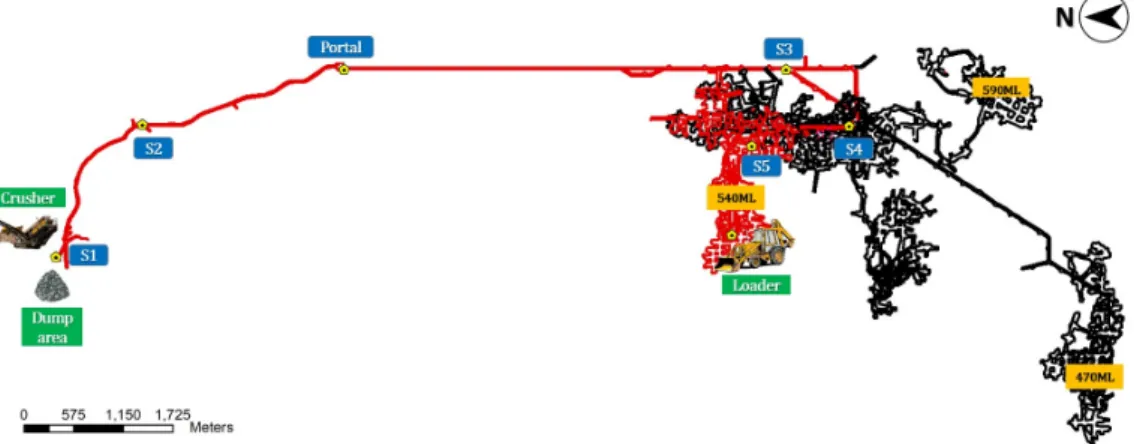
2017 년 현장조사 당시 연구지역에서는 540갱 작업장에 만 광석이 생산되었으며(Fig. 2), 이를 기준으로 트럭-로더 운반시스템 시뮬레이션에 필요한 시간인자 값들을 Table 1 과 같이 정리하였다. 광석 적재지점과 투하지점에서 트럭 의 단위작업과 관련된 시간인자 값들은 Park et al.(2014b) 를 참고하여 20회 반복 측정결과를 평균±표준편차 형태로 표현하였으며, 갱내외 운반도로 주요지점(station)간의 트 럭 이동시간은 Jung and Choi(2017)를 참고하여 4회 측정 결과의 평균값으로 결정하였다.
Fig. 1. Aerial view of the study area (image source: Vworld, http://map.vworld.kr/map/maps.do).
Fig. 2. Layout of the study area. Red color path represents the haulage route of dump trucks between the loading point at 540 ML
and the dumping points.
연구방법
시뮬레이션 모델 설계
연구지역 트럭-로더 운반시스템에서는 트럭이 지정된 운반도로를 따라 이동하면서 시간의 흐름에 따라 사건이 발생한다. 본 연구에서는 식(1)과 같이 트럭순환이론에 근 거하여 시뮬레이션 모델을 설계하였다.
TCT=STL+LT+TL+STD+DT+TE+AD (1)
여기서 TCT는 트럭순환시간(truck cycle time), STL은 로더 근처로 트럭이 접근하는 시간(spotting time at the loader), LT 는 적재작업시간(loading time), TL은 트럭이 투하지점으로 이동하는 시간(travel time of the loaded truck), STD 는 투하지점 근처로 트럭이 접근하는 시간
(spotting time at the dumping point), DT 는 투하작업시간 (dumping time), TE 는 투하작업을 끝낸 트럭이 다시 적재 장으로 이동하는 시간(travel time of the empty truck), AD 는 평균 지연시간(average delay time)을 의미한다. 트럭- 로더 운반시스템에서 발생하는 지연시간에는 운반갱도에 서 마주 오는 트럭을 회피하기 위한 시간, 적재지점이나 투 하지점에서 트럭의 대기행렬 발생으로 인한 대기시간, 계 근대에서 트럭에 적재한 광석의 중량을 확인하기 위한 시 간 등이 포함된다. 트럭순환이론에 대한 자세한 설명은 Choi(2011) 에 제시되었다.
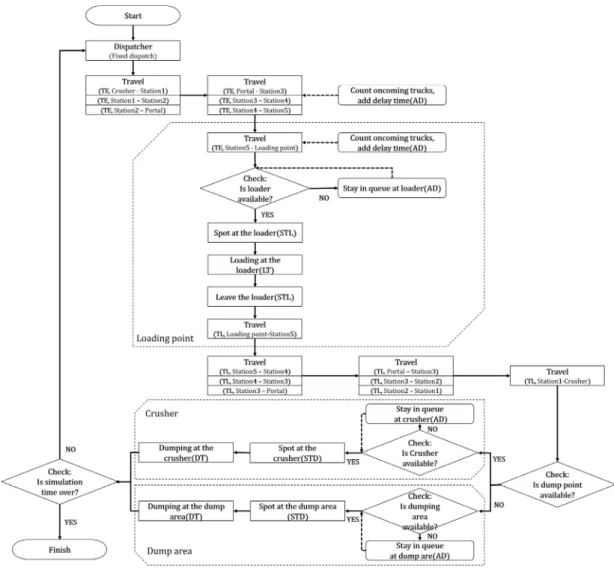
Fig. 3 은 연구지역 540갱 작업장을 대상으로 트럭-로더 운반시스템 시뮬레이션 모델을 설계한 결과를 보여준다.
현장조사 당시 540갱 작업장에는 4대의 트럭이 고정 배차 방식으로 운영되었다. 또한, 로더는 1대, 파쇄기는 2대(200 tph) 가 운영되었다. 파쇄장 또는 덤핑장에서 투하작업을 완 Table 1. Time parameters required for the truck-loader haulage simulation in the study area
Parameter Value (sec.)
On road
Empty truck
S1 → S2 93.1
S2 → Portal 121.9
Portal → S3 244.4
S3 → S4 70.0
S4 → S5 80.4
S5 → Loading point 117.3
Loaded truck
Loading point → S5 159.4
S5 → S4 90.3
S4 → S3 122.0
S3 → Portal 425.5
Portal → S2 165.2
S2 → S1 164.3
At loader
Waiting time in the queue 83.4 ± 28.2
Spotting time(wait in the queue) 48.0 ± 9.6
Spotting time(no wait in the queue) 29.4 ± 5.4
Loading time 176.4 ± 34.8
At crusher
Waiting time in the queue 50.4 ± 9.6
Spotting time(with wait in the queue) 52.2 ± 10.2
Spotting time(without wait in the queue) 28.2 ± 5.4
Dumping time 35.4 ± 6.6
At dump area Spotting time 45.6 ± 9.0
Dumping time 35.4 ± 6.6
Etc. Waiting time for oncoming trucks 22.2 ± 4.2
Time for measuring the ore weight 37.2 ± 7.2
료한 트럭은 공차상태로 적재지점으로 이동한다. 이때 Table 1 에 정리된 것과 같이 운반도로를 6개 구간으로 나누 어 구간별로 측정된 TE 값들이 시뮬레이션 시간인자로 입 력되도록 모델을 설계하였다.
적재지점에 도착한 트럭은 로더의 이용가능 여부에 따라 바로 로더로 접근할 것인지 대기할 것인지를 선택한다. 만 약 로더의 이용이 가능하다면 STL이 발생하며, 이용이 불 가능하다면 대기행렬에서 먼저 AD가 발생한 후 STL이 발 생한다. 트럭에 로더가 광석을 적재할 때에는 LT가 발생한 다. 실차상태의 트럭은 다시 6개 구간으로 나누어진 운반도 로를 따라 이동하며 TL이 발생한다. 투하지점에 도착한 트 럭은 파쇄기의 상태에 따라 파쇄기로 접근할지 야적장으로 갈지 결정한다(STD, DT). 이때에도 파쇄기를 사용하고 있
는 트럭이 있다면 대기시간(AD)이 발생할 수 있다. 투하작 업을 끝낸 트럭은 설정된 시뮬레이션 시간에 따라 적재지 점으로 다시 이동할 것인지 아니면 시뮬레이션을 종료할 것인지를 결정한다.
GPSS/H를 이용한 시뮬레이터 구현
연구지역의 트럭-로더 운반시스템 시뮬레이션 모델을 프로그램으로 구현하기 위해 GPSS/H를 사용하였다.
GPSS/H 는 이산적인 사건들로 구성된 시스템을 유연하게 모델링할 수 있으며, 광업 분야뿐만 아니라 다른 산업분야 에서 광범위하게 사용되고 있다. 또한, 코드를 간결하게 작 성할 수 있으며, 연산속도가 빠른 장점이 있다. GPSS/H에 관한 자세한 설명은 Choi(2011)을 참고하길 바란다.
Fig. 3. Design of a model for simulating the truck-loader haulage system in the study area.
PROOF5를 이용한 애니메이션 구현
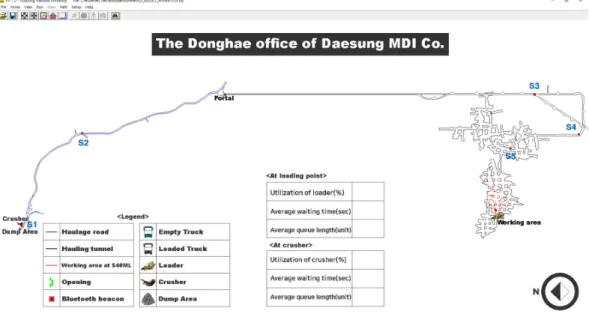
본 연구에서는 트럭-로더 운반시스템의 애니메이션 구 현을 위해 PROOF5 프로그램을 사용하였다. PROOF5는 복잡한 시스템을 2D 또는 3D로 가시화하여 도식적으로 표 현할 수 있다. PROOF5를 이용하여 애니메이션을 구현하 기 위해서는 Layout파일과 Trace파일이 필요하다. Layout 파일은 애니메이션을 구성하는 객체들과 객체들의 이동경 로 등을 정의한다. Layout 파일은 PROOF5에서 사용자가 직접 도면을 그리거나, CAD 파일을 변환하여 생성할 수 있 다(Fig. 4). Trace 파일은 애니메이션 중 발생하는 동적인 사건들을 정의한 코드들로 구성된다. 시간의 흐름에 따라 애니메이션 상에서 나타나고, 움직이고, 사라지는 것들을 Trace 파일에서 지정할 수 있다(Henriksen, 1999).
시뮬레이션과 애니메이션의 결합
지하광산 트럭-로더 운반시스템 시뮬레이션 결과를 애 니메이션으로 확인할 수 있도록 GPSS/H로 구현된 시뮬레 이터와 PROOF5 프로그램을 결합하는 방법을 Fig. 5과 같 이 제시하였다. 시뮬레이터가 트럭-로더 운반시스템의 주 요 지표 값들(.CSV file)뿐만 아니라 PROOF5 프로그램에 입력되는 Trace 파일(.ATF file)까지 함께 출력할 수 있도 록 GPSS/H 코드(.GPS file)를 작성하였다. 또한, 시뮬레이 터로부터 생성된 Trace 파일과 사용자가 작성한 Layout 파 일(.LAY file)을 PROOF5 프로그램에 입력하여 애니메이 션을 실행할 수 있도록 하였다.
연구결과 및 토의
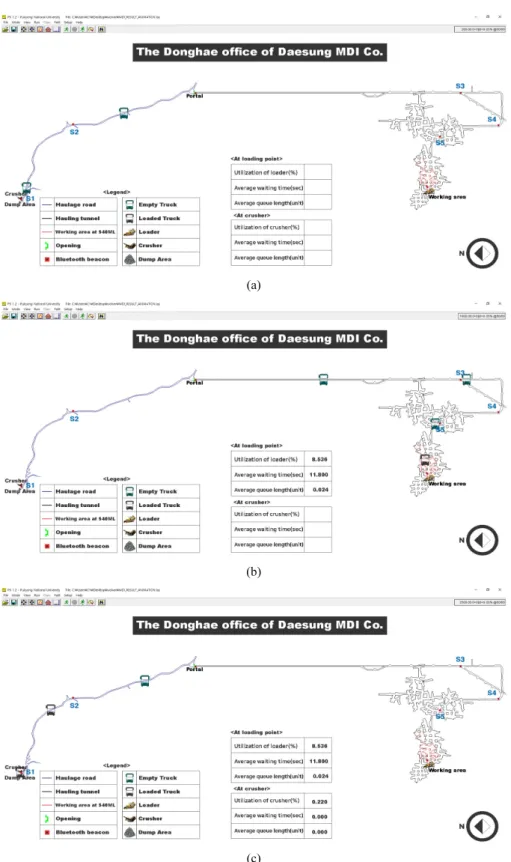
연구지역 지하광산 트럭-로더 운반시스템의 시뮬레이션 결과로서 생성된 Trace 파일을 Fig. 5에 제시된 방법에 따 라 PROOF5 프로그램에 입력하였다. 그 결과 시간의 흐름 에 따라 나타나는 사건들을 애니메이션을 통해 확인할 수 있었다(Fig. 6). Fig. 6(a)는 공차 상태의 첫 번째 트럭이 파 쇄장으로부터 출발하여 S2-갱구 구간을 지나고 있을 때 두 번째 트럭이 파쇄장으로부터 출발하고 있는 모습을 보여준 다. Fig. 6(b)는 시뮬레이션 시작 후 약 16분이 경과했을 때 의 모습이다. 4대의 트럭이 모두 투입되어 운반작업을 수행 하고 있으며, 첫 번째 트럭이 적재지점에 도착했을 때의 로 더의 사용률, 트럭의 대기시간 등의 지표 값들이 화면에 표
Fig. 4. Layout file required for conducting animations using PROOF5.
Fig. 5. Method for integrating GPSS/H simulation with
PROOF5 animation.
(a)
(b)
(c)
Fig. 6. Visualization of the simulation results though animation. (a) At 200 sec. (b) At 1000 sec. (c) At 2500 sec.
시되었다. Fig. 6(c)는 시뮬레이션을 시작한지 약 41분을 경 과하여 두 번째 트럭이 광석을 실고 파쇄장에 도착했을 때 의 모습을 보여주며, 이때 파쇄기의 이용률, 트럭의 대기시 간 등이 함께 화면에 표시되었다. 애니메이션을 통해 운반 시스템의 주요 지표 값들이 트럭들의 어떤 단위 작업에 영 향을 받고 있는지 확인할 수 있었다.
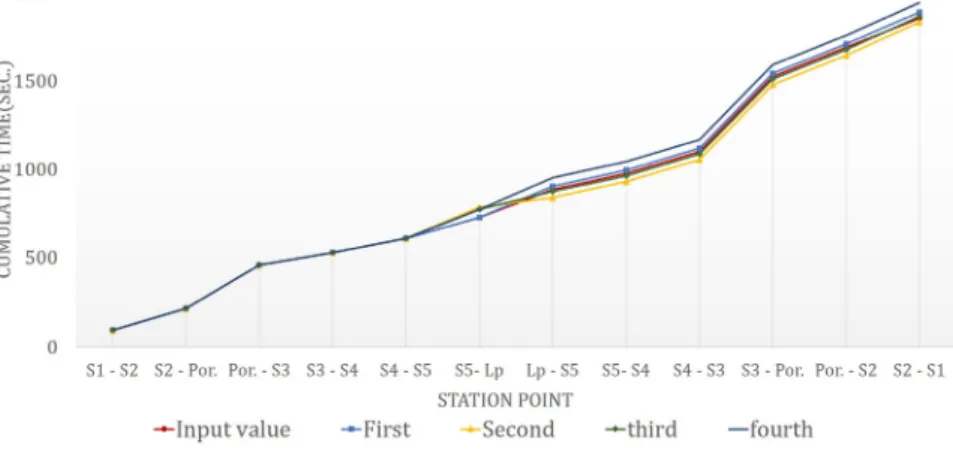
트럭들이 운반경로의 주요 지점들에 도착한 시간들을 Fig. 7 에 나타내었다. 4대의 트럭 모두 구간별 이동시간을 동일하게 설정하여 시뮬레이션을 수행했기 때문에 파쇄장 을 출발하여 로더에 도착할 때까지 주요 지점들에 동일한 시간에 도착했다. 그러나 트럭별로 적재지점에서 적재작 업 시간과 지연시간이 다르게 발생했기 때문에 실차상태의 각 트럭들이 파쇄장에 돌아올 때에는 주요 지점들에 도착 한 시간들이 달라진 것을 알 수 있다. 기존 연구에서는 시뮬 레이션 결과 트럭의 총 이동시간만 알 수 있었으나, 본 연구
에서는 애니메이션을 통해 각 구간별로 트럭 이동시간이 어떻게 달라지고 있는지 확인할 수 있었다.
최근 국내에서도 일부 지하광산에 ICT 기반 실시간 위치 추적시스템이 설치되어 작업장 내의 장비나 작업자의 위치 를 대시보드를 통해 파악할 수 있다(Fig. 8). 본 연구에서 제 시한 시뮬레이션과 애니메이션의 결합 방법을 ICT 기반 실 시간 위치추적시스템이 도입된 현장에 적용한다면, 애니 메이션을 통해 표현되는 시뮬레이션 결과와 대시보드를 통 해 표현되는 실시간 위치추적 결과를 비교하여 시뮬레이션 결과의 직접적인 검증이 가능할 것이다. 이를 위한 추가적 인 연구가 필요하다고 판단된다.
결 론
본 연구에서는 GPSS/H 시뮬레이션 언어를 이용하여 지 하광산 트럭-로더 운반시스템을 시뮬레이션한 후, 그 결과 를 PROOF5 애니메이션 프로그램을 통해 직관적으로 확 인할 수 있는 방법을 제시하였다. 국내 석회석 지하광산을 대상으로 이 방법을 적용한 결과 시간의 흐름에 따라 트럭- 로더 운반시스템에 나타나는 사건들을 애니메이션을 통해 한 눈에 확인할 수 있었다. 결론적으로 시뮬레이션과 애니 메이션의 결합을 통해 운반시스템의 전체적인 효율성 지표 값만을 제공할 수 있었던 기존 시뮬레이션 프로그램들의 한계를 극복할 수 있었다.
본 연구는 시뮬레이션과 애니메이션을 결합하는 것에 목 적을 두었기 때문에, 시뮬레이션 모델 자체는 단순하게 설 계하였고 보다 다양한 조건인 장비 고장, 여러 갱에서의 동 시 채굴 상황 등에 대해서는 고려하지 않았다. 향후 연구에 서는 보다 다양한 조건들을 시뮬레이션에 반영해야 할 것 Fig. 7. Lap times of trucks at each section simulated in the study area.
Fig. 8. Example of a ICT-based location tracking system in an
underground mine.
이다. 또한, 본 연구에서 제시한 방법을 이용한다면 애니메 이션을 통해 시뮬레이션 진행과정을 확인할 수 있으므로, 향후 연구로서 ICT 기반 실시간 위치추적시스템이 도입된 현장에 제시된 방법을 적용한다면 지하광산 트럭-로더 운 반시스템 시뮬레이션 결과의 직접적인 검증도 가능할 것이 라 판단된다.
사 사
본 연구는 과학기술정보통신부 ICT R&D 바우처 지원사 업(연구과제: 머신러닝 기반 스마트 광산 빅데이터 분석 기 술 개발)의 지원으로 수행되었다. 또한, 일부저자는 산업통 상자원부 2단계 자원개발특성화대학사업 산학협력연구단 ( 연구과제: 광물자원 탐사・개발)의 지원을 받았다. 이에 감 사한다.
References
Ali, S., 2015. Simulation of product transportation in open pit mines, MS Thesis, University of Witwatersrand, Johannesburg, Republic of South Africa, 117p.
Awuah-Offei, K., 2016. Energy efficiency in mining: a review with emphasis on the role of operators in loading and hauling operations, J. of Cleaner Production, 117(20), 89-97.
Banks, J., Carson, J., and Sy, J., 2003. Getting Started with GPSS/H(2nd Ed.), Wolverine Software Corporation, Alexandria, USA, 338p.
Choi, Y., 2011. New software for simulating truck-shovel operation in open pit mines, J. of the Korean Society for Geosystem Engineering, 48(4), 448-459.
Choi, Y., Park, S., Lee, S., Baek, J., Jung, J., and Park, H., 2016.
Development of a Windows-based Program for Discrete Event Simulation of Truck-Loader Haulage Systems in an Underground Mine, Tunnel & Underground Space, 26(2), 87-99.
Coronado, P. and Pablo, P., 2014. Optimization of the haulage cycle model for open pit mining using a discrete-event simulation and a context-based alert system, MS Thesis, the university of arizona, USA, p.22-34.
Eriksson, A., 2014. A Discrete-event Simulation Approach to Improve Efficiency in Stump Fuel Supply Chains, Licentiate Thesis, Swedish University of Agricultural Sciences, Uppsala, Sweden, p.29-37.
Farid, F. and Koning, T., 1994. Simulation Verifies Queuing Program for Selecting Loader-Truck Fleets, J. of Construction Engineering and Management, 120(2), 386-404.
Fioroni, M., Santos, L., Fanzese, L., Seixas, J., Penna, B., and
Alkmim, G., 2014. Logistic evaluation of an underground mine using simulation, J. of International Engineering REM, 67(4), 447-454.
Henriksen, J., 1999. General-purpose concurrent and post-processed Animation with PROOF, Pro. of the 1999 Winter Simulation Conference, Phhoenix, AZ, USA, p.176-181.
Ibarra, V., 2015. Discrete event simulation and animation for a complex open pit mine operation, MARIGOLD mine in winnemucca, nevada, MS Thesis, University of Nevada, Reno, USA, 133p.
Jung, J. and Choi, Y., 2017. Measuring Transport Time of Mine Equipment in an Underground Mine Using a Bluetooth Beacon System, Minerals, 7(1), 1-10.
Knights, P. and Bonates, E., 2007. Applications of discrete mine simulation modeling in South America, J. of Surface Mining, Reclamation and Environment, 13(2), 69-72.
Mahieu. P., 2017. Evaluation and Optimization of an Underground Haulage System using Discrete Event Simulation, MS Thesis, Aalto University, Finland, 43p.
Park, S. and Choi, Y., 2013. Simulation of shovel-truck haulage system by considering truck dispatch methods, J. of the Korean Society of Geosystem Engineering, 50(4), 543-556.
Park, S., Choi, Y., and Park, H., 2014a. Simulation of shovel- truck haulage system in open-pit mines by considering breakdown of trucks and crusher capacity, Tunnel &
Underground Space, 24(1), 1-10.
Park, S., Choi, Y., and Park, H., 2014b. Simulation of truck-loader haulage systems in underground mine using GPSS/H, Tunnel & Underground Space, 24(6), 430-439.
Park, S., Choi, Y., and Park, H., 2016. Optimization of truck-loader haulage systems in an underground mine using simulation methods, Geosystem Engineering, 19(5), 222-231.
Park, S., Lee, S., Choi, Y., and Park, H., 2014. Development of a Windows-based simulation program for selecting equip- ments in open-pit shovel-truck haulage systems, Tunnel &
Underground Space, 24(2), 111-119.
Salama, A. and Greberg, J., 2012. Optimization of Truck-Loader haulage system in an underground mine: A simulation approach using SimMine, Pro. of the 6
thInternational Conference and Exhibition on Mass Mining, Sudbury, Canada, p.1-10.
Salama, A., Greberg, J., and Schunnesson, H., 2014. The use of discrete event simulation for underground haulage mining equipment selection, Int. J. of Mining and Mineral Engineering, 5(3), 256-271.
Shelswell, K. and Labrecque, P., 2017. Discrete simulations
modelling the impact of operator numbers and truck
availability on haulage fleet productivity, Proc. of the First
International Conference on Underground Mining Technology,
Australian Centre for Geo mechanics, Perth, p.683-694.
Tarshizi, E., 2014. Multiple Discrete-event simulation and animation models to assist modern mining operations, Ph.D Thesis, University of Nevada, Reno, USA, p.33-143.
Tarshizi, E., Kocsis, C., and Taylor, C., 2016. Advanced approach to assess and improve underground mine evacuation using discrete-event simulation and animation, J. of Mining and Mineral Engineering, 7(2), 170-179.
이 채 영
2017년 부경대학교 환경해양대학 에너 지자원공학과, 공학사
현재 부경대학교 환경해양대학 에너지자원공학과 석사과정 (E-mail; [email protected])
최 요 순
현재 부경대학교 환경해양대학 에너지자원공학과 부교수 (本 學會誌 第55券 第2号 參照)