
IEG 환경지질연구정보센터
10
0
0
전체 글
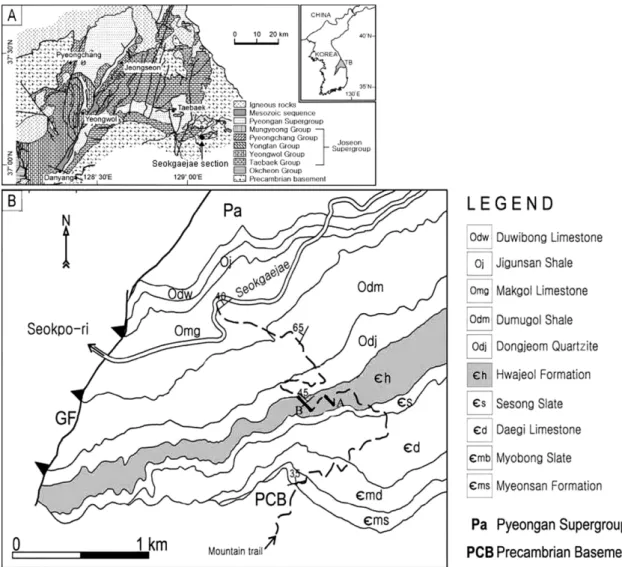
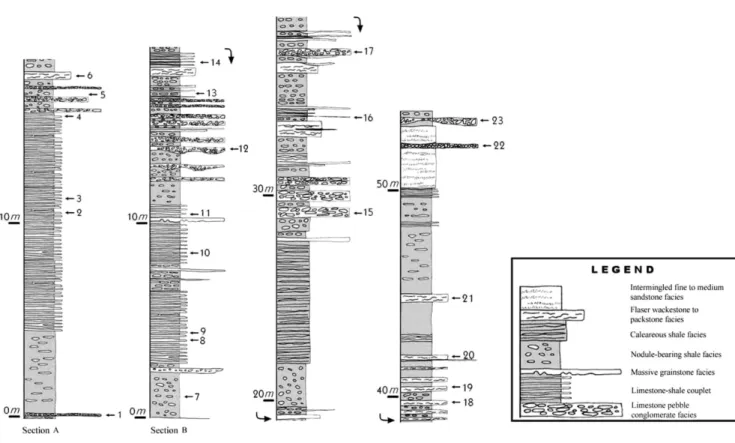
(2) 234. Byung-Su Lee and Kwang-Soo Seo. al., 2004). Choi et al. (2004) divided the Hwajeol Formation in the Seokgaejae section into three parts, consisting of lower (34 m thick), middle (14 m thick) and upper (ca. 5 m thick) parts. The lower part consists of nodule-bearing shale, limestone-shale couplets and limestone pebble conglomerate. The middle part consists of cyclic alternations of nodulebearing shale or calcareous shale and flaser wackestone to packstone. The upper part consists of nodule-bearing shale, laminated fine-grained sandstone and calcareous shale with limestone pebble conglomerate. Kobayashi (1935) correlated the Hwajeol Formation with the Chaumitian Series (upper part of the Furongian) of China based on his megafossil collection, and Choi et al. (2004) and Sohn and Choi (2007) correlated their Asioptychaspis, Quadraticephalus and Mictosaukia faunas with the uppermost Cambrian faunas of North China and Australia. Conodont correlation data of the Hwajeol Formation (Lee, B. S. and Lee, H. Y., 1988; Lee, 1989, 1990, 1992;. Lee, B. S. and Lee, J. D., 1993) are also similar to those of trilobite, representing time span from Franconian to Trempealeauan age (post-Paibian of the Furongian) of North America (Miller, 1988) and from Changshanian to Fengshanian age (also post-Paibian of the Furongian) of North China (An et al., 1983; Chen, 1986), respectively. 3. SECTION AND CONODONT OCCURRENCE The Seokgaejae section including full sequence of the Hwajeol Formation is located along a sinuous mountain trail ca. 25 km southeast of Taebaek City (Fig. 1). The outcrops of the section are well exposed along south side of mountain slope at the elevation of about 900 m near a border between Kangweon and Kyeongbuk provinces. Twenty three limestone samples were collected from two segments of the Seokgaejae section. Sample horizons and their lithologies are shown on Fig. 2. Each of samples, having the weight of 1 or 2 kg, was dissolved by acetic acid.. Fig. 1. (A) Simplified geologic map of the Choseon Supergroup in the Taebaeksan Basin and the location of study area. (B) Detailed geologic map of the Seokgaejae area, showing section locations (A, B), southeast Taebaeksan Basin (modified from Choi et al., 2004; Kwon and Chough, 2005)..
(3) Upper Cambrian conodonts from Seokgaejae section. 235. Fig. 2. Columnar sections of the Hwajeol Formation, with sample horizons and numbers (KH 1~23). Table 1. Stratigraphic nomenclature of the Choseon Supergroup in the Taebaeksan Basin (Lee, 2001). Group. Supergr.. Age. Duwibong area Formation. Ordovician. Duwibong Limestone Great Limestone. Maggol Limestone Dumugol Shale Dongjeom Quartzite Hwajeol Formation Sesong Slate Daegi Limestone. Yangdeok. Cambrian. Choseon. Jigunsan Shale. Myobong Slate Jangsan Quartzite. Of the twenty three, twenty one samples yielded 575 identifiable conodont elements and nineteen specimens of Phosphannulus universalis (Table 2). Conodont abundance from the upper part of the section is relatively greater than that from the lower of the section. Only two samples (KH 14, 18) contained more than 100 elements, and the average recovery was 27.38 elements. This recovery value is very similar to those of any other parts of Duwibong area (Lee and Lee, 1988).. Euconodont elements exceed protoconodont and paraconodont elements in number. Particularly, elements of Furnishina, Rotundoconus and Westergaardodina were scarce in comparison of other areas in Taebaeksan Basin (Lee and Lee, 1988). The two most dominant euconodont species are Eoconodontus notchpeakensis (128 specimens) and Proconodontus muelleri (106 specimens). Average element size of the Seokgaejae section was relatively small as compared to those of any parts of Duwibong area. However, Seokgaejae conodonts have similar state of preservation and surface color (CAI 5.5) like other Duwibong conodonts have. Recovered conodont elements are referred to thirty three species belong to sixteen genera. Ranges of conodonts in the short (Section A) and long (Section B) segments with biostratigraphic units recognized in full Seokgaejae section are shown on Fig. 3. Note the overlap of conodont ranges between two segments, particularly in the lower interval of the Hwajeol Formation. 4. CONODONT BIOSTRATIGRAPHY The conodont fauna of the Hwajeol Formation in the Seokgaejae section is useful for zonation and worldwide correlation, except in both the lowermost and uppermost parts of the formation. Protoconodonts and paraconodonts have long ranges, and the zonation is based on many worldwide index euconodonts, particularly those of the Procon-.
(4) 236. Byung-Su Lee and Kwang-Soo Seo. Table 2. Numerical distribution of conodont taxa in the samples from the Hwajeol Formation, Seokgaejae section. Species / Sample (KH) Cambrooistodus cambricus Cambrooistodus minutus Dasytodus nodus Dasytodus transmutatus Eoconodontus notchpeakensis rounded el. compressed el. Fryxellodontus fengshanensis Furnishina dayangchaensis Granatodontus ani Granatodontus asymmetrica Granatodontus hwajeolensis Granatodontus multicorrugata Hertzina triquetra Muellerodus cambricus Muellerodus? oelandicus Muellerodus hunjiangensis Phakelodus elongatus Phakelodus tenuis Proconodontus serratus Proconodontus tenuiserratus Proconodontus muelleri Prooneotodus gallatini Prooneotodus rotundatus Prosagittodontus eureka Prosagittodontus cf. minimus Prosagittodontus sp. Proscandodus dissimilaris Rotundoconus bulbousus noncarinate el. tricarinate el. tetracarinate el. Rotundoconus jingxiensis tricarinate el. tetracarinate el. Semiacontiodus cf. lavadamensis Semiacontiodus nogamii Semiacontiodus cf. nogamii Teridontus nakamurai Westergaardodina bicuspidata Westergaardodina sp. Phosphannulus universalis Total. 1. 2. 3. 1. 4. 5. 1 2. 9 8 6 3 1. 6. 7. 8. 9. 10. 1. 12. 13. 1 3. 5 1 1. 1. 1 3. 1. 14. 15. 6 3. 19. 20. 1. 18 12 10 4. 3 1. 2. 1 1. 23 39. 22 13 1. 1 1. 1. 1 1. 2 13 4. 16 1. 17 1. 1 7 3 1. 1. 3. 21 1 3. 22. 11 15. 1. 1. 1 1 2 15 2 2. 3 1. 1 3. 2 2 1 9. 1 1 1. 1 2. 1 3. 8 2. 1. 2 1 1. 1. 4 1 2 1 1. 1. 11 1. 1 1. 1. 1 1. 1. 2 1 1. 52. 2. 3. 1 1 1. 1. 1. 4. 15. 5. 7 1. 1. 1 3. 1 1. 1. 3. 1. 1 2 2. 1. 1. 2. 10. 12. 2 1. 1 1. 1. 5. 6. 1. 1. 1. 6. 7. 30. 1 1 18 113 24. 1 1. 29. 2. 2. 1 21 6. 1 55 20 2. 1 3 11 6. odontus lineage. Four conodont zones are established for the Hwajeol Formation in the Seokgaejae Sections A and B: Unnamed, Proconodontus, Eoconodontus notchpeakensis and Cambrooistodus minutus zones in ascending order (Figs. 3 and 4). The base of each conodont zones are drawn at the successive first appearance of nominated taxa. The four zones are essentially equivalent to the conodont zones. 3. 2 10. 10 1 1 19 149 49. 1 19. 1 34. 1. of southern (Lee and Lee, 1988) and northern (Lee, 1989, 1990, 2004) limbs of the Paekunsan syncline, Korea. Unfortunately, no named zonally indicative conodont species are recovered from the lower interval below KH 4 of Section A and KH 12 of Section B, so the interval is termed ‘unnamed’. Likewise, no zonally indicative conodonts are recovered from the interval above KH 21 of Section B,.
(5) Upper Cambrian conodonts from Seokgaejae section. 237. Fig. 3. Stratigraphic ranges of conodonts and their zones of the Hwajeol Formation in the Sections A and B, southeast Taebaeksan Basin.. representing KH 22 and KH 23, so the uppermost conodont zones in other areas, namely Cordylodus proavus and Monocostodus sevierensis-Semiacontiodus nogamii-Fryellodontus inornatus zones, are not recognized in this study. The lowest ‘Unnamed’ Zone is designated for the sample KH 1-3 of Section A and KH 7-11 of Section B (Table 2; Fig. 3). This zone contains several long-ranging species of protoconodonts (Pakelodus), paraconodonts (Prooneotodus. and Muellerodus), and euconodonts (Dasytodus and Teridontus) (Table 2; Fig. 3) before the first proconodontiids appeared in KH 4 and KH 12. These two horizons (KH 4 and KH 12) of Sections A and B are provisionally correlated based on the common occurrence of Proconodontus muelleri. Some interval near the lower boundary of the Hwajeol Formation appeared to be structurally controlled together with deformation caused by intrusion. This zone is.
(6) 238. Byung-Su Lee and Kwang-Soo Seo. the lowest, new one of the Hwajeol Formation, and equivalents to Distacodus? palmeri-Prooneotodus rotundatus Zone of Changshanian, North China (An et al., 1983) and preProconodontus muelleri Zone, North America (Miller et al., 2003). The Proconodontus Zone starts with the first appearance of Proconodontus tenuiserratus and Proconodontus muelleri (KH 4, 12) (Table 2; Fig. 3) and the upper boundary is drawn at the lowest appearance of Eoconodontus notchpeakensis (KH 15). In view of the range of Proconodontus muelleri, the base of the Proconodontus Zone in the Section B appeared to be drawn at the lower horizon than KH 12. This zone contains several protoconodonts and paraconodonts, together with euconodonts listed above and Dasytodus spp. and Teridontus nakamurai. One more exceptional recovery from KH 4 of Section A is Semiacontiodus nogamii which commonly occurs from the Cordylodus proavus. Zone. This single specimen appears to be a morphologic variant of the Teridontus lineage. Unfortunately, the subdivision of the Proconodontus Zone like Miller (1988) is unsuccessful in this study due to lack or overlapping in range of Proconodontus posterocostatus and Proconodontus muelleri. This zone is correlated with the Proconodontus-Rotundoconus Zone of North China (An et al., 1983), Proconodontus tenuiserratus-Proconodontus muelleri zones (Miller, 1988) and Proconodontus muelleri Zone (Miller et al., 2003) (Fig. 4). Eoconodontus notchpeakensis first occurs from sample KH 15 of Section B and persists into the top productive sample (KH 22) in the overlying Cambrooistodus minutus Zone. Sample KH 15 marks the base of the Eoconodontus notchpeakensis Zone. Eoconodontus notchpeakensis occurs in association with many euconodont species including Dasytodus nodus, Proconodontus muelleri, Cambrooisto-. Fig. 4. International correlation of the Upper Cambrian conodont zones in Western USA (Miller, 1988; Miller et al., 2003), Canada (Cooper et al., 2001), Iran (Müller, 1973), North China (An et al., 1983; Chen and Gong, 1986), Korea (Lee, 2004) and Australia (Nicoll and Shergold, 1991)..
(7) Upper Cambrian conodonts from Seokgaejae section. dus cambricus, Semiacontiodus nogamii and Teridontus nakamurai, along with some protoconodonts and paraconodonts. The Eoconodontus notchpeakensis Zone of the Seokgaejae section is correlated with the lower part of the same-named zones of North America (Miller, 1988; Miller et al., 2003; Cooper et al., 2001), the upper part of the Proconodontus Zone of North China (Chen and Gong, 1986) and the Hispidodontus appresus Zone of Australia (Nicoll and Shergold, 1991) (Fig. 4). The interval from sample KH 18 to 22 of Section B represents the Cambrooistodus minutus Zone. These samples yielded Cambrooistodus minutus along with species of Cambrooistodus cambricus, Eoconodontus notchpeakensis, Granatodontus ani, Proconodontus tenuiserratus, Proconodontus muelleri, Semiacontiodus nogamii, Semiacontiodus cf. nogamii, Semiacontiodus cf. lavadamensis, Teridontus nakamurai, and some paraconodonts. The upper limit of this zone is unclear due to the lack of any more zonal conodonts. This zone corresponds to the same-named subzone of the Eoconodontus Zone of Miller (1988), the upper part of the Eoconodontus notchpeakensis Zone of Cooper et al. (2001), the Cambrooistodus Zone of Chen et al. (1988) and the Hispidodontus discretus Zone of Nicoll and Shergold (1991). 5. CONCLUSIONS 1. This conodont biostratigraphic study was designed to re-evaluate the biozones of the Hwajeol Formation that have been established at other areas in the Taebaeksan Basin, through the detail examination of the Seokgaejae section, located in the southeastern margin of the basin. 2. Of 23 limestone samples collected from two segments of a section of the Hwajeol Formation in Seokgaejae area, 21 samples yielded 594 identifiable conodont elements and Phosphannulus universalis (incertae sedis). 3. The recovered conodont elements are assigned to thirty three species belong to sixteen genera. 4. Four conodont zones are recognized in the Hwajeol Formation in Seokgaejae section: Unnamed, Proconodontus, Eoconodontus notchpeakensis and Cambrooistodus minutus zones in ascending order. 5. The conodont zones recognized herein are basically similar to those of other parts of the Taebaeksan Basin. However, the basal “Unnamed” Zone is older than the lowermost conodont zone recognized in other sections of the Hwajeol Formation. Conversely, the two uppermost zones of the formation that have been established in other areas viz. Cordylodus proavus and Monocostodus sevierensisSemiacontiodus nogamii-Fryellodontus inornatus zones have not been recognized in this study. 6. A portion of the section near the lower boundary and another near the uppermost parts of the Hwajeol Formation in the Seokgaejae section appeared to have been structurally. 239. controlled together with deformation caused by intrusion. A possible cause for the inability to recognize the upper two zones of the Hwajeol Formation found in other areas may be a sea-level change that has been recognized in this interval near the worldwide Cambrian-Ordovician boundary. 7. Four conodont zones proposed herein of the Hwajeol Formation are correlated with the equivalent zones of the Upper Cambrian in North China, North America, and Australia. ACKNOWLEDGMENTS: Mr. Lee, Y. T., Miss Park, N. R. and Mr. Cheong, J. H. assisted the writers with field and laboratory research over the years. We are grateful to anonymous reviewers for their constructive comments and suggestions.. REFERENCES An, T. X., Zhang, F., Xiang, W., Zhang, Y., Xu, X., Zhang, H., Jiang, D., Yang, C., Lin, L., Cui, Z., and Yang, X., 1983, The conodonts of North China and adjacent regions. Science Publishing Company, Beijing, 223 p. (in Chinese with English abstract). Chen, J. Y. and Gong, W. L., 1986, Conodonts. In: Chen, J. Y. (Ed.), Aspects of Cambrian-Ordovician boundary in Dayangcha, China. Prospect Publishing House, Beijing, pp. 93−223. Chen, J. Y., Qian, Y. Y., Lin, Y. K., Zhang, J. M., Wang, Z. H., Yin, L. M., and Erdtmann, B. D., 1986, Study on Cambrian-Ordovician boundary strata and its biota in Dayangcha, Hunjiang, Jilin, China. Contribution to the Calgary Cambrian-Ordovician Boundary Meeting, Prospect Publishing House, Beijing 138 p. Chen, J. Y., Qian, Y. Y., Zhang, J. M., Lin, Y. K., Yin, L. M., Wang, Z. H., Wang, Z. Z., Yang, J. D., and Wang, Y. X., 1988, The recommended Cambrian-Ordovician boundary stratotype of the Xiaoyangqiao section (Dayangcha, Jilin Province), China. Geological Magazine, 125, 415−444. Cheong, C. H., 1969, Stratigraphy and paleontology of the Samcheog Coalfield, Gangweondo, Korea (1). Journal of the Geological Society of Korea, 5, 13−56. Choi, D. K., Chough, S. K., Kwon, Y. K., Lee, S.-B., Woo, J., Kang, I., Lee, H. S., Lee, S. M., Sohn, J. W., Shinn, Y. J., and Lee, D.J., 2004, Taebaek Group (Cambrian-Ordovician) in the Seokgaejae section, Taebaeksan Basin: a refined lower Paleozoic stratigraphy in Korea. Geosciences Journal, 8, 125−151. Cooper, R. A., Nowlan, G. S., and Williams, S. H., 2001, Global stratotype section and point for base of the Ordovician System. Episodes, 24, 19−28. Geological Investigation Corps of the Taebaeksan Region (GICTR), 1962, Report on the Geology and Mineral Resources of the Taebaeksan Region. Geological Society of Korea, 89 p. Kobayashi, T., 1935, The Cambro-Ordovician formations and faunas of South Chosen, Paleontology, Part III, Cambrian faunas of South Chosen with a special study on the Cambrian trilobite genera and families. Journal of the Faculty of Science (Imperial University of Tokyo), Section II, 16, 1−84. Kwon, Y. K. and Chough, S. K., 2005, Sequence stratigraphy of the cyclic successions in the Dumugol Formation (Lower Ordovician), mideast Korea. Geosciences Journal, 9, 305−324. Lee, B. S., 1983, Stratigraphy and micropaleontology of the Hwajeol Formation and Dumugol Shale in Mureungri area, Jeongseongun, Kangweondo. Unpublished M.S. Thesis, Yonsei University, 65 p. (in Korean with English abstract)..
(8) 240. Byung-Su Lee and Kwang-Soo Seo. Lee, B. S., 1989, Conodonts from the Hwajeol Formation (Upper Cambrian-lowest Ordovician) in northern district of Taebaeg City, Kangweon-do, Korea. Journal of the Geological Society of Korea, 25, 322−336. Lee, B. S., 1990, Conodont fauna of the Hwajeol Formation (Upper Cambrian-lowest Ordovician) in the Sabuk area, Kangweon-do and its implication on stratigraphy. Journal of the Geological Society of Korea, 26, 293−303. Lee, B. S., 1992, Additional conodonts from the Cambrian-Ordovician boundary beds in the Baegunsan syncline. Journal of the Geological Society of Korea, 28, 590−603. Lee, B. S., 2001, Conodonts from the Cambrian succession of South Korea. Journal of the Geological Society of India, 58, 319−328. Lee, B. S., 2002, Revision of conodont zones of the Hwajeol Formation (Upper Cambrian-Lower Ordovician), Kangweon-do, South Korea. Geology of the Pacific Ocean, Russian Academy of Sciences, 21, 18−30. Lee, B. S., 2004, Late Cambrian conodonts from Cheungsan, Kangweon Province, Korea. Alcheringa, 28, 53−64. Lee, B. S. and Lee, H. Y., 1988, Upper Cambrian conodonts from the Hwajeol Formation in the southern limb of the Baegunsan syncline, eastern Yeongweol and Samcheog areas, Kangweon-do, Korea. Journal of the Geological Society of Korea, 24, 195−208. Lee, B. S. and Lee, J. D., 1993, A reassessment on conodont biostratigraphy of the Cambrian-Ordovician boundary sections in the Paekunsan syncline. Journal of the Paleontological Society of Korea, 9, 155−165. Lee, B. S., 2008, Taxonomic revisions of Upper Cambrian Granatodontus Chen et Gong, 1986 of the Dasytodus lineage (Con-. odonta). Geosciences Journal, 12, 227−231. Lee, H. Y., 1975, Conodonts from the Upper Cambrian formations, Kangweon-do, South Korea. Yonsei Nonchong, Yonsei University Graduate School Bulletin, 12, 97−110. Lee, H. Y. and Lee, J. D., 1971, Conodont fauna from the Great Limestone Series in Dongjeom District, Samcheog-gun, Kangweon-do and its stratigraphical significance. Journal of the Geological Society of Korea, 7, 89−101. Miller, J. F., 1988, Conodonts as biostratigraphic tools for redefinition and correlation of the Cambrian-Ordovician boundary. Geological Magazine, 125, 349−362. Miller, J. F., Evans, K. R., Loch, J. D., Ethington, R. L., Stitt, J. H., Holmer, L. E., and Popov, L. E., 2003, Stratigraphy of the Sauk III interval (Cambrian-Ordovician) in the Ibex area, western Millard County, Utah and central Texas. Brigham Young University Geology Studies, 47, 23−118. Müller, K. J., 1973, Late Cambrian and Early Ordovician conodonts from northern Iran. Geological Survey of Iran Report, 30, 70 p. Nicoll, R. S. and Shergold, J. H., 1991, Revised Late Cambrian (prePayntonian-Datsonian) conodont biostratigraphy at Black Mountain, Georgina Basin, western Queensland. BMR Journal of Australian Geology and Geophysics, 12, 93−118. Sohn, J. W. and Choi, D. K., 2007, Furongian trilobites from the Asioptychaspis and Quadraticephalus zones of the Hwajeol Formation, Taebaeksan Basin, Korea. Geosciences Journal, 11, 297− 314. Manuscript received January 16, 2008 Manuscript accepted August 11, 2008.
(9) Upper Cambrian conodonts from Seokgaejae section. 241. Plate 1. SEM micrographs of selected conodonts from the Hwajeol Formation in the Seokgaejae section, southeast Taebaeksan Basin. (1-2) lateral views of Rotundoconus bulbousus Lee, 2002, tricarinate (KH 15, x100) and tetracarinate (KH 14, x100) elements. (3-4) lateral views of Rotundoconus jingxiensis (An and Zhang, 1983), tricarinate (KH 14, x50) and tetracarinate (KH 14, x50) elements. (5) lateral view of Dasytodus nodus (Zhang and Xiang, 1983), KH 12 (x50). (6) lateral view of Dasytodus transmutatus (Xu and Xiang, 1983), KH 12 (x50). (7) lateral view of Hertzina triqueta Chen and Gong, 1986, KH 4 (x75). (8) lateral view of Proscandodus dissimilaris Lee, 2002, KH 8 (x50). (9) lateral view of Teridontus nakamurai (Nogami, 1967), KH 7 (x75). (10) lateral view of Fryxellodontus fengshanensis Lee, 2002, KH 19 (x50). (11) lateral view of Muellerodus cambricus (Müller, 1959), KH 1 (x50). (12) lateral view of Muellerodus? oelandicus (Müller, 1959), KH 1 (x100). (13) posterolateral view of Muellerodus hunjiangensis Chen and Gong, 1986, KH 5 (x100). (14) posterior view of Prosagittodontus eureka (Müller, 1959), KH 5 (x75). (15) posterior view of Prosagittodontus sp., KH 14 (x100). (16) posterior view of Westergaardodina sp., KH 5 (x75). (17) lateral view of Phakelodus elongatus (An, 1983), KH 14 (x50). (18) lateral view of Phakelodus tenuis (Müller, 1959), KH 18 (x100). (19) lateral view of Furnishina dayangchaensis Chen and Gong, 1986, KH 18 (x100). (20) lateral view of Prooneotodus gallatini (Müller, 1959), KH 4 (x75). (21) lateral view of Prooneotodus rotundatus (Druce and Jones, 1971), KH 5 (x35). (22) upper view of Phosphannulus universalis (Müller, 1959), KH 14 (x75)..
(10) 242. Byung-Su Lee and Kwang-Soo Seo. Plate 2. (1-2) lateral views of Cambrooistodus cambricus Miller, 1969, KH 15 (x50), KH 18 (x100). (3-4) lateral views of Cambrooistodus minutus (Miller, 1969), KH 15 (x50), KH 16 (x75). (5-6) lateral views of Eoconodontus notchpeakensis (Miller, 1969), rounded (KH 15, x75) and compressed (KH 18, x100) elements. (7) lateral view of Proconodontus serratus Miller, 1969, KH 20 (x50). (8) lateral view of Proconodontus tenuiserratus Miller, 1980, KH 5 (x75). (9-10) lateral views of Proconodontus muelleri Miller, 1969, KH 13 (x75), KH 17 (x50). (11-12) posterior views of Semiacontiodus cf. lavadamensis Miller, 1980, KH 18 (x100), KH 20 (x35). (13) lateral view of Semiacontiodus nogamii Miller, 1980, KH 15 (x50). (14) lateral view of Semiacontiodus cf. nogamii Miller, 1980, KH 15 (x50). (15) lateral view of Granatodontus ani (Wang, 1985), KH 13 (x50). (16-17) lateral and posterolateral views of Granatodontus asymmetrica sp. nov. (Lee, 2008), KH 4 (x50), KH 14 (x100). (18) posterior view of Granatodontus hwajeolensis (Lee, 2002), KH 4 (x50). (19-20) posterolateral and lateral views of Granatodontus multicorrugata sp. nov. (Lee, 2008), KH 4 (x50), KH 5 (x75). (21) lateral view of Rotundoconus bulbousus Lee, 2002, noncarinate element (KH 14, x100)..
(11)
수치


관련 문서
issg.org/database/welcome/), 세계 100대 침입외래생물 목록 (Lowe et al., 2000)과 미국 (Invasive and Exotic Species of North America, http:/invasive.org),
filicinum along the Pacific coast of North America were found at Santa Catalina Island in Southern California (USA) on October 2003 (northern limit) (Miller et al. 2006);
Although the incidence of bladder cancer in Asia is lower in comparison to western countries, it is one of the most common urological cancer in Iran (Akbari et al.,
국가지질공원의 교육 프로그램은 지질공원 해설사 를 효과적으로 양성하기 위한 교육 프로그램의 개발 과 운영에 관한 연구에 대해서 이루어졌으며(Kim et al., 2014a;
동일한 에너지 주입시 PUV와 US에 의한 제거율 비교 2-MIB 와 geosmin의 제거에 대해 PUV와 US를 이용한 공정 중 더욱 효율적인 공정을 판단하기 위해서는 동일한 에너지를
지하수 또는 지표수의 온도는 강 주변의 물의 흐름을 평가하는데 있어서 일반적으로 사용되 는 추적자로서, 하천수 수온의 온도 변동 특성 분석뿐 아니라 천부 지하수와
서울시 도로변에서 채취한 퇴적물의 경우 양이온교환형 태로 존재하는 카드뮴의 함량이 매우 낮은 것으로 나타났 으나 (Lee et al., 2005) 7 번국도에 있는 도로변
The great majority are, however, observed as interwoven filaments (Fig. 2f) preserved in ancient microbial mats as in many Precambrian cherty stromatolites (Schopf et al.,
