• 검색 결과가 없습니다.

Eleocharis kuroguwai Ohwi Ameliorates LPS-mediated Inflammation by Suppressing MAPKs Signaling

N/A
N/A
Protected

Academic year: 2021

Share "Eleocharis kuroguwai Ohwi Ameliorates LPS-mediated Inflammation by Suppressing MAPKs Signaling"

Copied!
7
0
0

로드 중.... (전체 텍스트 보기)

전체 글

(1)

Eleocharis kuroguwai Ohwi Ameliorates LPS-mediated Inflammation by Suppressing MAPKs Signaling

Kang-Hoon Kim

1

, Eun Young Bae

2

, Hyun Goo Lim

3

, Mi Heui Kim

4

, Tae-Seok Oh

3

* and Seung Woong Lee

1

*

1

Immunoregulatory Material Research Center, Korea Research Institute of Bioscience and Biotechnology, 181 Ipsin-gil, Jeongeup-si, Jeonbuk 56212, Korea

2

Elohim Co., Ltd, R&D Center, 199 Techno 2-ro (Yongsan-dong, Migun Technoworld 1-cha), Yuseong-gu, Daejeon 34025, Korea

3

Department of Plant Resources, College of Industrial Science, Kongju National University, Yesan 32439, Korea

4

Department of Agricultural Environment Rural Environment and Resources Division, National Institute of Agricultural Sciences, 166 Nongsaengmyeong-ro, lseo-myeon, Wanju-gun 55365, Korea

Received March 21, 2020 /Revised May 6, 2020 /Accepted May 7, 2020

In rice agriculture, Eleocharis kuroguwai Ohwi (olbanggae) is a target for herbicidal intervention as a problem weed although it has also long been used clinically as a traditional medicine for jaundice, fever, and blood flow. E. kuroguwai has been evaluated in many clinical trials, but its molecular bio- logical advantages are still unknown. Here, we investigate the anti-inflammatory effects of E. kur- oguwai 80% ethanol extracts by screening NO production in LPS-induced macrophage activation. To find the most effective fractions, we partitioned five sub-fractions using HP20 column chromatog- raphy, namely 20%, 40%, 60%, 80%, and 100%. Of these, the 60% and 80% sub-fractions were found to significantly inhibit NO production; there were no toxicological effects at any concentration. In ad- dition, the 80% sub-fraction inhibited significantly the iNOS and the mRNA of the pro-inflammatory mediators IL-6, TNF-α, and IL-1β by inhibiting the phosphorylation of JNK and ERK pathways asso- ciated with MAPKs signaling. Our results suggest that the 80% E. kuroguwai sub-fraction has the most significant anti-inflammatory effects of inhibiting iNOS and pro-inflammatory mediators and suppress- ing the phosphorylation of JNK and ERK. Therefore, the 80% sub-fraction of E. kuroguwai extract may be a therapeutic candidate for inflammatory diseases associated with the overexpression of MAPKs.

Key words : Anti-inflammation, Eleocharis kuroguwai Ohwi, iNOS, MAPK

*Corresponding authors

*Tel : +82-41-330-1200, Fax : +82-41-330-1209

*E-mail : [email protected] (Tae-Seok Oh)

*Tel : +82-63-570-5264, Fax : +82-63-570-5239

*E-mail : [email protected] (Seung Woong Lee)

This is an Open-Access article distributed under the terms of the Creative Commons Attribution Non-Commercial License (http://creativecommons.org/licenses/by-nc/3.0) which permits unrestricted non-commercial use, distribution, and reproduction in any medium, provided the original work is properly cited.

Journal of Life Science 2020 Vol. 30. No. 5. 476~482 DOI : https://doi.org/10.5352/JLS.2020.30.5.476

Introduction

Inflammation is a biological response of the immune cells that can be triggered by a variety of factors, including patho- gens, damaged cell and toxins, and be act by removing in- jurious stimuli and initiating the healing process [2]. Nitric oxide (NO) is involved in a novel signaling molecule in the inflammatory pathogenesis. NO production requires by three nitric oxide synthase (NOS), which catalyze the oxida- tion of

L

-arginine to

L

-citrulline; endothelial NOS, neuronal NOS and inducible NOS (iNOS) [18]. Though NO leads an

anti-inflammatory effect under normal physiological con- ditions, NO is considered as pro-inflammatory mediator that causes inflammation owing to over production in abnormal conditions [6]. In inflammatory action, activated macro- phages express transcriptionally and translationally iNOS and results from profound NO production [20].

Pro-inflammatory mediators such as interleukin-6 (IL-6),

interleukin-1beta (IL-1beta), and tumor necrosis factor alpha

(TNF-alpha) lead to inflammatory signaling associated with

important intracellular signaling pathways [1]. Among sev-

eral pathways, mitogen-activated protein kinases (MAPKs),

which are family of serine/threonine protein kinase, regu-

late cell proliferation, differentiation, survival and apoptosis

[7]. The mammalian MAPKs include extracellular-signal-

regulated kinase (ERK) 1/2, p38 MAP Kinase, and c-Jun

N-terminal kinases (JNK) [8]. Activation of the MAPKs, in-

cluding Erk1/2, JNK, leads to phosphorylation and activa-

tion of p38 transcription factors present in the cytoplasm or

nucleus, which initiates the inflammatory response [16]. If

- Note -

(2)

inhibitory agents of phosphorylation of MAP kinases among natural substituents were developed, safe treatment will be possible for inflammatory diseases.

Eleocharis kuroguwai Ohwi (E. kuroguwai) is a perennial herb in the sedge family, Cyperaceae, and lives in pond, wet land, and rice paddy [15]. Especially, E. kuroguwai pro- liferates rapidly to cover rice fields and then, compete with rice growth [5]. Thus, E. kuroguwai became a dominant prob- lem weed because of wide use of herbicides in rice culti- vation [10]. To effectively eliminate E. kuroguwai, researches, related to physio-ecological and tuberization characteristics has been studied [9]. In Korean traditional medicine, how- ever, E. kuroguwai has consumed for chaste and sweet flavor grocery as an emergency food, and used for jaundice, fever clearance, and hemagogue [4]. Despite medicinal effects of E. kuroguwai, molecular science-based biological effects were still unknown in E. kuroguwai extract. In our study, we first tested inhibitory effects of NO production under LPS-medi- ated inflammatory conditions in RAW 264.7 using E. kur- oguwai extracts (total EtOH extract and sub-fractions). In ad- dition, we further evaluated pro-inflammatory cytokines;

iNOS, IL-6, TNF-α, and IL-1β and MAPKs pathway; phos- phorylation of JNK, ERK, and p-38. Our results suggested that 80% sub-fraction of E. kuroguwai extract of would be safe therapeutic agent for inflammatory diseases.

Materials and Methods

Plant material and Extraction

Eleocharis kuroguwai Ohwi were collected from Yesangun, Chungnam, Korea in July 2019. The plant was identified by Professor Chang Ho Kim (Kongju National University), and a voucher specimen (no. 20190123) was deposited at the Kongju National University. Aerial parts of Eleocharis kur- oguwai Ohwi were air-dried, pulverized to smaller than 1 cm size. The dried plant material (193 g) were extracted with 80% EtOH (300 l) at 70℃ for 3 hr, and the above process was repeated twice. After filtering (No. 10, 185 mm, Hyundai micro Co., Seoul, Korea) the extract in vacuo, the filtrates were concentrated by evaporation to obtain 49 g of extract.

The extract were suspended in distilled water (2 l), and it was subjected to HP20 gel column chromatography and elut- ed with a step-wise gradient of increasing MeOH in H

2

O (0:100, 20:80, 40:60, 60:40, 80:20, and 100:0, v/v) to obtain 6 sub-fractions. The extract and these fractions were meas- ured for anti-inflammatory activity.

Cell cultures

RAW264.7 (ATCC TIB-71) cells was cultured in Dulbec- co’s modified Eagle medium (DMEM) and RPMI 1640 me- dium supplemented with 10% fetal bovine serum (FBS), 2 mM glutamine, 100 U/ml penicillin, and 100 mg/ml strepto- mycin sulfate. Cell were maintained at 37℃ in humidified air with 5% CO

2

[12].

Measurement of NO contents and cell cytotoxicity RAW264.7 (ATCC TIB-71) cells was cultured in Dulbec- co’s modified Eagle medium (DMEM) and NO assay was carried out for measurements of NO release using pre- viously reported method [12]. Briefly, RAW264.7 cells were plated at 1×10

5

cell density in 96-well microplate, and cul- tured for 24 hr. E. kuroguwai extracts were pretreated with increasing dose concentrations (10, 30, 60, or 90 μg/ml), and than stimulated with LPS (1 μg/ml, Sigma–Aldrich, St.

Louis, MO, USA) for 18 hr. The mixture of cell supernatant (100 μl) and Griess reagent [(1% sulfanilamide + 0.1% N-(1- naphthyl)ethylenediamine (Sigma–Aldrich, St. Louis, MO, USA)] in 5% phosphoric acid was recorded at 550 nm using a microplate reader (Varioskan LUX, Thermo Fisher Scientific Inc., Waltham, MA, USA). RAW264.7 cell cytotoxicity was evaluated using 3-(4,5-dimethylthiazol-2-yl)-2,5-diphenylte- trazolium bromide (MTT) assay [13].

Real-time PCR using TaqMan Probe

Total RNA was extracted from RAW 264.7 cells using the

TaKaRa MiniBEST Universal RNA Extraction Kit following

the manufacturer’s instructions (TaKaRa Bio Inc., Shiga,

Japan). The complementary DNA (cDNA) was synthesized

from 1 μg of the total RNA using a PrimeScript 1st strand

cDNA synthesis kit (Takara Bio Inc. Japan). Quantitative re-

al-time PCR (qPCR) of Il1bβ (Mm00434228_m1), Il6 (Mm

00446190_m1), and Tnf (Mm00443258_m1) was performed

with a TaqMan Gene Expression Assay Kit (Thermo Fisher

Scientific, San Jose, CA, USA). To normalize the gene ex-

pression, an 18S rRNA endogenous control (Applied

Biosystems, Foster City, CA, USA) was used. The qPCR was

employed to verify the mRNA expression using a Step-One

Plus Real-Time PCR system. To quantify mRNA expression,

TaqMan mRNA assay was performed according to the

manufacturer’s protocol (Applied Biosystems) [3]. PCR am-

plification was analyzed using the comparative ∆∆CT

method.

(3)

A B

C D

Fig. 1. E. kuroguwai extract and sub-fractions inhibited nitric oxide production in LPS-induced RAW 264.7 cell line. (A) NO concen- tration evaluated in E. kuroguwai total extract. NO evaluation performed triplicate test, and results described as Mean ± SEM. An unpaired Student`s t test was used for statistical analysis. ###p<0.001 versus Con. *p<0.05, **p<0.01 versus LPS.

Con; control, LPS; lipopolysaccharide, Dx; dexamethasone. (B) NO concentration evaluated in the 20% to 100% sub-fractions of E. kuroguwai extract. NO evaluation performed triplicate test, and results described as Mean ± SEM. An unpaired Student`s t test was used for statistical analysis. ###p<0.001 versus Con. *p<0.05, **p<0.01 versus LPS. Con; control, LPS; lip- opolysaccharide, Dx; dexamethasone. (C) Cell viability was evaluated in 1 to 120 mg/ml in the 60% sub-fraction. (D) Cell viability was evaluated in 1 to 120 mg/ml in the 80% sub-fraction.

Immunoblots analysis

The whole cell lysate was extracted using Cell Lysis Buffer (Cell Signalling Technology, Beverly, MA, USA). Immuno- blots analysis was performed as previously described meth- od [11]. After transfer to nitrocellulose (NC) membrane, the blocking membrane with 5% skimmed milk powder was in- cubated overnight at 4℃ with primary antibody, including anti-iNOS (1:1,000), anti-phospho-JNK (1:1,000), anti-phos- pho-p38 (1:1,000), anti-phospho-ERK (1:1,000), and anti-β- actin antibodies (Cell Signalling, Beverly, MA, USA). The membranes were then incubated with a horseradish per- oxide-conjugated anti-rabbit secondary antibody (1:5,000) at room temperature. The band densities were calculated with Quantity One software. (Bio-Rad Laboratories, Hercules, CA, USA).

Statistical analysis

GraphPad Prism 5 software (GraphPad software, San Diego, CA, USA) was used for the statistical analysis of the experimental results. Each experiments, including NO assay, MTT assay, Immunoblots and real-time PCR, were per-

formed independently three times, and these data represent the mean ± SEM. The statistical significance of each value was measured by the unpaired Student`s t test. *p<0.05, **p<

0.01, and ***p<0.001 were considered significant.

Results and Discussion

Inhibitory effects of nitric oxide production from the E. kuroguwai extract and sub-fraction

NO is a major pro-inflammatory mediator, involved in the pathogenesis of inflammation [17]. A previous study re- ported that E. kuroguwai extract has used for jaundice and antifebrile in traditional Korean medicine. However, the effi- cacy of E. kuroguwai extract-based on molecular science was still uncovered. To investigate inhibitory action of NO asso- ciated inflammatory effects, we evaluated the NO pro- duction in LPS-induced RAW 264.7 cells, a mouse macro- phage cell line, upon treatment with the E. kuroguwai 80%

EtOH extract (Fig. 1A). On 30 and 60 μg/ml of E. kuroguwai

80% EtOH extract, NO production was significantly in-

hibited (Fig. 1A). To evaluate most effective fractions of an-

(4)

A B

C D E

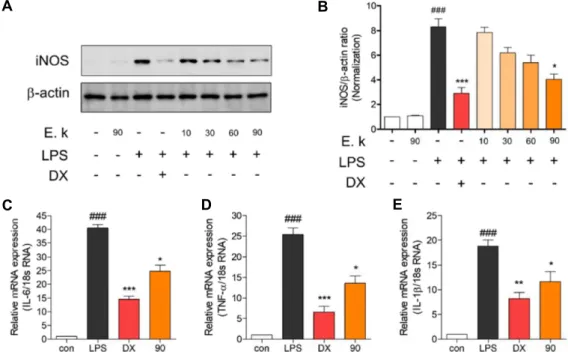
Fig. 2. The 80% sub-fraction showed anti-inflammatory effects by inhibiting pro-inflammatory mediators. (A) The 80% sub-fraction decreased iNOS expression levels in LPS-induced RAW 264.7 cells. (B) Relative ratio of iNOS versus β-actin was measured using densitometry, and dexamethasone was used as positive control. These graphs represented that the 80% sub-fraction dose-dependently inhibited iNOS using immunoblot analysis. Cells were pretreated with each compound for 2 hr and stimu- lated with LPS (1 μg/ml) for 16 hr. Immunoblot analysis was performed in triplicate tests, and results are expressed as means ± SEM. An unpaired Student’s t-test was used for statistical analysis. ###p<0.001 versus Con, *p<0.05, **p<0.01, and

***p<0.001 versus LPS. (C–E) The mRNA expression levels of IL-6, TNF-α, and IL-1β were measured using quantitative real-time PCR experiment, and these proinflammatory cytokines were significantly diminished by the 80% sub-fraction. Cells were preincubated for 2 hr with the 80% sub-fraction (90 μg/ml), and activated by LPS (1 μg/ml) for 2 hr. Results represented as mean ± SEM, and dexamethasone was used as a positive control. ###p<0.001 versus Con, *p<0.05, **p<0.01, and ***p<0.001 versus LPS. Con: control, LPS: lipopolysaccharide, Dx: dexamethasone.

ti-inflammation, furthermore, 80% EtOH sub-fraction of E.

kuroguwai extract were subjects to HP20 gel column chroma- tography eluted with 0% to 100% ethanol and each sub-frac- tions tested in LPS-induced RAW 264.7 cells (Fig. 1B). The 60% (60 μg/ml) and 80% sub-fractions (30 and 60 μg/ml) significantly inhibited NO production in LPS-induced RAW 264.7 cells. Additionally, to investigate cellular toxicology af- ter treatment of the 60% and 80% sub-fractions, we tested cell viability from 10 to 120 μg/ml using MTT assay (Fig.

1C). In the 60% and 80% sub-fractions, there were no toxico- logical effects without below 120 μg/ml. These results sug- gested that E. kuroguwai extracts had anti-inflammatory ef- fects and that the major bioactivity of inhibitory NO pro- duction in each fractions is the 80% sub-fraction.

The 80% sub-fraction inhibits iNOS, and pro-in- flammatory cytokines

To evaluate biological molecular evidences of effectively reduced NO production treated with the 80% sub-fraction,

we evaluated pro-inflammatory mediators such as iNOS,

TNF-α, IL-6, and IL-1β under LPS-induced macrophage,

RAW 264.7 cell line (Fig. 2). Because iNOS, which is involved

in production of NO, induction is novel signalling molecule

associated with MAPKs pathway [19]. Subsequently, pro-in-

flammatory cytokines such as, IL-6, TNF-α, and IL-1β are

induced by MAPK signalling pathway [14]. Under non-toxic

doses of cellular viability, we observed immunoblot of iNOS

expression after treatment with the 80% sub-fraction of 10,

30, 60, and 90 μg/ml (Fig. 2A). In our results, the 80% sub-

fraction (90 μg/ml) showed significant inhibition of iNOS

under LPS-induced macrophage on Western blot and its

graph (Fig. 2B). Moreover, pro-inflammatory cytokines; IL-6,

TNF-α, and IL-1β, were significantly disturbed after treat-

ment with 80% sub-fraction of 90 μg/ml (Fig. 2C, Fig. 2D,

Fig. 2E). These results suggested that the 80% sub-fraction

(90 μg/ml) had anti-inflammatory effects by inhibition of

iNOS, IL-6, TNF-α, and IL-1β.

(5)

A B

C D

Fig. 3. The 80% sub-fraction suppressed MAPK sig- nalling pathway. (A) Immunoblot analysis showed that phosphorylated JNK, ERK, and p38 of MAPKs pathway were observed after treatment with the 80% sub-fraction in RAW 264.7 macrophages. (B–D) The graphs repre- sent ratio of protein level of JNK (B), ERK (C), and p38 (D). Cells were pre-incubated for 2 hr with the 80% sub-fraction (10, 30, 60, and 90 μg/ml), and stimulated with LPS (1 μg/

ml) for 1 hr. Dexamethasone served as pos- itive control. Immunoblot analysis performed as triplicate experiments, and data represented as means ± SEM. Significant difference was considered at the levels of ###p<0.001 versus Con, *p<0.05, **p<0.01, and ***p<0.001 versus LPS. Con: control, LPS: lipopolysaccharide, Dx: dexamethasone.

The 80% sub-fraction disrupted JNK and ERK sig- nalling under LPS-induced inflammation

To investigate inhibition of pro-inflammatory mediators under LPS-induced inflammation, we evaluate major in- flammatory signalling associated with JNK, ERK, and p38 using Western blotting (Fig. 3). Under non-toxic doses of cel- lular viability, we observed phosphorylation of JNK, ERK, and p38 expression after treatment with the 80% sub-fraction of 10, 30, 60, and 90 μg/ml. In results of Western blotting, the 80% sub-fraction (90 μg/ml) significantly inhibited phos- phorylation of JNK and ERK (Fig. 3A). The protein ex- pression ratios of phosphorylation of JNK, ERK, and p38 were shown in Fig. 3B, Fig. 3C, Fig. 3D. These results sug- gested that the 80% sub-fraction (90 μg/ml) had anti-in- flammatory effects by disruption of phosphorylation of JNK and ERK under LPS-induced inflammation. Through these results, E. kuroguwai extract partly coved an anti-inflamma- tory effects by inhibiting MAPK pathways. These results in- dicate that E. kuroguwai extract and its 80% sub-fraction, may be useful and safe therapeutic agents for treatment with in- flammatory diseases with minimal side effects. Further stud- ies are necessary to improve isolation of natural compounds among E. kuroguwai 80% sub-fraction extract using separa- tion analysis and determine bioactivities of its substituents under inflammatory model.

E. kuroguwai extract, which has been treated for jaundice, fever clearance, and hemagogue in traditional Korean medi-

cine. In these results, we found the most effective inhibition of fraction concentration, the 80% sub-fraction among 0%

to 100% sub-fractions. In addition, we determined that the 80% sub-fraction had anti-inflammatory effects by inhibition of the major intracellular inflammatory signaling pathways associated with MAPKs and amelioration of pro-inflamma- tory mediators such as iNOS, IL-6, TNF-α, and IL-1β. These results indicate that the 80% sub-fraction may be useful and safe therapeutic agents for inflammatory action such as rheumatoid arthritis, allergic asthma, and atopic dermatitis.

Through anti-inflammatory effect of E. kuroguwai extract and the 80% sub-fraction, further researches should be proved under safe and therapeutic evaluation of pre-clinical and clinical studies.

Acknowledgements

This work was supported by a grant from the KRIBB Research Initiative Program (KGS1002012) and the National Research Foundation of Korea (NRF) grant funded by the Korea government (MSIT) (2017-0880-03).

The Conflict of Interest Statement

The authors declare that they have no conflicts of interest

with the contents of this article.

(6)

References

1. Abdulkhaleq, L. A., Assi, M. A., Abdullah, R., Zamri-Saad, M., Taufiq-Yap, Y. H. and Hezmee, M. N. M. 2018. The cru- cial roles of inflammatory mediators in inflammation: A review. Vet. World 11, 627-635.

2. Ashley, N. T., Weil, Z. M. and Nelson, R. J. 2012. Inflamma- tion: Mechanisms, costs, and natural variation. Annu. Rev.

Ecol. Evol. S. 43, 385-406.

3. Bertucci, A., Kim, K. H., Kang, J., Zuidema, J. M., Lee, S.

H., Kwon, E. J., Kim, D., Howell, S. B. and Ricci, F. 2019.

Tumor-targeting, microrna-silencing porous silicon nano- particles for ovarian cancer therapy. ACS. Appl. Mater. Inter.

11, 23926-23937.

4. Chul, C., Rhee, I. S., Lee, S. K. and Kang, S. A. 2008. A study on the qualitative properties of traditional sake using allbanggae. J. Kor. Soc. Food. Sci. Nutr. 37, 784-791.

5. Chung, I. M., Kim, J. T. and Kim, S. H. 2006. Evaluation of allelopathic potential and quantification of momilactone a,b from rice hull extracts and assessment of inhibitory bio- activity on paddy field weeds. J. Agric. Food. Chem. 54, 2527-2536.

6. Coleman, J. W. 2001. Nitric oxide in immunity and in- flammation. Int. Immunopharmacol. 1, 1397-1406.

7. Kaminska, B. 2005. Mapk signalling pathways as molecular targets for anti-inflammatory therapy--from molecular me- chanisms to therapeutic benefits. Biochim. Biophys. Acta.

1754, 253-262.

8. Kim, E. K. and Choi, E. J. 2010. Pathological roles of mapk signaling pathways in human diseases. Biochim. Biophys.

Acta. 1802, 396-405.

9. Kim, H. D., Park, J. S., Park, K. S., Choi, Y. J., Yu, C. J., Shim, S. W., Rho, Y. D. and Kwon, Y. W. 1997. Studies on tuberization characteristics of water chestnut (Eleocharis kur- oguwai ohwi). Kor. J. Weed. Sci. 17, 10-23.

10. Kim, H. D., Park, J. S., Park, K. Y., Choi, Y. J., Yu, C. J., Rho, Y. D. and Kwon, Y. W. 1996. Studies on characteristics of sprouting and occurrence on paddy field of water chest- nut (Eleocharis kuroguwai ohwi). Kor. J. Weed. Sci. 16, 264-281.

11. Kim, K. H., Lee, I. S., Park, J. Y., Kim, Y., An, E. J. and Jang, H. J. 2018. Cucurbitacin b induces hypoglycemic effect

in diabetic mice by regulation of amp-activated protein kin- ase alpha and glucagon-like peptide-1 via bitter taste re- ceptor signaling. Front. Pharmacol. 9, 1071.

12. Kim, K. H., Park, E. J., Jang, H. J., Lee, S. J., Park, C. S., Yun, B. S., Lee, S. W. and Rho, M. C. 2019. 1-Carbomethoxy- β-carboline, derived from Portulaca oleracea L., ameliorates lps-mediated inflammatory response associated with mapk signaling and nuclear translocation of NF-κb. Molecules 24, 4042.

13. Lim, H. J., Jang, H. J., Bak, S. G., Lee, S., Lee, S. W., Lee, K. M., Lee, S. J. and Rho, M. C. 2019. In vitro inhibitory effects of cirsiliol on IL-6-induced STAT3 activation through anti-inflammatory activity. Bioorg. Med. Chem. Lett. 29, 1586- 1592.

14. Liu, T., Zhang, L., Joo, D. and Sun, S. C. 2017. NF-κb signal- ing in inflammation. Signal. Transduct. Target. Ther. 2, e17023.

15. Moon, B. C., Cho, S. H., Kwon, O. D., Lee, S. G., Lee, B.

W. and Kim, D. S. 2010. Modelling rice competition with Echinochloa crus-galli and Eleocharis kuroguwai in trans- planted rice cultivation. J. Crop. Sci. Biotechnol. 13, 121-126.

16. Pearson, G., Robinson, F., Beers Gibson, T., Xu, B. E., Kara- ndikar, M., Berman, K. and Cobb, M. H. 2001. Mitogen-acti- vated protein (map) kinase pathways: Regulation and phys- iological functions. Endocr. Rev. 22, 153-183.

17. Sharma, J. N., Al-Omran, A. and Parvathy, S. S. 2007. Role of nitric oxide in inflammatory diseases. Inflammopharmacol- ogy 15, 252-259.

18. Sonar, S. A. and Lal, G. 2019. The iNOS activity during an immune response controls the cns pathology in experi- mental autoimmune encephalomyelitis. Front. Immunol. 10, 710.

19. Tripathi, P., Tripathi, P., Kashyap, L. and Singh, V. 2007.

The role of nitric oxide in inflammatory reactions. FEMS.

Immunol. Med. Mic. 51, 443-452.

20. Zhou, H. Y., Shin, E. M., Guo, L. Y., Youn, U. J., Bae, K., Kang, S. S., Zou, L. B. and Kim, Y. S. 2008. Anti-in- flammatory activity of 4-methoxyhonokiol is a function of the inhibition of iNOS and COX-2 expression in RAW 264.7 macrophages via NF-κb, JNK and p38 mapk inactivation.

Eur. J. Pharmacol. 586, 340-349.

(7)

초록:LPS로 유도된 염증 상태 내에서 MAPKs 세포신호 전달체계를 저해하는 올방개의 항염증 효과

김강훈

1

․배은영

2

․임현구

3

․김미희

4

․오태석

3

*․이승웅

1

*

(

1

한국생명공학연구원 면역조절소재연구센터,

2

엘로힘 R&D 센터,

3

공주대학교 식물자원학과,

4

국립농업과학원

농림환경자원부)

벼 농사에서 마릅으로 불리는 올방개는 문제의 잡초 종류 중 하나로서 제초 작용의 대상이다. 하지만, 올방개는 임상적으로 황달, 해열 및 통경을 위한 전통 의학에 쓰여왔다. 올방개는 오랫동안 임상적으로 사용되어왔음에도 불구하고, 분자생물학 기반의 생물학적 효과는 아직 밝혀지지 않았다. 때문에, 본 연구진은 LPS로 유도된 대식세 포 내에서 올방개 추출물 처리에 의한 NO 생산량을 스크리닝 함으로써 항염증 효과를 조사했다. 가장 효과적인 항염증 fraction을 찾기 위해, 본 연구진은 HP20 column chromatography를 이용하여 5 종류의 EtOH sub-fraction 을 동정하였다; 20%, 40%, 60%, 80%, 및 100% EtOH. 동정한 sub-fraction 중에서, 60%와 80% 성분에서 가장 유의 성 있는 NO 생산의 저해를 나타냈으며, 세포독성 효과도 나타내지 않는 결과를 나타냈다. 추가적으로 80%

sub-fraction은 유의성 있는 iNOS 저해와 전염증성 매개체의 mRNA; IL-6, TNF-α, 그리고 IL-1β를 저해하였으며,

이 결과는 MAPKs 세포신호전달과 관련 있는 JNK 및 ERK 단백질의 인산화 저해가 원인임을 밝혔다. 본 연구진

의 결과는 올방개 추출물 80% sub-fraction EtOH가 항염증 활성을 가장 효과적으로 저해하는 성분 임을 밝혔으

며, 이는 MAPKs 세포신호전달의 과 발현에 의한 염증성 질병의 치료제 후보 성분 일 수 있음을 시사한다.

수치

Fig.  1.  E.  kuroguwai  extract  and  sub-fractions  inhibited  nitric  oxide  production  in  LPS-induced  RAW  264.7  cell  line
Fig.  2.  The  80%  sub-fraction  showed  anti-inflammatory  effects  by  inhibiting  pro-inflammatory  mediators
Fig.  3.  The  80%  sub-fraction  suppressed  MAPK  sig- sig-nalling  pathway.  (A)  Immunoblot  analysis  showed  that  phosphorylated  JNK,  ERK,  and  p38  of  MAPKs  pathway  were  observed  after  treatment  with  the  80%  sub-fraction  in  RAW  264.

참조

관련 문서

1 John Owen, Justification by Faith Alone, in The Works of John Owen, ed. John Bolt, trans. Scott Clark, &#34;Do This and Live: Christ's Active Obedience as the

Despite this trend in addition to numerous studies examining the crime prevention effects of CCTV, a research that studies the difference between the effects

Among the sub-factors of autonomy support coaching behavior, strategy recognition had the most direct influence on the grit of athletes, followed by

The solidification process of metal alloy was expressed by the change of solid fraction, and the solid fraction was controlled by varying size and

The results of the study on how Boswellia affects the hair cycle of the inflammatory skin(? scalp) caused by DNCB in mice are as follows, Experimental method : 5 week-old

Conclusions: Thus, 25-HC induced odontoclast differentiation through the odontoclastogenesis factor-mediated activation of NF-κB and upregulated inflammatory

Pro-allergic cytokines were important mediators of allergic inflammation, cell recruitment and allergenic response decided to further investigate the

This study researched the possibility of using natural products for hair growth agents and hair loss prevention materials based on the test for the antioxidant and