655
F OREST S OCIETY
The Performance Analysis of Korean NGOs' Tree Plantation Projects in Mongolia
Min-Kyung Kang
1*, Dongkyun Park
2and Young-Woo Chun
11
Department of Forest Resources, Kookmin University, Seoul 136-702, Korea
2
Korea Forest Research Institute, Seoul 130-712, Korea
Abstract : Desertification has been expanding with a remarkable speed across the Northeast Asia. Desertification in Northeast Asia significantly influences Korea's economy and environmental health conditions in recent years.
For these reasons, a number of non-governmental organizations (NGOs) in Korea have carried out the reforestation projects to combat desertification in China and Mongolia. Several tree plantation projects were implemented in Mongolia and China. The objective of this study was to analyze and evaluate the performance of tree plantation aid projects carried out by Korean NGOs in Mongolia. The performance of tree plantation projects was examined through effectiveness, efficiency, equity and responsiveness of those projects. The performance was analyzed with the survival rate of planted trees and planting cost, the recognitions of Mongolian people. The analysis of the performance showed that the tree plantation cooperation projects carried out by Korean NGOs in Mongolia had comparatively high performance from a larger point of view. Especially, effectiveness and responsiveness of their projects were highly marked in spite of all the difficulties of carrying out the tree plantation. Such a high effectiveness represented the relatively higher survival rates of trees and Mongolian's positive recognition of plantation projects.
Furthermore, the responsiveness also turned out to be high with a great satisfaction of the Mongolian people for plantation projects conducted by the Korean NGOs. Survey results indicated that the efficiency and equity of the projects would be increased by promoting the cooperation projects for tree planting throughout Mongolia with reinforcing infrastructures. By comparison between Korean NGOs and Mongolian Government plantation projects, confirmed the importance of sustained financial support and maintenance activities in the plantation sites.
Key words : Mongolia, Northeast Asia, performance analysis, combating desertification, overseas plantation, Korean NGOs, Greenbelt Project
Introduction
Desert areas have rapidly increased in the worldwide.
Human reckless activities as well as natural reasons have caused to desertification across the world, and inevitably, Korea's economy and environmental conditions are influ- enced by desertification of China and Mongolia (Hong, 2004). To be specific, there is a risk of deterioration of almost 90% of the land in Mongolia to a desert (UNEP, 2001). However, economical and technical conditions of the country are still not enough to solve the desertifica- tion problem by itself, which means an immediate inter- national supports are needed (Moon and Park, 2004).
For this reason, a lot of Korean NGOs have carried on tree planting aid projects as a small scale since 2000
(Lim, 2005).
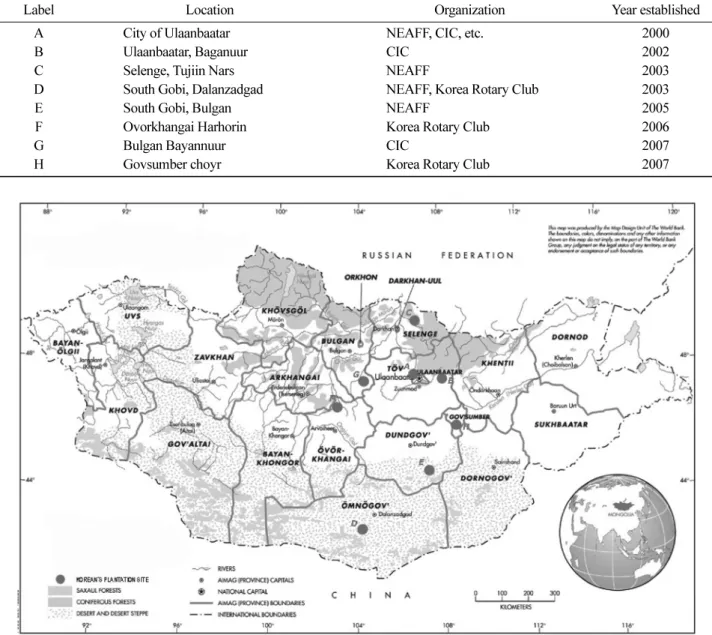
Northeast Asian Forest Forum (NEAFF), Korea's first citizens group for international afforestation and refor- estation movement, has strengthened its tree plantation programs, from Ulaanbaatar city in Mongolia, May of 2000, to the mountain areas of the north near Russian border and to the Gobi Desert of the south (NEAFF, 2005). Korean Government agencies and private com- pany has joined the tree plantation programs since 2002 through the support of the Mongolian Government (Lee, 2006). Until 2007, the area having been planted reached to 1,250ha in Tujiin Nars, a degraded areas by forest fire in the north of Mongolia. Citizen's Info & Media Center (CIC) started a small tree planting project in Ulaanbaatar in 2000 (CIC, 2008). The project was to build a forest for windbreak to protect the city from dust and pollu- tions coming from coal mines. This has been developed to establish an example of a residents' cooperation. Also,
*Corresponding author
E-mail: [email protected]
Korean Rotary Club has carried out tree plantation projects in different regions of Mongolia since 2005 as the 5-year plan in commemoration of the hundredth year of the foundation of Rotary International (Rotary Korea, 2006).
The Rotary club puts its attention on the installation of infrastructure to secure the background for residents resulting in independently their tree planting.
Korean Government supported five hundred million won (which is equivalent to US 500,000) to the Mon- golian Government for the greenbelt project in 2007 and will annually provide one billion won (about US 1 mil- lion) from 2009 (NEAFF, 2006). Other Korean NGOs and organizations, which are able to raise people's awareness and interest and participation in those tree planting projects is much easier than the government programs, are actively progressing for planting aid projects.
It is necessary to assess properly and impartially the performance of our tree planting cooperation projects in Mongolia. To get the evaluation, one need systematic data collection, analysis, and valuable reports (Tsoghtbaatar, 2004). We will get high performance of project outputs in the future through a continuing monitoring by orga- nized researchers and analysis. Although NEAFF (2006) set up ‘the Master Plan for the Greenbelt Project of Mongolia’ as a long-term assistance programs of the tree plantation by government and NGOs in Korea, there has been few of performance analysis of planting activities and comprehensive studies, except for some biological aspects of tree species.
A successive development of Korean tree plantation projects in Mongolia is dependent on correct assessment and analysis of their performance. The performance analysis is an important study not only for the projects that have been done until now but also future prospects can be judged, which will help provide improved per-
formances (Kim et al ., 2006). Since plans and promo- tions over a long period of time are essential for such planting aid projects to succeed, this analyses of perfor- mance for the last 10 years projects should be carried out.
When a performance analysis is conducted with accept- able criteria, which have been used in various study areas, the importances of tree planting aids will have public trust. This is an opportunity for NGOs to be assessed publicly and it will help institutions carry on and support continually those projects. Finally, this results could raise greater interests and participate other organizations.
The purpose of this study is to assess the performance of tree planting projects in Mongolia having been con- ducted by Korean NGOs. This study will analyze neces- sities and prospects for continued support and development of the aid projects. This study can motivate for support- ing finance and manpower to continue tree planting projects in Mongolia.
Methodology
1. Study site
This study was conducted in the sites of planting in Mongolia, which have been supported by Korean NGOs directly or indirectly and have been under their control until now (Table 1). To analyze the performance of the planting aid projects, those of the organizations that have carried on continually the projects, we analyzed them into two parts: their purposes and locations. Since envi- ronmental conditions can be significantly different among regions, comparative analysis between planting sites was not conducted among different regions. If the planting areas founded by the government of Mongolia are sim- ilar with those founded by the help of the Korean NGOs such as establishment year and tree species, we included them for comparison.
Table 1. Korean NGOs’ participation in the tree planting projects in Mongolia.
Organization Year started Region
Northeast Asian Forest Forum 2000 Ulaanbaatar, Selenge, South Gobi
Citizen's Info & Media Center 2000 Ulaanbaatar, Bulgan
Korea Rotary Club 2003 South Gobi, Ovorkhangai, Govsumber
Korea-Mongolia Exchange Promotion Institute 2007 Ulaanbaatar
*Source : http://www.simin.org, http://www.komex.or.kr, http://www.rotarykorea.org, http://www.neaff.org/
Table 2. Study areas and indices of the performance analysis.
Category Item Index
Quantitative level Effectiveness Survival rate of the planted trees , Mongolian's recognition of tree planting projects Efficiency Ratio of tree planting cost to tree survival rate
Qualitative level Equity Locational arrangement by region, Selection criteria of planting site
Responsiveness Satisfaction of supporting institution, Mongolian's satisfaction
2. Analysis
For a systematic analysis of the performance, general criteria and methods used in sociological and political studies were applied in this study. We used seven indexes in four areas: effectiveness, efficiency, equity and respon- siveness (Table 2). Effectiveness is related to outputs and results and can be obtained through the degree of achievement to a goal. Efficiency is the ratio of input to output (Steve, 1990). Equity is to examine if costs of political effects are distributed to different groups and regions without partiality (Fried and Ravinoviz, 1980).
Responsiveness shows if needs, expectation and prefer- ence of recipients of political measures are met and reflected (Kim and Kim, 1996).
After the literature review, field survey was conducted along with interview with responsible staffs, and exam- ined the proper methods of performance analysis. Spe- cifically, data on Mongolia's planting sites of several organizations including the World Bank and Korean NGOs were used and the residents near project sites were given a questionnaire on recognition and satisfac- tion for tree planting projects. The questionnaire given to one hundred people of Baganuur, Ulaanbaatar and Bay- annuur, Bulgan, where a planting site was made up. This was carried out by the help of Citizen's Info & Media Center (CIC) in May, 2008.
Results
1. Effectiveness
Effectiveness of the tree plantation projects is to check the degree of achievement to a project goal. Since the major goals of the tree plantation projects in Mongolia are to increase survival rate of planted trees and to make the Mongolian Government and people have a positive recognition of the tree planting aid, the effectiveness was examined with survival rates of trees and the state of people's recognition in Mongolia of planting activities.
1) Survival rate of the planted trees
Survival rate of planted trees in project sites by whom
planted. Tree planting sites were categorized into two groups: one by the Korean NGOs and the other by the Government of Mongolia. These covered projects in south and north of Mongolia. Desertification is increasing rap- idly in southern part of Mongolia, while the progress of degrade-forests restoration was progressing in northern Mongolia. A comparison of the survival rate in southern Mongolia and northern is little point, because their envi- ronmental condition is completely different.
Mongolian Government planted mainly with native spe- cies, but Korea NGOs selected Poplar that has remark- able drought hardiness (Pallardy and Kozlowski, 1981) and as native species for planting. At the first year after planting, the survival rates of trees were high in both sites established by the Korean NGOs and by the Mon- golian Government (The World Bank, 2006)(Table 3).
However, as time goes by, the survival rates remarkably decreased to less than 10% in the areas built by the Mongolian Government. It is very difficult to mention the annual survival rate to explain how these plantations site changed, since the annual data such as the survival rate or T/R rate are not reported scientifically by the Mon- golian government. Even though the growth related data are not available, the reasons for low survival rares are the staffs were withdrawn from the project sites and there was little maintenance activities, such as nursery management and practice, irrigation for the sites due to the decrease in the government expenditure. On the con- trary, sites developed by the Korean NGOs were still provided with financial and technical supports reaching to above 70% in survival rates. Jamsran Tsoghtbaatar, who is the Director of Geo-Ecology Institute of Mon- golian Academy of Sciences, claimed that the low sur- vival rates are, in most cases, caused by not taking care of planting sites properly due to financial difficulties (per- sonal communication, Seoul, August 24, 2010). He also recommended that the maximum three years of watering and weeding will be enough for the survival of planted trees in this harsh environmental condition.
Even though it is difficult to compare tree planting sites directly because their foundation year and project sizes
Table 3. The survival rates of the planting sites in southern Mongolia.
Category Site no. Year
established Size (ha) Species Survival rate in
first year (%) Survival rate (%)
Korean NGOs site A-1 2005 1 salix, tamarix 95 70
site A-2 2003 80 poplar 70 70
site A-3 2005 60 poplar, elm 77 65
Mongolian Gov. site A-4 2004 15 saxaul, elm 60 0
site A-5 2002 60 saxaul 70 0
site A-6 1989, 1996 120 saxaul 75 8
*Source: The World Bank. (2006)
are different between sites and also each site has differ- ent tree species under specific environmental conditions.
However, the survival rate of trees can be considered in the assessment of project performance because it is the final goal of tree planting projects. Therefore, the tree planting sites made by the Korean NGOs' aid projects showed a higher performance.
In the northern Mongolia, pines and larches were planted because these were native species of the region before being devastated. The survival rates of Korean NGOs sites were reported 50 to 65% by World Bank report (The World Bank, 2006), however, according to the joint-survey by Institute of Geo-Ecology of Mongolian Academy and Korean experts, the survival rates turned out to be more than 80%, whereas the survival rates founded by the Mongolian Government were less than 10% (Table 4). The reasons for such low survival rate are the same as those of the southern Mongolia. The tree planting sites developed by the Korean NGO in the north- ern part of Mongolia also showed a higher performance.
2) Mongolian's recognition of tree planting projects The people who lived in near the tree planting projects were given a questionnaire about their recognition of planting projects and consequent changes. To the ques- tion on the residents' recognition after the tree plantation of planting sites, 88% of the respondents answered pos- itively, saying “It is really necessary for solving prob- lems such as desertification and environmental pollution”,
while only 3% expressed a negative answer, saying that
“There should not be more establishment of planting sites”. After planting sites were built, 91% of the respon- dents made positive answers; 46% of them said the envi- ronment around them became better; 25% said it produced more jobs; 18% said the air got better. Those positive recognition of planting projects showed a probability that there will be people's affirmative agreement and cooperation for our tree planting aid projects in the future.
The 47% of people who live in near the project sites recognized exactly the planting aid agencies and 32% of them were aware of the situation that overseas organi- zations were supporting the tree planting projects of Mon- golia. The fact that a number of residents recognized other countries' cooperation, which can be regarded as a positive outcome in viewpoint of international cooperation.
2. Efficiency
Efficiency is the ratio of investment to output. To find out the efficiency of tree planting projects, the effects of the input including values and costs for the foundation and maintenance of the sites were examined to verify the success of the sites.
The planting sites made by the Korean NGOs were much more expensive than thirty times the costs of Mongolian Government (Table 5). The high cost by the Korean NGOs' projects was due to not only a considerable amount of advanced technologies and resources for basic facilities such as irrigation system for nurseries, but also Table 4. The survival rates of the planting sites in nouthern Mongolia.
Category Site no. Year
established Location
(Aimag) Size (ha) Species Survival rate (%)
Korea NGOs site B-1 2004 Selenge 150 pine 50.5
site B-2 2005 Selenge 250 pine 66.5
Mongolian Gov.
site B-3 2004 Selenge 20 pine 10.3
site B-4 2005 Tuv 10 larch 2.0
site B-5 2004 Tuv 10 larch 0.4
site B-6 2004 Khenti 10 pine 6.8
*Source: The World Bank. (2006)
Table 5. The survival rates of the planting sites in southern Mongolia based on maintenance costs.
Category Site no. Financing Institution Cost (Tg
1)/ha) Supervision Survival Rate (%)
Korean NGOs site A-1 NEAFF 1.5 million 2 full-time employees 70
site A-2 NEAFF 1.5 million 7 full-time employees 70
site A-3 Korea Rotary Club 2.6 million 6 full-time employees 65
Mongolian Gov. site A-4 Mongolian Government 66,700 Local Forester 0
site A-5 Mongolian Government no data Local Forester 0
site A-6 Mongolian Government 50,000 Local Forester 8
*Source: The World Bank. (2006)
1)