• 검색 결과가 없습니다.

MnO<sub>2</sub> as an Effective Sintering Aid for Enhancing Piezoelectric Properties of (K,Na)NbO<sub>3</sub> Ceramics

N/A
N/A
Protected

Academic year: 2021

Share "MnO<sub>2</sub> as an Effective Sintering Aid for Enhancing Piezoelectric Properties of (K,Na)NbO<sub>3</sub> Ceramics"

Copied!
5
0
0

로드 중.... (전체 텍스트 보기)

전체 글

(1)

DOI: 10.4150/KPMI.2010.17.5.399

MnO 2 as an Effective Sintering Aid for Enhancing Piezoelectric Properties of (K,Na)NbO 3 Ceramics

Seong-Kyu Jeong, In-Ki Hong, Nam-Binh Do, Vu Diem Ngoc Tran, Seong-Youl Cho

a

, Weon Pil Tai

b

, and Jae-Shin Lee *

School of Materials Science and Engineering, University of Ulsan, Ulsan 680-749, South Korea

a

R&D Center, LHE Corp., Gim-Hae 621-874, South Korea

b
Ulsan Fine Chemical Industry Center, Ulsan Technopark, Ulsan 681-340, South Korea (Received September 3, 2010; Revised September 20, 2010; Accepted October 1, 2010)

Abstract The effects of MnO

2

doping on the crystal structure, ferroelectric, and piezoelectric properties of (K,Na)NbO

3

(KNN) ceramics have been investigated. MnO

2

was found to be effective in enhancing the densification and grain growth during sintering. X-ray diffraction analysis indicated that Mn ions substituted B-site Nb ions up to 2 mol%, however, further doping induced unwanted secondary phases. In comparison with undoped KNN ceramics, the well developed microstructure and the substitution to B-sites in 2 mol% Mn-doped KNN ceramics resulted in sig- nificant improvements in both piezoelectric coupling coefficient and electromechanical quality factor.

Keywords : Lead-free piezoelectric ceramics, Bismuth sodium potassium titanate, Mn doping, Electric-field- induced strain

1. Introduction

The increasing demand for environmentally friendly materials in electronic industry accelerates intensive and extensive studies on new lead-free piezoelectric ceramics that can replace lead zirconate titanate (PZT) based ceramics. Among various lead-free ceramic compositions, (K

0.5

Na

0.5

)NbO

3

(KNN) solid solutions demonstrated promising electromechanical properties comparable to PZT ceramics in terms of electric-field-induced strain [1]. KNN is composed of equimolar solid solution of KNbO

3

(KN) and NaNbO

3

(NN) [2-4]. Both KN and NN reveal orthorhombic structure at room temperature. How- ever studies on lead-free piezoelectric ceramics have been principally focused on the improvement of piezoelectric strain characteristics that are particu- larly important for actuator applications. Mean- while, for high power or frequency applications such

as high frequency resonators, transformers, and ultra- sonic motors, piezoelectric materials are requested to have low dielectric loss, high mechanical quality factor ( Q

m

) as well as moderate piezoelectric coupling coeffi- cients instead of high electric-field-induced strain.

Recently many studies reported on the improve- ment of Q

m

of KNN-based ceramics by doping with acceptor impurities such as CuO [5-7], MnO

2

[8], co-doping of CuO and MnO

2

[9], co-doping of MnO

2

and K

5.4

Cu

1.3

Ta

10

O

29

(KCT) [10], and co-dop- ing of CuO and KCT [11]. In spite of extensive stud- ies on the effects of acceptor impurities on the piezoelectric properties, the effect of Mn doping is still unclear. Therefore we investigated the effects of MnO

2

additive on the microstructure and piezoelec- tric properties of KNN ceramics. It is found that Mn doping enhances the sinterability of KNN ceramics and further improves the electromechanical quality factor significantly.

*Corresponding Author : [Tel : +82-52-259-2286; E-mail : [email protected]]

(2)

Firstly, the powders were weighed according to the chemical formula and then ball-milled for 24 h in anhydrous ethanol with zirconia balls. The slurry was dried and calcined at 850°C for 2 h. The cal- cined powder was mixed with polyvinyl alcohol as a binder and pressed into green disks with a diameter of 18 mm at 200 MPa. Sintering was performed at 1025~1075 °C in a covered alumina crucible for 2 h in air.

The crystal structure was analyzed using an X-ray diffractometer (XRD, RADIII, Rigaku, Japan), and the surface morphology was examined with a field emission scanning electron microscope (FE-SEM),

quality factor ( Q

m

) were evaluated using the reso- nance method with an impedance analyzer (HP 4194A) on the basis of IEEE standards [12].

3. Results and Discussion

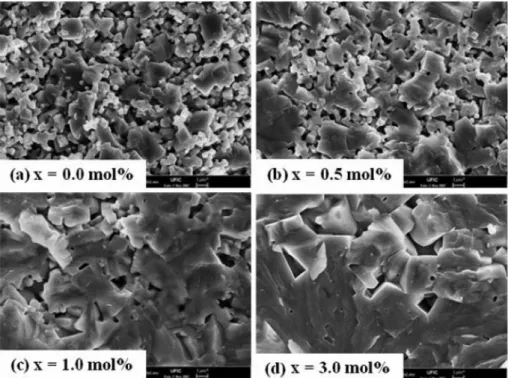
Fig. 1 shows the surface FE-SEM micrographs of KNN ceramics added with MnO

2

in the range of 0~3 mol%. Without MnO

2

additive, KNN ceramics reveals a porous structure with an average grain size less than 1 µ m, however, the addition of MnO

2

enhances the densification and grain sizes over 3 µ m when MnO

2

content reaches 3 mol%. This is probably due

Fig. 1. Effect of MnO

2

addition on the microstructure of KNN ceramics.

(3)

to the formation of O-vacancies that is induced by substituting pentavalent Nb-sites with divalent Mn ions in order to maintain charge neutrality in the lat- tice.

XRD patterns of MnO

2

doped KNN ceramics sin- tered at 1050°C for 2 h are given in Fig. 2. All speci- mens reveal typical orthorhombic symmetry without any secondary phase, which is in good agreement with previous reports on KNN ceramics [5-8]. How- ever, careful observation of (002)/(200) peaks around 46

o

indicates a shift of peak position toward higher angles with elevating Mn doping concentration. This means that the lattice constants a and c shrink with Mn doping. Considering the fact the ionic radii of K

+

, Na

+

, Nb

5+

, and Mn

2+

ions are 1.38, 1.02, 0.64, and 0.67 [13], respectively, Mn ions are presumed to substitute to B-site Nb

5+

ions. In this case, O- vacancies are generated to maintain charge neutral- ity in the lattice. The formation of O-vacancies might be responsible for the shrinkage of lattice by Mn- doping. The solubility of Mn ions in KNN ceramics seems to be 2 mol% because secondary phases that are identified as MnNb

2

O

6

and K

4

MnO

4

[14,15] are precipitated when 3 mol% MnO

2

is added. At high doping level of x =3, there may be a change in dop- ing behavior, for example, from B-site to A-site dop- ing like Cu ions in KNN-KCT ceramics [11].

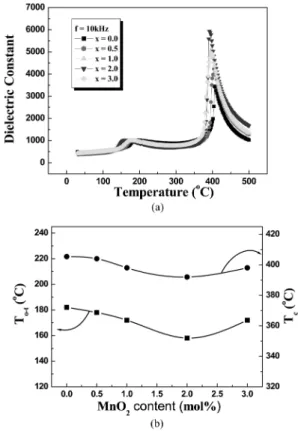
The temperature dependence of relative dielectric constant ( ε

r

) was measured as a function of Mn dop- ing level and displayed in Fig . 3. Room temperature

ε

r

of undoped KNN ceramics is 500, which well matches other report on KNN ceramics [3]. How- ever the ε

r

decreases down to 400 at x =2, and fur- ther doping increased up to 430 at x =3. Similarly to other previous reports on KNN ceramics [2-4], ε

r

(T) spectra clearly show two peaks at about 180°C ( T

O-T

) and 400°C ( T

C

). The former corresponds to the phase transition from orthogonal-to-tetragonal sym- metry, and the latter does that of tetragonal-to-cubic.

As Mn doping level increases up to 2 mol%, both

T

O-T

and T

C

decrease from 182°C to 158°C and from 405°C to 392°C, respectively. Further Mn doping levels them up slightly probably due to the change in Mn doping behavior as can be supposed from XRD data given in Fig. 2, which indicates that the solubil- ity of Mn into KNN is 2 mol%.

The temperature dependence of dielectric loss also Fig. 2. XRD patterns of x mol% MnO

2

added KNN ceram-

ics sintered at 1050

o

C for 2 h.

Fig. 3. The temperature dependence of (a) relative dielec-

tric constant and (b) transition points of KNN ceramics as

a function of Mn doping level.

(4)

shows two anomalies at about 180°C and 400°C for all specimens as seen in Fig. 4. The peaks also corre- spond to the transition points in ε

r

( T ) curves. Room temperature dielectric loss of undoped KNN ceram- ics is over 0.1, which is a high level for dielectrics.

However, Mn doping markedly decreased the loss down to 0.02, indicating the fact that Mn ions act as acceptor impurities in KNN ceramics in a similar manner that they behave as acceptors in PZT ceram- ics by substituting Ti ions [16].

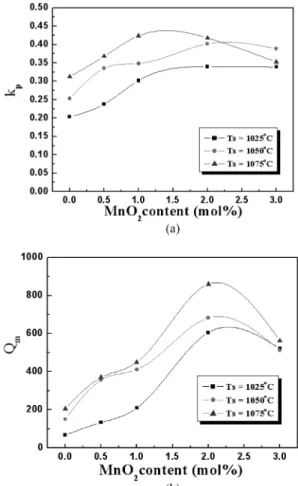
Fig. 5 shows the piezoelectric coupling coefficient

k

p

and electromechanical quality factor of KNN ceram- ics sintered with MnO

2

as a sintering aid. Without MnO

2

aid, the k

p

and Q

m

of KNN ceramics only show 0.31 and 200, respectively. However, MnO

2

addi- tion significantly enhances both k

p

and Q

m

up to 0.42 and 860, respectively, when 2 mol% MnO

2

is added.

These results seem to be related with the well devel- oped microstructure and O-vacancies that are induced by Mn-doping to Nb-sites. It is well known that the piezoelectric properties are enhanced by densifica- tion and grain growth [17-18]. In addition the Q

m

can also be improved by acceptor doping induced O- vacancies that pin the domain reorientation and harden the piezoelectric materials, resulting in enhancement in the mechanical quality factor [5-11]. This mecha- nism is indeed supported by the fact that the highest

Q

m

is observed at x =2 mol% in this work, where the

solubility of Mn ions in KNN ceramics reaches max- imum as disclosed by XRD results in Fig. 2.

4. Conclusions

The microstructure, crystal structure, dielectric and piezoelectric properties of MnO

2

added KNN ceram- ics have been systematically investigated. It was found that MnO

2

enhances the densification and grain growth of KNN ceramics during sintering, leading to the increased piezoelectric coupling coefficient k

p

. In addition, Mn dissolves into KNN ceramics during sintering up to 2 mol% by substituting to B-site ions and act as acceptors that significantly increase the Fig. 4. The dielectric loss of KNN ceramics as a function of

Mn doping level.

Fig. 5. (a) The piezoelectric coupling coefficient ( k

p

) and

(b) electromechanical quality factor ( Q

m

) of MnO

2

added

KNN ceramics.

(5)

mechanical quality factor. Therefore it can be con- cluded that the Mn doping is quite effective in microstructural evolution as well as in enhancement of piezoelectric properties of KNN ceramics.

Acknowledgments

This work was financially supported by the Minis- try of Knowledge Economy, Republic of Korea, under the contract No.B0009733.

References

[1] Y. Saito, H. Takao, T. Tani, T. Nonoyama, K. Takatori, T. Homma, T. Nagaya and M. Nakamura: Nature, 432 (2004) 84.

[2] B. Jaffe, W. R. Cook and H. Jaffe: Piezoelectric Ceramics.

Academic Press, New York (1971).

[3] L. Egerton and D. M. Dillon: J. Am. Ceram. Soc., 42

(1959) 438.

[4] L. E. Cross: Nature, 181 (1958) 178.

[5] D. Lin, K. W. Kwok and H. L. W. Chan: J. Appl. Phys.

Lett, 9 (2007) 232903.

[6] N. M. Hagh, K. Kerman, B. Jadidian and A. Safari: J.

Eur. Cerm. Soc., 29 (2009) 2325.

[7] M. Jiang, X. Li, J. Liu, J. Zhu, X. Zhu and L. Li: J.

Alloy. and Comp., 479 (2009) 18.

[8] J. Hao, Z. Xua, R. Chu, Y. Zhang, G. Li and Q. Yin:

Mater. Chem. and Phys., 118 (2009) 229.

[9] D. Lin, K.W. Kwok and H. L. W. Chan: J. Alloy. and Comp., 461 (2008) 273.

[10] D. Lin, M. S. Guo, K. H. Lam, K. W. Kwok and H. L.

W. Chan: J. Smart. Mat. Struct., 17 (2008) 035002.

[11] B. C. Park, I. K. Hong, H. D. Jang, V. D. N. Tran, W. P.

Tai and J. S. Lee: Mater. Lett., 64 (2010) 1577.

[12] ANSI/IEEE Standard No. 176-1987. New York (1987).

[13] R. Shannon: Acta. Cryst., 32 (1976) 751.

[14] PCPDF card number 75-2159.

[15] PCPDF card number 31-1051.

[16] L. X. He and C. E. Li: J. Mat. Sci., 35 (2000) 2477.

[17] G. H. Haerting: J. Am. Ceram. Soc., 50 (1967) 229.

[18] R. E. Jaeger and L. Egerton: J. Am. Ceram. Soc., 45

(1962) 209.

수치

Fig. 1 shows the surface FE-SEM micrographs of KNN ceramics added with MnO 2  in the range of 0~3 mol%
Fig. 3. The temperature dependence of (a) relative dielec- dielec-tric constant and (b) transition points of KNN ceramics as a function of Mn doping level.
Fig. 5. (a) The piezoelectric coupling coefficient ( k p ) and (b) electromechanical quality factor ( Q m ) of MnO 2  added KNN ceramics.

참조

관련 문서

dielectric loss because the coexistence of two or more of NKN-LNx structure. Thus, we investigated the dielectric properties of NKN- LNx ceramic because the need to

This is an Open-Access article distributed under the terms of the Creative Commons Attribution Non-Commercial License (http://creativecommons.org/licenses/by-nc/3.0)

This is an Open-Access article distributed under the terms of the Creative Commons Attribution Non-Commercial License

This is an Open-Access article distributed under the terms of the Creative Commons Attribution Non-Commercial License (http://creativecommons.org/licenses/by-nc/3.0)

This is an Open-Access article distributed under the terms of the Creative Commons Attribution Non-Commercial License (http://creativecommons.org/licenses/by-nc/3.0)

the phase structure, microstructure and electrical properties were investigated with a emphasis on the influence of the Nb 2 O 5

Hysteresis loop 특성은 standard ferroelectric test system (model: RT-66A, Radiant Technology Co.)을 이용하여 virtual ground mode에

We investigated the piezoelectric properties and microstructures of these disk samples sintered in reduced atmosphere in order to evaluate the possibility of