Vol. 26, No. 12 (2016)
721
Electrical Properties of Lead Free (1-x)(Na
0.5K
0.5) NbO
3-xLiNbO
3Piezoelectric Ceramics
Jong-Ho Park 1† , Hui-Jin Park 2 and Byung-Chun Choi 2
1
Department of Science Education, Chinju National University of Education, Jinju 52673, Republic of Korea2
Department of Physics, Pukyong National University, Pusan 48513, Republic of Korea(Received July 21, 2016 : Revised November 9, 2016 : Accepted November 9, 2016)
Abstract
This work focuses on the electrical conduction mechanism in a lead free (Na0.5
K0.5
NbO3
; NKN) ceramics system with LiNbO3
content of approximately critical concentration x ≥ 0.2. Lead free (1-x)(Na0.5
K0.5
)NbO3
-x(LiNbO3
), NKN-LNx (x = 0.1, 0.2) ceramics were synthesized by solid-state reaction method. Crystal structures are confirmed by X-ray diffraction.The electric-mechanical bond coefficient k
p
decreases and the phase transition temperature Tc
increases with increasing x content, as determined by dielectric and piezoelectric measurements. The value of the real dielectric constants ε' and kB
Tε'' showed anomalies around Tc
(462o
C in the NKN-LN0.1 and 500o
C in the NKN-LN0.2). For the ionic conduction of mobile ions, the activation energies are obtained as EI
= 1.76 eV (NKN-LN0.1) and EI
= 1.55 eV (NKN-LN0.2), above Tc
, and EII
= 0.78 (NKN- LN0.1) and EII
= 0.81 (NKN-LN0.2) below Tc
. It is believed that the conduction mechanisms of NKN-LNx ceramics are related to ionic hopping conduction, which may arise mainly due to the jumping of Li+
ions.Key words
Pb-free, electrical conductivity, dielectric, piezoelectric, ionic hopping.1. Introduction
A typical structure of the ferroelectric has a perovskite- type, tungsten-bronze-type and the spinel-type. Perovskite type has the general formula of ABO 3 such as BaTiO 3 PZT (Pb(Zr,Ti)O 3 et al. and typical materials of the spinel type is a LiNbO 3 and tungsten-bronze-type is a NKN (Na x K 1-x NbO 3 ) et al. 1) . Researchers have been many studies on the perovskite type since it is well known that, among ferroelectric materials, the relatively perovskite type structure than other ferroelectric is simpler. The most widely used piezoelectric ceramic is lead zirconate titanate Pb[Zr x Ti 1-x ]O 3 , or PZT. 2-5) One critical disadvan- tage of PZT is that it contains more than 60 percent lead(Pb) by weight. 5) This large lead content creates hazards during processing(lead volatilizes and is released into the atmosphere), limits applications, and is potentially environmentally toxic during disposal. Over the past few years, regulatory agencies world-wide began putting strict restrictions on the use of lead, with the exception of the electronics industry due to the lack of a suitable replacement. As a result, the study of the Pb-free pie-
zoelectric ceramic to replace the current PZT is being accelerated. 6-9)
Recently, NKN ceramics is a piezoelectric material, which receives attention in research and industry of Pb- free piezoelectric since highly phase transition temperature and electro-mechanical coupling coefficient. But it is difficult to manufacture the ceramics of high density because potassium(K) and sodium(Na) elements of con- stituting the NKN are a very well absorbed in the air moisture during manufacturing ceramic. 10-12) In order to compensate for these disadvantages, researchers are studying ways to produce a high density of the ceramic at a low temperature such as hot pressing, spark plasma sintering methods or BaTiO 3 ,(BT) 13) SrTiO 3 ,(STO) 11) LiNbO 3 (LN), 2) LiTaO 3 (LT) 14) doping method. 14-16) Hot pressing, spark plasma sintering method can be a problem to make a specimen of the same conditions, because the process is complicated and difficult making ceramics. So, the re- search focus has been to improve both the sinterability and piezoelectric properties of KNN by investigating solid solutions such as KNN-CaTiO 3 , 17) KNN-STO, 18) KNN-BaO, 19) KNN-LN, 20) KNN-LT, 21) KNN-LT-LiSbO 3 , 22)
†
Corresponding author
E-Mail : [email protected] (J.-H. Park, Chinju Nat'l Univ. Edu.)
© Materials Research Society of Korea, All rights reserved.
This is an Open-Access article distributed under the terms of the Creative Commons Attribution Non-Commercial License (http://creative-
commons.org/licenses/by-nc/3.0) which permits unrestricted non-commercial use, distribution, and reproduction in any medium, provided the
original work is properly cited.
amount of K on the A-site of the perovskite is approxi- mately equal to 0.5 mol. 2)
Recently, Guo et al studied the piezoelectric and dielectric properties for the NKN-LN (0.0 ≤ x ≤ 0.2) ceramic. 2,14-15,20) They reported that A phase K 3 Li 2 Nb 5 O 15 with tetragonal tungsten bronze structure begins to appear after the Li content reaches its solubility limit in the A sites of NKN ceramics (x = 0.08). A morphotropic phase boundary between orthorhombic and tetragonal phases is found at 0.05 ≤ x ≤ 0.07. Enhanced piezoelectric and electromechanical responses d 33 = 200 − 235 pC/N, kp = 38 % − 44 %, and kt = 44 % − 48 % are obtained for samples with composition near the MPB(morphotropic phase boundary). And park et al proposed that the ferroelectric phase transition of NKN-LNx (x ≤ 0.1), is a second-order transition without thermal hysteresis, and NKN-LNx (x ≥ 0.2) is a weak first-order transition with small thermal hysteresis. 24) Thus, their results demonstrate the possibility that the concentration of x~0.2 may be the critical concentration for a first-to-second-order-ferro- electric phase transition However, the structure of solid solution transforms from orthorhombic to tetragonal symmetry due to the large distortion caused by Li+.
Therefore, it is necessary to investigate further electrical properties of NKN-LNx ceramic because it seems that the effect of piezoelectric caused by Li+ to be important.
And there has been little research of ionic conduction in NKN-LNx below critical concentration x~0.2. Thus, the purpose of this study is to investigate the electrical pro- perties (Na 0.5 K 0.5 )NbO 3 in terms of its LiNbO 3 content (below critical concentration x).
2. Experimental Procedure
Pb-free (1-x)(Na 0.5 K 0.5 )NbO 3 -xLiNbO 3 , i.e., NKN-LNx (x = 0.1, 0.2), was prepared by mixing the oxides, K 2 CO 3 (99 % purity), Na 2 CO 3 (99 % purity), LiNbO 3 (99 % purity) and Nb 2 O 5 (99 % purity) in a molar ratio used in the conventional solid state reaction method. Before being weighed, the K 2 CO 3 and Na 2 CO 3 powders were first dried in an oven at 200 o C for 10 h to minimize the effect of moisture. These powders were then milled with ZrO 2 balls for 20 h using ethyl alcohol as a medium and dried. The dried powders were calcined at 850 o C for 2 h. After calcination, the powders were ball-milled again for 20 h and, dried, after which PVA(4 wt%) was added as a binder. They were then pressed into disks with diameter of under 13 mm. After burning off the PVA, the pellets were sintered at 1,070 o C for 2 h. The crystal structures were determined by X-ray power diffraction analysis using Cu Κα radiation(Philips X’ Pert - MPD
silver paste on both surfaces, and fired at 800 C for 30 min. The samples were poled using 25 kV/cm in silicon oil bath at 100 o C for piezoelectric property measure- ments. The piezoelectric properties were measured using an LCR meter(HP4192A, HEWLETTPACKARD). The dielectric properties were measured using an Solartron1260 at temperature ranging from room temperature to 600 o C with heating rate of 0.2 o C/min in the frequency range of 10 Hz to 1 MHz.
3. Results and Discussions
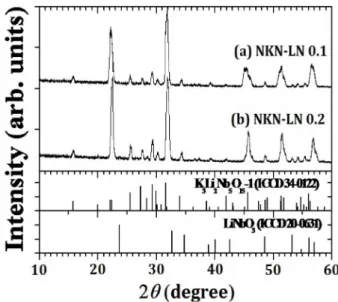
Fig. 1 shows the x-ray diffraction patterns of NKN- LNx ceramics. A phase K 3 Li 2 Nb 5 O 15 (ICDD: 52-0157) with a tetragonal tungsten bronze structure appear at x = 0.1, 0.2. Although both NKN and LN have octahedral NbO 6 basic structure units, they belong to different structures. NKN has the perovskite structure with space group Amm2 ( ). LiNbO3 however has the lithium niobate structure, which can be described as a heavily distorted perovskite or an ordered phase derived from the corundum structure with space group R 3C ( ). 20) Thus, it is believed that two effects on the structure of NKN ceramics have been observed in NKN-LN ceramics.
The (a) impedance magnitude and (b) phase of a NKN- LNx ceramics as a function of frequency and para- meterized by the x contents are shown in Fig. 2. The change of phase which appears at measuring frequencies between 260 Hz and 270 Hz is one peak for NKN-LN0.1 ceramic, while two Resonance-Antiresonance peaks were occasionally detected for impedance. In the case of NKN-
C
2v 14
C
3v 6
Fig. 1. X-ray diffraction patterns of (x-1)(Na
0.5K
0.5)NbO
3- xLiNbO
3,
NKN-LN x specimens with x = 0.1 and 0.2.
LN0.2, the change impedance and phase are observed at measuring frequencies between 270 Hz and 280 Hz. The peak frequency of phase and impedance moves to higher frequencies with increasing x, and the phase and impedance intensively increases with the x contents. The x dependence of the NKN-LNx ceramic can be obtained by determining the frequency at which the phase maxi- mum of each curve occurs.
Electric-mechanical bond coefficient, k p was calculated with following equation: 25-26)
(1) where, Δf = f a − f τ , f τ is resonance frequency, and f α is anti resonance frequency and The k p was obtained by the phase and impedance data to Eq. (1), which is shown in Fig. 2(a) and (b). The values of electric-mechanical bond coefficient, k p = 16 % in the NKN-LN0.1 and k p = 9.1 % in the NKN-LN0.2 ceramics were obtained from the Eq.
(1). The value of k p is reduced almost by half with in- creasing LiNbO 3 contents. This means that the piezoelectric properties of the NKN-LNx ceramic depend on the LiNbO 3
content. When the resonance results compared to the results of the x- ray experiments, the possible origin of the piezoelectric property for NKN-LNx ceramic is con- sidered to be the increasing electrical conductivity and
dielectric loss because the coexistence of two or more of NKN-LNx structure.
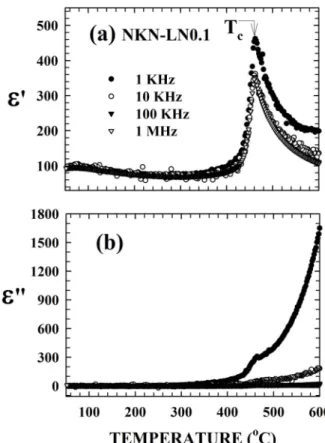
Thus, we investigated the dielectric properties of NKN- LNx ceramic because the need to recognize the electrical conductivity and dielectric loss. Fig. 3(a) and (b) show the real ( ε') and imaginary (ε'') parts of the complex dielectric constant of NKN-LN0.1 ceramic, shows a weakly sharp maximum around T c = 462 o C,. On further heating above T c , ε' decreases slightly with increasing temperature and ε'' increase continuously and rapidly for all measuring frequencies. Fig. 4(a) and (b) show the ε' and ε'' of NKN-LN 0.2 ceramic, show a broad maximum around T c = 500 o C. The behaviors of ε', ε'' in the case of the NKN-LN0.2 are similar to the case for NKN-LN0.1 ceramic. And the ferroelectric phase transition tempera- ture T c shifted to a higher value with an increase in the LN content, whereas the dielectric peak broadened. The changes of ε' of NKN-LNx ceramics are similar to re- sults reported previously. 2,14-15,20)
Park et al reported that the weakly sharp peaks around T c for the NKN-LN0.0 and NKN-LN0.1 sample show a second-order phase transition without thermal hysteresis and a weakly first order- phase transition in the case of NKN-LNx (x ≥ 0.2), they proposed that the concentration of x~0.2 may be the critical concentration for a first- to
k
p
Δf0.395f
τ
+0.574 fΔ ---=
Fig. 2. Frequency dependence of (a) impedance and (b) phase of the ( x-1)(Na
0.5K
0.5)NbO
3- xLiNbO
3, NKN-LN x specimens with x =
0.1 and 0.2. Fig. 3. Temperature dependence of (a) the real, ε' and (b) imaginary,
ε'' parts of the complex dielectric constant of the (x-1)(Na
0.5K
0.5)
NbO
3- xLiNbO
3, NKN-LN x specimens with x = 0.1.
second-order-ferroelectric phase transition. 24) At lower LiNbO 3 (x ≤ 0.07), Guo et al. 2,14-15,20) reported that Li mainly replaces Na and K in the A sites of ABO 3
perovskite structure(i.e. form a solid solution), leading to a linear shift of the T c to higher temperature. However, the structure of solid solution transforms from ortho- rhombic to tetragonal symmetry due to the large distortion caused by Li + .
However, we observed that dielectric dispersion of NKN-LNx ceramics start near 400 o C and the value of ε'' increases gradually to 400 o C and then increases rapidly with further heating. It is well known that ε'' is related to the ionic conductivity, σ. 27) So, ε'' increases gradually because the electrical conductivity increases above 400
o C. The corresponding increase in the values of ε'' may be due to increase in number of dipoles in the interlayer space while the corresponding decrease in the values ε'' may be due to the increase in the leakage current due to the higher doping.
In order to clarify the physical origin of the dielectric dispersion of NKN-LNx ceramics above 400 o C, we dis- played ε" by K B Tε" as shown Fig. 4(a) and (b).
Generally, the ionic conductivity σ was found to obey the following relation 27)
ε 0 ωε" = σ (2)
where ω is the frequency of the applied field and ε 0 the vacuum permittivity.
And the ionic conductivity is given by the diffusion constant through the Einstein relation 27) follow as :
σ/D = Ne 2 / K B T. (3)
where, N is number of charge carrier, the diffusion coefficient, D is related to the migration of ions or ion vacancies in the ionic crystals. e is ionic charge, k B is Boltzmann constant. And formation energy, Φ of ionic vacancy in the crystal and the probability, P of the ions to jump over the potential barrier represented as follows:
D = (Ca 2 /3)exp( −Φ/2k B T) (4)
P = vexp(−Δ/k B T) (5)
where a is distance of atom in the crystal, C is factor is the change of entropy caused by ion vacancy v is the ionic frequency. Thus, By Eq. (5), D is represented as Fig. 4. Temperature dependence of (a) the real, ε' and (b) imaginary,
ε'' parts of the complex dielectric constant of (x-1)(Na
0.5K
0.5)NbO
3-
xLiNbO
3, NKN-LN x specimens with x = 0.2. Fig. 5. The relationship between ln(k
BTε'') and 1/T for (a) NKN-
LN0.1 (b) NKN-LN0.2 ceramics. Solid lines fitted by Eq. (7). The
slope of the straight lines corresponds to the activation energies.
follows.
D = D 0 exp( −E/k B T) (6)
where, activation energy E = Δ + Φ/2 is dc conductivity caused by bulk at high temperature region, which corres- ponding to intrinsic properties and It is well known that activation energy, E = Δ is related to the ionic hopping of mobile ion. Thus one can obtain the relation as:
ln(K B Tε'') = (7)
This implies that when ln(K B Tε'') is plotted against 1/T, it should fall on a straight line with the slope of E
□/K B : Indeed, the present data show reasonable agreement with Eq. (7) as is seen from Fig. 5(a) and (b). K B Tε" increase slightly with increasing temperature and then it sharply rises around T c = 462 o C for the NKN-LN0.1 and drops discontinuously around T c = 500 o C for the NKN-LN0.2.
The total activation energies are thus obtained as E I = 1.76 eV(above T c ) and E II = 0.78(below T c ) for the ionic hopping of mobile ions in NKN-LN0.1 and E I = 1.55 eV(above T c ) and E II = 0.81(below T c ) for ionic hopping of mobile ions in NKN-LN0.2. The interval between curves 100 Hz, 1 kHz, 10 kHz, 100 kHz, 1 MHz are almost equal. These results are well described by Eq. (7) asso- ciated with the ionic hopping conduction.
4. Conclusion
Potassium sodium niobate (Na 0.5 K 0.5 NbO 3 ; NKN) cer- amics with the addition of LiNbO 3 , (1-x)(Na 0.5 K 0.5 )NbO 3 - x(LiNbO 3 ), NKN-LNx (x = 0.1, 0.2), NKN-LNx ceramics have been synthesized by solid-state reaction method.
Crystal structures are confirmed by the X-ray diffraction.
The temperature and frequency dependence of dielectric, piezoelectric properties were investigated by complex di- electric constant, electromechanical coupling factor, re- spectively. The piezoelectric properties, electrical conduc- tivity, phase transition temperature of the NKN-LNx ceramic depend on the LiNbO 3 content. The electrical conductivity and activation energies change at the T c , suggesting that both mechanisms are correlated with ion migration. The activation energies associated with hopping conduction are E I = 1.76 eV(NKN-LN0.1) and E I = 1.55 eV (NKN-LN0.2), above T c and E II = 0.78(NKN-LN0.1) and E II = 0.81 (NKN-LN0.2) below T c
References
1. Y. Xu, Ferroelectric Materials and Their Applicarions,
North-Holland (1991).
2. Y. Guo, K. Kakimoto and H. Ohsato, Solid State Commun., 129, 279 (2004).
3. M. Matubara, T. Yamaguchi, K. Kikuta and S. Hirano, Jpn. J. Appl. Phys., 44, 258 (2005).
4. B. Jaffe, R. S. Roth and S. marzullo, J. Appl. Phys., 25, 809 (1954).
5. H. Ouchi, K. Nagano and S. Hayakawa, J. Am. Ceram.
Soc., 48 630 (1965).
6. S.-E. Park and T. R. Shout, J. Appl. Phys., 42, 6086 (2003).
7. Y. Sugaya, K. Shoji and Koichiro, Jpn. J. Appl. Phys., 42, 6086 (2003).
8. Z. Yu, R. Guo and A. S. Bhalla, J. Mater. Lett., 57, 349 (2002).
9. H. Nagata and T. Taketaka, Jpn. J. Appl. Phys., 36, 6055 (1997).
10. Y. Guo, K. Kakimoto and H. Ohsato, Appl. Phys Lett., 85, 4121 (2004).
11. H.-Y. Park, C.-W. Ahn, H.-C. Song, J.-H. Lee and S.
Nahm, Appl. Phys. Lett., 89, 062906 (2006).
12. Y.-W. No, Y.-B. Yoo, S.-M. Son, and S.-T. Chung, J.
Korean Inst. Electr. Electron. Mater. Eng., 19, 717 (2006).
13. Y. Dai, X. Zhzng and G. Zhou, Appl. Phys. Lett., 90, 262903 (2007).
14. Y. Guo, K. Kakimoto and H. Ohsato, Jpn, J. Appl. Phys., 43, 6662 (2004).
15. Y. Guo, K. Kakimoto and H. Ohsato, Mater. Lett., 59, 241 (2005).
16. S. H. Park, C. W. Ahn, S. Nahm and J. S. Song, Jpn. J.
Appl. Phys., 43, 1072 (2004).
17. I. Ramajo, R. Parra, M. A. Ramirez and M. S. Castro, Bull. Mater.Sci., 34, 1213 (2011).
18. H.-Y. Park, K.-H. Cho, D.-S. Paik, S. Nahm, H.-G. Lee and D.-H. Kim, J. Appl. Phys., 124101, 102 (2007).
19. Z. S. Ahn and W. A. Schulze, J. Am. Ceram. Soc., 70, 18 (1987).
20. Y. Guo, K. Kakimoto and H. Ohsato, Appl. Phys. Lett., 85, 4121 (2004).
21. Y. Saito, H. Takao, T. Tani, T. Nonoyama, K. Takatori, T.
Homma, T. Nagaya and M. Nakamura, Nature (London, U. K.), 432, 84 (2004).
22. S. J. Zhang, R. Xia, T. R. Shrout, G. Z. Zang and J. F.
Wang, J. Appl. Phys., 100, 104108 (2006).
23. G. Z. Zang, J. F. Wang, H. C. Chen, W. B. Su, C. M.
Wang, P. Qi, B. Q. Ming, J. Du, L. M. Zheng, S. J. Zhang and T. R. Shrout, Appl. Phys. Lett., 88, 212908 (2006).
24. H. J. Park, H. J. Park and B. C. Choi, Trans. Electr.
Electron. Mater., 13, 297 (2012).
25. R. Wang, R. Xie, T. Sekiya and Y. Simoyo, Mater. Res.
Bull., 39, 1709 (2004).
26. M. Matsubara, T. Yamaguchi, K. Kikuta and S. Hirano, Jpn. J. Appl. Phys., 44, 258 (2005).
27. A. J. Dekker, Solid State Physics, Macmillan (1969).
Ne
2
D0
ε0
---⎝ ⎠
⎜ ⎟
⎛ ⎞
ω
( ) E
K
B
T ---⎝ ⎠
⎛ ⎞
– ln – ln