Regular Paper 806 J. KIEEME
Vol. 26, No. 11, pp. 806-809, November 2013 DOI: http://dx.doi.org/10.4313/JKEM.2013.26.11.806
소성 온도가 (Na,K,Li)(Nb,Sb,Ta)O 3 세라믹스의 유전 및 압전 특성에 미치는 영향
김유석1, 류주현1,a, 홍재일2, 이지영3
1 세명대학교 전기공학과
2 동서울대학교 전기정보제어과
3 세명대학교 컴퓨터학부
Effect of Sintering Temperature on the Dielectric and Piezoelectric Properties of (Na,K,Li)(Nb,Sb,Ta)O
3Ceramics
You-Seok Kim
1, Ju-Hyun Yoo
1,a, Jae-Il Hong
2, and Jie-Young Lee
31 Department of Electrical Engineering, Semyung University, Jecheon 390-711, Korea
2 Department of Electrical Information Control, Dong Seoul College, Sungnam 461-714, Korea
3 School of Computer Science, Semyung University, Jecheon 390-711, Korea
(Received September 11, 2013; Revised September 27, 2013; Accepted October 23, 2013)
Abstract: In this study, (Na0.525K0.443Li0.037)(Nb0.883Sb0.08Ta0.037)O3 + 0.10 wt%Bi2O3 + 0.35 wt%B2O3 ceramics were prepared by conventional soild-state sintering process. The specimens were sintered at temperature range from 1,060℃ to 1,100℃. XRD (X-ray diffractron), SEM (scanning electron microscope) were used to analyze the crystal structure and microstructural sproperties of specimens. And also, TO-T, TC were observed by the mesurement of temperature dependence of dielectric constant. Excellect physical properties of the piezoelectric constant d33= 170 pC/N, electromechanical coupling factor kp= 0.312, Tc= 315℃ were obtained, respectively, from the specimen sintered at 1,080℃.
Keywords: Piezoelectric and dielectric properties, Sintering temperature, Lead-free, NKN
1. 서 론
Pb를 기반으로 하는 Pb(ZrTi)O
3계 세라믹스는 그 들의 우수한 압전 특성과 유전 특성으로 인해서 변압 기, 엑츄에이터, 필터, 레조네이터와 같은 음향기기, 초음파기기, 통신기기, 계측기기 등 광범위한 분야에
a. Corresponding author; [email protected] Copyright ©2013 KIEEME. All rights reserved.
This is an Open-Access article distributed under the terms of the Creative Commons Attribution Non-Commercial License (http://creativecommons.org/licenses/by-nc/3.0) which permits unrestricted non-commercial use, distribution, and reproduction in any medium, provided the original work is properly cited.
응용되고 있다. 그러나 PbO를 60 wt% 이상 포함한
PZT계 압전 세라믹스는 소결동안에 급격한 PbO의
휘발로 환경오염 및 인체에 유해한 문제점들을 많이
발생시켜 최근 선진국들을 중심으로 Pb를 함유한 전
기 전자제품의 생산이 제한받고 있는 실정이다. 반면,
(Na,K)NbO
3계 세라믹스는 높은 큐리온도와 우수한
압전 특성으로 PZT계 압전 세라믹스를 대체할 수 있
는 압전 재료료서 주목받고 있다 [1,2]. 그러나 Na 및
K는 높은 조해성과 고온에서 높은 휘발성을 가지기
때문에 치밀한 세라믹스를 얻기 어렵다고 알려져 있
다. 따라서 Na와 K의 휘발을 억제하여 낮은 온도에
전기전자재료학회논문지, 제26권 제11호 pp. 806-809, 2013년 11월: 김유석 등 807
서도 치밀한 밀도를 갖는 세라믹스를 얻기 위해서 hot-press, SPS (spark plasma sintering), RTGG (reactive templated grain growth)와 같은 방법을 사 용하거나 다양한 불순물 및 SrTiO
3, BaTiO
3, LiTaO
3등의 화합물을 첨가하여 휘발 억제와 소결밀도 향상 을 추구하는 방법이 연구되고 있다 [3,4]. Rrim 등은 [5] 낮은 융점 (∼420℃)을 갖는 B
2O
3의 첨가는 세라믹스의 소결 온도를 낮출 수 있다는 것을 보고하였고, Fu 등은 [6]
높은 압전 특성을 얻기 위해서 (Na
0.52K
0.48-x)(Nb
0.92-xSb
0.08)O
3– xLiTaO
3(NKNS-xLT) 세라믹스의 특성을 조사하였으며 x= 0.03∼0.04일 때 상이 공존하는 PPB (polymorphic phase boundary) 근처에서 가장 좋은 특성을 나타낸 다는 것을 보고하였다.
본 연구에서는 소결 온도에 따라서 우수한 압전 및 유 전 특성을 가지는 무연 압전 세라믹스를 개발하기 위해서
(Na0.525K0.443Li0.037)(Nb0.883Sb0.08Ta0.037)O3에 소결조제로 B
2O
3를 0.35 wt% 첨가하였으며, 소결 온도를 1,060℃∼1,100℃
로 하여 온도별로 유전 및 압전 특성을 조사하였다.
2. 실험 방법
본 실험에서는 우수한 압전 및 유전 특성을 가지는 무연 압전 세라믹스를 제작하기 위해 다음과 같은 (
Na0.52K0.443Li0.037)(Nb0.883Sb0.08Ta0.037)조성 세라믹스 Na 의 휘발을 보상하기위해서 0.5 atom%Na를 과잉으로 하고
0.10 wt%Bi2O3와 0.35 wt%B2O3를 첨가한식 (1) 과 같이 하였다.
(Na0.525K0.443Li0.037)(Nb0.883Sb0.08Ta0.037)
+0.10 wt%Bi2O3 + 0.35 wt%B2O3 (1)
Na
2CO
3(99.5%),Nb
2O
5(99.9%),K
2CO
3(99.5%), Sb
2O
5(99.9%), Ta
2O
5(99.95%)를 출발 원료로 사용하 였으며, 원료를 조성에 따라 10
-4g까지 칭량하였고, 아세톤은 분산매로 하여 3Φ zirconia ball을 사용하여 24시간 동안 혼합, 분쇄하였다. 혼합, 분쇄된 시료는 850℃에서 5시간 2번 하소하였으며, 하소된 시료들은 조성식과 같이 몰비와 wt%에 맞게 측량 후 2차 혼합 분쇄하였다. 건조된 시료에 poly vinyl alcohol (0.5 wt% 수용액) 5 wt%를 첨가하고 17Φ 성형틀에 1 ton/
㎠의 힘을 가하여 성형하였다. 성형된 시편은 600℃에 서 3시간 동안 PVA를 태워버린 후, 승 하강 온도 구 배를 5℃/min로 하여 1,060℃∼1,100℃의 온도 범위에
서 3시간 동안 소결하였다. 소결된 시편을 1 ㎜의 두 께로 연마하고 Ag전극을 스크린 프린트법으로 도포한 후, 600℃에서 10분간 열처리하였고, 120℃ 실리콘 오 일 속에서 3 kV/㎜의 직류 전계를 30분간 인가하여 분극하였다. 분극된 시편을 24시간 동안 에이징한 후 impedence analyzer (Agilent 4294)를 이용하여 주파수 및 impedence 특성을 측정하였고, LCR meter-(ANDO AG4304)를 이용하여 1 kHz의 주파수로 유전 특성을 측정하였다. 시편의 압전 및 유전 특성은 IEEE의 규정 에 따라 공진·반공진 주파수와 공진시의 저항을 측정 하여 아래의 식을 이용해 계산하였다.
여기서 f
r과 f
a는 공진과 반공진 주파수 (Hz)이다 [9].
3. 결과 및 고찰
20 30 40 50 60
Diffraction angle[2θ]
Intensity [ Arb.Units ] (211)
(112)
(210)
(202)
(020)
(111)
(110)
(100)
1060℃
1070℃
1080℃
1100℃
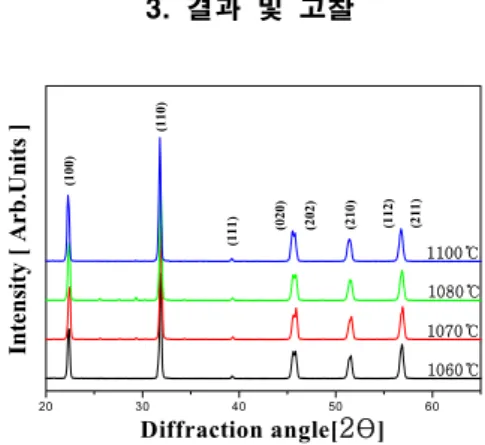
Fig. 1. X-ray diffraction patterns of specimens as a function of sintering temperature.
그림 1은 소성 온도 변화에 따른 시편의 XRD 패 턴을 나타낸 것이다. 시편은 소성 온도의 증가에 따 라서 이차상이 없는 단일 페로브스카이트 구조를 나 타내고 있으며, 그림 1에서 보여지듯이 45° 부근의 회 절각에서 (020)/(202) 피크를 나타내었고, 사방정계 (orthorh -ombic)상을 나타내었다 [6-8].
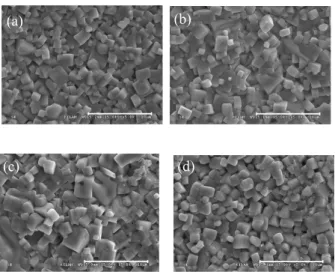
그림 2는 소성 온도 변화에 따른 시편의 미세 구조를
나타낸 것이다. 소결 온도가 증가할수록 입자의 치밀화가
이루어지고 입자 크기가 증가하였으며, 1,100℃ (d)에서
소성된 시편은 평균 입경 크기가 작아지고, 기공이
808 J. KIEEME, Vol. 26, No. 11, pp. 806-809, November 2013: Y.-S. Kim et al.
(a) (b)
(c)
(d)
Fig. 2. Microstructure of specimens as a function of sintering temperature (a) 1,060℃, (b) 1,070℃, (c) 1,080℃, (d) 1,100℃.
1050 1060 1070 1080 1090 1100 1110
0.24 0.26 0.28 0.30 0.32 0.34
Sintering Temperature
(℃)
kp
Fig. 3. Electromechanical coupling coeffcient(kp) of specimens as a function of sintering temperature.
관찰됨에 따라 과잉 소성되었기 때문으로 사료된다.
그림 2(c)는 1,080℃ 소성된 시편의 미세 구조이며 평 균 입경 크기는 2.52 ㎛로 최댓값을 나타냈다.
그림 3은 소성 온도 변화에 따른 시편의 전기기계 결합계수 (k
P)를 나타낸 것이다. 시편을 1,080℃에서 소성했을 때 k
P는 0.312로 최댓값을 나타내었으며 그 이상의 온도에서는 감소하는 경향을 나타내었다. 이는 미세 구조에서 확인한 바와 같이 1,080℃에서 소성시 킨 시편에 미세 구조가 치밀하게 되어 최대 전기 기 계 결합계수 (k
P) 특성이 나타난 것으로 사료된다. 또 한 1,100℃에서는 감소하는 경향을 보이는데 이것은 과잉 소성되어 소결성이 떨어졌기 때문으로 사료된다.
1050 1060 1070 1080 1090 1100 1110
0 20 40 60 80 100 120 140
Sintering Temperature (℃)
Qm
Fig. 4. Electromechanical quality factor (Qm) of specimens as a function of sintering temperature.
1050 1060 1070 1080 1090 1100 1110
120 130 140 150 160 170 180
Sintering Temperature (℃) d33 (pC/N)
Fig. 5. Piezoelectric coefficient(d33) of specimens as a function of sintering temperature.
그림 4는 소성 온도 변화에 따른 시편의 기계적 품 질 계수 (Qm)를 나타낸 것이다. 1,080℃의 소성 온도 에서 Qm은 71.14로 최댓값을 나타내었고, 소성 온도 가 증가함에 따라서 감소하였다.
그림 5는 소성 온도 변화에 따른 시편의 압전상수 (d
33)를 나타낸 것이다. d
33는 170.5 pC/N으로 최댓값 을 나타냈으며, 이는 전기기계결합계수 (k
P)의 변화와 일치하는 경향을 나타내었다.
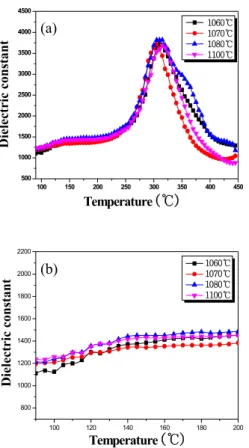
그림 6은 소성 온도에 따른 시편의 유전상수의 온
도 의존성을 나타낸 것이다. 1,080℃의 소성 온도에서
orthorhombic-tetragonal (T
O-T)와 curie온도 (Tc)는
각각 315℃와 145℃ 부근에서 일어나는 것을 관찰할
수 있었다. 소성 온도가 증가할수록 Tc도 같이 약간
증가하는 경향을 보였으며 1,080℃를 지나면 다시 떨
어지는 것을 확인하였다. 이는 다른 특성들과 마찬가
지로 1,080℃가 최적의 소성 온도임을 나타내고 있으며
전기전자재료학회논문지, 제26권 제11호 pp. 806-809, 2013년 11월: 김유석 등 809
100 150 200 250 300 350 400 450
500 1000 1500 2000 2500 3000 3500 4000 4500
Temperature
(℃)
Dielectric constant
1060℃
1070℃
1080℃
1100℃
(a)
100 120 140 160 180 200
800 1000 1200 1400 1600 1800 2000 2200
Temperature
(℃)
Dielectric constant
1060℃
1070℃
1080℃
1100℃
(b)
Fig. 6. Temperature dependence of dielectric of specimens as a function of sintering temperature.
-20 -15 -10 -5 0 5 10 15 20
-20 -15 -10 -5 0 5 10 15 20
Electric Field(kV/cm)
Polarization(μC/㎠)
1060℃
1070℃
1080℃
1100℃
Fig. 7. P-E hysteresis loops as a function of sintering temperature.
이 역시 1,100℃에서는 과잉 소성된 것으로 사료된 다. 또한, 소성 온도를 증가함에 따라 T
O-T부근에서 완만한 상전이 (diffuse phase transition) 특성을 보 이는 경향을 나타냈는데, 이에 대한 이유는 추가 연 구를 통해서 규명할 필요가 있다고 생각된다.
그림 7은 소성 온도에 따른 P-E hysteresis loop를 나타낸 것이다. 소성 온도가 증가함에 따라서 잔류분 극 (Pr)은 증가하였고 1,100℃에서는 다시 감소하는 경향을 나타내었다. 1,080℃의 소성 온도에서 잔류분 극은 15.70 [µC/㎠]로 최댓값을 나타내었다.
4. 결 론
본 연구에서는
(Na0.525K0.443Li0.037)(Nb0.883Sb0.08Ta0.037) + 0.10 wt%Bi2O3 + 0.35 wt%B2O3시편의 소성 온도에 따른 미세 구조, 압전 및 유전 특성을 조사하여 다음 과 같은 결과를 얻었다.
1. 소성 온도가 증가함에 따라서 grain 크기는 증가하 였으며, 1,080℃에서 1.11 ㎛으로 최댓값을 나타내 었고, 1,100℃에서 감소하였다.
2. 1,080℃에서 소성한 시편에서 전기기계결합계수 (k
P), 압전상수 (d
33)는 각각 0.312, 170.5 pC/N으로 가장 우수한 특성을 나타내었다.
3. 소성 온도가 증가할수록 잔류분극은 점차 증가하 다가 1,100℃에서 감소되는 경향을 나타내었다.
REFERENCES
[1] S. M. Byeon and J. H. Yoo, Ferroelectrics, 425, 98 (2011).
[2] Y. H. Lee, S. D. Beak, E. S. Choi, J. S. Kim, and G.
B. Bae, Structure and Piezoelectric Properties of NKN-LST Ceramics with Sintering Temperature, (KIEE, 2011) p. 1434.
[3] D. H. Lee, S. H. Lee, S. G. Lee, K. T. Lee, and Y.
H. Lee, J. KIEEME, 24, 543 (2011).
[4] T. H. Lee, J. H. Yeo, and S. G. Lee, J. KIEEME, 25, 506 (2012).
[5] S. M. Rhim, S. M. Hong, H. J. Bak, and O. K. Kim, J. Am. Ceram. Soc., 36, 767 (1999).
[6] J. Fu, R. Zuo, and Z. Xu, Appl. Phys. Lett., 99, 062901 (2011).
[7] M. H. Park, K. S. Lee, J. H. Yoo, and W. S. Jeong, J. KIEEME, 26, 104 (2013).
[8] S. L. Ryu, K. H. Chung, J. H. Yoo, B. Y. Lee, and Y.
H. Jeong, J. KIEEME, 18, 821 (2005).
[9] X. Chen, Y. Wang, F. He, H. Zhou, L. Fang, and L.
Liu, Ceram. Int., 39, 3747 (2013).