−
258
−Effects of Mo on the Passive Films Formed on Ni-(15, 30)Cr-5Mo Alloys in pH 8.5 Buffer Solution
HeeJin Jang* and HyukSang Kwon
†Dept. of Metallurgical Engineering, Chosun University, 375 Seosuk-dong, Dong-gu, Gwangju, 501-759, Republic of Korea
†
Dept. of Materials Science and Engineering, Korea Advanced Institute of Science and Technology, 373-1 Guseong- dong, Yuseong-gu, Daejeon, 305-701, Republic of Korea
(Received July 22, 2009 : Accepted Jyly 30, 2009)
Abstract :
The composition and semiconducting properties of the passive films formed on Ni- (15, 30)Cr-5Mo alloys in pH 8.5 buffer solution were examined. The depth concentration pro- file of passive films formed on Ni-(15, 30)Cr-5Mo in pH 8.5 buffer solution showed that Mo enhances the enrichment of Cr. The Mott-Schottky plot for the passive film on Ni-(15, 30)Cr- 5Mo closely resembled that for the film on Cr, whereas those for the less Cr-enriched film on Mo-free alloys showed similar behavior to that for the film on Ni. The acceptor density was reduced by increasing Cr content in Ni-(15, 30)Cr-(0, 5)Mo alloys, but addition of Mo considerably increased the acceptor density.
Keywords :
Ni-Cr-Mo alloy, Passive film, Mott-Schottky analysis
Introduction
Ni-Cr-Mo alloy such as C22 (Ni-22Cr-13Mo-3Fe-3W) is one of the most corrosion resistant of the Ni-based alloys.
1,2)The C22 alloy is the candidate material for the container of high level nuclear waste pack- ages in the Yucca Mountain repository (Nevada, USA) requiring long-term durability up to about 10,000 years.
3-5)The corrosion resistance of Ni-Cr-Mo alloys is largely dependent on the content of Cr and Mo.
6-7)Cr alloyed in Ni-based alloys is known to play a major role in enforcing passivity, significantly lowering both anodic dissolution rate and passive current density.
8-11)However, on the other side, Cr may cause increased corrosion susceptibility in highly oxidizing environments through transpassive disso- lution.
10-11)Mo alloyed in Ni-Cr alloys enhances corrosion resistance of alloys by increasing corrosion potential and reduces anodic dissolution rate, passive cur- rent density and corrosion rate in acidic media,
9,12,13)but it accelerates transpassive dissolution of Cr.
14)Mo is also noted for beneficial effect on localized corrosion resistance of Ni-based alloys and stainless steels.
13,15,16)According to Lloyd et al .,
12,17)the passive films formed on high-Cr alloys such as Alloy 625, C22, and C2000 in 1 M NaCl + H
2SO
4solution have duplex layered structure composed of inner Cr-Ni rich oxide layer and outer Cr-Mo rich oxide layer. On the contrary, he reported that the passive films of Alloy C4 and C276 with low Cr content (about 16 wt.%) did not show such a clear separation of layers from XPS and TOF SIMS analyses. Huang
18)reported that the pas- sive films formed on Ni-(12.4~21.7)Cr-(4.9~8.4)Mo alloys in artificial saliva (pH 5, 37
oC) comprise Ni(OH)
2, NiO, and Cr
2O
3, and MoO
3.
Corrosion resistance of an alloy is dependent on the nature of its passive film, so many research have been done to reveal the structure, composition, and the semiconducting properties of the passive film. In spite of the importance of Mo in improving corrosion resistance of Ni-Cr-Mo alloys, the influences of Mo on the semiconducting properties of the passive films of Ni-Cr-Mo alloys have not yet been clarified. In this work, the research objective is to examine the semi-
*E-mail: [email protected]
conducting properties of the passive films formed on Ni-(15, 30)Cr-5Mo alloys in pH 8.5 buffer solu- tion with focus on the effects of Mo on the passivity of the alloys using photoelectrochemical technique and Mott-Schottky analysis.
Experimental Procedures
High purity Ni-(15, 30)Cr-5Mo alloys were used as the working electrodes. The alloys were prepared by a vacuum-arc-melting, and then casts in a form of button. The cast was homogenized for 100 min at 1200
oC, and then hot rolled into 3 mm thick plate.
Specimens were prepared by cold rolling the hot rolled plates into 1.5 mm thick sheets and solution annealing at 1050
oC for 20 min, followed by water quenching.
The working electrode was mounted in an epoxy resin with an exposed area of 0.2 cm
2.
A conventional three-electrode cell of 1 L-multi neck flask was used electrochemical measurements. The cell was equipped with a platinum counter electrode and a saturated calomel reference electrode (SCE). All the electrode potentials are referred to the SCE. The experiments were carried out in deaerated pH 8.5 buffer solution, made of H
3BO
3, C
6H
8O
7·H
2O, and Na
3PO
4·12H
2O.
The working electrode was cathodically cleaned by polarization to − 1.5 V
SCEfor 5 min, and then passive film was formed on the alloy by stepping applied potential to a film formation potential ( U
f)
to which the alloy was polarized for more than 24 h before a steady state current density had been achieved.
Then the composition of the passive film was examined by XPS. PHI 5800 ESCA System with Al K α anode (250 W, 10 kV) was used for XPS analysis. The ref- erence energies were the C1s signal at 284.6 eV. In- depth composition profiling of passive film was per- formed using Ar ion gun (base pressure=2×10
−10torr, working pressure = 2 × 10
−8torr, energy: 3~4 kV).
The sputter rate was calibrated with SiO
2. For Mott- Schottky analysis, the specimen was passivated at an
U
ffor 2 h prior to measuring capacitance with sweeping the applied potential at a rate of − 1 mV/s.
The excitation voltage was 10 mV (peak-to-peak) and the frequency was 1 kHz.
Results and Discussion
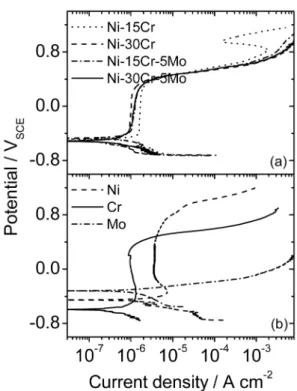
Fig. 1 shows the potentiodynamic polarization re-
sponses of Ni-(15, 30)Cr-(0, 5)Mo, Ni, Cr, and Mo in pH 8.5 buffer solution. The corrosion potential of Ni-(15, 30)Cr-5Mo was − 0.5 V
SCE(Fig. 1(a)), being slightly higher than Cr and lower than those of Ni and Mo (Fig. 1(b)). The passive region extended up to 0.3 V
SCEat which transpassive dissolution of Cr begins, demonstrating that the passivity of Ni-(15, 30)Cr-5Mo is governed largely by Cr. Secondary passivation did not occurred as known that Mo pro- motes the transpassive dissolution of Ni-based alloys.
7,11)The polarization curves of Ni-(15, 30)Cr- 5Mo were practically overlapping. The passive current density of Ni-15Cr was decreased by addition Mo (Fig. 1(a)), but that of Ni-30Cr was a little increased at high potentials by alloying with Mo (Fig. 1(b)).
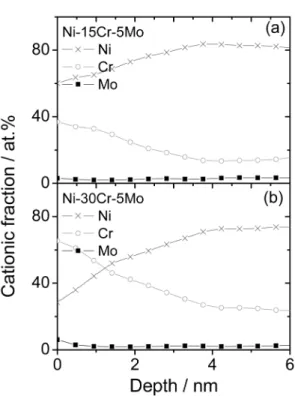
Fig. 2 shows the concentration profiles of Ni, Cr, and Mo in the passive film formed on Ni-(15, 30) Cr-5Mo alloys at − 0.1 V
SCEin pH 8.5 buffer solution.
The thickness of passive film was estimated to be about 3.0 nm, being slightly higher for the alloy with higher Cr. The chemical composition of the passive film on Ni-15Cr-5Mo was dominated by Ni oxide.
Fig. 1. Potentiodynamic polarization curves for (a) Ni-
(15, 30)Cr-(0, 5)Mo, (b) Ni, Cr, and Mo in deaerated pH
8.5 buffer solution at ambient temperature. Potential scan
rate was 0.5 mV/s.
However, Cr content in the film was found to be more than twice compared with that in the alloy. The con- centration of Mo was almost constant through the film and the alloy. In contrast, the passive film of Ni-30Cr-5Mo was highly Cr-enriched, with Ni sig- nificantly depleted at the outer region of the film.
Effects of Mo on the concentration of Cr are shown in Fig. 3. The concentration of Cr at the surface of the passive film was increased by addition of Mo in the alloys, especially for the film on the high-Cr alloys.
From these results, we expect that Mo enhances the dominance of Cr on the passivity of the Ni-Cr-Mo alloys, as confirmed by the potentiodynamic polarization responses as already shown in Fig. 1.
The effects of Mo on the Mott-Schottky plots for the passive film on Ni-(15, 30)Cr-5Mo are shown in Fig. 4. The passive film on Ni-(15, 30)Cr-5Mo exhibited much higher capacitance values than Ni- (15, 30)Cr, and the shape of Mott-Schottky plots closely resembled that for the passive film of Cr.
The Mott-Schottky plots for the passive films on Ni- (15, 30)Cr-5Mo well agree with the potentiody-
namic polarization curves (Fig. 1) in that Cr dominates the electrochemical behavior of Ni-(15, 30)Cr-5Mo.
The Mott-Schottky plots showed the linear region with negative slope at − 0.2~0.1 V
SCEexhibiting p-type semiconductivity as known for passive film of Cr.
19)From the linear regions, flat band potential for the pas- sive films were measured to be 0.7 V
SCEfor Cr, 1.16 V
SCEfor Ni-15Cr-5Mo, and 1.00 V
SCEfor Ni- 30Cr-5Mo. The acceptor density (N
A) for the passive films was 8.18×10
20cm
−3for Cr, 2.26× 10
21cm
−3for Ni-15Cr-5Mo, and 2.08 × 10
21cm
−3for Ni-30Cr-5Mo.
In contrast to the cases of Ni-(15, 30)Cr, the Mott-Schottky plots for the passive films on Ni-(15, 30)Cr-5Mo and Cr shown in Fig. 4 exhibited also n- type semiconductivity,
20-22)as confirmed from the linear region with positive slope at − 0.7~ − 0.3 V
SCE. The flat band potentials estimated from the n-type region were − 1.67 V
SCEfor the passive film of Cr,
− 1.1 V
SCEand − 1.2 V
SCEfor each of the films on Fig. 2. XPS depth concentration profiles of Ni, Cr, and
Mo for the passive film formed on (a) Ni-15Cr-5Mo and (b) Ni-30Cr-5Mo alloys at − 0.1 V
SCEin pH 8.5 buffer solution at ambient temperature for 24 h.
Fig. 3. Effects of Mo on the concentration profile of Cr in the passive film of Ni-(15, 30)Cr-(0, 5)Mo alloys.
Fig. 4. Mott-Schottky plots for the passive films formed
on Ni-(15, 30)Cr-5Mo in pH 8.5 buffer solution.
Ni-(15, 30)Cr-5Mo, respectively. The donor density (N
D) was 1.29 × 10
21, 1.21 × 10
21, and 1.31 × 10
21cm
−3for each of the passive films formed on Cr, Ni- 15Cr-5Mo, and Ni-30Cr-5Mo, respectively. The densities of acceptor and donor measured from the Mott-Schottky plots for the passive films of Ni-(15, 30)Cr-5Mo are summarized in Fig. 5. The acceptor density for the passive film of Ni-(15, 30)Cr-5Mo was about three times higher than that for the film on Mo- free alloys, and decreased with increase in Cr content in the alloy. It implies that high Cr concentration in the passive film is not the exclusive factor to reduce the defect density but seems to have some effect within an alloy system, i.e., Ni-Cr or Ni-Cr-Mo. The donor density for the passive film on Ni-(15, 30)Cr-5Mo was almost constant with the Cr content and comparable with that for the film on pure Cr. Improvement of protec- tiveness of passive film by increasing Cr content in the alloy can be explained by the reduction of acceptor density, i.e., concentration of cation vacancy,
23)in the film. However, beneficial effects of Mo on the corrosion resistance are not supposed to be associ- ated with the concentration of cation vacancy largely increased by addition of Mo, as presented in Fig. 5.
It should be, instead, supported by some other mech- anism such as bipolar model of the passive film,
24-25)precipitation of molybdate or oxyanion on active sites,
26-27)and/or electrostatic interaction of Mo
6+with cation vacancies.
28)Nevertheless, it is still required to investigate the defect properties of passive film formed on Ni-Cr-Mo alloys in solution with low pH and/or chloride ion, in which the effects of Mo on the passivity will be prominently revealed, by extension
of this work in pH 8.5 buffer solution.
Conclusions
The effects of Mo on the passivity of Ni-(15, 30) Cr-5Mo in pH 8.5 buffer solution at ambient tem- perature were examined by XPS and Mott-Schottky analysis. The potentiodynamic polarization behavior of Ni-(15, 30)Cr-5Mo appeared to be controlled largely by Cr. Mo appeared to slightly promote tran- spassive dissolution of Ni-Cr alloys. From XPS analysis, addition of Mo enhanced Cr enrichment at the sur- face of the passive film. This effect was more appre- ciable for Ni-30Cr alloys than for Ni-15Cr alloys.
Mott-Schottky plots for the passive film on Ni-(15, 30) Cr-5Mo closely resembled that for the film on Cr, exhibiting both n-type and p-type semiconducting prop- erties. The density of acceptor, i.e., cation vacancy, was decreased by increasing Cr content, but considerably increased by addition of Mo in the alloys. The donor density did not depend on the composition of the alloy.
References
1. W. Z. Friend, Corrosion of Nickel and Nickel-Base Alloys, Wiley Interscience, New York, 1980, p. 307.
2. N. Sridhar, ‘Corrosion of Nickel-Base Alloys’, Haynes International Conference Proceedings, 2000, p. 643.
3. G. M. Gordon, ‘Corrosion considerations related to per- manent disposal of high-level radioactive waste’ Corrosion .,
58
, 811 (2002).
4. J. J. Gray, J. R. Hayes, G. E. Gdowski, B. E. Viani, and C. A. Orme, ‘Influence of Solution pH, Anion Concen- tration, and Temperature on the Corrosion Properties of Alloy 22’ J. Electrochem. Soc. ,
153, B61 (2006).
5. N. Priyantha, P. Jayaweera, D. D. Macdonald, and A. Sun,
‘An electrochemical impedance study of Alloy 22 in NaCl brine at elevated temperature. I. Corrosion behavior’ J. Electroanal. Chem. ,
572, 409 (2004).
6. A. Nadezhdin and D. Wensley, Mater. Perform.,
31, 57 (1992).
7. M. Bojinov, G. Fabricius, P. Kinnunen, T. Laitinen, K.
Mäkelä, T. Saario, G. Sundholm, and K. Yliniemi, ‘Trans- passive dissolution of Ni-Cr alloys in sulphate solutions- comparison between a model alloy and two industrial alloys’ Electrochim. Acta ,
47, 1697 (2002).
8. H. Nanjo, N. J. Laycock, H. Deng, I. Ishikawa, and N.
Sanada, ‘Atomic-scale flattening of Ni-Cr alloy surfaces by electrochemical passivation treatments’ Curr. Appl.
Phys. ,
4, 156 (2004).
9. Y. Takizawa, K. Sugahara, ‘Corrosion-resistant Ni-Cr-Mo alloys in hot concentrated sulphuric acid with active carbon’
Fig. 5. Effects of contents of Cr and Mo on
NAand
NDfor the passive film formed on Ni-(15, 30)Cr-5Mo at 0.3 V
SCEin pH 8.5 buffer solution.
Mater. Sci. Eng. A ,
198, 145 (1995).
10. M. Bojinov, G. Fabricius, P. Kinunnen, T. Laitinen, K.
Mäkelä, T. Saario, and G. Sundholm, ‘The mechanism of transpassive dissolution of Ni-Cr alloys in sulphate solutions’
Electrochim. Acta ,
45, 2791 (2000).
11. L. J. Oblonsky and M. P. Ryan, ‘In Situ X-Ray Absorption Near-Edge Structure Study of the Active and Transpassive Dissolution of Passive Films on Ni and Ni-Cr Alloys in 0.1 M H
2SO
4’ J. Electrochem. Soc. ,
148, B405 (2001).
12. A. C. Lloyd, J. J. Noël, S. McIntyre, and D. W. Shoesmith,
‘Cr, Mo and W alloying additions in Ni and their effect on passivity’ Electrochim. Acta ,
49, 3015 (2004).
13. R. S. Lillard, M. P. Jurinski, and J. R. Scully, ‘Crevice corrosion of alloy 625 in chlorinated ASTM artificial ocean water’ Corrosion ,
50, 251 (1994).
14. M. Bojinov and T. Tzvetkoff, ‘The Influence of Solution Anion on the Mechanism of Transpassive Dissolution of Ferrous- and Nickel-Based Alloys’ J. Phys. Chem. B ,
107