Received: 16 February, 2016 Revised: 7 March, 2016 Accepted: 8 March, 2016 Corresponding author: Wan-hee Lee
Department of Physical Therapy, College of Health and Welfare, Sahmyook University, 815 Hwarang-ro, Nowon-gu, Seoul 01795, Republic of Korea Tel: 82-2-3399-1633 Fax: 82-2-3399-1639 E-mail: [email protected]
This is an Open-Access article distributed under the terms of the Creative Commons Attribution Non-Commercial License (http://creativecommons.org/licens es/by-nc/4.0) which permits unrestricted non-commercial use, distribution, and reproduction in any medium, provided the original work is properly cited.
Copyright © 2016 Korean Academy of Physical Therapy Rehabilitation Science
http://dx.doi.org/10.14474/ptrs.2016.5.1.47 pISSN 2287-7576
eISSN 2287-7584
Phys Ther Rehabil Sci 2016, 5 (1), 47-52 www.jptrs.org
Physical therapist perception survey for muscle re-education through visual feedback obtained from rehabilitative ultrasound imaging
Jun Sang Yoo
a, Hyun Geun Ha
b, Ju Ri Jeong
b, Young Jun Ko
b, Wan-hee Lee
caDepartment of Physical Therapy, Sinwoohospital, Seoul, Republic of Korea
bPhysical Therapy and Rehabilitation, Smasung Medical Center, Seoul, Republic of Korea
cDepartment of Physical Therapy, College of Health and Welfare, Sahmyook University, Seoul, Republic of Korea
Objective: This study surveyed the perceptions of physical therapists on muscle re-education through visual feedback obtained from rehabilitative ultrasound imaging (RUSI).
Design: Survey.
Methods: For this study, 500 physical therapists who participated in a refresher training held by the Seoul City Association in March 2015 were selected for a questionnaire-based survey. Subjects were randomly selected targets physiotherapists who partici- pated in a refresher training.The questionnaire had 21 items in total. Questions 1 to 15 could be answered by everyone. However, questions 16 to 21 could be answered only by people who used RUSI.
Results: The majority of respondents were aged 20 to 30 years. Respondents in their twenties, thirties, forties, and fifties ac- counted for 32.4%, 40.2%, 21.9%, and 5.6%respectively. Therapists with careers spanning one to 5 years accounted for 27.8%, while those with careers spanning 5 to 10 years and 10 to 15 years accounted for 34.6% and 17.0%, respectively. Those with ca- reers over 20 years accounted for 9.2%. The types of work have not been various including work related to the nervous system (49.0%), the musculoskeletal system (41.5%), sports (0.7%), juvenile physical therapy (4.2%), and others (4.6%).
Conclusions: In this study, we examined the perceptions of physical therapists on rehabilitation ultrasound imaging used in mus- cle re-education. We also examined how to use this technique. Many therapists who participated in the refresher training were found to be unaware of RUSI. In the future, further investigations on RUSI for muscle re-education are required through refresher training or training lectures at the national level.
Key Words: Physical therapy, Ultrasound, Survey
Introduction
Various diagnostic imaging techniques, including mag- netic resonance imaging, computed tomography, and ultra- sound imaging, are being used to treat patients. Among them, magnetic resonance imaging (MRI) provides high res- olution, selective images, and multi-aspect images. There- fore, this technique is considered most effective for the ob- servation and evaluation of soft tissues. However, it is diffi-
cult to use this technique because of high cost [1-3].
In contrast, ultrasound imaging is easy to use and control,
and has low cost. Furthermore, it is being used as a non-
invasive and safe means of examining myoarchitectonic
characteristics [4]. Quantitative analysis on myoarchitec-
tonics is available through ultrasound imaging [5,6]. Rehabili-
tative ultrasound imaging (RUSI) is a technique by which
physical therapists can perform muscle re-education through
visual feedback [5,7,8]. In general, muscle RUSI is being
practice. Furthermore, therapists argue that education and environmental setting are very important to optimize the ef- fects of rehabilitation. In addition, those authors reported that ultrasound imaging is widely used as a tool for muscle re-education by using visual feedback to review the symp- toms on a real-time basis. However, there are not many op- portunities for learning ultrasound imaging accurately and the costs are very high; therefore, many therapists are re- luctant to learn it. Furthermore, this technique is performed with help from radiologists in many cases [5]. Potter et al.
[9] discussed which body parts RUSI is often used on, the ef- fects of its use, and techniques for handling the device when physical therapists use RUSI in their fields. In addition, it has been reported that the majority of physical therapists face environmental problems, difficulties in education measurement using ultrasound devices, education time, and range of utilization. It has been shown that in other coun- tries, re-education is frequently performed by evaluating muscle structure through ultrasound imaging. In addition, associations organize lectures for the utilization of RUSI [5,9,13].
Ultrasound imaging is used very rarely for muscle re-edu- cation in patients by physical therapists in Korea. Not enough studies have been conducted in Korea; therefore, there is a lack of objective parameters on the use of ultra- sound imaging for clinical training and practice, on how much therapists know about using ultrasound imaging, and on the perceptions of physical therapists.
Accordingly, this study was conducted to determine the perceptions, basic objective data, and current state of RUSI used for muscle re-education through visual feedback.
Methods Subjects
For this study, 500 physical therapists who participated in a refresher training held by the Seoul City Association in March 2015 were selected for a questionnaire-based survey.
Subjects were randomly selected targets physiotherapists who participated in a refresher training. The inclusion cri- teria of the study is a physiotherapist to attend the refresher
formation and addressed the level of use and demographic statistics. The closed questions were restructured for the set- ting in Korea and consisted of perceptions on the results of training that incorporated ultrasound imaging and general information. The questionnaire consists of 21 items in total.
Items 1 to 8 address general information while items 9 to 15 are about the use and perception of ultrasound imaging.
Items 16 to 21 were answered by physical therapists who performed re-education through ultrasound imaging.
Analysis
The collected data were analyzed using PASW Statistics ver. 18.0 (IBM Co., Armonk, NY, USA), which is a statistics program. Frequency analysis was performed on the percep- tions of information, while the chi-square test was per- formed on the relationships between the type of service ca- reer and the type of education. The level of significance was set as p<0.05.
Results
Questionnaires were distributed randomly to 500 phys- ical therapists and the collection rate was 60.0%. The ma- jority of respondents were aged from 20 to 30 years. Res- pondents in their twenties, thirties, forties, and fifties ac- counted for 32.4%, 40.2%, 21.9%, and 5.6%, respectively.
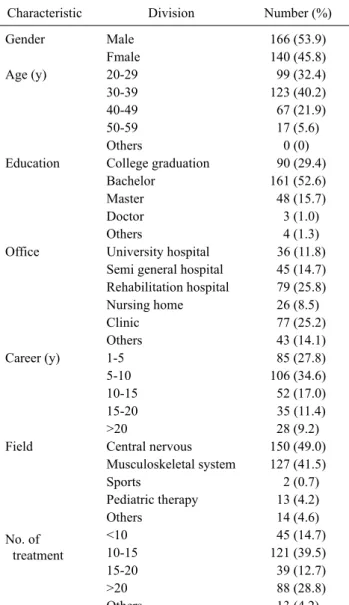
Therapists with careers spanning one year to 5 years ac- counted for 27.8%, while those with careers spanning 5 to 10 years and 10 to 15 years accounted for 34.6% and 17.0% of all therapists, respectively. Those with careers of over 20 years accounted for 9.2%. The types of work have not been various including work related to the central nervous (49.0%), the musculoskeletal system (41.5%), sports (0.7%), pedia- tric physical therapy (4.2%), and others (4.6%) (Figure 1).
Therapists were found to work at rehabilitation hospital
(25.8%), clinic (25.2%), semi general hospital (14.7%), uni-
versity hospital (11.8%), and nursing home (8.5%) (Table
1). Regarding questions about RUSI, 26.7% of the therapists
surveyed had heard of muscle re-education, while 73.3% of
them had not. Furthermore, only 7.6% of the therapists had
used RUSI. Of the therapists who used RUSI, 1.2%, 3.6%,
Figure 2. Question : Do you think that information you about the rehabilitative ultrasound image needed for muscle re-education?
Figure 1. Question: Do physical therapy in certain areas?
Table 1. General characteristics of respondents (N=306)
Characteristic Division Number (%)
Gender Male 166 (53.9)
Fmale 140 (45.8)
Age (y) 20-29 99 (32.4)
30-39 123 (40.2)
40-49 67 (21.9)
50-59 17 (5.6)
Others 0 (0)
Education College graduation 90 (29.4)
Bachelor 161 (52.6)
Master 48 (15.7)
Doctor 3 (1.0)
Others 4 (1.3)
Office University hospital 36 (11.8) Semi general hospital 45 (14.7) Rehabilitation hospital 79 (25.8)
Nursing home 26 (8.5)
Clinic 77 (25.2)
Others 43 (14.1)
Career (y) 1-5 85 (27.8)
5-10 106 (34.6)
10-15 52 (17.0)
15-20 35 (11.4)
>20 28 (9.2)
Field Central nervous 150 (49.0)
Musculoskeletal system 127 (41.5)
Sports 2 (0.7)
Pediatric therapy 13 (4.2)
Others 14 (4.6)
No. of treatment
<10 45 (14.7)
10-15 121 (39.5)
15-20 39 (12.7)
>20 88 (28.8)
Others 13 (4.2)
0.4%, and 1.2% used this technique at their universities, graduate schools, academies, and seminars, respectively.
However, none of the therapists and used or are currently us- ing the technique at their work places. Regarding the in- formation on the use of RUSI for muscle re-education, the questions related to use in clinical trials, basic information on ultrasound imaging, handling machines, and the mor- phology of muscle accounted for 68.9%, 61.4%, 41.4%, and 33.5% of the questions, respectively (Figure 2).
Regarding the information on RUSI according to educa- tion level, there were significant differences in the answers on the use of this technique (p<0.05), while no significant difference was found in the other answers (Table 2).
When asked about education on RUSI, 49.8%, 21.5%, 18.7%, and 15.5% of the respondents preferred training lec- tures, refresher training, online education, and individual study, respectively (Figure 3).
Regarding questions about measurement of education on RUSI according to career, significant differences were found in online education (p<0.05) while the other answers did not show significant differences (Table 3).
When asked about how the therapists would utilize RUSI even if they did not currently use it, 61.0%, 43.4%, 37.1%, and 26.7% of the therapists answered that they will use it for motivating patients, obtaining biofeedback, checking re- sults from rehabilitation therapy, and application to various therapeutic environments.
Discussion
This study examined the perceptions of therapists on
RUSI. Many therapists were found not to use RUSI.
Clinical manual Muscle morphology Etc.
60 (75.90) 26 (32.90) 2 (2.50)
89 (65.00) 43 (31.40) 2 (1.50)
31 (81.60) 15 (39.50) 1 (1.60)
0 (0) 0 (0) 0 (0)
1 (33.30) 2 (66.70) 0 (0)
181 (70.15) 86 (33.33) 5 (1.93)
9.69*/0.05 2.89/0.58 0.49/0.98 Values are presented as number (%).
1: associate degree, 2: bachelor degree, 3: master, 4: doctor, 5: etc.
*p<0.05.
Table 3. Training methods of rehabilitative ultrasound image in accordance with the work experience
Education system Type of service career
Total X2/p
1 2 3 4 5
Lecture
Refresher training Online
Study Etc.
39 (42.90) 23 (25.30) 17 (18.70) 15 (16.50) 1 (1.10)
47 (58.00) 17 (21.00) 10 (12.30) 12 (14.80) 1 (1.20)
20 (50.00) 8 (20.00) 6 (15.00) 8 (20.00) 0 (0)
13 (59.10) 3 (13.60) 4 (18.20) 4 (18.20) 0 (0)
12 (52.20) 3 (33.30) 10 (33.30) 2 (66.70) 1 (4.30)
131 (57.70) 54 (20.93) 47 (18.21) 41 (15.89) 3 (1.16)
4.62/0.33 2.62/0.62 11.98*/0.02 1.57/0.81 2.76/0.56 Values are presented as number (%).
1: 1 year-less than 5 years, 2: 5 year-less than 10 years, 3: 10 year-less than 15 years, 4: 15 year-less than 20 years, 5: over 20 years.
*p<0.05.
Figure 3. Question : Do you think that any way appropriate to the training methods through the rehabilitative ultrasound image?
According to the results from this study, only 10% of the therapists had used ultrasound imaging for rehabilitation.
Furthermore, none of them used this technique in the clinical setting. In addition, 73.2% of physical therapists answered that they did not use ultrasound imaging, but had heard of RUSI being necessary for muscle re-education. As indicated by our study, many physical therapists have not heard of
RUSI, but cannot use it in practice. Thus, there needs to be accurate information and education on how to use RUSI. In previous studies, more than 60% of therapists were trained in ultrasound. And that 67% of therapists have been trained in a short period of time. More than 30% of therapists were also in possession of an ultrasound equipment for practice [5].
Of the physical therapists, 68.9% have shown interest in the clinical usage of RUSI. Furthermore, 61.4% of the thera- pists were found to be interested in learning basic in- formation on ultrasound imaging. Further, 49.8% of phys- ical therapists wanted to participate in a training program. In cases of other countries, physical therapists are receiving enough education through lectures held by associations or through refresher training. Similar results came out before the Institute. Many wanted to receive further education, and wish to be through workshops and dvd [5,9]. Furthermore, many researchers are conducting studies on the utilization of RUSI [14].
For re-education with patients through visual feedback, therapists need accurate technique and ample practice [15].
Among the therapists who participated in this study, 54.6%
and 36.9% have been found to work with the nervous system
and the musculoskeletal system, respectively. For having an accurate posture and therapeutic reaction of patients with nervous or musculoskeletal problems, high level of stim- ulation through visual feedback is required to motivate pa- tients better [16,17]. Currently, visual feedback from RUSI is being provided actively for the abdominal muscles as well as the diaphragm and pelvic floor [18,19].
The results from this study have also shown that physical therapists who were surveyed recognized that ultrasound imaging helps muscle re-education by enabling closer visu- alization of the screen than by MRI and computed tomo- graphy, which is the merit of RUSI [20]. We found that 61.4% of therapists answered that motivation of patients is required, whereas 43.4% answered that biofeedback is required. van Vliet and Wulf [21] performed re-education through visual feedback and argued that rehabilitation ultra- sound imaging is required for effective treatment. More studies need to be conducted on the merits and usage of RUSI. Furthermore, the restrictions and difficulties of using RUSI need to be addressed.
A limitation of this study is from a 60% response rate. For that reason it did not complete the questionnaire. And not ev- eryone is submitted. For reasons that are not submitted peo- ple had no interest in ultrasound. And that was annoying surveys. We are also introduced to the questionnaire, and were encouraged to break every hour. But it seems that not enough attention because it is not subject gathered for the questionnaire. In addition, it seems that even a lack of inter- est in the ultrasound.
In this study, we examined the perceptions of physical therapists on rehabilitation ultrasound imaging used in mus- cle re-education. We also examined how to use this tech- nique. Many therapists who participated in the refresher training were found to be unaware of RUSI. For this reason, the questionnaire collection rate was 60.0%; those who did not answer may not be aware of or be interested in RUSI.
However, the therapists who did answer were found to be very interested in RUSI and were well aware of its merits and utility. Respondents have shown perceptions on materi- al or lecture for learning ultrasound imaging and wanted to learn through training lectures.
In the future, further investigations on RUSI for muscle re-education are required through refresher training or train- ing lectures at the national level. The results from this study can be used as the basic data for increasing awareness on ul- trasound imaging, and to establish a manual by which thera- pists can use the technique easily and a manual for important
of muscles re-education.
Conflict of Interest
The authors declared no potential conflicts of interest with respect to the authorship and/or publication of this article.
References
1. Mitsiopoulos N, Baumgartner RN, Heymsfield SB, Lyons W, Gallagher D, Ross R. Cadaver validation of skeletal muscle measurement by magnetic resonance imaging and computerized tomography. J Appl Physiol (1985) 1998;85:115-22.
2. Lee HJ, Kim MK, Ha HG, Lee WH. Comparison of muscle archi- tecture of lower Extremity using rehabilitative ultrasound image in young adults: a comparative study of muscle cross-sectional area of lower extremity of seoul and Hanoi in Vietnam. J Korean Soc Phys Ther 2014;26:324-30.
3. Kim MK, Ko YJ, Lee HJ, Ha HG, Lee WH. Ultrasound imaging for age-related differences of lower extremity muscle architecture. Phys Ther Rehabil Sci 2015;4:38-43.
4. Takai Y, Katsumata Y, Kawakami Y, Kanehisa H, Fukunaga T.
Ultrasound method for estimating the cross-sectional area of the psoas major muscle. Med Sci Sports Exerc 2011;43:2000-4.
5. Mckiernan S, Chiarelli P, Warren-Forward H. A survey of diag- nostic ultrasound within the physiotherapy profession for the de- sign of future training tools. Radiography 2010;17:121-5.
6. Teyn D. Rehabilitative ultrasound imaging symposium, May 8-10, 2006, San Antonio, Texas. J Orthop Sports Phys Ther 2006;36:A1-17.
7. Whittaker JL, Warner MB, Stokes MJ. Ultrasound imaging transducer motion during clinical maneuvers: respiration, active straight leg raise test and abdominal drawing in. Ultrasound Med Biol 2010;36:1288-97.
8. Koh EK, Jung DY. Effect of visual and palpation feedback on muscle activity of gluteus maximus an motion of pelvic rotation during clam exercise. J Korean Soc Phys Ther 2013;25:337-42.
9. Potter CL, Cairns MC, Stokes M. Use of ultrasound imaging by physiotherapists: a pilot study to survey use, skills and training.
Man Ther 2012;17:39-46.
10. Temes WC, Temes Clifton A, Hilton V, Girard L, Strait N, Karduna A. Reliability and validity of thickness measurements of the supraspinatus muscle of the shoulder: an ultrasonography study. J Sport Rehabil 2014. doi: 10.1123/jsr.2013-0023.
11. Lee DY, Choi WJ, Lee SW. The effect of focus of attention by elec- troencephalogram-feedback on balance in young adults. Phys Ther Rehabil Sci 2012;1:13-6.
12. Ko YJ, Ha HG, Jeong J, Lee WH. Variations in lateral abdominal muscle thickness during abdominal drawing-in maneuver in three positions in a young healthy population. Phys Ther Rehabil Sci 2014;3:101-6.
13. Lee KB, Kim JG, Park HG, Kim JE, Kim HS, Lee WH.
Correlation between lateral abdominal, rectus femoris, and tri- ceps brachii muscle thickness and endurance during prone bridge exercise in healthy young adults. Phys Ther Rehabil Sci
16. Maclean N, Pound P, Wolfe C, Rudd A. Qualitative analysis of stroke patients’ motivation for rehabilitation. BMJ 2000;321:
1051-4.
17. Giggins OM, Persson UM, Caulfield B. Biofeedback in rehabilitation. J Neuroeng Rehabil 2013;10:60.
18. Henry SM, Westervelt KC. The use of real-time ultrasound feed-
ing distal vastus medialis muscle using rehabilitative ultrasound imaging versus magnetic resonance imaging. Man Ther 2014;
19:259-63.
21. van Vliet PM, Wulf G. Extrinsic feedback for motor learning after stroke: what is the evidence? Disabil Rehabil 2006;28:831-40.