학 술 논 문
228
클러스터 초상자성체 산화철 나노입자를 이용한 색채학적 해석 기반 당 측정
최원석 · 기재홍*
연세대학교 보건과학대학 의공학과
Colorimetric Based Analysis Using Clustered Superparamagnetic Iron Oxide Nanoparticles for Glucose Detection
Wonseok Choi and Jaehong Key*
Department of Biomedical Engineering, Yonsei University, 1 Yonseidae-gil, Wonju, Gangwon-do, 220-710, Republic of Korea
(Manuscript received 17 November 2020 ; revised 11 December 2020 ; accepted 18 December 2020)
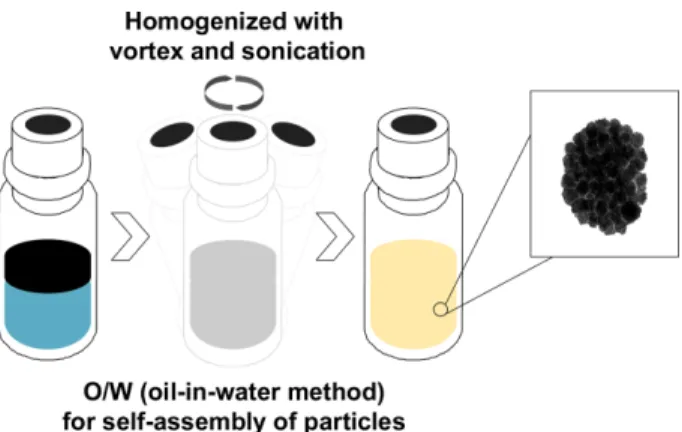
Abstract: Superparamagnetic iron oxide nanoparticles (SPIONs) are approved by the Food and Drug Administration (FDA) in the United States. SPIONs are used in magnetic resonance imaging (MRI) as contrast agents and targeted delivery in nanomedicine using external magnet sources. SPIONs act as an artificial peroxidase (i.e., nanozyme), and these reactions were highly stable in various pH conditions and temperatures. In this study, we report a nanozyme ability of the clustered SPIONs (CSPIONs) synthesized by the oil-in-water (O/W) method and coated with biocom- patible poly(lactic-co-glycolic acid) (PLGA). We hypothesize that the CSPIONs can have high sensitivity toward H
2O
2derived from the reaction between a fixed amount of glucose and glucose oxidase (GO
X). As a result, CSPIONs oxi- dized a 2,2 '-azino-bis(3-ethylbenzthiazoline-6-sulfonic acid) diammonium salt (ABTS) commonly used as a substrate for hydrogen peroxidase in the presence of H
2O
2, leading to a change in the color of the substrate. We also utilized a colorimetric assay at 417 nm using various glucose concentrations from 5 mM to 1.25 μM to validate β-D-glucose detection. This study demonstrated that the absorbance value increases along with increasing the glucose level. The results were highly repeated at concentrations below 5 mM (all standard deviations < 0.03). Moreover, the sensitivity and limit of detection were 1.50 and 5.44 μM, respectively, in which CSPIONs are more responsive to glucose than SPIONs. In conclusion, this study suggests that CSPIONs have the potential to be used for glucose detection in dia- betic patients using a physiological fluid such as ocular, saliva, and urine.
Key words: Clustered iron oxide nanoparticles, Artificial peroxidase, Diabetes, Colorimetric detection
I. 서 론
초상자성체 산화철 나노 입자(superparamagnetic iron oxide nanoparticles, SPIONs) 는 표적화된 약물 전달, T2
MRI 조영제, 그리고 고온 기반 암 파괴 등 의공학 분야에 널리 사용되고 있다[1-7]. 또한 SPIONs는 인조적인 과산화 효 소의 역할을 할 수 있다는 것이 보고되었다. SPIONs의 인 조 효소 역할은 몸에서 발현되는 실제 과산화 효소와 다르게 넓 은 온도 및 산성도(pH)에서 반응이 매우 안정적이며, 비교 적 값싼 비용으로 대량 합성할 수 있다는 장점이 있다[8-9].
최근에는 SPIONs를 이용한 당 계측의 시도도 이루어지고 있다. 당은 당 산화제(glucose oxidase, GO
x) 에 의해서 산 화되면서 과산화수소(hydrogen peroxide, H
2O
2) 를 만들어 낸다. SPIONs는 구체적으로 H
2O
2가 존재하는 환경에서 과산화 효소에 특이적으로 반응하는 기질인 3,3′,5,5′-tetramethyl-
*Corresponding Author : Jaehong Key
Department of Biomedical Engineering, Yonsei University, 1 Yonseidae-gil, Wonju, Gangwon-do, 220-710, Republic of Korea Tel: +82-33-760-2857
E-mail: [email protected]
본 연구는 한국연구재단이 지원하는 이공분야 기초연구사업(NRF- 2018R1D1A1B07042339), 국제기관간MOU지원사업(NRF- 2019K2A9A2A08000123)과 사회맞춤형 산학협력 선도대학(LINC+) 육성사업으로 수행된 연구결과임.