The Effects of Retinoic Acid and MAPK
Inhibitors on Phosphorylation of Smad2/3 Induced by Transforming Growth Factor β1
Sang Hoon Lee, M.D.
1,2, Ju Hye Shin, M.S.
1, Mi Hwa Shin, B.S.
1, Young Sam Kim, M.D., Ph.D.
1, Kyung Soo Chung, M.D.
1, Joo Han Song, M.D.
1, Song Yee Kim, M.D., Ph.D.
1, Eun Young Kim, M.D., Ph.D.
1, Ji Ye Jung, M.D., Ph.D.
1, Young Ae Kang, M.D., Ph.D.
1, Joon Chang, M.D., Ph.D.
1and Moo Suk Park, M.D., Ph.D.
11
Division of Pulmonary and Critical Care Medicine, Department of Internal Medicine, Institute of Chest Diseases, Severance Hospital, Younsei University Health System, Yonsei University College of Medicine, Seoul,
2Division of Pulmonary and Critical Care Medicine, Department of Internal Medicine, Seoul National University Bundang Hospital, Seoul National University College of Medicine, Seongnam, Korea
Background: Transforming growth factor β (TGF-β), retinoic acid (RA), p38 mitogen-activated protein kinase (MAPK), and MEK signaling play critical roles in cell differentiation, proliferation, and apoptosis. We investigated the effect of RA and the role of these signaling molecules on the phosphorylation of Smad2/3 (p-Smad2/3) induced by TGF-β1.
Methods: A549 epithelial cells and CCD-11Lu fibroblasts were incubated and stimulated with or without all- trans RA (ATRA) and TGF-β1 and with MAPK or MEK inhibitors. The levels of p-Smad2/3 were analyzed by western blotting. For animal models, we studied three experimental mouse groups: control, bleomycin, and bleomycin+ATRA group. Changes in histopathology, lung injury score, and levels of TGF-β1 and Smad3 were evaluated at 1 and 3 weeks.
Results: When A549 cells were pre-stimulated with TGF-β1 prior to RA treatment, RA completely inhibited the p-Smad2/3. However, when A549 cells were pre-treated with RA prior to TGF-β1 stimulation, RA did not completely suppress the p-Smad2/3. When A549 cells were pre-treated with MAPK inhibitor, TGF-β1 failed to phosphorylate Smad2/3. In fibroblasts, p38 MAPK inhibitor suppressed TGF-β1–induced p-Smad2. In a bleomycin-induced lung injury mouse model, RA decreased the expression of TGF-β1 and Smad3 at 1 and 3 weeks.
Conclusion: RA had inhibitory effects on the phosphorylation of Smad induced by TGF-β1 in vitro , and RA also decreased the expression of TGF-β1 at 1 and 3 weeks in vivo . Furthermore, pre-treatment with a MAPK inhibitor showed a preventative effect on TGF-β1/Smad phosphorylation in epithelial cells. As a result, a combination of RA and MAPK inhibitors may suppress the TGF-β1–induced lung injury and fibrosis.
Keywords: Transforming Growth Factor Beta; Retinoic Acid; Mitogen-Activated Protein Kinases; MEKs; Smad Proteins
Address for correspondence: Moo Suk Park, M.D., Ph.D.
Division of Pulmonary and Critical Care Medicine, Department of Internal Medicine, Institute of Chest Diseases, Severance Hospital, Yonsei University Health System, Yonsei University College of Medicine, 50-1 Yonsei-ro, Seodaemun-gu, Seoul 03722, Korea
Phone: 82-2-2228-1955, Fax: 82-2-393-6884, E-mail: [email protected]
Received: Sep. 28, 2017, Revised: Jan. 15, 2018, Accepted: Mar. 23, 2018, Published online: Jun. 19, 2018
cc
It is identical to the Creative Commons Attribution Non-Commercial License (http://creativecommons.org/licenses/by-nc/4.0/).
Copyright © 2019
The Korean Academy of Tuberculosis and Respiratory Diseases.
Introduction
Abnormal wound healing in pulmonary fibrosis is charac- terized by fibroblast and myofibroblast migration and prolif- eration, decreased myofibroblast apoptosis, and increased activity of and responses to fibrogenic cytokines, especially transforming growth factor β1 (TGF-β1)
1-3.
TGF-β induces phosphorylation of Smad2/3, which is re- leased and further propagates the signal of TGF-β. Changes in the level of Smad have been reported in human fibroblasts and epithelial cells following treatment with glucocorticoids, interferon-γ, and pirfenidone
4-6. TGF-β1 utilizes not only the Smad pathway, but also non-Smad pathways. These non- Smad pathways include the following signaling pathways and molecules: the phosphatidylinositol-3-kinase (PI3K)/
Akt pathways, mitogen-activated protein kinase (MAPK), and Rho-like GTPase
7. Pendaries et al.
8reported that retinoic acid receptors (RARs) interfere with the TGF-β signaling pathway.
Retinoic acids (RAs), which are active vitamin A derivatives, play a critical role in cell differentiation, proliferation, and apoptosis
8-10. It has been established that RA exerts its action through the activation of RARs and retinoid X receptors that regulate various transcriptional factors
11. Understanding the roles of RA can provide new insights into the products of on- cogenes/suppressor genes and the chronic fibrosis of human organs as it is associated with the TGF-β
1signaling pathway.
Additionally, it is well-known that TGF-β1 activates the extracellular-signal-regulated kinase and the MAPK pathway through mitogen-activated protein/extracellular signal-regu- lated kinase (MEK) in the non-Smad pathway
7.
The purpose of this investigation was to determine whether RAs could inhibit the TGF-β1 induced phosphorylation of Smad2/3, and to determine the difference in TGF-β1 ex- pression between epithelial cells and fibroblasts upon pre- treatment with MAPK inhibitors. Additionally, we aimed to compare the degree of expression between phospho-Smad2 (p-Smad2) and 3 (p-Smad3) in each cell type. Furthermore, we intended to confirm the effect of TGF-β1 and RA in a bleo- mycin-induced lung injury and fibrosis mouse model.
Materials and Methods
1. Human epithelial cell line and fibroblast cell line The A549 epithelial and CCD-11Lu fibroblast cell lines that were used for the experiments in this study were purchased from the American Type Culture Collection (ATCC, Rockville, MD, USA).
The study design in this report was approved by the Institu- tional Animal Care Committee at the Medical College of Yon- sei University (2014-0368). This experiment was performed in compliance with recommendations in the Guide for the Care
and Use of Laboratory Animals by the National Institutes of Health.
2. Chemicals and antibodies
TGF-β1 was purchased from Calbiochem (San Diego, CA, USA). Three types of RA, including all-trans retinoic acid (ATRA), 9-cis RA, and 13-cis RA were purchased from Sigma- Aldrich (St. Louis, MO, USA). The primary antibodies to Smad proteins for use in western blotting were obtained from Cell Signaling Technology (Danvers, MA, USA) and Zymed (San Francisco, CA, USA). β-Actin was used as a negative control, and was obtained from Delta Biolabs (Gilroy, CA, USA). The MEK 1/2 inhibitor, U0126, was purchased from Cell Signaling Technology (Beverly, MA, USA) and the p38 MAPK inhibitor (SB203580) was purchased from Santa Cruz Biotechnology (Santa Cruz, CA, USA).
3. Cell culture and chemical stimulation
A549 cells were cultured in RPMI 1640 medium (Gibco BRL, Grand Island, NY, USA) supplemented with 10% fetal bo- vine serum (FBS; Gibco BRL). CCD-11Lu cells were cultured in EMEM (Beckton Dickinson & Company, Lincoln Park, NJ, USA). Cells were incubated at 37°C with 5% CO
2for 24-hour durations, and subcultured two-to-three times, weekly, to maintain log phase growth.
To examine the effects of RA on the phosphorylation of Smad induced by TGF-β1, A549 cells were stimulated as follows: (1) TGF-β1, (2) RA, (3) 1 hour pre-stimulated with TGF-β1 prior to RA treatment, and (4) 1 hour pre-treated with RA prior to TGF-β1 stimulation. As a negative control, cells were incubated with only culture medium.
In total, 10
-6mol/L of each individual RA and/or 5 ng/mL of TGF-β1 were administered to the cells. RA and TGF-β1 were administered to A549 cells without delay. After stimulation, A549 cells were incubated for 24 hours, and then subjected to western blotting, as described below.
In a separate experiment, to investigate the effects of TGF-β1 on A549 cells and CCD-11Lu cells, each cell line was pre-treated with a p38 MAPK inhibitor, a MEK 1/2 inhibitor, or neither (control). These pre-treated cells were stimulated as described above; (1) TGF-β1, (2) RA, (3) pre-stimulated with TGF-β1 prior to RA treatment, and (4) pre-treated with RA prior to TGF-β1 stimulation.
4. Western blotting analysis (in vitro)
2×10
6cells were dissolved in 100-mm culture plates and
pre-incubated with RPMI 1640 medium. After 24 hours in the
presence or absence of chemical stimulation, as described
above, cells were washed twice with cold phosphate buffered
saline (PBS), scraped and solubilized in a RIPA-B buffer con-
taining 0.5% nonidet P-40, 20 mM Tris-HCl (pH 8.0), 50 mM NaCl, 50 mM NaF, 100 μM Na
3VO
4, 1 mM DTT, 50 μg/mL phenylmethanesulfonylfluoride, 20 μg/mL aprotinin, and 20 μg/mL leupeptin. After 30 minutes at 4°C, cell lysates were cleared of debris by centrifugation at 12,000 rpm at 4°C for 20 minutes. The protein lysates (20 μg) were applied to 10%
sodium dodecyl sulfate polyacrylamide gel electrophoresis gel (SDS-PAGE) gels and transferred to nitrocellulose mem- branes (Amersham Biosciences, Piscataway, NJ, USA). The membranes were blocked at room temperature with 5% skim milk in TBST (1×TBS, 0.1% Tween 20). After washing twice in TBST, the membranes were incubated with primary Smad antibodies for 2 hours at room temperature. The membranes were then washed 3 times for 10 minutes, each, in TBST, and incubated with the relevant horseradish peroxidase–conju- gated secondary antibodies (diluted 1:1,000 in 3% bovine se- rum albumin in TBST) for 1 hour. After washing three times in TBST, the reactive proteins were visualized using an enhanced chemiluminescence detection system (Amersham Biosci- ences).
5. Bleomycin-induced lung injury and fibrosis model Male C57BL/6J mice, 7 weeks old and weighing 18–22 g, were purchased from Orient Bio (Seongnam, Korea). Mice were provided with rodent food and water in a controlled environment. Twelve mice were divided into the following three groups (n=4/group): (A) a control group with PBS inha- lation, (B) a bleomycin plus PBS group, and (C) a bleomycin plus ATRA (25 mg/kg) group. Bleomycin (3 mg/mL; Dong-A Pharmaceutical, Co., Ltd., Seoul, Korea) was dissolved in PBS (3 mL). The mice were first lightly anesthetized by inhalation of isoflurane (Abbott Laboratories, North Chicago, IL, USA) in a supine position, and then PBS and bleomycin (50 μL) were administered intranasally. In the bleomycin plus ATRA group, 0.5 mg of ATRA (Sigma) powder dissolved in 0.1 mL dimethyl sulfoxide (DMSO) was injected. In the bleomycin plus ATRA group, bleomycin was only once inhaled and ATRA was in- jected three times per week, through intrapenitoneum. To col- lect lung specimens, the experimental mice were sacrificed on day 7 or day 21 using a lethal overdose of xylazine.
6. Histology
The pulmonary artery was flushed with sterile saline at low pressure, and the right lung was excised and stored at –80°C. Before the left lung was excised, it was inflated via tra- cheotomy using 4% low-melting point agarose in PBS at 25 cm H
2O pressure until pleural margins became sharp. After the left lungs were excised, the mouse lung tissues were fixed overnight in 10% formaldehyde in PBS, and embedded in par- affin. Serial sections (5-μm thick) were then stained with he- matoxylin and eosin or with Masson’s Trichrome stain. Lung
injury score was calculated under a light microscope by two qualified investigators blinded to samples according to the weighted scale guideline
12.
7. Western blotting analysis (in vivo)
Using PRO-PREP Extraction Solution (600 μL, Cat. #17081, iNtRON Biotechnology, Seongnam, Korea), the excised frozen right lungs (10 mg) were mechanically homogenized, lysed by incubation for 20–30 minutes in a freezer at –20°C, and then centrifuged at 13,000 ×g for 30 minutes at 4°C. Equal aliquots of protein were resolved on SDS-PAGE and transferred to ni- trocellulose membranes. The membranes were probed with TGF-β1 (Calbiochem), Smad3 (Millipore Technologies, Bil- lerica, MA, USA), and α-tubulin (Cell Signaling Technology), labeled with anti-rabbit or anti-goat IgG conjugated to horse- radish peroxidase, and visualized using a Super-Signal West Pico Chemiluminescence Detection Kit (Pierce, Rockford, IL, USA). Band densities were measured by the Alpha Ease FC software version 4.1.0 (Innotech, San Leandro, CA, USA). Im- ages were analyzed semi-quantitatively using NIH Image J.
8. Hydroxyproline assay
The amount of collagen in the left lung was measured using a hydroxyproline assay kit (Cell Biolabs, San Diego, CA, USA).
Lung tissue was homogenized in 100 mL of distilled water, and hydrolyzed in 100 μL 12 N HCl for 3 hours at 120°C. The hydrolyzed samples were mixed with 5 mg of activated char- coal, and centrifuged at 10,000×g for 5 minutes at 4°C. The absorbance of hydroxyproline content was determined at a wavelength of 540 nm, and absolute values were determined from a standard curve.
9. Statistical analysis
Continuous variables were compared by a Mann‒Whitney U test. An adjusted p-value of <0.05 was significant. SPSS ver- sion 22.0 (IBM Corp., Armonk, NY, USA) was used for all sta- tistical analyses.
Results
1. TGF-β
1induced Smad2/3 phosphorylation
To understand the early molecular mechanism involved in
the TGF-β1 induced phosphorylation of Smad, the phosphor-
ylation of Smad2/3 was examined using a phospho-specific
antibody. TGF-β1 stimulation induced the phosphorylation of
Smad2/3 in A549 cells. Time-course analysis revealed that the
phosphorylation of Smad2/3 was detected 15 minutes after
TGF-β1 stimulation and lasted for 24 hours. The phosphoryla-
tion of Smad2/3 in A549 cells reached its peak at 1 hour fol- lowing TGF-β1 stimulation (Figure 1).
2. The effects of Smad phosphorylation by RA and TGF-β1 stimulation
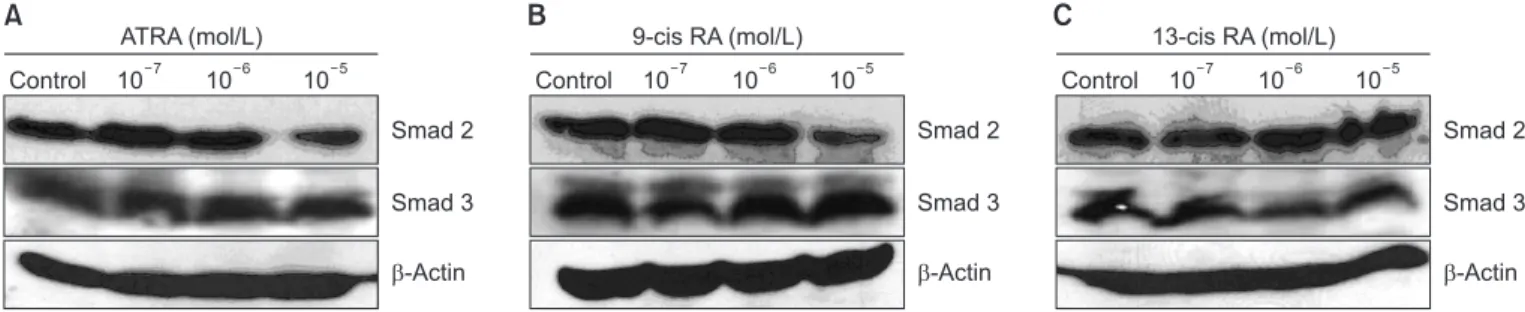
To examine the dose-dependent effects of RA on the activa- tion of Smad, RAs were dissolved in DMSO (final concentra- tion in culture medium was 0.1%) and the final concentrations of the RAs were 10
-7, 10
-6, and 10
-5mol/L. A549 cells were incu- bated with FBS-free RPMI alone or in the presence of various concentrations of each RA for 48 hours. They were subjected to western blotting to identify Smad2/3. The optimal RA con- centration was 10
-6mol/L (Figure 2).
Following TGF-β1 stimulation, both Smad2/3 and p-
Smad 2
Smad 3
p-Smad2 (Ser 465/467)
-Actin : TGF- : RA 1
p-Smad3 (Ser 423/425) ATRA
+ +
+ +
9-cis RA 13-cis RA
+ +
+ +
+ +
Smad 2
Smad 3
p-Smad2 (Ser 465/467)
-Actin : TGF- : RA 1
p-Smad3 (Ser 423/425) ATRA
+ +
+ +
9-cis RA 13-cis RA
+ +
+ +
+ +
A B
Figure 3. (A) Representative results of Smad expression by western blot upon pre-stimulation with TGF-β1 followed by administration of each of the three RAs. A549 cells were left untreated (control) or stimulated with one of the following conditions: TGF-β1 alone, each of the three RAs alone, or pre-stimulated with TGF-β1 followed by administration of one of the three retinoic acids. They were incubated for 24 hours and electrophoresed on a 10% SDS-PAGE gel. The levels of Smad2/3 and p-Smad2/3 were analyzed by western blot. TGF-β1 activated Smad2/3 and increased p-Smad2/3. In contrast, RA administration completely inhibited the phosphorylation of Smad2/3. This was simi- larly observed under conditions of pre-stimulated and simultaneous TGF-β1 administration followed by treatment with the three RAs. (B) Representative results of Smad expression by western blot upon pre-treatment with RA followed by TGF-β1 stimulation. A549 cells were left untreated (control) or stimulated with one of the following conditions: TGF-β1 alone, each of the three RAs alone or pre-treatment with each of the RAs followed administration of TGF-β1. The cells were incubated for 24 hours and electrophoresed on a 10% SDS-PAGE gel. The levels of Smad2/3 and p-Smad2/3 were analyzed by western blot. TGF-β1 activated Smad2/3 and increased p-Smad2/3. RA treatment completely inhibited the phosphorylation of Smad2/3. However, when pre-treated RA was administered, followed by TGF-β1 stimulation, RAs did not suppress the phosphorylation of Smad2/3. TGF-β1: transforming growth factor β1; ATRA: all-trans retinoic acid; RA: retinoic acid; SDS-PAGE:
sodium dodecyl sulfate polyacrylamide gel electrophoresis gel.
Smad 2
Smad 3
-Actin 13-cis RA (mol/L)
Control 107 10 6 105 Smad 2
Smad 3
-Actin 9-cis RA (mol/L)
Control 107 106 105 Smad 2
Smad 3
-Actin ATRA (mol/L)
Control 10 7 106 10 5
A B C
Figure 2. Representative results of Smad expression by western blot according to concentration of ATRA (A), 9-cis RA (B), and 13-cis RA (C) stimulation. After stimulation with various concentrations of the three RAs, A549 cells were incubated for 24 hours and then electrophoresed on a 10% SDS-PAGE gel. Expression of Smad2 and Smad3 protein was analyzed by western blot. The optimal concentration of the RAs was 10
-6mol/L, stimulating the maximum expression of Smad2 and Smad3. ATRA: all-trans retinoic acid; RA: retinoic acid; SDS-PAGE: sodium dodecyl sulfate polyacrylamide gel electrophoresis gel.
Figure 1. Time-dependent phosphorylation of Smad2/3 induced by TGF-β1 5 ng/mL. After stimulation with 5 ng/mL TGF-β1, A549 cells were incubated for the indicated times, and the reactive pro- teins were electrophoresed on a 10% SDS-PAGE gel. The protein levels of Smad2/3 and p-Smad2/3 were analyzed by western blot.
The phosphorylation of Smad2/3 reached a peak 1 hour following TGF-β1 stimulation. TGF-β1: transforming growth factor β1; SDS- PAGE: sodium dodecyl sulfate polyacrylamide gel electrophoresis gel.
Smad 2 Smad 3
p-Smad2/3 (Ser 423/425)
-Actin 0min
15 min
30 min
1hr
TGF- 1 (5 ng/mL) 6hr
12 hr
24 hr
Smad2/3 were increased compared with the control A549 cells. Each of the three RAs (10
-6mol/L), ATRA, 9-cis RA, and 13- cis RA, elicited a similar effect on Smad phosphory- lation. The RAs selectively inhibited the phosphorylation of Smad2/3. When cells were pre-stimulated with TGF-β1 and then treated with the three RAs, the phosphorylation of Smad2/3 was completely abrogated (Figure 3A).
However, when the cells were stimulated with each of the RAs before TGF-β1, different results were observed. After stimulation with TGF-β1, the RAs completely inhibited the phosphorylation of Smad2/3, but when the cells were pre-
treated with RA and then stimulated with TGF-β1, the phos- phorylation of Smad2/3 was not completely suppressed (Fig- ure 3B).
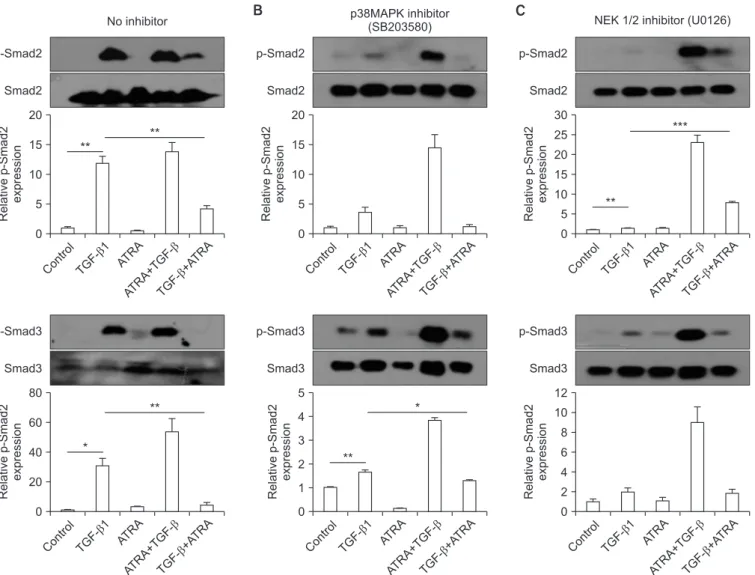
3. Effects of ATRA and MAPK inhibitors differ between A549 epithelial cells and CCD-11Lu fibroblasts Similar to the A549 epithelial cells, TGF-β1 significantly in- creased p-Smad2/3 expression in CCD-11Lu fibroblasts, and this effect was completely suppressed by administration of the ATRA. However, when these cells were pre-treated with each
A
No inhibitorB C
p-Smad2
Smad2
Relativep-Smad2 expression
Contro l
TGF-
1 ATRA ATRA+TGF-
TGF-
+ATRA
20
15 10 5 0
**
**
p38MAPK inhibitor (SB203580) p-Smad2
Smad2
Relativep-Smad2 expression
Contro l
TGF-
1 ATRA ATRA+TGF-
TGF-
+ATRA
20
15 10 5 0
NEK 1/2 inhibitor (U0126)
p-Smad2
Smad2
Relativep-Smad2 expression
Contro l
TGF-
1 ATRA ATRA+TGF-
TGF-
+ATRA
30
15 10 5 0
**
***
p-Smad3
Smad3
Relativep-Smad2 expression
Contro l
TGF-
1 ATRA ATRA+TGF-
TGF-
+ATRA
80
60 40 20 0
*
**
p-Smad3
Smad3
p-Smad3
Smad3
Relativep-Smad2 expression
Contro l
TGF-
1 ATRA ATRA+TGF-
TGF-
+ATRA
12
10 8 6 4 2 0 20 25
Relativep-Smad2 expression
Contro l
TGF-
1 ATRA ATRA+TGF-
TGF-
+ATRA
5
4 3 2 1 0
**
*
Figure 4. (A‒C) Representative western blot results of A549 epithelial cell Smad expression upon pre-treatment with a p38 MAPK inhibitor
(B) or a MEK inhibitor (C). A549 cells were pre-treated with a p38 MAPK inhibitor or a MEK inhibitor, and then the cells were stimulated
as follows: (1) control, (2) TGF-β1, (3) RA (ATRA), (4) pre-treated with RA (ATRA) prior to TGF-β1 stimulation, or (5) pre-stimulated with
TGF-β1 prior to RA (ATRA) treatment. The cells were then incubated for 24 hours and electrophoresed on a 10% SDS-PAGE gel. The levels of
Smad2/3 and p-Smad2/3 expression were analyzed by western blot. TGF-β1 did not significantly elevate p-Smad2 expression when epithelial
cells were pre-treated with the p38 MAPK inhibitor. When epithelial cells were pre-treated with the MEK 1/2 inhibitor, p-Smad3 expression
was not significantly increased by TGF-β1. MAPK: mitogen-activated protein kinase; TGF-β1: transforming growth factor β1; RA: retinoic
acid; ATRA: all-trans retinoic acid; SDS-PAGE: sodium dodecyl sulfate polyacrylamide gel electrophoresis gel. *p<0.05, **p<0.01, ***p<0.001.
of the ATRA, followed by TGF-β1 administration, suppression of p-Smad2/3 expression was not observed (Figures 4A, 5A).
To compare the effects of ATRA and MAPK inhibitors on the phosphorylation of Smad2/3 induced by TGF-β1 between A549 epithelial cells and CCD-11Lu fibroblasts, the cell lines were pre-treated with a p38 MAPK inhibitor (SB203580; 6 μM for 30 minutes) or a MEK 1/2 inhibitor (U0126; 10 μM for 30 minutes) prior to administration of RA and/or TGF-β1 (Figures 4B, C, 5B, C). TGF-β1 administration increased p- Smad2/3 levels, both in A549 and CCD-11Lu cells. However, there were some differences between A549 and CCD-11Lu cells when they were pre-treated with the p38 MAPK inhibi-
tor. In A549 cells, TGF-β1 did not increase p-Smad2 levels. Ad- ditionally, p-Smad2/3 levels in A549 cells pre-treated with the p38 MAPK inhibitor, followed by administration of TGF-β1, were lower than those in the cells that were not pre-treated.
A549 cells pre-treated with the MEK 1/2 inhibitor showed stable p-Smad3 levels. Although TGF-β1 treatment elevated the levels of p-Smad2 significantly in A549 cells pre-treated with the MEK 1/2 inhibitor, p-Smad2 levels were lower than those in the cells that were not pre-treated.
In CCD-11Lu cells, regardless of pre-treatment with MAPK inhibitors, TGF-β1 increased p-Smad3 levels. p-Smad2 levels, however, were not increased in response to pre-treatment
A B C
No inhibitor
p-Smad2
Smad2
Relativep-Smad2 expression
Contro l
TGF-
1 ATRA ATRA+TGF-
TGF-
+ATRA
15
10
5
0
*** ***
p38 MAPK inhibitor (SB203580) p-Smad2
Smad2
NEK 1/2 inhibitor (U0126)
p-Smad2
Smad2
Relativep-Smad2 expression
Contro l
TGF-
1 ATRA ATRA+TGF-
TGF-
+ATRA
0
** **
p-Smad3
Smad3
Relativep-Smad2 expression
Contro l
TGF-
1 ATRA ATRA+TGF-
TGF-
+ATRA
15
10
5
0
***
***
p-Smad3
Smad3
p-Smad3
Smad3
Relativep-Smad2 expression
Contro l
TGF-
1 ATRA ATRA+TGF-
TGF-
+ATRA
0
***
***
Relativep-Smad2 expression
Contro l
TGF-
1 ATRA ATRA+TGF-
TGF-
+ATRA
5
4 3 2 1 0
*** ***
15
10
5
15
10
5 Relativep-Smad2 expression
Contro l
TGF-
1 ATRA ATRA+TGF-
TGF-
+ATRA
4
3 2 1 0
Figure 5. (A‒C) Representative western blot results of CCD-11Lu fibroblast cell Smad expression upon pre-treatment with a p38 MAPK inhib-
itor (B) or a MEK inhibitor (C). CCD-11Lu cells were pre-treated with a p38 MAPK inhibitor or a MEK inhibitor, and then cells were stimulat-
ed as follows: (1) control, (2) TGF-β1, (3) RA (ATRA), (4) pre-treated with RA (ATRA) prior to TGF-β1 stimulation, or (5) pre-stimulated with
TGF-β1 prior to RA (ATRA) treatment. CCD-11Lu cells were then incubated for 24 hours and electrophoresed on a 10% SDS-PAGE gel. The
levels of Smad2/3 and p-Smad2/3 expression were analyzed by western blot. In fibroblasts pre-treated with the p38 MAPK inhibitor, TGF-β1
did not significantly increase p-Smad2 expression. MAPK: mitogen-activated protein kinase; TGF-β1: transforming growth factor β1; RA: reti-
noic acid; ATRA: all-trans retinoic acid; SDS-PAGE: sodium dodecyl sulfate polyacrylamide gel electrophoresis gel. **p<0.01, ***p<0.001.
with the p38 MAPK inhibitor.
4. ATRA attenuates bleomycin-induced lung injury and fibrosis in mouse model
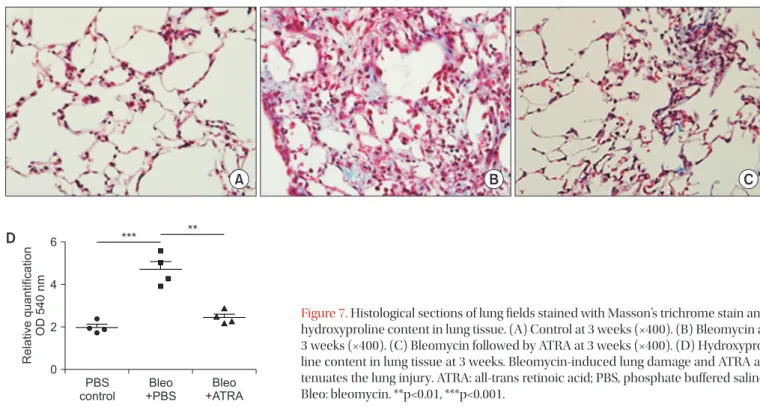
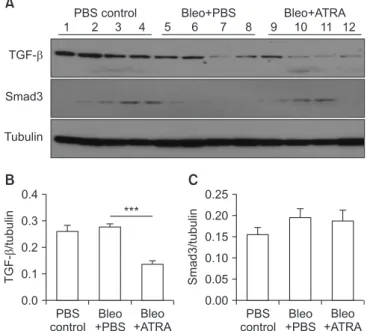
As shown in Figures 6 and 7, bleomycin treatment signifi- cantly induced lung injury after both 1 week (p<0.05) and 3 weeks (p<0.001), and ATRA significantly attenuated the lung injury at 3 weeks. At 1 week, the TGF-β and Smad3 levels in the bleomycin group were significantly increased compared with those in the control group (p<0.01 for both levels), but subsequent treatment with 0.5 mg ATRA significantly blocked this increase (p<0.001 for both levels) (Figure 8). However, at 3 weeks, neither TGF-β nor Smad3 levels were significantly
increased in the bleomycin group. ATRA only significantly blocked the increase of TGF-β levels (p<0.001), failing to sig- nificantly block Smad3 levels (Figure 9).
Discussion
In this study, we demonstrated that RA inhibits the phos- phorylation of Smad2/3 induced by TGF-β1 in both epithelial cells and fibroblasts. In addition, the inhibition of Smad2/3 phosphorylation using RA was clearly demonstrated in cells pre-treated with TGF-β1. This implies that RA may have an inhibitory effect on the progression of pulmonary fibrosis in patients who demonstrate activation and over-stimulation
Lunginjuryscore
PBS control
Bleo +PBS
Bleo +ATRA 0
*
8060
40
20 Lunginjuryscore
PBS control
Bleo +PBS
Bleo +ATRA 0
80
***
60
40
20
G H ***
A B C
D E F
Figure 6. Histological sections of lung fields stained with hematoxylin and eosin (A–F, ×400) and lung injury score (G, H) for the following treatments and at the specified timepoints: control at 1 week (A), bleomycin at 1 week (B), bleomycin followed by ATRA at 1 week (C), con- trol at 3 weeks (D), bleomycin at 3 weeks (E), bleomycin followed by ATRA at 3 weeks (F), lung injury score at 1 week (G), and at 3 weeks (H).
Bleomycin-induced lung damage and ATRA attenuates the lung injury. ATRA: all-trans retinoic acid; PBS: phosphate buffered saline; Bleo:
bleomycin. *p<0.05, ***p<0.001.
of TGF-β1, but not a preventative effect. This phenomenon was also investigated in a bleomycin-induced lung injury and fibrosis mouse model at 1 and 3 weeks. Furthermore, we demonstrated the inhibitory effect of pre-treatment with the p38 MAPK and MEK inhibitors on Smad phosphorylation induced by TGF-β1, and outlined differences in the effects on epithelial cells and fibroblasts. Our study suggests that a com- bination of MAPK inhibitors and ATRA may exert preventa- tive and inhibitory effects on pulmonary fibrosis.
There is evidence that interactions between RA and TGF-β play important roles in cellular proliferation and differentia- tion, including modulation of the balance between these two processes
13.
The effects of RA on pulmonary fibrosis have been inves- tigated, and RA has been shown to inhibit TGF-β1–induced collagen production from human lung fibroblasts, as well as from both idiopathic pulmonary fibrosis and neonatal lung fibroblasts
14,15. The inhibitory effects of RA on TGF-β1 are closely related to the phosphorylation of Smad3
16,17. A study demonstrated that ATRA prevents radiation- or bleomycin- induced pulmonary fibrosis through reduced production of interleukin 6, TGF-β1, and collagen from human fetal lung fibroblasts
18. These data may provide the rationale for explor- ing the clinical use of ATRA for the prevention of radiation- induced pulmonary fibrosis and other pathologic conditions involving pulmonary fibrosis.
It has been shown that RA induced hypochondrogenesis through regulation of the TGF-β1 pathway, suggesting a role for TGF-β receptor II (TβRII)/Smad in retinoid-induced cleft
palate
19. In contrast to embryonic cells, RA increased
8,20or decreased
21expression of TGF-β1 in leukemic cells. TGF-β1 in combination with ATRA acted synergistically to inhibit growth, and to stimulate apoptosis of these cells. The results for the effects of RA on the expression of TGF-β1 are con- flicted; depending on cell type, culture conditions, and type of RA used, both elevations and reductions have been reported.
This study demonstrated that RAs completely inhibited the phosphorylation of Smad2/3 in the presence of RA alone and when pre-stimulated with TGF-β1 followed by administra- tion of RA. However, RAs did not completely suppress the phosphorylation of Smad2/3 when cells were pre-treated RA followed TGF-β1 stimulation. In our study, epithelial cells that were pre-treated with RA followed TGF-β1 stimulation showed greater phosphorylated Smad2/3 expression than TGF-β1 stimulated epithelial cells that were not pre-treated with RA. This might be the result of a different spatiotemporal status of pre-stimulation because cells pre-treated with RA have a higher responsiveness to TβRII induction to exogenous TGF-β1 administration, as was observed in HL-60 leukemic cells
22, where the induction of TβRII led to an increased re- sponse to exogenous TGF-β1 and increased phosphorylation of Smad2/3.
In contrast, it might be the result of other mechanisms of Smad phosphorylation. TGF-β1 was shown to activate the PI3K and ERK pathways, which led to Smad3 phosphoryla- tion at the linker region in rat myofibroblasts
23. Additional studies are needed to elucidate the effects of RA on the various mechanisms of the TGF-β1 signal transduction pathway, and
A B C
D
Relativequantification OD540nm
PBS control
Bleo +PBS
Bleo +ATRA 0
6
***
4
2
**
Figure 7. Histological sections of lung fields stained with Masson’s trichrome stain and hydroxyproline content in lung tissue. (A) Control at 3 weeks (×400). (B) Bleomycin at 3 weeks (×400). (C) Bleomycin followed by ATRA at 3 weeks (×400). (D) Hydroxypro- line content in lung tissue at 3 weeks. Bleomycin-induced lung damage and ATRA at- tenuates the lung injury. ATRA: all-trans retinoic acid; PBS, phosphate buffered saline;
Bleo: bleomycin. **p<0.01, ***p<0.001.
on the various target genes that promote fibrosis, apoptosis, and epithelial-mesenchymal transition (EMT).
Many studies have indicated that unregulated recovery of epithelial injury is the beginning and cause of pulmonary fibrosis pathogenesis
1,24,25. Ross et al.
26demonstrated that Smad3 expression is regulated by mitogen-activated protein kinase kinase-1 (MEK1) in epithelial and smooth muscle cells.
p-Smad3 was not increased in epithelial cells in our study upon pre-treatment with a MEK 1/2 inhibitor (Figure 4C).
However, in fibroblasts pre-treated with the MEK 1/2 inhibitor, the effect of TGF-β1 was not inhibited (Figure 5C). Our study demonstrated that pre-treatment with MAPK inhibitors was effective in preventing the effect of TGF-β1 on epithelial cells.
Through Smad or non-Smad pathway and extracellular stimuli, TGF-β activate all ERK, p38 MAPK, and JNK MAPK
27. In our study, pre-treatment of epithelial cells and fibroblast with a p38 MAPK inhibitor showed a non-significant response to TGF-β1 in p-Smad2. Although TGF-β1 also significantly el- evated p-Smad3 expression, regardless of pre-treatment with the p38 MAPK inhibitor, the levels of expression were lower in the absence of the inhibitor. Therefore, the p38 MAPK inhibi- tor could be effective against both Smad2 and Smad3 phos- phorylation.
Previous studies have demonstrated that TGF-β1 is associ- ated with MAPK signaling and EMT induction
28,29. Through EMT, epithelial cells might be converted to myofibroblasts
30. Abnormal activated alveolar epithelial cells are important me- diators that induce the formation of fibroblast and myofibro- blast foci, which secrete excessive amounts of collagen, result- ing in scarring and compromised lung function
31. In our study, both fibroblasts and epithelial cells pre-treated with MAPK in- hibitors showed significant decreases in Smad2 phosphoryla- tion. Additionally, ATRA was shown to be effective in both epi- thelial cells and fibroblasts, pre-treated with a MAPK inhibitor, in suppressing p-Smad3. Furthermore, bleomycin-induced lung injury and fibrosis was reduced in vivo by ATRA in our study. At 1 week, TGF-β and Smad3 levels were increased by bleomycin treatment and decreased by subsequent treatment with ATRA. At 3 weeks, TGF-β and Smad3 levels showed in- creases similar to those shown at 1 week, but only the levels of TGF-β were significantly reduced by ATRA. This could be explained by the possibility that, while TGF-β and Smad3 play important roles in bleomycin-induced lung damage at 1 week, other pathways might exist in lung injury after 1 week.
Shi et al.
32showed that the signal of TGF-β was significantly stronger than that in the control group in an animal model within 2 weeks, and the signal of TGF-β was weaker later, as observed in our results. Additional experiments are needed to
TGF- Smad3
Tubulin
TGF-/tubulin
PBS control
Bleo +PBS
Bleo +ATRA 0.0
1.0
**
0.8 0.6 0.4 0.2
B ***
Smad3/tubulin
PBS control
Bleo +PBS
Bleo +ATRA 0.0
1.0
**
0.8 0.6 0.4 0.2
C ***
PBS control Bleo+PBS Bleo+ATRA
1 2 3 4 5 6 7 8 9 10 11 12
A
Figure 8. (A‒C) Expression of TGF-β and Smad3 in lung lysates upon treatment with bleomycin followed by ATRA, as measured by densitometry at 1 week for TGF-β (B) and Smad3 (C). Male C57BL/6J mice were stimulated as follows: (1) control, (2) bleomy- cin, or (3) bleomycin followed by ATRA. Bleomycin significantly increased the levels of TGF-β and Smad3, and ATRA significantly decreased the levels of TGF-β and Smad3 at 1 week. TGF-β: trans- forming growth factor β; ATRA: all-trans retinoic acid; PBS: phos- phate buffered saline; Bleo: bleomycin. **p<0.01, ***p<0.001.
TGF- Smad3
Tubulin
TGF-/tubulin
PBS control
Bleo +PBS
Bleo +ATRA 0.0
0.4 0.3 0.2 0.1
B
***
Smad3/tubulin
C
PBS control
Bleo +PBS
Bleo +ATRA 0.00
0.25 0.20 0.15 0.10 0.05
PBS control Bleo+PBS Bleo+ATRA
1 2 3 4 5 6 7 8 9 10 11 12