28
http://dx.doi.org/10.4046/trd.2013.74.1.28 ISSN: 1738-3536(Print)/2005-6184(Online) Tuberc Respir Dis 2013;74:28-31
CopyrightⒸ2013. The Korean Academy of Tuberculosis and Respiratory Diseases. All rights reserved.
A Case of Congenital Cystic Adenomatoid Malformation Infected with Mycobacterium avium-intracellulare Complex
Yong Jin Kim, M.D.1, Do Young Kim, M.D.1, Jung Woong Seo, M.D.1, Song Am Lee, M.D.2, Jae Joon Hwang, M.D.2, Hee Joung Kim, M.D.1, Kye Young Lee, M.D., Ph.D.1
Departments of 1Internal Medicine and 2Thoracic and Cardiovascular Surgery, Konkuk University School of Medicine, Seoul, Korea
We present a case of congenital cystic adenomatoid malformation (CCAM) in a 25-year-old male who was presented with chronic cough. Chest radiography revealed an abnormal mass-like shadow in the right lower pulmonary zone.
A contrast enhanced computed tomography showed an 11 cm solid, cystic mixed mass on the right lower lobe.
A right lower lobectomy was performed by video-assisted thoracoscopic surgery without complications. The gross specimen showed a massive cavitation with multiloculated cysts of varying size, consistent with CCAM, along with noticeable granulomatous inflammation. Non-tuberculosis mycobacteria were isolated from a bronchial wash specimen, and the resected tissue homogenates were positive for Mycobacterium avium-intracellulare complex by polymerase chain reaction.
Key Words: Cystic Adenomatoid Malformation of Lung, Congenital; Nontuberculous Mycobacteria; Mycobacterium avium Complex
Address for correspondence: Kye Young Lee, M.D., Ph.D.
Department of Internal Medicine, Konkuk University School of Medicine, 120-1, Neungdong-ro, Hwayang-dong, Gwang- jin-gu, Seoul 143-729, Korea
Phone: 82-2-2030-7521, Fax: 82-2-2030-7748 E-mail: [email protected]
Received: Jun. 27, 2012 Revised: Jul. 4, 2012 Accepted: Jul. 16, 2012
CCIt is identical to the Creative Commons Attribution Non-Commercial License (http://creativecommons.org/licenses/by-nc/3.0/).
Introduction
Congenital cystic adenomatoid malformation (CCAM) is a rare developmental anomaly of the terminal respira- tory structures with an incidence of 1 in 10,000 to 1 in 35,000 births
1. It was first described as a distinct dis- ease by Ch'In and Tang in 1949
2. The lesion is almost always unilateral and may occur in any lobe. The clin- ical presentations of CCAM include acute respiratory dis- tress, recurrent pulmonary infections, lung abscess, pne- umothorax, or hemoptysis. Most cases are diagnosed antenatally or in neonates and infants who present with severe respiratory distress or pulmonary infections in
the affected lung. Occasionally, CCAM remains unrecog- nized until adolescence or adulthood. Recurrent bacte- rial infections are a frequent feature of CCAM in adults.
Here, we report a case of CCAM associated with a Mycobacterium avium-intracellulare complex (MAC) infection.
Case Report
A 25-year-old male without a history of smoking pre- sented with a 1-week history of cough and right-sided back pain when coughing. The patient had a history of one hospital admission due to pneumonia approx- imately ten years prior to the current presentation and complained of intermittent cough over the intervening ten years.
A physical examination identified decreased breath- ing sounds over the right lower lung without other findings. A complete blood count test, liver function test and urine analysis were normal. His erythrocyte sed- imentation rate was 61 mm/hr and his high-sensitivity C-reactive protein was 3.86 mg/dL. Chest radiography
Case Report
Tuberculosis and Respiratory Diseases Vol. 74. No. 1, Jan. 2013
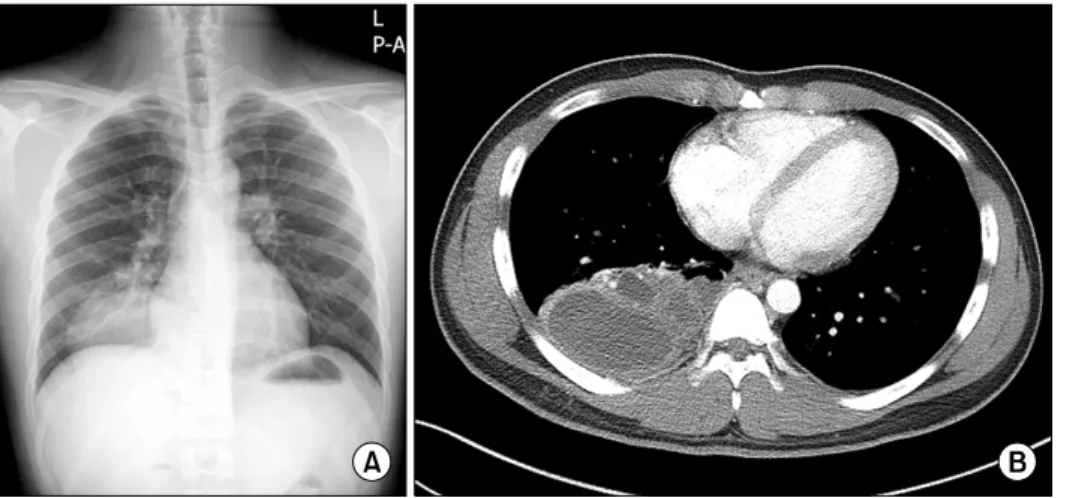
29 Figure 1. (A) A chest radio- graph showing increased haziness in the right lower lobe. (B) A thoracic com- puted tomography scan performed at the same time showing an 11 cm solid, cystic mixed mass in the right lower lobe without feeding vessels from the descending aorta.
Figure 2. A cutting plane of the resected lung specimen shows massive cavitation with multiloculated cysts of varying size within the lesion.
showed an abnormal mass-like shadow in the right low- er lung (Figure 1A). Contrast-enhanced computed to- mography (CT) revealed an 11 cm solid, cystic mixed mass in the right lower lobe without a feeding vessel from the descending aorta (Figure 1B). Bronchoscopy disclosed purulent secretion from the posterior basal segmental bronchus of the right lower lobe. A pulmo- nary function test was normal.
Subsequently, the patient underwent a right lower lo- bectomy by video-assisted thoracoscopic surgery. A macroscopic examination showed a massive cavitation with multiloculated cysts of varying size within the le- sion and pleural fibrosis (Figure 2). Microscopically, the specimen consisted of multiple cysts (Figure 3A) which were lined by cuboidal-to-ciliated pseudostratified col- umnar epithelium, and some cysts contained extensive secondary inflammation (Figure 3B). These histological features were consistent with typical type I CCAM. In addition, a microscopic examination revealed a notice- able caseous granulomatous inflammation in the cyst walls (Figure 3A). The necrotic center was surrounded by epithelioid histiocytes and then by a rim of lympho- cytes (Figure 3C). Forty colony forming units of non-tu- berculosis mycobacterium (NTM) were isolated from a bronchial wash specimen. Furthermore, resected lung tissue homogenates were positive for MAC by real-time polymerase chain reaction (Figure 3D). The post- operative course was uneventful without anti-myco- bacterial treatment. Two years after surgery, chest ra- diography showed a well-expanded right lung without
lesions.
Discussion
CCAM is a rare developmental, non-hereditary, ha-
martomatous abnormality of the lower respiratory tract
first described in 1949
2. It occurs sporadically and is not
related to genetic predisposition, gender predilection, or
maternal factors such as race, age, or environmental
exposures. Stocker et al.
3suggested a new name, con-
genital pulmonary airway malformation, and classified
CCAM into five types based on the site of the defect
in the tracheobronchial tree. Type I CCAM is the most
common subtype and consists of a single or multiple
large epithelial-lined cysts. The walls of the cysts con-
YJ Kim et al: Congenital cystic adenomatoid malformation infected with MAC
30
Figure 3. (A) The lesion consists of multiple cysts with caseous granulomas and inflamed granulation tissue (H&E stain, ×40).
(B) The cysts are lined by cuboidal-to-ciliated pseu- dostratified columnar epi- thelium (H&E stain, ×100).
(C) A marked caseous gra- nuloma is shown, and the necrotic center is surround- ed by epithelioid histiocytes (H&E stain, ×100). (D) Ele- ctrophoresis of the poly- merase chain reaction pro- duct. M: size marker; PC 1:
positive control (Kit-positive sample); PC 2: positive co- ntrol (Mycobacterium avi- um-intracellulare complex);
NC: negative control; Pt:
patient sample.
tain prominent smooth muscle and elastic tissue and mucus-producing cells are occasionally present
3.
The pathogenesis of CCAM is uncertain but may in- clude an imbalance between cell proliferation and apoptosis during organogenesis
4. Affected patients may present with symptoms, including cough, dyspnea, he- moptysis, and respiratory distress, or remain asympto- matic. The typical manifestations include progressive respiratory distress in the newborn and recurrent pul- monary infections in older children.
The majority of cases are identified by prenatal ultra- sound examinations. Additional prenatal magnetic reso- nance imaging may help to distinguish CCAM from oth- er congenital lesions. A postnatal diagnosis can usually be made using plain radiography. Chest CT scans may be helpful for confirming the diagnosis in cases that are confusing. The differential diagnosis of CCAM includes bronchopulmonary sequestration, a congenital diaphra- gmatic hernia, a bronchogenic cyst, congenital lobar
emphysema, and pneumatoceles. The most frequent complication of CCAM is recurrent or persistent pulmo- nary infection. Other complications include hemopneu- mothorax, hemoptysis, and chronic cough. CCAM has been associated with the development of malignancies, such as bronchioloalveolar carcinoma
5, adenocarcinoma in aged
6, and pleuropulmonary blastoma
7. Surgical re- section of the affected part of the lung is the treatment of choice, and this prevents recurrent infections and ma- lignant transformation.
Pulmonary NTM infection usually occurs in patients with destroyed lungs, including those with chronic ob- structive lung disease, pulmonary tuberculosis, bron- chiectasis, or pneumonoconiosis. While NTM infection is known to occur commonly in old age, NTM infection occurs in destroyed lung caused by CCAM despite young age in our patient.
A few case reports have detailed NTM infection in
congenital lung lesions such as bronchogenic cysts
8and
Tuberculosis and Respiratory Diseases Vol. 74. No. 1, Jan. 2013