This is an Open-Access article distributed under the terms of the Creative Commons Attribution Non-Commercial License(http://creativecommons.org/licenses/by-nc/3.0) which permits unrestricted non-commercial use, distribution, and reproduction in any medium, provided the original work is properly cited.
Journal of Welding and Joining, Vol.32 No.5(2014) pp50-57
Defect Detection in Friction Stir Welding by Online Infrared Thermography
Igor Kryukov* , †, Michael Hartmann*, Stefan Böhm*, Malte Mund**, Klaus Dilger**
and Fabian Fischer**
*Department for Cutting and Joining (tff), University of Kassel, 34125 Kassel, Germany
**Institute of Joining and Welding (ifs), University of Braunschweig, 38106 Braunschweig, Germany
†Corresponding author : [email protected] (Received July 12, 2014 ; Accepted July 23, 2014)
Abstract
Friction Stir Welding (FSW) is a complex process with several mutually interdependent parameters. A slight difference from known settings may lead to imperfections in the stirred zone. These inhomogeneities affect on the mechanical properties of the FSWed joints. In order to prevent the failure of the welded joint it is necessary to detect the most critical defects non-destructive. Especially critical defects are wormhole and lack of penetration (LOP), because of the difficulty of detection.
Online thermography is used process-accompanying for defect detecting. A thermographic camera with a fixed position relating to the welding tool measures the heating-up and the cool down of the welding process. Lap joints with sound weld seam surfaces are manufactured and monitored. Different methods of evaluation of heat distribution and intensity profiles are introduced.
It can be demonstrated, that it is possible to detect wormhole and lack of penetration as well as surface defects by analyzing the welding and the cooling process of friction stir welding by passive online thermography measurement. Effects of these defects on mechanical properties are shown by tensile testing.
Key Words : Friction Stir Welding (FSW), Non-destructive testing (NDT), infrared thermography, online process monitoring, defect detection, quality of joint
ISSN 1225-6153 Online ISSN 2287-8955
1. Introduction
The friction stir welding (FSW) is an innovative pressure welding process which was developed in 1991 at the TWI (The Welding Institute, England). A rotating tool is moved through the workpieces and heats these by friction to shortly below the melting point. Afterwards, the materials, that are to be joined, are stirred, resulting in a metallic connection. An important advantage of the FSW is that no auxiliaries or additive materials are necessary for this process. Fur- thermore, the preferential use of low melting metals like aluminium and magnesium creates a strong interest in the FSW for applications in
the light weight construction.
The FSW is a process with a lot of interacting parameters which are divided in tool and process parameters. Variations of known setting can lead to diverse irregularities in the weld seam 1) . These anomalies reduce the bending and breaking strength of the friction stir welded joint. To avoid the failure of weld joints and to secure a consistent weld quality, it is necessary to detect critical defects non-destructive.
An adequate non-destructive testing should offer a quick availability of test results as well as the possibility to perform a 100% inspection of the welds.
For the FSW, the infrared thermography serves as an instrument for the online non-
Research Paper
Direction of welding
r φ
Fig. 1 Position of thermographic camera relating to the welding tool
Si Fe Cu Mn Mg Cr Zn Ti
6082-T6 1.00 0.38 0.10 0.52 0.70 0.04 0.05 0.03 Table 1 Chemical composition of used aluminium
alloy destructive testing. By this means, the infrared
radiation of the examined object is measured contact free. Irregularities in the weld seam can already be distinguished due to minor differences in the temperature on the object surface. Defects in the test object lead to a reduced temperature flow, which is the reason why the surface temperature is locally higher than in adjoining regions. The advantages of thermography are the high exactness when measuring large areas online. Due to the short measurement time, the reactionless process offers high automation potential 2,3) .
Thermography has already been used multiple times with the friction stir welding. Mainly, it was used for the examination of the temperature distribution during the process 4-7) . Lahiri et al.
examined a primed friction stir welded joint by using the optically excited lock-in thermo- graphy. By identifying the inserted wormholes they concluded that the infrared thermography can generally be used as a non-destructive testing technology for weld joints 8) . Dehelean et al. succeeded in proving the existence of simulated surface defects during the friction stir welding by using a thermography camera 9) . So far, nobody managed to detect the existence of internal defects online and to define the defects.
In this article, thermography is used to detect internal defects in the lap joint of friction stir welded joints. In order to achieve this, sound and defected welds are compared with each other. On the basis of the cooling behaviour of the weld as well as of the temperature develop- ment in the process, conclusions can be drawn with regard to defects during the welding process.
2. Experimental details 2.1 Experimental setup
Lap joints of the aluminium alloy EN AW 6082-T6 (AlMgSi1) are examined on aluminium plates with the measures 500mm × 120mm × 2mm (see table 1 for the chemical composition).
The weld seam length is 250mm.
An infrared camera is chosen for the thermography measurement during the process and firmly positioned relating to the welding tool. The FLIR SC5600-M is used as the thermography camera.
This actively cooled camera with an indium antimonide sensor is distinguished for FSW due to a high resolution of 640 pixels × 512 pixels, a radiography rate of 100Hz, as well as a spectral range of 2.5µm - 5.1µm. Due to the noise equivalent temperature difference (NETD) of less then 20mK, this camera is especially suited for the detection of the smallest temperature differences 10) . With the help of a construction, the camera is positioned directly over the weld seam to ensure that the distance to the weld seam always stays the same.
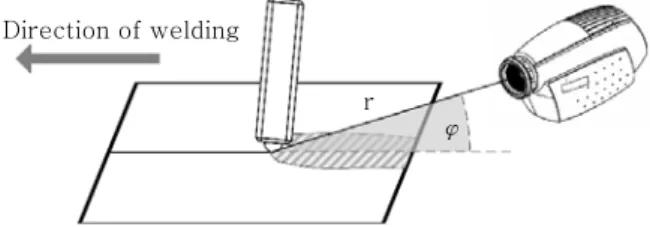
Due to the tracking of the tool, the cooling process of a constantly large area (min. 90mm × 100mm) can be monitored and evaluated. The distance between the objective and the tool r is about 270mm, the inclination angle of the camera φ relating to the weld level is about 55°, as shown in Fig. 1. The entire welding process has been recorded and evaluated.
To avoid disturbing reflections of the surroun- dings or the welding machine, the welding area as well as the elements located there are encap- sulated, or the surfaces are dyed dull black.
However, the aluminium plates deliberately stay
undyed. Due to the strong self-heating, the
tool emits a lot of heat to the outside. As the
aluminium plates are undyed and as they have
a very high reflection coefficient, a measurement
feed rate [mm/min] rotation speed [min
-1] tilt angle [°] plunge depth [mm] pin length [mm]
sound weld 800 -1000 2 2.68 2.3
wormhole defect 1000 +800 2 2.68 2.3
lack of penetration v1 800 -1000 2 2.30 2.0
lack of penetration v2 800 -1000 2 2.23 2.0
Table 2 Welding parameters of the area directly surrounding the tool is
strongly distorted. In order to keep this area out of the measurement, the tool including the tool holding device was encased with a thin walled, dull black hollow cylinder which almost reaches the aluminium plates. It can absorb most of the radiation. Thus, the heat radiating from the tool is mostly isolated from the measure- ment. Only a small part of residual radiation can be seen on the edge of the hollow cylinder.
2.2 Imperfections in FSW
Significant irregularities in the friction stir welding are defined by the AWS D17.3/D17.3M:
2010 11) as well as DIN EN ISO 25239-5 12) . Among the most crucial defects are internal defects, like wormholes and the lack of penetration (LOP), which cannot be detected by a simple visual inspection. These defects influence the static and dynamic strength of the weld seam.
Other than the thermography, no testing method can detect these defects online.
A wormhole (also referred as cavities or voids) results from insufficient material flow during the process. Due to low rotational speeds and high feed rates, not enough heat is inserted in the weld seam. In case of such a cold weld, a tunnel is generated on the advancing side which is continuing along the weld.
A “lack of penetration” (LOP) is the conse- quence of an inadequate mixture of the work- pieces at the root of the weld. The reason for this is the insufficient plunge depth of the pin into the material. While this defect can be detected in case of a butt joint by inspecting of the reverse side, it is not possible to identify this type of defect in case of a lap joint.
By varying the weld parameters, both sound welds and welds with wormholes as well as
“lack of penetrations” have been generated. Two different parameters have been chosen for the
“lack of penetration”, variant 1 with barely a penetration and variant 2 where the workpieces are not connected to each other. The used weld parameters are shown in table 2. The used tools have a concave shoulder with a diameter of 10mm and a cylindrical pin with a diameter of 4mm. The tools are adjusted to a counter- clockwise rotation (negative rotation speed, see table 2) and have a thread support to improve the material flow.
With regard to the wormholes, the rotating direction has been changed from counter-clockwise to clockwise (positive rotation speed, see table 2). Furthermore, the rotation speed has been reduced and the feed rate increased. To generate the “lack of penetration”, a tool with a shortened pin has been used. Additionally, the plunge depth has been reduced. With these parameters, it has been ensured that the welds seem to be sound on the outside despite the inserted defects.
Fig. 2 shows the produced welds a) sound weld, b) weld with wormhole, c) “lack of penetra- tion” variation 1, connection still existing, d) “lack of penetration” variation 2, without connection between the workpieces.
3. Results and discussion 3.1 Evaluation of online measurement
Sound welds as well as weld specimens with
the mentioned defects have been successfully
produced. Related to the process, thermographic
measurements have been made throughout the
(a)
(c)
(b)
(d)
Fig. 2 Surface of welded joints: (a) sound weld, (b) weld containing wormhole defect, (c) lack of penetration defect v1 (with connection between workpieces), (d) lack of penetration defect v2 (without connection between workpieces)
(a) (b)
(c) (d)
Fig. 3 Thermographic exposure in the welding process: (a) sound weld, (b) weld containing wormhole defect, (c) lack of penetration defect v1 (with connection between workpieces), (d) lack of penetration defect v2 (without connection between workpieces)
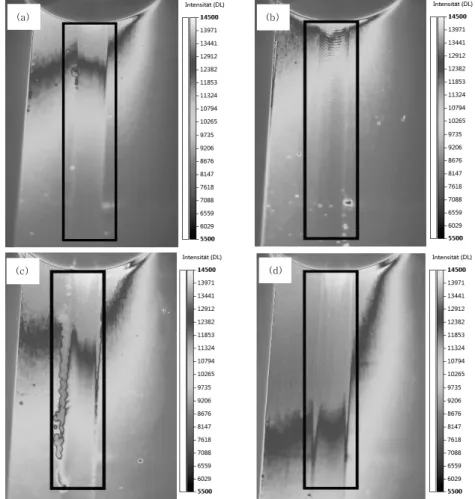
whole process. Infrared images of the single weld tests are presented in Fig. 3. In the centre, the imbricated weld can be seen which proceeds from the bottom to the top. Above it, the men- tioned hollow cylinder can be seen which does not radiate or reflect heat. On the left of the weld, the edge of the plate is distinctly visible.
The defective heat conduction leads to a heating
of the plate edge, while the aluminium plate
lying below is considerably less influenced by
the heat. The single, round heat sources, as well
as the heat sources along the weld are flashes,
which were generated during the process. Flashing
and other surface defects are a major problem
for the thermography. As these defects have a
higher heat radiation than the weld seam, the
8000 9000 10000 11000 12000 13000 14000
0, 2 2, 7 5, 3 8, 0
10
, 7
13
, 4
16
, 0
18
, 7
21
, 4
24
, 1
26
, 7
29
, 4
32
, 1
34
, 7
37
, 4
40
, 1
42
, 8
45
, 4
48
, 1
50
, 8
53
, 5
56
, 1
58
, 8
61
, 5
64
, 1
66
, 8
69
, 5
72
, 2
74
, 8
77
, 5
Distance from sheath [mm]
Sound Weld Wormhole Defect Lack of Penetration V1 Lack of Penetration V2
Intensit y
Fig. 4 Intensity profiles on the basis of figure 3:
mean intensity value per distance at an optional time
lower lying defects are overlaid at this position and, consequently, not discernible.
To achieve a better comparability of the single thermography images, they have been equally scaled. It is impossible to display the absolute temperature of the weld seam at this position.
The reason for this is the not exactly known but low emissivity of the workpieces. However, this is not important for the evaluation. The scale describes a dimensionless intensity quantity.
As each measurement has been made under the same conditions, the measured intensity distributions can be compared directly with each other.
A first comparison of the thermographic images at any time during the process already provides first insights. The thermography image of the sound weld serves as a reference for further comparisons. The temperature distribution of the weld seam with the wormhole (see Fig. 3 b)) shows low intensity compared with the sound weld seam. This suggests a cold weld. The uneven intensity distribution along the weld seam suggests a continuous wormhole. Other cold weld defects change the seam surface and can be easily detected by strong local increase of intensity or even visual inspection. The shortened pin in Fig. 3 c) still leads to a joining of the workpieces.
The thermographic image shows a similar result as the reference weld. Only the stated intensities display slightly higher data. In comparison to that, it is possible to detect a heat accumulation on the surface in Fig. 3 d). The heat generated during the process cannot flow off into the lower workpiece which can be attributed to a
“lack of penetration”.
3.2 Evaluation of intensity profiles
For a more distinct evaluation, a quadratic area around the weld seam has been chosen during each measurement, and the measured intensities have been examined. The area has a size of 100 pixels × 450 pixels and complies with an evaluated weld seam area of about 20mm × 80mm. This area is encircled by the black mark in Fig. 3.
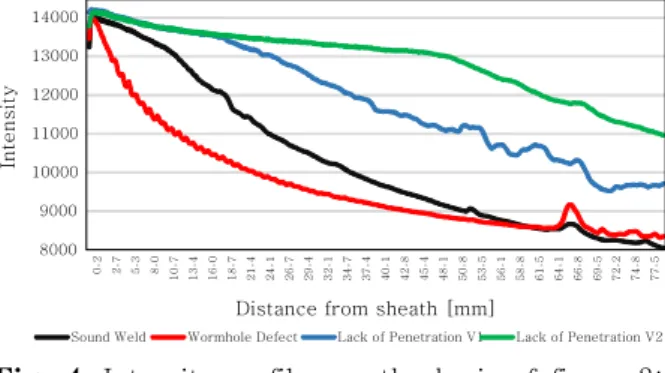
At first, the cooling behaviour of the weld seams during the process, shown in Fig. 3 a) to 3 d), has been evaluated. Thereby, the average intensities along each row with the same distance to the sheath within the mark have been determined.
The cooling behaviour of the welds is demonst- rated in Fig. 4. Defects caused by flashes on the surface in form of sudden temperature rises can be easily distinguished due to the intensity profiles.
The almost linear intensity profile of the reference weld can be clearly recognized. A sound weld proportionally cools down with increasing distance to the tool. In case of the cold weld, less heat is inserted into the weld. Though the temperature shortly after the welding process is almost as high as in other welding processes, this weld cools down exponentially. With regard to the lack of penetration variant 1, the com- pletely welded area is considerably smaller com- pared with the reference weld. The reduced area lowers the heat conduction into the lowest aluminium plate, causing a slower but never- theless linear decline of temperature and intensity.
Compared to that, there is no connection between both workpieces in case of the lack of penet- ration variant 2. The produced heat can only be spread within the upper aluminium plate.
Due to the smaller material volume and the smaller surface, the cooling down is slower, which can be seen in Fig. 4.
In addition to the evaluation of the single
thermography images at particular points in
time, the intensity distribution over the whole
weld process has been evaluated. In order to
Fig. 6 Location of removal of the specimen (drawing without scale)
(a)
(b)
264.02㎛
1000㎛
1000㎛
2847.89㎛
Fig. 7 Metallographic confirmation for accurate seam (a) and wormhole defect (b)
0, 00 1, 10 2, 20 3, 30 4, 40 5, 50 6, 60 7, 70 8, 80 9, 90
11
, 00 12
, 10 13
, 20 14
, 30 15
, 40 16
, 50 17
, 60 18
, 70 19
, 80 20
, 90 22
, 00 23
, 10 24
, 20 25
, 30 26
, 40 27
, 50 28
, 60 29
, 70 30
, 80 7000
8000 9000 10000 11000 12000 13000
Time [s]
Sound Weld Wormhole Defect Lack of Penetration V1 Lack of Penetration V2
In te nsity
Fig. 5 Intensity profiles during the welding process:
mean intensity value development during the total welding process
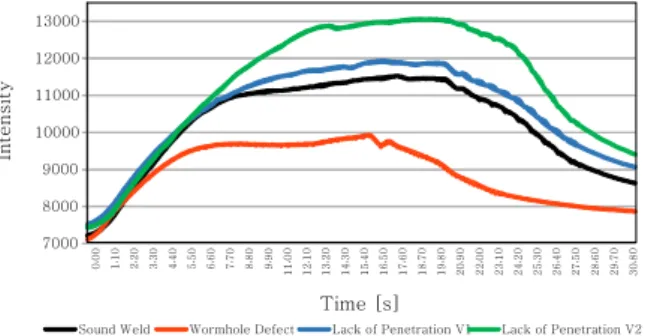
achieve this, an average intensity value has been created from the 45,000 measurement data per measurement image. The resulting intensity profiles are shown in Fig. 5. An initially strong temperature increase is visible, where the work- pieces have been heated to weld temperature.
Afterwards, a lower temperature increase ensued during the welding process. The maximum tem- perature is reached at the end of the weld.
Due to the higher feed rate, the maximum temperature is reached faster if it is a wormhole than in case of the other welds. From this point in time the joined plates cool down.
The intensity profiles over the whole duration of the weld process confirm the already achieved insights. Compared to the sound weld, the average intensity of the weld with wormholes is about 15% lower. While the lack of penetration variant 1, just shows a 5% higher intensity, it is 10% to 15% higher for lack of penetration variant 2, than the reference value.
In order to examine the results with regard to the reproducibility, each weld test has been repeated three times with the correspondent parameters. Despite of the intensity variation by 2-3%, each result, the thermography images as well as the intensity profiles have been reproducible. Consequently, it is possible, to infer from the thermography images and the intensity profiles of the weld that there are wormholes or a lack of penetration.
3.3 Destructive evaluation
In order to validate the results, destructive
test has been made with the specimens. Two specimens have been removed from each weld specimen to execute the tensile test and the microscopic analysis, as it is shown in Fig. 6.
It was not possible to take specimens of the lack of penetration variant 2, as these directly disintegrated during the removal due to the non-existing penetration.
Microscopic analyses have been made of the specimens to validate the results. Under the microscope, there are no defects visible in the sound weld (see Fig. 7). However, it is relatively easy to distinguish the centered wormhole (length about 2848µm, width about 264µm), also detec- table in Fig. 3 b).
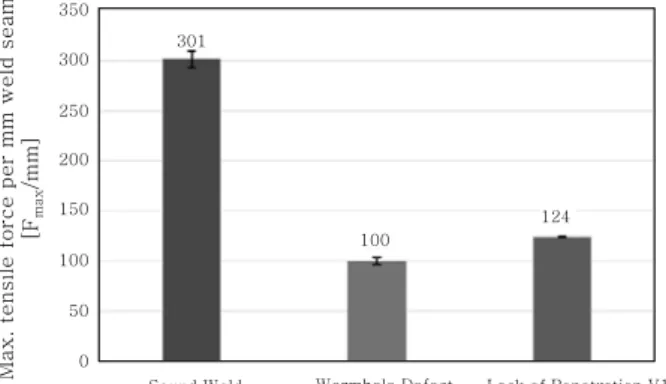
At the end, simplified tensile tests were executed
10000 9000 8000 7000 6000 5000 4000 3000 2000 1000 0
0,00 0,04 0,17 0,34 0,51 0,67 0,84 1,01 1,17 1,34 1,51 1,67 1,84 2,01 2,17 2,35 2,52 2,69 2,88
Elongation [mm]
Sound Weld 1 Sound Weld 2 Wormhole 1
Wormhole 2 Lack of Penetration V1 1 Lack of Penetration V1 2
Forc e [N]
Fig. 8 Tensile testing of defective and sound weld seams
350 300 250 200 150 100 50
Ma x. t e n s ile f orc e p er mm we ld s ea m [F /m m]
max 0Sound Weld Wormhole Defect Lack of Penetration V1 301
100
124