Sinfony 간접복합수지와 비귀금속합금간의 전단결합강도와 파절양상
민 병 록, 정 인 성 부산가톨릭대학교 보건과학대학 치기공학과
Shear Bond Strength and Failure Mode between Sinfony Indirect Composite Resin and Non Precious Metal
Byung-Rok Min, In-Sung Chung
Department of Dental Laboratory Science, College of Health Science, Catholic University of Pusan, Busan
The purpose of this study was to investigate the effect retention element formed by metal surface treatment method on the bond strength of indirect composite resin and metal.
The metal specimens were cast from Ni-Cr alloy(Rexillium ). They were divided into 5 groups by applied retention element: 50 aluminium oxide sandblasting group, 250 aluminium oxide sandblasting group, 0.2 retention crystal group, 10% H 2 SO 4 solution etching group, 110 Rocatec
TMPlus system group. Total 50 metal specimens were veneered with Sinfony indirect composite resin system.
Specimens were tested for shear bond strength on an Instron universal testing machine and fracture mode of fractured specimens were analyzed by SEM and EDS.
1. 0.2 retention crystals were most effective in improving the resin-metal shear bond strength (p<0.05).
2. Sandblasting by 250 aluminium oxide were more effective than sandblasting by 50 aluminium oxide in improving the resin-metal shear bond strength(p<0.05).
3. Fracture mode of resin-metal fractured surface were cohesive failure mode in 0.2 retention crystal, mixed failure mode in sandblasted specimens, etched specimens and the specimens sandblasted with 110 Rocatec
TMPlus system.
Key word :
Surface treatments, Sinfony, Shear bond strength, Fracture pattern
[Abstract]
Ⅰ. 서 론
심미수복용 간접복합레진은 1980년대 개발되어 사용되 었으나, 임상적으로 많은 실패를 보였다. 그러나 1990년 에 소개된 2세대 간접복합레진은 심미적으로 우수하며, 자연치와 마모도가 비슷하고, 파절시 간단하게 수리할 수 있으며, 모든 종류의 치과용 금속에 사용할 수 있으며, 도 재용착주조관의 단점을 보완할 수 있다는 점에서 완전피 개관, 라미네이트, 인레이, 온레이, 금속-레진 수복물, 섬 유강화형 복합레진 수복물 등 다양한 방법으로 적용되고 있다(Setz and Engel, 1997; Cesar et al., 2001).
금속-레진 수복물의 경우 금속과 레진의 계면에서 발생 되는 결합력의 소실로 레진과 하부 금속과의 결합강도는 금속-도재 수복물보다 낮은 것으로 보고되고 있으며 (Barzilay et al., 1988; Shue et al., 1987), 레진과 금속 간의 결합력 부족으로 인한 계면에서의 결합실패가 가장 큰 문제점으로 지적되고 있다(Setz et al., 1997;
Matsumura et al., 1991).
레진과 금속간의 결합력을 증진시키기 위한 방법으로는 기계적인 방법과 화학적인 방법이 있으며, 화학적인 방법 에는 인산 에스테르계 컴포짓트 레진 시멘트 도포법 (Ishijima et al., 1992), 주석도금법(Matsumura et al., 2001), silica -coating법(Watanabe et al., 1999), RocatecTM system(Robin et al., 2002) 등이 있으며, 기계적인 방법에는 loop, nail head, mesh, undercut finish line(NaBadalung et al., 1998), 유지구슬 (retention bead) 이용법, sandblasting(Lin et al., 1990), 화학적 식각(Shue et al., 1987), 전기 화학적 식 각(Livaditis et al., 1982) 등이 있다. 또한, 기계적 유지 력과 금속표면의 화학적 처리를 통한 유지력을 동시에 이 용하여 결합강도를 증진시키기 위한 방법들이 소개되고 있다(Shue et al., 1987; Watanabe et al., 1999; Robin et al., 2002).
기계적인 방법 중 유지구슬 이용법은 간단하고 우수한 기계적 유지력을 제공하므로 가장 흔히 사용되는 방법이 지만(Hudgins et al., 1985), 적용된 유지구슬의 두께에 의해 색조재현이 어렵다는 단점이 있어 작은 크기의 유지 구슬을 적용하여 결합강도를 증진시키는 방법이 필요하
다고 보고하였으며(Barzilay et al., 1988; Laufer et al., 1988), 샌드블라스팅에 관해서는 Peutzfeldt 등(1988)이 금 합금, 백색합금 및 Cr-Co 합금에서 표면처리 후 접착 성 레진 시멘트와의 결합력차이를 실험한바 400㎛의 산 화알루미늄을 이용하여 표면 처리한 것보다 250㎛ 산화 알루미늄으로 표면 처리한 것이 결합력이 강했다고 보고 하는 등 산화알루미늄의 입자크기가 결합강도에 영향을 미치는 것으로 보고하였다. 산 처리에 관해서는 Shue 등 (1987)이 금속표면처리방법에 따른 레진전장주조관의 유 지에 관한 연구에서 10% 황산과 90%의 메탄올의 혼합물 로 산 처리한 시편이 0.27㎜의 유지구슬을 사용한 시편과 동일한 결합강도를 보였다고 보고하였다. 이와 같이 금속 의 표면처리방법이 금속-간접복합레진의 결합강도에 관 련이 있음을 시사하고 있다. 그러나 금속의 표면처리방법 즉 샌드블라스팅에 사용되는 산화알루미늄의 입자크기 변화, 110㎛ RocatecTM Plus system, 0.2㎜ retention crystal, 10% H 2 SO 4 용액을 이용한 산 처리 방법 간의 결 합강도를 비교한 연구 보고는 거의 없는 실정이므로 이에 대한 연구가 필요하다.
이에 본 연구는 금속면의 표면처리방법에 따른 간접복 합레진과 금속간의 결합강도를 알아보기 위해 50㎛
sandblasting, 250㎛ sandblasting, 110㎛ RocatecTM Plus system, 0.2㎜ retention crystal, 10% H 2 SO 4 solution etching을 적용하여 금속-레진 시편을 제작한 다음 전단결합강도 실험과 SEM관찰 그리고 EDS 분석을 통해 금속-간접복합레진의 결합강도와 파절양상을 비교 분석하여 금속표면처리방법과 간접복합수지의 결합강도 와의 상관관계를 규명하고자 하였다.
Ⅱ. 실험 방법
1) 실험재료
Sinfony(3M, ESPE, AG)와 비 귀금속 합금인 Rexillium
�Ⅲ(Jeneric
�/pentron
�, Walligford. CT.
USA)를 사용하였다.
2) 시편제작
⑴ 금속시편 제작
Sillcone mold를 사용하여 직경 12㎜, 두께 2㎜의 레진 disk와 15㎜ 길이의 plastic sprue를 연결한 뒤 C2군은 disk에 Retention Adhesive(Bredent, Senden, Germany)를 바른 뒤 접시에 담긴 유지요소를 부착시키 고 나머지 군은 통법에 의해 인산염계 매몰재를 이용하여 매몰하고 Rexillium
�Ⅲ alloy로 주조하여 50개의 금속시 편을 제작하였다. C2군을 제외한 나머지군은 표면을 400, 600, 800, 1000, 1200 grit의 silicon carbide 연마지로 균일하게 한 후 diamond paste로 최종 연마를 하였다.
S50군의 시편들은 50㎛의 산화알루미늄 분말(Cobra, Renfert, Germany)로 10㎜ 거리에서 30초간 2.8 기압 의 압력으로 처리하고 증류수에서 10분간 초음파 세척하 였다.
S250군의 시편들은 250㎛의 산화알루미늄 분말 (Cobra, Renfert, Germany)로 10㎜ 거리에서 30초간 2.8 기압의 압력으로 처리하고 증류수에서 10분간 초음 파 세척 하였다.
RC군의 시편들은 110㎛의 Rocatec
TMPlus(3M ESPE AG. Seefeld, Germany)로 10㎜ 거리에서 30초간 2.8 기압의 압력으로 처리하고 air cleaning 하였다.
C2군의 시편들은 disk에 retention adhesive (Bredent, Senden, Germany)를 바른 뒤 접시에 담긴 0.2mm retention crystal을 부착시키고 인산염계 매몰 재를 이용하여 매몰하고 Rexillium
�Ⅲ alloy로 주조한 다 음 250㎛ 산화알루미늄 분말(Cobra: Renfert, Germany) 로 2기압의 압력으로 매몰재를 제거한 후 증류수에서 10 분간 초음파 세척 하였다.
HS군의 시편들은 10% H 2 SO 4 용액, 100℃에서 5분간 etching 시킨 후 증류수에서 10분간 초음파 세척 하였다.
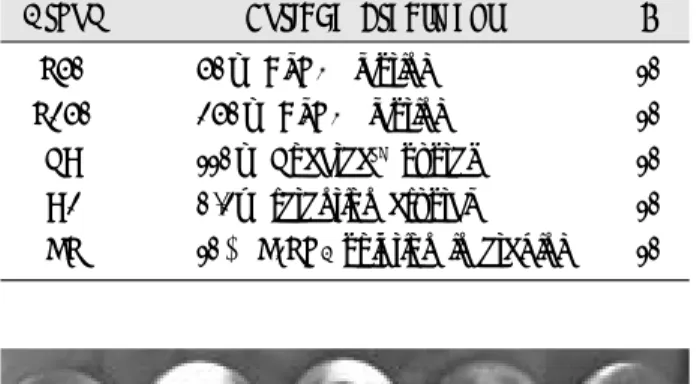
금속 표면 처리방법에 관한 내용은 Table 1, Fig. 1과 같다.
⑵ 레진 전장 (Sinfony[3M ESPE])
2세대 강화형 복합레진으로 제조사의 추천방식에 따라 적용 하였다. 각 시편에 ESPE-Sil을 바르고 5초간 건조 시킨 후 opaque resin을 혼합하여 도포 후 Visio Alfa 중 합기로 5초 사이클로 2번 광중합한 후 body resin을 직 경 6㎜, 두께 4㎜로 적용한 후 Visio Beta Vario 중합기 에서 1분간 빛에 노출시키고 14분간 진공상태에서 광중합 을 하였다.
1) 전단결합강도 측정
완성된 시편을 37℃의 증류수하에서 24시간 저장 후 만 능시험기(Universal Testing Machine Model 8871;
Instron, USA)에 전단장치를 부착하여 cross head speed 1㎜/min로 전단결합강도를 측정하였다.
2) 통계분석
결합강도 값의 다양성에 대하여 SPSS Ver. 14.0 for Win(SPSS Inc., Chicago, IL. USA)을 이용하여 일원배 치분석(One way ANOVA analysis)을 시행하였다. 각 군 의 유의성 검증을 위하여 TukeyHSD를 이용하여 95% 유 의수준에서 검증하였다.
S50 S250
RC C2 HS
50㎛ Al 2 O 3 blasting 250㎛ Al 2 O 3 blasting 110㎛ Rocatec
TMsystem 0.2㎜ retention crystal
10% H 2 SO 4 solution in etching Table 1. Classification of experimental group
Group Surface Treatment N
10 10 10 10 10
S50 S250 RC C2 HS
Fig. 1. Metal specimens with applied treatments
3) 미세구조 및 EDS 분석
전단응력에 의해 파절된 시편을 주사현미경(JSM- 6480LV, JELO, Japan)을 사용하여 10㎸로 13배 확대하 여 파절양상을 관찰하고 EDS(Energy dispersive X-ray spectroscopy)를 이용하여 파절면의 성분을 분석하였다.
Ⅲ. 실험 결과 및 고찰
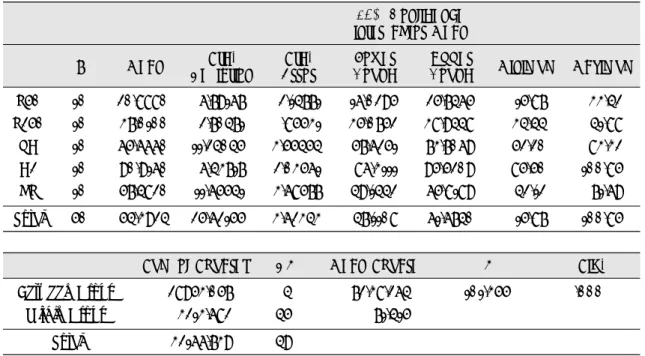
표면 처리된 시편에 Sinfony 간접복합레진을 적용한 금 속-간접복합레진 수복물의 전단결합강도 분석결과를 Table 2와 Figure 2에 나타내었다.
Sinfony 간접복합레진과 금속간의 전단결합강도 분석 결과, 0.2㎜ retention crystal을 사용하여 표면 처리한 C2군이 90.916㎫로 가장 높게 나타났으며, 110㎛
Rocatec
TMsystem에 의해 표면 처리한 RC군(65.666㎫), 10%의 H2SO4 용액에서 5분간 산 처리한 HS군 (57.482 MPa), 250㎛ 산화알루미늄으로 샌드블라스팅 처리한 S250군(37.01㎫), 50㎛ 산화알루미늄으로 샌드블라스팅 처리한 S50군(20.89㎫) 순으로 나타났다.
각 군 간의 통계학적 유의차를 살펴보기 위한 Tucky HSD teat 결과, 0.2㎜ retention crystal을 사용하여 표 면 처리한 C2군이 90.916㎫로 가장 높게 나타났으며 (p<0.05), 산화알루미늄을 이용한 샌드블라스팅 처리법에 서는 250㎛ 산화알루미늄으로 샌드블라스팅 처리한 S250군(37.01㎫)이 50㎛ 산화알루미늄으로 샌드블라스 팅 처리한 S50군(20.89㎫)보다 높게 나타났다(p<0.05).
그리고 110㎛ Rocatec
TMsystem에 의해 표면 처리한 RC 군(65.666㎫)은 250㎛ 산화알루미늄으로 샌드블라스팅 처리한 S250군(37.01㎫)과 50㎛ 산화알루미늄으로 샌드 블라스팅 처리한 S50군(20.89㎫)보다 높게 나타났고 (p<0.05), 10%의 H2SO4 용액에서 5분간 산 처리한 HS 군(57.482㎫)은 250㎛ 산화알루미늄으로 샌드블라스팅 처리한 S250군(37.01㎫)과 50㎛ 산화알루미늄으로 샌드 블라스팅 처리한 S50군(20.89㎫)보다 높게 나타났으며 (p<0.05), 110㎛ Rocatec
TMsystem에 의해 표면 처리한 RC군(65.666㎫)은 10%의 H 2 SO 4 용액에서 5분간 산 처 리한 HS군(57.482㎫) 보다 높게 나타났으나, 통계학적 유의차는 없었다.
기계적 유지방법인 유지구슬에 관한 연구로 Shue 등 (1987)은 Dentacolor의 경우 유지구슬의 크기가 작은 경
S50 S250
RC C2 HS
Between Group Within Group
Total
28953.057 3213.682 32166.739
4 45 49
72.38.264 71.415
101.355 .000
10 10 10 10 10
20.8880 37.0100 65.6660 90.9160 57.4820
6.79167 2.70471 11.24045 6.43717 11.65541
2.14771 .85531 3.55454 2.03561 3.68577
16.0295 35.0752 57.6251 86.3111 49.1442
25.7465 38.9448 73.7069 95.5209 65.8189
15.87 34.44 52.20 85.50 42.12
33.42 41.88 83.32 100.85 71.69 Total 50 54.3924 25.62155 3.62343 47.1108 61.6740 15.87 100.85
Table 2. Shear bond strength of Sinfony composite resin bonded to non-precious metal, as analyzed by one way ANOVA
Maximum Minimum
Upper Bound Lower
Bound Std.
Error Std.
Deviation Mean
N
Sum of Squares DF Mean Square F Sig.
95% Confidence interval for Mean
S50; 50㎛ Al2O3blasting, S250; 250㎛ Al2O3blasting RC; 110㎛ RocatecTMsystem, C2; 0.2㎜ retention crystal, HS; 10%
H2SO4solution in etching
우에 인장결합강도가 높게 나타났다고 보고하였으며, Jones 등(1991)은 유지구슬에 의한 유지력이 화학적인 결 합방식보다 높다고 보고하였는데, 본 연구에서도 0.2㎜
retention crystal을 사용하여 표면 처리한 C2군이 가장 높게 나타났으며, 다른 처리 군과 통계학적으로 유의한 차이를 나타냈다(p<0.05). 그러나 유지구슬을 이용한 방 법은 구강 내 온도변화로 미세누출과 변색가능성이 있고 유지구슬의 두께에 의한 치아 순면을 추가적으로 삭제하 여야 하는 단점을 지적할 수 있다.
샌드블라스팅에 관한 연구로 Mukai 등(1995)은 샌드블 라스팅이 금속의 표면에 미세한 요철부위를 형성하여 레진 의 접촉면적을 증가시키고 표면흐름성을 향상시키며, 동시 에 금속의 표면을 순간적으로 용해시켜 금속산화물을 형성 함으로써 화학적 결합에도 관여한다고 하였다. 하지만 샌 드블라스팅 시 산화알루미늄의 입자크기가 결합력에 미치 는 영향에 관한 보고는 상이하다. William과 Wiltshire (1986)에 의하면 110㎛나 250㎛로 분사한 경우의 결합력이 50㎛로 처리한 경우보다 더 높은 결합강도를 보인다고 보 고하였으나, 최와 방(1994)은 Ni-Cr 합금에서 입자크기가 결합력에 영향을 미치지 못한다고 하였으며, Peutzfeldt와 Asmussen(1988)은 Co-Cr 합금에서 산화알루미늄의 입자 크기가 결합력에 영향을 미치지 못한다고 보고하였다. 그 러나 본 연구에서는 250㎛ 산화알루미늄으로 샌드블라스 팅 처리한 S250군이 50㎛ 산화알루미늄으로 샌드블라스
팅 처리한 S50군보다 높게 나타났으며, 통계학적 으로 유의한 차이를 나타냈다(p<0.05).
파절양상은 파절의 부위가 레진과 합금의 계면 에서 발생되는 접착성 파절과 레진의 내부에서 발생되는 응집성 파절 및 복합파절로 분류할 수 있으며, 파절이 레진과 합금의 계면에서 발생하 는 지 레진 내부에서 일어나는 지를 평가함으로 써 결합실패를 분석할 수 있는 방법이다.
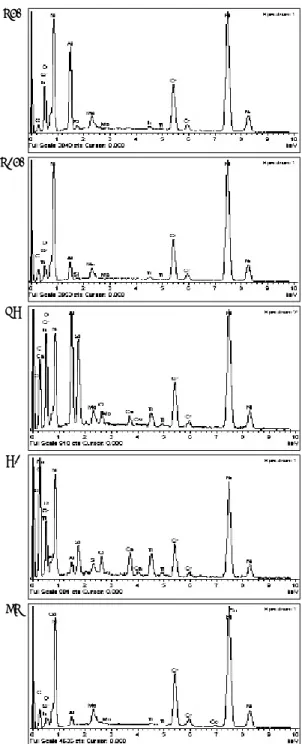
표면 처리된 시편에 Sinfony 간접복합레진을 적용한 금속-간접복합레진 수복물들을 전단응력 에 의해 파절시킨 후 파절양상을 알아보기 위해 금속-간접복합레진의 파단면을 SEM과 EDS를 통해 분석한 결과를 Fig. 3, 4에 나타내었다.
SEM과 EDS 분석결과, 0.2㎜ retention crystal을 사 용하여 표면 처리한 C2군과 110㎛ Rocatec
TMsystem에 의해 표면 처리한 RC군은 레진 내의 파절선이 adhesive -opaque-body resin 층을 지나는 응집성 파절이 관찰 되었고, 샌드블라스팅 처리한 S50군과 S250군, 그리고 10%의 H 2 SO 4 용액에서 5분간 산 처리한 HS군에서는 adhesive-opaque resin 층을 지나거나 opaque층 내에 서 파절이 일어나는 복합파절이 관찰되었다. EDS를 통해 파절면의 성분 분석 결과, 탄소(C)의 중량비가 0.2㎜
retention crystal을 사용하여 표면 처리한 C2군에서 40.53wt%로 가장 높게 나타났으며, 110㎛ Rocatec™
system에 의해 표면 처리한 RC군(28.82 wt%), 10%의 H2SO4 용액에서 5분간 산 처리한 HS군 (16.93 wt%), 250㎛ 산화알루미늄으로 샌드블라스팅 처리한 S250군 (13.62wt%), 50㎛ 산화알루미늄으로 샌드블라스팅 처리 한 S50군(7.73wt%) 순으로 나타나, SEM과 EDS의 결과 가 일치하는 것으로 나타났다.
본 연구결과 110㎛ Rocatec
TMsystem과 250㎛ 산화알 루미늄으로 샌드블라스팅 처리한 방법과 10%의 H 2 SO 4 용액에서 5분간 산 처리방법만으로는 0.2㎜ retention crystal 처리법의 결합강도를 재현할 수 없기 때문에 기 계적 처리법과 화학적 처리법의 병용을 통한 해결방안을 모색해야 한다고 생각한다.
Fig. 2. Shear bond strengths between Sinfony composite resin and Rexillium
�Ⅲ after various surface treatments(민병록, 2008).
S50; 50㎛ Al
2O
3blasting, S250; 250㎛ Al
2O
3blasting RC; 110
㎛ Rocatec™system, C2; 0.2㎜ retention crystal, HS; 10%
H
2SO
4solution in etching
Ⅳ. 결 론
본 연구는 금속면의 표면처리방법에 의해 형성된 유지 의 형상이 Sinfony 간접복합레진과 비귀금속합금간의 결 합강도에 미치는 영향을 알아보고자 하였다.
비귀금속합금은 Rexillium
�Ⅲ를 사용하였으며, 시편을
유지형상에 따라 50㎛ sandblasting군, 250㎛
sandblasting군, 0.2㎜ retention crystal군, 10%
H 2 SO 4 solution etching군, 110㎛ RocatecTM Plus system 군으로 분류하고 Sinfony로 전장하여 총 50개의 금속-간접복합레진 시편을 제작하였다. 만능시험기를 이 용하여 전단결합강도를 측정하였고, 파절양상을 분석하
S250 S250
RC RC
C2 C2
HS HS
Fig. 3. SEM photomicrograph of debonded surface after shear bond test
Fig. 4. EDS analysis of debonded surface after shear bond test