서 론
틱장애는 갑자기 반복적이고 불수의적인 불규칙한 상동적 근육운동이나 음성이 특징적으로 나타나는 소아기 신경질환 이다.1) 초기에는 단일 혹은 다양한 운동 틱이나 음성 틱으로 나타나는데 대체로 1년 이내에 자연적으로 사라지지만 1년 이 상 근육 틱과 음성 틱이 지속적으로 나타나면 뚜렛장애로 진 행할 수 있다. 뚜렛장애는 만성적인 예후를 나타내며 치료 받 지 않을 경우에는 평생 동안 지속되기도 한다.2)
외국 연구에서 틱장애의 유병률은 6-12% 정도로 보고되고 있으며,3,4) 뚜렛장애는 0.3-1%로 보고되고 있으나5) 우리나라 의 경우는 아직 유병률에 대한 구체적인 역학연구 자료가 없 다. 틱장애는 발병연령이 5-7세경으로 대개 학습이 처음 이루
어지는 시기에 호발하며, 오랜 역사에도 불구하고 의외로 그 근본적인 원인에 대해서는 잘 알려지지 않았다. 최근에 틱장 애와 관계된 뇌의 병리적 기전은 감각운동 대뇌피질-선조체- 시상-피질 회로 등의 신경회로 이상이 제시된 바 있다.6,7)
틱장애 혹은 뚜렛장애의 약물치료는 1960년대부터 시작되 었다.8) 틱장애 혹은 뚜렛장애에서 향정신성 약물의 사용은 오랜 역사에도 불구하고 임상연구는 매우 적은 편이었다. 그 러한 이유로는 향정신성 약물이 진정감, 추체외로 부작용 등 의 부작용으로 인해서 투여시에 환자의 순응도가 좋은 편이 아니었으며 다른 소아정신과 질환에 비해서 향정신성 약물의 치료효과에 대한 효능이 우수하지 않았고 또한 틱 증상의 예 후 평가도구에 대한 표준화가 아직까지 이루어지지 않았기 때문이기도 하다. 이러한 이유로 틱장애의 임상치료에서는 일 차적으로 비약물치료가 선호되고 있다.9)
그간 이루어진 연구결과를 토대로 최근 2011년에 유럽에서 는 European Society for the Study of Tourette’s Syndrome 이 뚜렛 증후군 및 다른 틱장애의 비약물치료에 대한 임상 지 침을 보고하였다.9,10) 또한 미국에서는 최근 치료지침이 보고 되지 않았지만 2012년에 북미 캐나다11)에서는 틱장애의 비약
틱장애 혹은 뚜렛장애의 비약물치료
임명호1)2)・이영림2)・김붕년3)
단국대학교 의과대학 정신건강의학교실,1) 단국대학교 공공인재대학 심리학교실,2)
서울대학교 의과대학 정신건강의학교실3)
Non-Psychopharmacologic Therapy of Tic or Tourette’s Disorder
Myung Ho Lim, M.D., Ph.D.
1)2), Young Lim Lee, Ph.D.
2), and Bung-Nyun Kim, M.D., Ph.D.
3)1)
Department of Psychiatry, College of Medicine, Dankook University, Cheonan, Korea
2)
Department of Psychology, College of Public Service, Dankook University, Cheonan, Korea
3)
Department of Psychiatry, College of Medicine, Seoul National University, Seoul, Korea
Tic disorder is a childhood neuropsychological disorder characterized by abrupt, involuntary, and repetitive stereotyped mus- cle movement or vocal sound. Tourette’s disorder shows a chronic prognosis, and can last for life if no treatment is applied. Al- though tic disorder has been known for ages, the underlying cause is still not well known. Non-pharmacological treatments have long been used for the tic disorder, but few clinical studies were conducted. However, the European Society for the Study of To- urette’s Syndrome recently issued non-pharmacologic guidelines for treatment of tic disorders based on the research findings ob- tained so far. In addition, guidelines for non-pharmacologic evidence-based treatment were reported in Canada, North America.
By synthesizing the newly reported foreign guidelines for treatment and review articles, the aim of this study is to investigate the non-pharmacologic therapies used for treatment of tic disorder or Tourette’s disorder.
KEY WORDS : Tic DisorderㆍTourette’s DisorderㆍNon-Pharmacologic Therapy.
접수완료:2014년 1월 21일 / 수정완료:2014년 3월 9일 심사완료:2014년 3월 12일
Address for correspondence:Myung Ho Lim, M.D., Ph.D., Department of Psychia- try, College of Medicine, Dankook University, 119 Dandae-ro, Dongnam-gu, Cheonan 330-714, Korea
Tel : +82.41-550-3945, Fax : +82.41-561-3007 E-mail : [email protected]
http://dx.doi.org/10.5765/jkacap.2014.25.2.53
J Korean Acad Child Adolesc Psychiatry 2014;25(2):53-64
물치료에 대해서 근거에 기초한 치료지침(Guideline for the evidence-based treatment)을 보고하였다.
그동안 틱장애 혹은 뚜렛장애에 사용되는 비정신과적 치 료요법으로는 여러 가지 인지행동치료, 심리교육과 집단치료, 그리고 심부뇌자극과 반복적 뇌자기자극 등이 주로 보고되었 다. 본 연구에서는 최근에 보고된 외국의 치료지침 및 종설 논문들을 종합하여 틱장애 혹은 뚜렛장애에서 사용되는 비 약물치료에 대해서 알아보고자 한다.
인지행동치료(Cognitive Behavior Therapy)
1. 행동치료적 개입(Table 1)
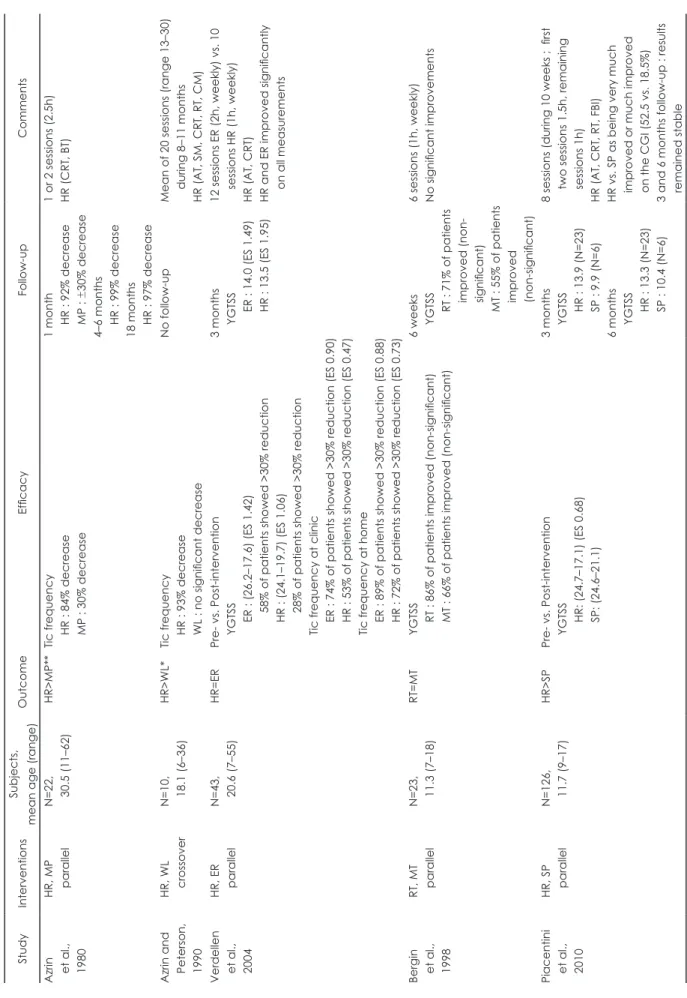
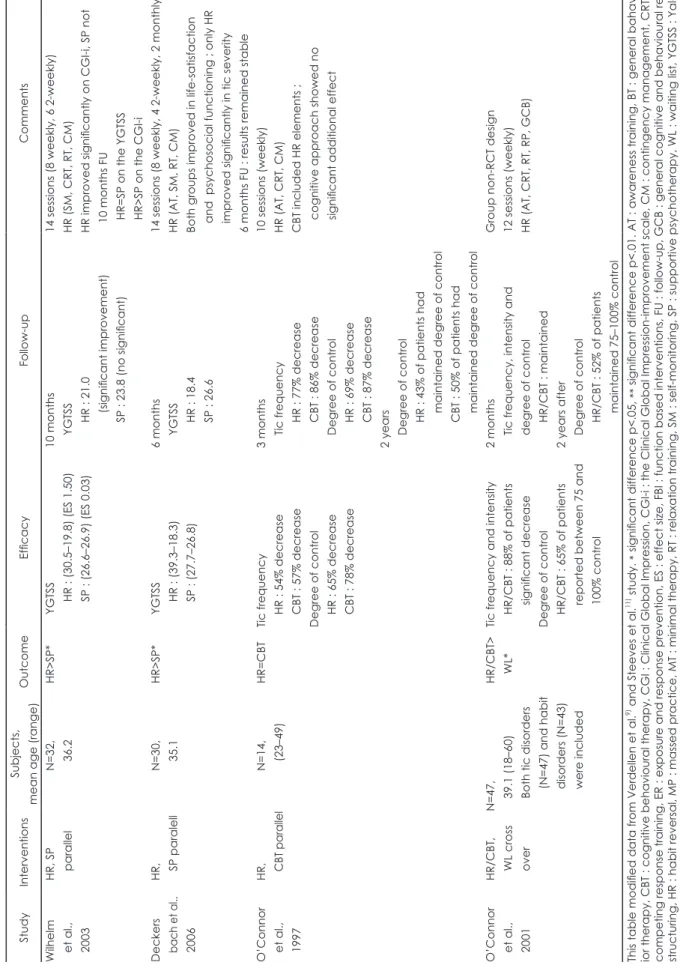
행동치료는 심리치료 중에서 그동안 가장 활발하게 연구된 치료방법이다. 틱 증상 치료를 위한 행동치료는 지금까지 8개 정도의 방법이 보고되었는데 집중실행(massed practice), 습관 치환(habit reversal), 자기관찰(self-monitoring), 연관사건 조 절(contingency management)/기능기반 개입(function based intervention), 이완훈련(relaxation training), 노출과 반응억 제(exposure and response prevention), 인지 기법을 포함한 행동치료, 그리고 바이오피드백 혹은 뉴로피드백 등이다.9,11) 대부분의 연구가 증례 및 비조절연구였으며 6개의 무작위 조 절연구가 있었는데 이 중에서 4개의 연구가 아동 및 성인이 모두 포함된 연구였고 2개의 연구에서만 소아청소년을 대상 으로 한 연구였다. 북미 임상지침에서는 틱장애의 행동치료에 서 습관치환법은 ‘적극적 추천, 높은 기준의 근거’, 노출과 반 응억제는 ‘적극 추천, 낮은 기준의 근거’로 규정하고 있다.11)
1) 집중실행(Massed practice)
집중실행은 틱 증상의 치료에 대한 가장 오래된 방법이다.
1회에 1분 이상 지속적이고 반복적으로 의도적인 틱을 실행하 고 잠시의 휴식 시간을 갖고 다시 반복하여 총 30분 정도 시 행한다.9) 이러한 틱의 집중실행은 증상의 억제효과 혹은 피로 를 유발할 수 있을 것이다. 그렇지만 집중실행에 대한 증례연 구들의 결과는 초기에 성공적인 증례보고가 있었지만 이후 대부분의 보고에서 효과가 없는 것으로 나타났다.12-14)
습관치환법과 비교했던 하나의 무작위 조절연구에서 집중 실행은 틱 증상의 17% 감소를 나타내어 대조군에 비해 유의 한 차이를 나타내지 못했으며 상대적으로 습관치환은 80%
감소를 나타내어 대조군에 비해서 유의한 효과를 나타내었 다.12) 현재까지 연구결과로서 종합해보면 집중실행 방법은 틱 증상의 치료방법으로는 제한적인 것으로 보인다.15)
2) 습관치환(Habit reversal)
습관치환은 틱 증상의 치료에 가장 많이 연구된 행동치료 방법으로 Azrin과 Nunn16)에 의해 처음으로 시행되었다. 이 는 틱 증상의 인지, 경쟁반응훈련, 그리고 사회적 지지 요소 로 이루어져 있다.17,18) 또한 습관치환은 이완훈련, 연관사건 조 절, 일반화 훈련 등이 추가되기도 한다. 틱 증상의 인지과정은 틱 증상을 자각(awareness)하기, 틱을 정의하기, 선행감각 행 동을 기술하기, 선행감각과 틱 발생을 알아차리고 표현하기 등으로 이루어진다. 경쟁반응훈련은 환자가 틱을 수행하기 전 에 1-3분 정도 시행하거나 또는 전조 욕구가 없어질 때까지 시행한다. 경쟁반응훈련은 틱 증상에 신체적으로 양립할 수 없는 행동을 선택하여 의도적으로 연계한다. 그리하여 적어 도 1분 이상 전조충동이 사라질 때까지 자연스럽게 경쟁반응 훈련을 시행하도록 한다.19) 이십여 개의 비조절연구에서 습관 치환은 30-100%의 틱 증상 감소를 나타내었으나 대부분의 연구에서 소수를 대상으로 하였고 명확하지 않은 진단기준을 사용하였다.10) 그간 시행된 8개의 무작위 조절연구에서 습관 치환은 틱장애에 대한 임상효과를 나타내었는데 4개의 연구 는 18-60세를 대상으로 한 성인 연구였고20-23) 9-17세의 126 명을 대상으로 한 하나의 연구,24) 그리고 6-62세를 대상으로 한 3개의 연구25)였다. 대부분의 연구는 10-14주 회기로 대개 1주에 1회씩이었으며 간혹 1개월에 1-2번 시행하기도 하였다.
추후연구에서 습관치환법은 10개월 이후에도 효과가 유지되 었다. 여러 종설연구에서 습관치환법의 임상효과를 지지하였
다.26-31) 대표적인 연구는 Piacentini 등24)이 126명의 뚜렛 증
후군/만성 틱장애를 대상으로 습관치환법과 지지정신치료를 비교한 연구이다. 이 연구에서 대상군은 9세에서 17세까지의 아동청소년이었으며 평균 연령은 11.7세였다. 매주 1회씩 10주 동안에 각각 8번의 회기가 있었으며 3개월 후에 추가회기가 있었다. 첫 회기는 90분간이었고 그 외의 회기는 각각 60분씩 이었다. 습관치환법은 인식훈련, 경쟁반응훈련, 이완훈련, 기 능기반 개입으로 이루어졌으며 지지정신치료는 지지적 정신 치료와 교육으로 이루어졌다. 기준일과 치료 후에 시행한 Yale Global Tic Severity Scale상의 점수는 습관치환법은 24.7에 서 17.7점으로, 지지정신치료는 24.6점에서 21.1점으로 감소하 였으며 양 군 간에 유의한 차이가 있었다. 임상전반인상 개선 척도(the Clinical Global Impression-Improvement scale) 평 가에서도 습관치환법은 52.5% 감소하였고 지지정신치료는 18.5% 감소하여 양 군 간에 유의한 차이가 나타났다. 이 연구 에서 습관치환법은 각각 3개월과 6개월에 시행한 평가에서도 치료효과가 유지되었다.
국내에서도 10명의 틱장애 아동을 대상으로 한 연구에서 습관치환과 호흡훈련을 시행하여 증상개선을 나타내었던 연
Tabel 1.
Behavioural interventions for tics or Tourette’s disorders Study Interventions Subjects, mean age (range) Outcome Efficacy Follow-up Comments Azrin et al., 1980
HR, MP parallel N=22, 30.5 (11–62) HR>MP** Tic frequency HR : 84% decrease MP : 30% decrease
1 month HR : 92% decrease MP : ± 30% decrease 4–6 months HR : 99% decrease 18 months HR : 97% decrease
1 or 2 sessions (2.5h) HR (CRT, BT) Azrin and Peterson, 1990
HR, WL crossover N=10, 18.1 (6–36) HR>WL* Tic frequency HR : 93% decrease WL : no significant decrease
No follow-up Mean of 20 sessions (range 13–30) during 8–11 months HR (AT, SM, CRT, RT, CM) Verdellen et al., 2004
HR, ER parallel N=43, 20.6 (7–55) HR=ER Pre- vs. Post-intervention YGTSS ER : (26.2–17.6) (ES 1.42) 58% of patients showed >30% reduction HR : (24.1–19.7) (ES 1.06) 28% of patients showed >30% reduction Tic frequency at clinic ER : 74% of patients showed >30% reduction (ES 0.90) HR : 53% of patients showed >30% reduction (ES 0.47) Tic frequency at home ER : 89% of patients showed >30% reduction (ES 0.88) HR : 72% of patients showed >30% reduction (ES 0.73)
3 months YGTSS ER : 14.0 (ES 1.49) HR : 13.5 (ES 1.95)
12 sessions ER (2h, weekly) vs. 10 sessions HR (1h, weekly) HR (AT, CRT) HR and ER improved significantly on all measurements Bergin et al., 1998
RT, MT parallel N=23, 11.3 (7–18) RT=MT YGTSS RT : 86% of patients improved (non-significant) MT : 66% of patients improved (non-significant)
6 weeks YGTSS RT : 71% of patients improved (non- significant) MT : 55% of patients improved (non-significant)
6 sessions (1h, weekly) No significant improvements Piacentini et al., 2010
HR, SP parallel N=126, 11.7 (9–17) HR>SP Pre- vs. Post-intervention YGTSS HR: (24.7–17.1) (ES 0.68) SP: (24.6–21.1)
3 months YGTSS HR : 13.9 (N=23) SP : 9.9 (N=6) 6 months YGTSS HR : 13.3 (N=23) SP : 10.4 (N=6)
8 sessions (during 10 weeks ; first two sessions 1.5h, remaining sessions 1h) HR (AT, CRT, RT, FBI) HR vs. SP as being very much improved or much improved on the CGI (52.5 vs. 18.5%) 3 and 6 months follow-up : results remained stable
Tabel 1.
Continued Study Interventions Subjects, mean age (range) Outcome Efficacy Follow-up Comments Wilhelm et al., 2003
HR, SP parallel N=32, 36.2 HR>SP* YGTSS HR : (30.5 –19.8) (ES 1.50) SP : (26.6 –26.9) (ES 0.03)
10 months YGTSS HR : 21.0 (significant improvement) SP : 23.8 (no significant)
14 sessions (8 weekly, 6 2-weekly) HR (SM, CRT, RT, CM) HR improved significantly on CGI-i, SP not 10 months FU HR=SP on the YGTSS HR>SP on the CGI-i Deckers
bach et al.,2006
HR, SP paralell N=30, 35.1 HR>SP* YGTSS HR : (39.3 –18.3) SP : (27.7 –26.8)
6 months YGTSS HR : 18.4 SP : 26.6
14 sessions (8 weekly, 4 2-weekly, 2 monthly) HR (AT, SM, RT, CM) Both groups improved in life-satisfaction and psychosocial functioning ; only HR improved significantly in tic severity 6 months FU : results remained stable O’Connor et al., 1997
HR, C BT pa ralle l N=14, (23 –49) HR=CBT Tic frequency HR : 54% decrease CBT : 57% decrease Degree of control HR : 65% decrease CBT : 78% decrease
3 months Tic frequency HR : 77% decrease CBT : 86% decrease Degree of control HR : 69% decrease CBT : 87% decrease 2 years Degree of control HR : 43% of patients had maintained degree of control CBT : 50% of patients had maintained degree of control
10 sessions (weekly) HR (AT, CRT, CM) CBT included HR elements ; cognitive approach showed no significant additional effect O’Connor et al., 2001
HR/CBT, WL cross over
N=47, 39.1 (18 –60) Both tic disorders (N=47) and habit disorders (N=43) were included
HR/CBT> WL* Tic frequency and intensity HR/CBT : 88% of patients significant decrease Degree of control HR/CBT : 65% of patients reported between 75 and 100% control
2 months Tic frequency, intensity and degree of control HR/CBT : maintained 2 years after Degree of control HR/CBT : 52% of patients maintained 75 –100% control
Group non-RCT design 12 sessions (weekly) HR (AT, CRT, RT, RP, GCB) This table modified data from Verdellen et al.
9)and Steeves et al.
11)study. * significant difference p<.05, ** significant difference p<.01. AT : awareness training, BT : general bahav - ior therapy, CBT : cognitive behavioural therapy, CGI : Clinical Global Impression, CGI-i : the Clinical Global Impression-improvement scale, CM : contingency management, CRT : competing response training, ER : exposure and response prevention, ES : effect size, FBI : function based interventions, FU : follow-up, GCB : general cognitive and behavioural re - structuring, HR : habit reversal, MP : massed practice, MT : minimal therapy, RT : relaxation training, SM : self-monitoring, SP : supportive psychotherapy, WL : waiting list, YGTSS : Yale Global Tic Severity Scale
구보고가 있었다.32) 습관치환법의 여러 가지 요소 중에서 인 지훈련과 경쟁반응 훈련이 틱 증상의 감소에 가장 강력한 것 으로 보인다.33)
과거에 틱 증상에 대한 잘못된 오해가 있었으나 최근에 과 학적인 연구로 실제로 그렇지 않음이 밝혀졌다. 첫째로 틱을 억제하는 것이 오히려 반발효과(rebound effect)처럼 틱을 증 가 시킬 수 있다는 오해였다.34,35) 한 연구에서 일반인들의 77%
에서 이러한 믿음을 갖고 있는 것으로 보고되었지만 실제 임 상연구에서는 이러한 믿음을 지지하지 않았다.36) 둘째로 하나 의 틱 억제가 다른 틱으로 환치(substitution)될 수 있다는 오해 였다. 그러나 후속연구에서 하나의 틱을 억제하는 것은 다른 틱을 유발하지 않으며 전체적인 틱증상의 완화를 나타내었다.
셋째로 틱을 억제하려는 주의집중이 다른 집중을 요하는 인지 활동의 수행을 지연시킬 것이라는 오해이다.37,38) 그러나 초기 의 유사한 보고와는 달리 후속연구에서는 이러한 결과 역시 지지되지 않고 있다.39)
3) 자기관찰(Self-monitoring)
자기관찰은 환자가 특정한 기간 동안 틱 증상을 기록하는 것이다. 이러한 관찰의 목적은 틱이 나타나는 상황을 알아내 는 것이다. 자기관찰은 대체로 습관치환법을 포함한 여러 가 지 치료 패키지에 포함되어 시행된다. 매우 적은 사례에서 자 기관찰법은 일차치료법으로 시행되었는데 일시적인 틱 증상의 호전을 보고한 바 있다.40) 자기관찰은 지연된 기록보다는 즉 시 기록하는 것이 증상의 개선에 효과적이었다.41,42) 틱 증상에 대한 자기관찰의 효과연구에서는 무작위 조절연구가 시행된 적이 없었으며 틱 증상에 효과적이라는 임상적인 근거도 제시 된 바 없다.25) 비록 틱 증상에 대한 전반적인 치료 효과 혹은 효과를 얻기 위한 치료기간에 대한 근거는 분명하지 않지만 틱 증상의 개선에 어느 정도 유용성이 있을 것으로 보인다.9)
4) 연관사건 조절(Contingency management)/기능기반 개입 (Function based intervention)
연관사건 조절은 환경적인 연관사건을 조절하는 것이다. 즉 틱 증상이 나타나지 않을 때에는 긍정적으로 강화하고 틱 증 상이 나타날 때에는 무시한다. 필요하면 틱 증상이 나타나지 않을 때에 토큰(token)을 사용하기도 하며 반면에 틱이 나타 날 때에 벌로써 타임아웃을 사용하기도 한다.43,44) 대체로 연 관사건 조절은 여러 가지 치료 패키지에 포함되어 사용되기 때문에 단독의 치료효과를 평가하기 어렵다.
기능기반 개입은 좀 더 특정화된 연관사건 조절방법이다.
기능기반 개입은 틱 증상을 감소시키기 위한 개개인의 고유한 환경에 맞추어 특정화되어 있으며 증상을 감소시키기 위해서
이러한 요인들을 조절한다. 기능기반 개입의 임상효과에 대한 일 증례 연구가 보고된 바 있다.45)
5) 이완훈련(Relaxation training)
이완훈련이 사용되는 근거는 스트레스와 불안이 증가할 때 에 틱 증상이 증가한다는 관찰에 기인한다. 이완훈련은 근육 을 이완시키고 스트레스를 감소시킴으로써 간접적으로 틱 증 상의 감소를 유도한다. 이완훈련은 심호흡, 점진적 근육훈련, 상상기법으로 이루어져 있다. 이완훈련의 단독 효과를 보고 한 2개의 조절된 연구가 있었다. Peterson과 Azrin40)은 이완훈 련을 시행 후에 틱 증상이 32%(6명) 감소하였다고 하였으며, 함께 시행한 경쟁반응 훈련에서는 55%, 그리고 자기관찰에서 는 45% 감소하였다고 보고하였다. Bergin 등46)은 7-18세의 아동을 대상으로 한 무작위 조절연구에서 이완훈련과 최소한 의 조절치료(minimal therapy)를 비교하였는데 6주간의 수행 에서 양 군 간에 유의한 차이를 나타내지 않았다고 보고하였 다. 이 연구에서 틱 증상의 개선효과는 일시적이었다. 최근에 는 수면과 단서 조절 이완훈련 등의 특정한 방법이 이용되기도
한다.47,48) 이완훈련은 단기간의 개선에는 효과가 있을 것으로
생각되지만, 아직 근거기반에 충족되는 치료방법은 아니다.9)
6) 노출과 반응억제(Exposure and response prevention) 노출과 반응억제는 강박증에서 가장 많이 사용되는 행동 치료 방법으로 임상적으로는 틱장애에서 강박장애가 많이 동 반되고 틱 증상과 강박행동(compulsion) 증상이 매우 유사 하다는 점에서 이러한 방법이 시행되기 시작하였다.24,49,50) 실제 로 틱장애의 전조감각(premonitory sensation)은 강박장애의 강박 사고(obssesion), 그리고 틱 증상은 강박 행동(compu- sion)과 유사하다. 노출과 반응억제는 불쾌한 전조감각 이후 에 틱 증상이 나타나는 것에 기초하여 전조감각을 감소시킴으 로써 틱 증상을 감소하려는 방법이다.51) 학습이론에 따르면 틱 증상은 전조감각이라는 자극에 대한 조건화 반응이다. 계 속해서 틱이 나타나면서 전조감각과 후속물인 틱 증상은 더 욱 강화된다. 노출과 반응억제의 목적은 이러한 연관성을 차 단하여 틱을 예방하는 것이다. 노출과 반응억제는 환자로 하 여금 지속적인 시간 동안 불쾌한 전조감각에 대면하도록 하 면서(노출), 틱에 저항하도록 한다(반응억제). 그리하여 환자 가 불쾌한 감각을 참을 수 있도록 한다(습관화). 습관화는 틱 을 진행하려는 욕구를 약화시켜서 결과적으로 틱을 감소시킬 수 있다. 습관치환법과 달리 노출과 반응억제는 대체행동을 제공받지 않는다. Verdellen 등25)은 7-55세의 틱장애를 대상 으로 한 무작위 조절연구에서 2시간씩 12회기의 노출과 반응 억제를 시행하고, 한편으로는 1시간씩 10-12회기의 습관치환
법을 시행한 결과를 비교하였다. 결과적으로 양 군 간에 유의 한 차이는 나타나지 않았으나 노출과 반응억제가 습관치환법 에 비해서 상대적으로 effect size가 큰 것으로 나타났으나 연 구방법상 노출과 반응억제가 습관치환법에 비해 2배 정도의 시간을 투여한 것이어서 대등한 조건으로 보기 어렵다는 비 판이 있었다. 그 외에 무작위 조절연구로 노출과 반응억제의 임상효과를 보고한 소수의 연구가 있었다.52) 이러한 치료결과 를 근거로 Tourette Syndrome Association 치료지침 및 몇몇 종설연구에서 틱장애의 초기치료방법으로 노출과 반응억제 를 추천하고 있다.9,11) 일부에서는 틱장애에서 강박증을 동반 한 경우에는 주로 정신 전조 충동(mental premonitory urge) 으로 노출과 반응억제를 추천하고 순수한 형태의 틱장애에는 주로 감각 전조 충동(sensory premonitory urge)으로 습관치 환을 추천한다.53) 노출과 반응억제는 음성 틱과 운동 틱에 모 두 효과적이고, 성인과 아동에서, 그리고 틱의 빈도와 강도 모 두에서 효과가 있으며 틱 증상의 억제 후에 나타날 수 있는 반동효과도 없는 것으로 보인다.54) 어린 아동들은 전조 감각 운동 현상을 알아채지 못할 수 있다. 습관치환법처럼 노출과 반응억제도 치료의 적응증에 연령의 제한이 필요하며 참고로 습관치환법은 10세 이상의 아동에게 추천하고 있다.55)
7) 인지 기법을 포함한 행동치료
성인을 포함한 2개의 연구가 있었다. 인지적 기법은 틱을 유 발하는 고위험 상황에서 환자의 잘못된 기대와 행동을 평가 하며 이에 도전(challenging)하고 재구성(restructuring)하는 기법으로 구성되어 있다. 만성 틱장애를 대상으로 한 연구에 서 인지행동기법과 습관치환법을 비교하였는데 양 군 간에 유의한 차이가 없었다.22) 또 다른 연구에서는 인지행동기법과 습관치환법을 결합한 치료법이 만성 틱장애에서 대기자 대조 군에 비해서 유의한 임상개선효과를 나타내었다.23) 입 안에 침이 너무 많이 고이는 느낌이 들어서 자꾸 침을 뱉는 틱 증 상을 보이는 환자에게 잘못된 사고를 인지적으로 교정해서 틱 증상을 개선하였던 증례보고가 있었다.56) 인지기법 역시 독립적인 효과를 보고한 연구가 없으며 습관치환법과 같은 방법에 병합하여 사용되어 왔다. 틱장애의 치료에 인지기법이 부가적인 효과를 나타낸다는 연구보고는 아직 없었지만 우울 과 불안 증상이 동반된 틱장애에서 임상적인 개선효과를 나 타낼 것으로 보인다.9)
8) 바이오피드백 혹은 뉴로피드백(Biofeedback/neurofeed- back)
뉴로피드백은 뇌전기활성을 통한 자기주도적 조절법이다.57) 이는 조작적 조건이론에 근거하며 긍정적 보상 피드백에 의해
서 환자가 원하는 방향으로 뇌활성의 변화를 이끌어낸다. 두 명의 뚜렛장애에 대한 증례연구에서 1명에서만 긍정적인 결 과를 보였다.58,59) 15명의 뚜렛 환자를 대상으로 한 연구에서 이완 바이오피드백이 각성 바이오피드백에 비해 유의한 틱 증상의 감소를 나타내었다.60) 뉴로피드백은 최근에 주의력결 핍 과잉행동장애에 대한 무작위 조절연구에서 행동조절에 유 의한 개선효과를 보였는데, 틱장애에 대한 효과는 이보다 덜 하지만 틱장애와 주의력결핍 과잉행동장애가 동반된 경우에 서는 유의한 임상효과를 보고한 바 있었다.61,62) 틱장애의 바 이오피드백에 대한 무작위 조절연구가 아직 없기 때문에 효 과 검증을 위한 추후연구가 필요하다.
2. 심리사회적 개입(Psychosocial intervention)
최근의 종설보고에서 심리사회적 개입은 뚜렛장애의 치료 에 근거기반 치료법으로 타당성이 없다고 하였다.63) 부모, 교사, 친구와 같은 환경을 변화하여 틱 증상을 개선하고 생활의 질 을 개선하는 개입에 대한 근거연구는 매우 적다.39,64) 그러나 틱 장애에 대한 교육과 환자 및 그들의 가족에 지지와 안심을 주 는 이러한 방법은 다른 여러 치료법의 기초과정이 된다.65) 그러 므로 심리사회적 개입은 실험적 근거보다는 임상적 실제에서 틱장애의 치료지침에 추천되고 있다.
1) 심리교육(Psychoeducation)
심리교육은 틱장애에서 광범위하게 채택되어 환자 및 가족 에서 많은 영향을 준다. 특히 환자의 진단으로 인해서 환자 및 가족은 많은 어려움을 겪고 있으며 틱장애에 동반된 분노 폭발 혹은 과잉행동 등의 문제로 어려움을 겪는다.66) 심리교 육은 오해와 불확실성, 낙인 등을 해소하고 지지를 제공하는 주요한 요소이다.67) 틱장애의 자연경과에 대한 정보와 개인의 강점을 파악하는 것은 불안을 감소시키며 이러한 심리교육은 대응전략과 자기효능감을 개선시키고 다른 사람에게 자신의 질환에 대해서 설명할 수 있도록 돕는다. 틱장애의 원인, 양 상, 경과 등에 대한 일반적 정보를 제공함으로써 교실 내의 행 동을 조절하는 효과적인 개인 전략을 시행하고 학습을 증대 할 수 있다. 뚜렛장애의 양상은 빠르게 변하기 때문에 유연한 접근이 필요하며 부모와 가족은 긴밀하게 연계하여 자주 증 상을 평가하여야 한다.68)
‘틱을 가진 아동들은 질환이 없는 그들의 동료로부터 덜 환 영받는다’는 실험 연구결과가 있었다.69,70) 비디오테이프를 통 한 심리교육을 시행함으로써 동료의 인식이 좋아졌으며, 틱 교육 비디오를 본 청소년들은 그렇지 않았던 대조군에 비해 틱장애 아동에 대해서 좀 더 긍정적인 태도를 보였다는 보고 가 있었다.71,72) 그러나 좀 더 어린 아동을 대상으로 한 연구에
서는 심리교육 이후에 양 군 간에 차이가 나타나지 않았다고 하였다. 심리교육에 대한 임상효과는 아직 명확하지 않은 것 으로 보인다.
2) 집단치료(Group therapy)
집단치료는 아동과 부모들이 서로 지지적인 환경을 만날 수 있도록 제공한다. 집단치료는 심리교육 요소를 환아 및 보 호자에게 제공함으로써 틱 증상의 조절, 분노조절, 학교문제, 자존감의 개선 등에서 긍정적인 효과를 보이는 것으로 보고 되었다.73)
3) 지지단체(Support organizations)
틱장애를 가진 아동과 가족에 대한 단체의 역할은 매우 중 요하다.74) 미국에서는 Tourette Syndrome Association이라는 큰 단체가 틱장애에 대한 보호와 변론을 제공하고 있고 독일, 프랑스, 네덜란드 등에서는 European self-help 단체가 적극 적인 활동을 하고 있다. 한편 가족을 위한 지지단체도 중요한 데 전문가, 자선단체, 정부 간에 전체적인 접근이 도움이 될 수 있을 것이다.
심부뇌자극(Deep Brain Stimulation)(Table 2)
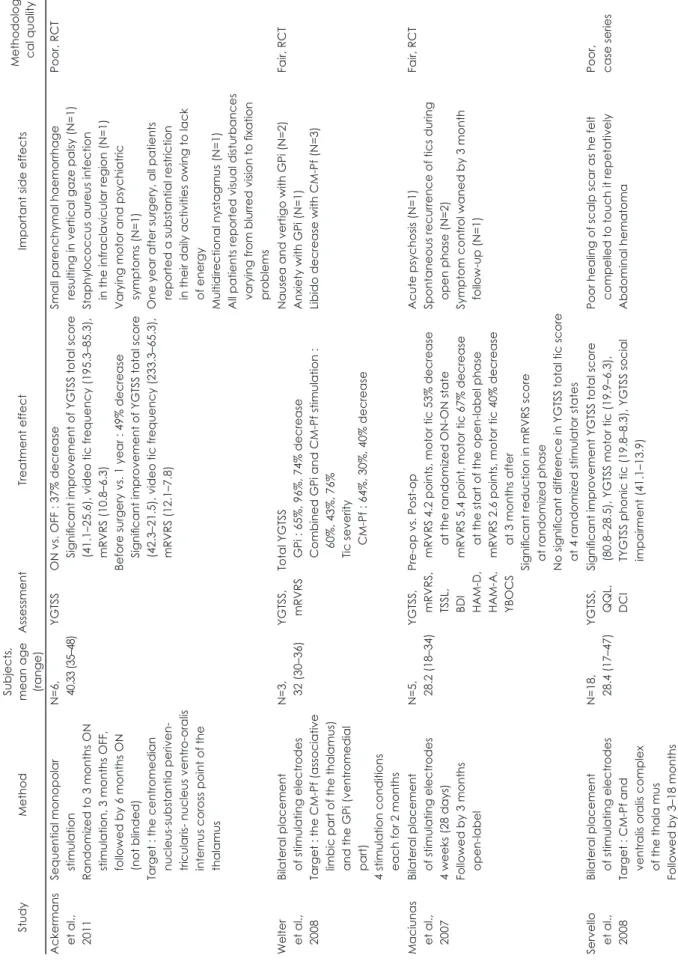
1955년에 뚜렛 증후군에서 박피성(ablative) 수술이 처음으 로 시행되었으며75) 1970년에 Hassler와 Dieckmann은 3명의 뚜렛 환자군에서 centromedial parafascicular complex의 시 상절제술을 시행하여 70-100%의 틱 증상 감소를 나타내었다 고 보고하였다.76,77) 이후 Babel 등78)은 17명의 뚜렛 환자에서 뇌실천자 후에 stereotactic zona incerta와 dorsolateral lamela medialis 시상절제술을 시행하여 14명(82.4%)에서 틱 증상의 완화를 나타내었다. 그러나 이 연구에서 69%의 환자는 수술 후 부작용을 나타내었다. 1999년에 난치성 뚜렛장애에서 처 음으로 시상 심부뇌자극이 시행되었다.79) 이후 시상 외에 다 른 뇌부위에 대한 심부뇌자극이 시행되었다.10,11) 심부뇌자극 은 파킨슨질환, 긴장 이상증, 진전 등의 신경질환에서는 비교 적 다수의 연구결과들이 보고되었으나 정신과 질환에서의 사 용보고는 아직 드물다.
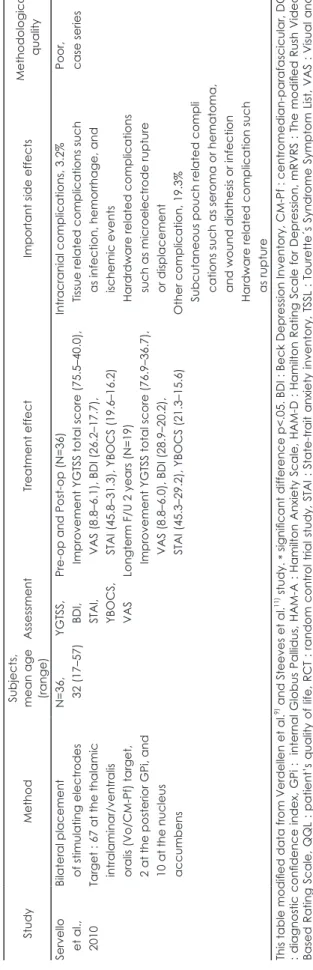
2012년까지의 연구를 종합해보면 24개의 틱장애에 대한 심 부뇌자극 연구가 있었으며 총 63명의 환자가 대상군이었다.10) 이 중에서 대부분은 증례보고 연구였으며 무작위 맹검연구는 3개뿐이었다.80-82) 또한 2개의 연구만이 다수의 환자를 대상으 로 한 연구였는데 한 연구는 18명이었고 이 연구의 후속연구 였던 다른 한 연구는 32명을 대상으로 한 연구였다.83,84) 결과 적으로 총 63명 중에서 59명(93.7%)에서 심부뇌자극 후에 틱
증상의 개선을 나타내었으며 심부뇌자극 후에 심각하고 지속 적인 부작용은 없었지만 외과수술 관련 부작용과 자극관련 부작용들이 나타났다.10) 외과 수술관련 부작용은 전극 팁에 기인하는 출혈로 인한 일시적인 종적 주시마비, 복부 혈종, 창 상치유 문제, 견인통, 전극 팁 주위의 혈종으로 인한 일측성 서맥, 감염 등이 나타났다. 자극관련 부작용으로는 진정감, 피 로, 감소된 기운, 무관심, 무기력 등이 가장 많이 나타났으며 일시적인 시력감소, 감소된 성욕/성기능/능력/사정 등이 많이 나타났고 그 외에도 오심, 현훈, 불안, 우울, 경조증, 체중감소, 증가된 성욕, 급작스러운 근육긴장 이상, 사회적 회피 등이 나 타났다. 최근에 15명의 환자에서 심부뇌자극 시행 후에 24개 월이 지난 이후에도 틱 증상의 감소 및 행동증상의 개선이 있 었지만 인지기능의 감소는 나타나지 않았다는 보고가 있었 다.85) 뚜렛 증후군 환자에서 심부뇌자극의 부위는 대부분 시 상과 내측 담창구였다.10) 그동안 7개 정도의 심부뇌자극 위치 가 보고되었으며 그 위치는 각각 시상(centromedian nucleus- parafascicular and centromedian nucleus-substantia peri- ventricularis/nucleus ventralis oralis intermedius), 내측 담창 구(postero-ventrolateral and anteromedial part), 측위신경핵 (nucleus accumbens), 내포(internal capsule)의 anterior limb, 시상하부핵(subthalamicus nucleus) 등이다. 최근 외측 담창구 에 심부뇌자극을 시행한 연구도 있었다. 이러한 대부분의 연 구에서 시행한 부위는 틱장애의 기능이상으로 추론되고 있 는 배측 선조-시상-피질 회로와도 연관성이 있을 것으로 보 인다.
심부뇌자극의 임상효과에 대한 연구는 반복적 뇌자기자극 이나 전기충격요법(electroconvulsive therapy)에 비해서 아직 불충분하며 앞으로 충분한 임상효과 연구가 필요하다. 이는 뇌의 심부까지 침습적인 전극을 사용해야 하는 방법이므로 매우 숙련된 뇌입체정위 수술전문가만이 가능한 방법이며 전 극의 자극에 의한 일차적 부작용뿐만 아니라 수술 후유증 문 제로 인한 이차적 부작용도 고려해야 한다. 북미 임상지침에 서는 심부뇌자극은 성인에서 ‘공식적(formal) 추천, 불충분한 근거’로 소아에서는 ‘추천하지 않음’으로 규정하였다.11)
반복적 뇌자기자극(Repetitive Transmagnetic Stimulation)(Table 2)
뇌자기자극은 1902년에 임상적으로는 처음으로 우울증 환 자를 치료하기 위하여 두부에 사용하기 시작하였다.10) 반복적 뇌자기자극의 기전은 전기자장을 두피에 자극하여 피질의 표 면에 전류를 유발시켜서 피질 신경원과 상호신경원을 활성화 시키는 것이다. 대체로 1Hz 정도의 느린 주파수 자기장으로
Table 2.
Deep brain stimulation studies for tics or Tourette’s disorders Study Method
Subjects, mean age (range)
Assessment Treatment effect Important side effects Methodologi - cal quality Ackermans et al., 2011
Sequential monopolar stimulation Randomized to 3 months ON stimulation, 3 months OFF, followed by 6 months ON (not blinded) Target : the centromedian nucleus-substantia periven- tricularis- nucleus ventro-oralis internus coross point of the thalamus
N=6, 40.33 (35–48) YGTSS ON vs. OFF : 37% decrease Significant improvement of YGTSS total score (41.1–25.6), video tic frequency (195.3–85.3), mRVRS (10.8–6.3) Before surgery vs. 1 year : 49% decrease Significant improvement of YGTSS total score (42.3–21.5), video tic frequency (233.3–65.3), mRVRS (12.1–7.8)
Small parenchymal haemorrhage resulting in vertical gaze palsy (N=1) Staphylococcus aureus infection in the infraclavicular region (N=1) Varying motor and psychiatric symptoms (N=1) One year after surgery, all patients reported a substantial restriction in their daily activities owing to lack of energy Multidirectional nystagmus (N=1) All patients reported visual disturbances varying from blurred vision to fixation problems
Poor, RCT Welter et al., 2008
Bilateral placement of stimulating electrodes Target : the CM-Pf (associative limbic part of the thalamus) and the GPi (ventromedial part) 4 stimulation conditions each for 2 months
N=3, 32 (30–36) YGTSS, mRVRS Total YGTSS GPi : 65%, 96%, 74% decrease Combined GPi and CM-Pf stimulation : 60%, 43%, 76% Tic severity CM-Pf : 64%, 30%, 40% decrease
Nausea and vertigo with GPi (N=2) Anxiety with GPi (N=1) Libido decrease with CM-Pf (N=3)
Fair, RCT Maciunas et al., 2007
Bilateral placement of stimulating electrodes 4 weeks (28 days) Followed by 3 months open-label
N=5, 28. 2 (18–34) YGTSS, mRVRS, TSSL, BDI HAM-D, HAM-A, YBOCS
Pre-op vs. Post-op mRVRS 4.2 points, motor tic 53% decrease at the randomized ON-ON state mRVRS 5.4 point, motor tic 67% decrease at the start of the open-label phase mRVRS 2.6 points, motor tic 40% decrease at 3 months after Significant reduction in mRVRS score at randomized phase No significant difference in YGTSS total tic score at 4 randomized stimulator states
Acute psychosis (N=1) Spontaneous recurrence of tics during open phase (N=2) Symptom control waned by 3 month follow-up (N=1)
Fair, RCT Servello et al., 2008
Bilateral placement of stimulating electrodes Target : CM-Pf and ventralis oralis complex of the thala mus Followed by 3–18 months
N=18, 28. 4 (17–47) YGTSS, QQL, DCI
Significant improvement YGTSS total score (80.8–28.5), YGTSS motor tic (19.9–6.3), TYGTSS phonic tic (19.8–8.3), YGTSS social impairment (41.1–13.9)
Poor healing of scalp scar as he felt compelled to touch it repetatively Abdominal hematoma
Poor, case series
자극하면 피질의 활성이 억제되는 효과가 나타나고, 반대로 5Hz 이상의 빠른 주파수 자기장으로 자극하면 피질의 활성 이 항진되는 효과가 나타나는데, 틱장애의 경우에서는 피질 활성이 과다항진된 문제로 추론되므로 반복적 뇌자기자극의 투여는 느린 주파수의 자극을 주로 이용하게 된다.86) 반복적 뇌자기자극은 뇌피질에 간접적으로 자기자극을 가하는 방법 이므로 직접 뇌피질에 전기자극을 가하는 전기경련요법에 비 해서 간접적이고, 뇌의 심부에 직접 자극을 가하는 뇌심부자 극에 비해서는 비교적 안전한 방법이다.
초기에는 뚜렛장애를 가진 성인에서 반복적 뇌자기자극 투 여가 임상적인 효과를 나타내지 못했다는 보고가 있었지만87,88) 최근에는 전운동영역 피질에 대한 반복적 뇌자기자극 투여가 효과적이었다는 보고가 있었다.89,90) 국내에서도 10명의 남아 를 대상으로 운동보조영역에 1Hz의 느린 주파수로서 반복적 뇌자기자극을 투여하여 유의한 임상효과를 나타내었다고 보 고한 바 있다.91) 북미 임상지침에서는 성인에서 반복적 뇌자기 자극은 ‘공식적(formal) 추천, 불충분한 근거’로 소아에서는
‘추천하지 않음’으로 규정하였다.11)
결 론
본 연구에서는 최근에 보고된 외국의 치료지침 및 종설 논 문을 종합하여 틱장애 혹은 뚜렛장애에서 사용되는 비약물 치료에 대해서 알아보았다. 비약물치료는 일부에서 틱장애 혹 은 뚜렛장애에서 뚜렷한 임상적 효과를 나타낼 수 있는 것으 로 보인다. 틱장애 혹은 뚜렛 증후군에서 임상적으로 효과가 보고된 비약물치료방법은 인지행동치료, 심리교육과 집단치 료, 그리고 심부뇌자극과 반복적 뇌자기자극 등이 주로 보고 되었다.
중심 단어
:틱장애 ・뚜렛장애・비약물치료.References
1) American Psychiatric Association. Diagnostic and Statistical Man- ual of Mental Disorders: DSM-IV-TR. 4th ed., Text revision.
Washington, DC: American Psychiatric Association;2000.
2) Singer HS. Tourette’s syndrome: from behaviour to biology. Lan- cet Neurol 2005;4:149-159.
3) Kurlan R, McDermott MP, Deeley C, Como PG, Brower C, Eapen
S, et al. Prevalence of tics in schoolchildren and association with
placement in special education. Neurology 2001;57:1383-1388.4) Gadow KD, Nolan EE, Sprafkin J, Schwartz J. Tics and psychiatric comorbidity in children and adolescents. Dev Med Child Neurol 2002;44:330-338.
5) Robertson MM, Eapen V, Cavanna AE. The international preva- lence, epidemiology, and clinical phenomenology of Tourette syn- drome: a cross-cultural perspective. J Psychosom Res 2009;67:
475-483.
Table 2.
Continued Study Method
Subjects, mean age (range)
Assessment Treatment effect Important side effects Methodological quality Servello et al., 2010
Bilateral placement of stimulating electrodes Target : 67 at the thalamic intralaminar/ventralis oralis (Vo/CM-Pf) target, 2 at the posterior GPi, and 10 at the nucleus accumbens
N=36, 32 (17–57) YGTSS, BDI, STAI, YBOCS, VAS
Pre-op and Post-op (N=36) Improvement YGTSS total score (75.5–40.0), VAS (8.8–6.1), BDI (26.2–17.7), STAI (45.8–31.3), YBOCS (19.6–16.2) Longterm F/U 2 years (N=19) Improvement YGTSS total score (76.9–36.7), VAS (8.8–6.0), BDI (28.9–20.2), STAI (45.3–29.2), YBOCS (21.3–15.6)
Intracranial complications, 3.2% Tissue related complications such as infection, hemorrhage, and ischemic events Hardrdware related complications such as microelectrode rupture or displacement Other complication, 19.3% Subcutaneous pouch related compli cations such as seroma or hematoma, and wound diathesis or infection Hardware related complication such as rupture
Poor, case series This table modified data from Verdellen et al.
9)and Steeves et al.
11)study. * significant difference p<.05. BDI : Beck Depression Inventory, CM-Pf : centromedian-parafascicular, DCI : diagnostic confidence index, GPi : internal Globus Pallidus, HAM-A : Hamilton Anxiety Scale, HAM-D : Hamilton Rating Scale for Depression, mRVRS : The modified Rush Video- Based Rating Scale, QQL : patient’s quality of life, RCT : random contr ol trial study, STAI : State-trait anxiety inventory, TSSL : Tourette´s Syndrome Symptom List, VAS : Visual ana - logue scale, YBOCS : Yale-Brown Obsessive Compulsive Scale, YGTSS : Yale Global Tic Severity Scale, F/U : follow up
6) George MS, Belmaker RH. Transcranial Magnetic Stimulation in Clinical Psychiatry. Washington, DC: American Psychiatric As- sociation;2007.
7) Mink JW. Neurobiology of basal ganglia and Tourette syndrome:
basal ganglia circuits and thalamocortical outputs. Adv Neurol 2006;99:89-98.
8) Shapiro AK, Shapiro E. Treatment of Gilles de la Tourette’s Syn- drome with haloperidol. Br J Psychiatry 1968;114:345-350.
9) Verdellen C, van de Griendt J, Hartmann A, Murphy T; ESSTS
Guidelines Group. European clinical guidelines for Tourette syn-
drome and other tic disorders. Part III: behavioural and psychoso- cial interventions. Eur Child Adolesc Psychiatry 2011;20:197-207.10) Müller-Vahl KR, Cath DC, Cavanna AE, Dehning S, Porta M,
Robertson MM, et al. European clinical guidelines for Tourette
syndrome and other tic disorders. Part IV: deep brain stimulation.Eur Child Adolesc Psychiatry 2011;20:209-217.
11) Steeves T, McKinlay BD, Gorman D, Billinghurst L, Day L, Car-
roll A, et al. Canadian guidelines for the evidence-based treatment
of tic disorders: behavioural therapy, deep brain stimulation, and transcranial magnetic stimulation. Can J Psychiatry 2012;57:144- 12) Azrin NH, Nunn RG, Frantz SE. Habit reversal vs. negative prac-151.tice treatment of nervous tics. Behav Ther 1980;11:169-178.
13) Nicassio FJ, Liberman RP, Patterson RL, Ramirez E, Sanders N.
The treatment of tics by negative practice. J Behav Ther Exp Psy- chiatry 1972;3:281-287.
14) Tophoff M. Massed practice, relaxation and assertion training in the treatment of Gilles de la Tourette’s syndrome. J Behav Ther Exp Psychiatry 1973;4:71-73.
15) Task Force on Promotion and Dissemination of Psychological
Procedures. Training in and dissemination of empirically- vali-
dated psychological treatments: Report and recommendations.Clin Psychol 1995;48:3-23.
16) Azrin NH, Nunn RG. Habit-reversal: a method of eliminating nervous habits and tics. Behav Res Ther 1973;11:619-628.
17) Azrin NH, Peterson AL. Treatment of Tourette syndrome by habit reversal: a waiting-list control group comparison. Behav Ther 1990;
21:305-318.
18) Woods DW, Miltenberger RG. Habit reversal: a review of applica- tions and variations. J Behav Ther Exp Psychiatry 1995;26:123-131.
19) Woods DW, Piacentini JC, Chang SW, Deckersbach T, Ginsburg
GS, Peterson AL, et al. Managing Tourette Syndrome: a Behav-
ioral Intervention for Children and Adults: Therapist Guide. New York: Oxford University Press;2008.20) Wilhelm S, Deckersbach T, Coffey BJ, Bohne A, Peterson AL,
Baer L. Habit reversal versus supportive psychotherapy for To-
urette’s disorder: a randomized controlled trial. Am J Psychiatry 2003;160:1175-1177.21) Deckersbach T, Rauch S, Buhlmann U, Wilhelm S. Habit reversal versus supportive psychotherapy in Tourette’s disorder: a random- ized controlled trial and predictors of treatment response. Behav Res Ther 2006;44:1079-1090.
22) O’Connor K, Gareau D, Borgeat F. A comparison of a behavioural and a cognitive-behavioural approach to the management of chron- ic tic disorders. Clin Psychol Psychother 1997;4:105-117.
23) O’Connor KP, Brault M, Robillard S, Loiselle J, Borgeat F, Stip E.
Evaluation of a cognitive-behavioural program for the manage- ment of chronic tic and habit disorders. Behav Res Ther 2001;39:
667-681.
24) Piacentini J, Woods DW, Scahill L, Wilhelm S, Peterson AL, Chang
S, et al. Behavior therapy for children with Tourette disorder: a
randomized controlled trial. JAMA 2010;303:1929-1937.25) Verdellen CW, Keijsers GP, Cath DC, Hoogduin CA. Exposure with response prevention versus habit reversal in Tourettes’s syn- drome: a controlled study. Behav Res Ther 2004;42:501-511.
26) Carr JE, Chong IM. Habit reversal treatment of tic disorders: a
methodological critique of the literature. Behav Modif 2005;29:
858-875.
27) Cook CR, Blacher J. Evidence-based psychosocial treatments for tic disorders. Clin Psychol Sci Pract 2007;14:252-267.
28) Himle MB, Woods DW, Piacentini JC, Walkup JT. Brief review of habit reversal training for Tourette syndrome. J Child Neurol 2006;
21:719-725.
29) Peterson A. Psychosocial management of tics and intentional re- petitive behaviors associated with Tourette syndrome. In: Woods DW, Piacentini J, editors. Treating Tourette Syndrome and Tic Disorders: a Guide for Practitioners. New York: Guilford Press;
2007. p.154-184.
30) Piacentini J, Chang S. Behavioral treatments for Tourette syn- drome and tic disorders: state of the art. Adv Neurol 2001;85:319- 31) Piacentini J, Chang S. Habit reversal training for tic disorders in 331.
children and adolescents. Behav Modif 2005;29:803-822.
32) Hong JW, Doh JA, Kim HW, Lim MH. Habit reversal training in tic disorder. Anxiety Mood 2010;6:24-30.
33) Miltenberger RG, Fuqua RW, McKinley T. Habit reversal with muscle tics: replication and component analysis. Behav Ther 1985;
16:39-50.
34) Marcks BA, Woods DW, Teng EJ, Twohig MP. What do those who know, know? Investigating providers’ knowledge about Tourette’s syndrome and its treatment. Cogn Behav Pract 2004;11:298-305.
35) Burd L, Kerbeshian J. Treatment-generated problems associated with behavior modification in Tourette disorder. Dev Med Child Neurol 1987;29:831-833.
36) Woods DW, Himle MB, Miltenberger RG, Carr JE, Osmon DC,
Karsten AM, et al. Durability, negative impact, and neuropsycho-
logical predictors of tic suppression in children with chronic tic disorder. J Abnorm Child Psychol 2008;36:237-245.37) Silverstein SM, Como PG, Palumbo DR, West LL, Osborn LM.
Multiple sources of attentional dysfunction in adults with Tourette’s syndrome: comparison with attention deficit-hyperactivity disor- der. Neuropsychology 1995;9:157-164.
38) Shimberg EF. Living with Tourette Syndrome. New York: Fire- side Books;1995.
39) Conelea CA, Woods DW. The influence of contextual factors on tic expression in Tourette’s syndrome: a review. J Psychosom Res 2008;65:487-496.
40) Peterson AL, Azrin NH. An evaluation of behavioral treatments for Tourette syndrome. Behav Res Ther 1992;30:167-174.
41) Billings A. Self-monitoring in the treatment of tics: a single-sub- ject analysis. J Behav Ther Exp Psychiatry 1978;9:339-342.
42) Turpin G, Powell GE. Effects of massed practice and cue-con- trolled relaxation on tic frequency in Gilles de la Tourette’s syn- drome. Behav Res Ther 1984;22:165-178.
43) Woods DW, Himle MB. Creating tic suppression: comparing the effects of verbal instruction to differential reinforcement. J Appl Behav Anal 2004;37:417-420.
44) Lahey BB, McNees MP, McNees MC. Control of an obscene “ver- bal tic” through timeout in an elementary school classroom. J Appl Behav Anal 1973;6:101-104.
45) Watson TS, Sterling HE. Brief functional analysis and treatment of a vocal tic. J Appl Behav Anal 1998;31:471-474.
46) Bergin A, Waranch HR, Brown J, Carson K, Singer HS. Relax- ation therapy in Tourette syndrome: a pilot study. Pediatr Neurol 1998;18:136-142.
47) Culbertson FM. A four-step hypnotherapy model for Gilles de la Tourette’s syndrome. Am J Clin Hypn 1989;31:252-256.
48) Hoogduin K, Cazemier B, Verdellen C. Exposure, responspreven- tie en zelfcontrole bij Gilles de la Tourette-patiënten [Exposure, response prevention and self-control in patients with Gilles de la Tourette syndrome]. Gedragstherapie 1995;28:31-40.
49) Wetterneck CT, Woods DW. An evaluation of the effectiveness of
exposure and response prevention on repetitive behaviors associ- ated with Tourette’s syndrome. J Appl Behav Anal 2006;39:441- 50) Woods DW, Hook SS, Spellman DF, Friman PC. Case study: Ex-444.
posure and response prevention for an adolescent with Tourette’s syndrome and OCD. J Am Acad Child Adolesc Psychiatry 2000;
39:904-907.
51) Leckman JF, Walker DE, Cohen DJ. Premonitory urges in To- urette’s syndrome. Am J Psychiatry 1993;150:98-102.
52) Hoogduin K, Verdellen C, Cath D. Exposure and response pre- vention in the treatment of Gilles de la Tourette’s syndrome: four case studies. Clinical Psycho Psychother 1997;4:125-135.
53) Franklin SA, Walther MR, Woods DW. Behavioral interventions for tic disorders. Psychiatr Clin North Am 2010;33:641-655.
54) Verdellen CW, Hoogduin CA, Keijsers GP. Tic suppression in the treatment of Tourette’s syndrome with exposure therapy: the re- bound phenomenon reconsidered. Mov Disord 2007;22:1601-1606.
55) Banaschewski T, Woerner W, Rothenberger A. Premonitory sen- sory phenomena and suppressibility of tics in Tourette syndrome:
developmental aspects in children and adolescents. Dev Med Child Neurol 2003;45:700-703.
56) Fuata P, Griffiths RA. Cognitive behavioural treatment of a vocal tic. Behav Change 1992;9:14-18.
57) Heinrich H, Gevensleben H, Strehl U. Annotation: neurofeedback - train your brain to train behaviour. J Child Psychol Psychiatry 2007;48:3-16.
58) Tansey MA. A simple and a complex tic (Gilles de la Tourette’s syndrome): their response to EEG sensorimotor rhythm biofeed- back training. Int J Psychophysiol 1986;4:91-97.
59) Breteler MHM, van Heeswijk L, Arns M, Verdellen C. Psycholo- gische interventies bij het syndroom van Gilles de la Tourette [Psy- chological interventions in Gilles de la Tourette syndrome]. Tijd- schrift voor Neuropsychiatrie en Gedragsneurologie 2008;7:158- 60) Nagai Y, Cavanna A, Critchley HD. Influence of sympathetic au-164.
tonomic arousal on tics: implications for a therapeutic behavioral intervention for Tourette syndrome. J Psychosom Res 2009;67:
599-605.
61) Gevensleben H, Holl B, Albrecht B, Vogel C, Schlamp D, Kratz O,
et al. Is neurofeedback an efficacious treatment for ADHD? A ran-
domised controlled clinical trial. J Child Psychol Psychiatry 2009;50:780-789.62) Gevensleben H, Holl B, Albrecht B, Schlamp D, Kratz O, Studer P,
et al. Neurofeedback training in children with ADHD: 6-month
follow-up of a randomised controlled trial. Eur Child Adolesc Psychiatry 2010;19:715-724.63) Woods DW, Piacentini J, Walkup JT. Treating Tourette Syndrome and Tic Disorders: a Guide for Practitioners. New York: Guilford Press;2007.
64) Packer LE. Tic-related school problems: impact on functioning, accommodations, and interventions. Behav Modif 2005;29:876- 65) Peterson BS, Cohen DJ. The treatment of Tourette’s syndrome: 899.
multimodal, developmental intervention. J Clin Psychiatry 1998;59 Suppl 1:62-72; discussion 73-74.
66) Dooley JM, Brna PM, Gordon KE. Parent perceptions of symptom severity in Tourette’s syndrome. Arch Dis Child 1999;81:440-441.
67) Cutler D, Murphy T, Gilmour J, Heyman I. The quality of life of young people with Tourette syndrome. Child Care Health Dev 2009;
35:496-504.
68) Kepley HO, Conners S. Management of learning and school diffi- culties in children with Tourette syndrome. In: Woods DW, Pia- centini J, Walkup JT, editors. Treating Tourette Syndrome and Tic Disorders: a Guide for Practitioners. New York: Guilford Press;
2007. p.242-264.
69) Boudjouk PJ, Woods DW, Miltenberger RG, Long ES. Negative
peer evaluation in adolescents: effects of tic disorders and tricho- tillomania. Child Fam Behav Ther 2000;22:17-28.
70) Woods DW, Fuqua RW, Outman RC. Evaluating the social ac- ceptability of persons with habit disorders: the effects of topogra- phy, frequency, and gender manipulation. J Psychopathol Behav Assess 1999;21:1-18.
71) Friedrich S, Morgan SB, Devine C. Children’s attitudes and be- havioral intentions toward a peer with Tourette syndrome. J Pedi- atr Psychol 1996;21:307-319.
72) Woods DW, Marcks BA. Controlled evaluation of an educational intervention used to modify peer attitudes and behavior toward persons with Tourette’s Syndrome. Behav Modif 2005;29:900- 73) Murphy T, Heyman I. Group work in young people with Tourette 912.
Syndrome. Child Adolesc Ment Health 2007;12:46-48.
74) Taubert KA. Role of voluntary organizations in clinical care re- search and public policy. In: Leckman JF, Cohen DJ, editors. To- urette’s Syndrome--Tics, Obsessions, Compulsions: Developmen- tal Psychopathology and Clinical Care. Hoboken: Wiley;1999.
p.399-413.
75) Temel Y, Visser-Vandewalle V. Surgery in Tourette syndrome. Mov Disord 2004;19:3-14.
76) Hassler R, Dieckmann G. [Stereotaxic treatment of tics and inartic- ulate cries or coprolalia considered as motor obsessional phenom- ena in Gilles de la Tourette’s disease]. Rev Neurol (Paris) 1970;123:
89-100.
77) Rickards H, Wood C, Cavanna AE. Hassler and Dieckmann’s semi- nal paper on stereotactic thalamotomy for Gilles de la Tourette syndrome: translation and critical reappraisal. Mov Disord 2008;
23:1966-1972.
78) Babel TB, Warnke PC, Ostertag CB. Immediate and long term out- come after infrathalamic and thalamic lesioning for intractable To- urette’s syndrome. J Neurol Neurosurg Psychiatry 2001;70:666-671.
79) Vandewalle V, van der Linden C, Groenewegen HJ, Caemaert J.
Stereotactic treatment of Gilles de la Tourette syndrome by high frequency stimulation of thalamus. Lancet 1999;353:724.
80) Houeto JL, Karachi C, Mallet L, Pillon B, Yelnik J, Mesnage V, et
al. Tourette’s syndrome and deep brain stimulation. J Neurol Neu-
rosurg Psychiatry 2005;76:992-995.81) Maciunas RJ, Maddux BN, Riley DE, Whitney CM, Schoenberg
MR, Ogrocki PJ, et al. Prospective randomized double-blind trial
of bilateral thalamic deep brain stimulation in adults with To- urette syndrome. J Neurosurg 2007;107:1004-1014.82) Welter ML, Mallet L, Houeto JL, Karachi C, Czernecki V, Cornu P,
et al. Internal pallidal and thalamic stimulation in patients with
Tourette syndrome. Arch Neurol 2008;65:952-957.83) Servello D, Porta M, Sassi M, Brambilla A, Robertson MM. Deep brain stimulation in 18 patients with severe Gilles de la Tourette syndrome refractory to treatment: the surgery and stimulation. J Neurol Neurosurg Psychiatry 2008;79:136-142.
84) Servello D, Sassi M, Brambilla A, Defendi S, Porta M. Long-term, post-deep brain stimulation management of a series of 36 patients affected with refractory gilles de la tourette syndrome. Neuro- modulation 2010;13:187-194.
85) Porta M, Brambilla A, Cavanna AE, Servello D, Sassi M, Rickards
H, et al. Thalamic deep brain stimulation for treatment-refractory
Tourette syndrome: two-year outcome. Neurology 2009;73:1375- 1380.86) Speer AM, Kimbrell TA, Wassermann EM, D Repella J, Willis MW,
Herscovitch P, et al. Opposite effects of high and low frequency
rTMS on regional brain activity in depressed patients. Biol Psychi- atry 2000;48:1133-1141.87) Münchau A, Bloem BR, Thilo KV, Trimble MR, Rothwell JC, Rob-
ertson MM. Repetitive transcranial magnetic stimulation for To-
urette syndrome. Neurology 2002;59:1789-1791.88) Chae JH, Nahas Z, Wassermann E, Li X, Sethuraman G, Gilbert D,
et al. A pilot safety study of repetitive transcranial magnetic stimu-
lation (rTMS) in Tourette’s syndrome. Cogn Behav Neurol 2004;17:109-117.
89) Mantovani A, Leckman JF, Grantz H, King RA, Sporn AL, Lisan-
by SH. Repetitive Transcranial Magnetic Stimulation of the Sup-
plementary Motor Area in the treatment of Tourette Syndrome:report of two cases. Clin Neurophysiol 2007;118:2314-2315.
90) Picard N, Strick PL. Imaging the premotor areas. Curr Opin Neu-
robiol 2001;11:663-672.
91) Kwon HJ, Lim WS, Lim MH, Lee SJ, Hyun JK, Chae JH, et al.
1-Hz low frequency repetitive transcranial magnetic stimulation in children with Tourette’s syndrome. Neurosci Lett 2011;492:1-4.
92) Ackermans L, Duits A, van der Linden C, Tijssen M, Schruers K,